

Read and download the CBSE Class 10 Social Science Political Parties Worksheet Set 01 in PDF format. We have provided exhaustive and printable Class 10 Social Science worksheets for Democratic Politics II Chapter 4 Political Parties, designed by expert teachers. These resources align with the 2026-27 syllabus and examination patterns issued by NCERT, CBSE, and KVS, helping students master all important chapter topics.
Chapter-wise Worksheet for Class 10 Social Science Democratic Politics II Chapter 4 Political Parties
Students of Class 10 should use this Social Science practice paper to check their understanding of Democratic Politics II Chapter 4 Political Parties as it includes essential problems and detailed solutions. Regular self-testing with these will help you achieve higher marks in your school tests and final examinations.
Class 10 Social Science Democratic Politics II Chapter 4 Political Parties Worksheet with Answers
Objective Questions
(b) societies
(d) pressure groups
(b) powerful
(d) none of the above
(b) choice
(d) none of the above
(a) Kanshi Ram
(b) Sahu Maharaj
(c) B.R. Ambedkar
(d) Jotiba Phule
(b) authoritarian
(d) none of the above
(b) 12
(d) 20
(b) society
(d) all of the above
Question. What is the political party that runs government known as ?
(a) Ruling party
(b) Pressure Group
(c) Opposition party
(d) None of these
Answer : A
Question. Who is a ‘Partisan’ ?
(a) Disloyal party member
(b) Ex-party member
(c) Estranged party member
(d) None of these
Answer : A
Question. Which of these is a National Party ?
(a) INC
(b) BJP
(c) BSP
(d) All of these
Answer : D
Question. What is meant by ‘Defection’ ?
(a) Being loyal towards a party.
(b) Changing party allegiance.
(c) Introducing political reforms.
(d) None of these.
Answer : B
Question. Which of these is the function of political party ?
(a) Contesting election
(b) Forming and running government
(c) Forming public opinion
(d) All of these
Answer : D
Question. What is the system of two parties known as ?
(a) Uni-party system
(b) Multi-party system
(c) Bi-party system
(d) None of these
Answer : C
Question. Which party was formed under the leadership of Kanshi Ram ?
(a) DMK
(b) BSP
(c) CPI (M)
(d) Congress
Answer : B
Question. Arrange the following in the correct sequence :
(i) Lack of internal democracy.
(ii) Meaningful choice to the voters.
(iii) Money and muscle power in politics.
(iv) Dynastic succession.
Options-
(a) (iv)-(iii)-(ii)-(i)
(b) (i)-(iv)-(iii)-(ii)
(c) (ii)-(i)-(iii)-(iv)
(d) (i)-(iv)-(ii)-(iii)
Answer : B
Question. What is the challenge faced by political parties ?
(a) Lack of internal democracy.
(b) Dynastic succession.
(c) Growing role of money and muscle power.
(d) All of these.
Answer : D
Question. To whom do political parties should register them for contesting the elections ?
(a) State government
(b) Central government
(c) Election Commission
(d) None of these
Answer : C
Question. Arrange the followings in correct sequence according to the formation year :
(i) Bhartiya Janata Party
(ii) Congress
(iii) Bahujan Samaj Party
(iv) Communist Party of India
Options-
(a) (i)-(ii)-(iii)-(iv)
(b) (ii)-(i)-(iii)-(iv)
(c) (ii)-(iv)-(i)-(iii)
(d) (i)-(iii)-(ii)-(iv)
Answer : C
Question. What is a government formed by several parties known as ?
(a) Alliance
(b) Uni-party system
(c) Group
(d) None of these
Answer : A
Question :
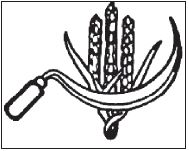
From which political party, this sign belongs to ?
(A) Bhartiya Janata Party
(B) Bahujan Samaj Party
(C) Communist Party of India
(D) Indian National Congress
Answer : C
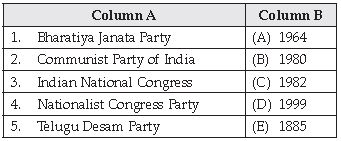
Answers : 1. (B), 2. (A), 3. (E), 4. (D), 5. (C)
True/False
Question. Every party in the country need not register with the Election Commission of India. (True/False)
Answer : False
Question. Political parties in India are classified into three types. (True/False)
Answer : False
Question. Regional parties in recent times have actively participated in the formation of the government at the Centre. (True/False)
Answer : True
Question. Bharatiya Janata Party came into power at the centre in 2000. (True/False)
Answer : False
Question. Political parties have a significant role to play in nation building. (True/False)
Answer : True
Assertion and Reasoning Based Questions
Mark the option which is most suitable :
(a) If both assertion and reason are true and reason is the correct explanation of assertion.
(b) If both assertion and reason are true but reason is not the correct explanation of assertion.
(c) If assertion is true and reason is false.
(d) If both assertion and reason are false.
Question. Assertion : Political parties reflect fundamental political divisions in a society.
Reason : Parties work to convince people why their policies are better than others and implement them by seeking popular support.
Answer : (a) Political parties agree on some policies they believe are for collective good and aim to convince people for support. For popular vote, political parties tend to please certain sections of the society and thus, bring in partisanship.
Question. Assertion : The multi-party system tends to be extremely messy and mostly leads to political instability.
Reason : Multi-party systems give rise to coalitions which can break at any moment over smallest difference of opinion.
Answer : (a) In a democracy like India, having a multi-party system leading to coalitions is very common. It can be so that one party who lends support to the Centre may not agree with them, thus breaking away and collapsing the government.
Question. Assertion : In a democracy, political parties are a must.
Reason : Without Political Parties there will be no elections.
Answer : (c) Despite the fact that Political Parties are needed in a democracy, a lack of them would not stop the election process. However, it would make it
impossible to choose any one government. In a democracy, political parties are a must as without them, any number of candidates can contest elections.
Question. Assertion : Large established parties are called recognised parties.
Reason : These parties have been given certain specialised symbols that people can rally behind.
Answer : (a) Large established parties are recognised all over the country and in fact in the world too as they have been in power, made governments and have a presence in many places. They also have a clear ideology and a symbol that becomes synonymous to the party.
Question. Assertion : One party system is a democratic system.
Reason : It is because elections are held on a regular basis.
Answer : (d) In a democracy, at least two parties are required to contest elections to make it inclusive of all points of views.
Assertion and Reason based questions
In the questions given below there are two statements marked as Assertion (A) and Reason (R). Read the statement and choose the correct option.
Options:
(a) If both (A) and (R) are true and (R) is the correct explanation of (A)
(b) Both (A) and (R) are true but (R) is not the correct explanation.
(c) (A) is true but (R) is false
(d) (A) is false but (R) is true.
Question. Assertion : In recent years the Indian parliament has become more and more diverse.
Reason : The number and strength of state parties has increased.
Answer. A
Question. Assertion : Ordinary members of politcial party cannot hope to rise higher as there are no internal elections.
Reason : The top leadership is often disconnected with the grass root workers.
Answer. B
Question. Assertion : Anti defection law has helped bring down defection.
Reason : The law says that if any MLA or MP changes parties, he or she will lose the seat in the legislature.
Answer. A
Give one word for the following statement :
Question. A group of people who come together to contest election and hold power in the government ___ .
Answer. Political parties
Rewrite the following sentence
Question. Multi party system appears messy but it leads to political stability.
Answer. Multi party system appears messy but it leads to political stability.
Source/Extract Based Questions
Read the source given below and answer the following questions.
In some countries, only one party is allowed to control and run the government. These are called one-party systems. In China, only the Communist Party is allowed to rule. Although, legally speaking, people are free to form political parties, it does not permit free competition for power. In some countries, power usually changes between two main parties. Several other parties may exists, contest elections and win a few seats in the national legislature.If several parties compete for power, and more than two parties have a reasonable chance of coming to power either on their own strength or in alliance with others, we call it a multi-party system.
Answer the following MCQs by choosing the most appropriate option:
1. What is a government formed by several parties known as ?
(a) Alliance
(b) Uni-party system
(c) Group
(d) None of these
Answer : A
2. Political party system can be divided into _________
(a) 2
(b) 3
(c) 4
(d) All of the above.
Answer : D
3. In which of the following countries only bi-party system exist?
(a) USA
(b) India
(c) China
(d) All of them
Answer : A
4. In which of the following countries multi-party system exist?
(a) India
(b) China
(c) South Korea
(d) Canada
Answer : A
Read the extract and answer the questions that follows :
In some countries, only one party is allowed to control and run the government. These are called one-party systems. In Class IX, we noted that in China, only the Communist Party is allowed to rule. Although, legally speaking, people are free to form political parties, it does not permit free competition for power. In some countries, power usually changes between two main parties. Several other parties may exists, contest elections and win a few seats in the national legislature. If several parties compete for power, and more than two parties have a reasonable chance of coming to power either on their own strength or in alliance with others, we call it a multi-party system.
1 Why is one party system not a good democratic option ?
Answer : One-party system cannot be a good option because this is not a democratic option. Any democratic system must allow at least two parties to compete in elections and provide a fair chance for the competing parties to come to power.
2 Which parties have chance of winning the elections ? Give examples.
Answer : (i) Only two main parties have a serious chance of winning majority of seats to form government. Such a party is called two-party system.
(ii) The United States of America and the United Kingdom are examples of two-party system.
3 What is an alliance or a front ? Give an example.
Answer : (i) When several parties in a multi-party system join hands for the purpose of contesting elections and winning power, it is called an alliance or a front.
(ii) For example, in India there were three such major alliances in 2004 parliamentary elections— the National Democratic Alliance, the United Progressive Alliance and the Left Front.
Read the source given below and answer the following questions.
Democracies that follow a federal system all over the world tend to have two kinds of political parties: parties that are present in only one of the federal units and parties that are present in several or all units of the federation. This is the case in India as well. There are some countrywide parties, which are called ‘national parties’. These parties have their units in various states. But by and large, all these units follow the same policies, programmes and strategy that is decided at the national level. Every party in the country has to register with the Election Commission.While the Commission treats all parties equally, it offers some special facilities to large and established parties. These parties are given a unique symbol – only the official candidates of that party can use that election symbol. Parties that get this privilege and some other special facilities are ‘recognised’ by the Election Commission for this purpose. That is why these parties are called, ‘recognised political parties’. The Election Commission has laid down detailed criteria of the proportion of votes and seats that a party must get in order to be a recognised party. A party that secures at least six per cent of the total votes in an election to the Legislative Assembly of a State and wins at least two seats is recognised as a State party. A party that secures at least six per cent of the total votes in Lok Sabha elections or Assembly elections in four States and wins at least four seats in the Lok Sabha is recognized as a national party.
Answer the following MCQs by choosing the most appropriate option:
1. How many parties are classified as national party in India?
(a) 2
(b) 5
(c) 7
(d) 9
Answer : C
2. Which one of the following party is considerd as national party?
(a) Janata Dal
(b) Bahujan Samaj Party
(c) Samata Party
(d) All of the above
Answer : B
3. A party that secures at least six per cent of the total votes in an election to the Legislative Assembly of a State and wins at least two seats is recognised as a_________
(a) National Party
(b) State Party
(c) Local Party
(d) All of them
Answer : B
4. A party has to secure at least _________ seats in the Lok Sabha ,to become a national party?
(a) 2
(b) 3
(c) 4
(d) 5
Answer : C
Very Short Answer Type Questions
Question : A group of people who come together to contest elections and hold power in the government is called a _____ .
Answer : political party.
Question. How does Election commission recognise a party as a ‘national party’ ?
Answer : The parties which operate all over the country with same principles, policies and agendas are recognised as national parties. For example-BJP, Indian National Congress.
Question. Why is one party political system not consider a good democratic system ?
Answer : One-party system is not considered as a good democratic system because any democratic system must allow at least two parties to compete in elections and provide a fair chance for the competing parties to come to power.
Question. What is the measure taken by Supreme Court for lowering the influence of money and muscle power in politics ?
Answer : For lowering the influence of money and muscle power in politics, the Supreme Court has made it mandatory for all candidates to submit an affidavit about property details and pending criminal cases against them.
Question. Suggest any one way to promote the public participation in the Political Parties for enhancing the quality of democracy.
Answer : A law should be made to regulate the internal affairs of political parties. It should be made compulsory for political parties to maintain a register of it members, to follow its own constitution,to have an independent authority, to act as a judge in case of party disputes, to hold open elections to the highest posts.
Question. Suggest any one way to make political parties more responsive to the people’s need and demand.
Answer : Peaceful protest or mass mobilisation.
Question. Discuss one advantage of multi-party system.
Answer : One advantage of multi-party system is that it is based on democratic principles and offer ample choices with different opinions.
Question. Discuss the role of opposition parties in democracy.
Answer : Opposition parties criticise the government for its faulty policies and failures in this way it plays the role of a watchdog for keeping the ruling parties on track.
Question. Why India choose to have a multi-party system ?
Answer : Since, India is a socially and regionally diverse country, for giving expression to diverse opinions and views it has a multi-party system.
Question. At what level non-party based elections are held in India ?
Answer : The non-party based elections in India are held for panchayats.
Question. What is the role of money and muscle power in elections ?
Answer : Rich and influential people often contribute towards the party’s campaigns and in return try to influence the policies and decisions of the party.
Question. Does one party system comply with the principles of democracy ?
Answer : No, one party system doesn’t comply with the principles of democracy. Every democratic system should have at least two parties for giving a fair chance to compete and come into power.
Free study material for Social Science
CBSE Social Science Class 10 Democratic Politics II Chapter 4 Political Parties Worksheet
Students can use the practice questions and answers provided above for Democratic Politics II Chapter 4 Political Parties to prepare for their upcoming school tests. This resource is designed by expert teachers as per the latest 2026 syllabus released by CBSE for Class 10. We suggest that Class 10 students solve these questions daily for a strong foundation in Social Science.
Democratic Politics II Chapter 4 Political Parties Solutions & NCERT Alignment
Our expert teachers have referred to the latest NCERT book for Class 10 Social Science to create these exercises. After solving the questions you should compare your answers with our detailed solutions as they have been designed by expert teachers. You will understand the correct way to write answers for the CBSE exams. You can also see above MCQ questions for Social Science to cover every important topic in the chapter.
Class 10 Exam Preparation Strategy
Regular practice of this Class 10 Social Science study material helps you to be familiar with the most regularly asked exam topics. If you find any topic in Democratic Politics II Chapter 4 Political Parties difficult then you can refer to our NCERT solutions for Class 10 Social Science. All revision sheets and printable assignments on studiestoday.com are free and updated to help students get better scores in their school examinations.
FAQs
You can download the latest chapter-wise printable worksheets for Class 10 Social Science Democratic Politics II Chapter 4 Political Parties for free from StudiesToday.com. These have been made as per the latest CBSE curriculum for this academic year.
Yes, Class 10 Social Science worksheets for Democratic Politics II Chapter 4 Political Parties focus on activity-based learning and also competency-style questions. This helps students to apply theoretical knowledge to practical scenarios.
Yes, we have provided solved worksheets for Class 10 Social Science Democratic Politics II Chapter 4 Political Parties to help students verify their answers instantly.
Yes, our Class 10 Social Science test sheets are mobile-friendly PDFs and can be printed by teachers for classroom.
For Democratic Politics II Chapter 4 Political Parties, regular practice with our worksheets will improve question-handling speed and help students understand all technical terms and diagrams.