

Official Class 12 Geography Worksheets: Chapter 03 Human Development
Review targeted academic worksheets with the CBSE Class 12 Geography Human Development Worksheet. Built according to official educational standards for the 2026-27 term, these downloadable Class 12 Geography resources support effective daily practice and detailed self-evaluation for Chapter 03 Human Development.
Solved Practice Worksheets for Geography
Navigate directly to the solved Geography worksheets using the digital viewer below. Each practice set includes detailed step-by-step solutions, allowing students to instantly cross-check their work and identify areas requiring further revision.
GIST OF THE LESSON:
“Human development is a process of enlarging the range of people’s choices, increasing their opportunities for education health care income and empowerment and covering the full range of human choices from a sound physical environment to economic social and political reedom”.
HUMANDEVELOPMENTREPORT: Progressive democratization and increasing empowerment
of people are seen as the minimum conditions for human development.
HUMAN DEVELOPMENT IN INDIA
• India ranked 130 among 188 countries according to 2015 UNDP report
• HDI value is 0.609
• Fall in medium group among the nations
• Low score is due to
1. Historical Factors
Colonization, imperialism, neo imperialism,
2. Socio Cultural Factors
Human rights violation, social discrimination, crimes, terrorism, war
3. Political Factors
Nature of state, form of government, level of empowerment,
IDICATORS OF ECONOMIC ATTAINMENTS
• Access to all resources by all the people
• Prevalence of poverty , deprivation, malnutrition various types of prejudices
• Large scale regional disparities
• Maharashtra, Punjab, Haryana, Gujrat, Delhi have high per capita income
• Low per capita income is found in Uttar Pradesh, Bihar, Odisha, Madhya Pradesh, Assam, Jammu & Kashmir
INDICATORS OF HEALTHY LIFE
• Long life without ailment is called longevity
• Availability of pre, post health care facilities decrease the death rate
• Old age health care, adequate nutrition and safety of individual are important measures for health
• Death rate decreased from 25.1 / 1000 to 8.1 /1000
♦ IMR decreased from 148 to 70
♦ Life expectancy increased from 37.1 years to 65.3 years
♦ Decreased birth rate from 40.8 to 26.1
♦ Decline in sex ratio in rural areas is alarming
INDICATORS OF SOCIAL EMPOWERMENT
♦ Access to knowledge about society and environment
♦ Literacy rate is the indicator of social development
♦ Literacy rate increased to65.4%
♦ Literacy rate is Higher than the national average in many states
♦ Kerala has highest and Bihar has lowest literacy
HUMAN DEVELOPMENT INDEX IN INDIA
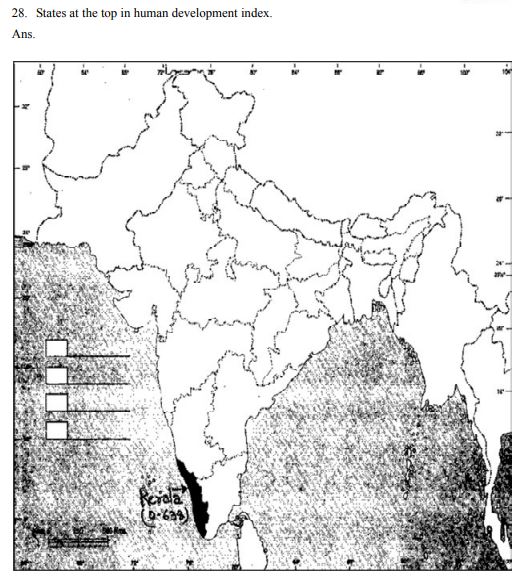
♦ Kerala with 0.638 placed on the top
♦ Orissa with 0.404 placed at the bottom
♦ Due to highest sex ratio and literacy Kerala place on the top
♦ Due low sex ratio, per-capita income, and low literacy Orissa kept at the bottom
REASONS FOR LOW HDI
♦ Low Literacy Rate
♦ Low Economic Development
♦ Regional Disparities
POPULATION ENVIORNMENT AND DEVELOPMENT
♦ Social inequalities, discriminations deprivations displacement of people, abuse of human rights cause low HDI
♦ Methods to increase the HDI
i) Sustainable development
ii) Government Expenditure on public health and education
iii) Increase social and political freedom
GIST OF THE LESSON:
GROWTH: It is the quantitative and value neutral, it may be positive, or negative.
DEVELOPMENT: Qualitative change which is always value positive.
CONCEPT OF HUMAN DEVELOPMENT
The concept of human development was introduced by DR. Mahbub-ul- Haq. Human development is a process of enlarging people choices and raising the level of their wellbeing.
People can live meaningful life. Life with some purpose, people must be healthy, develop their talents, participate in society and be free to achieve their goal.
THE FOUR PILLARS OF HUMAN DEVELOPMENT
• EQUITY: equal opportunities available to everybody.
Irrespective of gender, race, income ( in case of India women and low caste people drop out the school is more)
• SUSTAINABILITY: continuity in availability of resources, each generation must have opportunities,
• PRODUCTIVITY: productivity in terms of labor productivity, it should be constantly enriched.
• EMPOWERMENT: to have power to make decisions. Increasing freedom and capability, good governance, and govt. policies.
APPROACHES TO HUMANDEVELOPMENT
• INCOME APPROACH: oldest method, level of income leads to development
• WELFARE APPROACH: higher the expenditure on education, health, and other amenities by the government.
• BASIC NEEDS APPROACH: it was introduced by ILO
• SIX BASIC NEEDS
Health
Education
Food
Water Supply
Sanitation
Housing
• CAPABILITY APPROACH: associated with Prof. Amartya Sen. Access to education and health facilities.
INTERNATIONAL COMPARISIONS
Size of the country and per-capita income are not directly related to human development. Like Sri Lanka and Trinidad and Tobago have higher rank than India in human development.
THERE ARE THREE GROUPS OF HDI
♦ HIGH ABOVE 0.8 57 COUNTRIES
♦ MEDIUM 0.5-0.799 88 COUNTRIES
♦ LOW BELOW 0.5 32 COUNTRIES
♦ COUNTRIES WITH HIGH INDEX VALUE: NORWAY, ICELAND, AUSTRALIA education and health care are priorities for the government.
♦ COUNTRIES WITH MEDIUM INDEX: it consists of large group, emerged after Second World War, adopting people oriented policies.
♦ COUNTRIES WITH LOW INDEX VALUE: large number of these countries are very small.
Political turmoil, social instability, civil war, high incidence of diseases.
Question. Which one of the following is the best description of development?
(a) An increase in size
(b) A constant in size
(c) A positive change in quality
(d) A simple change in quality
Answer : C
Question. Which of the following section of the society are included under marginalised section?
(a) Scheduled Caste
(b) Scheduled Tribe
(c) Landless Labourers
(d) All of these
Answer : D
Question. Which of the following is the reason leading to decline in personal capabilities of the people?
(a) Weakening social ties
(b) Pollution
(c) Increasing diseases
(d) Displacement of people
Answer : C
Question. In which year the first Human Development Report was published?
(a) 1985
(b) 1990
(c) 1992
(d) 1995
Answer : B
Question. What is India’s rank in 2019 Human Development Index.
(a) 129
(b) 130
(c) 131
(d) 132
Answer : A
Question. Which of these human development report mentions that “Development must be woven around people, and not people around development”?
(a) HDR, 1990
(b) HDR, 2016
(c) HDR, 2013
(d) HDR, 1993
Answer : D
Question. India’s Human Development Index is released by which Organisation/Ministry?
(a) Planning Commission
(b) Ministry of Social Justice
(c) NITI Aayog
(d) Ministry of HRD
Answer : C
Question. The indicator used by the erstwhile planning commission includes
(a) Healthy life
(b) Economic attainment
(c) Social empowerment
(d) All the above
Answer : D
Question. Which of these states has recorded more than 30% of people living below poverty line in 2011-12?
(a) Maharashtra
(b) Manipur
(c) West Bengal
(d) Punjab
Answer : B
Question. Which of these is the reason that few states have higher levels of human development as compared to others?
(a) Economic development
(b) Literacy levels
(c) Levels of regional imbalance
(d) All of the above
Answer : D
Question. Which one of the following is India’s rank in terms of Human Development Index among the countries of the world in 2016?
(a) 126
(b) 138
(c) 134
(d) 131
Answer : D
Question. Which one of the following states of India has thehighest rank in the Human Development Index?
(a) Tamil Nadu
(b) Punjab
(c) Kerala
(d) Haryana
Answer : C
Question. Which one of the following states of India has the lowest female literacy?
(a) Jammu and Kashmir
(b) Arunachal Pradesh
(c) Jharkhand
(d) Bihar
Answer : D
Question. Which one of the following states of India has the lowest female child sex ratio 0-6 years?
(a) Gujarat
(b) Haryana
(c) Punjab
(d) Himachal Pradesh
Answer : B
Question. Which one of the following Union Territories of India has the highest literacy rate?
(a) Lakshadweep
(b) Chandigarh
(c) Daman and Diu
(d) Andman and Nicobar islands
Answer : A
Question. Improvements in which of the following would lead to human development?
1. Political freedom
2. Education
3. Human rights
4. Access to resources
Codes
(a) 1 and 2
(b) 2, 3 and 4
(c) 1, 3 and 4
(d) All of these
Answer : D
Question. Which of the following is/are the adverse effects of imbalanced human development?
1. Ecological degradation
2. Shortage of basic facilities
3. Rise in social capabilities
Codes
(a) 1 and 2
(b) 1, 2 and 3
(c) 2 and 3
(d) 1 and 3
Answer : A
Question. Which of the following is correctly arranged in terms of per cent of population living below poverty line, in the increasing order?
(a) Jharkhand, Chhattisgarh, Rajasthan, Punjab
(b) Chhattisgarh, Rajasthan, Punjab, Jharkhand
(c) Rajasthan, Chhattisgarh, Punjab, Jharkhand
(d) Punjab, Rajasthan, Jharkhand, Chhattisgarh
Answer : D
Question. Choose the correct arrangement of states in terms of their increasing order of female literacy.
(a) Rajasthan, Mizoram, Kerala, Nagaland
(b) Himachal Pradesh, Rajasthan, Mizoram, Kerala
(c) Rajasthan, Himachal Pradesh, Mizoram, Kerala
(d) Kerala, Rajasthan, Mizoram, Himachal Pradesh
Answer : C
Question. What are the consequences of imbalanced development?
(a) Decline in social capabilities
(b) Decline in environmental capabilities
(c) Decline in personal capabilities
(d) All of the above
Answer : D
Question. Which of the following States/UTs do not have less than 10% population living below the poverty line?
(a) Himachal Pradesh
(b) Puducherry
(c) Sikkim
(d) Manipur
Answer : D
Question. Which of the following states has 10%-20% population living below the poverty line?
(a) Andhra Pradesh
(b) Bihar
(c) Punjab
(d) Nagaland
Answer : D
Question. Female literacy in India is [as per 2011 census]
(a) 74.04%
(b) 65.46%
(c) 68.04%
(d) 61.23%
Answer : B
Question. In which year Swachh Bharat Mission was launched?
(a) 2014
(b) 2015
(c) 2013
(d) 2016
Answer : A
Question. Match the Following.
Rank (UNDP, 2018 Report) Country
A. Norway 1. 1
B. Sri Lanka 2. 76
C. India 3. 130
D. USA 4. 13
Codes
(a) A-4, B-2, C-1, D-3
(b) A-3, B-2, C-1, D-4
(c) A-2, B-1, C-4, D-3
(d) A-1, B-2, C-3, D-4
Answer : D
One Marks Questions
Question. Which state of India has highest HDI?
Answer: Kerala.
Question. Which state of India has the lowest literacy rate?
Answer: Bihar.
Question. Name the state of India that has the highest poverty incidence ratio.
Answer: Odissa and Bihar.
Question. Name any four countries having low human development index. Discuss three reason for low human development index.
Answer: (1) Democratic Republic of Congo
(2) Nigeria
(3) Burundi
(4) Mozambique
Reasons for low HDI
• Political turmoil
• Social instability (civil war)
• Famine
• High incidence of diseases.
Question. Name four countries having high human development index. Discuss three reasons for high human development index.
Answer: Four counties with high human development index:
1. Norway
2. Australia
3. Netherlands
4. U.S.A
Reason for high HDI
• Investment more in the Social Sector (education, health care)
• Good governance
• Free from political turmoil and instability.
Question. Define human development. What is the basic goal of human development? Explain with examples the four pillars of human development.
Answer: Human development is a process of enlarging the range of people’s choices, increasing their opportunities for education, health care, income and empowerment and covering the full range of human choices from a sound physical environment to economic, social and political freedom.
The basic goal of development is to create conditions where people can live meaningful lives.
The four pillars of human development: -
• Equity –It refers to providing equal access to opportunities available to everybody irrespective of their gender, race, income and caste.
• Sustainability-sustainability means continuity in the availability of opportunities for sustainable human development.
• Productivity-It refers to human labour productivity in terms of human work. It must be constantly enriched by building capabilities in people.
• Empowerment –It means to have the power to make choices. Such power comes from increasing freedom and capabilities, good governance and people –oriented policies, so as to empower people.
Question. Discuss in detail about the alternative view of development given by Dr. Mahbub –ul – haq and Prof. Amartya Sen.
Answer: For many decades a country’s level of development was measured only in terms of its economic growth.
The ideas that the quality of life people enjoy in a country, the opportunities they have and freedoms they enjoy are important aspects of development now and the works of Mahbub-ul-Haq and Amartya Sen are important in this regard.
• According to Haq-development in all about enlarging people’s choices in order to lead long, healthy lives with dignity. The basic goal of development is to create conditions where people can live meaningful lives.
• Prof.Amartya Sen saw an increase in freedom or decrease in unfreedom as the main objective of dvelopment.
• The works of these economist are path breaking and have succeeded in bringing people to the centre of any discussion on development.
Question. Explain various indicators of human development.
Answer: United Nation’s Development Programs has suggested the following indicators of human development.
1. Health
2. Education
3. Access to resources
Question. Explain the reasons for low human development index in few states of India.
Answer: Reasons –
1. Low rate of literacy in the sates like Bihar, M.P and Orissa.
2. Low economic development in the states like Orissa, Assam and Bihar etc.
3. Lack of effective implementations of govt. policies in these states.
Question. What is Human Development? Explain the indicators of Human Development in India.
Answer: Human development- it is the enhancement in the people’s choice and improvement in their lives.
The concept of human development was introduced by Dr. Mahbub-ul-haq in 1990.
Key Areas in Human Level Indicators
1. Access to resources Purchasing power (in $)
2. Health Life expectancy at birth
3. Education Adult literacy rate & gross Enrolment ratio.
One Marks Question
Question. Who introduced the concept of Human development?
Answer: Dr. Mahbub ul Haq
Question. Which countries has the highest human development index?
Answer: Norway
Question. Write four pillars of the human development.
Answer: Equity, sustainability, productivity and empowerment.
Three Marks Question.
Question. Name four countries having high human development index. Discuss three reasons for high human development index.
Answer: Four counties with high human development index:
1. Norway
2. Australia
3. Netherlands
4. U.S.A
Reason for high HDI
♦ Investment more in the Social Sector (education, health care)
♦ Good governance
♦ Free from political turmoil and instability.
Question. Name any four countries having low human development index.Discuss three reason for low human development index.
Answer: (1) Democratic Republic of Congo
(2) Nigeria
(3) Burundi
(4) Mozambique
Reasons for low HDI
♦ Political turmoil
♦ Social instability (civil war)
♦ Famine
♦ High incidence of diseases.
Question. Discuss in detail about the alternative view of development given by Dr. Mahbub –ul –haq and Prof. Amartya Sen .
Answer: For many decades a country’s level of development was measured only in terms of its economic growth.
The ideas that the quality of life people enjoy in a country, the opportunities they have and freedoms they enjoy are important aspects of development now and the works of Mahbub-ul-Haq and Amartya Sen are important in this regard.
♦ According to Haq-development in all about enlarging people’s choices in order to lead long, healthy lives with dignity . The basic goal of development is to create conditions where people can live meaningful lives.
♦ Prof.Amartya Sen saw an increase in freedom or decrease in unfreedom as the main objective of dvelpment.
♦ The works of these economist are path breaking and have succeeded in bringing people to the centre of any discussion on development
Five Marks Question
Question. Define human development .What is the basic goal of human development? Explain with examples the four pillars of human development.
Answer: Human development is a process of enlarging the range of people’s choices , increasing their opportunities for education, health care , income and empowerment and covering the full range of human choices from a sound physical environment to economic , social and political freedom.
The basic goal of development is to create conditions where people can live meaningful lives.
The four pillars of human development:-
♦ Equity – It refers to providing equal access to opportunities available to everybody irrespective of their gender, race, income and caste.
♦ Sustainability- Sustainability means continuity in the availability of opportunities for sustainable human development.
♦ Productivity- It refers to human labour productivity in terms of human work. It must be constantly enriched by building capabilities in people.
♦ Empowerment –It means to have the power to make choices. Such power comes from increasing freedom and capabilities, good governance and people –oriented policies, so as to empower people.
Download Class 12 Geography Chapter 03 Human Development Practice Worksheets
Practice Exercises for Class 12 Geography Chapter 03 Human Development
Explore reliable practice questions for Chapter 03 Human Development tailored for Class 12 Geography learners. Use these structured worksheets to evaluate exam preparedness and strengthen problem-solving skills throughout the 2026 academic session.
Step-by-Step Solutions and Practice Guidelines
Designed around the official curriculum for Class 12 Geography, these practice sheets guarantee standard compliance. Reviewing step-by-step solutions after completion sharpens your accuracy and clarifies complex sub-topics within Chapter 03 Human Development.
Enhance Speed with Online Practice
Consistent engagement with these exercises builds familiarity with recurring exam themes. If specific areas within Chapter 03 Human Development cause trouble, utilize our dedicated NCERT solutions for Class 12 Geography to clear up doubts immediately.
FAQs
You can download the latest chapter-wise printable worksheets for Class 12 Geography Chapter 03 Human Development for free from StudiesToday.com. These have been made as per the latest CBSE curriculum for this academic year.
Yes, Class 12 Geography worksheets for Chapter 03 Human Development focus on activity-based learning and also competency-style questions. This helps students to apply theoretical knowledge to practical scenarios.
Yes, we have provided solved worksheets for Class 12 Geography Chapter 03 Human Development to help students verify their answers instantly.
Yes, our Class 12 Geography test sheets are mobile-friendly PDFs and can be printed by teachers for classroom.
For Chapter 03 Human Development, regular practice with our worksheets will improve question-handling speed and help students understand all technical terms and diagrams.