MCQ Questions for Class 10 Social Science Minerals and Energy Resources
Question : Which mineral may occur as alluvial deposits ?
(a) Steel
(b) Silver
(c) Iron
(d) Aluminium
Answer : B
Question : In which areas sedimentary minerals are formed as a result of evaporation ?
(a) Semi-arid regions
(b) Dry regions
(c) Arid regions
(d) Moist regions
Answer : C
Question : Where are minerals generally found ?
(a) In ores
(b) Under the earth
(c) Above the Earth
(d) In rocks
Answer : A
Question : Igneous, metamorphic rocks and minerals may occur in the _______________ .
(a) Cracks
(b) Crevices
(c) Faults or Joints
(d) All of these
Answer : D
Question : Minerals occur in igneous and metamorphic rocks in ......... .
(a) the veins and the lodes
(b) layers
(c) alluvial deposits
(d) the decomposed surface rocks
Answer : A
Question : Which one is not a ferrous mineral?
(a) Iron ore
(b) Manganese
(c) Copper
(d) Hematite
Answer : C
Question : Which is the basic mineral and the backbone of industrial development?
(a) Coal
(b) Bauxite
(c) Copper
(d) Iron ore
Answer : D
Question : Minerals are deposited and accumulated in the strata of which of the following rocks?
(a) Sedimentary rocks
(b) Metamorphic rocks
(c) Igneous rocks
(d) None of the above
Answer : A
Question : Which of the following minerals are obtained from veins and lodes?
(i) Zinc (ii) Copper (iii) Coal (iv) Bauxite
(a) Only (i) and (ii)
(b) Only (ii) and (iii)
(c) Only (iii) and (iv)
(d) All of the above
Answer : A
Question : Which metal has a very high content of iron up to 70 per cent?
(a) Magnetite ore
(b) Hematite iron
(c) Hematite ore
(d) Iron ore
Answer : A
Question : _____ is the basic raw material for the cement industry and essential for smelting iron ore in the blast furnace.
(a) Gypsum
(b) Limestone
(c) Potash salt
(d) Sodium salt
Answer : B
Question : Where are minerals usually found?
(a) Rocks
(b) Earth crust
(c) Ores
(d) Earth core
Answer : C
Question : Arrange the following in the most usable source of energy in India.
i. Coal
ii. Solar energy
iii. Petroleum
iv. Geothermal energy
Options :
(a) (i)-(iv)-(iii)-(ii)
(b) (i)-(ii)-(iii)-(iv)
(c) (i)-(ii)-(iii)-(iv)
(d) (i)-(iii)-(iv)-(ii)
Answer : C
Question : Rocks are combinations of homogeneous substances called _______________ .
(a) Minerals
(b) Ores
(c) Limestone
(d) Metals
Answer : A
Question : Minerals are a _________ part of our lives.
(a) useful
(b) vital
(c) important
(d) indispensable
Answer : D
Explanation: Minerals are an indispensable part of our lives. Almost everything we use, from a tiny pin to a towering building or a big ship, all are made from minerals. In all the stages of development, human beings have used minerals for their livelihood, decoration, festivities, religious and ceremonial rites.
Question : Which is the oldest oil producing state of India?
(a) Rajasthan
(b) Assam
(c) Maharashtra
(d) Gujarat
Answer : B
Explanation: Assam is the oldest oil producing state of India. Digboi, Naharkatiya and Moran-Hugrijan are the important oil fields in the state.
Digboi has the distinction of being India's oldest continuously producing oilfield.
Question : The vast alluvial plains of North India are almost devoid of ________.
(a) Rock minerals
(b) economic minerals
(c) petro minerals
(d) fuel minerals
Answer : B
Explanation: The vast alluvial plains of north India are almost devoid of economic minerals. These variations exist largely because of the differences in the geological structure, processes and time involved in the formation of minerals.
Question. Which one of the following minerals is not obtained from the veins and lodes?
(a) Tin
(b) Zinc
(c) Lead
(d) Gypsum
Answer : B
Question. One of the following is a non-metallic mineral. Choose the correct option
(a) Manganese
(b) Copper
(c) Coal
(d) Granite
Answer : D
Question. The larger occurrences of minerals of igneous and metamorphic rocks are called:
(a) Veins
(b) Lodes
(c) Beds
(d) Layers
Answer : B
Question. Which ore is the most important industrial iron ore in terms of the quantity used?
(a) Magnetite
(b) Pyrite
(c) Goethite
(d) Hematite
Answer : D
Question. Uranium and thorium used for generating nuclear power are found in
(a) Godavari Basin
(b) Gulf of Cambay
(c) Manikarn in Himachal Pradesh
(d) Aravalli ranges of Rajasthan
Answer : D
Question. Which one of the following features is not true about copper?
(a) India is deficient in the reserve and production of copper.
(b) It is reliable, ductile and a good conductor.
(c) It is a ferrous ore.
(d) It is mainly used in electrical cables and electronic goods.
Answer : C
Question. Aluminium is obtained from
(a) bauxite
(b) limestone
(c) copper
(d) manganese
Answer : A
Question. Which one of the following states, is the largest producer of copper in India ?
(a) Orissa
(b) Karnataka
(c) Madhya Pradesh
(d) Gujarat
Answer : C
Question. Which of the following is the oldest oil producing state of India?
(a) Gujarat
(b) Madhya Pradesh
(c) Assam
(d) Andaman Nicobar island
Answer : A
Question. Mica is used in electric and electronic industries because
(a) of its insulating properties and resistance to high voltage
(b) it is a good conductor of electricity
(c) of its great malleability
(d) of its sonorous nature
Answer : A
Question. In which of the following iron ore belt Kudremukh mines are located?
(a) Orissa-Jharkhand belt
(b) Maharashtra-Goa belt
(c) Durg-Baster-Chandrapur belt
(d) Bellary-Chitradiga-Chikmaglur-Tumkur belt
Answer : D
Fill in the blanks:
Question. Rajasthan is the …………………… largest producer of mica in India.
Answer : Second
Question. . ………………must be present in ferrous minerals.
Answer : Irkn
Question. Deposits of lignite coal along with are ……………….. found in Rajasthan.
Answer : Limestone
Question. The mineral deposits in Sands of Valley floors and the base of hills called - - - -
Answer : Placer Deposits
Question. In India, - - - - - - - is the most abundantly available fossil fuel.
Answer : coal
Question. - - - - - - - - - is the largest producer of manganese ores in India.
Answer : Petroleum
Question. Major metallic minerals like tin, copper, zinc and lead are obtained from - - - - -
Answer : Veins and Lodes
Assertion and Reasoning Based Questions
Mark the option which is most suitable :
(a) If both assertion and reason are true and reason is the correct explanation of assertion.
(b) If both assertion and reason are true but reason is not the correct explanation of assertion.
(c) If assertion is true but reason is false.
(d) If both assertion and reason are false.
Question : Assertion : Uses of iron brought a radical change in human life.
Reason : Different kinds of tools where invented by using minerals
Answer : (a) Revolution in agriculture-different type of tools invented like axe, hook, plough etc., revolution in industry-different tools and machines like spinning and also revolution in transportation- bullock-cart, ships, boats etc brought a radical change in human life
Question : Assertion : Natural gas is referred as an environment friendly fuel.
Reason : Natural gas contains low carbon dioxide emissions.
Answer : (a) Natural gas is considered an environment friendly fuel because of low carbon dioxide emissions.
Question : Assertion : Mica is a metallic mineral.
Reason : Mica mineral is the basic raw material for cement industry
Answer : (d) Mica is a mineral made up of a series of plates or leaves. It is a non-metallic mineral and it is used in electric and electronic industries.
Question : Assertion : Increased use of fossil fuels creates a healthy environment.
Reason : Fossil fuels such as coal, oil and gas are easily obtained from natural resource.
Answer : (d) Increased use of fossil fuels causes serious environmental problems. Hence, there is a pressing need to use renewable energy sources like solar energy, wind, tide, biomass and energy from waste material.
Question : Assertion : Geological processes of mineral formation is slow
Reason : Minerals resources are consumed way quickly than they are formed.
Answer : (b) Mineral formation is slow as it requires millions of years to be created but are used very quickly in comparison.
True / False
Question : Metallic minerals occur in sedimentary rocks.
Answer : False
Question : The sources of energy used on a large scale are conventional sources of energy.
Answer : True
Question : Anthracite coal has more than 80% carbon.
Answer : True
Read the sources given below and answer the questions that follow:
Source A – Energy Resources Energy can be generated from fuel minerals like coal, petroleum, natural gas, uranium and from electricity. Energy resources can be classified as conventional and non-conventional sources. Conventional sources include: firewood, cattle dung cake, coal, petroleum, natural gas and electricity (both hydel and thermal).
Source B –Non – Conventional Sources of Energy The growing consumption of energy has resulted in the country becoming increasingly dependent on fossil fuels such as coal, oil and gas. Rising prices of oil and gas and their potential shortages have raised uncertainties about the security of energy supply in future, which in turn has serious repercussions on the growth of the national economy. Moreover, increasing use of fossil fuels also causes serious environmental problems. Hence, there is a pressing need to use renewable energy sources like solar energy, wind, tide, biomass and energy from waste material. These are called non–conventional energy sources.
Source C –Conservation of Energy Resources Energy is a basic requirement for economic development. Every sector of the national economy : agriculture, industry, transport, commercial and domestic needs inputs of energy. The economic development plans implemented since independence necessarily required increasing amounts of energy to remain operational. As a result, consumption of energy in all forms has been steadily rising all over the country
Source A – Conventional Sources of Energy.
Question : How can we conserve energy resources?
Answer : We have to adopt a cautious approach for the judicious use of our limited energy resources. For example, as concerned citizens we can do our bit by using public transport systems instead of individual vehicles; switching off electricity when not in use, using powersaving devices and using non-conventional sources of energy.
Question : Which is the most abundantly available conventional source of energy?
Answer : Coal. Source B –Non Conventional Sources of Energy
Question : Write any two benefits of Non Conventional Sources of Energy.
Answer : (i) Non Conventional Sources of Energy are renewable that means never be finished.
(ii) They are environment friendly. Source C –Conservation of Energy Resources
Very Short Questions for Class 10 Social Science Mineral And Energy Resources
Question : What is a mineral?
Answer : Mineral is a homogeneous naturally occurring substance with a definable internal structure.
Question : How do minerals occur in igneous and metamorphic rocks?
Answer : In igneous and metamorphic rocks, minerals may occur in racks, crevices, faults and joints.
Question : Name the minerals formed in beds and layers.
Answer : Coal, and some forms of iron ore.
Question : How did the Bailadila iron-ore field get its name?
Answer : The Bailadila hills look like the hump of an ox, hence Bailadila iron-ore field get its name.
Question : Why is copper mainly used in electrical cables and electronic industries?
Answer : It is used in electrical cables as it is malleable, ductile and a good conductor of heat and electricity.
Question : How are ‘Gobar Gas Plants’ beneficial to the farmers?
Answer : ‘Gobar Gas Plants’ are beneficial to the farmers in the form of energy and improved quality of manure.
Question : Mention the context of iron present in magnetite.
Answer : A very high context of iron, upto 70 percent, is present in magnetite.
Question : What are placer deposits?
Answer : There are some minerals which occur as alluvial deposits in sands of valley floors and the base of hills. These deposits are called placer deposits.
Question : Name one hardest mineral and one softest mineral.
Answer : Hardest mineral – diamond
Softest mineral – tale
Question : What is an important condition to make the extraction of minerals commercially viable?
Answer : The mineral context of the ore must be in sufficient concentration.
Question : How is aluminium an important metal?
Answer : Aluminium combines the strength of metals such as iron, with extreme lightness and also with good conductivity and great malleability.
Question : Name the regions where India’s bauxite deposits are mainly found.
Answer : The Amarkantak plateau, Maikal hills and the plateau region of Bilaspur-Katur.
Question : What are veins and lodes?
Answer : In igneous and metamorphic rocks minerals may occur in the cracks, crevices, faults or joints. The smaller occurrences are called veins and the larger are cabled lodes.
Question : Name the major metallic minerals which are obtained from veins and lodes.
Answer : Tin, copper, zinc and lead.
Question : Which rock consists of single mineral only?
Answer : Limestone consists of a single mineral only.
Question : What is hematite?
Answer : Hematite ore is the most important industrial iron ore in terms of the quantity used.
Question : What are placer deposits?
Answer : Certain mineral deposits that occur in sands of valley floors and the base of the hills as alluvial deposits are called placer deposits.
Question : Name the most abundantly available fossil fuel in India.
Answer : Coal is the most abundantly available fossil fuel in India.
Question : Name the gulf that provides ideal conditions for utilising tidal energy in India.
Answer : Gulf of Khambhat and Gulf of Kuchchh in Gujarat provide ideal conditions for utilising tidal energy in India.
Question : How power resources are classified?
Answer : Power resources may be broadly categorised into conventional and non-conventional resources.
Question : What is biogas energy?
Answer : Bio gas is produced from shrubs, farm waste, animal and human wastes.
Question : At which place in India, experimental project for geothermal energy has been Set-up?
Answer : Manikaran.
Question : Why are there a wide range of colours, hardness, crystal forms, lustre and density found in minerals?
Answer : The ranges found in minerals are due to physical and chemical conditions.
Question : How do minerals occur in sedimentary rocks?
Answer : In sedimentary rocks, minerals occur in beds or layers.
They have been formed as a result of deposition, accumulation and concentration in horizontal strata.
Question : How does mining affect the health of miners?
Answer : The dust and the noxious fumes inhaled by the miners makes them vulnerable to pulmonary diseases.
Question : Which state is the largest producer of manganese ores in India? What was its total productions in the state in 2000-01?
Answer : Odisha is the largest producer of manganese ores in India. It accounted for onethird of the country’s total production in 2000-01.
Question : Where do minerals occur in sedimentary rocks?
Answer : In sedimentary rocks minerals occur in beds or layers.
Question : Which minerals are largely derived from ocean waters?
Answer : Common salt, magnesium and bromine are some minerals largely derived from ocean waters.
Question : ‘Different regions of India contain different minerals’. What is the reason behind it?
Answer : It happens because of the difference in the geological structure, processes and time involved.
Question : Name the two countries which import iron ore from India.
Answer : Japan and South Korea.
Question : How are ferrous minerals important?
Answer : They are important because they provide a strong base for the development of metallurgical industries.
Question : How are minerals indispensable part of our lines?
Answer : Almost everything we use, from a tiny pin to a towering building or a big shop, all are made from minerals. Life processes cannot occur without minerals.
Question : How do geologists define minerals?
Answer : Geologists define minerals as a homogenous, naturally occurring substance with a definable internal structure.
Question : Name any four minerals which obtained form placer deposits.
Answer : Gold, silver, tin and platinum.
Question : Name the regions where India’s mica deposits are mainly found.
Answer : The northern edge of the Chhota Nagpur plateau.
Question : How is iron-ore transported from Kudremukh mines to a port near Mangaluru?
Answer : Iron-ore is transported as slurry through pipelines.
Question : Why aluminium metal has great importance?
Answer : It h as great importance because it combines the strength of metals such as iron with extreme lightness and also with good conductivity and great malleability.
Question : Which rock consists of single mineral only?
Answer : Limestone.
Question : Which mineral is found abundantly in the monazite sand?
Answer : Monazite sand is found in Kerala and the mineral which is found abundantly in monazite sand is thorium.
Question : Name the regions containing the highest and the lowest amounts of mineral deposits in India.
Answer : Regions having the highest amount of mineral deposit are the areas of peninsular plateau and the regions having lowest amount of mineral deposits are the Northern Plains.
Short Questions for Class 10 Social Science Mineral And Energy Resources
Question : How is mining activity hazardous? Explain. or
How is the mining activity injurious to the health of the miners and environment? Explain.
or
“Mining affects health and environment both.” Comment.
or
How is mining activity hazardous? Explain.
Answer : The mining activity is injurious to the health of the miners and environment as:
a. The dust and noxious fumes inhaled by miners make them vulnerable to pulmonary diseases.
b. The risk of collapsing mine roofs.
c. Inundation on coal mines are a constant threat to miners.
d. The water sources in the region get contaminated due to mining.
e. Dumping of waste and slurry leads to degradation of land, soil and increase in stream and river pollution.
Question : Which are the two main minerals used to obtain nuclear energy? Name any two states where these minerals are found.
Answer : Nuclear or atomic energy is obtained by altering the structure of bn atom; When such an alteration is made, much energy is released in the form of heat and this is used to generate electric power.
a. Uranium and Thorium are used for generating atomic or nuclear power.
b. They are available in Jharkhand and Rajasthan.
Question : Name the non-metallic mineral which can split easily into thin sheets. Mention its uses.
Answer : Mica is the non-metallic mineral which can be split easily into thin sheets.
Mica is used in:
a. Electric and electronic industries: Mica is used in these industries due to its excellent dielectric strength, low power loss factor, insulating properties and resistance to high voltage.
b. Plastic industry uses mica as an extender and filler.
Question : Why is energy required for all activities ? How can energy be generated?
Answer : a. Energy is a basic requirement for economic development.
b. Every sector of the national economy needs input of energy.
c. Consumption of energy in all forms has been steadily rising all over the country.
d. Rising prices of oil and gas and their potential shortage have raised uncertainties about the security of energy supply in future.
Energy can be generated from fuel minerals like coal, petroleum, natural gas, uranium and from electricity.
Question : “Natural gas is considered an environment friendly fuel.” Explain the statement in two points.
Answer : Natural gas is used as a source of energy as well as an industrial raw material.
a. It can be transported easily through pipelines.
b. Pipelines have helped in setting up fertilizer plants and power plants on its way.
c. Natural gas is a clean source of energy.
d. It is an environment friendly fuel because of the low carbon emission.
Question : Explain any three different forms in which minerals generally occur.
Answer : a. Minerals occur in the form of veins and lodes (In igneous and metamorphic rocks).
b. In sedimentary rocks, a number of minerals occur in beds and layers.
c. As residual mass of weathered material.
d. As alluvial deposits in ocean waters.
Question : Why is it essential to use renewable sources of energy?
Answer : a. Non-renewable sources are going to exhaust such as coal, petrol, natural gas etc. They can cause environmental pollution therefore, we have to use’ renewable resources.
b. India has abundance of solar energy, wind, water and biomass.
c. Rising prices of oil and gas and their shortage have raised uncertainties about energy resources in the future.
Question : Which are the potential sources of biogas? State any four benefits of biogas.
Answer : Potential sources of biogas are: Shrubs, farm wastes, animal waste, human waste, etc.
Four benefits of biogas are:
a. Its calorific value is high.
b. It burns without smoke, causing no pollution.
c. It is the cheapest gaseous fuel.
d. Biogas plants provide twin benefits to the farmer in the form of energy and improved quality of manure.
Question : What are the uses of copper? Name the two leading copper producing states of India.
Answer : Uses of copper:
a. In manufacturing electrical cables.
b. In electronic industries.
c. In chemical industries.
The two leading copper producing states of India are Madhya Pradesh and Rajasthan.
Question : Why is mica considered the most important mineral in electric and electronic industries? Give three reasons.
or
How is mica one of the most indispensable minerals ?
Explain any three points.
Answer : Mica is:
a. Excellent dielectric in strength and has low power loss factor.
b. It has insulating properties and resistance to high voltage.
c. Most indispensable mineral used in electric and electronic industries.
Question : “How is geo-thermal energy produced ? Explain.
Answer : The earth grows progressively hotter with increasing depth. Where the geothermal gradient is high, high temperatures are found at shallow depths.
Groundwater in such areas absorbs heat from the rocks and becomes hot.
It is so hot that when it rises to the earth’s surface, it turns into steam. This steam is used to drive turbines to generate electricity.
Question : Why is conservation of minerals important? How can we conserve minerals?
Answer : Conservation of minerals is important for the following reasons:
a. Minerals are exhaustible.
b. They are limited.
c. Minerals have manifold uses.
d. Growth of industrialisation has accelerated the extraction of minerals.
We can conserve minerals by making an efficient use of them and using recyclable sources of energy wherever possible.
Question : Name the mineral ore from which aluminium is extracted. Why is it gaining importance? Give its distribution in India.
Answer : a. Bauxite.
b. Aluminium is gaining importance because of its extreme lightness, good conductivity and great malleability. It combines the strength of metals such as Iron.
c. It is mainly found in Amarkantak Plateau, Maikal Hills and the plateau region of Bilaspur-Katni.
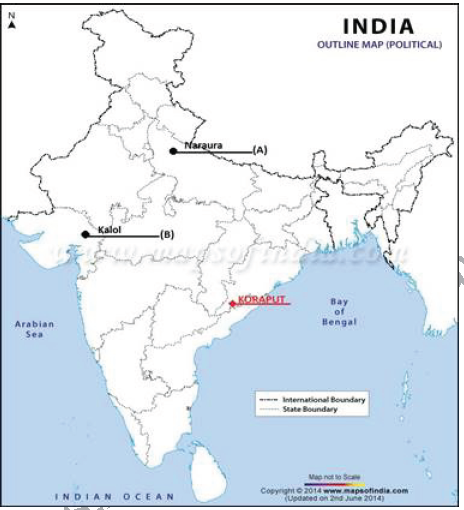
Koraput district in Odisha has large deposits.
Odisha is the largest bauxite producing state.
Others are Gujarat, Maharashtra and Jharkhand.
Question : Describe any three important uses of coal as a source of energy.
Answer : Importance of coal as a source of energy in India are:
a. Coal is the most abundantly available fossil fuel in India.
b. It provides a substantial part of the nation’s energy needs.
c. It is used for power generation.
d. It supplies energy to industry as well as for domestic needs.
Question : Describe any three non-conventional sources of energy.
Answer : Non-conventional sources of energy are:
a. Solar Energy: India is a tropical country. It has enormous possibilities of trapping solar energy.
Photovoltaic technology converts sunlight directly into electricity. Solar energy is rapidly becoming popular in rural and remote areas.
b. Wind Energy: India now ranks as a ‘wind super power’ in the world. The largest wind farm cluster is located in Tamil Nadu from Nagercoil to Madurai. Apart from these, Andhra Pradesh, Karnataka, Gujarat, Kerala, Maharashtra and Lakshadweep have important wind farms.
Nagercoil and Jaisalmer are well-known for effective use of wind energy in the country.
c. Biogas: Shrubs, farm waste, animal and human waste are used to produce biogas for domestic consumption in rural areas. Biogas plants using cattle dung are known as ‘Gobar Gas Plants’ in rural India. These provide twin benefits to the farmer in the form of energy and improved quality of manure.
Question : Explain three factors that make mineral extractions commercially viable.
Answer : a. The minerals content of the ore must be in sufficient concentration.
b. The type of formation or structure in which they are found determines the relative cases with which mineral ores may be mined.
c. The mineral should be close to the market so that the transportation cost is low.
Question : What are ‘placer deposits’? Give examples of minerals found in such deposits.
Answer :
a. Certain minerals may occur as alluvial deposits in sands of valley floors and base of hills. These deposits are called ‘placer deposits’.
b. They generally contain minerals which are not corroded by water.
c. Gold, silver, tin and platinum are examples of some important minerals found in ‘placer deposits’.
Question : Name any one rock mineral. Write about its formation. Name the industry in which it is used. (3)
Answer : Limestone is a rock mineral. It is found in association with rocks composed of calcium carbonate or calcium and magnesium carbonates.
It is found in sedimentary rocks of most geological formations.
Limestone is the basic raw material for cement industry and essential for smelting iron ore in the blast furnaces.
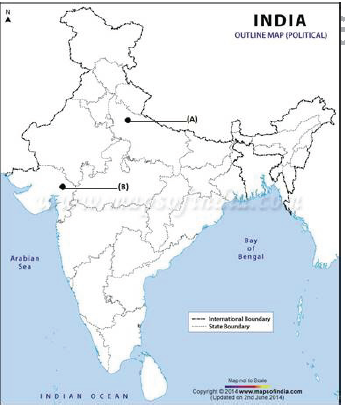
Question : i. Two features A and B are marked in the given political map of India. Identify these features with the help of the following information and write their correct names on the lines marked on the map.
a. Nuclear Plant
b. Oil Field
ii. Locate and Label Koraput Bauxite mine with appropriate symbols on the same map given for identification
Answer :
Long Questions for Class 10 Social Science Mineral And Energy Resources
Question : Explain the importance of conservation of minerals. Highlight any three measures to conserve them.
or
Why is conservation of mineral resources essential?
Explain any three methods to conserve them.
Answer : Reasons for Conservation:
a. The strong dependence of industry and agriculture upon minerals.
b. The process of mineral formation is slow.
c. They are non-renewable.
Methods to conserve:
a. Minerals should be used in a planned and sustainable manner.
b. Improved technology needs to be constantly evolved to allow use of low grade ore at low cost.
c. Recycling of metals using scrap metals.
d. Wastage in the mining and processing should be minimised.
Question : “Which minerals are used to obtain nuclear energy ? Name all the six nuclear power stations of India.
Answer : The minerals which are used to obtain this energy are:
(i) Uranium and (ii) Thorium.
The six nuclear power stations of India are
(i) Narora nuclear power station
(ii) Kakrapara nuclear power station.
(iii) Tarapur nuclear power station.
(iv) Kaiga nuclear power station.
(v) Kalpakkam nuclear power station.
(vi) Rawat Bhata nuclear power station.
Question : There is an urgent need to develop a sustainable path of energy development. Give two broad measures for it. As concerned citizens, how can you help to conserve energy?
Answer : Twin planks/measures:
(i) Promotion of energy conservation.
(ii) Increased use of renewable energy sources. As concerned citizens we can do our bit by:
(i) Using public transport systems instead of individual vehicles.
(ii) Switching off electricity when not in use.
(iii) Using power-saving devices.
(iv) Using non-conventional sources of energy.
Question : Which is the most abundantly available fossil fuel in India? Assess the importance of its different forms.
Answer : Abundantly available fossil fuel in India is coal.
Importance of its different forms are:
a. Peat has low carbon and high moisture content and low heating capacity
b. Lignite is a low grade brown coal which is soft with high moisture content. It is used for generating electricity.
c. Bituminous is the most popular coal of commercial use. It has a special value for smelting iron in blast furnaces.
d. Anthracite is the highest quality hard coal.
Question : “How can solar energy solve the energy problem to some extent in India? Give your opinion.
or
Why is solar energy fast becoming popular in rural and remote areas of India? Explain.
Answer : a. India is a tropical country therefore it receives sunlight in abundance throughout the year.
b. Solar plant can be easily established in rural and remote areas.
c. It will minimise the dependence of rural households on firewood and dung cakes which in turn will contribute to environmental conservation and adequate quantity of manure.
Question : “Minerals are indispensable part of our lives”. Support the statement with example.
Answer : Minerals are an indispensable part of our lives:
a. Almost everything we use, from a tiny pin to a towering building or a big ship, all are made from minerals.
b. The railway lines and the tarmac (paving) of the roads, our implements and machinery too are made from minerals.
c. Cars, buses, trains, aeroplanes are manufactured from minerals and run on power resources derived from the earth.
d. Even the food that we eat contains minerals.
e. In all stages of development, human beings have used minerals for their livelihood, decoration, festivities, religious and ceremonial rites.
Question : What efforts are required to use mineral resources in a planned and sustainable manner? Explain in three points.
Answer : Following efforts have to be made to use mineral in a planned and sustainable manner:
a. Recycling of metals: We should recycle the metal or metal-made products to prevent its scarcity.
For example: Used steel blade should be sent for recycling, so that the steel can be used again for other purposes.
b. Improved technologies need to be evolved:
Traditional technologies should be replaced with new and improved technologies, so that the wastages can be minimised.
c. Use of substitute or alternative resources: The resources which cannot be recycled or reused should be replaced with the recyclable resources, e.g. Use of green gas instead of coal for cooking purpose.
Question : Consumption of energy in all forms has been rising all over the country. There is an urgent need to develop a sustainable path of energy development and energy saving. Suggest and explain any three measures to solve this burning problem.
or
In the present day energy crisis, which step will you take for saving energy?
Answer : The following steps can be taken for saving energy:
1. Judicious use of energy resources.
2. Use of public transport/ car pool.
3. To use bicycle for short distances.
4. Switching off electrical gadgets when not in use.
5. Regular cleaning of gas burners and switching off
the gas regulator when not in use.
6. Avoid using refrigerator/ A. C. when not needed.
7. Creating awareness in neighbourhood with catchy slogans
8. As India has been blessed with abundance of sunlight, water, wind and biomass, we must use these to overcome present day energy crisis. (Any three)
Question : Highlight the importance of petroleum. Explain the occurrence of petroleum in India.
Answer : Importance of Petroleum:
a. Petroleum is the major energy source in India.
b. Provides fuel for heat and lighting.
c. Provides lubricant for machinery.
d. Provides raw material for a number of manufacturing industries.
e. Petroleum refineries act as nodal industry for synthetic textile, fertilizer and chemical industries.
Its occurrence:
a. Most of the petroleum occurrences in India are associated with anticlines and fault traps.
b. In regions of folding, anticline or domes, it occurs where oil is trapped in the crest of the upfold.
c. Petroleum is also found in fault traps between porous and non-porous rocks.
Question : “Conservation of minerals is the need of the hour”.
Support the statement with five facts.
Answer : Conservation of minerals is the need of the hour:
1. Minerals are considered to be the backbone of the economy.
2. Industry and agriculture depend on mineral deposits.
3. The substances manufactured from them also depend on mineral deposits.
4. Total volume of workable mineral deposits is very less-only 1% of the earth’s crust.
5. Mineral resources are being consumed rapidly, and minerals require millions of years to be created and concentrated.
6. The geological processes of mineral ; formation are so slow that the rates of replenishment are infinitely small in comparison to the present rates of consumption.
7. Minerals resources are finite and non¬renewable.
8. The rich mineral deposits of our country are
extremely valuable but short-lived possessions.
Question : “There is a pressing need to use renewable energy resources.” Justify the statement with suitable arguments.
Answer : Need to use renewable energy resources are:
(i) The growing consumption of energy has resulted in the country becoming increasingly dependent on fossil fuels such as coal, oil and gas.
(ii) Rising prices of oil and gas and their potential shortages have raised uncertainties about the security of energy supply in future.
(iii) Has serious repercussions on the growth of the national economy.
(iv) Increasing use of fossil fuels also causes serious environmental problems.
(v) Hence, there is a pressing need to use renewable energy sources like solar energy, wind, tidal, biomass and energy from waste material.
Question : Why is energy needed? How can we conserve energy resources? Explain.
Answer : Energy is required for all activities. It is needed to cook, to provide light and heat, to propel vehicles and to drive machinery in industries.
To conserve energy resources:
1. Need to develop a sustainable path of energy development, i.e., energy development but not at the cost of environment or needs of future generation.
2. Judicious use of limited energy resources.
3. Wastage of minerals should be minimised.
4. Modem technology should be used for the exploitation of energy resources.
5. Export of energy resources should be minimised.
6. Use of substitutes in order to save energy resources.
7. Encourage recycling of energy resources.
Question : Explain the different forms of occurrence of minerals.
Answer : The difference forms of occurrence of minerals are:
i. In igneous and metamorphic rocks: In igneous and metamorphic rocks minerals may occur in cracks, crevices, faults and joints. The smaller occurrence is called veins and the larger are called lodes. Major metallic minerals like tin, copper, zinc and lead, etc. are obtained from veins and lodes.
ii. In sedimentary rocks: In sedimentary rocks a number of minerals occur in beds and layers. They have been formed as a result of deposition, accumulation and concentration in horizontal strata. Coal and some forms of iron ore have been concentrated as a result of long periods.
iii. Through decomposition of surface rocks: Another mode of formation involves the decomposition of surface rocks, and the removal of soluble constituents, leaving a residual mass of weathered material containing ores. Bauxite is formed in this way.
iv. Alluvial deposits: Certain minerals may occur as alluvial deposits in sands of valley floors and the base of hills. These deposits are called placer deposits.
v. In ocean water and ocean beds: The ocean water contains vast quantities of minerals. Common salt, magnesium and bromine are largely derived from ocean water. The ocean beds too are rich in manganese nodules.