

Read and download the CBSE Class 12 Accountancy Retirement And Death Of Partner Worksheet Set 02 in PDF format. We have provided exhaustive and printable Class 12 Accountancy worksheets for Part 1 Chapter 3 Reconstitution of a Partnership Firm Retirement/Death of a Partner, designed by expert teachers. These resources align with the 2026-27 syllabus and examination patterns issued by NCERT, CBSE, and KVS, helping students master all important chapter topics.
Chapter-wise Worksheet for Class 12 Accountancy Part 1 Chapter 3 Reconstitution of a Partnership Firm Retirement/Death of a Partner
Students of Class 12 should use this Accountancy practice paper to check their understanding of Part 1 Chapter 3 Reconstitution of a Partnership Firm Retirement/Death of a Partner as it includes essential problems and detailed solutions. Regular self-testing with these will help you achieve higher marks in your school tests and final examinations.
Class 12 Accountancy Part 1 Chapter 3 Reconstitution of a Partnership Firm Retirement/Death of a Partner Worksheet with Answers
Question : What is the need and required entry to be passed in the books of the firm for distribution of specifi c reserve or fund?
Answer : If specific reserve or funds like Workmen’s Compensation Fund, Investment Fluctuation Fund, etc. Are more in value than the actual liability or if liability does not exist, they should be distributed among all partners (including the retiring partner) in their old profi t-sharing ratio.
Answer : X and Z’s Capital debited respectively with Rs.16,000 and Rs.8,000 and Y’s Capital A/c credited with Rs.24,000 respectively (X & Z sacrifi cing ratio is 2:1).
Question : What are the rights of a Retiring partner after retiring from the firm?
Answer : The rights of a retiring partner are as follows :
(i) An outgoing partner may carry on a business competing with that of the firm but he must not use the firm’s name, must not represent that he is carrying on the business of the firm and must not solicit the customers of the firm.
(ii) If on retirement, the accounts of the firm are not settled and the outgoing partner is not paid his dues, he is entitled to a share in the profits even after his retirement or interest at the rate of 6% on the amount of his share in the firm.
Question : A, B, C and D share profits in the ratio of 3 : 2 : 3 : 2. A retires and the goodwill of the firm is valued at Rs. 1,20,000. The remaining partners decide to share profits as 3 :1: 6 among themselves.
Question : A,B and C were partners in a firm. C died on 28th Feb 2014. His share of profit from the closure of the last accounting year till the date of death was to be calculated on the basis of the average profit of three complete years before death, profit for 2011 2012 and 2013 were Rs. 1400 and Rs. 1600 and Rs. 1800 respectively.
Calculate C’s share of profit till his death.
Ans:- Average profit =14,000 +16,000 +18,000
3
=48,000/3 = 16000
Estimate profit till the date of death = 16,000 X = 2666.66 C’s share of estimated profit = 2666.66 x = 888.8
Question : If profit till the date of death are to be ascertained A B and sharing profit in the ratio of 2:2:1
B died on 31st March 2014,Accounting are closing on December sales for the year 2013 amounted to Rs. 9,00,000 , sales of Rs. 3,00,000 amounted between the period from 1 Jan 2014 to 31 March 2014. The profit for the year 2013 amounted to Rs. 90,000.
Calculate deceased partner’s share in the Profit of the firm.
Solution:- % of profit to sale for the year 2013 = X 100 = 10%
Profit up to death 10% of 3,00,000 i.e. 30,000
B’s share 30,000 X = 12,000
Or
X 3,00,000 = 30,000
Question : A B and C are partners sharing profit and losses in the ratio 2:2:1 . C died on 31st March 2014 profit and sales for the calendar year 2013 were Rs. 3,00,000 and Rs. 30,00,000 respectively. Sales during Jan to March 2014 were 4,50,000. Calculate share and profit of C up to date of death.
Hint:- C’s share 9,000.
Question : D P and G were partner in a firm sharing profit and losses in the ratio of 5:3:2 . P died on 31May 2013 his share of profit from the closure of the last accounting year to the date of death , was to be calculated on the basis of the average of three completed years of profit, before death, profit for the years ended 31stdec 2010,2011,2012 were Rs. 51,000 Rs. 45,000 and 39,000 respectively.
Calculate P’s share of profit.
Hint:- Rs. 5,625
Question : A, B and c are partners in a firm sharing profits and losses in the ratio of 3:2:1. B died on January 2016. C, the son of B, is of the opinion that he is rightful owner of his father’s share of profits, and the profits of the firm be shared between A and c equally. A does not agree. Settle the dispute between A and c and decide the profit sharing ratio for them.
True/False
Question 21. In the event of death, the combined share of profit of the continuing partners will increase.
Answer: True
In simple words: When a partner dies, their share of future profits no longer goes to them. The continuing partners now split the entire profit among themselves, so each person's percentage goes up.
Exam Tip: This increase in share is the basis for calculating the gaining ratio - each continuing partner gains a portion of the deceased partner's share.
Question 22. In the event of death, profit or loss on Revaluation Account is transferred to the continuing partners in the new profit-sharing ratio.
Answer: False
In simple words: Revaluation gains and losses go to all partners - both continuing and retiring (or deceased) - in their OLD profit-sharing ratio. The new ratio applies only to future profits, not to revaluation results.
Exam Tip: Remember: old ratio for all past adjustments (revaluation, reserves, undistributed profits), new ratio only for future business profits.
Question 23. At the time of retirement and death, undistributed profits or losses and reserves are distributed among all the partners in their old profit-sharing ratio.
Answer: True
In simple words: All profits and reserves built up during the old partnership belong to all partners based on how they originally shared profits. They must be divided in the old ratio before anyone leaves.
Exam Tip: Undistributed profits and reserves are past earnings - they belong to the partnership as it existed, so use the old profit-sharing ratio without exception.
Question 24. The firm is under obligation to pay an agreed rate of interest for the unpaid balance to the retiring partner.
Answer: True
In simple words: If the partnership deed states an interest rate on unpaid amounts, the firm must pay this interest. Even if no rate is fixed, the law requires 6% interest as a default.
Exam Tip: Interest on the retiring partner's unpaid balance is a legal obligation - always check the deed first, then apply the 6% statutory rate if silent.
Question 25. Gaining ratio is calculated at the time of retirement or death of a partner and change in profit-sharing ratio.
Answer: True
In simple words: When a partner leaves, the continuing partners take over that person's share, so each partner's profit percentage changes. The gaining ratio measures exactly how much more each person gains.
Exam Tip: Gaining Ratio = New Share - Old Share. It is always calculated whenever a partner retires or dies and the profit-sharing ratio changes among remaining partners.
Fill in the Blanks
Question 26. P, Q and R are partners sharing profits and losses in the ratio of 2/5, 2/5 and 1/5 respectively. R retires, P and Q decide to share future profits in the ratio of 2:1. P's gain is _______.
Answer: 4/15
In simple words: P's old share was 2/5. P's new share is 2/3 (from the 2:1 ratio). The gain is 2/3 - 2/5 = 10/15 - 6/15 = 4/15.
Exam Tip: Always convert the new ratio to fractions of the total before subtracting the old share to find the gaining ratio.
Question 27. ____________ is the ratio in which the remaining partners gain the share of retiring or deceased partner.
Answer: Gaining Ratio
In simple words: The gaining ratio shows how the retiring or deceased partner's profit share gets split among the partners who stay, based on how much more profit each continuing partner will earn.
Exam Tip: Gaining Ratio is always calculated as New Share minus Old Share for each continuing partner.
Question 28. Advance or loan taken by the partner from the firm is _____________to the deceased partner's ____________.
Answer: debited; Loan Account
In simple words: Any money the deceased partner borrowed from the firm gets subtracted from what the firm owes them, because the debt reduces the final payment due to the deceased's family.
Exam Tip: Partner's loans are liabilities that must be recovered before distributing the final settlement amount.
Question 29. Unless agreed otherwise, it is presumed that the continuing partners gain in their _____________ and hence their _____________ is same as their old profit-sharing ratio.
Answer: capital; Gaining Ratio
In simple words: When partners don't agree on a new profit ratio, the law assumes each continuing partner's gain is equal to their current capital proportion. So the gaining ratio stays the same as the old profit ratio.
Exam Tip: This is an important assumption - use it only when the partnership deed is completely silent about the new profit-sharing arrangement.
Question 30. In case of retirement, when the firm pays an amount in excess of total amount due to the retiring partner, then excess amount is treated as _____________.
Answer: Hidden Goodwill
In simple words: If the firm pays more than what is owed, the extra amount represents value the firm hasn't formally recorded - this is hidden or secret goodwill that the retiring partner is being paid for.
Exam Tip: Hidden goodwill appears when the firm is willing to overpay a retiring partner. It is debited to all continuing partners' capital accounts in the gaining ratio.
Very Short Answer Questions
Question 31. On the retirement of a partner, how is the profit-sharing ratio of remaining partners decided?
Answer: The profit-sharing ratio of remaining partners is decided according to the mutual agreement among the remaining partners.
In simple words: The partners who stay in the firm can choose any new profit-sharing arrangement they both accept. The partnership deed may guide this, but mutual consent is key.
Exam Tip: Always mention that the new ratio must be agreed upon by the continuing partners - it is not automatic or prescribed by law.
Question 32. At the time of retirement of a partner, state the condition when there is no need to compute the gaining ratio.
Answer: There is no need to compute the gaining ratio when the continuing partners decide to share profits in the same ratio that existed among them prior to retirement.
In simple words: If the remaining partners keep the exact same profit percentages they had before (not including the retiring partner's old share), there is no gain or loss - just a recalculation based on fewer people.
Exam Tip: The gaining ratio is only needed when the profit percentages of continuing partners change. If their ratio stays the same relative to each other, no gaining ratio calculation is required.
Question 33. Give any one distinction between sacrificing ratio and gaining ratio.
Answer: The sacrificing ratio is the ratio in which the old partners surrender a part of their profit-sharing in favor of a new partner. The gaining ratio is the ratio in which the remaining partners gain the share of the retiring (retired or deceased) partner.
Exam Tip: Sacrificing ratio happens at admission of a new partner (surrender of share). Gaining ratio happens at retirement or death (acquisition of share). These are opposite situations.
Question 34. Jamuna, Ganga and Krishna are partners in a firm. Krishna retired from the firm. After making adjustments for Reserves and Revaluation of Assets and Liabilities, the balance in Krishna's capital account was Rs. 1,20,000. Jamuna and Ganga paid Rs. 1,80,000 in full settlement to Krishna. Identify the item for which Jamuna and Ganga paid Rs. 60,000 more to Krishna.
Answer: Share of Goodwill.
In simple words: Krishna's capital was Rs. 1,20,000, but the partners paid Rs. 1,80,000 - which is Rs. 60,000 more. This extra amount represents Krishna's share of goodwill that was not shown on the books.
Exam Tip: When actual payment exceeds the calculated capital balance, the difference is always goodwill or hidden goodwill. This goodwill must be debited to continuing partners' capital accounts.
Question 35. Name the account which is opened to credit the share of profit of the deceased partner, till the time of his death to his Capital Account.
Answer: Profit and Loss Suspense Account.
In simple words: When a partner dies before the year ends, their share of profit till that date is held temporarily in the Profit and Loss Suspense Account. It is later transferred to their capital account for settlement.
Exam Tip: The Profit and Loss Suspense Account is a temporary account only used for deceased partners. It bridges the gap between the date of death and final settlement.
Question 36. State the need for treatment of goodwill on retirement of a partner.
Answer: Since the retiring partner will not be sharing profit in the future, goodwill is given to help him with the same.
In simple words: The retiring partner built up the firm's reputation and goodwill over the years. Since they no longer share future profits, they deserve a share of this goodwill value as compensation.
Exam Tip: Goodwill compensates the retiring partner for their lost share of future profits. Always calculate and credit their goodwill share to their capital account.
Question 37. For which share of goodwill a partner is entitled at the time of his retirement?
Answer: A partner is entitled to his own share of goodwill at the time of his retirement.
In simple words: The retiring partner gets a goodwill share equal to their profit-sharing percentage in the old partnership. They do not get more or less.
Exam Tip: Goodwill of retiring partner = Goodwill value × Retiring partner's profit-sharing ratio in the old partnership.
Question 38. Why are retiring or heirs of deceased partner entitled to a share of goodwill of the firm?
Answer: The retiring partner or the heirs of a deceased partner are entitled to his share of goodwill because the level of reputation enjoyed by the firm or goodwill earned by the firm is the result of efforts of all partners of the firm in the past.
In simple words: Goodwill builds up because all partners worked together to earn the firm's reputation. So when one partner leaves, they deserve their fair share of this collective value they helped create.
Exam Tip: Goodwill is a joint creation - every past partner contributed to building it. The retiring partner is therefore entitled to their proportionate share as recognition of their past contribution.
Question 39. X, Y and Z are partners sharing profits in the ratio of 1/2, 1/5, 1/10. Find the new ratio of remaining partners if Z retires.
Answer: Old Ratio of X, Y and Z = 1/2: 1/5: 1/10 = 5:2:1
Therefore, if Z retires, the new ratio between X and Y will be 5:2.
In simple words: Convert all fractions to a common denominator (10 here). X gets 5 parts, Y gets 2 parts, and Z gets 1 part. When Z leaves, X and Y keep their 5 and 2 parts respectively.
Exam Tip: When a partner retires and no new arrangement is stated, the continuing partners automatically share in their old ratio relative to each other - their share amounts change, but the ratio stays the same.
Question 40. Why does a firm revalue its assets and liabilities on retirement or death of a partner?
Answer: On the retirement or death of a partner, the retiring partner or the representative of the deceased partner must be given his share of profit or loss arising out of change in the revaluation of assets and assessment of liabilities. That is why assets and liabilities are revalued on retirement or death of a partner.
In simple words: Revaluation shows what the firm is actually worth at the time of exit. The retiring or deceased partner deserves their fair share of any gains or losses from this updated value before the firm moves forward.
Exam Tip: Revaluation ensures fairness - it prevents the retiring partner from losing out if asset values have changed. Always revalue unless the partnership deed specifically says not to.
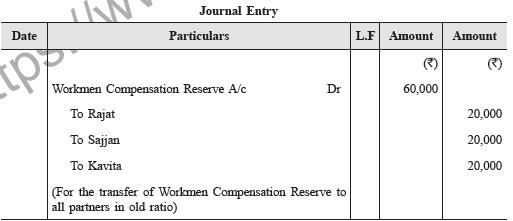
Question 41. Give the journal entry to distribute 'Workmen Compensation Reserve' of Rs. 60,000 at the time of retirement of Sajjan, when there is no claim against it. The firm has three partners Rajat, Sajjan and Kavita.
Answer:
| Date | Particulars | L.F. | Dr. (Rs.) | Cr. (Rs.) |
|---|---|---|---|---|
| Workmen Compensation Reserve A/c To Rajat's Capital A/c To Sajjan's Capital A/c To Kavita's Capital A/c (Being Workmen Compensation Reserve transferred to Partners' Capital account) | 60,000 | 20,000 20,000 20,000 |
In simple words: The reserve is debited (removed from the balance sheet), and credited equally to each partner's capital account in the old profit-sharing ratio, which is 1:1:1 (meaning each partner gets Rs. 20,000).
Exam Tip: Always distribute reserves using the OLD profit-sharing ratio, not the new ratio. All partners share equally unless told otherwise.
Question 42. Kumar, Verma and Naresh were partners in a firm sharing profit and loss in the ratio of 3:2:2. On 23rd January, 2015 Verma died. Verma's share of profit till the date of his death was calculated at Rs. 2,350. Pass necessary journal entry for the same in the books of the firm.
Answer:
| Date | Particulars | L.F. | Dr. (Rs.) | Cr. (Rs.) |
|---|---|---|---|---|
| 2015 Jan. 23 | Profit and Loss Suspense A/c To Verma's Capital A/c (Being Verma's share of profit upto 23rd Jan., 2015 transferred to his capital account) | 2,350 | 2,350 |
In simple words: Verma's profit up to the date he died is held temporarily in the Profit and Loss Suspense Account, then credited to his capital account so it forms part of his final settlement amount.
Exam Tip: Use Profit and Loss Suspense Account only for deceased partners. The debit side goes up, credit side goes to the deceased partner's capital account.
Question 43. At what rate, interest is payable on the amount remaining unpaid to the executor of deceased partner?
Answer: 6% p.a.
In simple words: This is the default rate set by the Indian Partnership Act, 1932 (Section 37). If the partnership deed is silent, 6% interest is automatically due on unpaid amounts.
Exam Tip: Section 37 allows the executor to choose between the firm's profit share OR 6% interest, whichever benefits them more. Always mention this choice in exam answers.
Question 44. Differentiate between 'Profit and Loss Appropriation Account' and 'Profit and Loss Suspense Account'.
Answer: Profit and Loss Appropriation Account is prepared to show the distribution of net profit (calculated after making adjustments regarding partners' remuneration, interest on Capital, interest on drawings etc.) among the partners while Profit and Loss Suspense Account is prepared to adjust the deceased partner's share of profit upto the date of his death.
In simple words: The Appropriation Account divides yearly profits among all active partners. The Suspense Account is only for a deceased partner - it holds their share of profit up to death, then passes it to the capital account.
Exam Tip: Remember: Appropriation = all partners, yearly profit sharing. Suspense = only deceased partners, temporary holding account for profits earned before death.
Question 45. Neetu, Meetu and Teetu were partners in a firm. On 1st January, 2018, Meetu retired. On Meetu's retirement the goodwill of the firm was valued at Rs. 4,20,000. Pass necessary journal entry for the treatment of goodwill on Meetu's retirement.
Answer:
| Date | Particulars | L.F. | Dr. (Rs.) | Cr. (Rs.) |
|---|---|---|---|---|
| 2018 Jan. 1 | Neetu's Capital A/c Teetu's Capital A/c To Meetu's Capital A/c (Being Meetu's share of goodwill credited in her capital account by debiting Neetu's and Teetu's capital account in the gaining ratio) | 70,000 70,000 | 1,40,000 |
Working Note:
Old Profit Sharing Ratio = 1:1:1
Neetu's Share = 1/3, Meetu's Share = 1/3 and Teetu's Share = 1/3
Meetu retired on 1st Jan., 2018; So, Gaining Ratio = 1:1; Goodwill = Rs. 4,20,000
Meetu's share = 4,20,000 × 1/3 = 1,40,000, Neetu's gain = 1,40,000 × 1/2 = 70,000,
Teetu's gain = 1,40,000 × 1/2 = 70,000
In simple words: Goodwill worth Rs. 4,20,000 is divided equally among all three partners (1:1:1). Meetu gets Rs. 1,40,000 (her one-third share). Neetu and Teetu each pay half of this (Rs. 70,000 each) to compensate Meetu, since they gain by her leaving.
Exam Tip: Credit the retiring partner's goodwill share to their capital account. Debit the continuing partners' capital accounts in the GAINING RATIO - this is crucial, not in the old ratio.
Question 46. Is the retirement of a partner means reconstitution of a firm?
Answer: Yes, on the retirement of a partner, the old partnership comes to an end but the firm continues and a new partnership comes into existence. So a retirement means reconstitution of firm.
In simple words: The original partnership agreement ends when a partner leaves. The remaining partners form a new partnership agreement with a new profit-sharing ratio. This change in the firm's legal structure is called reconstitution.
Exam Tip: Retirement always causes reconstitution because the partnership deed changes. This is different from just a change in the profit ratio - it is a change in the firm's legal identity.
Question 47. At the time of Harsh's retirement, the total amount payable to him was Rs. 2,50,000. He took over a machinery of Rs. 25,000, a computer of Rs. 18,000 and a vehicle of Rs. 45,000 and remaining amount will be paid after 2 years. Give the journal entry at the time of retirement.
Answer:
| Date | Particulars | L.F. | Dr. (Rs.) | Cr. (Rs.) |
|---|---|---|---|---|
| Harsh's Capital A/c To Machinery A/c To Computer A/c To Vehicle A/c To Harsh's Loan A/c (Being assets took over by Harsh on his retirement and balance transferred to his loan account) | 2,50,000 | 25,000 18,000 45,000 1,62,000 |
In simple words: Harsh's capital account is cleared: the assets he takes (machinery, computer, vehicle totaling Rs. 88,000) reduce what the firm owes him. The remaining Rs. 1,62,000 is set up as a loan account to be paid later with interest.
Exam Tip: When a retiring partner takes assets, debit those asset accounts and credit the retiring partner's capital account. Any unpaid balance goes to a loan account - interest will be due on it.
Question 48. X, Y and Z are partners in a firm sharing profits in the ratio of 3:2:1. On 1st April 2017, X retires from the firm, Y and Z agree that the capital of the new firm shall be fixed at Rs. 2,10,000 in the profit sharing ratio. The Capital Accounts of Y and Z after all adjustments on the date of retirement showed balances of Rs. 1,45,000 and Rs. 63,000 respectively. State the amount of actual cash to be brought in or to be paid to the partners.
Answer: New Profit Sharing Ratio is 2:1
Capital of firm = Rs. 2,10,000
Calculation of actual cash to be withdrawn or brought in by Y and Z
| Particulars | Y (Rs.) | Z (Rs.) |
|---|---|---|
| New Capital (2:1) | 1,40,000 | 70,000 |
| Less: Existing Capital after adjustments | (1,45,000) | (63,000) |
| Actual Cash (Withdrawn) or brought in | (5,000) | 7,000 |
In simple words: Y's new share should be Rs. 1,40,000 but already has Rs. 1,45,000, so Y withdraws Rs. 5,000. Z's new share should be Rs. 70,000 but has only Rs. 63,000, so Z brings in Rs. 7,000.
Note: In the absence of information, old ratio of remaining partners will be their new profit sharing ratio, i.e., 2:1.
Exam Tip: Always calculate the new capital requirement first, then compare with existing capital. The difference is the cash movement - positive means bring in, negative means withdraw.
Question 19. A, B and C are partners in a firm whose books are closed on March 31st each year. A died on 30th June, 2017 and according to the agreement, the share of profits of a deceased partner upto the date of the death is to be calculated on the basis of the average profits for the last five years. The net profits for the last 5 years have been: 2013 - ₹14,000; 2014 - ₹18,000; 2015 - ₹16,000; 2016 - ₹10,000 (loss) and 2017 - ₹16,000. Calculate A's share of the profits upto the date of death and pass necessary journal entry.
Answer: Average Profit = {14,000 + 18,000 + 16,000 - 10,000 + 16,000}/{5} = Rs 54,000/5 = Rs10,800 A's share = Rs10,800 × {3}/{12} ×+{1}/{3} = Rs900
| Date | Particulars | L.F. | Dr. (₹) | Cr. (₹) |
|---|---|---|---|---|
| 2017 June 30 | Profit & Loss Suspense A/c To A's Capital A/c (Being deceased partner's share of profit credited to his capital account) | Dr. | 900 | 900 |
In simple words: Find the average profit from the last 5 years. Then calculate A's share of profit for the 3 months he was alive. Make a journal entry to credit this amount to A's capital account.
Exam Tip: Always calculate the average profit correctly and then find the proportionate share based on the number of months/days the deceased partner was alive in the final year.
Question 20. P, Q and R are partners in a firm without any partnership deed. R retires, his capital account after making adjustment of reserves and profit on revaluation exists at ₹64,000. P and Q have agreed to pay him ₹80,000 in full settlement of his claim. Record necessary journal entry for goodwill on R's retirement.
Answer:
(i) It shows that ₹16,000 (₹80,000 - ₹64,000) is R's share of goodwill of the firm.
(ii) In the absence of agreement, profits will be shared equally.
(iii)
| Date | Particulars | L.F. | Dr. (₹) | Cr. (₹) |
|---|---|---|---|---|
| P's Capital A/c Q's Capital A/c To R's Capital A/c (Being retiring partner's share of goodwill adjusted to continuing partners' capital accounts in their gaining ratio 1 : 1) | Dr. Dr. | 8,000 8,000 | 16,000 |
In simple words: When a partner retires and receives more than his capital account balance, the extra amount is goodwill. Share this goodwill among the staying partners based on what they gain from the retiring partner's departure.
Exam Tip: The excess amount paid over the capital account balance always represents goodwill. Allocate it in the gaining ratio of the continuing partners.
Question 21. State the basis of calculating the amount of profit payable to the legal representative of a deceased partner in the year of death.
Answer: Profit may be estimated on the following bases:
(a) On the basis of Last year's profit/Average profits of last given number of years
(b) On the basis of Turnover/Sales.
In simple words: You can calculate profit for a deceased partner using either the average profit from earlier years or by looking at the firm's sales and turnover figures during the year of death.
Exam Tip: The method to use depends on what the partnership deed specifies. Always check the agreement first before selecting the basis of calculation.
Question 22. Jayant, Kartik and Leena were partners in a firm sharing profits and losses in the ratio of 5:2:3. Kartik died and Jayant and Leena decided to continue the business. Their gaining ratio was 2:3. Calculate the new profit sharing ratio of Jayant and Leena.
Answer: Old Profit Sharing Ratio = 5:2:3 Jayant's share = 5/10, Kartik's share = 2/10, Leena's share = 3/10 Kartik dies; then gaining ratio of Jayant and Leena = 2:3; Kartik's Sacrifice = 2/10 Jayant's Gain = \( \frac{2}{10} × \frac{2}{5} = \frac{4}{50} \) Jayant's New Share = Old share + Gaining share = \( \frac{5}{10} + \frac{4}{50} = \frac{25+4}{50} = \frac{29}{50} \) Leena's gain = \( \frac{2}{10} × \frac{3}{5} = \frac{6}{50} \) Leena's New share = Old share + Gaining share = \( \frac{3}{10} + \frac{6}{50} = \frac{15+6}{50} = \frac{21}{50} \) New Ratio of Jayant and Leena after Kartik's death = \( \frac{29}{50} : \frac{21}{50} \) or 29:21
In simple words: When a partner leaves, the staying partners take over his share based on the gaining ratio. Add what they gain to their old share to find the new share.
Exam Tip: Always separate the old share from the gained share in your calculation. The new ratio comes from adding these two parts together.
Question 23. P, Q and R are partners sharing profits in the ratio of 2 : 2 : 1. P retires and his share is entirely taken by R. Find out new profit-sharing ratio of Q and R.
Answer: New ratio = Old ratio + Gaining ratio Calculation of gaining share: Q's new share = \( \frac{2}{5} + 0 = \frac{2}{5} \), R's new share = \( \frac{1}{5} + \frac{2}{5} = \frac{3}{5} \) Thus, new ratio of Q and R will be 2 : 3.
In simple words: Q's share stays the same since he doesn't gain anything. R gets P's full share added to his own share. The new ratio is found by comparing their updated shares.
Exam Tip: When a retiring partner's share is taken entirely by one partner, only that partner gains. Others keep their existing share unchanged.
Question 24. A, B and C have been sharing profits in the ratio of 8 : 5 : 3. A retires. B takes 3/16th share from A and C takes 5/16th share from A. Calculate gaining ratio.
Answer: When gain made by the staying partners are expressly given in the question, there is no need to compute it, merely mention the gaining ratio as given in the question itself. Share taken by B out of A's share = \( \frac{3}{16} \), Share taken by C out of A's share = \( \frac{5}{16} \) Gaining Ratio = B's Gain : C's Gain = \( \frac{3}{16} : \frac{5}{16} \) or 3 : 5.
In simple words: The question already tells you how much each staying partner gains from the retiring partner. Just put those amounts in ratio form.
Exam Tip: When shares taken are given directly, avoid unnecessary calculations. Simply express those shares as a ratio to find the gaining ratio.
Question 25. A, B, C and D are partners sharing profits in the ratio of 3 : 2 : 1 : 4. A retires and his share is acquired by B and C in the ratio of 3 : 2. Calculate new ratio and gaining ratio.
Answer: (a) Calculation of new ratio: (i) Calculation of gaining share of remaining partners: B's gain = \( \frac{3}{5} \text{ of } \frac{3}{10} = \frac{9}{50} \), C's gain = \( \frac{2}{5} \text{ of } \frac{3}{10} = \frac{6}{50} \), D's gain = \( \frac{0}{5} \text{ of } \frac{3}{10} = 0 \) Thus, gaining ratio = 9:6 or 3:2. (ii) Calculation of new profit-sharing ratio of remaining partners: New Ratio = Old Ratio + Gaining Ratio B's new share = \( \frac{2}{10} + \frac{9}{50} = \frac{10+9}{50} = \frac{19}{50} \) C's new share = \( \frac{1}{10} + \frac{6}{50} = \frac{5+6}{50} = \frac{11}{50} \) D's new share = \( \frac{4}{10} + \frac{0}{50} = \frac{4+0}{10} = \frac{4}{10} \) Thus, new ratio of B, C and D is \( \frac{19}{50} : \frac{11}{50} : \frac{4}{10} = \frac{19:11:20}{50} = 19:11:20 \).
In simple words: First, divide the retiring partner's share among the staying partners based on the ratio given. Then add what each gains to their old share to get the new share.
Exam Tip: Break the retiring partner's share into parts and give them to the staying partners in the specified ratio. Then calculate new shares by combining old and gained amounts.
Question 26. Give the journal entry to distribute 'Workmen Compensation Reserve' of ₹70,000 at the time of retirement of Neeti, when there is a claim of ₹25,000 against it. The firm has three partners Raveena, Neeti and Rajat.
Answer:
| Date | Particulars | L.F. | Dr. (₹) | Cr. (₹) |
|---|---|---|---|---|
| Workmen Compensation Reserve A/c To Raveena's Capital A/c To Neeti's Capital A/c To Rajat's Capital A/c To Provision for Workmen Compensation Claim A/c (Being the liability for workmen compensation claim created and surplus WCR transferred to Partners' Capital Accounts in their old ratio) | Dr. | 70,000 | 15,000 15,000 15,000 25,000 |
In simple words: Close the Workmen Compensation Reserve account. Put aside ₹25,000 for the claim as a provision. Share the remaining ₹45,000 among all three partners in their old ratio.
Exam Tip: Reserves are always shared among all partners (including the retiring partner) in their old profit-sharing ratio before retirement adjustments are made.
Question 27. A, B and C were partners in a firm sharing profits and losses in the ratio of 4 : 3 : 2. B retired and his share was taken over by A and C equally. Calculate the gaining ratio.
Answer: Gaining Ratio of A and C is 1:1 as they have taken over B's share equally.
In simple words: When two partners take a retiring partner's share in equal amounts, the gaining ratio between them is 1:1.
Exam Tip: The gaining ratio shows how much each continuing partner gains from the retiring partner's departure. Equal shares mean equal gains, resulting in a 1:1 ratio.
Question 28. A, B and C are equal partners. C retires. He surrenders 3/5th of his share in favour of A and 2/5th in favour of B. Calculate new ratio and gaining ratio.
Answer: (a) Calculation of new profit-sharing ratio: A's gain = \( \frac{1}{3} × \frac{3}{5} = \frac{3}{15} \) A's new Share = Old Share + Gained Share = \( \frac{1}{3} + \frac{3}{15} = \frac{5+3}{15} = \frac{8}{15} \) B's gain = \( \frac{1}{3} × \frac{2}{5} = \frac{2}{15} \) B's new Share = Old Share + Gained Share = \( \frac{1}{3} + \frac{2}{15} = \frac{5+2}{15} = \frac{7}{15} \) New Profit-Sharing Ratio = \( \frac{8}{15} : \frac{7}{15} = 8 : 7 \) (b) Calculation of gaining ratio: Gaining ratio = A's gain : B's gain = \( \frac{3}{15} : \frac{2}{15} = 3 : 2 \).
In simple words: A gets 3/5 of C's share and B gets 2/5. Add these gains to their old shares. The gaining ratio shows how much each gained compared to the other.
Exam Tip: When a partner surrenders different fractions of his share to different partners, calculate each partner's gain separately. The gaining ratio is found by comparing these individual gains.
Short Answer Questions [3, 4 marks]
Question 1. Arjun, Bhim and Nakul are partners sharing profits and losses in the ratio of 14 : 5 : 6 respectively. Bhim retires and surrenders his 5/25th share in favour of Arjun. The goodwill of the firm is valued at 2 years' purchase of super profits based on average profits of last 3 years. The profits for the last 3 years are ₹50,000, ₹55,000 and ₹60,000 respectively. The normal profits for the similar firm are ₹30,000. Goodwill already appears in the books of the firm at ₹75,000. The profit for the first year after Bhim's retirement was ₹1,00,000. Give the necessary Journal Entries to adjust Goodwill and distribute profits showing your workings.
Answer:
| Date | Particulars | L.F. | Dr. (₹) | Cr. (₹) |
|---|---|---|---|---|
| Arjun's Capital A/c Bhim's Capital A/c Nakul's Capital A/c To Goodwill A/c (Being the amount of existing goodwill written off to the capital accounts of all partners) | Dr. Dr. Dr. | 42,000 15,000 18,000 | 75,000 |
| Date | Particulars | L.F. | Dr. (₹) | Cr. (₹) |
|---|---|---|---|---|
| Arjun's Capital A/c To Bhim's Capital A/c (Being the share of goodwill adjusted) | Dr. | 10,000 | 10,000 |
| Date | Particulars | L.F. | Dr. (₹) | Cr. (₹) |
|---|---|---|---|---|
| Profit and Loss A/c To Arjun's Capital A/c To Nakul's Capital A/c (Being profit transferred to Capital A/cs of Arjun and Nakul in their new profit-sharing ratio) | Dr. | 1,00,000 | 76,000 24,000 |
Working Notes:
1. Calculation of share in existing goodwill:
Arjun's Share in Goodwill = ₹75,000 × \( \frac{14}{25} \) = ₹42,000 Bhim's Share in Goodwill = ₹75,000 × \( \frac{5}{25} \) = ₹15,000 Nakul's Share in Goodwill = ₹75,000 × \( \frac{6}{25} \) = ₹18,000
2. Valuation of goodwill:
Total Profit of last 3 years = ₹50,000 + ₹55,000 + ₹60,000 = ₹1,65,000 Average profit = \( \frac{Rs1,65,000}{3} \) = ₹55,000 Super profit = ₹55,000 - ₹30,000 = ₹25,000 Goodwill = Super Profit × No. of years' purchase = ₹25,000 × 2 = ₹50,000 Bhim's share in Goodwill = ₹50,000 × \( \frac{5}{25} \) = ₹10,000
3. Calculation of New Profit-sharing Ratio:
Old Ratio of Arjun, Bhim and Nakul = 14 : 5 : 6 Bhim surrenders his share in favour of Arjun = 5/25 New Share of Arjun = \( \frac{14}{25} + \frac{5}{25} = \frac{19}{25} \) New Share of Nakul = \( \frac{6}{25} \) Therefore, New Ratio of Arjun and Nakul = 19 : 6, which means Arjun = \( \frac{19}{25} \) and Nakul = \( \frac{6}{25} \) To distribute profit in this ratio: - Arjun's share = ₹1,00,000 × \( \frac{19}{25} \) = ₹76,000 - Nakul's share = ₹1,00,000 × \( \frac{6}{25} \) = ₹24,000
In simple words: First, remove the old goodwill from all partners' accounts based on the old ratio. Then, add goodwill paid by the incoming partner to the retiring partner. Finally, share the new profit using the new profit-sharing ratio among staying partners.
Exam Tip: Always work with three separate journal entries: (1) write off old goodwill, (2) adjust the retiring partner's goodwill share, and (3) distribute profit in the new ratio.
Question 2. Nandan, John and Rosa are partners sharing profits in the ratio of 4:3:2. On 1st April, 2012, John gave a notice to retire from the firm. Nandan and Rosa decided to share future profits in the ratio of 1:1. The capital accounts of Nandan and Rosa after all adjustments showed a balance of ₹43,000 and ₹80,500 respectively. The total amount to be paid to John was ₹95,500. This amount was to be paid by Nandan and Rosa in such a way that their capitals become proportionate to their new profit-sharing ratio. Pass necessary Journal entries in the books of the firm for the above transactions. Show your working clearly.
Answer: In the Books of Nandan, John and Rosa
| Date | Particulars | L.F. | Dr. (₹) | Cr. (₹) |
|---|---|---|---|---|
| Bank A/c To Nandan's Capital A/c To Rosa's Capital A/c (Being amount paid by Nandan and Rosa to bring their capital into their new profit-sharing ratio, i.e., 1:1) | Dr. | 95,500 | 66,500 29,000 |
| Date | Particulars | L.F. | Dr. (₹) | Cr. (₹) |
|---|---|---|---|---|
| John's Capital A/c To Bank A/c (Being amount paid to John on his retirement) | Dr. | 95,500 | 95,500 |
Working Notes:
(a) Total Adjusted Capital of the Firm: Nandan's Capital = ₹43,000 Rosa's Capital = ₹80,500 John's Capital = ₹95,500 Total = ₹2,19,000
(b) Nandan and Rosa will contribute to the firm's capital in 1:1 ratio. Nandan's New Capital = ₹1,09,500 Rosa's New Capital = ₹1,09,500
In simple words: Find out how much capital Nandan and Rosa should have to match their new 1:1 profit-sharing ratio. They pay the difference between what they should have and what they currently have.
Exam Tip: When a retiring partner's payment comes from contributions by remaining partners, calculate the total capital needed for the remaining partners first, then determine how much each must pay.
Question 3. Vikas, Vishal and Vaibhav were partners in a firm sharing profits in the ratio of 2 : 2 : 1. The firm closes its books on 31st March every year. On 31st December, 2015 Vaibhav died. On that date his capital account showed a credit balance of Rs 3,80,000 and goodwill of the firm was valued at Rs 1,20,000. There was a debit balance of Rs 50,000 in the Profit and Loss Account. Vaibhav's share of profit in the year of his death was to be calculated on the basis of the average profit of last five years. The average profit of last five years was Rs 75,000. Pass necessary journal entries in the books of the firm on Vaibhav's death.
Answer:
| Date | Particulars | L.F. | Dr. (₹) | Cr. (₹) |
|---|---|---|---|---|
| 2015 Dec. 31 | Vikas's Capital A/c Vishal's Capital A/c To Vaibhav's Capital A/c (Being Vaibhav share of goodwill adjusted in the capital accounts of the existing partners in their gaining ratio, i.e., 1 : 1) | Dr. Dr. | 12,000 12,000 | 24,000 |
| Vaibhav's Capital A/c To Profit and Loss A/c (Being Vaibhav's share in debit balance of profit and loss account transferred) | Dr. | 10,000 | 10,000 | |
| OR | ||||
| Vikas's Capital A/c Vishal's Capital A/c Vaibhav's Capital A/c To Profit and Loss A/c (Being Vaibhav's share in debit balance of profit and loss account transferred) | Dr. Dr. Dr. | 20,000 20,000 10,000 | 50,000 | |
| Profit and Loss Suspense A/c To Vaibhav's Capital A/c (Being Vaibhav's share of profit upto the date of death transferred to his capital account) | Dr. | 11,250 | 11,250 | |
| Vaibhav's Capital A/c To Vaibhav's Executors' A/c (Being amount due to Vaibhav transferred to his executors' account) | Dr. | 4,05,250 | 4,05,250 | |
Working Note: Vaibhav's share of profit of current year = 75,000 \( \times \frac{9}{12} \times \frac{1}{5} \) = 11,250
In simple words: When a partner dies, the firm must record the goodwill shared among remaining partners, shift any losses from the profit account to the deceased partner's account, add their share of profit earned till death, and move the complete amount owed to them to an executors' account.
Exam Tip: Always calculate the deceased partner's profit share from the start of the financial year to the date of death using the average profit method. Remember to adjust goodwill in the gaining ratio of continuing partners only.
Question 4. Vikas, Gagan and Momita were partners in a firm sharing profits in the ratio of 2 : 2 : 1. The firm closes its books on 31st March every year. On 30th September, 2014 Momita died. According to the provisions of partnership deed, the legal representatives of a deceased partner are entitled for the following in the event of his/her death:
(i) Capital as per the last Balance Sheet.
(ii) Interest on capital at 6% p.a. till the date of her death.
(iii) Her share of profit to the date of death calculated on the basis of average profits of last four years.
(iv) Her share of goodwill to be determined on the basis of three years' purchase of the average profits of last four years. The profits of last four years were:
| Year | Profit (₹) |
|---|---|
| 2010-2011 | 30,000 |
| 2011-2012 | 50,000 |
| 2012-2013 | 40,000 |
| 2013-2014 | 60,000 |
The balance in Momita's capital account on 31-3-2014 was Rs 60,000 and she had withdrawn Rs 10,000 till the date of her death. Interest on her drawings were Rs 300. Prepare Momita's capital account to be presented to her executors.
Answer:
| Dr. | Momita's Capital Account | Cr. | ||
|---|---|---|---|---|
| Particulars | Amount (₹) | Particulars | Amount (₹) | |
| To Drawings A/c | 10,000 | By Balance b/d | 60,000 | |
| To Interest on Drawings A/c | 300 | By Profit and Loss Suspense A/c | 4,500 | |
| To Momita's Executor's A/c | 83,000 | By Interest on Capital | 1,800 | |
| By Vikas's Capital A/c | 13,500 | |||
| By Gagan's Capital A/c | 13,500 | |||
| 93,300 | 93,300 | |||
Working Notes:
(i) Calculation of Interest on Capital = 60,000 \( \times \frac{6}{100} \times \frac{6}{12} \) = Rs 1,800
(ii) Calculation of Momita's Share of Profit = 45,000 \( \times \frac{1}{5} \times \frac{6}{12} \) = Rs 4,500
(iii) Share in Goodwill = 45,000 \( \times 3 \times \frac{1}{5} \) = Rs 27,000.
In simple words: Momita's executors receive her capital balance plus interest on that capital for six months, plus her share of the profit earned from April to September. The goodwill worth is calculated at three times the average yearly profit, and her one-fifth share gets distributed among the staying partners.
Exam Tip: Calculate interest on capital from the last balance sheet date to the death date. Always use average profit of the specified years and then multiply by the years' purchase factor to find goodwill value.
Question 5. Banwari, Girdhari and Murari are partners in a firm sharing profits and losses in the ratio of 4:5:6. On 31st March, 2014, Girdhari retired. On that date the capitals of Banwari, Girdhari and Murari before the necessary adjustments stood at Rs 2,00,000, Rs 1,00,000 and Rs 50,000 respectively. On Girdhari's retirement, goodwill of the firm was valued at Rs 1,14,000. Revaluation of assets and reassessment of liabilities resulted in a profit of Rs 6,000. General Reserve stood in the books of the firm at Rs 30,000. The amount payable to Girdhari was transferred to his loan account. Banwari and Murari agreed to pay Girdhari two yearly instalments of Rs 75,000 each including interest @10% p.a. on the outstanding balance during the first two years and the balance including interest in the third year. The firm closes its books on 31st March every year. Prepare Girdhari's loan account till it is finally paid showing the working notes clearly.
Answer:
| Dr. | Girdhari's Loan Account | Cr. | |||
|---|---|---|---|---|---|
| Date | Particulars | (₹) | Date | Particulars | (₹) |
| 2015 Mar. 31 | To Bank A/c | 75,000 | 2014 April 1 | By Girdhari's Capital A/c | 1,50,000 |
| 2015 Mar. 31 | By Interest A/c | 15,000 | |||
| To Balance c/d | 90,000 | ||||
| 1,65,000 | 1,65,000 | ||||
| 2016 Mar. 31 | To Bank A/c | 75,000 | 2015 April 1 | By Balance b/d | 90,000 |
| 2016 Mar. 31 | By Interest A/c | 9,000 | |||
| To Balance c/d | 24,000 | ||||
| 99,000 | 99,000 | ||||
| 2017 Mar. 31 | To Bank A/c | 26,400 | 2016 April 1 | By Balance b/d | 24,000 |
| 2017 Mar. 31 | By Interest A/c | 2,400 | |||
| 26,400 | 26,400 | ||||
Working Note:
Dr. Girdhari's Capital Account Cr.
| Particulars | (₹) | Particulars | (₹) |
|---|---|---|---|
| To Girdhari's Loan A/c | 1,50,000 | By Balance b/d | 1,00,000 |
| By Profit on Revaluation | 2,000 | ||
| By Banwari's Capital A/c | 15,200 | ||
| By Murari's Capital A/c | 22,800 | ||
| By General Reserve A/c | 10,000 | ||
| 1,50,000 | 1,50,000 |
Total goodwill = Rs 1,14,000
Girdhari's share = 1,14,000 \( \times \) 5/15 = Rs 38,000
Banwari's gain = 38,000 \( \times \) 4/10 = Rs 15,200
Murari's gain = 38,000 \( \times \) 6/10 = Rs 22,800
Girdhari's share in general reserve = 30,000 \( \times \) 5/15 = Rs 10,000
In simple words: When a partner leaves, we calculate how much the firm owes them by adding their capital, their share of profit adjustments, goodwill, and reserves. This amount gets moved to a loan account and paid back in instalments, with interest charged on the outstanding balance each year.
Exam Tip: Always prepare the retiring partner's capital account first to find the total amount due. Then transfer it to a loan account and track each payment along with interest carefully to show how the debt is settled.
Question 6. Shirish, Harit and Asha were partners in a firm sharing profits in the ratio of 5 : 4 : 1. Shirish died on 30th June, 2018. On this date their Balance Sheet was as follows:
| Liabilities | (₹) | Assets | (₹) | |
|---|---|---|---|---|
| Capitals: | Plant and Machinery | 5,60,000 | ||
| - Shirish | 1,00,000 | Stock | 90,000 | |
| - Harit | 2,00,000 | Debtors | 10,000 | |
| - Asha | 3,00,000 | 6,00,000 | Cash | 40,000 |
| Profits for the year 2017-18 | 80,000 | |||
| Bills Payable | 20,000 | |||
| 7,00,000 | 7,00,000 |
According to the partnership deed, in addition to deceased partner's capital, his executor is entitled to:
(i) Share in profits in the year of death on the basis of average of last two years' profit. Profit for the year 2016-17 was Rs 60,000.
(ii) Goodwill of the firm was to be valued at 2 years' purchase of average of last two years' profits. Prepare Shirish's Capital Account to be presented to his executor.
Answer:
| Dr. | Shirish's Capital Account | Cr. | ||
|---|---|---|---|---|
| Particulars | Amount (₹) | Particulars | Amount (₹) | |
| To Shirish's Executor's A/c | 2,18,750 | By Balance b/d | 1,00,000 | |
| By Profit and Loss A/c | 40,000 | |||
| By Profit and Loss Suspense A/c | 8,750 | |||
| By Harit's Capital A/c | 56,000 | |||
| By Asha's Capital A/c | 14,000 | |||
| 2,18,750 | 2,18,750 | |||
Working Notes available at source but not included in answer section. The calculation shows: Average profit of last two years = (60,000 + 80,000) / 2 = Rs 70,000. Shirish's share of profit = 70,000 \( \times \) 1/2 \( \times \) 5/10 = Rs 17,500. However, the working shows Shirish's share of profit as Rs 40,000 from P&L A/c (full half-year profit) and Suspense A/c adjustment of Rs 8,750.
In simple words: When Shirish died, his executors received his capital balance plus his share of the current year's profit (calculated from the average of two previous years) and a share of the firm's goodwill based on two years' purchase. The goodwill portion was split among the staying partners in their gain ratio.
Exam Tip: Always calculate the deceased partner's share of profit from the start of the financial year to the date of death. Use the average profit method specified in the deed, and remember to distribute goodwill gains to continuing partners in their profit ratio.
Question 7. A, B and C were partners in a firm. A died on 31.3.2018 and the Balance Sheet of the firm on that date was as under:
| Liabilities | (₹) | Assets | (₹) | |
|---|---|---|---|---|
| Creditors | 7,000 | Cash at Bank | 12,000 | |
| General Reserve | 9,000 | Debtors | 32,000 | |
| Workmen's Compensation Fund | 10,000 | Furniture | 30,000 | |
| Profit and Loss Account | 6,000 | Plant | 40,000 | |
| Capital : | Patents | 8,000 | ||
| - A | 40,000 | |||
| - B | 30,000 | |||
| - C | 20,000 | 90,000 | ||
| 1,22,000 | 1,22,000 |
On A's death it was found that patents were valueless, furniture was to be brought down to Rs 24,000, plant was to be reduced by Rs 10,000 and there was a liability of Rs 7,000 on account of workmen's compensation. Pass the necessary journal entries for the above at the time of A's death.
Answer:
| Date | Particulars | L.F. | Dr. (₹) | Cr. (₹) |
|---|---|---|---|---|
| Revaluation A/c To Patents A/c To Furniture A/c To Plant A/c (Being assets revalued) | Dr. | 24,000 | 8,000 6,000 10,000 | |
| Workmen's Compensation Fund A/c To Claim for Workmen's Compensation (Being compensation fund transferred to claim and balance distributed) | Dr. | 10,000 | 7,000 1,000 1,000 1,000 | |
| To A's Capital A/c To B's Capital A/c To C's Capital A/c | ||||
| (Being loss on revaluation distributed among partners) | ||||
| A's Capital A/c B's Capital A/c C's Capital A/c To Revaluation A/c (Being loss on revaluation distributed among partners) | Dr. Dr. Dr. | 8,000 8,000 8,000 | 24,000 | |
In simple words: When a partner dies, the firm must revalue all assets and liabilities on that date. If some assets lose value (like patents becoming worthless or furniture needing price cuts), those losses are recorded and shared among all partners in their profit-sharing ratio. Any funds set aside for future claims are also settled at this time.
Exam Tip: On a partner's death, always revalue all assets and liabilities immediately. Record losses on revaluation and distribute them among all partners (including the deceased) according to their profit-sharing ratio before settling the deceased partner's account.
Question 8. X, Y and Z are partners sharing profits in the ratio 1:2:3. Z retires on 1st April, 2018 and his capital after making all adjustments for reserves and profit on revaluation stands at Rs.2,40,000. X and Y here agreed to pay him Rs.3,00,000 in full settlement of his claim. Record necessary journal entry for the treatment of goodwill if the new profit-sharing ratio is decided as 1:3.
Answer: Hidden Goodwill calculation: Amount to be paid in full settlement to Z = Rs.3,00,000 Less: Z's Capital (after all adjustments) = Rs.2,40,000 Hidden Goodwill = Rs.60,000 Gaining Ratio: New Ratio = 1:3 and Old Ratio = 1:2:3 X's Gain = 1/4 - 1/6 = (3-2)/12 = 1/12 Y's Gain = 3/4 - 2/6 = (9-4)/12 = 5/12 Gaining ratio of X and Y = 1:5 Journal Entry:
| Date | Particulars | L.F. | Dr. (Rs) | Cr. (Rs) |
|---|---|---|---|---|
| 2018 | X's Capital A/c | 10,000 | ||
| Apr. 1 | Y's Capital A/c | 50,000 | ||
| To Z's Capital A/c | 60,000 | |||
| (Being Z's share of goodwill adjusted in gaining ratio, i.e., 1:5) |
In simple words: When Z leaves the firm, the remaining partners X and Y gain his share. They must record the hidden goodwill (the extra amount paid beyond his capital) and distribute it among themselves based on their gaining ratio of 1:5.
Exam Tip: Always identify the hidden goodwill first by comparing the settlement amount with the adjusted capital. Then divide it in the gaining ratio, not the profit-sharing ratio.
Question 9. A, B and C are partners in a firm. A retires on 1st January, 2013. On the date of retirement, Rs.80,000 is due to him in all. It is agreed to pay him this amount in instalments every year at the end of the year. Prepare A's Loan Account until he is paid the amount due to him. A is to be paid in four equal instalments alongwith interest @10% p.a. The partnership firm closes its books on 31st December every year.
Answer: A's Loan Account (for four years from 2013 to 2016):
| Date | Particulars | Rs | Date | Particulars | Rs | |
|---|---|---|---|---|---|---|
| 2013 | 2013 | |||||
| Dec. 31 | To Bank A/c (20,000 + 8,000) | 28,000 | Jan. 1 | By A's Capital A/c | 80,000 | |
| Dec. 31 | To Balance c/d | 60,000 | Dec. 31 | By Interest on Rs.80,000 @10% | 8,000 | |
| 88,000 | 88,000 | |||||
| 2014 | 2014 | |||||
| Dec. 31 | To Bank A/c (20,000 + 6,000) | 26,000 | Jan. 1 | By Balance b/d | 60,000 | |
| Dec. 31 | To Balance c/d | 40,000 | Dec. 31 | By Interest on Rs.60,000 @10% | 6,000 | |
| 66,000 | 66,000 | |||||
| 2015 | 2015 | |||||
| Dec. 31 | To Bank A/c (20,000 + 4,000) | 24,000 | Jan. 1 | By Balance b/d | 40,000 | |
| Dec. 31 | To Balance c/d | 20,000 | Dec. 31 | By Interest on Rs.40,000 @10% | 4,000 | |
| 44,000 | 44,000 | |||||
| 2016 | 2016 | |||||
| Dec. 31 | To Bank A/c (20,000 + 2,000) | 22,000 | Jan. 1 | By Balance b/d | 20,000 | |
| Dec. 31 | By Interest on Rs.20,000 @10% | 2,000 | ||||
| 22,000 | 22,000 | |||||
In simple words: A receives his Rs.80,000 in four equal instalments of Rs.20,000 each year, plus interest calculated on the outstanding balance at 10% per year. Each year the interest gets smaller because the balance reduces.
Exam Tip: Remember that interest is always computed on the outstanding balance (the amount still owed), not the original amount. The balance reduces by Rs.20,000 each year.
Question 10. A, B and C are partners sharing profits and losses in the ratio of 2:3:1. B retires and sells his share of profit to A and C for Rs.8,100, being purchased by A for Rs.3,600 and by C for Rs.4,500. The profit for the year after B's retirement was Rs.10,500. You are required to give necessary journal entries to record the sale of B's share to A and C and distribution of profit among partners.
Answer: Journal Entries for Sale of B's Share and Distribution of Profit:
| Date | Particulars | L.F. | Dr. (Rs) | Cr. (Rs) |
|---|---|---|---|---|
| Entry 1: To record purchase of B's share by A and C | ||||
| A's Capital A/c | 3,600 | |||
| C's Capital A/c | 4,500 | |||
| To B's Capital A/c | 8,100 | |||
| (Being Partners' Capital Accounts adjusted for the sale of B's share to A and C) | ||||
| Entry 2: To record profit distribution in new ratio | ||||
| Profit and Loss Appropriation A/c | 10,500 | |||
| To A's Capital A/c | 7,000 | |||
| To C's Capital A/c | 3,500 | |||
| (Being profit distributed in new ratio, i.e., 2:1) | ||||
Working Notes: Old Ratio: A = 2/6, B = 3/6, C = 1/6 New Ratio (after B's retirement): A gets B's 3/6 share in proportion to their purchase amounts. - A's share becomes: 2/6 + (3/6 × 3,600/8,100) = 2/6 + (3/6 × 4/9) = 2/6 + 2/9 = 6/9 + 2/9 = 8/9 (approximately 2/3) - C's share becomes: 1/6 + (3/6 × 4,500/8,100) = 1/6 + (3/6 × 5/9) = 1/6 + 5/18 = 3/18 + 5/18 = 8/18 = 4/9 (approximately 1/3) New Ratio A:C = 2:1 Distribution of profit Rs.10,500: - A's share = 10,500 × 2/3 = 7,000 - C's share = 10,500 × 1/3 = 3,500
In simple words: When B retires and sells his share to A and C, we first record the cash payment they make to B. Then we distribute the new profit based on the new profit-sharing ratio of A and C (which becomes 2:1 after B leaves).
Exam Tip: When a partner sells his share, always determine the new profit-sharing ratio first, then distribute profits or losses accordingly. The purchase price paid is recorded as a capital adjustment.
Question 1. Leena, Madan and Naresh were partners in a firm sharing profits and losses in the ratio of 2:2:3. On 31st March, 2015, their Balance Sheet was as follows:
| Liabilities | Rs | Assets | Rs |
|---|---|---|---|
| Trade Creditors | 1,60,000 | Land and Building | 10,00,000 |
| Bank overdraft | 44,000 | Machinery | 5,00,000 |
| Long-term Debts | 4,00,000 | Furniture | 7,00,000 |
| Employees' Provident Fund | 76,000 | Investments | 2,00,000 |
| Closing Stock | 8,00,000 | ||
| Capitals: | Sundry Debtors | 4,00,000 | |
| Leena | 12,50,000 | Bank | 80,000 |
| Madan | 8,00,000 | Deferred Advertisement Expenditure | 1,00,000 |
| Naresh | 10,50,000 | ||
| 31,00,000 | |||
| 37,80,000 | 37,80,000 | ||
On 31st March, 2015, Madan retired from the firm and the remaining partners decided to carry on the business. It was decided to revalue assets and liabilities as under: (i) Land and Building be appreciated by Rs.2,40,000 and Machinery be depreciated by 10%. (ii) 50% of Investments were taken over by the retiring partner at book value. (iii) An old customer, Mohit whose account was written off as bad debt had promised to pay 7,000 in settlement of his full debt of Rs.10,000. (iv) Provision for Doubtful Debts was to be made at 5% on debtors. (v) Closing Stock will be valued at market price which is Rs.1,00,000 less than the book value. (vi) Goodwill of the firm be valued at Rs.5,60,000 and Madan's share of goodwill be adjusted in the accounts of Leena and Naresh. Leena and Naresh decided to share future profits and losses in the ratio of 3:2. (vii) The total capital of the new firm will be Rs.32,00,000 which will be in the proportion of the profit-sharing ratio of Leena and Naresh. (viii) Amount due to Madan was settled by accepting a Bill of Exchange in his favour payable after 4 months. Prepare Revaluation Account, Partners' Capital Accounts and Balance Sheet of the firm after Madan's retirement.
Answer:
| Dr. | Revaluation Account | Cr. | |
|---|---|---|---|
| Particulars | Rs | Particulars | Rs |
| To Machinery A/c | 50,000 | By Land and Building A/c | 2,40,000 |
| To Closing Stock A/c | 1,00,000 | ||
| To Provision for Doubtful Debts A/c | 20,000 | ||
| To Profit transferred to: | |||
| Leena's Capital A/c | 20,000 | ||
| Madan's Capital A/c | 20,000 | ||
| Naresh's Capital A/c | 30,000 | ||
| 2,40,000 | 2,40,000 | ||
| Partners' Capital Accounts | Dr. | Cr. | |||||
|---|---|---|---|---|---|---|---|
| Particulars | Leena (Rs) | Madan (Rs) | Naresh (Rs) | Particulars | Leena (Rs) | Madan (Rs) | Naresh (Rs) |
| To Deferred Advertisement Expenses A/c | 28,571 | 28,571 | 42,858 | By Balance b/d | 12,50,000 | 8,00,000 | 10,50,000 |
| To Madan's Capital A/c | 1,60,000 | By Revaluation A/c (Gain) | 20,000 | 20,000 | 30,000 | ||
| To Naresh's Capital A/c | 16,000 | By Leena's Capital A/c (WN 1 and 2) | 1,60,000 | 16,000 | |||
| To Investments A/c | 1,00,000 | By Bank A/c (Balancing Figure) | 8,54,571 | 2,26,858 | |||
| To Bills Payable A/c | 8,51,429 | ||||||
| To Balance c/d (WN3) | 19,20,000 | 12,80,000 | |||||
| 21,24,571 | 9,80,000 | 13,22,858 | 21,24,571 | 9,80,000 | 13,22,858 | ||
| Balance Sheet as at 1st April, 2015 | |||
|---|---|---|---|
| Liabilities | Rs | Assets | Rs |
| Trade Creditors | 1,60,000 | Land and Building | 12,40,000 |
| Bank Overdraft | 44,000 | Machinery | 4,50,000 |
| Bills Payable | 8,51,429 | Furniture | 7,00,000 |
| Long-term Debts | 4,00,000 | Closing Stock | 7,00,000 |
| Employees' Provident Fund | 76,000 | Investments | 1,00,000 |
| Debtors | 4,00,000 | ||
| Capital: Leena | 19,20,000 | Less: Provision for Doubtful Debts | 20,000 |
| Naresh | 12,80,000 | 3,80,000 | |
| Bank (WN4) | 11,61,429 | ||
| 32,00,000 | |||
| 47,31,429 | 47,31,429 | ||
Working Notes: 1. Calculation of Gain of each Partner: Gain of a Partner = New Share - Old Share Leena's Gain = 3/5 - 2/7 = 11/35; Naresh's Gain = 2/5 - 3/7 = -1/35 Negative result shows that Naresh has sacrificed because Leena is the only gaining partner and she will compensate not only the retiring partner (Madan) but also the sacrificing partner (Naresh). 2. Naresh's Share of Goodwill = Rs.5,60,000 × 1/35 = Rs.16,000. Madan's Share of Goodwill = Rs.5,60,000 × 2/7 = Rs.1,60,000. 3. Capital of the partners in the New Firm: Leena's Capital = Rs.32,00,000 × 3/5 = Rs.19,20,000; Naresh's Capital = Rs.32,00,000 × 2/5 = Rs.12,80,000 4. Dr. Bank Account Cr.
| Particulars | Rs | Particulars | Rs |
|---|---|---|---|
| To Balance b/d | 80,000 | By Balance c/d | 11,61,429 |
| To Leena's Capital A/c | 8,54,571 | ||
| To Naresh's Capital A/c | 2,26,858 | ||
| 11,61,429 | 11,61,429 |
5. In adjustment No. (iii) an old customer Mohit whose account was written off as bad debt has promised to pay Rs.7,000, is not treated as debtors because it is merely a promise to pay, if this promise is given in writing, then it could be treated as bad debts recovered and revaluation profit would have increased by Rs.7,000.
In simple words: When a partner leaves the firm, we must revalue all assets and liabilities, calculate the retiring partner's share of goodwill, and adjust the remaining partners' capital accounts. The gains and losses from revaluation are shared among all three partners based on their profit-sharing ratio at that time. After all adjustments, Madan's capital is settled through a bill of exchange, and the new firm continues with Leena and Naresh sharing profits in the ratio 3:2.
Exam Tip: Always prepare the Revaluation Account first, then adjust all asset and liability values. Then prepare the Partners' Capital Accounts showing the effect of revaluation gains/losses, goodwill adjustments, and settlements. Finally, prepare the new Balance Sheet using the updated figures.
Question 2. X, Y and Z were partners in a firm sharing profits in the ratio of 5:3:2. On 31st March, 2015 their Balance Sheet was as follows:
Answer: The solution involves preparing a Revaluation Account, Partners' Capital Accounts, and a Balance Sheet for the reconstituted firm after Y's retirement and X and Z's agreement to continue business under the new profit sharing ratio of 3:2.
Revaluation Account
| Dr. | Revaluation Account | Cr. | |
|---|---|---|---|
| Particulars | Amount (Rs) | Particulars | Amount (Rs) |
| To Claim for Workmen Compensation A/c | 4,000 | By Provision for Bad Debts A/c | 1,000 |
| By Partners' Capital A/cs: (transfer of loss) | |||
| X | 1,500 | ||
| Y | 900 | ||
| Z | 600 | ||
| 3,000 | |||
| 4,000 | 4,000 |
Partners' Capital Accounts
| Dr. | Particulars | X (Rs) | Y (Rs) | Z (Rs) | Cr. | Particulars | X (Rs) | Y (Rs) | Z (Rs) |
|---|---|---|---|---|---|---|---|---|---|
| To Revaluation A/c | 1,500 | 900 | 600 | By Balance b/d | 50,000 | 40,000 | 20,000 | ||
| To Y's Capital A/c | 5,100 | - | 10,200 | By Investment Fluctuation Fund | 5,000 | 3,000 | 2,000 | ||
| To Cash A/c | - | 8,200 | - | By Profit and Loss A/c | 20,000 | 12,000 | 8,000 | ||
| To Y's Loan A/c | - | 61,200 | - | By X's Capital A/c | - | 5,100 | - | ||
| To X's Current A/c | 15,840 | - | - | By Z's Capital A/c | - | 10,200 | - | ||
| To Balance c/d | 52,560 | - | 35,040 | By Z's Current A/c | - | - | 15,840 | ||
| 75,000 | 70,300 | 45,840 | 75,000 | 70,300 | 45,840 |
Balance Sheet of X and Z as at 31st March, 2015
| Liabilities | (Rs) | Assets | (Rs) |
|---|---|---|---|
| Partners' Capital | Land and Building | 62,000 | |
| X | 52,560 | Motor Van | 20,000 |
| Z | 35,040 | Investments | 19,000 |
| 87,600 | Machinery | 12,000 | |
| X's Current A/c | 15,840 | Stock | 15,000 |
| Y's Loan | 61,200 | Debtors | 40,000 |
| Creditors | 21,000 | Less: Provision | 2,000 |
| Claim for Workmen Compensation | 4,000 | 38,000 | |
| Cash | 7,800 | ||
| Z's Current A/c | 15,840 | ||
| 1,89,640 | 1,89,640 |
Working Notes:
1. Calculation of Gaining ratio: New share - Old share
X = 3/5 - 5/10 = 1/10, Z = 2/5 - 2/10 = 2/10
Gaining ratio = 1:2
2. Y's share of goodwill = 51,000 × 3/10 = Rs 15,300
X's gain = 15,300 × 1/3 = 5,100, Z's gain = 15,300 × 2/3 = 10,200
3. Adjustment of Capital in Profit-sharing Ratio = Total capital of X and Z after adjustments = Rs 68,400 + Rs 19,200 = Rs 87,600
X's Capital = 87,600 × 3/5 = Rs 52,560, Y's Capital = 87,600 × 2/5 = Rs 35,040
Amount transferred to X's Current A/c = 68,400 - 52,560 = 15,840
Amount transferred from Z's Current A/c = 35,040 - 19,200 = 15,840
Exam Tip: When a partner retires, always prepare the Revaluation Account first to record asset revaluations and liabilities adjustments, then distribute gains/losses to all partners in the old ratio before settling with the retiring partner.
Question 3. X, Y and Z were partners in a firm sharing profits and losses in the ratio of 5:3:2. On 31.3.2016 their Balance Sheet was as follows:
Answer: The solution involves calculating goodwill using the average profit method, making asset revaluations, recording profit entitlement for the period of Z's death, and preparing journal entries to settle Z's executors' account with interest on instalments due.
Working Notes:
1. Calculation of goodwill:
Goodwill = Average profit × No. of years' purchase
Average profit = (Rs32,500 + Rs30,000 + Rs40,000 + Rs37,500) / 4 = Rs1,40,000 / 4 = Rs35,000
Goodwill = Rs35,000 × 2.5 = 87,000; Z's share in goodwill = 87,500 × 2/10 = 17,500
X's gain = 17,500 × 5/8 = 10,937.5 or Rs 10,938, Y's gain = 17,500 × 3/8 = Rs 6,562
2. Calculation of Profit:
Z's share of profit (2016-17) = 37,500 × 4/12 × 2/10 = 2,500
3. Z's Capital Account
| Dr. | Date | Particulars | (Rs) | Cr. | Date | Particulars | (Rs) |
|---|---|---|---|---|---|---|---|
| 2016 July 31 | To Z's Executor's A/c | 60,000 | 2016 July 31 | By Balance b/d | 37,500 | ||
| By Profit and Loss Suspense A/c | 2,500 | ||||||
| By Revaluation A/c | 2,500 | ||||||
| By X's Capital A/c | 10,938 | ||||||
| By Y's Capital A/c | 6,562 | ||||||
| 60,000 | 60,000 |
Journal Entries:
| Date | Particulars | L.F. | Dr. (Rs) | Cr. (Rs) |
|---|---|---|---|---|
| 2016 July 31 | X's Capital A/c | Dr. | 10,938 | |
| Y's Capital A/c | Dr. | 6,562 | ||
| To Z's Capital A/c | 17,500 | |||
| (Being Z's share of goodwill compensated by the existing partners) | ||||
| 2016 July 31 | Profit and Loss Suspense A/c | Dr. | 2,500 | |
| To Z's Capital A/c | 2,500 | |||
| (Being Z's share of profit till the date of death) | ||||
| 2016 July 31 | Revaluation A/c | Dr. | 5,000 | |
| To Machinery A/c | 5,000 | |||
| (Being decrease in the value of machinery recorded) | ||||
| 2016 July 31 | Patents A/c | Dr. | 5,000 | |
| Building A/c | Dr. | 12,500 | ||
| To Revaluation A/c | 17,500 | |||
| (Being assets revalued) | ||||
| 2016 July 31 | Revaluation A/c | Dr. | 12,500 | |
| To X's Capital A/c | 6,250 | |||
| To Y's Capital A/c | 3,750 | |||
| To Z's Capital A/c | 2,500 | |||
| (Being Profit transferred to Partner's Capital Accounts) | ||||
| 2016 July 31 | Z's Capital A/c | Dr. | 60,000 | |
| To Z's Executors' A/c | 60,000 | |||
| (Being net amount due to Z transferred to his Executors' A/c) | ||||
| 2016 July 31 | Z's Executors' A/c | Dr. | 17,500 | |
| To Bank A/c | 17,500 | |||
| (Being partly cash paid to executors) | ||||
| 2017 Jan. 31 | Z's Executors' A/c | Dr. | 13,175 | |
| To Bank A/c (10,625 + 2,550) | 13,175 | |||
| (Being second instalment with interest paid) |
Z's Executors' Account
| Dr. | Date | Particulars | (Rs) | Cr. | Date | Particulars | (Rs) |
|---|---|---|---|---|---|---|---|
| 2016 July 31 | To Bank A/c | 17,500 | 2016 July 31 | By Z's Capital A/c | 60,000 | ||
| 2017 Jan. 31 | To Bank A/c (10,625 + 2,550) | 13,175 | 2017 Jan. 31 | By Interest on loan (for 6 months) | 2,550 | ||
| To Balance c/d | 31,875 | ||||||
| 62,550 | 62,550 |
Exam Tip: When a partner dies, calculate goodwill first, then revalue assets, record profit up to death date, and settle all amounts due using the specified payment schedule with correct interest calculations on instalments.
Question 4. 'G', 'E' and 'F' were partners in a firm sharing profits in the ratio of 7:2:1. The Balance Sheet of the firm as on 31st March, 2017 was as follows:
Answer: E's death on 24th August, 2017 requires settling the deceased partner's claims which include: (i) share of profit to the death date based on average profits of Rs80,000; (ii) share in revaluation gains or losses on asset revaluations and liability adjustments; and (iii) transfer of net amount due to the executor's loan account for future payment in instalments with interest.
The key adjustments are:
- Calculate goodwill as per partnership deed
- Revalue assets as per given figures
- Create provision on debtors for doubtful debts
- Calculate E's share of profit for 5 months (31st March to 31st August 2017)
- Distribute revaluation gain or loss to all partners in their old profit sharing ratio
- Settle the final amount due to E's executors
Asset Revaluation:
Land and Buildings: Revalued from Rs60,000 to Rs94,000 - gain of Rs34,000
Machinery: Revalued from Rs40,000 to Rs38,000 - loss of Rs2,000
Stock: Revalued from Rs7,000 to Rs5,000 - loss of Rs2,000
Debtors: Provision of 2.5% to be created on Rs12,000 = Rs300
Profit Calculation:
E's share of profit for 5 months (31st March to 31st August) = Rs80,000 × 5/12 × 2/10 = Rs6,667 (approximately)
The net amount due to E's executors is transferred to the loan account and can be paid in instalments with interest @ 12% per annum, starting from the date specified in the settlement agreement.
Exam Tip: When a partner dies mid-year, always calculate profit for the exact number of months from year-end to death date, record all asset revaluations and new provisions, then transfer the final settled amount to the executor's loan account rather than paying immediately.
Free study material for Accountancy
CBSE Accountancy Class 12 Part 1 Chapter 3 Reconstitution of a Partnership Firm Retirement/Death of a Partner Worksheet
Students can use the practice questions and answers provided above for Part 1 Chapter 3 Reconstitution of a Partnership Firm Retirement/Death of a Partner to prepare for their upcoming school tests. This resource is designed by expert teachers as per the latest 2026 syllabus released by CBSE for Class 12. We suggest that Class 12 students solve these questions daily for a strong foundation in Accountancy.
Part 1 Chapter 3 Reconstitution of a Partnership Firm Retirement/Death of a Partner Solutions & NCERT Alignment
Our expert teachers have referred to the latest NCERT book for Class 12 Accountancy to create these exercises. After solving the questions you should compare your answers with our detailed solutions as they have been designed by expert teachers. You will understand the correct way to write answers for the CBSE exams. You can also see above MCQ questions for Accountancy to cover every important topic in the chapter.
Class 12 Exam Preparation Strategy
Regular practice of this Class 12 Accountancy study material helps you to be familiar with the most regularly asked exam topics. If you find any topic in Part 1 Chapter 3 Reconstitution of a Partnership Firm Retirement/Death of a Partner difficult then you can refer to our NCERT solutions for Class 12 Accountancy. All revision sheets and printable assignments on studiestoday.com are free and updated to help students get better scores in their school examinations.
FAQs
You can download the latest chapter-wise printable worksheets for Class 12 Accountancy Part 1 Chapter 3 Reconstitution of a Partnership Firm Retirement/Death of a Partner for free from StudiesToday.com. These have been made as per the latest CBSE curriculum for this academic year.
Yes, Class 12 Accountancy worksheets for Part 1 Chapter 3 Reconstitution of a Partnership Firm Retirement/Death of a Partner focus on activity-based learning and also competency-style questions. This helps students to apply theoretical knowledge to practical scenarios.
Yes, we have provided solved worksheets for Class 12 Accountancy Part 1 Chapter 3 Reconstitution of a Partnership Firm Retirement/Death of a Partner to help students verify their answers instantly.
Yes, our Class 12 Accountancy test sheets are mobile-friendly PDFs and can be printed by teachers for classroom.
For Part 1 Chapter 3 Reconstitution of a Partnership Firm Retirement/Death of a Partner, regular practice with our worksheets will improve question-handling speed and help students understand all technical terms and diagrams.