

Get the most accurate NCERT Solutions for Class 4 Mathematics Chapter 11 Tables And Shares here. Updated for the 2026-27 academic session, these solutions are based on the latest NCERT textbooks for Class 4 Mathematics. Our expert-created answers for Class 4 Mathematics are available for free download in PDF format.
Detailed Chapter 11 Tables And Shares NCERT Solutions for Class 4 Mathematics
For Class 4 students, solving NCERT textbook questions is the most effective way to build a strong conceptual foundation. Our Class 4 Mathematics solutions follow a detailed, step-by-step approach to ensure you understand the logic behind every answer. Practicing these Chapter 11 Tables And Shares solutions will improve your exam performance.
Class 4 Mathematics Chapter 11 Tables And Shares NCERT Solutions PDF
NCERT Solutions for Class 4 Mathematics Math Magic for Chapter 11 Tables And Shares
Read the following passage and answer the questions that follow:
1. What are the ways in which the sunflower and marigold are planted?
Ans. 18 = 16 x 3 So there are 6 rows with 3 plants each.
18 = 2x9 So there are 2 rows with 9 plants each.
2. Can you think of other ways to make a shelf to keep 30 jars?
Ans. The other ways to make a shelf to keep 30 jars can be as under:
30 = 10 x 3 So, there are 10 rows with 3 jars each.
30 = 3 x 10 So, there are 3 rows with 10 jars each.
30 = 5 x 6 So, there are 5 rows and 6 jars each.
30 = 6 x 5 So, there are 6 rows and 5 jars each.
3. Draw a shelf. Show how many jars you will keep in each row. How many rows are there?
Ans. A shelf to keep 30 jars is shown in the adjoining figure:
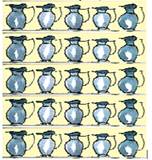
Yes, my friends make it in different ways as under:
30 = 10 x 3 So, there are 10 rows with 3 jars each.
30 = 5 x 6 So, there are 5 rows with 6 jars each.
4. Help bunty to make the table of 7, using table of 4 and 3.
Ans. Table of 4:

Table of 3:

Table of 7:

In fact, we have added the two respective numbers in the lowest boxes of 4 and table of 3 to get the table of 7.
5. Which two tables will you use for writing the table of 12?
Ans. The tables of 4 and 8 can be used for writing the table of 12.
6. How many cats?
Ans.
| How many legs? | 4 | 8 | 12 | 16 | 20 | 24 | 28 |
| How many cats? | 1 | 2 | 3 | 4 | 5 | 6 | 7 |
So, 28 legs mean 7 cats.
7. Billo has kept his chickens in a box. He counted 28 legs. How many chickens are there?
Ans.
| How many legs? | 2 | 4 | 6 |
| How many chickens? | 1 | 2 | 3 |
So, 28 legs mean 14 chickens.
8. Leela has not gone to school for 21 days. For how many weeks was she away from school?
Ans.
| How many days? | 7 | 14 | 21 |
| How many weeks? | 1 | 2 | 3 |
So, 21 days mean 3 weeks.
9. Jumping Animals:
(a) Count the jumps he takes to reach 27. So, he has taken 27/3 = __ jumps.
Ans. (a) So, he has taken 9 jumps.
(b) He has taken 12 jumps if he is at 36.
Ans. (b) Because 36/3 = 12.
(c) If he is at 42, he has taken 14 jumps.
Ans. (c) Because 42/3= 14.
(d) In how many jumps does he reach 25?
Ans. He will reach 25 in 25/5 = 5 jumps.
(e) He reaches 40 after taking 8 jumps.
Ans. (e) Because 8x5= 40.
(f) He needs 11 jumps to reach 55.
And. (f) Because 55/5 = 11.
10. Sea Shells:
(a) How many shells are left now?
Ans. (a) 84 – 28 = 56 shells are left now.
(b) How many necklaces can Dhruv make from 112 shells?
Ans. (b) Dhruv can make 4 necklaces of 28 shells each from 112 shells.
(c) Are the shells enough for making necklaces for all his friends.
Ans. (c) Yes, the shells are enough for making necklaces for all his friends.
11. Try these:
(a) Kannu made a necklace of 17 sea-shellls. How many such necklaces can be made using 100 sea-shells?
Ans. (a) Let us do this problem by the process of repeated subtraction.
(1) 100 – 17 = 83
(2) 83 – 17 = 66
(3) 66 – 17 = 49
(4) 49 -17 = 32
(5) 32 – 17 = 15
Thus, Kannu can make 5 necklaces of 17 sea-shells using 100 sea-shells. He will also be left with 15 sea-shells as unused.
(b) One carton can hold 85 soaps. Shally wants to pack 338 soaps. How many cartons does the need for packing all of them?
Ans. (b) By the process of repeated subtraction, we have
(1) 338 – 85 = 253
(2) 253 – 85 = 168
(3) 168 – 85 = 83
(c) Manpreet wants 1500 sacks of cement for making a house. A truck carries 250 sacks at a time. How many trips will the truck make? A driver charges Rs 500 for a trip. How much will Manpreet pay the driver for all the trips?
Ans. (c) By the process of repeated subtraction, we have
(1) 1500 – 250 = 1250
(2) 1250 – 250 = 1000
(3) 1000 – 250 = 750
(4) 750 – 250 = 500
(5) 500 – 250 = 250
(6) 250 – 250 = 0
Thus, the truck will make 6 trips to carry 1500 sacks of cement.
Driver’s charge for 1 trip = Rs. 500
Therefore, driver’s charge for 6 trips = Rs. (500 x 6) = Rs. 3000
Thus, the money paid by Manpreet to driver = Rs. 3000.
12. Gangu’s Sweets:
(a) Are the sweets in the tray enough to pack 23 small boxes?
Ans. (a) Laddoos needed for 23 small boxes at the rate of 4 per pack = 4x23 = 92. Because 92 > 80, so the sweets in the tray are not enough.
(b) How many more sweets are needed?
Ans. (b) Number of more sweets needed = 92 – 80 = 12.
(c) Gangu also has a bigger box in which he pack 12 laddoos. How many boxes does he used he need for packing 60 laddoos?
Ans. (c) Number of boxes needed for packing 60 laddoos at the rate of 12 per pack = 60/12 = 5.
13. Neelu brought 15 storybooks to her class. Today 45 students are present. How many children will need to share one book?
Ans. Number of students = 45
Number of story books = 15
Number of children sharing one book = 45/15 = 3
Thus, 3 children will need to share one book.
14. A family of 8 people needs 60 kg wheat for a month. How much wheat does this family need for a week?
Ans. Wheat needed by a family for a month =60 kg
Therefore, wheat needed by a family for a week = (60/4) = 15 kg.
15. Razia wants change for Rs. 500. How many notes will she get if she wants in return.
Ans. (1) Number of notes required = 500/100 = 5
(2) Number of notes required = 500/50= 10
(3) Number of notes required = 500/20 = 25
(4) Number of notes required = 500/5 = 100
16. You have to distribute 72 tomatoes equally in baskets. How many tomatoes will there be in each?
Ans. Number of tomatoes = 72
Number of baskets = 3
Number of tomatoes distributed equally per basket = 72/3 = 24.
17. There are 350 bricks in a hand-cart. Binod found the weight of a brick to be 2 kg. What will be the weight of all the blocks?
Ans. Number of brick in a hand-cart = 350
Weight of 1 brick = 2 kg
Total weight of 350 bricks = (350x2) kg = 700 kg
18. How will Lokesh distribute the rest of the money? Complete it.
Ans. Lokesh will distribute the rest of the money, that is, Rs. 15 among 5 by finding 15/5 , which is 3.
Or, it can be completed as under:
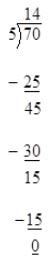
Lokesh distributed Rs. 3 more. Now nothing is left. And all the money is divided equally.
So, each child gets 5 + 6+ 3 = 14 rupees.
Checking of answer:
Since, 14x5 = 70, so answer is correct.
19. Now use your own method to divide Rs. 70 equally among 5 people. If you want you can start by giving Rs. 2 to each. Or you can even start with Rs. 11 to each.
Ans. Let us start with Rs. 11 to each.
First, I give Rs. 11 to each.
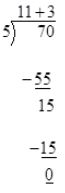
I have distributed 11 x 5 = 55 rupees. Next, I give Rs. 3 more to everyone. I have distributed 5x3 – 15 rupees. Now nothing is left. And all the money is divided equally. So, each child gets 11+ 3= 14 rupees.
20. Can you start with Rs. 15 to each?
Ans. We cannot start with Rs. 15 as Rs. 15 x 5 = Rs. 75, which is more than Rs. 70.
21.Try doing these:
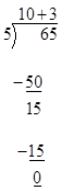
(a) 5√65
Ans. (a)
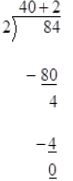
(b) 2√84
Ans. (b)
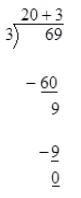
(c) 3√69
Ans. (c)
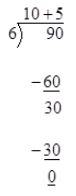
(d) 6√90
Ans. (d)
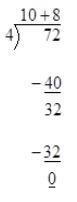
(e) 4√72
Ans. (e)
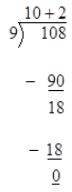
(f) 9√108
Ans. (f)
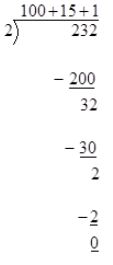
(g) 2√232
Ans. (g)
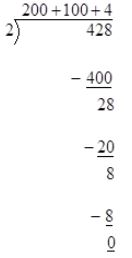
(h) 2√428
Ans. (h)
(i) Meera made 204 candles to sell in the market. She makes packets of 6. How many packets will she make? If she packs them in packets of 12 then how many packets will she make?
Ans. (i) Number of candles = 204
Number of packets at the rate of 6 packets = 204/ 6 = 34
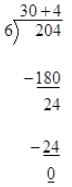
Thus, the required number of packets = 34.
Number of packet @ 12 per packet = 204/12 = 17.
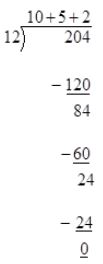
Thus, the required number of packet = 17.
(j) On sports day 161 children are in the school playground. They are standing in 7 equal rows. How many children are there in each row?
Ans. (i) Number of children = 161
They are standing in 7 equal rows.
Number of children per row = 161/7 =23
Thus, there are 23 children standing in each row.
22. Now you look at the other picture and make questions like Srishti.
(a) There are 8 packets of rachis. Each packet has 7 rakhis in it.
Ans. (a) My question: How many rakhis are there in all?
Number of rakhis = 8x7 =56
(b) There are 10 packets of sugar. Saurabha paid 110 rupees for all the packets.
Ans. (b) My question: What is the cost of 1 packet of sugar?
Cost of one packet of sugar = (110/10) rupees = 11 rupees
(c) There are 35 students in 7 rows. Each row has the same number of students.
Ans. (c) My question: How many students are there in each row?
Number of students in each row = 35/7 = 5 students
(d) Hari, Seema, Chinku and Lakshmi are going to Guwahati. The cost of one rail ticket is Rs. 62.
Ans. (d) My question: How much is the cost of four rail tickets?
Cost of 4 rail tickets = Rs. 62x4 = Rs. 248.
(e) One metre of cloth cost Rs. 20. Lalbiak bought some cloth and paid Rs. 140.
Ans. (e) My question: How many metres of cloth was bought for Rs. 140?
Length of cloth bought for Rs. 140= (140/2) m = 7 m.
Question. Ramesh, Aruna, Vasu and Deena each have the same number of crayons. Ramesh ties up his crayons in bundles of 6. Aruna ties up her crayons in bundles of 12. Vasu ties up his crayons in bundles of 4. Deena ties up her crayons in bundles of 8. Who will have the greatest number of BUNDLES?
(a) Ramesh
(b) Aruna
(c) Vasu
(d) Deena
Answer : C
Question. For which of the following can you multiply 74 by 6 to get the answer?
(a) 74 increased by 6
(b) take away 6 from 74
(c) 6 more than 74
(d) 74 added 6 times
Answer : D
Question. Atul wants to buy a ball which costs 6 rupees. He checks his pocket and finds that he has these coins. Which of the following is true?
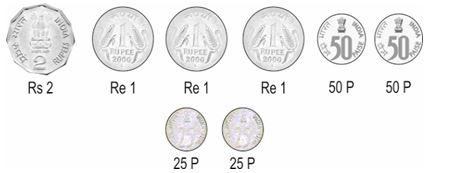
(a) Atul can buy the ball and be left with 1 rupee and 50 paise.
(b) Atul cannot buy the ball because he will fall short by 2 rupees and fifty paise.
(c) Atul cannot buy the ball because he will fall short by 1 rupee and 50 paise.
(d) Atul can buy the ball and be left with 50 paise.
Answer : D
Question. Which of the following gives the smallest quotient?
(a) 478 divided by 5
(b) 479 divided by 9
(c) 480 divided by 7
(d) 481 divided by 12
Answer : D
Question. Study this pattern of boxes carefully. Which of these would be a CORRECT way of counting the total number of boxes in this pattern?
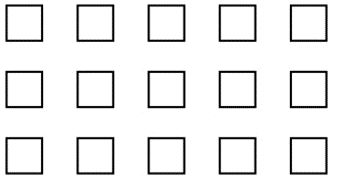
(a) 5 divided by 3
(b) 3 + 5 + 3 + 5
(c) 3 times 3
(d) 5 + 5 + 5
Answer : D
Question. The 42 children in Navya's class are seated in 7 rows in such a way that the number of children in each row is the same. How many children are seated in the FIRST row?
(a) 5
(b) 6
(c) 7
(d) 8
Answer : B
Question. Ramesh buys 1 pencil on the 1 of January, 2 pencils on the 2, 3 pencils on the 3 and so on till the 7 of January. If he had no pencils beforehand, how many will he have after he buys pencils on the 7?
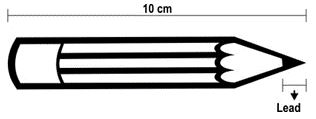
(a) 7
(b) 28
(c) 36
(d) 100
Answer : B
Question. Keerthi bought 8 of EACH of these 3 types of sweets shown here: The next day, she and three of her friends distributed them equally among themselves. How many sweets did each of them get?
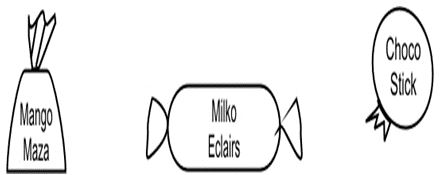
(a) 3
(b) 4
(c) 6
(d) 8
Answer : C
Question. Mala gave each of her four friends a bar of chocolate on her birthday and asked them to share it equally with their brother or sister at home. Ritu broke her chocolate into 6 equal pieces and gave 4 to her sister. Arjun broke his chocolate into 8 equal pieces and gave 4 pieces to his sister. Raju broke his chocolate into 10 equal pieces and gave 5 to his sister. Akul broke his chocolate into 12 equal pieces and kept 6 pieces for himself and gave 6 pieces to his sister . Who among them did not share the chocolate equally with his/her brother/sister ?
(a) Ritu
(b) Arjun
(c) Raju
(d) Akul
Answer : A
Question. The teacher brings a big bag of crayons to distribute to her class of 30 children. If she plans to give 1 bundle of 6 crayons to each child and has no extra crayons, how many crayons are there in the bag?
(a) 36
(b) 60
(c) 180
(d) 5
Answer : C
Question. Kamal is arranging his father's books in a new bookshelf which has 3 shelves. After putting 12 books in each shelf, he finds that 7 books are still left outside. How many books are there in total?
(a) 22
(b) 29
(c) 36
(d) 43
Answer : D
Question. Which digit should come in place of box, so that the following multiplication is correct?
5 ....... 3
x 7
3 6 6 1
(a) 1
(b) 2
(c) 4
(d) 7
Answer : B
Question. What is box, if 8 x 6 = 2 x box x 8?
(a) 32
(b) 4
(c) 3
(d) 2
Answer : C
Question. If the cost of 1 packet of BEST biscuits is Rs 5, how many packets can I get for Rs. 50 with the FREE OFFER shown here?
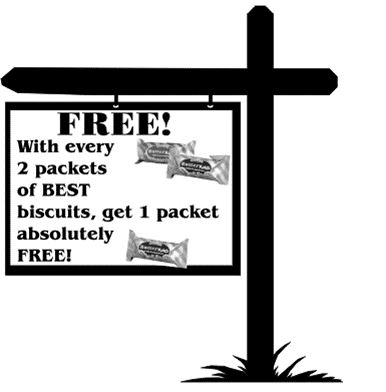
(a) 6
(b) 9
(c) 10
(d) 15
Answer : D
Question. This is the seating arrangement for students in a classroom with each box showing one chair. The chairs which have a cross mark are occupied. Write the fraction for the occupied chairs.
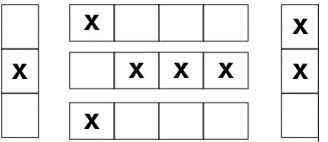
(a) 6/12
(b) 8/10
(c) 6/18
(d) 8/18
Answer : D
Question. Which of the following lies between 34 times 9 and 9 times 36?
(a) 9 times 35
(b) 34 times8
(c) 36 times 10
(d) 9 times 33
Answer : A
Question. Each box below contains 6 crayons,How many MORE BOXES like this are needed to make 60 crayons in all?
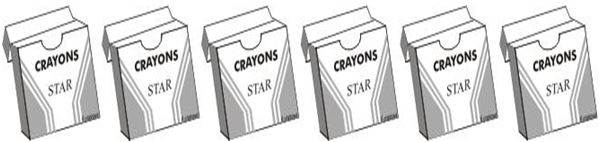
(a) 4
(b) 6
(c) 10
(d) 40
Answer : A
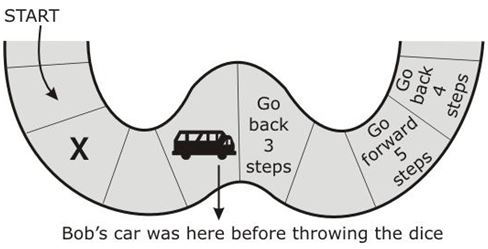
Question. Bob is playing a board and dice game called 'Car Race' with his friend. A part of the board is shown below:Bob's car is shown on the board. After throwing the dice, his car had to move to the place marked 'X'.
What number did he throw on the dice?
(a) 1
(b) 2
(c) 3
(d) 4
Answer : A
Free study material for Mathematics
NCERT Solutions Class 4 Mathematics Chapter 11 Tables And Shares
Students can now access the NCERT Solutions for Chapter 11 Tables And Shares prepared by teachers on our website. These solutions cover all questions in exercise in your Class 4 Mathematics textbook. Each answer is updated based on the current academic session as per the latest NCERT syllabus.
Detailed Explanations for Chapter 11 Tables And Shares
Our expert teachers have provided step-by-step explanations for all the difficult questions in the Class 4 Mathematics chapter. Along with the final answers, we have also explained the concept behind it to help you build stronger understanding of each topic. This will be really helpful for Class 4 students who want to understand both theoretical and practical questions. By studying these NCERT Questions and Answers your basic concepts will improve a lot.
Benefits of using Mathematics Class 4 Solved Papers
Using our Mathematics solutions regularly students will be able to improve their logical thinking and problem-solving speed. These Class 4 solutions are a guide for self-study and homework assistance. Along with the chapter-wise solutions, you should also refer to our Revision Notes and Sample Papers for Chapter 11 Tables And Shares to get a complete preparation experience.
FAQs
The complete and updated is available for free on StudiesToday.com. These solutions for Class 4 Mathematics are as per latest NCERT curriculum.
Yes, our experts have revised the as per 2026 exam pattern. All textbook exercises have been solved and have added explanation about how the Mathematics concepts are applied in case-study and assertion-reasoning questions.
Toppers recommend using NCERT language because NCERT marking schemes are strictly based on textbook definitions. Our will help students to get full marks in the theory paper.
Yes, we provide bilingual support for Class 4 Mathematics. You can access in both English and Hindi medium.
Yes, you can download the entire in printable PDF format for offline study on any device.