

Download Class 10 Mathematics Worksheets for Chapter 09 Some Applications of Trigonometry
Access printable practice worksheets for Chapter 09 Some Applications of Trigonometry designed to align with the 2026-27 academic syllabus for Class 10 Mathematics. These structured exercises help students evaluate their conceptual understanding and improve exam readiness.
Access Chapter 09 Some Applications of Trigonometry Questions and Exercises
Navigate directly to the printable exercises for Chapter 09 Some Applications of Trigonometry using the digital viewer below. Each practice set allows students to isolate specific topics for thorough review and uninterrupted practice alongside standard textbooks.
SHORT ANSWER TYPE QUESTIONS :
Question. The angle of depression of the top and the bottom of a 9 m high building from the top of a tower are 30° and 60° respectively. Find the height of the tower and the distance between the building and the tower.
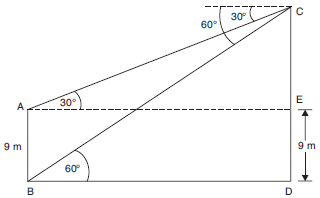
Answer : Let AB represents the building and CD be the tower.
∴ AB = 9 m
In right Δ BDC, we have:
CD/DB = tan 60° = √3
⇒ CD = DB· √3
In right Δ AEC, we have:
CE/AE = tan 30° = 1/√3
⇒ CD− 9/AE = 1/√3 ⇒ AE = √3 CD − 9√3
⇒ BD = √3 (DB·√3 ) − 9√3
⇒ BD = 3 BD − 9√3
⇒ 2BD = 9√3
⇒ BD = 9/2√3 = 9×1.732/2
⇒ BD = 7.8 m
From (1), we have,
CD = √3 × 9/2 × √3 = 27/2 = 13.5
Thus, height of the tower = 13.5 m
Distance between the building and the tower = 7.8 m
Question. A tower stands vertically on the ground. From a point on the ground which is 20 m away from the foot of the tower, the angle of elevation of the top of the tower is found to be 60°. Find the height of the tower.
Answer : In the figure, AB is the tower,
∴ AB = h metres
In rt Δ ABC, we have:
BC/AC = tan 60°
⇒ h/20 = √3
|ä tan 60° = √3 and AB = 20 m
⇒ h = 20√3 metre
Thus, the height of the tower = 20√3 m.
Extra Based Questions :
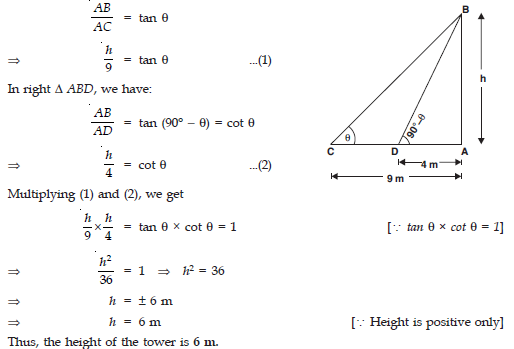
Question. The angles of elevation of the top of a tower from two points at a distance of 4 m and 9 m from the base of the tower and in the same straight line with it are complementary. Prove that the height of the tower is 6 m.
Answer : Let the tower be represented by AB in the figure.
Let AB = h metres.
∴ In right Δ ABC, we have:
Question. From a point on the ground, the angles of elevation of the bottom and the top of a transmission tower fixed at the top of a 20 m high building are 45° and 60° respectively. Find the height of the tower.
Answer : Let the height of the building be BC
∴ BC = 20 m
And height of the tower be CD.
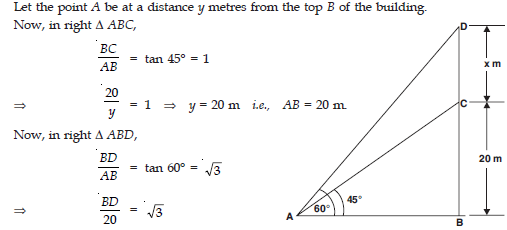
⇒ 20+x/20 = √3 ⇒ 20 + x = 20√3
⇒ x = 20√3 − 20 = 20 [ √3 − 1]
⇒ x = 20 [1.732 − 1]
⇒ x = 20 × 0.732 = 14.64
Thus, the height of the tower is 14.64 m.
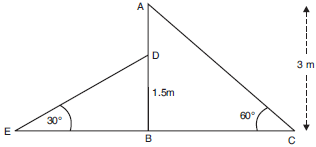
Question. A contractor plans to install two slides for the children to play in a park. For the children below the age of 5 years, she prefers to have a slide whose top is at a height of 1.5 m, and is inclined at an angle of 30° to the ground, whereas for older children, she wants to have a steep slide at a height of 3 m, and inclined at an angle of 60° to the ground. What should be the length of the slide in each case?
Answer : In the figure, DE is the slide for younger children whereas AC is the slide for older children.
In right Δ ABC,
AB = 3 m
AC = length of the slide
∴ AB/AC = sin 60°
⇒ 3/AC = √3/2
⇒ AC = 2 × 3/√3 = 2√3 m
Again in right ΔBDE,
DE/BD = cosec 30° = 2
⇒ DE/1.5 = 2
⇒ DE = 2 × 1.5 m
⇒ DE = 3 m
Thus, the lengths of slides are 3 m and 2√3m.
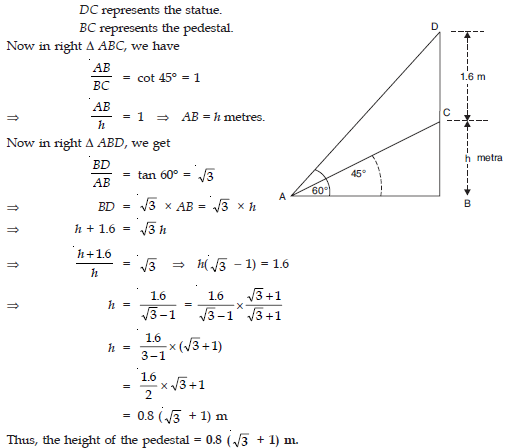
Question. A statue, 1.6 m tall, stands on the top of a pedestal. From a point on the ground, the angle of elevation of the top of the statue is 60° and from the same point the angle of elevation of the top of the pedestal is 45°. Find the height of the pedestal.
Answer : In the figure,
Question. A tree breaks due to storm and the broken part bends so that the top of the tree touches the ground making an angle 30° with it. The distance between the foot of the tree to the point where the top touches the ground is 8 m. Find the height of the tree.
Answer : Let the original height of the tree = OP.
It is broken at A and its top is touching the ground at B.
Now, in right Δ AOB, we have
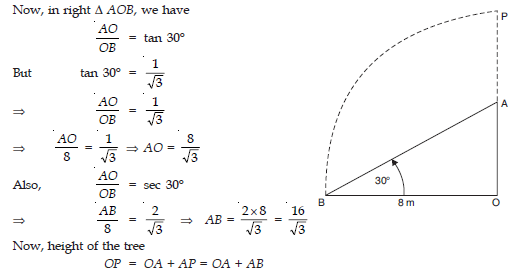
= 8/√3 + 16/√3 [∵ AB = AP]
= 24/√3m = 24/√3 × √3/√3 m = 8√3m
Question. A straight highway leads to the foot of a tower. A man standing at the top of the tower observes a car at an angle of depression of 30°, which is approaching the foot of the tower with a uniform speed. Six seconds later, the angle of depression of the car is found to be 60°. Find the time taken by the car to reach the foot of the tower from this point.
Answer : In the figure, let AB is the height of the tower and C and D be the two positions of the car.
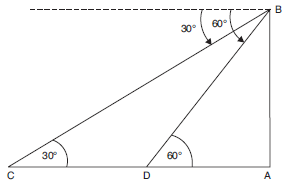
In right Δ ABD, we have:
AB/AD
= tan 60°
⇒ AB/AD = √3 ⇒ AB = √3 · AD
In right Δ ABC, we have:
AB/AC
= tan 30°
⇒ AB/AC = 1/√3 ⇒ AB = AC/√3
From (1) and (2)
√3 AD = AC/√3
⇒ AC = √3 × √3 × AD = 3 AD
Now CD = AC − AD
= 3 AD − AD = 2 AD
Since the distance 2 AD is covered in 6 seconds,
∴ The distance AD will be covered in 6/2 i.e., 3 seconds.
Thus, the time taken by the car to reach the tower from D is 3 seconds.
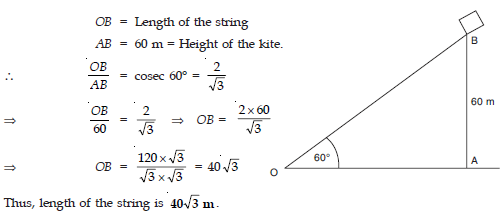
Question. A kite is flying at a height of 60 m above the ground. The string attached to the kite is temporarily tied to a point on the ground. The inclination of the string with the ground is 60°. Find the length of the string, assuming that there is no slack in the string.
Answer : Let in the right Δ AOB,
Question. As observed from the top of a 75 m high lighthouse from the sea-level, the angles of depression of two ships are 30° and 45°. If one ship is exactly behind the other on the same side of the lighthouse, find the distance between the two ships.
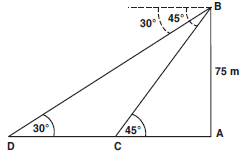
Answer : In the figure, let AB represent the light house.
∴ AB = 75 m.
Let the two ships be C and D such that angles of depression from B are 45° and 30° respectively.
Now in right Δ ABC, we have:
AB/AC = tan 45°
⇒ 75/AC = 1 ⇒ AC = 75
Again, in right Δ ABD, we have:
AB/AD = tan 30°
⇒ 75/AD = 1/√3 ⇒ AD = 75√3
Since the distance between the two ships = CD
= AD − AC
= 75√3 − 75 = 75 [ √3 − 1]
= 75 [1.732 − 1] = 75 × 0.732 = 54.9
Thus, the required distance between the ships = 54.9 m.
Question. A circus artist is climbing a 20 m long rope, which is tightly stretched and tied from the top of a vertical pole to the ground. Find the height of the pole, if the angle made by the rope with the ground level is 30° (see figure).
Answer : In the figure, let AC is the rope and AB is the pole. In right Δ ABC, we have:
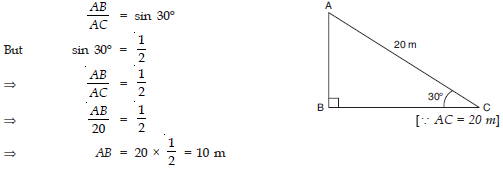
Thus, the required height of the pole is 10 m.
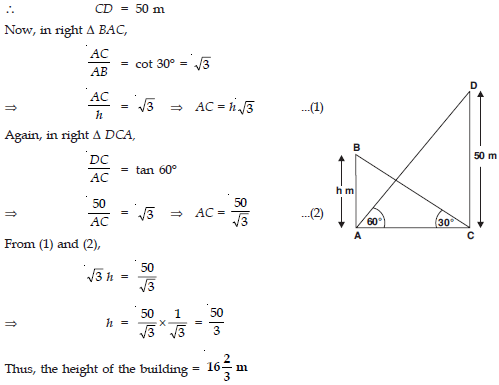
Question. The angle of elevation of the top of a building from the foot of the tower is 30° and the angle of elevation of the top of the tower from the foot of the building is 60°. If the tower is 50 m high, find the height of the building.
Answer : In the figure, let height of the building = AB = h m
Let CD be the tower.
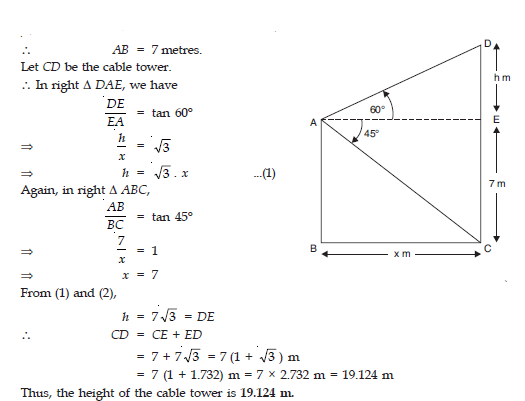
Question. From the top of a 7 m high building, the angle of elevation of the top of a cable tower is 60° and the angle of depression of its foot is 45°. Determine the height of the tower.
Answer : In the figure, let AB be the height of the tower.
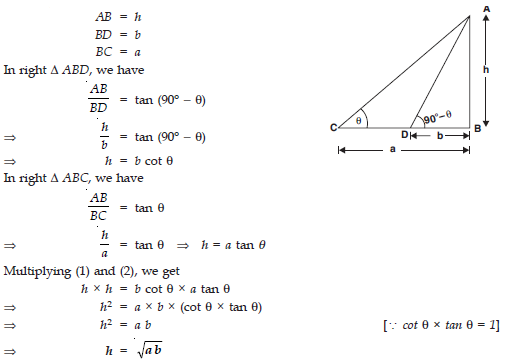
Question. The angles of elevation of the top of a tower from two points on the ground at distances a and b units from the base of the tower and in the same straight line with it are complementary. Prove that the height of the tower is √ab units.
Answer : In the figure, AB is the tower, such that:
Question. The angles of depression of the top and the bottom of a building 50 m high as observed from the top of a tower are 30° and 60° respectively. Find the height of the tower and also the horizontal distance between the building and the tower.
Answer : In the figure,
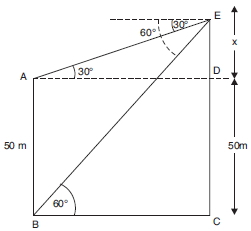
Let AB = 50 m be the building.
Let CE be the tower such that CE = (50 + x) m
In right Δ ADE, we have:
DE/AD = tan 30° = 1/√3
⇒ x/AD = 1/√3 ⇒ AD ⇒ x √3 or BC = x √3
In right Δ ACE, we have:
CE/BC = tan 60° = 3√
⇒ 50 + x/BC = 3 ⇒ BC = 50 + x/3
From (1) and (2), we get
√3 x = 50 + x/3
⇒ √3x × √3 = 50 + x
⇒ 3x − x = 50 ⇒ x = 25
∴ Height of the tower = 50 + x
= 50 + 25
= 75 m
Now from (1), BC = √3 × x
= √3 × 25 m
= 1.732 × 25 m
= 43.25 m
i.e., The horizontal distance between the building and the tower = 43.25 m.
Question. From the top of a hill 200 m high, the angles of depression of the top and bottom of a pillar are 30° and 60° respectively. Find the height of the pillar and its distance from the hill.
Answer : In the figure, let AD is the hill such that
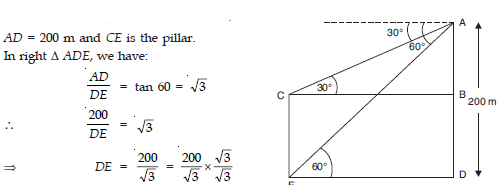
⇒ DE = √3×200/3 = 1.73×200/3
= 346/3 = 115.33 m
⇒ Distance between pillar and hill = 115.33 m
Now, BC = DE = 200/√3 m [∵ DE = BC]
In right Δ ABC, we have:
AB/BC = tan 30° = 1/√3
⇒ AB = BC/√3 = 200/√3 × 1/√3 = 200/3 [∵ BC = 200/√3]
= 66.67 m
∴ Height of the pillar
CE = AD − AB [∵ CE = BD]
= 200 − 66.67 m
= 133.33 m
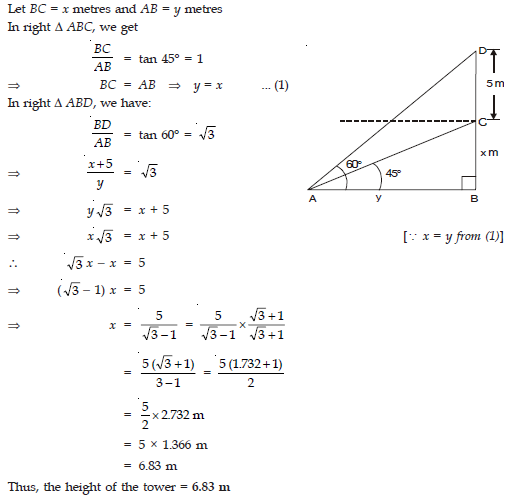
Question. A pole 5 m high is fixed on the top of a tower. The angle of elevation of the top of the pole observed from a point ‘A’ on the ground is 60° and the angle of depression of the point ‘A’ from the top of the tower is 45°. Find the height of the tower.
Answer : In the figure, let BC be the tower and CD be the pole.
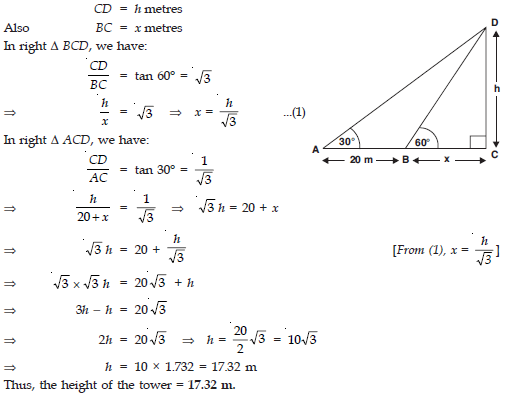
Question. The length of the shadow of a tower standing on level plane is found to be 20 m longer when the sun’s altitude is 30° than when it was 60°. Find the height of the tower.
Answer : In the figure, let CD be the tower such that
Please click on below link to download CBSE Class 10 Mathematics Application of Trignometry Worksheet Set A
Free study material for Mathematics
Exam Preparation Worksheet for Class 10 Mathematics Chapter 09 Some Applications of Trigonometry
Chapter 09 Some Applications of Trigonometry Printable Worksheet for Class 10 Mathematics
Review targeted practice exercises for Class 10 Mathematics Chapter 09 Some Applications of Trigonometry. Curated to match official CBSE guidelines, these downloadable PDF sheets support daily revision and core concept reinforcement.
How to Use These Practice Sheets
Cross-reference your completed exercises with comprehensive NCERT solutions for Class 10 Mathematics to ensure absolute clarity across all sub-topics in this chapter.
Enhance Speed with Online Practice
Follow up your worksheet practice by attempting the interactive online Mathematics MCQ test for this chapter to evaluate your execution speed. All platform resources are free to access.
FAQs
You can download the teacher-verified PDF for CBSE Class 10 Mathematics Some Applications of Trigonometry Worksheet Set 01 from StudiesToday.com. These practice sheets for Class 10 Mathematics are designed as per the latest CBSE academic session.
Yes, our CBSE Class 10 Mathematics Some Applications of Trigonometry Worksheet Set 01 includes a variety of questions like Case-based studies, Assertion-Reasoning, and MCQs as per the 50% competency-based weightage in the latest curriculum for Class 10.
Yes, we have provided detailed solutions for CBSE Class 10 Mathematics Some Applications of Trigonometry Worksheet Set 01 to help Class 10 and follow the official CBSE marking scheme.
Daily practice with these Mathematics worksheets helps in identifying understanding gaps. It also improves question solving speed and ensures that Class 10 students get more marks in CBSE exams.
All our Class 10 Mathematics practice test papers and worksheets are available for free download in mobile-friendly PDF format. You can access CBSE Class 10 Mathematics Some Applications of Trigonometry Worksheet Set 01 without any registration.