

Access the latest CBSE Class 10 Mathematics Polynomials Worksheet Set 07. We have provided free printable Class 10 Mathematics worksheets in PDF format, specifically designed for Chapter 2 Polynomials. These practice sets are prepared by expert teachers following the 2025-26 syllabus and exam patterns issued by CBSE, NCERT, and KVS.
Chapter 2 Polynomials Mathematics Practice Worksheet for Class 10
Students should use these Class 10 Mathematics chapter-wise worksheets for daily practice to improve their conceptual understanding. This detailed test papers include important questions and solutions for Chapter 2 Polynomials, to help you prepare for school tests and final examination. Regular practice of these Class 10 Mathematics questions will help improve your problem-solving speed and exam accuracy for the 2026 session.
Download Class 10 Mathematics Chapter 2 Polynomials Worksheet PDF
SECTION - A
Multiple Choice Questions (MCQs)
Question. The zeroes of the quadratic polynomial \( x^2 + 99x + 127 \) are :
(a) both positive
(b) both negative
(c) one positive and one negative
(d) both equal
Answer: (b) both negative
Question. If \( \alpha, \beta \) are zeroes of \( x^2 - 4x + 1 \), then \( \frac{1}{\alpha} + \frac{1}{\beta} - \alpha\beta \) is :
(a) 3
(b) 5
(c) -5
(d) -3
Answer: (a) 3
Question. If \( \alpha, \beta \) are zeroes of polynomial \( f(x) = x^2 + px + q \) then polynomial having \( \frac{1}{\alpha} \) and \( \frac{1}{\beta} \) as its zeroes is:
(a) \( x^2 + qx + p \)
(b) \( x^2 - px + q \)
(c) \( qx^2 + px + 1 \)
(d) \( px^2 + qx + 1 \)
Answer: (c) \( qx^2 + px + 1 \)
Question. If \( \alpha \) and \( \beta \) are the zeroes of the polynomial \( 5x^2 - 7x + 2 \), then sum of their reciprocals is :
(a) \( \frac{7}{2} \)
(b) \( \frac{7}{5} \)
(c) \( \frac{2}{5} \)
(d) \( \frac{14}{25} \)
Answer: (a) \( \frac{7}{2} \)
Question. The quadratic polynomial \( p(x) \) with -81 and 3 as product and one of the zeroes respectively is:
(a) \( x^2 + 24x - 81 \)
(b) \( x^2 - 24x - 81 \)
(c) \( x^2 - 24x + 81 \)
(d) \( x^2 + 24x + 81 \)
Answer: (a) \( x^2 + 24x - 81 \)
Question. If 1 is zero of the polynomial \( p(x) = ax^2 - 3(a - 1)x - 1 \), then the value of 'a' is
(a) 1
(b) -1
(c) 2
(d) -2
Answer: (a) 1
Question. If \( \alpha, \beta \) are zeroes of \( x^2 - 6x + k \). What is the value of \( k \) if \( 3\alpha + 2\beta = 20 \).
(a) -16
(b) 8
(c) -2
(d) -8
Answer: (a) -16
Question. If one zero of \( 2x^2 - 3x + k \) is reciprocal to the other, then the value of \( k \) is :
(a) 2
(b) \( \frac{-2}{3} \)
(c) \( \frac{-3}{2} \)
(d) -3
Answer: (a) 2
Question. The number of polynomials having zeroes -2 and 5 is :
(a) 1
(b) 2
(c) 3
(d) more than 3
Answer: (d) more than 3
Question. The value of \( p \) for which the polynomial \( x^3 + 4x^2 - px + 8 \) is exactly divisible by \( (x - 2) \) is
(a) 0
(b) 3
(c) 16
(d) 12
Answer: (c) 16
Question. The quadratic polynomial whose sum of zeroes is 3 and product of zeroes is -2 is:
(a) \( x^2 + 3x - 2 \)
(b) \( x^2 - 2x + 3 \)
(c) \( x^2 - 3x + 3 \)
(d) \( x^2 - 3x - 2 \)
Answer: (d) \( x^2 - 3x - 2 \)
Question. If one of the zeroes of the quadratic polynomial \( (k - 1)x^2 + kx + 1 \) is -3, then the value of \( k \) is
(a) -4/3
(b) 4/3
(c) 2/3
(d) -2/3
Answer: (b) 4/3
Question. The number of zeroes for the polynomial \( y = p(x) \). If graph meet x-axis at 3 points is:
(a) 3
(b) 1
(c) 2
(d) 0
Answer: (a) 3
Question. The degree of the polynomial \( (x + 1)(x^2 - x - x^4 + 1) \) is :
(a) 2
(b) 3
(c) 4
(d) 5
Answer: (d) 5
Question. If -4 is a zero of the polynomial \( x^2 - x - (2 + 2k) \), then the value of \( k \) is
(a) 3
(b) 9
(c) 6
(d) -9
Answer: (b) 9
Question. The quadratic polynomial having zeroes are 1 and -2 is :
(a) \( x^2 - x + 2 \)
(b) \( x^2 - x - 2 \)
(c) \( x^2 + x - 2 \)
(d) \( x^2 + x + 2 \)
Answer: (c) \( x^2 + x - 2 \)
SECTION - B
Very Short Answer Type Questions
Question. If \( \alpha \) and \( \beta \) are the zeroes of \( x^2 + 7x + 12 \), then find the value of \( \frac{1}{\alpha} + \frac{1}{\beta} + 2\alpha\beta \).
Answer: \( \frac{281}{12} \)
Question. Find the zeroes of the quadartic polynomial \( 2x^2 - 25 \).
Answer: \( \pm \frac{5}{\sqrt{2}} \)
Question. Find the zeroes of the quadratic polynomial \( 4x^2 - 7 \).
Answer: \( \pm \frac{\sqrt{7}}{2} \)
Question. Find a quadratic polynomial whose zeroes are \( 3 + \sqrt{5} \) and \( 3 - \sqrt{5} \).
Answer: \( x^2 - 6x + 4 \)
Question. If \( \alpha, \beta \) are zeroes of quadratic polynomial \( x^2 - (k + 6)x + 2(2k - 1) \). Find \( k \) if \( \alpha + \beta = \frac{1}{2}\alpha\beta \).
Answer: \( k = 7 \)
Question. Form a quadratic polynomial whose one of the zeroes is +15 and sum of the zeroes is 42.
Answer: \( x^2 - 42x - 405 \)
Question. Divide \( (2x^2 + x - 20) \) by \( (x + 3) \) and verify division algorithm.
Answer: \( Q = 2x - 5, R = -5 \)
Question. Find the zeroes of the quadratic polynomial \( \sqrt{3}x^2 - 8x + 4\sqrt{3} \).
Answer: \( 2\sqrt{3} \) and \( \frac{2}{\sqrt{3}} \)
Question. What must be added to polynomial \( f(x) = x^4 + 2x^3 - 2x^2 + x - 1 \) so that the resulting polynomial is exactly divisible by \( x^2 + 2x - 3 \)?
Answer: \( x - 2 \)
Question. Find a quadratic polynomial with zeroes \( 3 + \sqrt{2} \) and \( 3 - \sqrt{2} \).
Answer: \( x^2 - 6x + 7 \)
Question. If \( \alpha \) and \( \frac{1}{\alpha} \) are the zeroes of the polynomial \( 4x^2 - 2x + (k - 4) \), find the value of \( k \).
Answer: \( k = 8 \)
Question. It being given that 1 is one of the zeroes of the polynomial \( 7x - x^3 - 6 \). Find its other zeroes.
Answer: 2 and -3
Question. \( \alpha, \beta \) are the roots of the quadratic polynomial \( p(x) = x^2 - (k - 6)x + (2k + 1) \). Find the value of \( k \), if \( \alpha + \beta = \alpha\beta \).
Answer: \( k = -7 \)
Question. Find the zeroes of the polynomial \( 100x^2 - 81 \).
Answer: \( \pm \frac{9}{10} \)
Question. Divide the polynomial \( p(x) = 3x^2 - x^3 - 3x + 5 \) by \( g(x) = x - 1 - x^2 \) and find its quotient and remainder.
Answer: \( Q = x - 2, R = 3 \)
Question. Find a quadratic polynomial, the sum of whose zeroes is 7 and their product is 12. Hence find the zeroes of the polynomial.
Answer: \( x^2 - 7x + 12 \); zeroes are 3 and 4
Question. Find a quadratic polynomial whose zeroes are 2 and -6. Verify the relation between the coefficients and zeroes of the polynomial.
Answer: \( x^2 + 4x - 12 \)
Question. Can \( (x - 3) \) be the remainder on the division of a polynomial \( p(x) \) by \( (2x + 5) \)? Justify your answer.
Answer: No
Question. Form a quadratic polynomial \( p(y) \) with sum and product of zeroes are 2 and -3/5 respectively.
Answer: \( x^2 - 2x - \frac{3}{5} \)
Question. Divide \( 6x^3 + 13x^2 + x - 2 \) by \( 2x + 1 \), and find quotient and remainder.
Answer: \( Q = 3x^2 + 5x - 2, R = 0 \)
SECTION - C
Assertion-Reason Questions
The following questions consist of two statements—Assertion(A) and Reason(R). Answer these questions selecting the appropriate option given below:
(a) Both A and R are true and R is the correct explanation for A.
(b) Both A and R are true but R is not the correct explanation for A.
(c) A is true but R is false.
(d) A is false but R is true.
Question. Assertion (A) : If \( (2 - \sqrt{3}) \) is one zero of a quadratic polynomial then other zero will be \( (2 + \sqrt{3}) \).
Reason (R) : Irrational zeros (roots) always occurs in pairs.
Answer: Solution : As irrational roots/zeros always occurs in pairs therefore, when one zero is \( 2 - \sqrt{3} \) then other will be \( 2 + \sqrt{3} \). So, both A and R are true and R is the correct explanation of A.
Hence, option (a) is correct.
Question. Assertion (A) : If both zeros of the quadratic polynomial \( x^2 - 2kx + 2 \) are equal in magnitude but opposite in sign then value of \( k \) is \( \frac{1}{2} \).
Reason (R) : Sum of zeros of a quadratic polynomial \( ax^2 + bx + c \) is \( \frac{-b}{a} \).
Answer: Solution : Given polynomial is \( x^2 - 2kx + 2 \) its zeros are equal but opposite in sign.
\( \therefore \text{Sum of zeros} = 0 = \frac{-(-2k)}{1} = 0 \)
\( \implies 2k = 0 \)
\( \implies k = 0 \)
So, A is false but R is true.
Hence, option (d) is correct.
Question. Assertion (A) : \( p(x) = 14x^3 - 2x^2 + 8x^4 + 7x - 8 \) is a polynomial of degree 3.
Reason (R) : The highest power of \( x \) in any polynomial \( p(x) \) is the degree of the polynomial.
Answer: Solution : The highest power of \( x \) in the polynomial \( p(x) = 14x^3 - 2x^2 + 8x^4 + 7x - 8 \) is 4.
\( \therefore \text{Degree of } p(x) \text{ is } 4. \text{ So, A is false but R is true.} \)
Hence, option (d) is correct.
Question. Assertion (A) : The graph \( y = f(x) \) is shown in figure, for the polynomial \( f(x) \). The number of zeros of \( f(x) \) is 4.
Reason (R) : The number of zero of the polynomial \( f(x) \) is the number of point at which \( f(x) \) cuts or touches the axes.
Answer: Solution : As the number of zeroes of polynomial \( f(x) \) is the number of points at which \( f(x) \) cuts (intersects) the \( x \)-axis and number of zeroes in the given figure is 4. So A is true but R is false.
Hence, option (c) is correct.
Question. Assertion (A) : If the sum and product of the zeros of a quadratic polynomial are \( -\frac{1}{4} \) and \( \frac{1}{4} \) respectively. Then the quadratic polynomial is \( 4x^2 + x + 1 \).
Reason (R) : The quadratic polynomial whose sum and product of zeros are given is \( x^2 - (\text{sum of zeros})x + \text{product of zeros} \).
Answer: Solution : \( \text{Sum of zeros} = -\frac{1}{4} \text{ and product of zeros} = \frac{1}{4} \)
\( \therefore \text{Quadratic polynomial is } x^2 - \left( -\frac{1}{4} \right)x + \frac{1}{4} \)
\( \implies x^2 + \frac{1}{4}x + \frac{1}{4} = \frac{1}{4}(4x^2 + x + 1) \)
\( \therefore \text{Quadratic polynomial be } 4x^2 + x + 1. \)
So, both A and R are true and R is the correct explanation of A.
Hence, option (a) is correct.
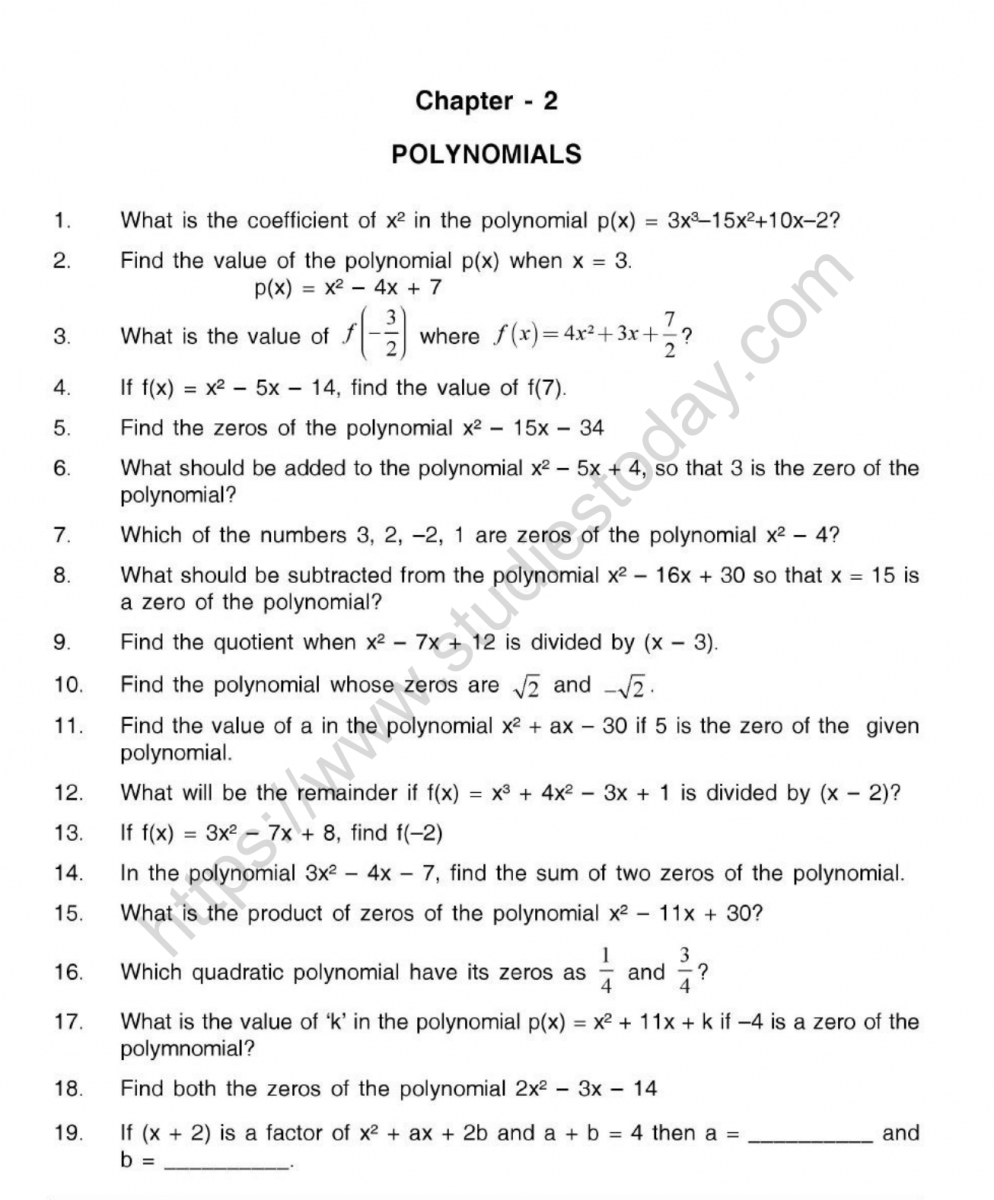
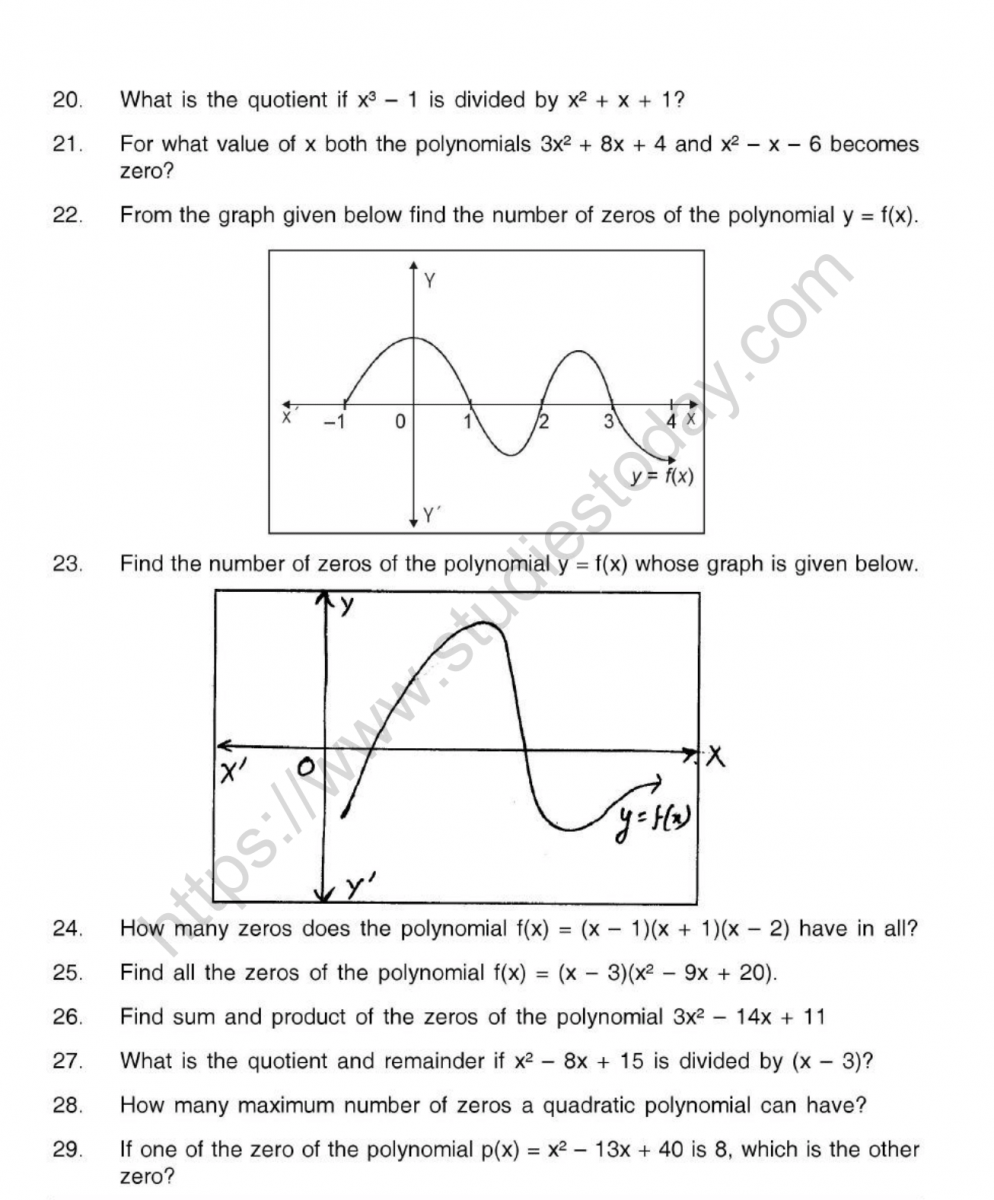
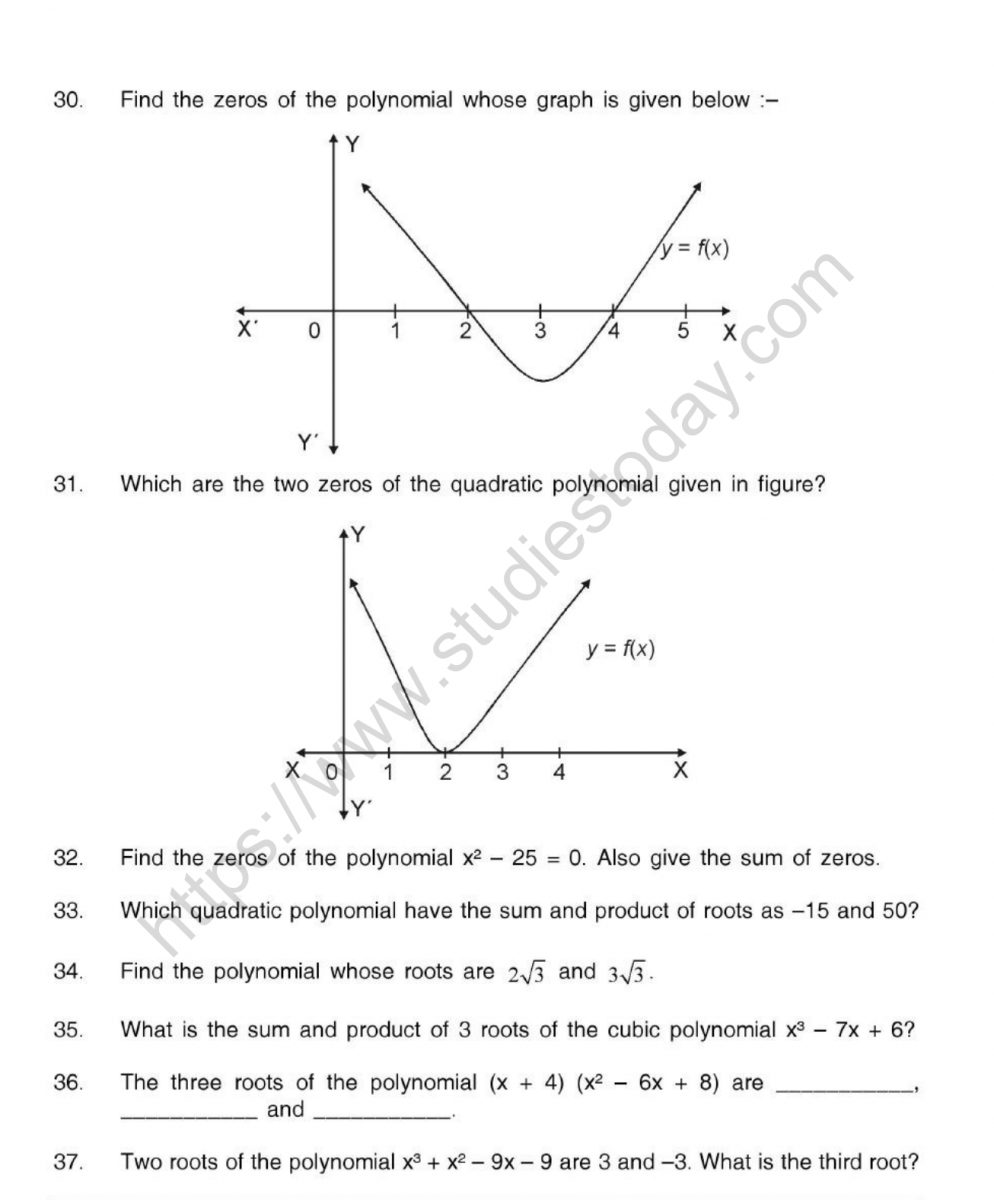
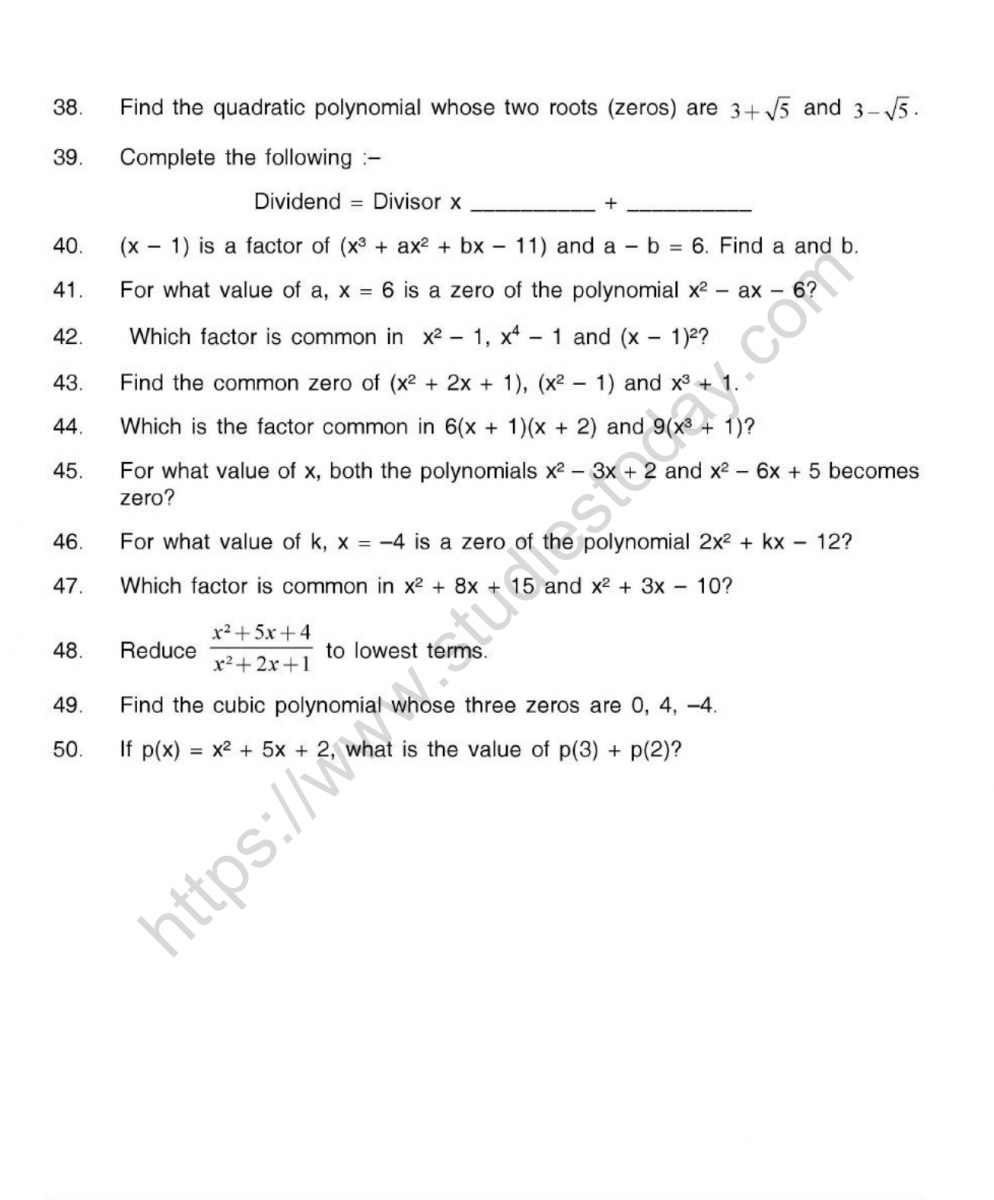
Free study material for Mathematics
Chapter 2 Polynomials CBSE Class 10 Mathematics Worksheet
Students can use the Chapter 2 Polynomials practice sheet provided above to prepare for their upcoming school tests. This solved questions and answers follow the latest CBSE syllabus for Class 10 Mathematics. You can easily download the PDF format and solve these questions every day to improve your marks. Our expert teachers have made these from the most important topics that are always asked in your exams to help you get more marks in exams.
NCERT Based Questions and Solutions for Chapter 2 Polynomials
Our expert team has used the official NCERT book for Class 10 Mathematics to create this practice material for students. After solving the questions our teachers have also suggested to study the NCERT solutions which will help you to understand the best way to solve problems in Mathematics. You can get all this study material for free on studiestoday.com.
Extra Practice for Mathematics
To get the best results in Class 10, students should try the Mathematics MCQ Test for this chapter. We have also provided printable assignments for Class 10 Mathematics on our website. Regular practice will help you feel more confident and get higher marks in CBSE examinations.
FAQs
You can download the teacher-verified PDF for CBSE Class 10 Mathematics Polynomials Worksheet Set 07 from StudiesToday.com. These practice sheets for Class 10 Mathematics are designed as per the latest CBSE academic session.
Yes, our CBSE Class 10 Mathematics Polynomials Worksheet Set 07 includes a variety of questions like Case-based studies, Assertion-Reasoning, and MCQs as per the 50% competency-based weightage in the latest curriculum for Class 10.
Yes, we have provided detailed solutions for CBSE Class 10 Mathematics Polynomials Worksheet Set 07 to help Class 10 and follow the official CBSE marking scheme.
Daily practice with these Mathematics worksheets helps in identifying understanding gaps. It also improves question solving speed and ensures that Class 10 students get more marks in CBSE exams.
All our Class 10 Mathematics practice test papers and worksheets are available for free download in mobile-friendly PDF format. You can access CBSE Class 10 Mathematics Polynomials Worksheet Set 07 without any registration.