

Access the latest CBSE Class 10 Mathematics Polynomials Worksheet Set 02. We have provided free printable Class 10 Mathematics worksheets in PDF format, specifically designed for Chapter 2 Polynomials. These practice sets are prepared by expert teachers following the 2025-26 syllabus and exam patterns issued by CBSE, NCERT, and KVS.
Chapter 2 Polynomials Mathematics Practice Worksheet for Class 10
Students should use these Class 10 Mathematics chapter-wise worksheets for daily practice to improve their conceptual understanding. This detailed test papers include important questions and solutions for Chapter 2 Polynomials, to help you prepare for school tests and final examination. Regular practice of these Class 10 Mathematics questions will help improve your problem-solving speed and exam accuracy for the 2026 session.
Download Class 10 Mathematics Chapter 2 Polynomials Worksheet PDF
Question. If one of the zeroes of the quadratic polynomial (k – 1)x2 + kx + 1 is –3, then the value of k is
(a) 4/3
(b) -4/3
(c) 2/3
(d) -2/3
Answer: A
Question. If the zeroes of the quadratic polynomial x2 + (a + 1) x + b are 2 and –3, then
(a) a = –7, b = –1
(b) a = 5, b = –1
(c) a = 2, b = –6
(d) a = 0, b = –6
Answer: D
Question. Zeroes of a polynomial p(x) can be determined graphically. No. of zeroes of a polynomial is equal to no. of points where the graph of polynomial
(a) intersects y-axis
(b) intersects x-axis
(c) intersects y-axis or intersects x-axis
(d) none of the options
Answer: B
Question. If graph of a polynomial p(x) does not intersects the x-axis but intersects y-axis in one point, then no. of zeroes of the polynomial is equal to
(a) 0
(b) 1
(c) 0 or 1
(d) none of the options
Answer: A
Question. If p(x) = ax2 + bx + c and a + b + c = 0, then one zero is
(a) -b/a
(b) c/a
(c) b/c
(d) none of the options
Answer: B
Question. The number of polynomials having zeroes as –2 and 5 is
(a) 1
(b) 2
(c) 3
(d) more than 3
Answer: D
Question. The quadratic polynomial, the sum of whose zeroes is –5 and their product is 6, is
(a) x2 + 5x + 6
(b) x2 – 5x + 6
(c) x2 – 5x – 6
(d) –x2 + 5x + 6
Answer: A
Question. If zeroes of p(x) = 2x2 – 7x + k are reciprocal of each other, then value of k is
(a) 1
(b) 2
(c) 3
(d) 4
Answer: B
In the following questions 9 and 10, a statement of assertion (A) is followed by a statement of reason (R). Mark the correct choice as:
(a) Both assertion (A) and reason (R) are true and reason (R) is the correct explanation of assertion (A).
(b) Both assertion (A) and reason (R) are true but reason (R) is not the correct explanation of assertion (A).
(c) Assertion (A) is true but reason (R) is false.
(d) Assertion (A) is false but reason (R) is true.
Question. Assertion (A): x2 + 4x + 5 has two real zeroes.
Reason (R): A quadratic polynomial can have at the most two zeroes.
Answer: p(x) = 0 ⇒ x2 + 4x + 5 = 0
Question. Assertion (A): If the sum of the zeroes of the quadratic polynomial x2 – 2kx + 8 are is 2 then value of k is 1.
Reason (R): Sum of zeroes of a quadratic polynomial ax2 + bx + c is –b/a
Answer: Relation is true as we know that Sum of zeroes = b
Question. Find the zeros of the quadratic polynomial \( 6x^2 - 3 - 7x \) and verify the relationship between the zeros and the co-efficients.
Answer: We have, \( p(x) = 6x^2 - 3 - 7x \)
\( p(x) = 6x^2 - 7x - 3 \) (In general form)
\( = 6x^2 - 9x + 2x - 3 = 3x (2x - 3) + 1 (2x - 3) \)
\( = (2x - 3)(3x + 1) \)
The zeros of polynomial \( p(x) \) is given by
\( p(x) = 0 \)
\( \implies \) \( (2x - 3)(3x + 1) = 0 \)
\( \implies \) \( x = \frac{3}{2}, -\frac{1}{3} \)
Thus, the zeros of \( 6x^2 - 7x - 3 \) are \( \alpha = \frac{3}{2} \) and \( \beta = -\frac{1}{3} \)
Now, sum of the zeros \( = \alpha + \beta = \frac{3}{2} - \frac{1}{3} = \frac{9 - 2}{6} = \frac{7}{6} \)
and \( \frac{-(\text{Coefficient of } x)}{\text{Coefficient of } x^2} = \frac{-b}{a} = \frac{-(-7)}{6} = \frac{7}{6} \)
Therefore, sum of the zeros \( = \frac{-(\text{Coefficient of } x)}{\text{Coefficient of } x^2} \)
Again, product of zeros \( = \alpha . \beta = \frac{3}{2} \times \left( -\frac{1}{3} \right) = -\frac{1}{2} \)
and \( \frac{\text{Constant term}}{\text{Coefficient of } x^2} = \frac{c}{a} = \frac{-3}{6} = -\frac{1}{2} \)
Therefore, product of zeros \( = \frac{\text{Constant term}}{\text{Coefficient of } x^2} \) Hence verified.
Question. Verify that the numbers given alongside the cubic polynomial below are its zeros. Also verify the relationship between the zeros and the coefficients.
\( x^3 - 4x^2 + 5x - 2; 2, 1, 1 \)
Answer: Let \( p(x) = x^3 - 4x^2 + 5x - 2 \)
On comparing with general polynomial \( p(x) = ax^3 + bx^2 + cx + d \), we get \( a = 1, b = -4, c = 5 \) and \( d = -2 \).
Given zeros 2, 1, 1.
\(\because\) \( p(2) = (2)^3 - 4(2)^2 + 5(2) - 2 = 8 - 16 + 10 - 2 = 0 \)
and \( p(1) = (1)^3 - 4(1)^2 + 5(1) - 2 = 1 - 4 + 5 - 2 = 0 \).
Hence, 2, 1 and 1 are the zeros of the given cubic polynomial.
Again, consider \( \alpha = 2, \beta = 1, \gamma = 1 \)
\(\therefore\) \( \alpha + \beta + \gamma = 2 + 1 + 1 = 4 \)
and \( \alpha + \beta + \gamma = \frac{-(\text{Coefficient of } x^2)}{\text{Coefficient of } x^3} = \frac{-b}{a} = \frac{-(-4)}{1} = 4 \)
\( \alpha\beta + \beta\gamma + \gamma\alpha = (2)(1) + (1)(1) + (1)(2) = 2 + 1 + 2 = 5 \)
and \( \alpha\beta + \beta\gamma + \gamma\alpha = \frac{\text{Coefficient of } x}{\text{Coefficient of } x^3} = \frac{c}{a} = \frac{5}{1} = 5 \)
\( \alpha\beta\gamma = (2)(1)(1) = 2 \)
and \( \alpha\beta\gamma = \frac{-(\text{Constant term})}{\text{Coefficient of } x^3} = \frac{-d}{a} = \frac{-(-2)}{1} = 2 \)
Question. Find the zeroes of the following quadratic polynomial \( 4u^2 + 8u \) and verify the relationship between the zeroes and the coefficients.
Answer: \( 4u^2 + 8u = 4u(u + 2) \)
Zeroes are 0 and \( -2 \), so, value of \( 4u^2 + 8u \) is zero, when
\( 4u = 0 \)
\( \implies \) \( u = 0 \)
or \( u + 2 = 0 \)
\( \implies \) \( u = -2 \)
Verification:
\( \alpha = 0, \beta = -2 \)
\(\therefore\) \( \alpha + \beta = 0 + (-2) = -2 \)
\( = \frac{-\text{coefficient of } u}{\text{coefficient of } u^2} = -\frac{8}{4} = -2 \)
and \( \alpha\beta = 0(-2) = 0 \)
\( = \frac{\text{constant term}}{\text{coefficient of } u^2} = \frac{0}{4} = 0 \) verified.
Question. Find the zeroes of the polynomial \( x^2 - 3 \) and verify the relationship between the zeroes and the coefficients.
Answer: Recall the identity \( a^2 - b^2 = (a - b)(a + b) \). Using it, we can write:
\( x^2 - 3 = (x - \sqrt{3})(x + \sqrt{3}) \)
So, the value of \( x^2 - 3 \) is zero when \( x = \sqrt{3} \) or \( x = -\sqrt{3} \).
Therefore, the zeroes of \( x^2 - 3 \) are \( \sqrt{3} \) and \( -\sqrt{3} \).
Now,
Sum of zeroes \( = \sqrt{3} - \sqrt{3} = 0 = \frac{-(\text{Coefficient of } x)}{\text{Coefficient of } x^2} \)
Product of zeroes \( = (\sqrt{3})(-\sqrt{3}) = -3 = \frac{-3}{1} = \frac{\text{Constant term}}{\text{Coefficient of } x^2} \)
Question. Find a quadratic polynomial each with the given numbers as the sum and product of its zeroes respectively.
(i) \( \sqrt{2}, \frac{1}{3} \)
(ii) \( -\frac{1}{4}, \frac{1}{4} \)
Answer: (i) Let the zeroes of polynomial be \( \alpha \) and \( \beta \).
Then, \( \alpha + \beta = \sqrt{2} \) and \( \alpha\beta = \frac{1}{3} \)
\(\because\) Required polynomial is
\( x^2 - (\alpha + \beta)x + \alpha\beta = x^2 - \sqrt{2}x + \frac{1}{3} \)
\( = 3x^2 - 3\sqrt{2}x + 1 \)
(ii) Let the zeroes of the polynomial be \( \alpha \) and \( \beta \).
Then, \( \alpha + \beta = -\frac{1}{4} \) and \( \alpha\beta = \frac{1}{4} \)
\(\because\) Required polynomial is
\( x^2 - (\alpha + \beta)x + \alpha\beta \)
\( = x^2 - \left(-\frac{1}{4}\right)x + \frac{1}{4} \)
\( = 4x^2 + x + 1 = 0 \)
Multiple Choice Questions
Question. The quadratic polynomial, the sum of whose zeros is \( -5 \) and their product is 6, is
(a) \( x^2 + 5x + 6 \)
(b) \( x^2 - 5x + 6 \)
(c) \( x^2 - 5x - 6 \)
(d) \( -x^2 + 5x + 6 \)
Answer: (a) \( x^2 + 5x + 6 \)
Question. If one of the zeros of the quadratic polynomial \( (k - 1)x^2 + kx + 1 \) is \( -3 \), then the value of \( k \) is
(a) \( \frac{4}{3} \)
(b) \( \frac{-4}{3} \)
(c) \( \frac{2}{3} \)
(d) \( \frac{-2}{3} \)
Answer: (a) \( \frac{4}{3} \)
Question. If the zeros of the quadratic polynomial \( x^2 + (a + 1)x + b \) are 2 and \( -3 \), then
(a) \( a = -7, b = -1 \)
(b) \( a = 5, b = -1 \)
(c) \( a = 2, b = -6 \)
(d) \( a = 0, b = -6 \)
Answer: (d) \( a = 0, b = -6 \)
Question. \( p \) and \( q \) are the zeroes of the polynomial \( 4y^2 - 4y + 1 \). What is the value of \( \frac{1}{p} + \frac{1}{q} + pq \)?
(a) \( \frac{-15}{4} \)
(b) \( \frac{-3}{4} \)
(c) \( \frac{5}{4} \)
(d) \( \frac{17}{4} \)
Answer: (d) \( \frac{17}{4} \)
Question. The zeros of the polynomial \( x^2 - 3x - m(m + 3) \) are
(a) \( m, m + 3 \)
(b) \( -m, m + 3 \)
(c) \( m, -(m + 3) \)
(d) \( -m, -(m + 3) \)
Answer: (b) \( -m, m + 3 \)
Question. If one of the zeros of a quadratic polynomial of the form \( x^2 + ax + b \) is the negative of the other, then it
(a) has no linear term and the constant term is negative.
(b) has no linear term and the constant term is positive.
(c) can have a linear term but the constant term is negative.
(d) can have a linear term but the constant term is positive.
Answer: (a) has no linear term and the constant term is negative.
Question. The number of polynomials having zeros as \( -2 \) and 5 is
(a) 1
(b) 2
(c) 3
(d) more than 3
Answer: (d) more than 3
Question. If one root of the polynomial \( p(y) = 5y^2 + 13y + m \) is reciprocal of other, then the value of \( m \) is
(a) 6
(b) 0
(c) 5
(d) \( \frac{1}{5} \)
Answer: (c) 5
Question. Given \( m + 2 \), where \( m \) is a positive integer, is a zero of the polynomial \( q(x) = x^2 - mx - 6 \). Which of these is the value of \( m \)?
(a) 4
(b) 3
(c) 2
(d) 1
Answer: (c) 2
Question. Consider the expression \( x^{(m^2 - 1)} + 3x^2 \), where \( m \) is a constant. For what value of \( m \), will the expression be a cubic polynomial?
(a) 1
(b) 2
(c) -1
(d) -2
Answer: (b) 2
Question. Given that one of the zeros of the cubic polynomial \( ax^3 + bx^2 + cx + d \) is zero, the product of the other two zeros is
(a) \( -\frac{c}{a} \)
(b) \( \frac{c}{a} \)
(c) 0
(d) \( -\frac{b}{a} \)
Answer: (b) \( \frac{c}{a} \)
Question. If one of the zeros of the cubic polynomial \( x^3 + ax^2 + bx + c \) is \( -1 \), then the product of the other two zeroes is
(a) \( b - a + 1 \)
(b) \( b - a - 1 \)
(c) \( a - b + 1 \)
(d) \( a - b - 1 \)
Answer: (a) \( b - a + 1 \)
Question. Which of these is a zero of the polynomial \( p(y) = 3y^3 - 16y - 8 \)?
(a) 2
(b) 8
(c) -2
(d) -8
Answer: (c) -2
Question. If one of the zeroes of the quadratic polynomial \( x^2 + 3x + k \) is 2, then the value of \( k \) is
(a) 10
(b) -10
(c) -7
(d) -2
Answer: (b) -10
Question. The value of \( \lambda \) for which \( (x^2 + 4x + \lambda) \) is a perfect square, is
(a) 16
(b) 9
(c) 1
(d) 4
Answer: (d) 4
Question. How many zero(es) does \( (x - 2)(x + 3) \) have?
(a) zero
(b) one
(c) two
(d) three
Answer: (c) two
Question. Which of these is the polynomial whose zeroes are \( \frac{1}{3} \) and \( \left(-\frac{3}{4}\right) \)?
(a) \( 12x^2 + 5x - 3 \)
(b) \( 12x^2 - 5x - 3 \)
(c) \( 12x^2 + 13x + 3 \)
(d) \( 12x^2 - 13x - 3 \)
Answer: (b) \( 12x^2 - 5x - 3 \)
Question. How many zero(es) does the polynomial \( 293x^2 - 293x \) have?
(a) 0
(b) 1
(c) 2
(d) 3
Answer: (c) 2
Question. Without actually calculating the zeroes, form a quadratic polynomial whose zeroes are reciprocals of the zeroes of the polynomial \( 5x^2 + 2x - 3 \).
Answer: Let zeroes of given quadratic polynomial be \( \alpha \) and \( \beta \).
Now, \( \alpha + \beta = \frac{-2}{5} \) and \( \alpha\beta = \frac{-3}{5} \)
\( \frac{1}{\alpha} + \frac{1}{\beta} = \frac{\beta + \alpha}{\alpha\beta} = \frac{-2/5}{-3/5} = \frac{2}{3} \)
\( \frac{1}{\alpha\beta} = \frac{-5}{3} \)
Required polynomial is
\( x^2 - \frac{2}{3}x - \frac{5}{3} \) or \( 3x^2 - 2x - 5 \)
Question. Find the zeroes of the quadratic polynomial \( pqx^2 + (pr + qs)x + rs \) and verify the relationship between the zeroes and the coefficients.
Answer: Given quadratic polynomial is \( pqx^2 + (pr + qs)x + rs \).
Here coefficient of \( x^2 = pq \), coefficient of \( x = pr + qs \) and constant term \( = rs \).
Now, \( pqx^2 + (pr + qs)x + rs \)
\( = (pqx^2 + prx) + (qsx + rs) \)
\( = px(qx + r) + s(qx + r) \)
\( = (px + s)(qx + r) \)
Clearly, \( px^2 + (pr + qs)x + rs = 0 \)
\( \implies \) \( (px + s)(qx + r) = 0 \)
\( \therefore \) \( x = -\frac{s}{p} \) or \( x = -\frac{r}{q} \)
Hence zeroes of the given quadratic polynomial are \( -\frac{s}{p} \) and \( -\frac{r}{q} \).
Second Part:
Sum of zeroes \( = -\frac{s}{p} - \frac{r}{q} = -\frac{sq + pr}{pq} = -\frac{\text{Coefficient of } x}{\text{Coefficient of } x^2} \)
Product of zeroes \( = \left( -\frac{s}{p} \right) \left( -\frac{r}{q} \right) = \frac{sr}{pq} = \frac{\text{Constant term}}{\text{Coefficient of } x^2} \)
Question. Given that the zeroes of the cubic polynomial \( x^3 - 6x^2 + 3x + 10 \) are of the form \( a, a + b, a + 2b \) for some real numbers \( a \) and \( b \), find the values of \( a \) and \( b \) as well as the zeroes of the given polynomial.
Answer: Let \( f(x) = x^3 - 6x^2 + 3x + 10 \)
Given that \( a, (a + b) \) and \( (a + 2b) \) are the zeroes of \( f(x) \). Then
Sum of the zeroes \( = -\frac{(\text{Coefficient of } x^2)}{(\text{Coefficient of } x^3)} \)
\( \implies \) \( a + (a + b) + (a + 2b) = \frac{-(-6)}{1} \)
\( \implies \) \( 3a + 3b = 6 \)
\( \implies \) \( a + b = 2 \) ...(i)
Sum of product of two zeros at a time \( = \frac{(\text{Coefficient of } x)}{(\text{Coefficient of } x^3)} \)
\( \implies \) \( a(a + b) + (a + b)(a + 2b) + a(a + 2b) = \frac{3}{1} \)
\( \implies \) \( a(a + b) + (a + b) \{(a + b) + b\} + a\{(a + b) + b\} = 3 \)
\( \implies \) \( 2a + 2(2 + b) + a(2 + b) = 3 \) [Using Eq. (i)]
\( \implies \) \( 2a + 2(2 + 2 - a) + a(2 + 2 - a) = 3 \) [Using Eq. (i)]
\( \implies \) \( 2a + 8 - 2a + 4a - a^2 = 3 \)
\( \implies \) \( -a^2 + 8 = 3 - 4a \)
\( \implies \) \( a^2 - 4a - 5 = 0 \)
Using factorisation method
\( a^2 - 5a + a - 5 = 0 \)
\( \implies \) \( a(a - 5) + 1(a - 5) = 0 \)
\( \implies \) \( (a - 5)(a + 1) = 0 \)
\( \implies \) \( a = -1, 5 \)
When \( a = -1 \), then \( b = 3 \)
When \( a = 5 \) then \( b = -3 \) [using equation (i)]
\( \therefore \) Required zeroes of \( f(x) \) are
When \( a = -1 \) and \( b = 3 \)
Then, \( a, (a + b), (a + 2b) = -1, (-1 + 3), (-1 + 6) \) or \( -1, 2, 5 \)
When \( a = 5 \) and \( b = -3 \) then
\( a, (a + b), (a + 2b) = 5, (5 - 3), (5 - 6) \) or \( 5, 2, -1 \)
Hence, the required values of \( a \) and \( b \) are \( a = -1 \) and \( b = 3 \) or \( a = 5, b = -3 \) and the zeroes are \( -1, 2 \) and 5.
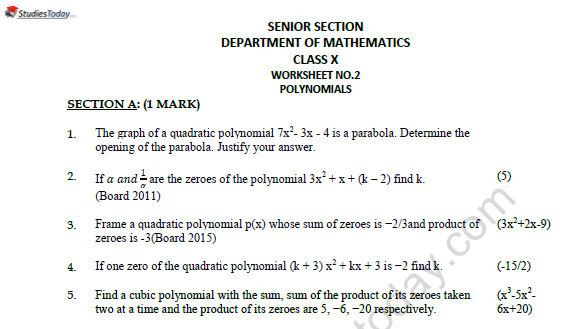
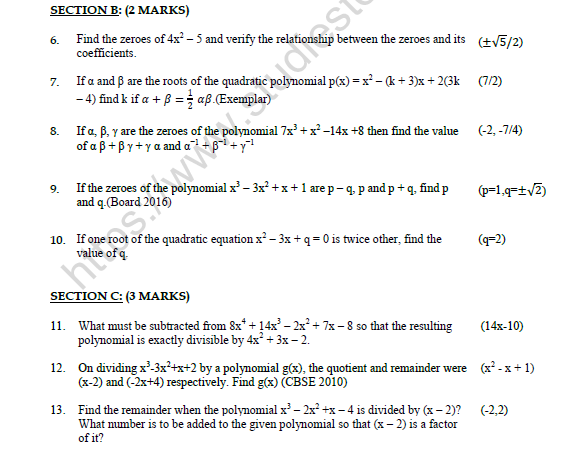
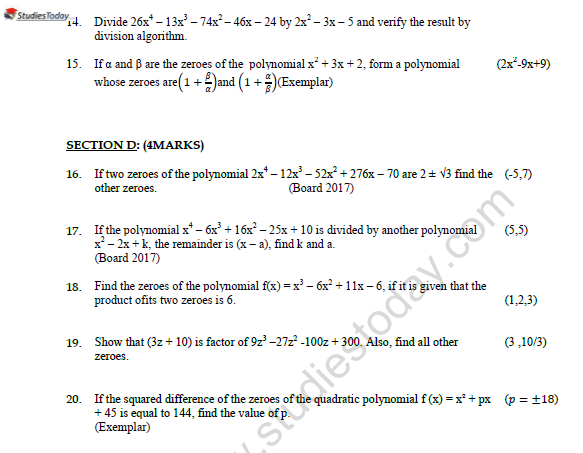
CBSE Class 10 Mathematics Polynomials Worksheet Set BPlease click on below link to download
Free study material for Mathematics
Chapter 2 Polynomials CBSE Class 10 Mathematics Worksheet
Students can use the Chapter 2 Polynomials practice sheet provided above to prepare for their upcoming school tests. This solved questions and answers follow the latest CBSE syllabus for Class 10 Mathematics. You can easily download the PDF format and solve these questions every day to improve your marks. Our expert teachers have made these from the most important topics that are always asked in your exams to help you get more marks in exams.
NCERT Based Questions and Solutions for Chapter 2 Polynomials
Our expert team has used the official NCERT book for Class 10 Mathematics to create this practice material for students. After solving the questions our teachers have also suggested to study the NCERT solutions which will help you to understand the best way to solve problems in Mathematics. You can get all this study material for free on studiestoday.com.
Extra Practice for Mathematics
To get the best results in Class 10, students should try the Mathematics MCQ Test for this chapter. We have also provided printable assignments for Class 10 Mathematics on our website. Regular practice will help you feel more confident and get higher marks in CBSE examinations.
FAQs
You can download the teacher-verified PDF for CBSE Class 10 Mathematics Polynomials Worksheet Set 02 from StudiesToday.com. These practice sheets for Class 10 Mathematics are designed as per the latest CBSE academic session.
Yes, our CBSE Class 10 Mathematics Polynomials Worksheet Set 02 includes a variety of questions like Case-based studies, Assertion-Reasoning, and MCQs as per the 50% competency-based weightage in the latest curriculum for Class 10.
Yes, we have provided detailed solutions for CBSE Class 10 Mathematics Polynomials Worksheet Set 02 to help Class 10 and follow the official CBSE marking scheme.
Daily practice with these Mathematics worksheets helps in identifying understanding gaps. It also improves question solving speed and ensures that Class 10 students get more marks in CBSE exams.
All our Class 10 Mathematics practice test papers and worksheets are available for free download in mobile-friendly PDF format. You can access CBSE Class 10 Mathematics Polynomials Worksheet Set 02 without any registration.