

Download Class 11 Physics Worksheets for Chapter 11 Thermodynamics
Access printable practice worksheets for Chapter 11 Thermodynamics designed to align with the 2026-27 academic syllabus for Class 11 Physics. These structured exercises help students evaluate their conceptual understanding and improve exam readiness.
Access Chapter 11 Thermodynamics Questions and Exercises
View or download the dedicated Chapter 11 Thermodynamics practice resource below. Engaging with these objective and subjective questions daily ensures continuous academic progress and mastery of the 2026-27 curriculum.
Question. During melting of ice, its entropy
(a) increases
(b) decreases
(c) remains same
(d) cannot say
Answer: A
Question. Ice contained in a beaker starts melting when
(a) the specific heat of the system is zero
(b) internal energy of the system remains constant
(c) temperature remains constant
(d) entropy remains constant
Answer: C
Question. A uniform sphere is supplied heat electrically at the centre at a constant rate. In the steady state, steady temperatures are established at all radial locations r, heat flows outwards radial and is ultimately radiated out by the outer surface is otropically. In this steady state, the temperature gradient varies with radial distance r according to
(a) r–1
(b) r–2
(c) r–3
(d) r–3/2
Answer: B
Question. In thermodynamic processes which of the following statements is not true?
(a) In an isochoric process pressure remains constant
(b) In an isothermal process the temperature remains constant
(c) In an adiabatic process PVg = constant
(d) In an adiabatic process the system is insulated from the surroundings
Answer: A
Question. For an ideal gas graph is shown for three processes. Process 1, 2 and 3 are respectively.
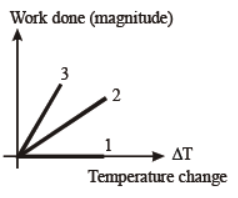
(a) Isobaric, adiabatic, isochoric
(b) Adiabatic, isobaric, isochoric
(c) Isochoric, adiabatic, isobaric
(d) Isochoric, isobaric, adiabatic
Answer: D
Question. The efficiency of carnot engine when source temperature is T1 and sink temperature is T2 will be
(a) T1-T2/T1
(b) T2-T1/T2
(c) T1-T2/T2
(d) T1/T2
Answer: A
Question. In the equation PVγ = constant, the value of γ is unity. Then the process is
(a) isothermal
(b) adiabatic
(c) isobaric
(d) irreversible
Answer: A
Question. For adiabatic processes (Letters have usual meanings)
(a) PγV = constant
(b) TγV = constant
(c) TVγ–1 = constant
(d) TVγ = constant
Answer: C
Question. The gas law PV/T = constant is true for
(a) isothermal changes only
(b) adiabatic changes only
(c) both isothermal and adiabatic changes
(d) neither isothermal nor adiabatic change
Answer: C
Question. When heat is given to a gas in an isothermal change, the result will be
(a) external work done
(b) rise in temperature
(c) increase in internal energy
(d) external work done and also rise in temperature
Answer: A
Question. Which of the following processes is adiabatic ?
(a) Melting of ice
(b) Bursting of tyre
(c) Motion of piston of an engine with constant speed
(d) None of these
Answer: B
Question. Which of the following statements about a thermodynamic process is wrong ?
(a) For an adiabatic process ΔEint = – W
(b) For a constant volume process ΔEint = + Q
(c) For a cyclic process ΔEint = 0
(d) For free expansion of a gas ΔEint > 0
Answer: A
Question. Volume of one mole gas changes according to the V = a/T. If temperature change is DT, then work done will be
(a) RΔT
(b) – RΔT
(c) R/γ-1 ΔT
(d) R (γ – 1) ΔT
Answer: B
Question. Two Carnot engines A and B are operated in series. The engine A receives heat from the source at temperature T1 and rejects the heat to the sink at temperature T. The second engine B receives the heat at temperature T and rejects to its sink at temperature T2. For what value of T the efficiencies of the two engines are equal?
(a) T1+T2/2
(b) T1-T2/2
(c) T1T2
(d) √T1T2
Answer: D
Question. The temperature of 5 moles of a gas which was held at constant volume was changed from 100º to 120ºC. The change in the internal energy of the gas was found to be 80 joule, the total heat capacity of the gas at constant volume will be equal to
(a) 8 joule per K
(b) 0.8 joule per K
(c) 4.0 joule per K
(d) 0.4 joule per K
Answer: C
Question. In changing the state of thermodynamics from A to B state, the heat required is Q and the work done by the system is W. The change in its internal energy is
(a) Q + W
(b) Q – W
(c) Q
(d) Q – W/2
Answer: B
Question. If ΔQ and ΔW represent the heat supplied to the system and the work done on the system respectively, then the first law of thermodynamics can be written as
(a) ΔQ = ΔU + ΔW
(b) ΔQ = ΔU - ΔW
(c) ΔQ = ΔW - ΔU
(d) ΔQ = –ΔW - ΔU
Answer: B
Question. The efficiency of a Carnot engine operating with reservoir temperatures of 100ºC and –23ºC will be
(a) 100+23/100
(b) 100-23/100
(c) 100+23/373
(d) 100-23/373
Answer: C
Question. The work done in which of the following processes is equal to the internal energy of the system?
(a) Adiabatic process
(b) Isothermal process
(c) Isochoric process
(d) None of these
Answer: A
Please click on below link to download pdf file for CBSE Class 11 Physics Thermodynamics Worksheet Set A
Free study material for Physics
Chapter 11 Thermodynamics Practice Sheet and Solutions for Class 11 Physics
CBSE Practice Material: Class 11 Physics Chapter 11 Thermodynamics
Explore reliable practice questions for Chapter 11 Thermodynamics tailored for Class 11 Physics learners. Use these structured worksheets to evaluate preparedness and strengthen problem-solving skills.
NCERT-Aligned Questions and Solutions
Cross-reference your completed exercises with comprehensive NCERT solutions for Class 11 Physics to ensure absolute clarity across all sub-topics in this chapter.
Next Steps in Your Exam Preparation
Wrap up your chapter revision by testing your knowledge against standard question formats. Everything on our platform is provided free of charge.
FAQs
You can download the teacher-verified PDF for CBSE Class 11 Physics Thermodynamics Worksheet Set 01 from StudiesToday.com. These practice sheets for Class 11 Physics are designed as per the latest CBSE academic session.
Yes, our CBSE Class 11 Physics Thermodynamics Worksheet Set 01 includes a variety of questions like Case-based studies, Assertion-Reasoning, and MCQs as per the 50% competency-based weightage in the latest curriculum for Class 11.
Yes, we have provided detailed solutions for CBSE Class 11 Physics Thermodynamics Worksheet Set 01 to help Class 11 and follow the official CBSE marking scheme.
Daily practice with these Physics worksheets helps in identifying understanding gaps. It also improves question solving speed and ensures that Class 11 students get more marks in CBSE exams.
All our Class 11 Physics practice test papers and worksheets are available for free download in mobile-friendly PDF format. You can access CBSE Class 11 Physics Thermodynamics Worksheet Set 01 without any registration.