

Read and download the CBSE Class 10 Mathematics Surface Areas And Volume VBQs Set 01. Designed for the 2026-27 academic year, these Value Based Questions (VBQs) are important for Class 10 Mathematics students to understand moral reasoning and life skills. Our expert teachers have created these chapter-wise resources to align with the latest CBSE, NCERT, and KVS examination patterns.
VBQ for Class 10 Mathematics Chapter 12 Surface Areas and Volumes
For Class 10 students, Value Based Questions for Chapter 12 Surface Areas and Volumes help to apply textbook concepts to real-world application. These competency-based questions with detailed answers help in scoring high marks in Class 10 while building a strong ethical foundation.
Chapter 12 Surface Areas and Volumes Class 10 Mathematics VBQ Questions with Answers
Question. In a city the corporation supplies water to 35 houses in a street through a cylindrical tank of diameter 42cm and length 105cm.On a particular day due to the leakage in the tank water was sufficient only to 25houses.The people in the street told the water man to distribute the available water to all the 35 houses.
CONTEXTUAL QUESTION
(i) How much water each house gets on any day?
(ii) How much water each house gets on the day there was leakage in the tank?
VALUE BASED QUESTION
(iii) What values (any two) the people in the street possess?
KEY POINTS.
* Sharing
* Care for others
* Selflessness
* Unity
* Self discipline
* Concern for others
* Responsible citizen
* Right for equality.
Question. Asha and Usha are two sisters of Rohan. On a Rakhee day Rohan gave 16 Laddus (sweet, Sphere in shape)of diameter 6cm to Asha and 2 laddus of radius 6cm to Usha.
CONTEXTUAL QUESTION
(i) To which sister Rohan gave more sweets?
VALUE BASED QUESTION
(ii) What value Rohan possess in distributing the sweets to his sisters?
KEY POINTS.
*Impartial
*Responsible
*Concern
*Sensitive
CASE STUDY BASED
Case Study 1. Arun a 10th standard student makes a project on corona virus in science for an exhibition in his school. In this project, he picks a sphere which has volume 38808 cm3 and 11 cylindrical shapes, each of volume 1540 cm3 with length 10 cm. Based on the above information, answer the following questions.
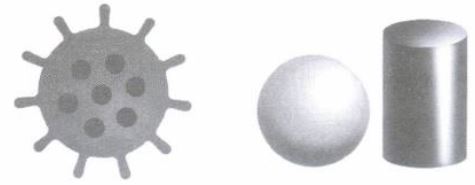
(ii) Diameter of the sphere is
Answer : 42cm
(iii) Total volume of the shape formed is
Answer : 55748cm3
(iv) Curved surface area of the one cylindrical shape is
Answer : 440 cm2
(v) Total area covered by cylindrical shapes on the surface of sphere is
Answer : 539 𝜋 cm2
CASE STUDY 2. A carpenter used to make and sell different kinds of wooden pen stands like rectangular, cuboidal, cylindrical, conical. Aanav went to his shop and asked him to make a pen stand as explained below. Pen stand must be of the cuboidal shape with three conical depressions, which can hold 3 pens. The dimensions of the cuboidal part must be 20 cm x 15 cm x 5 cm and the radius and depth of each conical depression must be 0.6 cm and 2.1cm respectively.
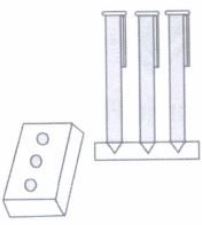
Based on the above information, answer the following questions.
(i) The volume of the cuboidal part is ---------------
Answer : 1500cm3
(ii) Total volume of conical depressions is ----------------
Answer : 2.376 cm3
(iii) Volume of the wood used in the entire stand is ------------
Answer : 1497.624 cm3
(iv) If the cost of wood used is Rs 0.05 per cm3, then the total cost of making the pen stand is ---
Answer : Rs 748.80 approx)
ASSERTION REASONING
Question. Assertion: a cylinder and right circular cone are having the same base and same height the volume of cylinder is three times the volume of cone
Reason: if the radius of cylinder is doubled and height is halved the volume will be doubled
a) both Assertion and reason are correct and reason is correct explanation for Assertion
b) both Assertion and reason are correct but reason is not correct explanation for Assertion
c) Assertion is correct but reason is false
d) both Assertions and reason are false
Answer : B
Question. Assertion: the lateral surface area of a right cone is 62.82 if the radius is 4 cm and the slant height is 5 cm.
Reason: lateral surface area of cone = πrl
a) both Assertion and reason are correct and reason is correct explanation for Assertion
b) both Assertion and reason are correct but reason is not correct explanation for Assertion
c) Assertion is correct but reason is false
d) both Assertions and reason are false
Answer : A
Question. Assertion: the perpendicular distance between two bases is the height of cylinder
Reason: the line segment joining the centre of two bases is the axis of cylinder
a) both Assertion and reason are correct and reason is correct explanation for Assertion
b) both Assertion and reason are correct but reason is not correct explanation for Assertion
c) Assertion is correct but reason is false
d) both Assertions and reason are false
Answer : B
Question. Assertion: volume of cuboid is defined as the amount of space occupied by the walls of cuboid in three dimensional space
Reason: volume of cuboid is the product of length ,width ,height
a) both Assertion and reason are correct and reason is correct explanation for Assertion
b) both Assertion and reason are correct but reason is not correct explanation for Assertion
c) Assertion is correct but reason is false
d) both Assertions and reason are false
Answer : B
Question. Assertion: a sphere is a symmetrical object
Reason: a sphere had an only a curved surface no flat surface no edge and no vertices
a) both Assertion and reason are correct and reason is correct explanation for Assertion
b) both Assertion and reason are correct but reason is not correct explanation for Assertion
c) Assertion is correct but reason is false
d) both Assertions and reason are false
Answer : B
Very Short Answer type Questions
Question. The height of a cone is 42 cm. A small cone is cut off at the top by a plane parallel to the base. If its volume is 1/64 of the volume of the given cone, find the height at which the section is made.
Answer : 10.5 cm
Question. A juice seller was serving his customers using glasses as shown in Fig. The inner diameter of the cylindrical glass was 5 cm, but the bottom of the glass had a hemispherical raised portion which reduced the capacity of the glass. If the height of a glass was 10 cm, find the apparent capacity of the glass and its actual capacity. (Use π = 3.14.)
Answer : 163.54 cm2
Question. A cistern, internally measuring 150 cm × 120 cm × 110 cm, has 129600 cm3 of water in it. Porous bricks are placed in the water until the cistern is full to the brim. Each brick absorbs one-seventeenth of its own volume of water. How many bricks can be put in without overflowing the water, each brick being 22.5 cm × 7.5 cm × 6.5 cm?.
Answer : 1792
Question. A solid toy is in the form of a hemisphere surmounted by a right circular cone. The height of the cone is 2 cm and the diameter of the base is 4 cm. Determine the volume of the toy. If a right circular cylinder circumscribes the toy, find the difference of the volumes of the cylinder and the toy. (Take π = 3.14)
Answer : 25.12 cm3. 25.12 cm3
Question. A sector of circle of radius 15 cm has the angle 120°. It is rolled up so that two boundary radii are joined together to form a cone. Find the volume of cone.
Answer : 250√23𝜋 cm3
Question. A right triangle, whose sides are 3 cm and 4 cm (other than hypotenuse) is made to revolve about its hypotenuse. Find the volume and surface area of the double cone so formed. (Choose value of π as found appropriate.)
Answer : 30.14 cm3 ; 52.75 cm2)
Question. A tent is in the shape of a right circular cylinder surmounted by a cone. The total height and the diameter of the base are 13.5 m and 28 m. If the height of the cylindrical portion is 3 m, find the total surface area of the tent.
Answer : 287 𝜋 cm2
Question. A copper wire, 3 mm in diameter, is wound about a cylinder whose length is 12 cm, and diameter 10 cm, so as to cover the curved surface of the cylinder. Find the length and mass of the wire, assuming the density of copper to be 8.88 g per cm3 .
Answer : 1256 cm; 788g app
Question. 2 cubes each of volume 64 cm3 are joined end to end. Find the surface area of the resulting cuboid.
Answer : 160 cm2
Question. Rachel, an engineering student, was asked to make a model shaped like a cylinder with two cones attached at its two ends by using a thin aluminium sheet. The diameter of the model is 3 cm and its length is 12 cm. If each cone has a height of 2 cm, find the volume of air contained in the model that Rachel made. (Assume the outer and inner dimensions of the model to be nearly the same.)
Answer : 66 cm3.
Question. A toy is in the form of a cone of radius 3.5 cm mounted on a hemisphere of same radius. The total height of the toy is 15.5 cm. Find the total surface area of the toy.
Answer : 214.5 cm2
Question. A solid consisting of a right circular cone of height 120 cm and radius 60 cm standing on a hemisphere of radius 60 cm is placed upright in a right circular cylinder full of water such that it touches the bottom. Find the volume of water left in the cylinder, if the radius of the cylinder is 60 cm and its height is 180 cm.
Answer : 1.131 m3 (approx.)
Question. A hemispherical depression is cut out from one face of a cubical wooden block such that the diameter l of the hemisphere is equal to the edge of the cube. Determine the surface area of the remaining solid.
Answer : (1/4)l2 (π +24)
Question. A vessel is in the form of an inverted cone. Its height is 8 cm and the radius of its top, which is open, is 5 cm. It is filled with water up to the brim. When lead shots, each of which is a sphere of radius 0.5 cm are dropped into the vessel, one-fourth of the water flows out. Find the number of lead shots dropped in the vessel.
Answer : 100
Question. From a solid cylinder whose height is 2.4 cm and diameter 1.4 cm, a conical cavity of the same height and same diameter is hollowed out. Find the total surface area of the remaining solid to the nearest cm2.
Answer : 18 cm2
Question. A solid is in the shape of a cone standing on a hemisphere with both their radii being equal to 1 cm and the height of the cone is equal to its radius. Find the volume of the solid in terms of π.
Answer : π cm3
Question. A vessel is in the form of a hollow hemisphere mounted by a hollow cylinder. The diameter of the hemisphere is 14 cm and the total height of the vessel is 13 cm. Find the inner surface area of the vessel.
Answer : 572 cm2
Question. A solid iron pole consists of a cylinder of height 220 cm and base diameter 24 cm, which is surmounted by another cylinder of height 60 cm and radius 8 cm. Find the mass of thepole, given that 1 cm3 of iron has approximately 8g mass. (Use π = 3.14)
Answer : 892.26 kg
Question. A tent is in the shape of a cylinder surmounted by a conical top. If the height and diameter of the cylindrical part are 2.1 m and 4 m respectively, and the slant height of the top is 2.8 m, find the area of the canvas used for making the tent. Also, find the cost of the canvas of the tent at the rate of ₹500 per m2.
Answer : 44 m2, Rs 22000
Question. A spherical glass vessel has a cylindrical neck 8 cm long, 2 cm in diameter; the diameter of the spherical part is 8.5 cm. By measuring the amount of water it holds, a child finds itsvolume to be 345 cm3. Check whether she is correct, taking the above as the inside measurements, and π = 3.14.
Answer : Not correct. Correct answer is 346.51 cm3.
Question. A cubical block of side 7 cm is surmounted by a hemisphere. What is the greatest diameter the hemisphere can have? Find the surface area of the solid.
Answer : Greatest diameter = 7 cm, surface area = 332.5 cm2
Free study material for Mathematics
VBQs for Chapter 12 Surface Areas and Volumes Class 10 Mathematics
Students can now access the Value-Based Questions (VBQs) for Chapter 12 Surface Areas and Volumes as per the latest CBSE syllabus. These questions have been designed to help Class 10 students understand the moral and practical lessons of the chapter. You should practicing these solved answers to improve improve your analytical skills and get more marks in your Mathematics school exams.
Expert-Approved Chapter 12 Surface Areas and Volumes Value-Based Questions & Answers
Our teachers have followed the NCERT book for Class 10 Mathematics to create these important solved questions. After solving the exercises given above, you should also refer to our NCERT solutions for Class 10 Mathematics and read the answers prepared by our teachers.
Improve your Mathematics Scores
Daily practice of these Class 10 Mathematics value-based problems will make your concepts better and to help you further we have provided more study materials for Chapter 12 Surface Areas and Volumes on studiestoday.com. By learning these ethical and value driven topics you will easily get better marks and also also understand the real-life application of Mathematics.
FAQs
The latest collection of Value Based Questions for Class 10 Mathematics Chapter 12 Surface Areas and Volumes is available for free on StudiesToday.com. These questions are as per 2026 academic session to help students develop analytical and ethical reasoning skills.
Yes, all our Mathematics VBQs for Chapter 12 Surface Areas and Volumes come with detailed model answers which help students to integrate factual knowledge with value-based insights to get high marks.
VBQs are important as they test student's ability to relate Mathematics concepts to real-life situations. For Chapter 12 Surface Areas and Volumes these questions are as per the latest competency-based education goals.
In the current CBSE pattern for Class 10 Mathematics, Chapter 12 Surface Areas and Volumes Value Based or Case-Based questions typically carry 3 to 5 marks.
Yes, you can download Class 10 Mathematics Chapter 12 Surface Areas and Volumes VBQs in a mobile-friendly PDF format for free.