

Read the CBSE Class 6 Science Fibre to Fabric Exam Notes below. Find downloadable advanced study resources for 2026-27 built to support Class 6 Science students with thorough revision notes and question sets. Each guide follows current testing guidelines from CBSE, NCERT, and KVS.
Download Class 6 Science Chapter 3 Fibre to Fabric Advanced Notes
Check out this Class 6 Chapter 3 Fibre to Fabric study material to gain an edge in Science. Packed with clear concept overviews and solved practice questions, these resources help Class 6 learners grasp difficult topics quickly.
Get Chapter 3 Fibre to Fabric Study Material PDF for Class 6 Science
CBSE Class 6 Science Fibre to Fabric Exam Notes. There are many more useful educational material which the students can download in pdf format and use them for studies. Study material like concept maps, important and sure shot question banks, quick to learn flash cards, flow charts, mind maps, teacher notes, important formulas, past examinations question bank, important concepts taught by teachers. Students can download these useful educational material free and use them to get better marks in examinations. Also refer to other worksheets for the same chapter and other subjects too. Use them for better understanding of the subjects.
Fibre to Fabric
Animal Fibre — Wool and Silk
Wool: Wool comes from sheep, goat, yak and some other animals. These wool-yielding animals bear hair on their body. Hair trap a lot of air. Air is a poor conductor of heat. So, hair keeps these animals warm. Wool is derived from these hairy fibres.
Animals that yield wool
Several breeds of sheep are found in different parts of our country. However, the fleece of sheep is not the only source of wool. Though sheey wool is commonly available in the market, Yak wool is common in Tibet and Ladakh, Angora wool is obtained from angora goats. Wool is also obtained from goat hair. The under fur of Kashmiri goat is soft. It is woven into fine shawls called Pashmina shawls. The fur (hair) on the body of camels is also used as wool. Llama and Alpaca, found in South America, also yield wool.
From Fibres to Wool
Rearing and breeding of Sheep: Shepherds taking their herds of sheep for grazing. Sheeps are herbivores and prefer grass and leaves. Apart from grazing sheep, rearers also feed them on a mixture of pulses, corn, jowar, oil cakes (material left after taking out oil from seeds) and minerals.
Certain breeds of sheep have thick coat of hair on their body which yields good quality wool in large quantities. As mentioned earlier, these sheep are “selectively bred” with one parent being a sheep of good breed.
Processing Fibres into Wool
The wool which is used for knitting sweaters or for weaving shawls is the finished product of a long process, which involves the following steps:
Step I: The fleece of this sheep along with a thin layer of skin is removed from its body. This process is called Shearing.
Step II: The sheared skin with hair is thoroughly washed in tanks to remove grease, dust, and dirt. This is called Scouring.
Step III: After scouring, sorting is done. The hairy skin is sent to a factory where hair of different textures are separated or sorted.
Step IV: The small fluffy fibres, called burrs, are picked out from the hair. These are the same burrs which sometimes appear on your sweaters. The fibres are scoured again and dried. This is the wool ready to be drawn into fibres.
Step V: The fibres can be dyed in various colours, as the natural fleece of sheep and goats is black, brown or white.
Step VI: The fibres are straightened, combed and rolled into yarn. The longer fibres are made into wool for sweaters and the shorter fibres are spun and woven into woollen cloth.
Wool industry is an important means of livelihood for many people in our country. But sorter’s job risky as sometimes they get infected by a bacterium, anthrax, which causes a fatal blood disease called Sorter’s disease.
Silk
Silk fibres are also animal fibres. Silkworms spin the ‘silk fibres’. The rearing of silkworms for obtaining silk is called sericulture.
Life History of Silk Moth
The female silk moth lays eggs, hatch larvae which are called caterpillars or silkworms. They grow in size and when the caterpillar is ready to enter the next stage of its life history called pupa, it first weaves a net to hold itself. During these movements of the head, the caterpillar secretes fibre made of protein which hardens on exposure to air and becomes silk fibre. Soon the caterpillar completely covers itself by silk fibres. This covering is known as cocoon. The further development of the moth continues inside the cocoon. Silk fibres are used for weaving silk cloth. Can you imagine that the soft silk yarn is as strong as a comparable thread of steel.
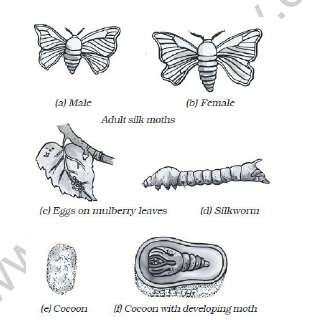
The silk yarn (thread) is obtained from the cocoon of the silk moth. There is a variety of silk moths which look very different from one another and the silk yarn they yield is different in texture (coarse, smooth, shiny, etc.). Thus, tassar silk, mooga silk, kosa silk etc., are obtained from cocoons spun by different types of moths. The most common silk moth is the mulberry silk moth. The silk fibre from the cocoon of this moth is soft, lustrous and elastic and can be dyed in beautiful colours.
From Cocoon to Silk
Rearing silkworms: A female silk moth lays hundreds of eggs at a time. The eggs are stored carefully on strips of cloth or paper and sold to silkworm farmers. The farmers keep eggs under hygienic conditions and under suitable conditions of temperature and humidity.
The eggs are warmed to a suitable temperature for the larvae to hatch from eggs. This is done when mulberry trees bear a fresh crop of leaves. The larvae, called caterpillars or silkworms, eat day and night and increase enormously in size.
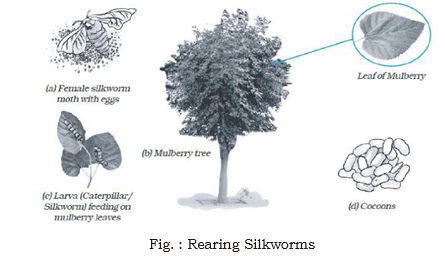
The worms are kept in clean bamboo trays along with freshly chopped mulberry leaves. After 25 to 30 days, the caterpillars stop eating and move to a tiny chamber of bamboo in the tray to spin cocoons. Small racks or twigs may be provided in the trays to which cocoons get attached. The caterpillar or silkworm spins the cocoon inside which develops the silk moth.
Processing silk: A pile of cocoons is used for obtaining silk fibres. The cocoons are kept under the sun or boiled or exposed to steam. The silk fibres separate out. The process of taking out threads from the cocoon for use as silk is called reeling the silk.
Polymers
Polymers are high molecular mass substances consisting of large number of repeating structural units derived from simple molecules called as monomers.
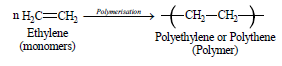
Monomers: The simple molecules which combine to give polymers are called monomers. The process by which the simple molecules (i.e. monomers) are converted into polymers is called polymerisation.
Homopolymer: A polymer formed from one type of monomers is called homopolymer. For example.
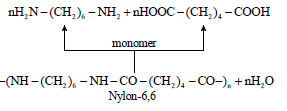
Co-polymer: A polymer formed from two or more different monomers is called co-polymer or mixed polymers.
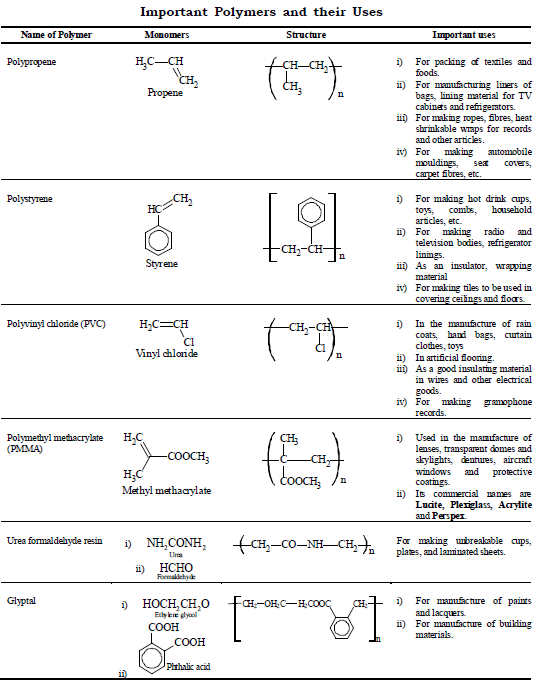
Classification of Polymers on Basis of Molecular Forces
A large number of applications of polymers depend upon their mechanical properties such as tensile strength, elasticity, toughness, etc.
Depending upon the intermolecular forces, the polymers have been classified into four types:
- Elastomers
- Fibres
- Thermoplastics
- Thermosetting polymers
1. Elastomers: The polymers that have elastic character like rubber are called elastomer E.g. buna-S, buna-N etc.
2. Fibres: These are the polymers which have strong intermolecular forces between the chains.The common examples are Nylon-66, Terylene, Silk etc.
3. Thermoplastics: These are the polymers which can be easily softened repeatedly when heated and hardened and cooled with little change in their properties. Common example of thermoplastics are polythene, polystyrene, polyvinyl chloride, teflon, etc.
4. Thermosetting polymers: These are the polymers which undergo permanent change on heating. The common examples are Bakelite, Melamine, Urea formaldehyde etc.
Natural and Synthetic Rubbers
Natural Rubber: Rubber is a naturally occurring polymer. It is obtained as latex from rubber trees. Rubber latex is a colloidal suspension of rubber in water. Rubber trees are found in tropical and semi-tropical countries such as India (southern part), Malaysia, Indonesia, Ceylon, South America, etc. It is highly elastic. It can be elastically deformed but regains its original shape after the stress is relieved. This elasticity makes it a valuable for variety of uses.
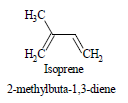
Natural rubber is a polymer of isoprene (2-methyl buta-1, 3-diene)
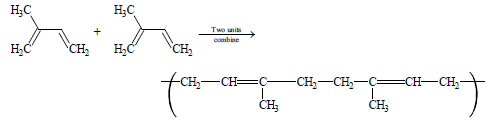
In natural rubber, about 11,000 to 20,000 isoprene units are linked together in a chain like arrangement as shown below:
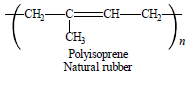
When n isoprene units combine, the polymer has the formula
Vulcanization of Rubber
The process of heating natural rubber with sulphur to improve its properties is called vulcanization.
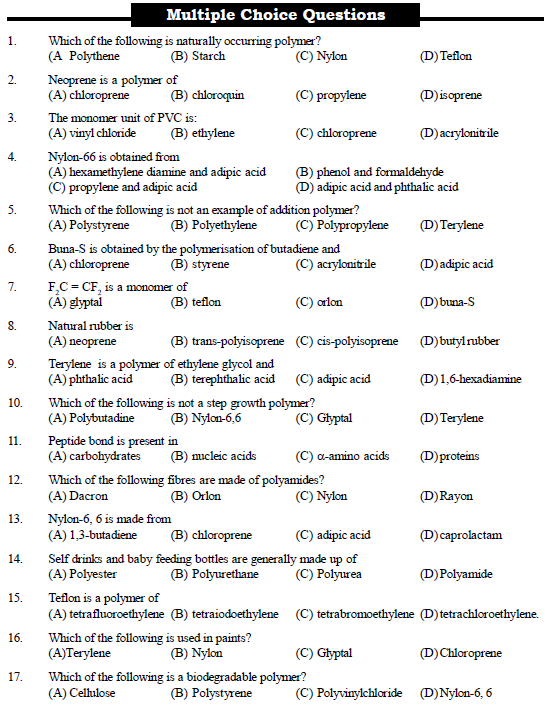
Please click the link below to download CBSE Class 6 Science Fibre to Fabric Exam Notes.
Free study material for Science
CBSE Class 6 Science Study Material: Chapter 3 Fibre to Fabric
Comprehensive Study Resources for Chapter 3 Fibre to Fabric
Gather all necessary academic resources for Chapter 3 Fibre to Fabric on this dedicated page. Formulated in direct alignment with the active 2026 standards for Class 6 Science, the pack offers thorough notes, handy Mind Maps, and exam-focused Sure Shot Questions for CBSE exams. Instructors advise leveraging these assets daily to optimize study speed.
Expert-Crafted Notes & Previous Questions
Drawing directly from the authorized NCERT book for Class 6 Science, our faculty built these guides to ensure standard compliance. They feature past examination questions coupled with detailed, step-by-step solutions that demystify board grading criteria. Following your review of the notes, tackle the exercise problems and cross-verify with our official NCERT solutions for Class 6 Science.
Complete Revision for Science
To get the best marks in your Class 6 exams you should use Science Sample Papers along with these chapter notes. Daily practicing with our online MCQ Tests for Chapter 3 Fibre to Fabric will also help you improve your speed and accuracy. All the study material provided on studiestoday.com is free and updated regularly to help Class 6 students stay ahead in their studies and feel confident during their school tests.
FAQs
Our advanced study package for Chapter 3 Fibre to Fabric includes detailed concepts, diagrams, Mind Maps, and explanation of complex topics to ensure Class 6 students learn as per syllabus for 2026 exams.
The Mind Maps provided for Chapter 3 Fibre to Fabric act as visual anchors which will help faster recall during high-pressure exams.
Yes, teachers use our Class 6 Science resources for lesson planning as they are in simple language and have lot of solved examples.
Yes, You can download the complete, mobile-friendly PDF of the Science Chapter 3 Fibre to Fabric advanced resources for free.
Yes, our subject matter experts have updated the Chapter 3 Fibre to Fabric material to align with the rationalized NCERT textbooks and have removed deleted topics and added new competency-based questions.