

Chapter-wise Worksheets for Class 10 Mathematics: Chapter 07 Coordinate Geometry
Explore structured practice materials through the CBSE Class 10 Mathematics Coordinate Geometry Worksheet Set 05. Tailored for Class 10 learners, utilizing these Mathematics worksheets ensures thorough preparation and strengthens problem-solving accuracy before final school evaluations.
Practice Class 10 Mathematics Worksheets: Chapter 07 Coordinate Geometry
Navigate directly to the solved Mathematics worksheets using the digital viewer below. Each practice set includes detailed step-by-step solutions, allowing students to instantly cross-check their work and identify areas requiring further revision.
Case Study Based Questions
I. Student of a school are standing in rows and columns in a playground for a drill practice.
A, B, C, D are the positions of four students as shown in the figure
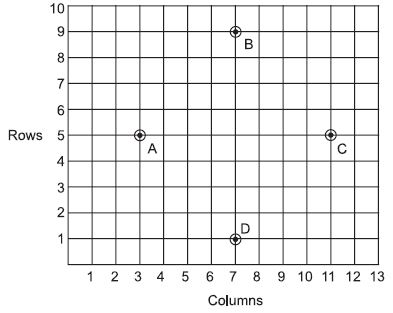
Question. The coordinates of A and B are respectively
(a) (3, 5) and (7, 9)
(b) (5, 3) and (9, 7)
(c) (–3, –5) and (7, 9)
(d) (3, 5) and (–7, –9)
Answer : A
Question. The coordinates of the points C and D are respectively
(a) (5, 11) and (1, 7)
(b) (11, 5) and (7, 1)
(c) (–5, –11) and (–1, –7)
(d) (5, 11) and (–1, –7)
Answer : B
Question. The distance between A and B is
(a) 4√2 units
(b) 3√2 units
(c) 5√2 units
(d) 2√2 units
Answer : A
Question. The distance between A and C is
(a) 8 units
(b) 8√2 units
(c) 5√2 units
(d) 3√2 units
Answer : A
Question. The coordinates of the point which is equidistant from each of the four students A, B, C and D are
(a) (5, 7)
(b) (–5, –7)
(c) (–7, –5)
(d) (7, 5)
Answer : D
II. Three friends are playing in a ground to form a triangle. They are standing at the vertex of the triangle having coordinates A(2a, 4a), B(2a, 6a) and C(2a + a√3 , 5a). Teacher wants to check the some measurements of the triangle and ask few questions. Answer them.

Question. Length of AB is
(a) 2a
(b) 4a
(c) 8a
(d) 6a
Answer : A
Question. Length between the points B and C is
(a) a
(b) 2a
(c) 4a
(d) 6a
Answer : B
Question. Length between the point A and C is
(a) a
(b) 2a
(c) 3a
(d) 4a
Answer : B
Question. Mid-point of AB is
(a) (2a, 5a)
(b) (4a, 5a)
(c) (2a, 3a)
(d) (5a, 4a)
Answer : A
Question. Height of triangle =
(a) √2a
(b) 3a
(c) √3a
(d) √5a
Answer : C
III. Kartikeya starts walking from his house to office. Instead of going to the office directly, he goes to the bank first, from there to his daughter’s school and then reaches the office. Assuming that all distances covered are in straight lines and if the coordinates of house at (2, 4), bank at (5, 8), school at (13, 14) and office (13, 26) are represented in km. Then find answer from question (1) to question (5).
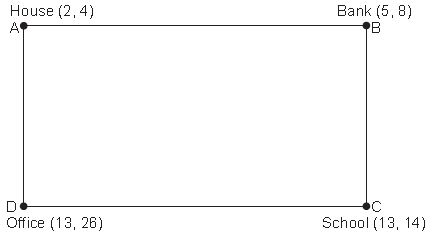
Question. Total distance covered by Kartikeya is
(a) 27 km
(b) 24 km
(c) 30 km
(d) 18 km
Answer : A
Question. Extra distance travelled by Kartikeya in reaching his office is
(a) 1.5 km
(b) 3.7 km
(c) 2.41 km
(d) 4 km
Answer : C
Question. Distance travelled by Kartikeya in reaching his daughter’s school is
(a) 14 km
(b) 20 km
(c) 15 km
(d) 10 km
Answer : A
Question. The shortest distance between his house and the office is
(a) 12.53 km
(b) 20.53 km
(c) 14.53 km
(d) 24.59 km
Answer : D
Question. The distance between his daughter’s school and his office is
(a) 10 km
(b) 12 km
(c) 16 km
(d) 18 km
Answer : B
Question 1. Show that the points (a, a), (-a, - a) and (- √3a, √3a) are the vertices of an equilateral Δ
Answer: Let us denote the given vertices as \( A(a, a) \), \( B(-a, -a) \), and \( C(-\sqrt{3}a, \sqrt{3}a) \).
Using the distance formula, we find the lengths of the three sides of the triangle:
\( AB = \sqrt{(-a - a)^2 + (-a - a)^2} \)
\( \implies AB = \sqrt{(-2a)^2 + (-2a)^2} = \sqrt{4a^2 + 4a^2} = \sqrt{8a^2} = 2\sqrt{2}a \)
\( BC = \sqrt{(-\sqrt{3}a - (-a))^2 + (\sqrt{3}a - (-a))^2} \)
\( \implies BC = \sqrt{(a - \sqrt{3}a)^2 + (a + \sqrt{3}a)^2} \)
\( \implies BC = \sqrt{a^2(1 - 2\sqrt{3} + 3) + a^2(1 + 2\sqrt{3} + 3)} \)
\( \implies BC = \sqrt{a^2(4 - 2\sqrt{3}) + a^2(4 + 2\sqrt{3})} \)
\( \implies BC = \sqrt{a^2(4 - 2\sqrt{3} + 4 + 2\sqrt{3})} = \sqrt{8a^2} = 2\sqrt{2}a \)
\( CA = \sqrt{(a - (-\sqrt{3}a))^2 + (a - \sqrt{3}a)^2} \)
\( \implies CA = \sqrt{(a + \sqrt{3}a)^2 + (a - \sqrt{3}a)^2} \)
\( \implies CA = \sqrt{a^2(1 + 2\sqrt{3} + 3) + a^2(1 - 2\sqrt{3} + 3)} \)
\( \implies CA = \sqrt{a^2(8)} = \sqrt{8a^2} = 2\sqrt{2}a \)
Since the lengths of all three sides are equal (\( AB = BC = CA \)), the given coordinates form an equilateral triangle.
In simple words: We calculate the length of each side using the distance formula. Because all three sides turn out to be exactly the same length, the shape is an equilateral triangle.
Exam Tip: When evaluating terms like \( (1 \pm \sqrt{3})^2 \), expand them carefully using algebraic identity formulas to ensure that the irrational terms cancel out smoothly.
Question 2. Show that four points (0,-1), (6, 7), (-2, 3) and (8, 3) are the vertices of a rectangle
Answer: Let us label the given points as \( A(0, -1) \), \( B(6, 7) \), \( C(8, 3) \), and \( D(-2, 3) \).
Using the distance formula, we calculate the lengths of the four sides of this quadrilateral:
\( AB = \sqrt{(6-0)^2 + (7 - (-1))^2} = \sqrt{6^2 + 8^2} = \sqrt{36 + 64} = 10 \)
\( BC = \sqrt{(8-6)^2 + (3-7)^2} = \sqrt{2^2 + (-4)^2} = \sqrt{4 + 16} = \sqrt{20} \)
\( CD = \sqrt{(-2-8)^2 + (3-3)^2} = \sqrt{(-10)^2 + 0} = 10 \)
\( DA = \sqrt{(0 - (-2))^2 + (-1-3)^2} = \sqrt{2^2 + (-4)^2} = \sqrt{4 + 16} = \sqrt{20} \)
Since the opposite sides are equal in length (\( AB = CD = 10 \) and \( BC = DA = \sqrt{20} \)), the shape is a parallelogram.
To prove it is a rectangle, we also calculate the lengths of the two diagonals \( AC \) and \( BD \):
\( AC = \sqrt{(8-0)^2 + (3 - (-1))^2} = \sqrt{8^2 + 4^2} = \sqrt{64 + 16} = \sqrt{80} \)
\( BD = \sqrt{(-2-6)^2 + (3-7)^2} = \sqrt{(-8)^2 + (-4)^2} = \sqrt{64 + 16} = \sqrt{80} \)
Since both diagonals are also equal in length (\( AC = BD = \sqrt{80} \)), the given vertices form a rectangle.
In simple words: By finding the side lengths, we see that the opposite sides are equal, which makes the shape a parallelogram. Because the two corner-to-corner diagonal measurements are also equal, it is confirmed to be a rectangle.
Exam Tip: Simply showing that opposite sides are equal only proves the shape is a parallelogram. You must show the diagonals are equal to prove it is a rectangle.
Question 3. Prove that (4, -1), (6, 0), (7, 2) and (5, 1) are the vertices of a rhombus. Is it a square?
Answer: Let us define the points as \( A(4, -1) \), \( B(6, 0) \), \( C(7, 2) \), and \( D(5, 1) \).
First, we determine the lengths of the sides using the distance formula:
\( AB = \sqrt{(6-4)^2 + (0 - (-1))^2} = \sqrt{2^2 + 1^2} = \sqrt{5} \)
\( BC = \sqrt{(7-6)^2 + (2-0)^2} = \sqrt{1^2 + 2^2} = \sqrt{5} \)
\( CD = \sqrt{(5-7)^2 + (1-2)^2} = \sqrt{(-2)^2 + (-1)^2} = \sqrt{5} \)
\( DA = \sqrt{(4-5)^2 + (-1-1)^2} = \sqrt{(-1)^2 + (-2)^2} = \sqrt{5} \)
Since all four sides are equal in length (\( AB = BC = CD = DA = \sqrt{5} \)), the given points form a rhombus.
Now, we check if it is a square by finding the lengths of the diagonals \( AC \) and \( BD \):
\( AC = \sqrt{(7-4)^2 + (2 - (-1))^2} = \sqrt{3^2 + 3^2} = \sqrt{18} = 3\sqrt{2} \)
\( BD = \sqrt{(5-6)^2 + (1-0)^2} = \sqrt{(-1)^2 + 1^2} = \sqrt{2} \)
Since the diagonals are not equal in length (\( 3\sqrt{2} \neq \sqrt{2} \)), the given vertices do not form a square.
In simple words: All four sides are equal, which proves the shape is a rhombus. However, since the diagonal lines are of different lengths, it cannot be a square.
Exam Tip: A square is a special type of rhombus with equal diagonals. Always compute diagonal lengths to distinguish between a regular rhombus and a square.
Question 4. Show that the following points are the vertices of a right angled isosceles triangle: (1, 2), (1, 5) and (4, 2)
Answer: Let us label the points as \( A(1, 2) \), \( B(1, 5) \), and \( C(4, 2) \).
Using the distance formula, we find the lengths of the three sides:
\( AB = \sqrt{(1-1)^2 + (5-2)^2} = \sqrt{0 + 3^2} = 3 \)
\( BC = \sqrt{(4-1)^2 + (2-5)^2} = \sqrt{3^2 + (-3)^2} = \sqrt{9 + 9} = \sqrt{18} = 3\sqrt{2} \)
\( CA = \sqrt{(1-4)^2 + (2-2)^2} = \sqrt{(-3)^2 + 0} = 3 \)
Since two sides are equal (\( AB = CA = 3 \)), the triangle is isosceles.
Next, we check if the sides satisfy Pythagoras' theorem:
\( AB^2 + CA^2 = 3^2 + 3^2 = 9 + 9 = 18 \)
\( BC^2 = (3\sqrt{2})^2 = 18 \)
Since \( AB^2 + CA^2 = BC^2 \), the triangle is a right-angled triangle.
Thus, the points are the vertices of a right-angled isosceles triangle.
In simple words: Two of the sides are 3 units long, meaning the triangle is isosceles. Since the squares of these two sides add up to the square of the longest side, it also has a right angle.
Exam Tip: Verify both conditions separately - first show that two side lengths are equal, and then use the converse of the Pythagorean theorem to confirm the right angle.
Question 5. Find a relation between x and y such that the point (x, y) is equidistant from the points (7, 1) and (3, 5) (x - y = 2)
Answer: Let \( P(x, y) \) be equidistant from \( A(7, 1) \) and \( B(3, 5) \). Since the distances are equal, we can write:
\( PA = PB \)
\( \implies PA^2 = PB^2 \)
Applying the distance formula:
\( (x - 7)^2 + (y - 1)^2 = (x - 3)^2 + (y - 5)^2 \)
\( \implies x^2 - 14x + 49 + y^2 - 2y + 1 = x^2 - 6x + 9 + y^2 - 10y + 25 \)
Cancel \( x^2 \) and \( y^2 \) from both sides of the equation:
\( \implies -14x - 2y + 50 = -6x - 10y + 34 \)
Rearranging the terms to one side:
\( \implies -14x + 6x - 2y + 10y + 50 - 34 = 0 \)
\( \implies -8x + 8y + 16 = 0 \)
Dividing the entire equation by \( -8 \):
\( \implies x - y - 2 = 0 \)
\( \implies x - y = 2 \).
This is the required relationship between \( x \) and \( y \).
In simple words: We set the distance from \( (x, y) \) to both points as equal. After simplifying the squared terms, we get a simple linear equation, which is \( x - y = 2 \).
Exam Tip: The relation representing points equidistant from two fixed coordinates is always a straight line, which geometrically acts as the perpendicular bisector of the segment joining them.
Question 6. If the distance of P(x, y) from the points A (3, 6) and B (-3, 4) are equal, prove that 3x + y = 5
Answer: It is given that \( P(x, y) \) is equidistant from \( A(3, 6) \) and \( B(-3, 4) \), which means:
\( PA = PB \)
\( \implies PA^2 = PB^2 \)
Using the distance formula:
\( (x - 3)^2 + (y - 6)^2 = (x - (-3))^2 + (y - 4)^2 \)
\( \implies (x - 3)^2 + (y - 6)^2 = (x + 3)^2 + (y - 4)^2 \)
Expanding both sides:
\( \implies x^2 - 6x + 9 + y^2 - 12y + 36 = x^2 + 6x + 9 + y^2 - 8y + 16 \)
Simplify by cancelling \( x^2 \) and \( y^2 \):
\( \implies -6x - 12y + 45 = 6x - 8y + 25 \)
Move all terms to one side:
\( \implies 6x + 6x - 8y + 12y + 25 - 45 = 0 \)
\( \implies 12x + 4y - 20 = 0 \)
Divide the equation by 4:
\( \implies 3x + y - 5 = 0 \)
\( \implies 3x + y = 5 \).
Hence proved.
In simple words: Since point \( P \) is at the same distance from both \( A \) and \( B \), we set their squared distances equal. Simplifying the equation leaves us with the relation \( 3x + y = 5 \).
Exam Tip: Always look to simplify the final linear equation by dividing it by the highest common factor of the coefficients to get the required relation format.
Question 7. Find the values of x for which the distance between the points P (2, -3) and Q (x, 5) is 10 units (8 or -4)
Answer: The distance between the points \( P(2, -3) \) and \( Q(x, 5) \) is given as 10 units.
Using the distance formula:
\( \sqrt{(x - 2)^2 + (5 - (-3))^2} = 10 \)
\( \implies \sqrt{(x - 2)^2 + 8^2} = 10 \)
Squaring both sides to remove the root:
\( \implies (x - 2)^2 + 64 = 100 \)
\( \implies (x - 2)^2 = 36 \)
Taking square root on both sides:
\( \implies x - 2 = \pm 6 \)
This gives us two cases:
Case 1: \( x - 2 = 6 \implies x = 8 \)
Case 2: \( x - 2 = -6 \implies x = -4 \).
Therefore, the possible values of \( x \) are \( 8 \) or \( -4 \).
In simple words: We set up the distance formula equal to 10. After squaring and solving, we find that the horizontal distance between the points can be satisfied when \( x \) is either 8 or -4.
Exam Tip: Do not forget to include the negative root when resolving a square root equation, as this is a common reason students miss one of the two valid solutions.
Question 8. Given A (-2, 3) and AB = 10 units .If ordinate of B is 9, find abscissa of B (-10, 6)
Answer: The coordinate terms mean that the ordinate is the y-coordinate and the abscissa is the x-coordinate.
Let the coordinates of point \( B \) be \( (x, 9) \). We are given that \( A(-2, 3) \) and \( AB = 10 \) units.
Using the distance formula:
\( \sqrt{(x - (-2))^2 + (9 - 3)^2} = 10 \)
\( \implies \sqrt{(x + 2)^2 + 6^2} = 10 \)
Squaring both sides:
\( \implies (x + 2)^2 + 36 = 100 \)
\( \implies (x + 2)^2 = 64 \)
Taking the square root:
\( \implies x + 2 = \pm 8 \)
This gives two cases:
Case 1: \( x + 2 = 8 \implies x = 6 \)
Case 2: \( x + 2 = -8 \implies x = -10 \).
Thus, the abscissa of \( B \) is either \( -10 \) or \( 6 \).
In simple words: The y-coordinate of \( B \) is 9, and we need to find its x-coordinate. Using the distance formula set to 10 units, we calculate that the x-coordinate can be either 6 or -10.
Exam Tip: Be comfortable with coordinate terminology: "abscissa" always refers to the x-coordinate, and "ordinate" always refers to the y-coordinate.
Question 9. Find the coordinates of the point equidistant from three given points A (5, 1), B (-3, -7) and C (7, -1) (2,-4)
Answer: Let the required point be \( P(x, y) \). Since \( P \) is equidistant from \( A(5, 1) \), \( B(-3, -7) \), and \( C(7, -1) \), we have:
\( PA^2 = PB^2 = PC^2 \)
First, equating \( PA^2 = PB^2 \):
\( (x - 5)^2 + (y - 1)^2 = (x - (-3))^2 + (y - (-7))^2 \)
\( \implies (x - 5)^2 + (y - 1)^2 = (x + 3)^2 + (y + 7)^2 \)
\( \implies x^2 - 10x + 25 + y^2 - 2y + 1 = x^2 + 6x + 9 + y^2 + 14y + 49 \)
Cancel \( x^2 \) and \( y^2 \):
\( \implies -10x - 2y + 26 = 6x + 14y + 58 \)
\( \implies 16x + 16y = -32 \)
Divide by 16:
\( \implies x + y = -2 \) - - - (Eq 1)
Next, equating \( PA^2 = PC^2 \):
\( (x - 5)^2 + (y - 1)^2 = (x - 7)^2 + (y - (-1))^2 \)
\( \implies (x - 5)^2 + (y - 1)^2 = (x - 7)^2 + (y + 1)^2 \)
\( \implies x^2 - 10x + 25 + y^2 - 2y + 1 = x^2 - 14x + 49 + y^2 + 2y + 1 \)
Cancel \( x^2 \) and \( y^2 \):
\( \implies -10x - 2y + 26 = -14x + 2y + 50 \)
\( \implies 4x - 4y = 24 \)
Divide by 4:
\( \implies x - y = 6 \) - - - (Eq 2)
Adding (Eq 1) and (Eq 2):
\( (x + y) + (x - y) = -2 + 6 \)
\( \implies 2x = 4 \implies x = 2 \)
Substituting \( x = 2 \) into (Eq 1):
\( 2 + y = -2 \implies y = -4 \).
Therefore, the coordinates of the equidistant point are \( (2, -4) \).
In simple words: Since the point is equally far from three corners, we write distance equations for any two pairs. Solving these two linear equations together gives us the point \( (2, -4) \).
Exam Tip: This point is the circumcentre of the triangle formed by the three vertices. Solving it using pairwise distance equations is the most reliable algebraic method.
Question 10. If the point p(x, y) is equidistant from the points A (a + b, b - a) and B (a - b, a + b), prove that b x = a y
Answer: It is given that point \( P(x, y) \) is equidistant from \( A(a+b, b-a) \) and \( B(a-b, a+b) \). Thus, we have:
\( PA^2 = PB^2 \)
Using the distance formula:
\( [x - (a+b)]^2 + [y - (b-a)]^2 = [x - (a-b)]^2 + [y - (a+b)]^2 \)
Expanding both sides of the equation:
\( \implies x^2 - 2x(a+b) + (a+b)^2 + y^2 - 2y(b-a) + (b-a)^2 = x^2 - 2x(a-b) + (a-b)^2 + y^2 - 2y(a+b) + (a+b)^2 \)
Observe that \( x^2 \), \( y^2 \), and \( (a+b)^2 \) appear on both sides and cancel out. Also, \( (b-a)^2 = (a-b)^2 \) cancels out. This leaves:
\( \implies -2x(a+b) - 2y(b-a) = -2x(a-b) - 2y(a+b) \)
Divide the entire equation by \( -2 \):
\( \implies x(a+b) + y(b-a) = x(a-b) + y(a+b) \)
\( \implies ax + bx + by - ay = ax - bx + ay + by \)
Cancel \( ax \) and \( by \) from both sides:
\( \implies bx - ay = -bx + ay \)
\( \implies 2bx = 2ay \)
Divide by 2:
\( \implies bx = ay \).
Hence proved.
In simple words: Setting the squared distances equal allows many of the complex algebraic terms to cancel out on both sides. Simplifying the remaining terms directly leads to the relation \( bx = ay \).
Exam Tip: When dealing with variables like \( a \) and \( b \) in coordinates, look for common algebraic terms on both sides early in your simplification to avoid expanding unnecessarily long expressions.
Question 11. Find the point on y- axis which is equidistant from the point (5, -2) and (-3, 2) (0, -2)
Answer: Any point on the y-axis has coordinates of the form \( P(0, y) \). Since \( P \) is equidistant from \( A(5, -2) \) and \( B(-3, 2) \), we have:
\( PA^2 = PB^2 \)
Using the distance formula:
\( (0 - 5)^2 + (y - (-2))^2 = (0 - (-3))^2 + (y - 2)^2 \)
\( \implies 25 + (y + 2)^2 = 9 + (y - 2)^2 \)
\( \implies 25 + y^2 + 4y + 4 = 9 + y^2 - 4y + 4 \)
Cancel \( y^2 \) and \( 4 \) from both sides:
\( \implies 25 + 4y = 9 - 4y \)
\( \implies 8y = -16 \)
\( \implies y = -2 \).
So, the coordinates of the required point are \( (0, -2) \).
In simple words: Since the point lies on the vertical axis, its horizontal position is 0. Equating the distances from this point to both given coordinates shows that its vertical coordinate is -2, yielding \( (0, -2) \).
Exam Tip: A point on the y-axis always has an x-coordinate of 0. Always write the coordinates as \( (0, y) \) before executing the distance equations.
Question 12. Find the point on x- axis which is equidistant from the points (2, -5) and (-2, 9) (-7, 0)
Answer: Let the point on the x-axis be \( P(x, 0) \). Since it is equidistant from \( A(2, -5) \) and \( B(-2, 9) \), we have:
\( PA^2 = PB^2 \)
Applying the distance formula:
\( (x - 2)^2 + (0 - (-5))^2 = (x - (-2))^2 + (0 - 9)^2 \)
\( \implies (x - 2)^2 + 25 = (x + 2)^2 + 81 \)
\( \implies x^2 - 4x + 4 + 25 = x^2 + 4x + 4 + 81 \)
Cancel \( x^2 \) and \( 4 \) from both sides:
\( \implies -4x + 25 = 4x + 81 \)
\( \implies 8x = -56 \)
\( \implies x = -7 \).
Therefore, the required point on the x-axis is \( (-7, 0) \).
In simple words: Since the point is on the horizontal axis, its height is 0. Equating the distances to both coordinates gives the horizontal position as -7, resulting in the point \( (-7, 0) \).
Exam Tip: A point on the x-axis always has a y-coordinate of 0. Start your calculation by setting up the point as \( (x, 0) \).
Question 13. If the points A (4, 3), and B(x, 5) are on the circle with the centre. O (2, 3), find the value of x (x=2)
Answer: Since both points \( A(4, 3) \) and \( B(x, 5) \) lie on the circle with centre \( O(2, 3) \), the distance from the centre to both points is equal to the radius of the circle.
Hence, \( OA = OB \)
\( \implies OA^2 = OB^2 \)
Using the distance formula:
\( (4 - 2)^2 + (3 - 3)^2 = (x - 2)^2 + (5 - 3)^2 \)
\( \implies 2^2 + 0 = (x - 2)^2 + 2^2 \)
\( \implies 4 = (x - 2)^2 + 4 \)
\( \implies (x - 2)^2 = 0 \)
\( \implies x - 2 = 0 \)
\( \implies x = 2 \).
The required value of \( x \) is 2.
In simple words: The distance from the center to any point on the circle is always the same. Setting the squared distance to \( A \) and \( B \) as equal shows that \( x \) must be 2.
Exam Tip: In circle problems, use the concept of equal radii (\( OA = OB \)) to set up an equation when dealing with coordinates lying on the boundary of the circle.
Question 14. The three consecutive vertices of a parallelogram are (-2, 1), (1, 0) and (4, 3). Find the Coordinates of the fourth vertex (1, 4)
Answer: Let the three consecutive vertices of the parallelogram be \( A(-2, 1) \), \( B(1, 0) \), and \( C(4, 3) \), and let the fourth vertex be \( D(x, y) \).
Since the diagonals of a parallelogram bisect each other, the midpoint of the diagonal \( AC \) must be equal to the midpoint of the diagonal \( BD \).
Midpoint of \( AC \):
\( \left( \frac{-2 + 4}{2}, \frac{1 + 3}{2} \right) = (1, 2) \)
Midpoint of \( BD \):
\( \left( \frac{1 + x}{2}, \frac{0 + y}{2} \right) \)
Equating the coordinates:
\( \frac{1 + x}{2} = 1 \implies 1 + x = 2 \implies x = 1 \)
And,
\( \frac{y}{2} = 2 \implies y = 4 \).
So, the coordinates of the fourth vertex are \( (1, 4) \).
In simple words: The diagonals of a parallelogram cross each other exactly in the middle. Matching the midpoints of both diagonals helps us calculate the coordinates of the fourth corner as (1, 4).
Exam Tip: Avoid using side lengths to find the fourth vertex. The diagonal midpoint property is always the simplest and fastest method.
Question 15. Find the value of k for which the points (7, -2), (5, 1), and (3, k) are collinear. (k = 4)
Answer: Let the points be \( A(7, -2) \), \( B(5, 1) \), and \( C(3, k) \).
Since these three points are collinear, they lie on a single straight line, meaning the slope of line segment \( AB \) is equal to the slope of line segment \( BC \).
Slope of \( AB = \) Slope of \( BC \)
\( \implies \frac{1 - (-2)}{5 - 7} = \frac{k - 1}{3 - 5} \)
\( \implies \frac{3}{-2} = \frac{k - 1}{-2} \)
Since the denominators are equal, we can equate the numerators directly:
\( \implies 3 = k - 1 \)
\( \implies k = 4 \).
Thus, the required value of \( k \) is 4.
In simple words: Because the points are in a straight line, the slope from the first point to the second is the same as from the second to the third. Equating these slopes shows that \( k \) must be 4.
Exam Tip: Slope equality is a quick alternative to setting the area formula to zero when showing collinearity, especially when the coordinates are integers.
Question 16. Find the value of m, for which the points with co-ordinates (3, 5), (m, 6) and [1/2, 15/2] are collinear (m = 2)
Answer: Let the coordinates of the points be \( A(3, 5) \), \( B(m, 6) \), and \( C(1/2, 15/2) \).
Since the points are collinear, the slope of \( AB \) is equal to the slope of \( AC \).
\( \text{Slope of } AB = \frac{6 - 5}{m - 3} = \frac{1}{m - 3} \)
\( \text{Slope of } AC = \frac{15/2 - 5}{1/2 - 3} = \frac{5/2}{-5/2} = -1 \)
Equating the slopes:
\( \frac{1}{m - 3} = -1 \)
\( \implies 1 = -(m - 3) \)
\( \implies 1 = -m + 3 \)
\( \implies m = 2 \).
Therefore, the value of \( m \) is 2.
In simple words: Since the points are on the same line, the slope calculated between any two pairs is identical. Equating these slopes gives the value of \( m \) as 2.
Exam Tip: Be careful when simplifying fractions within fractions (like \( 15/2 \) and \( 1/2 \)) to avoid simple arithmetic mistakes.
Question 17. Find a relation between x and y, if (x, y), (1, 3) and (8, 0) are collinear (3x +7y = 24)
Answer: Let the points be \( A(x, y) \), \( B(1, 3) \), and \( C(8, 0) \).
Since these points are collinear, the slope of \( AB \) is equal to the slope of \( BC \).
\( \text{Slope of } AB = \frac{3 - y}{1 - x} \)
\( \text{Slope of } BC = \frac{0 - 3}{8 - 1} = -\frac{3}{7} \)
Equating the slopes:
\( \frac{3 - y}{1 - x} = -\frac{3}{7} \)
Cross-multiplying:
\( \implies 7(3 - y) = -3(1 - x) \)
\( \implies 21 - 7y = -3 + 3x \)
Rearranging terms to one side:
\( \implies 3x + 7y - 21 - 3 = 0 \)
\( \implies 3x + 7y = 24 \).
This is the required relationship between \( x \) and \( y \).
In simple words: Because the three points lie on a single line, they share the same slope. Setting the slopes equal and rearranging gives us the equation \( 3x + 7y = 24 \).
Exam Tip: Cross-multiplication is highly effective for removing fractions when establishing a relation between coordinates.
Question 18. If the points (-2, 1), (a, b) and (4,-1) are collinear and a - b = 1, then find the values of a and b (a =1, b = 0)
Answer: Let the points be \( A(-2, 1) \), \( B(a, b) \), and \( C(4, -1) \).
Since these points are collinear, the slope of \( AB \) is equal to the slope of \( AC \).
\( \frac{b - 1}{a - (-2)} = \frac{-1 - 1}{4 - (-2)} \)
\( \implies \frac{b - 1}{a + 2} = \frac{-2}{6} = -\frac{1}{3} \)
Cross-multiplying:
\( \implies 3(b - 1) = -(a + 2) \)
\( \implies 3b - 3 = -a - 2 \)
\( \implies a + 3b = 1 \) - - - (Eq 1)
We are also given that:
\( a - b = 1 \implies a = b + 1 \) - - - (Eq 2)
Substituting (Eq 2) in (Eq 1):
\( (b + 1) + 3b = 1 \)
\( \implies 4b + 1 = 1 \)
\( \implies 4b = 0 \implies b = 0 \)
Substituting \( b = 0 \) into (Eq 2):
\( a = 0 + 1 = 1 \).
So, the values are \( a = 1 \) and \( b = 0 \).
In simple words: The collinear condition gives us one linear equation in \( a \) and \( b \). Using this along with the given relation \( a - b = 1 \) allows us to solve for both variables.
Exam Tip: Substituting one variable in terms of another is the easiest way to solve simultaneous linear equations in coordinate geometry.
Question 19. Check whether the points (4, 5), (7, 6) and (6, 3) are collinear.
Answer: Let the points be \( A(4, 5) \), \( B(7, 6) \), and \( C(6, 3) \).
We calculate the slopes of \( AB \) and \( BC \):
\( \text{Slope of } AB = \frac{6 - 5}{7 - 4} = \frac{1}{3} \)
\( \text{Slope of } BC = \frac{3 - 6}{6 - 7} = \frac{-3}{-1} = 3 \)
Since the slope of \( AB \) is not equal to the slope of \( BC \) (\( \frac{1}{3} \neq 3 \)), the points do not lie on a single straight line.
Therefore, the points are not collinear.
In simple words: We find the slope from the first to the second point, and then from the second to the third. Since the two slopes are different, the points are not in a straight line.
Exam Tip: If the slopes of two adjacent segments of three points are not equal, the points are non-collinear and will always form a triangle.
Question 20. If A (-5, 7), B (-4, -5), C (-1, -6) and D (4, 5) are the vertices of a quadrilateral, find the area of the quadrilateral ABCD.
Answer: Let us split the quadrilateral \( ABCD \) into two triangles \( \triangle ABC \) and \( \triangle ACD \) by drawing the diagonal \( AC \).
Area of \( \triangle ABC \) with vertices \( A(-5, 7) \), \( B(-4, -5) \), and \( C(-1, -6) \):
\( \text{Area}_1 = \frac{1}{2} | -5(-5 - (-6)) + (-4)(-6 - 7) + (-1)(7 - (-5)) | \)
\( \implies \text{Area}_1 = \frac{1}{2} | -5(1) - 4(-13) - 1(12) | = \frac{1}{2} | -5 + 52 - 12 | = \frac{1}{2} | 35 | = 17.5 \) sq. units.
Area of \( \triangle ACD \) with vertices \( A(-5, 7) \), \( C(-1, -6) \), and \( D(4, 5) \):
\( \text{Area}_2 = \frac{1}{2} | -5(-6 - 5) + (-1)(5 - 7) + 4(7 - (-6)) | \)
\( \implies \text{Area}_2 = \frac{1}{2} | -5(-11) - 1(-2) + 4(13) | = \frac{1}{2} | 55 + 2 + 52 | = \frac{1}{2} | 109 | = 54.5 \) sq. units.
Now, the total area of quadrilateral \( ABCD \) is:
\( \text{Area} = \text{Area}_1 + \text{Area}_2 = 17.5 + 54.5 = 72 \) sq. units.
In simple words: We divide the quadrilateral into two triangles, find the area of each triangle using the coordinate formula, and add them together to get the total area of 72 square units.
Exam Tip: Splitting a quadrilateral into two triangles with a diagonal is a standard way to find its area. Make sure to keep the vertices in cyclic order.
Question 21. ABCDE is polygon whose vertices are A (-1, 0), B (4, 0), C (4, 4), D (0, 7) and E (-6, 2). Find the area of the polygon
Answer: Let us find the area of the pentagon \( ABCDE \) using the Shoelace formula for a polygon with vertices in cyclic order: \( A(-1, 0) \), \( B(4, 0) \), \( C(4, 4) \), \( D(0, 7) \), and \( E(-6, 2) \).
The vertices are written in order, repeating the first vertex at the end:
\( (-1, 0), (4, 0), (4, 4), (0, 7), (-6, 2), (-1, 0) \)
Now, we calculate the sum of the forward diagonal products:
\( S_1 = (-1)(0) + (4)(4) + (4)(7) + (0)(2) + (-6)(0) = 0 + 16 + 28 + 0 + 0 = 44 \)
Next, we calculate the sum of the backward diagonal products:
\( S_2 = (0)(4) + (0)(4) + (4)(0) + (7)(-6) + (2)(-1) = 0 + 0 + 0 - 42 - 2 = -44 \)
The area of the polygon is given by:
Area \( = \frac{1}{2} | S_1 - S_2 | = \frac{1}{2} | 44 - (-44) | = \frac{1}{2} | 88 | = 44 \) sq. units.
In simple words: We calculate the area using the shoelace method by multiplying coordinates diagonally. Subtracting these diagonal sums gives the final area of 44 square units.
Exam Tip: The Shoelace formula is extremely useful for polygons with more than four sides. Ensure you repeat the first coordinate at the end of your calculation list.
Question 22. Using A (4, -6), B (3, -2) and C (5, 2), verify that a median of the ΔABC divides it into two triangles of equal areas
Answer: Let us find the midpoint of side \( BC \), which we denote as \( D \).
\( D = \left( \frac{3 + 5}{2}, \frac{-2 + 2}{2} \right) = (4, 0) \).
The median is the line segment \( AD \). It divides \( \triangle ABC \) into two smaller triangles, \( \triangle ABD \) and \( \triangle ACD \). We need to verify that their areas are equal.
Area of \( \triangle ABD \) with vertices \( A(4, -6) \), \( B(3, -2) \), and \( D(4, 0) \):
\( \text{Area}(ABD) = \frac{1}{2} | 4(-2 - 0) + 3(0 - (-6)) + 4(-6 - (-2)) | \)
\( \implies \text{Area}(ABD) = \frac{1}{2} | 4(-2) + 3(6) + 4(-4) | = \frac{1}{2} | -8 + 18 - 16 | = \frac{1}{2} | -6 | = 3 \) sq. units.
Area of \( \triangle ACD \) with vertices \( A(4, -6) \), \( C(5, 2) \), and \( D(4, 0) \):
\( \text{Area}(ACD) = \frac{1}{2} | 4(2 - 0) + 5(0 - (-6)) + 4(-6 - 2) | \)
\( \implies \text{Area}(ACD) = \frac{1}{2} | 4(2) + 5(6) + 4(-8) | = \frac{1}{2} | 8 + 30 - 32 | = \frac{1}{2} | 6 | = 3 \) sq. units.
Since \( \text{Area}(ABD) = \text{Area}(ACD) = 3 \) sq. units, we have verified that the median divides the triangle into two triangles of equal areas.
In simple words: The line from the top corner to the middle of the bottom side splits the main triangle into two smaller ones. Calculating the area of both shows they are both exactly 3 square units.
Exam Tip: A median always bisects the area of a triangle. Ensure you clearly state the coordinates of the midpoint of the base first before computing the two areas.
Question 23. The coordinates of A, B, C are (3, 4), (5, 2), (x, y) respectively. If area of ∆ABC = 3, show that x + y = 10
Answer: We are given the vertices \( A(3, 4) \), \( B(5, 2) \), and \( C(x, y) \), and the area of \( \triangle ABC \) is 3.
Using the triangle area formula:
\( \frac{1}{2} | 3(2 - y) + 5(y - 4) + x(4 - 2) | = 3 \)
\( \implies | 6 - 3y + 5y - 20 + 2x | = 6 \)
\( \implies | 2x + 2y - 14 | = 6 \)
This gives us two possible cases:
Case 1: \( 2x + 2y - 14 = 6 \implies 2x + 2y = 20 \implies x + y = 10 \).
Case 2: \( 2x + 2y - 14 = -6 \implies 2x + 2y = 8 \implies x + y = 4 \).
Since we are asked to show \( x + y = 10 \), this corresponds to Case 1.
Thus, it is shown that \( x + y = 10 \).
In simple words: By setting the area formula equal to 3 and simplifying, we get an absolute value equation. Solving the positive case directly gives the relation \( x + y = 10 \).
Exam Tip: Absolute value equations have two distinct cases. In "show that" questions, solve the case that matches the target expression while mentioning both possibilities.
Question 24. The coordinates of the vertices of ΔABC are A (4, 1), B (-3, 2) and C (0, k).Given that the area of ΔABC is 12 unit2, Find the Value of k (k = - 13/ 7)
Answer: The area of \( \triangle ABC \) with vertices \( A(4, 1) \), \( B(-3, 2) \), and \( C(0, k) \) is 12.
Using the area formula:
\( \frac{1}{2} | 4(2 - k) + (-3)(k - 1) + 0(1 - 2) | = 12 \)
\( \implies | 8 - 4k - 3k + 3 + 0 | = 24 \)
\( \implies | 11 - 7k | = 24 \)
This gives us two cases:
Case 1: \( 11 - 7k = 24 \implies -7k = 13 \implies k = -\frac{13}{7} \)
Case 2: \( 11 - 7k = -24 \implies -7k = -35 \implies k = 5 \).
Thus, the possible values of \( k \) are \( -\frac{13}{7} \) or \( 5 \). The printed solution corresponds to \( k = -\frac{13}{7} \).
In simple words: We set up the area formula equal to 12. Solving the absolute value equation gives two possible values for \( k \), which are \( -\frac{13}{7} \) and 5.
Exam Tip: Unless specified otherwise, always list both solutions from the absolute value equation in your final answer to ensure you cover all geometrically valid options.
Question 25. Find the ratio in which the point (2, y) divides the line segment joining the points A (-2, 2) and B (3, 7) (4: 1)
Answer: Let the ratio in which the point \( P(2, y) \) divides the segment joining \( A(-2, 2) \) and \( B(3, 7) \) be \( m : n = k : 1 \).
Using the section formula for the x-coordinate:
\( x_P = \frac{k x_2 + x_1}{k + 1} \)
\( \implies 2 = \frac{k(3) + 1(-2)}{k + 1} \)
\( \implies 2(k + 1) = 3k - 2 \)
\( \implies 2k + 2 = 3k - 2 \)
\( \implies k = 4 \).
Thus, the ratio is \( 4 : 1 \).
In simple words: Since we know the horizontal coordinate of the dividing point is 2, we use the section formula to find that the line segment is split in a 4 to 1 ratio.
Exam Tip: When the dividing point has one coordinate known and one unknown, always use the known coordinate (in this case, x = 2) to find the ratio first.
Question 26. If P divides the join of A (-2, -2) and B (2, -4) such that AP/AB = 3/7, find the coordinates of P (-2/7, -20/7)
Answer: We are given \( \frac{AP}{AB} = \frac{3}{7} \). Since \( AB = AP + PB \), we can write:
\( \frac{AP}{AP + PB} = \frac{3}{7} \implies 7AP = 3AP + 3PB \implies 4AP = 3PB \implies \frac{AP}{PB} = \frac{3}{4} \).
So, point \( P \) divides the segment \( AB \) internally in the ratio \( m : n = 3 : 4 \).
Using the section formula for \( A(-2, -2) \) and \( B(2, -4) \):
\( x_P = \frac{3(2) + 4(-2)}{3 + 4} = \frac{6 - 8}{7} = -\frac{2}{7} \)
\( y_P = \frac{3(-4) + 4(-2)}{3 + 4} = \frac{-12 - 8}{7} = -\frac{20}{7} \).
Therefore, the coordinates of \( P \) are \( \left( -\frac{2}{7}, -\frac{20}{7} \right) \).
In simple words: The given ratio of the part to the whole means the line is divided in a 3 to 4 ratio. Applying the section formula with this ratio gives the coordinates as \( \left( -\frac{2}{7}, -\frac{20}{7} \right) \).
Exam Tip: Be careful with the ratio: \( \frac{AP}{AB} = \frac{3}{7} \) does not mean the ratio is \( 3 : 7 \). You must convert it to the ratio of parts \( AP : PB = 3 : 4 \).
Question 27. Find the ratio in which the line 2x + y – 5 = 0 divides the line segment joining A (2,-3) and B (3, 9) (2:5)
Answer: Let the line \( 2x + y - 5 = 0 \) divide the line segment joining \( A(2, -3) \) and \( B(3, 9) \) in the ratio \( k : 1 \).
Using the section formula, the coordinates of the dividing point are:
\( P = \left( \frac{3k + 2}{k + 1}, \frac{9k - 3}{k + 1} \right) \).
Since this point lies on the line \( 2x + y - 5 = 0 \), we substitute these coordinates into the line equation:
\( 2\left( \frac{3k + 2}{k + 1} \right) + \left( \frac{9k - 3}{k + 1} \right) - 5 = 0 \)
Multiply the entire equation by \( k + 1 \):
\( \implies 2(3k + 2) + (9k - 3) - 5(k + 1) = 0 \)
\( \implies 6k + 4 + 9k - 3 - 5k - 5 = 0 \)
\( \implies 10k - 4 = 0 \)
\( \implies 10k = 4 \implies k = \frac{4}{10} = \frac{2}{5} \).
Thus, the line divides the segment in the ratio \( 2 : 5 \).
In simple words: We find the general coordinates of the dividing point using the ratio \( k : 1 \). Substituting these coordinates into the line equation and solving gives the ratio as 2 to 5.
Exam Tip: This method is very robust for line division problems. Multiplying by the denominator \( k+1 \) is the easiest way to clear fractions.
Question 28. Determine the ratio in which the line 3x + 4y – 9 = 0 divides the line segment joining the points (1, 3) and (2, 7) (k = - 6/25)
Answer: Let the line \( 3x + 4y - 9 = 0 \) divide the segment joining \( A(1, 3) \) and \( B(2, 7) \) in the ratio \( k : 1 \).
The coordinates of the dividing point are:
\( P = \left( \frac{2k + 1}{k + 1}, \frac{7k + 3}{k + 1} \right) \).
Substituting these into the line equation:
\( 3\left( \frac{2k + 1}{k + 1} \right) + 4\left( \frac{7k + 3}{k + 1} \right) - 9 = 0 \)
Multiply through by \( k + 1 \):
\( \implies 3(2k + 1) + 4(7k + 3) - 9(k + 1) = 0 \)
\( \implies 6k + 3 + 28k + 12 - 9k - 9 = 0 \)
\( \implies 25k + 6 = 0 \)
\( \implies k = -\frac{6}{25} \).
Since \( k \) is negative, the line divides the segment externally in the ratio \( 6 : 25 \).
In simple words: Using the section formula with the ratio \( k : 1 \), we find the coordinates and plug them into the line equation. This yields \( k = -\frac{6}{25} \), meaning the line cuts the segment externally.
Exam Tip: A negative ratio indicates external division. Keep the negative sign in your calculation to clearly show the type of division.
Question 29. Find the length of medians of triangle whose vertices are A (-1, 3), B (1, -1), and C (5, 1)
Answer: First, let us find the midpoints of the three sides of \( \triangle ABC \):
1) Midpoint of \( BC \), denoted as \( D \):
\( D = \left( \frac{1 + 5}{2}, \frac{-1 + 1}{2} \right) = (3, 0) \).
2) Midpoint of \( CA \), denoted as \( E \):
\( E = \left( \frac{5 + (-1)}{2}, \frac{1 + 3}{2} \right) = (2, 2) \).
3) Midpoint of \( AB \), denoted as \( F \):
\( F = \left( \frac{-1 + 1}{2}, \frac{3 + (-1)}{2} \right) = (0, 1) \).
Now, we calculate the lengths of the medians \( AD \), \( BE \), and \( CF \) using the distance formula:
- Length of median \( AD \):
\( AD = \sqrt{(3 - (-1))^2 + (0 - 3)^2} = \sqrt{4^2 + (-3)^2} = \sqrt{16 + 9} = 5 \) units.
- Length of median \( BE \):
\( BE = \sqrt{(2 - 1)^2 + (2 - (-1))^2} = \sqrt{1^2 + 3^2} = \sqrt{1 + 9} = \sqrt{10} \) units.
- Length of median \( CF \):
\( CF = \sqrt{(0 - 5)^2 + (1 - 1)^2} = \sqrt{(-5)^2 + 0} = \sqrt{25} = 5 \) units.
The lengths of the medians are \( 5 \) units, \( \sqrt{10} \) units, and \( 5 \) units.
In simple words: We find the midpoints of each of the sides first. Then, we measure the straight-line distance from each corner to the opposite midpoint, giving the three median lengths.
Exam Tip: Structure your answer clearly by calculating the midpoints first, and then finding each of the three median lengths in separate steps.
Question 30. If the midpoint of of the segment joining A (a, b +1), and B (a +1, b +2) is C (3/2, 5/2) Find a and b (a=1, b=1)
Answer: The midpoint of the segment joining \( A(a, b+1) \) and \( B(a+1, b+2) \) is given as \( C(3/2, 5/2) \).
Using the midpoint formula:
\( \left( \frac{a + (a + 1)}{2}, \frac{(b + 1) + (b + 2)}{2} \right) = \left( \frac{3}{2}, \frac{5}{2} \right) \)
\( \implies \left( \frac{2a + 1}{2}, \frac{2b + 3}{2} \right) = \left( \frac{3}{2}, \frac{5}{2} \right) \)
Equating the x-coordinates:
\( \frac{2a + 1}{2} = \frac{3}{2} \implies 2a + 1 = 3 \implies 2a = 2 \implies a = 1 \).
Equating the y-coordinates:
\( \frac{2b + 3}{2} = \frac{5}{2} \implies 2b + 3 = 5 \implies 2b = 2 \implies b = 1 \).
Therefore, \( a = 1 \) and \( b = 1 \).
In simple words: Since we know the coordinates of the midpoint, we set up equations where the average of the coordinates of \( A \) and \( B \) equals those of \( C \). Solving these gives \( a = 1 \) and \( b = 1 \).
Exam Tip: Since both denominators in the midpoint equation are 2, you can equate the numerators directly to find the values of \( a \) and \( b \).
Question 31. The coordinates of one end point of a diameter of a circle are (4, -1) and the coordinates of the centre of the circle are (1, -3) Find the coordinates of the other end of the diameter (-2, -5)
Answer: Let the coordinates of the other end point of the diameter be \( B(x, y) \). The given end point is \( A(4, -1) \), and the centre is \( O(1, -3) \).
Since the centre of a circle is the midpoint of its diameter, we can use the midpoint formula:
\( \left( \frac{4 + x}{2}, \frac{-1 + y}{2} \right) = (1, -3) \)
Equating the x-coordinates:
\( \frac{4 + x}{2} = 1 \implies 4 + x = 2 \implies x = -2 \).
Equating the y-coordinates:
\( \frac{-1 + y}{2} = -3 \implies -1 + y = -6 \implies y = -5 \).
Therefore, the coordinates of the other end point of the diameter are \( (-2, -5) \).
In simple words: The center of the circle is exactly halfway between both ends of the diameter. Using the midpoint formula, we find that the coordinates of the opposite end must be \( (-2, -5) \).
Exam Tip: This is a very common diameter application of the midpoint formula. Make sure to equate the midpoint expression to the coordinates of the center point.
Question 32. If P(x, y) is any point on the line joining the points A (a, 0), B (0, b), then show that \( \frac{x}{a} + \frac{y}{b} = 1 \)
Answer: The equation of a straight line passing through the points \( A(a, 0) \) and \( B(0, b) \) can be written using the two-point form:
\( y - y_1 = \left( \frac{y_2 - y_1}{x_2 - x_1} \right)(x - x_1) \)
Substitute \( (a, 0) \) and \( (0, b) \):
\( y - 0 = \left( \frac{b - 0}{0 - a} \right)(x - a) \)
\( \implies y = -\frac{b}{a}(x - a) \)
Multiply both sides by \( a \):
\( \implies ay = -b(x - a) \)
\( \implies ay = -bx + ab \)
Rearranging terms:
\( \implies bx + ay = ab \)
Divide the entire equation by \( ab \):
\( \implies \frac{bx}{ab} + \frac{ay}{ab} = \frac{ab}{ab} \)
\( \implies \frac{x}{a} + \frac{y}{b} = 1 \).
Since \( P(x, y) \) lies on this line, its coordinates must satisfy this relation.
Hence proved.
In simple words: We find the equation of the line passing through both points. Dividing by the product of the intercepts directly yields the standard equation \( \frac{x}{a} + \frac{y}{b} = 1 \).
Exam Tip: This equation is the intercept form of a straight line, where \( a \) and \( b \) represent the x-intercept and y-intercept respectively.
Question 33. The centre of a circle is (2a – 1, 7) and it passes through the point (-3, -1). If the diameter of the circle is 20 units, then find the value of a (-4, 2)
Answer: We are given that the diameter of the circle is 20 units, which means the radius of the circle is:
Radius \( R = \frac{20}{2} = 10 \) units.
The distance between the centre \( C(2a - 1, 7) \) and the point on the circle \( P(-3, -1) \) is equal to the radius.
Using the distance formula:
\( \sqrt{(-3 - (2a - 1))^2 + (-1 - 7)^2} = 10 \)
\( \implies \sqrt{(-3 - 2a + 1)^2 + (-8)^2} = 10 \)
\( \implies \sqrt{(-2a - 2)^2 + 64} = 10 \)
Squaring both sides:
\( \implies (-2a - 2)^2 + 64 = 100 \)
\( \implies (-2a - 2)^2 = 36 \)
Taking square root on both sides:
\( \implies -2a - 2 = \pm 6 \)
This gives us two cases:
Case 1: \( -2a - 2 = 6 \implies -2a = 8 \implies a = -4 \).
Case 2: \( -2a - 2 = -6 \implies -2a = -4 \implies a = 2 \).
So, the possible values of \( a \) are \( -4 \) or \( 2 \).
In simple words: The radius is half the diameter (10 units). Setting the distance between the center and the given boundary point equal to 10 gives us two possible values for \( a \), which are -4 and 2.
Exam Tip: Always make sure to divide the diameter by 2 to get the radius before using it in the distance formula.
Question 34. Determine the value of a if AB = BC, where A, B, C are the points (-5, 1), (0, 5) and (a, 1) respectively (±5)
Answer: We are given that \( AB = BC \), which implies \( AB^2 = BC^2 \).
Using the distance formula with the coordinates \( A(-5, 1) \), \( B(0, 5) \), and \( C(a, 1) \):
\( (0 - (-5))^2 + (5 - 1)^2 = (a - 0)^2 + (1 - 5)^2 \)
\( \implies 5^2 + 4^2 = a^2 + (-4)^2 \)
\( \implies 25 + 16 = a^2 + 16 \)
Subtracting 16 from both sides:
\( \implies a^2 = 25 \)
\( \implies a = \pm 5 \).
So, the value of \( a \) is \( \pm 5 \).
In simple words: Setting the squared distances equal simplifies the equation significantly, leaving us with \( a^2 = 25 \), which gives \( a = 5 \) or \( -5 \).
Exam Tip: Simplifying both sides of the equation can save you from doing unnecessary calculations. Notice how the \( 4^2 \) terms on both sides cancel out directly.
Question 35. A (5, -1), B (-1, 8) and C (-3, -2) are the vertices of triangle ABC. E and F are the midpoints of the sides AB and AC Respectively. Show that EF = ½ BC
Answer: Let us first find the coordinates of the midpoints \( E \) and \( F \):
Midpoint of \( AB \), denoted as \( E \):
\( E = \left( \frac{5 + (-1)}{2}, \frac{-1 + 8}{2} \right) = \left( 2, \frac{7}{2} \right) \).
Midpoint of \( AC \), denoted as \( F \):
\( F = \left( \frac{5 + (-3)}{2}, \frac{-1 + (-2)}{2} \right) = \left( 1, -\frac{3}{2} \right) \).
Now, we find the length of \( EF \) using the distance formula:
\( EF = \sqrt{(1 - 2)^2 + \left( -\frac{3}{2} - \frac{7}{2} \right)^2} \)
\( \implies EF = \sqrt{(-1)^2 + \left( -\frac{10}{2} \right)^2} \)
\( \implies EF = \sqrt{1 + (-5)^2} = \sqrt{1 + 25} = \sqrt{26} \) units.
Next, we calculate the length of \( BC \):
\( BC = \sqrt{(-3 - (-1))^2 + (-2 - 8)^2} \)
\( \implies BC = \sqrt{(-2)^2 + (-10)^2} = \sqrt{4 + 100} = \sqrt{104} \)
Since \( \sqrt{104} = \sqrt{4 \times 26} = 2\sqrt{26} \) units, we have:
\( \frac{1}{2} BC = \frac{1}{2}(2\sqrt{26}) = \sqrt{26} \) units.
Since \( EF = \sqrt{26} \) and \( \frac{1}{2} BC = \sqrt{26} \), it is shown that \( EF = \frac{1}{2} BC \).
In simple words: We find the coordinates of midpoints \( E \) and \( F \) and calculate the length of segment \( EF \) as \( \sqrt{26} \). Since the base \( BC \) has a length of \( \sqrt{104} \) (which is \( 2\sqrt{26} \)), \( EF \) is exactly half of \( BC \).
Exam Tip: This is the coordinate geometry verification of the Midpoint Theorem. Make sure to simplify the square root of \( BC \) to show the exact relation clearly.
Free study material for Mathematics
Chapter 07 Coordinate Geometry Printable Worksheets and Exercises for Class 10 Mathematics
Practice Exercises for Class 10 Mathematics Chapter 07 Coordinate Geometry
Explore reliable practice questions for Chapter 07 Coordinate Geometry tailored for Class 10 Mathematics learners. Use these structured worksheets to evaluate exam preparedness and strengthen problem-solving skills throughout the 2026 academic session.
Step-by-Step Solutions and Practice Guidelines
Designed around the official curriculum for Class 10 Mathematics, these practice sheets guarantee standard compliance. Reviewing step-by-step solutions after completion sharpens your accuracy and clarifies complex sub-topics within Chapter 07 Coordinate Geometry.
Enhance Speed with Online Practice
Consistent engagement with these exercises builds familiarity with recurring exam themes. If specific areas within Chapter 07 Coordinate Geometry cause trouble, utilize our dedicated NCERT solutions for Class 10 Mathematics to clear up doubts immediately.
FAQs
You can download the latest chapter-wise printable worksheets for Class 10 Mathematics Chapter 07 Coordinate Geometry for free from StudiesToday.com. These have been made as per the latest CBSE curriculum for this academic year.
Yes, Class 10 Mathematics worksheets for Chapter 07 Coordinate Geometry focus on activity-based learning and also competency-style questions. This helps students to apply theoretical knowledge to practical scenarios.
Yes, we have provided solved worksheets for Class 10 Mathematics Chapter 07 Coordinate Geometry to help students verify their answers instantly.
Yes, our Class 10 Mathematics test sheets are mobile-friendly PDFs and can be printed by teachers for classroom.
For Chapter 07 Coordinate Geometry, regular practice with our worksheets will improve question-handling speed and help students understand all technical terms and diagrams.