

Class 10 Mathematics Practice Sheet: CBSE Class 10 Mathematics Areas Related To Circles Worksheet Set 04
Explore structured practice materials through the CBSE Class 10 Mathematics Areas Related To Circles Worksheet Set 04. Tailored for Class 10 learners, utilizing these Mathematics worksheets ensures thorough preparation and strengthens problem-solving accuracy before final school evaluations.
Download Chapter 11 Areas related to Circles Worksheet PDF with Answers
Access the complete worksheet PDF for Class 10 Mathematics below. Regular practice with these targeted academic tasks builds familiarity with standard question patterns and helps secure higher marks in final school examinations.
Question. If the perimeter of a semi-circular protractor is 36 cm, then its diameter is:
(a) 12 cm
(b) 13 cm
(c) 14 cm
(d) 15 cm
Answer : C
Question. The perimeter of a quadrant of a circle of radius ‘r' is:
(a) πr/2
(b) 2πr
(c) r/2 [π + 4]
(d) 2πr + r/2
Answer : C
Question. The area of a circle, whose circumference is 22 cm, is:
(a) 54 cm2
(b) 46 cm2
(c) 40.5 cm2
(d) 38.5 cm2
Answer : D
Question. If the sum of the areas of two circles with radii R1 and R2 is equal to the area of a circle of radius R, then:
(a) R1 + R2 = R
(b) R12 + R22 = R2
(c) R1 + R2 < R
(d) R12 + R22 < R2
Answer : B
Question. If the sum of the circumferences of two circles with radii R1 and R2 is equal to the circumference of a circle of radius R, then:
(a) R1 + R2 = R
(b) R1 + R2 > R
(c) R1 + R2 < R
(d) Nothing definite can be said about the relation among R1 R2 and R.
Answer : A
Question. It is proposed to build a single circular park equal in area to the sum of areas of two circular parks of diameters 16 m and 12 m in a locality. The radius of the new park would be:
(a) 10 m
(b) 15 m
(c) 20 m
(d) 24 m
Answer : A
Question. The radii of two concentric circles are 4 cm and 5 cm. The difference in the areas of these two circles is:
(a) π
(b) 7 π
(c) 9 π
(d) 13 π
Answer : C
Question. If the area of a circle is 154 cm2, then its circumference is:
(a) 11 cm
(b) 22 cm
(c) 44 cm
(d) 55 cm
Answer : C
Question. A wire is in the shape of a circle of radius 21 cm. It is bent to form a square. The side of the square is: (π = 22/7)
(a) 22 cm
(b) 33 cm
(c) 44 cm
(d) 66 cm
Answer : B
Question. The area of a circle that can be inscribed in a square of side 6 cm is:
(a) 36 p cm2
(b) 18 p cm2
(c) 12 p cm2
(d) 9 p cm2
Answer : D
Question. The outer and inner diameters of a circular ring are 34 cm and 32 cm respectively. The area of the ring is:
(a) 66p cm2
(b) 60p cm2
(c) 33p cm2
(d) 29p cm2
Answer : C
Question. The diameter of a circle whose area is equal to the sum of the areas of the two circles of radii 24 cm and 7 cm is:
(a) 31 cm
(b) 25 cm
(c) 62 cm
(d) 50 cm
Answer : D
Question. If a circular grass lawn of 35 m in radius has a path 7 m wide running around it on the outside, then the area of the path is
(a) 1450 m2
(b) 1576 m2
(c) 1694 m2
(d) 3368 m2
Answer : C
Question. If a square ABCD is inscribed in a circle of radius ‘r' and AB = 4 cm, then the value of r is:
(a) 2 cm
(b) 2√2 cm
(c) 4 cm
(d) 4√2 cm
Answer : B
Question. The radius of a circle whose circumference is equal to the sum of the circum ferences of the two circles of diameters 36 cm and 20 cm is:
(a) 56 cm
(b) 42 cm
(c) 28 cm
(d) 16 cm
Answer : C
Fill in the Blanks
Fill in the blanks/tables with suitable information:
Question. The ratio of the areas of a circle and an equilateral triangle whose diameter and a side are respectively equal is ......................
Answer : π/√3
Question. The radius of a wheel is 0.25 m. The number of revolutions it will make to travel a distance of 11 km is ......................
Answer : 7000
Question. The area of the circle inscribed in a square of side a cm is ...................... .
Answer : (πa2/4) cm2
Question. If circumference and the area of a circle are numerically equal, then the diameter of the circle is ...................... .
Answer : 4 units
Question. If the circumference of a circle is 66 cm, then is its area is ...................... .
Answer : 86.625 cm2
Question. If the area of circle is 616 cm2, then its circumference is ...................... .
Answer : 88 cm
Question. If the area of a semi-circlular region is 308 sq cm, then its perimeter is .........................
Answer : 72 cm]
Question. Number of rounds that a wheel of diameter 7/11 metre will make in moving a distance of 2 km is ...............
Answer : [1000 rounds]
Case Study Based Questions
I. A student of class X standard finds in a circular table cover with radius 32 cm, a design which is formed leaving an equilateral triangle ABC in the middle as shown in the figure. Some questions arises in his mind which he shares with you. Help him to solve these questions.
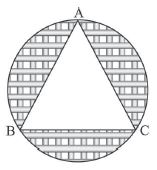
Question. What is the area of the circular table?
(a) (22528/7) cm2
(b) (20528/7) cm2
(c) (22028/7) cm2
(d) (28022/7) cm2
Answer : A
Question. What is the measure of angle subtended by each side of the equilateral triangle at the centre of the circle?
(a) 30°
(b) 60°
(c) 120°
(d) 90°
Answer : C
Question. Each side of the equilateral triangle is
(a) 64√3 cm
(b) 8√3 cm
(c) 16√3 cm
(d) 32√3 cm
Answer : D
Question. What is the area of equilateral triangle?
(a) 700 3√2 cm
(b) 768 3√2 cm
(c) 678 3√2 cm
(d) 876 3√2 cm
Answer : B
Question. What is the area of the design?
(a) 1888 cm2
(b) 1688 cm2
(c) 1988 cm2
(d) 1588 cV
Answer : A
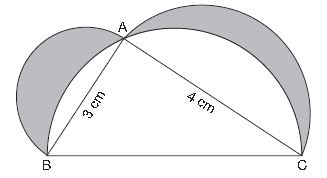
II. Some students of class-Xth get together and decide to form a design by combining different
mathematical shapes. First of all they select a triangle ABC with AB = 3 cm, AC = 4 cm and ∠BAC
= 90°. They draw semicircles on sides AB, AC and BC but they have some doubts which they want
to clarify with you. So, answer their questions given below:
Question. The length of side BC is
(a) 5 cm
(b) 25 cm
(c) 9 cm
(d) 16 cm
Answer : B
Question. Area of semicircle on side AB is
(a) (3/2)π cm2
(b) (9/8)π cm2
(c) 9π cm2
(d) 4π cm2
Answer : C
Question. Area of semicircle on side AC is
(a) 4π cm2
(b) 2π cm2
(c) 9π cm2
(d) 16π cm2
Answer : D
Question. Area of given figure is
(a) (9/4 π+6) cm2
(b) (16π/9 + 6) cm2
(c) (25π/8 + 6) cm2
(d) (4π/25 + 6) cm2
Answer : B
Question. Find the area of the shaded region.
(a) 6 cm2
(b) 8 cm2
(c) 10 cm2
(d) 12 cm2
Answer : A
Question 1) A bicycle wheel makes 5000 revolution in moving 11 km. find the diameter of the wheel
Answer:
Total distance covered by the bicycle is 11 km, which is equivalent to 11,000 m or 1,100,000 cm.
The number of rotations made by the wheel is 5000.
Distance covered in 1 single revolution:
\( \text{Distance} = \frac{1,100,000}{5000} = 220 \text{ cm} \)
Since the distance covered in one rotation is equal to the circumference of the wheel (\( \pi d \)):
\( \pi d = 220 \)
\( \implies \frac{22}{7} \times d = 220 \)
\( \implies d = 220 \times \frac{7}{22} \)
\( \implies d = 70 \text{ cm} \)
Therefore, the diameter of the bicycle wheel is 70 cm.
In simple words: First find the distance the wheel covers in just one turn by dividing the total distance by the number of turns. Then, use the perimeter formula to find the diameter.
Exam Tip: Keep your units consistent. Converting kilometers to centimeters early in the problem makes finding the wheel's diameter in centimeters much simpler.
Question 2) In the figure o is the centre of a circle. The area of sector OAPB is 5/18 of the area of the circle. Find x
Answer:
We are given that the area of sector OAPB is \( \frac{5}{18} \) of the total area of the circle.
Let \( x \) be the central angle of this sector.
The formula for the area of a sector with central angle \( x \) is:
\( \text{Area of sector} = \frac{x}{360^\circ} \times \text{Total Area of circle} \)
According to the given condition:
\( \frac{x}{360^\circ} \times \text{Total Area} = \frac{5}{18} \times \text{Total Area} \)
\( \implies \frac{x}{360^\circ} = \frac{5}{18} \)
\( \implies x = \frac{5}{18} \times 360^\circ \)
\( \implies x = 100^\circ \)
Therefore, the value of \( x \) is \( 100^\circ \).
In simple words: Since the slice is 5/18 of the entire circle, the angle of this slice must also be 5/18 of the full 360 degrees of the circle.
Exam Tip: Remember that sector area is directly proportional to the central angle, which allows you to set up a direct ratio with 360 degrees.
Question 3) Area of a sector of a circle is 1/6 to the area of circle. Find the degree measure of its minor arc
Answer:
Let \( \theta \) be the degree measure of the minor arc.
The area of the sector is given as \( \frac{1}{6} \) of the area of the circle.
\( \frac{\theta}{360^\circ} \times \text{Area of circle} = \frac{1}{6} \times \text{Area of circle} \)
\( \implies \frac{\theta}{360^\circ} = \frac{1}{6} \)
\( \implies \theta = \frac{360^\circ}{6} \)
\( \implies \theta = 60^\circ \)
Therefore, the degree measure of its minor arc is \( 60^\circ \).
In simple words: The arc length and sector area occupy the same fraction of the circle, so taking 1/6 of 360 degrees gives the central angle.
Exam Tip: The degree measure of an arc is always equal to the central angle subtended by that arc.
Question 4) If the diameter of a semi circle protractor is 14 cm. Find its perimeter
Answer:
The diameter of the semicircular protractor is \( d = 14 \text{ cm} \).
The radius is \( r = \frac{14}{2} = 7 \text{ cm} \).
The perimeter of a semicircular protractor is equal to the length of the curved boundary plus the straight diameter:
\( \text{Perimeter} = \pi r + d \)
\( \implies \text{Perimeter} = \left(\frac{22}{7} \times 7\right) + 14 \)
\( \implies \text{Perimeter} = 22 + 14 = 36 \text{ cm} \)
Therefore, the perimeter of the protractor is 36 cm.
In simple words: To find the total perimeter around a half-circle, add the curved top edge to the straight bottom edge.
Exam Tip: Do not just calculate the curved arc length (\(\pi r\)) - always remember to add the diameter (\(2r\)) to get the complete perimeter of a closed semicircle.
Question 5) The circumference of a circle A is 132cm. It is equal to the sum of the circumference of two circles B & C, the radius of the circle B is 14cm. Find the radius of circle C.
Answer:
The circumference of circle A is given as 132 cm.
Let \( R_A \), \( R_B \), and \( R_C \) be the radii of circles A, B, and C respectively.
First, find the radius of circle A:
\( 2 \pi R_A = 132 \)
\( \implies 2 \times \frac{22}{7} \times R_A = 132 \)
\( \implies \frac{44}{7} R_A = 132 \)
\( \implies R_A = 132 \times \frac{7}{44} = 21 \text{ cm} \)
According to the problem, the circumference of A equals the sum of the circumferences of B and C:
\( 2 \pi R_A = 2 \pi R_B + 2 \pi R_C \)
Dividing the entire equation by \( 2 \pi \):
\( R_A = R_B + R_C \)
Given that \( R_B = 14 \text{ cm} \):
\( 21 = 14 + R_C \)
\( \implies R_C = 21 - 14 = 7 \text{ cm} \)
Therefore, the radius of circle C is 7 cm.
In simple words: Since circumferences are directly proportional to their radii, the radius of the big circle is simply the sum of the radii of the two smaller circles.
Exam Tip: Simplify your equations early. Canceling the constant factor \(2\pi\) saves you from performing tedious calculations.
Question 6) The area of quadrant is 154sq cm. Find its perimeter.
Answer:
Let the radius of the circle be \( r \).
The area of a quadrant (one-fourth of a circle) is given as 154 cm²:
\( \frac{1}{4} \pi r^2 = 154 \)
\( \implies \frac{1}{4} \times \frac{22}{7} \times r^2 = 154 \)
\( \implies \frac{11}{14} r^2 = 154 \)
\( \implies r^2 = 154 \times \frac{14}{11} \)
\( \implies r^2 = 14 \times 14 \)
\( \implies r = 14 \text{ cm} \)
The perimeter of a quadrant consists of the curved arc plus the two straight boundary radii:
\( \text{Perimeter} = \frac{1}{4}(2 \pi r) + 2r = \frac{\pi r}{2} + 2r \)
\( \implies \text{Perimeter} = \left(\frac{22}{7} \times \frac{14}{2}\right) + 2(14) \)
\( \implies \text{Perimeter} = 22 + 28 = 50 \text{ cm} \)
Therefore, the perimeter of the quadrant is 50 cm.
In simple words: Use the area to calculate the radius first. Then find the perimeter by adding the curved quarter-circle arc to the two straight edges.
Exam Tip: A common mistake is forgetting to add the two radii (\(2r\)) to the arc length when calculating the boundary of a sector or quadrant.
Question 7) A circular disc of 6cm radius is divided into 3 sectors with central angles 120˚, 150˚and 90˚.Find the ratio of the areas of 3 Sectors
Answer:
Let the areas of the three sectors be \( A_1 \), \( A_2 \), and \( A_3 \) with corresponding central angles \( \theta_1 = 120^\circ \), \( \theta_2 = 150^\circ \), and \( \theta_3 = 90^\circ \).
The area of any sector is given by \( \frac{\theta}{360^\circ} \times \pi r^2 \). Since all sectors belong to the same disc, their radii \( r \) are identical.
Thus, the ratio of their areas is equal to the ratio of their central angles:
\( A_1 : A_2 : A_3 = \theta_1 : \theta_2 : \theta_3 \)
\( \implies A_1 : A_2 : A_3 = 120^\circ : 150^\circ : 90^\circ \)
Dividing each term by their greatest common divisor, which is 30:
\( A_1 : A_2 : A_3 = 4 : 5 : 3 \)
Therefore, the ratio of the areas of the three sectors is 4 : 5 : 3.
In simple words: Since the sectors are all part of the same circle, the ratio of their sizes is exactly the same as the ratio of their angles.
Exam Tip: Do not waste time calculating the actual areas of the sectors when only their ratio is required.
Question 8) The difference between circumferences and diameter of a circle is 105 cm. Find the radius of the circle
Answer:
Let the radius of the circle be \( r \). Then its circumference is \( 2 \pi r \) and its diameter is \( 2r \).
We are given:
\( 2 \pi r - 2 r = 105 \)
\( \implies 2r(\pi - 1) = 105 \)
\( \implies 2r\left(\frac{22}{7} - 1\right) = 105 \)
\( \implies 2r \times \frac{15}{7} = 105 \)
\( \implies 2r = 105 \times \frac{7}{15} \)
\( \implies 2r = 7 \times 7 \)
\( \implies 2r = 49 \)
\( \implies r = 24.5 \text{ cm} \)
Therefore, the radius of the circle is 24.5 cm.
In simple words: Write down the formula for the boundary minus the width of the circle, group the terms together, and solve for the radius.
Exam Tip: Factoring out \(2r\) early in the equation makes resolving the fraction with \(\pi\) much cleaner and less prone to mistakes.
Question 9) Find the area of a major sector of a circle of diameter 42 cm and central angle is 60˚
Answer:
The diameter of the circle is 42 cm, so its radius is \( r = \frac{42}{2} = 21 \text{ cm} \).
The central angle of the minor sector is \( 60^\circ \).
Therefore, the central angle of the major sector is:
\( \theta_{\text{major}} = 360^\circ - 60^\circ = 300^\circ \)
The area of the major sector is:
\( \text{Area} = \frac{\theta_{\text{major}}}{360^\circ} \times \pi r^2 \)
\( \implies \text{Area} = \frac{300}{360} \times \frac{22}{7} \times 21 \times 21 \)
\( \implies \text{Area} = \frac{5}{6} \times 22 \times 3 \times 21 \)
\( \implies \text{Area} = \frac{5}{2} \times 22 \times 21 \)
\( \implies \text{Area} = 5 \times 11 \times 21 \)
\( \implies \text{Area} = 1155 \text{ cm}^2 \)
Therefore, the area of the major sector is 1155 cm².
In simple words: Find the angle of the major sector first by subtracting the minor angle from 360 degrees, and then calculate its area.
Exam Tip: Always read carefully whether the question asks for the minor or major sector area to avoid calculating the wrong region.
Question 10) If the area and circumference of a circle are numerically equal, then find the radius of the circle
Answer:
Let the radius of the circle be \( r \).
Given that the area is numerically equal to the circumference:
\( \pi r^2 = 2 \pi r \)
Dividing both sides by \( \pi r \) (since \( r \neq 0 \)):
\( r = 2 \text{ units} \)
Therefore, the radius of the circle is 2 cm (or 2 units).
In simple words: Equating the formulas for area and perimeter directly cancels out the common values, leaving us with a radius of 2.
Exam Tip: This is a standard conceptual question - write down the basic formulas clearly before canceling terms.
Question 11) The length of a rope by which a cow is tethered is increased from 16m to 23m. How much additional area can the cow graze? Now (π =22/7)
Answer:
Let the initial radius of grazing be \( r = 16 \text{ m} \) and the new radius be \( R = 23 \text{ m} \).
The cow can graze in a circular field. The additional area that the cow can graze is the difference between the two circular areas:
\( \text{Additional Area} = \pi R^2 - \pi r^2 = \pi (R^2 - r^2) \)
\( \implies \text{Additional Area} = \frac{22}{7} \times (23^2 - 16^2) \)
Using the identity \( A^2 - B^2 = (A - B)(A + B) \):
\( 23^2 - 16^2 = (23 - 16)(23 + 16) = 7 \times 39 \)
Substitute this value back:
\( \text{Additional Area} = \frac{22}{7} \times 7 \times 39 \)
\( \implies \text{Additional Area} = 22 \times 39 = 858 \text{ m}^2 \)
Therefore, the cow can graze an additional area of 858 m².
In simple words: Find the area of the larger circle with the longer rope and subtract the area of the smaller circle to see how much extra space is gained.
Exam Tip: Using algebraic identities like \( a^2 - b^2 \) can simplify your calculations and help prevent mistakes when working with large numbers.
Question 12) What will be the increase in area of circle if its radius is increased by 40%
Answer:
Let the original radius of the circle be \( r \).
Original Area \( A_1 = \pi r^2 \).
If the radius is increased by 40%, the new radius \( R \) becomes:
\( R = r + 0.40r = 1.4r \)
New Area \( A_2 = \pi R^2 = \pi (1.4r)^2 = 1.96 \pi r^2 \)
The increase in area is:
\( \text{Increase} = A_2 - A_1 = 1.96 \pi r^2 - \pi r^2 = 0.96 \pi r^2 \)
Percentage increase in area:
\( \text{Percentage Increase} = \frac{0.96 \pi r^2}{\pi r^2} \times 100\% = 96\% \)
Therefore, the area of the circle increases by 96%.
In simple words: When the radius grows to 1.4 times its original size, squaring it tells us the area becomes 1.96 times larger, which is a 96% increase.
Exam Tip: Remember that area scales with the square of the radius, so a linear increase of 40% leads to a non-linear area increase of 96%.
Question 13) The radius of the wheel of a bus is 70cm, how many revolutions per minute must a wheel make in order to move at a speed of 66 km/h
Answer:
Radius of the wheel \( r = 70 \text{ cm} \).
Circumference of the wheel (distance covered in 1 revolution):
\( C = 2 \pi r = 2 \times \frac{22}{7} \times 70 = 440 \text{ cm} \)
Speed of the bus \( = 66 \text{ km/h} \).
Let's convert this speed to centimeters per minute:
\( 66 \text{ km/h} = \frac{66 \times 100,000 \text{ cm}}{60 \text{ minutes}} = 110,000 \text{ cm/min} \)
Number of revolutions per minute:
\( \text{Revolutions} = \frac{\text{Distance covered in 1 minute}}{\text{Circumference}} \)
\( \implies \text{Revolutions} = \frac{110,000}{440} = 250 \)
Therefore, the wheel must make 250 revolutions per minute.
In simple words: Calculate how far the bus travels in one minute and divide that by the distance the wheel rolls in a single complete turn.
Exam Tip: Be extra careful when converting speed units from km/h to cm/min to ensure you do not miss any zeros.
Question 14) An arc of a circle is of length 5π cm and the sector it bounds has an area of 20π cm2 . Find the radius of the circle
Answer:
Let \( l \) be the length of the arc and \( A \) be the area of the sector.
We are given \( l = 5\pi \text{ cm} \) and \( A = 20\pi \text{ cm}^2 \).
The relationship between the area of a sector, arc length, and radius \( r \) is:
\( A = \frac{1}{2} \times l \times r \)
Substitute the given values:
\( 20\pi = \frac{1}{2} \times (5\pi) \times r \)
Divide both sides by \( \pi \):
\( 20 = \frac{5}{2} r \)
\( \implies r = 20 \times \frac{2}{5} = 8 \text{ cm} \)
Therefore, the radius of the circle is 8 cm.
In simple words: Use the direct formula that links sector area to arc length and radius to find the answer without needing the angle.
Exam Tip: Using the formula \( A = \frac{1}{2} l r \) is much faster than solving for the angle \( \theta \) first and then finding \( r \).
Question 15) The circumference of a circle exceeds the diameter by 16.8cm. Find the radius of circle
Answer:
Let the radius of the circle be \( r \).
We are given that the circumference exceeds the diameter by 16.8 cm:
\( 2 \pi r - 2r = 16.8 \)
\( \implies 2r(\pi - 1) = 16.8 \)
\( \implies 2r\left(\frac{22}{7} - 1\right) = 16.8 \)
\( \implies 2r \times \frac{15}{7} = 16.8 \)
\( \implies 2r = 16.8 \times \frac{7}{15} \)
\( \implies 2r = 1.12 \times 7 = 7.84 \)
\( \implies r = 3.92 \text{ cm} \)
Therefore, the radius of the circle is 3.92 cm.
In simple words: Write down the formula showing that the boundary minus the width equals 16.8, and isolate the radius step-by-step.
Exam Tip: Substitute \( \pi = \frac{22}{7} \) and simplify the fraction inside the parentheses before performing any division.
Question 16) The area enclosed between two concentric circles is 770 sq cm. If the radius of outer circle is 21cm. Find the radius of the inner circle.
Answer:
Let \( R \) be the radius of the outer circle and \( r \) be the radius of the inner circle.
Given \( R = 21 \text{ cm} \), and the area of the ring is 770 cm²:
\( \pi (R^2 - r^2) = 770 \)
\( \implies \frac{22}{7} \times (21^2 - r^2) = 770 \)
\( \implies 21^2 - r^2 = 770 \times \frac{7}{22} \)
\( \implies 441 - r^2 = 35 \times 7 \)
\( \implies 441 - r^2 = 245 \)
\( \implies r^2 = 441 - 245 \)
\( \implies r^2 = 196 \)
\( \implies r = 14 \text{ cm} \)
Therefore, the radius of the inner circle is 14 cm.
In simple words: Find the inner area by subtracting the ring's area from the outer circle's area, then use that to find the inner radius.
Exam Tip: Always double-check your arithmetic when subtracting and taking square roots, as \(196\) is a perfect square of \(14\).
Question 17 The length of the minute hand of a clock is 7cm. How much area does it sweep in 20minutes
Answer:
The length of the minute hand acts as the radius of the circle, so \( r = 7 \text{ cm} \).
The total time in a clock face is 60 minutes, which corresponds to \( 360^\circ \).
In 20 minutes, the fraction of the circle swept is:
\( \text{Fraction} = \frac{20}{60} = \frac{1}{3} \)
The angle swept in 20 minutes is \( \frac{1}{3} \times 360^\circ = 120^\circ \).
Area swept in 20 minutes:
\( \text{Area} = \frac{1}{3} \times \pi r^2 \)
\( \implies \text{Area} = \frac{1}{3} \times \frac{22}{7} \times 7 \times 7 \)
\( \implies \text{Area} = \frac{154}{3} \text{ cm}^2 \)
Therefore, the area swept by the minute hand in 20 minutes is \( \frac{154}{3} \text{ cm}^2 \).
In simple words: Since 20 minutes is exactly one-third of a full hour, the minute hand sweeps across exactly one-third of the total circle's area.
Exam Tip: Keeping your final answer as an improper fraction is highly acceptable and prevents rounding errors unless a decimal is explicitly requested.
Question 18) The perimeter of a sector of a circle of radius 5.2cm is 16.4cm.Find the area of sector
Answer:
Let \( r \) be the radius of the circle and \( l \) be the length of the arc.
Given \( r = 5.2 \text{ cm} \) and \( \text{Perimeter} = 16.4 \text{ cm} \).
The perimeter of a sector is given by:
\( \text{Perimeter} = l + 2r \)
\( \implies 16.4 = l + 2(5.2) \)
\( \implies 16.4 = l + 10.4 \)
\( \implies l = 6 \text{ cm} \)
Now, the area of the sector is:
\( \text{Area} = \frac{1}{2} \times l \times r \)
\( \implies \text{Area} = \frac{1}{2} \times 6 \times 5.2 \)
\( \implies \text{Area} = 3 \times 5.2 = 15.6 \text{ cm}^2 \)
Therefore, the area of the sector is 15.6 cm².
In simple words: Find the length of the curved edge by taking away the two straight side lengths from the total perimeter, then use it to find the area.
Exam Tip: Using the formula \( A = \frac{1}{2} l r \) bypasses the need to find the central angle, saving valuable time during exams.
Question 19) Given a circle of radius 9cm, and the length of the chord AB of a circle is 9√3 cm, find the area of the sector formed by arc AB.
Answer:
Let \( O \) be the center of the circle, so \( OA = OB = 9 \text{ cm} \).
The length of the chord \( AB = 9\sqrt{3} \text{ cm} \).
Let \( \theta \) be the angle \( \angle AOB \). Draw a perpendicular from \( O \) to \( AB \) meeting at \( M \). Then \( M \) is the midpoint of \( AB \), so \( AM = \frac{9\sqrt{3}}{2} \text{ cm} \).
In right-angled triangle \( OMA \):
\( \sin\left(\frac{\theta}{2}\right) = \frac{AM}{OA} = \frac{\frac{9\sqrt{3}}{2}}{9} = \frac{\sqrt{3}}{2} \)
\( \implies \frac{\theta}{2} = 60^\circ \)
\( \implies \theta = 120^\circ \)
Now, the area of the sector formed by arc AB is:
\( \text{Area} = \frac{\theta}{360^\circ} \times \pi r^2 \)
\( \implies \text{Area} = \frac{120^\circ}{360^\circ} \times \pi \times 9^2 \)
\( \implies \text{Area} = \frac{1}{3} \times \pi \times 81 \)
\( \implies \text{Area} = 27\pi \text{ cm}^2 \)
Using \( \pi \approx 3.14159 \):
\( \text{Area} \approx 27 \times 3.14159 \approx 84.82 \text{ cm}^2 \) (or \( 84.85 \text{ cm}^2 \) with \( \pi \approx 3.1428 \)).
Therefore, the area of the sector is approximately 84.85 cm².
In simple words: Find the angle at the center using trigonometry on the triangle formed by the radius and chord, then calculate the area of that sector.
Exam Tip: Be prepared to use basic trigonometric ratios to find the central angle when only the chord length and radius are given.
Question 20) Length of minor arc of a circle of radius 10 cm is 14cm. Find the area of minor sector of a circle.
Answer:
Given radius \( r = 10 \text{ cm} \) and minor arc length \( l = 14 \text{ cm} \).
The area of the minor sector is:
\( \text{Area} = \frac{1}{2} \times l \times r \)
\( \implies \text{Area} = \frac{1}{2} \times 14 \times 10 \)
\( \implies \text{Area} = 7 \times 10 = 70 \text{ cm}^2 \)
Therefore, the area of the minor sector is 70 cm².
In simple words: Simply multiply half of the arc length by the radius of the circle to quickly find the area.
Exam Tip: Remember this simplified formula \( A = \frac{1}{2} l r \) for sectors - it acts as a shortcut when the angle is not explicitly provided.
Question 21) A chord AB of a circle of radius 14cm makes a right angle at the centre of the circle. Find the area of the minor segment. (π = 22/7)
Answer:
The radius of the circle \( r = 14 \text{ cm} \).
The angle subtended at the center is \( \theta = 90^\circ \).
The area of the minor segment is calculated as:
\( \text{Area of segment} = \text{Area of sector OAB} - \text{Area of triangle OAB} \)
\( \text{Area of sector OAB} = \frac{90^\circ}{360^\circ} \times \pi r^2 = \frac{1}{4} \times \frac{22}{7} \times 14 \times 14 = 154 \text{ cm}^2 \)
\( \text{Area of triangle OAB} = \frac{1}{2} \times r^2 \times \sin(90^\circ) = \frac{1}{2} \times 14 \times 14 \times 1 = 98 \text{ cm}^2 \)
\( \text{Area of minor segment} = 154 - 98 = 56 \text{ cm}^2 \)
Therefore, the area of the minor segment is 56 cm².
In simple words: Find the area of the quarter-circle slice and subtract the right-angled triangle's area to get the small leftover region at the edge.
Exam Tip: The area of a triangle with a right angle at the center is simply \( \frac{1}{2} \times r^2 \), which makes calculation straightforward.
Question 22) Find the area of the major segment APB, in figure of a circle of radius 35 cm and ∟AOB = 90˚ (π = 22/7)
Answer:
The radius of the circle \( r = 35 \text{ cm} \).
The angle subtended at the center is \( \theta = 90^\circ \).
First, let's find the total area of the circle:
\( \text{Area of circle} = \pi r^2 = \frac{22}{7} \times 35 \times 35 = 22 \times 5 \times 35 = 3850 \text{ cm}^2 \)
Next, calculate the area of the minor segment:
\( \text{Area of minor sector} = \frac{90^\circ}{360^\circ} \times \pi r^2 = \frac{1}{4} \times 3850 = 962.5 \text{ cm}^2 \)
\( \text{Area of triangle AOB} = \frac{1}{2} \times r^2 = \frac{1}{2} \times 35 \times 35 = 612.5 \text{ cm}^2 \)
\( \text{Area of minor segment} = \text{Area of minor sector} - \text{Area of triangle} = 962.5 - 612.5 = 350 \text{ cm}^2 \)
The area of the major segment APB is:
\( \text{Area of major segment} = \text{Area of circle} - \text{Area of minor segment} \)
\( \implies \text{Area of major segment} = 3850 - 350 = 3500 \text{ cm}^2 \)
Therefore, the area of the major segment is 3500 cm².
In simple words: Calculate the whole circle's area, find the small segment's area, and subtract it to get the large remaining part.
Exam Tip: Major segment area is best found by subtracting the minor segment from the total circle area, rather than calculating the major sector and adding a triangle.
Question 23) A chord of a circle of radius 14cm subtends an angle of 120˚ at the centre Find the area of the corresponding minor segment of The circle (π = 22/7, √3 = 1.73)
Answer:
The radius of the circle \( r = 14 \text{ cm} \).
The angle subtended at the center is \( \theta = 120^\circ \).
The area of the minor segment is:
\( \text{Area of minor segment} = \text{Area of sector} - \text{Area of triangle} \)
\( \text{Area of sector} = \frac{120^\circ}{360^\circ} \times \pi r^2 = \frac{1}{3} \times \frac{22}{7} \times 14 \times 14 = \frac{616}{3} \approx 205.33 \text{ cm}^2 \)
The area of the triangle with central angle \( 120^\circ \) is:
\( \text{Area of triangle} = r^2 \sin\left(\frac{\theta}{2}\right) \cos\left(\frac{\theta}{2}\right) = r^2 \sin(60^\circ) \cos(60^\circ) \)
\( \implies \text{Area of triangle} = 14 \times 14 \times \frac{\sqrt{3}}{2} \times \frac{1}{2} = 49\sqrt{3} \text{ cm}^2 \)
Using \( \sqrt{3} = 1.73 \):
\( \text{Area of triangle} = 49 \times 1.73 = 84.77 \text{ cm}^2 \)
\( \text{Area of minor segment} = 205.33 - 84.77 = 120.56 \text{ cm}^2 \)
Therefore, the area of the minor segment is 120.56 cm².
In simple words: Find the area of the 120-degree sector, calculate the triangle's area using the sine/cosine formula, and subtract the triangle from the sector.
Exam Tip: For a central angle of \(120^\circ\), remember that the triangle's area can be computed easily as \( r^2 \sin(60^\circ)\cos(60^\circ) \).
Question 24) From a thin metallic piece, in the shape of a trapezium ABCD in which AB II CD and ∟BCD = 90˚, a quarter circle BFEC is removed. Given AB = BC = 3.5 cm and DE = 2cm, calculate the area of the remaining (shaded) part of the metal sheet ( π = 22/7)
Answer:
In trapezium ABCD, we are given:
\( AB \parallel CD \) and \( \angle BCD = 90^\circ \).
The heights and side lengths are:
\( AB = 3.5 \text{ cm} \)
\( BC = 3.5 \text{ cm} \) (which acts as the perpendicular height of the trapezium and the radius of the quarter circle)
Since BFEC is a quarter circle of radius \( BC = 3.5 \text{ cm} \), the segment \( EC \) along the base \( CD \) is also equal to the radius \( 3.5 \text{ cm} \).
Therefore, the total base of the trapezium is:
\( CD = DE + EC = 2 \text{ cm} + 3.5 \text{ cm} = 5.5 \text{ cm} \)
Now, find the area of trapezium ABCD:
\( \text{Area of trapezium} = \frac{1}{2} \times (AB + CD) \times BC \)
\( \implies \text{Area} = \frac{1}{2} \times (3.5 + 5.5) \times 3.5 = \frac{1}{2} \times 9 \times 3.5 = 15.75 \text{ cm}^2 \)
Next, find the area of the quarter circle BFEC removed:
\( \text{Area of quarter circle} = \frac{1}{4} \pi r^2 \)
\( \implies \text{Area} = \frac{1}{4} \times \frac{22}{7} \times (3.5)^2 = \frac{1}{4} \times \frac{22}{7} \times 12.25 = 9.625 \text{ cm}^2 \)
The area of the remaining shaded part is:
\( \text{Remaining Area} = \text{Area of trapezium} - \text{Area of quarter circle} \)
\( \implies \text{Remaining Area} = 15.75 - 9.625 = 6.125 \text{ cm}^2 \)
Therefore, the area of the remaining part is 6.125 cm².
In simple words: Find the area of the entire four-sided shape first, then subtract the area of the quarter-circle slice that was cut out to find what is left.
Exam Tip: Be sure to correctly sum DE and EC to get the total base of the trapezium before calculating its area.
Exercise: Surface Areas and Volumes
Question 1) A well of a diameter 3m is 14m deep dug the earth taken out of its spread evenly all around it to form an embankment of width 4m. Find the height of the embankment
Answer:
Let \( r \) be the radius of the well and \( h \) be its depth.
Diameter \( = 3 \text{ m} \implies r = 1.5 \text{ m} \), and depth \( h = 14 \text{ m} \).
Volume of earth dug out of the well:
\( \text{Volume} = \pi r^2 h = \pi \times (1.5)^2 \times 14 = 31.5 \pi \text{ m}^3 \)
This earth is spread to form an embankment of width 4 m around the well.
The inner radius of the embankment is \( r = 1.5 \text{ m} \).
The outer radius of the embankment is \( R = 1.5 + 4 = 5.5 \text{ m} \).
Area of the embankment base:
\( \text{Area} = \pi (R^2 - r^2) = \pi (5.5^2 - 1.5^2) = \pi (30.25 - 2.25) = 28 \pi \text{ m}^2 \)
Let \( H \) be the height of the embankment. Since the volume of the embankment equals the volume of earth dug out:
\( \text{Area} \times H = \text{Volume} \)
\( \implies 28 \pi \times H = 31.5 \pi \)
\( \implies H = \frac{31.5}{28} = 1.125 \text{ m} \)
Therefore, the height of the embankment is 1.125 m.
In simple words: The dirt taken out of the deep cylindrical hole is spread out to make a ring around the top. Find the volume of that dirt, and divide it by the ring's area to find how high it stacks.
Exam Tip: Keeping \(\pi\) as a symbol throughout your intermediate calculations prevents unnecessary arithmetic steps and rounding errors.
Question 2) Three cubes of each side 5 cm are joined end to end. Find the surface area of the resulting cuboids
Answer:
When three cubes of side 5 cm are joined end to end, they form a single cuboid.
The dimensions of the resulting cuboid are:
Length \( l = 5 + 5 + 5 = 15 \text{ cm} \)
Breadth \( b = 5 \text{ cm} \)
Height \( h = 5 \text{ cm} \)
The total surface area of a cuboid is given by:
\( \text{Total Surface Area} = 2(lb + bh + hl) \)
\( \implies \text{TSA} = 2(15 \times 5 + 5 \times 5 + 5 \times 15) \)
\( \implies \text{TSA} = 2(75 + 25 + 75) = 2(175) = 350 \text{ cm}^2 \)
Therefore, the surface area of the resulting cuboid is 350 cm².
In simple words: Joining three identical blocks in a straight line makes one long box. Calculate its new length and use the box surface area formula.
Exam Tip: Be careful not to just multiply the surface area of one cube by three, as some faces are hidden inside the joined structure.
Question 3) A solid cylinder of diameter 12 cm and height 15 cm is melted and recast into toys with the shape of a right circular cone mounted on a hemisphere of radius 3cm, if the height of the toy is 12 cm, find the number of toys
Answer:
First, find the volume of the solid cylinder:
Radius \( R = 6 \text{ cm} \), height \( H = 15 \text{ cm} \).
\( \text{Volume of cylinder} = \pi R^2 H = \pi \times 6^2 \times 15 = 540 \pi \text{ cm}^3 \)
Each toy is a cone mounted on a hemisphere with radius \( r = 3 \text{ cm} \).
The total height of the toy is 12 cm, which means the height of the cone \( h \) is:
\( h = 12 - 3 = 9 \text{ cm} \)
The volume of one toy is the sum of the volumes of the cone and the hemisphere:
\( \text{Volume of toy} = \text{Volume of cone} + \text{Volume of hemisphere} \)
\( \implies \text{Volume} = \frac{1}{3} \pi r^2 h + \frac{2}{3} \pi r^3 \)
\( \implies \text{Volume} = \frac{1}{3} \pi \times 3^2 \times 9 + \frac{2}{3} \pi \times 3^3 \)
\( \implies \text{Volume} = 27 \pi + 18 \pi = 45 \pi \text{ cm}^3 \)
Let \( n \) be the number of toys. Since the total volume remains constant:
\( n \times 45 \pi = 540 \pi \)
\( \implies n = \frac{540}{45} = 12 \)
Therefore, the number of toys that can be made is 12.
In simple words: Find the volume of the initial metal cylinder, then find the volume of one finished toy. Divide the first volume by the second to find the total number of toys.
Exam Tip: Deduct the radius of the hemispherical base from the total height of the toy to find the actual height of the conical part.
Question 4) The surface area of a sphere is 616 cm2. Find its radius
Answer:
Let the radius of the sphere be \( r \).
The surface area of a sphere is given by:
\( 4 \pi r^2 = 616 \)
\( \implies 4 \times \frac{22}{7} \times r^2 = 616 \)
\( \implies \frac{88}{7} r^2 = 616 \)
\( \implies r^2 = 616 \times \frac{7}{88} \)
\( \implies r^2 = 7 \times 7 = 49 \)
\( \implies r = 7 \text{ cm} \)
Therefore, the radius of the sphere is 7 cm.
In simple words: Put the surface area into the sphere formula and solve to find the radius.
Exam Tip: Since \(616\) is a multiple of \(88\) (\(88 \times 7 = 616\)), simplification is very quick if you keep it in fractional form.
Question 5) A bucket made up of a metal sheet is in the form of a frustum of a cone of high 16cm with diameter of its lower and upper end are 16cm and 40cm Find the volume of the bucket.
Answer:
The height of the frustum is \( h = 16 \text{ cm} \).
The upper radius is \( R = \frac{40}{2} = 20 \text{ cm} \).
The lower radius is \( r = \frac{16}{2} = 8 \text{ cm} \).
The volume of a frustum of a cone is given by:
\( V = \frac{1}{3} \pi h (R^2 + r^2 + R r) \)
\( \implies V = \frac{1}{3} \times 3.14 \times 16 \times (20^2 + 8^2 + 20 \times 8) \)
\( \implies V = \frac{1}{3} \times 3.14 \times 16 \times (400 + 64 + 160) \)
\( \implies V = \frac{1}{3} \times 3.14 \times 16 \times 624 \)
\( \implies V = 3.14 \times 16 \times 208 \)
\( \implies V = 10449.92 \text{ cm}^3 \)
Therefore, the volume of the bucket is 10449.92 cm³.
In simple words: Plug the top radius, bottom radius, and height of the bucket into the frustum volume formula to find the total capacity.
Exam Tip: Always divide the given diameters by 2 to get the radii before using the volume formula.
Question 6) A farmer connects a pipe of internal diameter 20cm from a canal into a cylindrical tank in the field which is 10m in diameter and 2 meter deep? If water flows through the pipe at the rate of 6km per hour. In how much time the tank will be filled
Answer:
Let's convert all measurements to meters:
For the pipe:
Diameter \( = 20 \text{ cm} \implies \text{Radius } r = 10 \text{ cm} = 0.1 \text{ m} \).
Rate of flow of water \( v = 6 \text{ km/h} = 6000 \text{ m/h} \).
Volume of water flowing through the pipe per hour:
\( \text{Volume per hour} = \pi r^2 v = \pi \times (0.1)^2 \times 6000 = 60 \pi \text{ m}^3/\text{hour} \)
For the cylindrical tank:
Diameter \( = 10 \text{ m} \implies \text{Radius } R = 5 \text{ m} \).
Depth \( H = 2 \text{ m} \).
Volume of the tank:
\( \text{Tank Volume} = \pi R^2 H = \pi \times 5^2 \times 2 = 50 \pi \text{ m}^3 \)
Time required to fill the tank:
\( \text{Time} = \frac{\text{Volume of tank}}{\text{Volume of water per hour}} = \frac{50 \pi}{60 \pi} = \frac{5}{6} \text{ hours} \)
In minutes:
\( \text{Time} = \frac{5}{6} \times 60 = 50 \text{ minutes} \)
Therefore, the tank will be filled in \( \frac{5}{6} \) hours (or 50 minutes).
In simple words: Calculate the volume of water the pipe brings in one hour and compare it to the total capacity of the big tank to find the filling time.
Exam Tip: Converting all dimensions to meters right at the beginning keeps the volume calculations clean and directly comparable.
Question 7) The sum of the radius of the base and height of a solid cylinder is 37cm. If the total surface area of the solid cylinder is 1628sqcm. Find the volume of the cylinder.
Answer:
We are given:
\( r + h = 37 \text{ cm} \)
The total surface area of a solid cylinder is:
\( 2 \pi r (r + h) = 1628 \)
Substitute the value of \( r + h = 37 \):
\( 2 \times \frac{22}{7} \times r \times 37 = 1628 \)
\( \implies \frac{1628}{7} r = 1628 \)
\( \implies r = 7 \text{ cm} \)
Now, calculate the height \( h \):
\( h = 37 - r = 37 - 7 = 30 \text{ cm} \)
The volume of the cylinder is:
\( V = \pi r^2 h = \frac{22}{7} \times 7^2 \times 30 \)
\( \implies V = \frac{22}{7} \times 49 \times 30 = 22 \times 7 \times 30 = 4620 \text{ cm}^3 \)
Therefore, the volume of the cylinder is 4620 cm³.
In simple words: Substitute the sum of radius and height into the surface area formula to find the radius. Then, determine the height and calculate the volume.
Exam Tip: Recognise that \(2 \times 22 \times 37 = 1628\), which allows you to cancel terms on both sides of the equation immediately.
Question 8) A path of 7m width runs around outside a circular park whose radius 18m. Find the area of path
Answer:
The radius of the inner circular park is \( r = 18 \text{ m} \).
The width of the path is 7 m, so the outer radius of the path is:
\( R = 18 + 7 = 25 \text{ m} \)
The area of the path is the difference between the outer and inner circular areas:
\( \text{Area of path} = \pi R^2 - \pi r^2 = \pi (R^2 - r^2) \)
\( \implies \text{Area} = \frac{22}{7} \times (25^2 - 18^2) \)
\( \implies \text{Area} = \frac{22}{7} \times (625 - 324) \)
\( \implies \text{Area} = \frac{22}{7} \times 301 \)
\( \implies \text{Area} = 22 \times 43 = 946 \text{ m}^2 \)
Therefore, the area of the path is 946 m².
In simple words: Find the area of the large outer circle and subtract the area of the park inside to leave just the path's area.
Exam Tip: Verify that \(301\) is divisible by \(7\) (\(7 \times 43 = 301\)) before finalizing your multiplication to ensure your calculation is correct.
Question 9) A rocket in the form of a circular cylinder closed at the lower end. The diameter and height of the cylinder is 6m and 12m. The Cylindrical portion is Surmounted by a cone of the same radius that of cylinder, the slant height of the conical portion is 5cm. Find its total surface area and volume
Answer:
Given dimensions for the rocket:
For the cylinder:
Diameter \( = 6 \text{ m} \implies \text{Radius } r = 3 \text{ m} \).
Height \( h_1 = 12 \text{ m} \).
For the cone:
Radius \( r = 3 \text{ m} \).
Slant height \( l = 5 \text{ m} \) (assuming unit correction from "cm" to "m" for consistency).
Height of the cone \( h_2 = \sqrt{l^2 - r^2} = \sqrt{25 - 9} = 4 \text{ m} \).
1. Total Surface Area (since the lower end is closed):
\( \text{TSA} = \text{Curved surface of cone} + \text{Curved surface of cylinder} + \text{Base area of cylinder} \)
\( \implies \text{TSA} = \pi r l + 2 \pi r h_1 + \pi r^2 \)
\( \implies \text{TSA} = \pi \times 3 \times 5 + 2 \pi \times 3 \times 12 + \pi \times 3^2 \)
\( \implies \text{TSA} = 15 \pi + 72 \pi + 9 \pi = 96 \pi \approx 96 \times 3.14 = 301.44 \text{ m}^2 \)
2. Total Volume:
\( \text{Volume} = \text{Volume of cylinder} + \text{Volume of cone} \)
\( \implies V = \pi r^2 h_1 + \frac{1}{3} \pi r^2 h_2 \)
\( \implies V = \pi \times 3^2 \times 12 + \frac{1}{3} \pi \times 3^2 \times 4 \)
\( \implies V = 108 \pi + 12 \pi = 120 \pi \approx 376.8 \text{ m}^3 \)
Therefore, the total surface area of the rocket is 301.44 m² and its volume is 376.8 m³.
In simple words: Find the height of the cone using Pythagoras theorem, then calculate and sum the surface areas and volumes of both shapes.
Exam Tip: Be watchful for inconsistent units in questions (like 'm' and 'cm') and adjust them logically so that all measurements match before solving.
Question 10) How many spherical lead shots each 4.2cm in diameter can be obtained from a rectangular solid of Lead with dimensions 66cm, 42cm and 21cm.
Answer:
First, find the volume of the rectangular block of lead:
\( V_{\text{block}} = 66 \times 42 \times 21 = 58212 \text{ cm}^3 \)
For each spherical lead shot:
Diameter \( = 4.2 \text{ cm} \implies \text{Radius } r = 2.1 \text{ cm} \).
Volume of one spherical shot:
\( V_{\text{shot}} = \frac{4}{3} \pi r^3 = \frac{4}{3} \times \frac{22}{7} \times (2.1)^3 \)
\( \implies V_{\text{shot}} = \frac{88}{21} \times 9.261 = 38.808 \text{ cm}^3 \)
Number of spherical shots that can be made:
\( \text{Number of shots} = \frac{V_{\text{block}}}{V_{\text{shot}}} = \frac{58212}{38.808} = 1500 \)
Therefore, 1500 lead shots can be obtained.
In simple words: Find the total volume of the rectangular block and divide it by the volume of one spherical shot to get the quantity.
Exam Tip: Write the ratio as a single fraction \( \frac{66 \times 42 \times 21}{\frac{4}{3} \times \frac{22}{7} \times 2.1 \times 2.1 \times 2.1} \) to cancel out terms before doing any big multiplications.
Question 11) A cube and cuboids have the same volume, the dimension of the cuboid are in the ratio 1:2:4. If the difference between the Cost of polishing the cuboid and the cube at the rate of Rs 5 per sq m is Rs 80. Find their volumes
Answer:
Let the dimensions of the cuboid be \( x \), \( 2x \), and \( 4x \).
Volume of the cuboid \( = x \times 2x \times 4x = 8x^3 \).
Since the volume of the cube is equal to the volume of the cuboid, the volume of the cube is \( 8x^3 \).
Therefore, the side of the cube \( a = \sqrt[3]{8x^3} = 2x \).
Now, find the surface areas:
Surface area of the cuboid \( A_1 = 2(lb + bh + hl) = 2(x \times 2x + 2x \times 4x + 4x \times x) \)
\( \implies A_1 = 2(2x^2 + 8x^2 + 4x^2) = 2(14x^2) = 28x^2 \)
Surface area of the cube \( A_2 = 6a^2 = 6(2x)^2 = 24x^2 \).
The difference in surface area is:
\( \text{Difference} = 28x^2 - 24x^2 = 4x^2 \)
Given that the difference in polishing cost at Rs 5 per sq m is Rs 80:
\( 5 \times 4x^2 = 80 \)
\( \implies 20x^2 = 80 \)
\( \implies x^2 = 4 \implies x = 2 \text{ m} \)
The volume of either solid is:
\( V = 8x^3 = 8 \times (2)^3 = 64 \text{ m}^3 \)
Therefore, their volumes are 64 m³.
In simple words: Represent the dimensions in terms of a variable, calculate the surface areas of both shapes, and use the cost difference to find the variable and volume.
Exam Tip: Be sure to correctly express the side of the cube in terms of \(x\) by taking the cube root of the volume expression.
Question 12) A solid right circular cone of diameter of 14cm and height 8 cm is melted to form a hollow sphere. If the external diameter of the sphere is 10cm. Find its internal diameter.
Answer:
For the solid cone:
Radius \( r = 7 \text{ cm} \), height \( h = 8 \text{ cm} \).
\( \text{Volume of cone} = \frac{1}{3} \pi r^2 h = \frac{1}{3} \pi \times 7^2 \times 8 = \frac{392}{3} \pi \text{ cm}^3 \)
For the hollow sphere:
External radius \( R = \frac{10}{2} = 5 \text{ cm} \).
Let the internal radius be \( r_1 \).
\( \text{Volume of hollow sphere} = \frac{4}{3} \pi (R^3 - r_1^3) = \frac{4}{3} \pi (125 - r_1^3) \)
Since the cone is melted to form the sphere, their volumes are equal:
\( \frac{4}{3} \pi (125 - r_1^3) = \frac{392}{3} \pi \)
Cancel \( \frac{\pi}{3} \) from both sides:
\( 4(125 - r_1^3) = 392 \)
\( \implies 125 - r_1^3 = 98 \)
\( \implies r_1^3 = 125 - 98 = 27 \)
\( \implies r_1 = 3 \text{ cm} \)
The internal diameter is \( 2 \times r_1 = 6 \text{ cm} \).
Therefore, the internal diameter of the hollow sphere is 6 cm.
In simple words: Equate the volume of the cone to the volume formula of a hollow sphere to solve for the missing internal radius.
Exam Tip: Remember to multiply the final internal radius by 2 to state the final answer as the internal diameter.
Question 13) A cone of base radius 20cm is divided into two parts by drawing a plane through the mid point of its Axis parallel to its base. Find the ratio of the Volume of the two parts.
Answer:
Let the total height of the cone be \( H \).
The plane bisects the axis, so the smaller top cone has height \( \frac{H}{2} \).
Since the smaller cone is similar to the original cone, the ratio of their heights is \( 1 : 2 \).
The ratio of their volumes is the cube of the ratio of their heights:
\( \frac{\text{Volume of smaller cone}}{\text{Volume of original cone}} = \left(\frac{1}{2}\right)^3 = \frac{1}{8} \)
Let the volume of the original cone be \( V \).
Volume of the top smaller cone \( V_1 = \frac{1}{8}V \).
Volume of the remaining bottom frustum part \( V_2 = V - \frac{1}{8}V = \frac{7}{8}V \).
The ratio of the volume of the two parts is:
\( V_1 : V_2 = \frac{1}{8}V : \frac{7}{8}V = 1 : 7 \)
Therefore, the ratio of the volumes of the two parts is 1 : 7.
In simple words: Cutting a cone at its midpoint creates a small top cone that is 1/8th of the original volume, leaving the bottom frustum with the remaining 7/8ths.
Exam Tip: Remember that volume ratios of similar solid shapes scale with the cube of their linear dimensions (like height or radius).
Question 14) A cylindrical pipe has inner diameter of 7cm. Water is flowing through it at 192.5 liters per minute. Find the speed of the flow of water in km/hr.
Answer:
Inner radius of the pipe \( r = \frac{7}{2} = 3.5 \text{ cm} \).
Area of cross-section of the pipe:
\( A = \pi r^2 = \frac{22}{7} \times 3.5 \times 3.5 = 38.5 \text{ cm}^2 \)
The flow rate of water is \( 192.5 \text{ liters/min} = 192,500 \text{ cm}^3/\text{min} \) (since 1 liter = 1000 cm³).
Let the speed of water be \( v \) cm/min:
\( \text{Flow rate} = \text{Area} \times v \)
\( \implies 192,500 = 38.5 \times v \)
\( \implies v = \frac{192,500}{38.5} = 5000 \text{ cm/min} \)
Convert this speed to km/h:
\( v = 5000 \text{ cm/min} = 50 \text{ m/min} \)
\( \implies v = 50 \times 60 \text{ m/hour} = 3000 \text{ m/hour} = 3 \text{ km/h} \)
Therefore, the speed of the flow of water is 3 km/h.
In simple words: Calculate the pipe's opening area, find the speed in centimeters per minute by dividing flow rate by area, and convert it to kilometers per hour.
Exam Tip: Make sure you know basic conversion rates: \(1 \text{ liter} = 1000 \text{ cm}^3\) and \(1 \text{ m/min} = 0.06 \text{ km/h}\).
Question 15) A solid is in the form of a cylinder with hemispherical ends. The total height of the solid is 19cm and the diameter of the Cylinder is 7 cm. Find the total surface area of a solid.
Answer:
The diameter of the cylinder and the hemisphere is 7 cm, so the radius \( r = 3.5 \text{ cm} \).
The total height of the solid is 19 cm.
The height of the cylindrical portion \( h \) is obtained by subtracting the radii of both hemispherical ends:
\( h = 19 - 2(3.5) = 19 - 7 = 12 \text{ cm} \)
The total surface area of the solid consists of the curved surface area of the cylinder and the curved surface area of both hemispheres:
\( \text{TSA} = \text{Curved surface of cylinder} + 2 \times \text{Curved surface of hemisphere} \)
\( \implies \text{TSA} = 2 \pi r h + 4 \pi r^2 = 2 \pi r (h + 2r) \)
\( \implies \text{TSA} = 2 \times \frac{22}{7} \times 3.5 \times (12 + 7) \)
\( \implies \text{TSA} = 22 \times (19) = 418 \text{ cm}^2 \)
Therefore, the total surface area of the solid is 418 cm².
In simple words: Find the height of the cylinder part alone, then add the curved surface areas of the cylinder and the two end-caps together.
Exam Tip: Do not include the flat circular faces where the hemispheres join the cylinder, as those surfaces are on the inside of the solid.
Question 16) A bucket is in the form of a frustum of a cone with a capacity of 12308.8 cucm. The radii of the top and Bottom are 20cm and 12cm. Find the height of the bucket
Answer:
Given volume \( V = 12308.8 \text{ cm}^3 \), top radius \( R = 20 \text{ cm} \), and bottom radius \( r = 12 \text{ cm} \).
The volume of a frustum is given by:
\( V = \frac{1}{3} \pi h (R^2 + r^2 + R r) \)
\( \implies 12308.8 = \frac{1}{3} \times 3.14 \times h \times (20^2 + 12^2 + 20 \times 12) \)
\( \implies 12308.8 = \frac{3.14}{3} \times h \times (400 + 144 + 240) \)
\( \implies 12308.8 = \frac{3.14}{3} \times h \times 784 \)
\( \implies 12308.8 = 820.587 \times h \)
\( \implies h = \frac{12308.8}{820.587} = 15 \text{ cm} \)
Therefore, the height of the bucket is 15 cm.
In simple words: Insert the volume and both radii into the frustum formula to isolate and solve for the height.
Exam Tip: Use \(3.14\) as the value for \(\pi\) when the given volume is a decimal, as it usually leads to clean whole number values for the height.
Question 17) 21 Glass spheres each of radius 2cm are packed in a cuboidal box of internal dimensions 16cmx8cmx8cm and the box is filled with water. Find the volume of water filled in the box
Answer:
First, find the total internal volume of the cuboidal box:
\( V_{\text{box}} = 16 \times 8 \times 8 = 1024 \text{ cm}^3 \)
Next, find the volume of one glass sphere of radius \( r = 2 \text{ cm} \):
\( V_{\text{sphere}} = \frac{4}{3} \pi r^3 = \frac{4}{3} \times \frac{22}{7} \times 2^3 = \frac{704}{21} \text{ cm}^3 \)
Volume of 21 such glass spheres:
\( V_{\text{all spheres}} = 21 \times \frac{704}{21} = 704 \text{ cm}^3 \)
The volume of water that can be filled is the empty space left in the box:
\( V_{\text{water}} = V_{\text{box}} - V_{\text{all spheres}} = 1024 - 704 = 320 \text{ cm}^3 \)
Therefore, the volume of water filled in the box is 320 cm³.
In simple words: Find the space inside the box, subtract the volume occupied by all the glass marbles, and the leftover space is the volume of water.
Exam Tip: Multiplying by 21 cancel out the denominator of 21 in the sphere's total volume, which makes the subtraction much simpler.
Question 18) The slant height of a frustum of a cone is 5 cm. If the difference between the radii of its two circular ends Is 4 cm, write the height of the frustum
Answer:
Let \( l \) be the slant height, \( h \) be the height, and \( R - r \) be the difference between the radii of the circular ends.
We are given \( l = 5 \text{ cm} \) and \( R - r = 4 \text{ cm} \).
The formula relating these is:
\( l^2 = h^2 + (R - r)^2 \)
Substitute the given values:
\( 5^2 = h^2 + 4^2 \)
\( \implies 25 = h^2 + 16 \)
\( \implies h^2 = 25 - 16 = 9 \)
\( \implies h = 3 \text{ cm} \)
Therefore, the height of the frustum is 3 cm.
In simple words: The relationship forms a right-angled triangle where the slant height is the hypotenuse, so use Pythagoras theorem to find the height.
Exam Tip: This uses the standard Pythagorean triple \((3, 4, 5)\), which helps you find the height immediately without writing long steps.
Question 19) The radii of the internal and external surfaces of a metallic spherical shell are 3 cm and 5 cm reactively. It is melted and recast into a solid right circular cylinder of height 10 ⅔ cm. Find the diameter of the base of the cylinder
Answer:
The volume of the spherical shell with internal radius \( r_1 = 3 \text{ cm} \) and external radius \( r_2 = 5 \text{ cm} \) is:
\( V_{\text{shell}} = \frac{4}{3} \pi (r_2^3 - r_1^3) = \frac{4}{3} \pi (5^3 - 3^3) = \frac{4}{3} \pi (125 - 27) = \frac{4}{3} \pi \times 98 = \frac{392}{3} \pi \text{ cm}^3 \)
This shell is melted into a cylinder of height \( H = 10\frac{2}{3} = \frac{32}{3} \text{ cm} \).
Let the radius of the base of the cylinder be \( r_c \).
\( V_{\text{cylinder}} = \pi r_c^2 H = \pi r_c^2 \times \frac{32}{3} \)
Since the volume remains the same:
\( \pi r_c^2 \times \frac{32}{3} = \frac{392}{3} \pi \)
Dividing both sides by \( \frac{\pi}{3} \):
\( 32 r_c^2 = 392 \)
\( \implies r_c^2 = \frac{392}{32} = 12.25 \)
\( \implies r_c = \sqrt{12.25} = 3.5 \text{ cm} \)
The diameter of the cylinder base is:
\( d = 2 \times r_c = 2 \times 3.5 = 7 \text{ cm} \)
Therefore, the diameter of the base of the cylinder is 7 cm.
In simple words: Find the metal volume in the shell, set it equal to the cylinder's volume formula, solve for the radius, and double it to get the diameter.
Exam Tip: Be sure to convert the mixed fraction height \(10 \frac{2}{3}\) to the improper fraction \(\frac{32}{3}\) early to make canceling terms easier.
Question 20) Three cubes of a metal whose edges are in the ratio 3: 4: 5 are melted and converted into a single cube whose diagonal is 12√3. Find the edges of three cubes
Answer:
Let the side of the new single cube be \( a \).
The diagonal of a cube is given by \( a\sqrt{3} \).
Given \( a\sqrt{3} = 12\sqrt{3} \implies a = 12 \text{ cm} \).
Volume of the new single cube \( V = a^3 = 12^3 = 1728 \text{ cm}^3 \).
Let the edges of the three smaller cubes be \( 3x \), \( 4x \), and \( 5x \).
The sum of the volumes of the three smaller cubes is:
\( V_{\text{sum}} = (3x)^3 + (4x)^3 + (5x)^3 = 27x^3 + 64x^3 + 125x^3 = 216x^3 \)
Since they are melted to form the single cube:
\( 216x^3 = 1728 \)
\( \implies x^3 = \frac{1728}{216} = 8 \)
\( \implies x = 2 \)
The edges of the three cubes are:
\( 3x = 3 \times 2 = 6 \text{ cm} \)
\( 4x = 4 \times 2 = 8 \text{ cm} \)
\( 5x = 5 \times 2 = 10 \text{ cm} \)
Therefore, the edges of the three cubes are 6 cm, 8 cm, and 10 cm.
In simple words: Find the side length of the big cube from its diagonal, then find its volume and set it equal to the sum of the volumes of the three smaller cubes.
Exam Tip: The diagonal of a cube of side \(s\) is always \(s\sqrt{3}\). Memorize this to find the side length instantly.
Question 21) A tent is made in the form of a frustum of cone surmounted by another cone as shown in the figure. The diameters of the Frustum is 24m and 8m and the height of the frustum is 15m. If the total height of the tent is 18m, find the Quantity of Canvas required. Find the cost at Rs 7 per sqm
Answer:
For the frustum part:
Lower radius \( R = 12 \text{ m} \), upper radius \( r = 4 \text{ m} \), and height \( h_1 = 15 \text{ m} \).
Slant height of the frustum \( l_1 \):
\( l_1 = \sqrt{h_1^2 + (R - r)^2} = \sqrt{15^2 + (12 - 4)^2} = \sqrt{225 + 64} = \sqrt{289} = 17 \text{ m} \)
Curved surface area of the frustum:
\( \text{CSA}_1 = \pi (R + r) l_1 = \pi (12 + 4) \times 17 = 272 \pi \text{ m}^2 \)
For the conical top:
Radius \( r = 4 \text{ m} \).
Height of the cone \( h_2 = \text{Total height} - \text{Frustum height} = 18 - 15 = 3 \text{ m} \).
Slant height of the cone \( l_2 \):
\( l_2 = \sqrt{h_2^2 + r^2} = \sqrt{3^2 + 4^2} = 5 \text{ m} \)
Curved surface area of the cone:
\( \text{CSA}_2 = \pi r l_2 = \pi \times 4 \times 5 = 20 \pi \text{ m}^2 \)
Total surface area of canvas required:
\( \text{Total Area} = \text{CSA}_1 + \text{CSA}_2 = 272 \pi + 20 \pi = 292 \pi \text{ m}^2 \)
Using \( \pi = \frac{22}{7} \):
\( \text{Total Area} = 292 \times \frac{22}{7} \approx 917.71 \text{ m}^2 \)
Cost of canvas at Rs 7 per sq m:
\( \text{Cost} = 917.71 \times 7 = 292 \times 22 = \text{Rs. } 6424 \) (or Rs. 6423 using approximate decimal calculations).
Therefore, the quantity of canvas required is approximately 917.71 m² and the total cost is Rs. 6423.
In simple words: Find the slant heights of both the frustum and the cone, compute their curved surface areas, add them up, and multiply by the rate to find the cost.
Exam Tip: Since the rate is Rs 7 per sq m, multiplying by \(\pi = \frac{22}{7}\) simplifies the final cost calculation because the 7s cancel out.
Question 22) A cylinder and a cone are of same base radius and of same height. Find the ratio of the volume of cylinder to that of the cone
Answer:
Let the common radius of the cylinder and cone be \( r \) and their common height be \( h \).
The volume of the cylinder is:
\( V_{\text{cylinder}} = \pi r^2 h \)
The volume of the cone is:
\( V_{\text{cone}} = \frac{1}{3} \pi r^2 h \)
The ratio of their volumes is:
\( \text{Ratio} = \frac{V_{\text{cylinder}}}{V_{\text{cone}}} = \frac{\pi r^2 h}{\frac{1}{3} \pi r^2 h} = 3 : 1 \)
Therefore, the ratio of the volume of the cylinder to that of the cone is 3 : 1.
In simple words: Since a cylinder holds exactly three times the volume of a cone with the same base and height, the ratio is simply 3 to 1.
Exam Tip: This is a standard formula-based conceptual question - write down the formulas clearly to show how the terms cancel out.
Question 23) A spherical copper shell, of external diameter 18cm, is melted and recast into a solid cone of base radius 14cm an Height 4 3/7cm Find the inner diameter of the shell
Answer:
Let \( R \) be the external radius and \( r \) be the internal radius of the shell.
External diameter \( = 18 \text{ cm} \implies R = 9 \text{ cm} \).
Volume of the copper shell:
\( V_{\text{shell}} = \frac{4}{3} \pi (R^3 - r^3) = \frac{4}{3} \pi (729 - r^3) \)
For the solid cone:
Base radius \( r_c = 14 \text{ cm} \).
Height \( H = 4\frac{3}{7} = \frac{31}{7} \text{ cm} \).
Volume of the cone:
\( V_{\text{cone}} = \frac{1}{3} \pi r_c^2 H = \frac{1}{3} \pi \times 14^2 \times \frac{31}{7} = \frac{1}{3} \pi \times 196 \times \frac{31}{7} = \frac{868}{3} \pi \text{ cm}^3 \)
Since the shell is melted to make the cone, their volumes are equal:
\( \frac{4}{3} \pi (729 - r^3) = \frac{868}{3} \pi \)
Divide both sides by \( \frac{\pi}{3} \):
\( 4(729 - r^3) = 868 \)
\( \implies 729 - r^3 = 217 \)
\( \implies r^3 = 729 - 217 = 512 \)
\( \implies r = 8 \text{ cm} \)
The inner diameter of the shell is \( 2r = 16 \text{ cm} \).
Therefore, the inner diameter of the shell is 16 cm.
In simple words: Set the volume of the hollow sphere equal to the volume of the cone, solve for the inner radius, and double it to get the inner diameter.
Exam Tip: Be careful with perfect cubes - knowing that \(8^3 = 512\) will help you solve for \(r\) instantly without guessing.
Question 24) The radii of the circular ends of a solid frustum of a cone are 18 cm and 12 cm and its height is 8 cm. Find its total Surface area
Answer:
Given dimensions for the frustum of a cone:
Upper radius \( R = 18 \text{ cm} \), lower radius \( r = 12 \text{ cm} \), and height \( h = 8 \text{ cm} \).
First, find the slant height \( l \):
\( l = \sqrt{h^2 + (R - r)^2} = \sqrt{8^2 + (18 - 12)^2} = \sqrt{64 + 36} = 10 \text{ cm} \)
The total surface area of the frustum is:
\( \text{TSA} = \text{Curved surface area} + \text{Area of top circular base} + \text{Area of bottom circular base} \)
\( \implies \text{TSA} = \pi (R + r) l + \pi R^2 + \pi r^2 \)
\( \implies \text{TSA} = \pi [ (18 + 12) \times 10 + 18^2 + 12^2 ] \)
\( \implies \text{TSA} = \pi [ 300 + 324 + 144 ] \)
\( \implies \text{TSA} = \pi \times 768 \)
Using \( \pi = \frac{22}{7} \):
\( \text{TSA} = 768 \times \frac{22}{7} \approx 2413.71 \text{ cm}^2 \)
Therefore, the total surface area of the frustum is approximately 2413.71 cm².
In simple words: Find the slant height first, then calculate the curved side area and the areas of both circular bases, and add them together.
Exam Tip: Use the combined formula \( \text{TSA} = \pi [ (R+r)l + R^2 + r^2 ] \) to group \(\pi\) and avoid doing separate decimal multiplications for each term.
Question 25) The surface area of the sphere and cube are numerically equal. Prove that the volumes are in the ratio √6: √π
Answer:
Let the radius of the sphere be \( r \) and the side of the cube be \( a \).
Given that their surface areas are equal:
\( 4 \pi r^2 = 6 a^2 \)
\( \implies \frac{r^2}{a^2} = \frac{6}{4 \pi} = \frac{3}{2 \pi} \)
Taking the square root on both sides:
\( \frac{r}{a} = \sqrt{\frac{3}{2\pi}} \)
Now, find the ratio of their volumes:
\( \text{Ratio} = \frac{\text{Volume of sphere}}{\text{Volume of cube}} = \frac{\frac{4}{3} \pi r^3}{a^3} = \frac{4}{3} \pi \left(\frac{r}{a}\right)^3 \)
Substitute the value of \( \frac{r}{a} \):
\( \text{Ratio} = \frac{4}{3} \pi \left(\sqrt{\frac{3}{2\pi}}\right)^3 = \frac{4}{3} \pi \times \frac{3}{2\pi} \sqrt{\frac{3}{2\pi}} \)
\( \implies \text{Ratio} = 2 \times \sqrt{\frac{3}{2\pi}} = \sqrt{4 \times \frac{3}{2\pi}} = \sqrt{\frac{6}{\pi}} = \frac{\sqrt{6}}{\sqrt{\pi}} \)
Hence, the ratio of their volumes is \( \sqrt{6} : \sqrt{\pi} \).
In simple words: Use the equal surface areas to find the relationship between the radius and the side length, then plug that ratio into their volume formulas to prove the statement.
Exam Tip: When simplifying terms under the square root, rewrite \( 2\sqrt{\frac{3}{2\pi}} \) as \( \sqrt{\frac{12}{2\pi}} \) to make the path to \( \sqrt{\frac{6}{\pi}} \) obvious and elegant.
Question 26) A hollow sphere of internal and external diameters 4cm and 8cm respectively is melted to form a cone of base diameter 8cm. Find the height and the slant height of the cone
Answer:
For the hollow sphere:
Internal radius \( r_1 = \frac{4}{2} = 2 \text{ cm} \).
External radius \( r_2 = \frac{8}{2} = 4 \text{ cm} \).
\( \text{Volume of hollow sphere} = \frac{4}{3} \pi (r_2^3 - r_1^3) = \frac{4}{3} \pi (4^3 - 2^3) = \frac{4}{3} \pi (64 - 8) = \frac{224}{3} \pi \text{ cm}^3 \)
For the cone:
Base diameter \( = 8 \text{ cm} \implies \text{Radius } R = 4 \text{ cm} \).
Let \( h \) be the height and \( l \) be the slant height of the cone.
\( \text{Volume of cone} = \frac{1}{3} \pi R^2 h = \frac{1}{3} \pi \times 4^2 \times h = \frac{16}{3} \pi h \)
Since the sphere is melted to form the cone, their volumes are equal:
\( \frac{16}{3} \pi h = \frac{224}{3} \pi \)
Divide both sides by \( \frac{\pi}{3} \):
\( 16 h = 224 \)
\( \implies h = \frac{224}{16} = 14 \text{ cm} \)
Now, find the slant height \( l \):
\( l = \sqrt{h^2 + R^2} = \sqrt{14^2 + 4^2} = \sqrt{196 + 16} = \sqrt{212} \)
\( \implies l = \sqrt{4 \times 53} = 2\sqrt{53} \text{ cm} \)
Therefore, the height of the cone is 14 cm and its slant height is \( 2\sqrt{53} \text{ cm} \).
In simple words: Calculate the volume of metal in the hollow sphere, set it equal to the cone's volume to find the height, and use Pythagoras theorem to find the slant height.
Exam Tip: Simplify your radical expressions completely - write \( \sqrt{212} \) in its simplest surd form \( 2\sqrt{53} \) to secure full credit.
Question 27) The radius of the base and the height of a right circular cylinder are in the ratio 2: 3 and its volume is 1617 cu. Cm. Find the Curved surface area of the cylinder (π = 22/7)
Answer:
Let the radius of the base be \( r = 2x \) and the height be \( h = 3x \).
The volume of a cylinder is given by:
\( V = \pi r^2 h = 1617 \)
\( \implies \frac{22}{7} \times (2x)^2 \times 3x = 1617 \)
\( \implies \frac{22}{7} \times 4x^2 \times 3x = 1617 \)
\( \implies \frac{264}{7} x^3 = 1617 \)
\( \implies x^3 = 1617 \times \frac{7}{264} \)
\( \implies x^3 = \frac{11319}{264} = 42.875 \)
\( \implies x = 3.5 \text{ cm} \)
Now, calculate the radius and height:
\( r = 2x = 2 \times 3.5 = 7 \text{ cm} \)
\( h = 3x = 3 \times 3.5 = 10.5 \text{ cm} \)
The curved surface area of the cylinder is:
\( \text{CSA} = 2 \pi r h = 2 \times \frac{22}{7} \times 7 \times 10.5 \)
\( \implies \text{CSA} = 44 \times 10.5 = 462 \text{ cm}^2 \)
Therefore, the curved surface area of the cylinder is 462 cm².
In simple words: Represent the radius and height using a variable, substitute them into the volume formula to find the dimensions, and use them to find the curved surface area.
Exam Tip: Be careful when simplifying \( x^3 = \frac{1617 \times 7}{264} \). Look for common factors like 11 and 3 to simplify the fraction before dividing.
Free study material for Mathematics
Chapter 11 Areas related to Circles Printable Worksheets and Exercises for Class 10 Mathematics
Daily Practice Questions for Class 10 Mathematics
Review targeted practice exercises for Class 10 Mathematics Chapter 11 Areas related to Circles. Curated to match official CBSE guidelines, these printable problem sets support daily revision and improve overall test readiness.
Detailed Answers for Class 10 Mathematics Chapter 11 Areas related to Circles
Built using official NCERT guidelines for Class 10 Mathematics, these practice sheets provide reliable academic support. Cross-reference your completed work with our detailed solutions to learn standard answer-writing formats for CBSE exams.
Complete Your Chapter Revision
Follow up your worksheet practice by attempting the interactive online MCQ tests for Chapter 11 Areas related to Circles to evaluate your execution speed. All printable assignments and revision sheets on our platform are updated for the 2026 session and available free of charge.
FAQs
You can download the latest chapter-wise printable worksheets for Class 10 Mathematics Chapter 11 Areas related to Circles for free from StudiesToday.com. These have been made as per the latest CBSE curriculum for this academic year.
Yes, Class 10 Mathematics worksheets for Chapter 11 Areas related to Circles focus on activity-based learning and also competency-style questions. This helps students to apply theoretical knowledge to practical scenarios.
Yes, we have provided solved worksheets for Class 10 Mathematics Chapter 11 Areas related to Circles to help students verify their answers instantly.
Yes, our Class 10 Mathematics test sheets are mobile-friendly PDFs and can be printed by teachers for classroom.
For Chapter 11 Areas related to Circles, regular practice with our worksheets will improve question-handling speed and help students understand all technical terms and diagrams.