

Step-by-Step Textbook Solutions for Class 12 Economics Chapter 04 Revenue
Explore reliable textbook solutions for Chapter 04 Revenue tailored for Class 12 learners. Utilizing these Economics answers ensures thorough preparation and strengthens foundational knowledge before final NCERT evaluations.
Download Chapter 04 Revenue Textbook Solutions PDF
Navigate directly to the solved Economics textbook exercises using the digital viewer below. Each solution includes detailed step-by-step explanations, allowing students to instantly cross-check their work and identify areas requiring further revision.
Question. How are the total revenue of a firm, market price, and the quantity sold by the firm related to each other?
Answer: Total Revenue = Market Price x Quantity sold
Question. Compute the total revenue, marginal revenue and average revenue schedules in the following table. Market price of each unit of good is Rs. 10.
| Quantity sold | 1 | 2 | 3 | 4 | 5 | 6 |
| TR | ||||||
| MR | ||||||
| AR |
Answer:
| QUANTITY SOLD | TR | MR | AR |
| 0 | 0 | 0 | - |
| 1 | 10 | 10 | 10 |
| 2 | 20 | 10 | 10 |
| 3 | 30 | 10 | 10 |
| 4 | 40 | 10 | 10 |
| 5 | 50 | 10 | 10 |
| 6 | 60 | 10 | 10 |
Question. What would be the shape of the demand curve so that the total revenue curve is
(a) A positively sloped straight line passing through the origin?
(b) A horizontal line?
Answer:
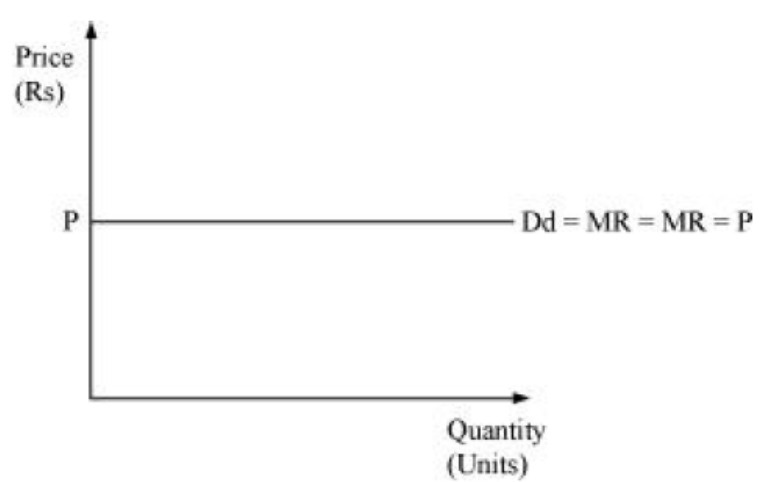
(a) If the total revenue curve is a positively sloped straight line passing through the origin, then the slope of the demand curve will be a horizontal line parallel to the x-axis. This happens when prices are constant.
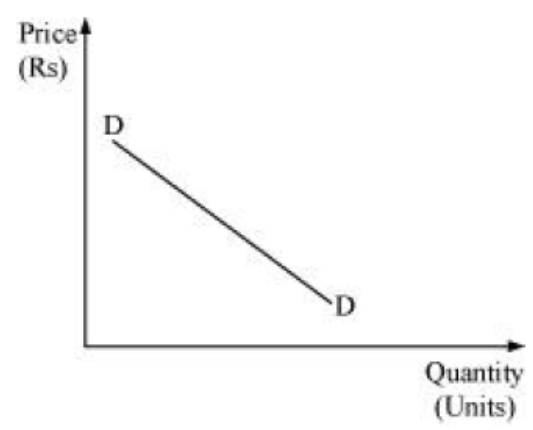
(b) If the total revenue curve is a horizontal line, then the demand curve will be downward sloping. Firms can increase their volume by decreasing the price i.e., AR falls with increase in sales
Question. Comment on the shape of the MR curve in case the TR curve is a (i) positively sloped straight line, (ii) horizontal straight line.
Answer: (i) When TR curve is positively sloped straight line, MR is a horizontal line. MR coincides with the demand curve. Price or AR is constant at each level of output.
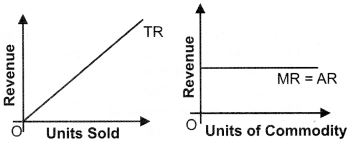
When AR is constant, MR is also constant.
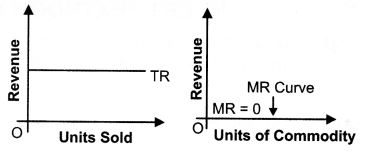
(ii) When TR is a horizontal straight line, MR is zero. It is because horizontal TR means when price falls, quantity demanded rises in the same proportion. Thus, MR is zero. MR curve coincides with the x-axis
Question. From the schedule provided below calculate the total revenue, demand curve and the price elasticity of demand:
| Quantity | 1 | 2 | 3 | 4 | 5 | 6 | 7 | 8 | 9 |
| Marginal Revenue | 10 | 6 | 2 | 2 | 2 | 0 | 0 | 0 | -5 |
Answer:
| Quantity | MR | TR | AR | Ed = ΔQ/ΔP x P/Q |
| 1 | 10 | 10 | 10 | - |
| 2 | 6 | 16 | 8 | 5 |
| 3 | 2 | 18 | 6 | 2 |
| 4 | 2 | 20 | 5 | 2 |
| 5 | 2 | 22 | 4.4 | 2.5 |
| 6 | 0 | 22 | 3.6 | 1 |
| 7 | 0 | 22 | 3.1 | 1.2 |
| 8 | 0 | 22 | 2.7 | 1.1 |
| 9 | -5 | 17 | 1.9 | 0.38 |
MORE QUESTIONS SOLVED
I. Very Short Answer Type Questions
Question. Give the meaning of revenue. Or
Define revenue.
Answer: Revenue of a firm refers to receipts from the sale of output in a given period.
Question. Define total revenue.
Answer: The amount received from the sale of given amount of output is known as Total Revenue.
For example, if a firm sells 100 chairs at a price of? 200 per chair, The total revenue will be
100 Chairs x Rs. 200 = Rs 20,000.
Question.Define average revenue.
Answer: The per unit amount received from the sale of given amount of output.
Question. Define marginal revenue.
Answer: The amount received from the sale of additional unit of output is known as Marginal Revenue.
Question. How is MR derived from TR?
Answer: MRn=TRn - TRn-1
Question. What change in TR will result in a decrease in MR?
Answer: When TR increases at a diminishing rate.
Question. When TR falls, what happens to MR?
Answer: MR is negative.
Question. How does TR change with the output when MR is zero?
Answer: Then, TR is maximum and constant.
Question. What is the behaviour of average revenue in a market in which a firm can sell more only by lowering the price?
Answer: Average revenue will fall.
Question. What is the behaviour of Marginal Revenue in a market in which a firm can sell any quantity of the output it produces at a given price?
Answer: Marginal revenue remains constant.
II. Multiple Choice Questions
Question. Assume that when price is Rs.20, the quantity demanded is 9 units, and when price is Rs.19 the quantity demanded is 10 units. Based on this information what is the marginal revenue resulting from an increase in output from 9 units to 10 units.
(a) Rs.20
(b)Rs.19
(c) Rs.10
(d) Rs. 1
Answer: (c)
Question. Assume that when price is Rs.20, the quantity demanded is 15 units and when price is Rs.18, the quantity demanded is 16 units. Based on this information what is the marginal revenue resulting from an increase in output from 15 units to 16 units?
(a) Rs. 18
(b) Rs.16
(c) Rs.12
(d) Rs. 28
Answer: (c)
Question. Marginal Revenue is equal to:
(a) The change in price divided by the change in output.
(b) The change in quantity divided by the change in price.
(c) The change in P * Q due to a one unit change in output.
(d) Price, but only if the firm is a price searcher.
Answer: (c)
Question. Total revenue =
(a) Price x quantity
(b) Price x income
(c) Income x quantity
(d) None of these.
Answer: (a)
Question. Average revenue is the revenue earned
(a) per unit of input
(b) per unit of output
(c) different units of input
(d) different units of output
Answer: (b)
Question. AR can be symbolically written as:
(a) MR/Q
(b) Price x quantity
(c) TR/Q
(d) None of these.
Answer: (c)
Question. AR is also known as:
(a) Price
(b) Income
(c) Revenue
(d) None of these.
Answer: (a)
Question. Marginal revenue can be defined as the change in total revenue resulting from—
(a) purchase of an additional unit of a commodity
(b) sale of an additional unit of a commodity
(c) sale of subsequent units of a product
(d) None of these.
Answer: (b)
Question. When price remains constant at all level of output, total revenue—
(a) increases at increasing rate
(b) increases at diminishing rate
(c) increases at constant rate
(d) None of these.
Answer: (c)
Question. How does TR change with output when MR is negative?
(a) TR falls with the increase in output
(b) TR rise with the increase in output
(c) TR falls with the decrease in output
(d) None of these.
Answer: (a)
Question. Average revenue curve is also known as:
(a) Profit Curve
(b) Demand Curve
(c) Average Cost Curve
(d) Indifference Curve
Answer: (b)
III. Short Answer Type Questions
Question. Calculate Average Revenue (AR) and Marginal Revenue (MR).
| Units sold Q | 1 | 2 | 3 | 4 | 5 | 6 | 7 |
| TR (Rs) | 20 | 36 | 48 | 56 | 60 | 60 | 56 |
Answer:
| Units sold Q | TR(Rs) | AR(Rs) | MR(Rs) |
| 1 | 20 | 20 | 20 |
| 2 | 36 | 18 | 16 |
| 3 | 48 | 16 | 12 |
| 4 | 56 | 14 | 8 |
| 5 | 60 | 12 | 4 |
| 6 | 60 | 10 | 0 |
| 7 | 56 | 8 | -4 |
Question. Calculate TR and AR from the following data.
| Units sold Q | 1 | 2 | 3 | 4 | 5 | 6 | 7 |
| MR (Rs) | 14 | 10 | 7 | 5 | 0 | -3 | -5 |
Answer:
| Units sold Q | MR (Rs) | TR =∑MR | AR (Rs) |
| 1 | 14 | 14+0=14 | 14 |
| 2 | 10 | 14+10=24 | 12 |
| 3 | 7 | 24+7=31 | 10.33 |
| 4 | 5 | 31+5=36 | 9 |
| 5 | 0 | 36+0=36 | 7.2 |
| 6 | -3 | 36-3=33 | 5.5 |
| 7 | -5 | 35-5=28 | 4 |
Question. Calculate TR and MR from the following data.
| Units sold | 1 | 2 | 3 | 4 | 5 | 6 | - |
| AR (Rs) | 25 | 23 | 21 | 19 | 18 | 15 | - |
Answer:
| Units sold Q | AR (Rs) | TR(Rs) | MR (Rs) |
| 1 | 25 | 25 | 25 |
| 2 | 23 | 46 | 21 |
| 3 | 21 | 63 | 17 |
| 4 | 19 | 76 | 13 |
| 5 | 18 | 90 | 14 |
| 6 | 15 | 90 | 0 |
| - | - | - | - |
Question. Complete the following table
|
Price(Rs) |
12 | 10 | 8 | 6 |
| Output | 1 | 2 | 3 | 4 |
| TR(Rs) | - | - | - | - |
| MR(Rs) | - | - | - | - |
Answer:
| Price(Rs) | Output Units |
TR(Rs) P×Q |
MR(Rs) TRn-TRn-1 |
| 12 | 1 | 12 | 12 |
| 10 | 2 | 20 | 8 |
| 8 | 3 | 24 | 4 |
| 6 | 4 | 24 | 0 |
Question. Complete the following table.
| Price(Rs) | 10 | 9 | 6 | 4 |
| Output Units | 1 | 2 | 3 | 4 |
| TR(Rs) | - | - | - | - |
| MR(Rs) | - | - | - | - |
Answer:
| Price(Rs) | Output Units | TR(Rs) P×Q |
MR(Rs) TRn-TRn-1 |
| 10 | 1 | 10 | 10 |
| 9 | 2 | 18 | 8 |
| 6 | 3 | 18 | 0 |
| 4 | 4 | 16 | -2 |
Free study material for Economics
Economics Class 12 Curriculum Solutions: Chapter 04 Revenue
Accessing Chapter 04 Revenue Solutions
Explore reliable textbook solutions for Chapter 04 Revenue tailored for Class 12 learners. Utilizing these complete exercise answers ensures your preparation aligns exactly with official NCERT standards for Economics.
Concept-Driven Answers for Class 12 Economics
Beyond providing final answers, these guides offer step-by-step breakdowns for complex queries in the Class 12 Economics module. This approach helps students balance theoretical depth with practical problem-solving skills required for NCERT exams.
Maximizing Study Efficiency
These resources act as an effective roadmap for daily homework tasks and independent study. Supplement your review of Chapter 04 Revenue with official sample papers and interactive practice tests available on our platform free of charge.
FAQs
The complete and updated NCERT Solutions Class 12 Economics Chapter 4 Revenue is available for free on StudiesToday.com. These solutions for Class 12 Economics are as per latest NCERT curriculum.
Yes, our experts have revised the NCERT Solutions Class 12 Economics Chapter 4 Revenue as per 2026 exam pattern. All textbook exercises have been solved and have added explanation about how the Economics concepts are applied in case-study and assertion-reasoning questions.
Toppers recommend using NCERT language because NCERT marking schemes are strictly based on textbook definitions. Our NCERT Solutions Class 12 Economics Chapter 4 Revenue will help students to get full marks in the theory paper.
Yes, we provide bilingual support for Class 12 Economics. You can access NCERT Solutions Class 12 Economics Chapter 4 Revenue in both English and Hindi medium.
Yes, you can download the entire NCERT Solutions Class 12 Economics Chapter 4 Revenue in printable PDF format for offline study on any device.