

Chapter-wise Worksheets for Class 12 Computer Science: Inheritance Extending Classes
Review targeted academic worksheets with the CBSE Class 12 Computer Science Inheritance Extending Classes Worksheet. Built according to official educational standards for the 2026-27 term, these downloadable Class 12 Computer Science resources support effective daily practice and detailed self-evaluation for Inheritance Extending Classes.
Practice Class 12 Computer Science Worksheets: Inheritance Extending Classes
Access the complete worksheet PDF for Class 12 Computer Science below. Regular practice with these targeted academic tasks builds familiarity with standard question patterns and helps secure higher marks in final school examinations.
Inheritance
Inheritance is the process of creating a new class from existing class/classes. The existing class is known as the base/super/parent class and newly created class is known as derived/sub/child class. The derived class will inherits the properties of base class. Advantages of Inheritance are given below:
Reusability: It helps the code to be reused in derived class. The base class is defined and once it is compiled, it needs not to be reworked.
Transitivity: If class B inherits properties of another class A, then all subclasses of class B will automatically inherits the properties of A. It is called transitive property.
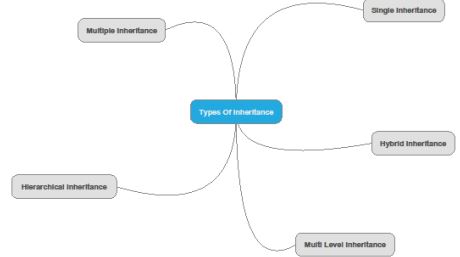
Types of Inheritance:
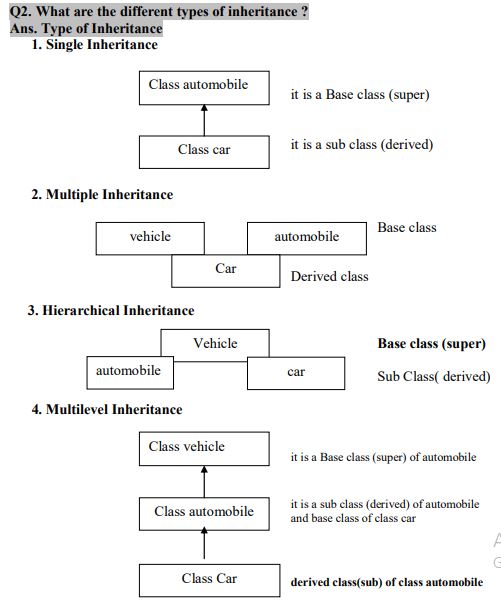
1. Single inheritance:- When a sub class inherits only from one base class, is known as single inheritance.
2. Multiple Inheritance:- When a sub class inherits from multiple base classes, is known as multiple inheritance.
3. Hierarchical Inheritance:- When many sub classes inherit from a single class, it is known as hierarchical inheritance.
4. Multilevel Inheritance:-When a class inherit from a class that itself inherits from another class it is known as a multilevel inheritance.
5. Hybrid Inheritance: It is a combination of 2 or more of above types of inheritance. There is no pattern of deriving from classes.
Q1. What is Inheritance ?
Answer . It is a special feature of OOPS. Inheritance is capability to inherit the properties of one class in to another class.
The derive new class is called derived class (sub class) and old class is called based class (super class).
The Class whose properties of data members are inherited, is called Base Class or Super Class and the class that inherits these properties, is called Derived Class or Sub Class.
Exp1:- If Class A inherits the data of Class B then we can say A is Sub Class and B is super class.
5. Hybrid Inheritance
It is combination of two or more forms of inheritance.
Q2. What do you mean by Base and Derived Class ?
Answer . A derived class (or sub class) has to identify the class from which it is derived i.e. its base class (or super class)
class derived-class-name : visibility-mode base-class-name
{
members of derived class;
};
class is a key word and visibility mode is a access speicifier (i.e. public, private or protected), : (colon) is used separation
colon (:) indicates derived class (sub class) is based on base class( super class)
Example
class car : public automobile
{
members
};
Q3. What is Multiple Inheritance ?
Answer . Multiple Inheritance means deriving a class from more than one base class.
Class kvschool
{
int rollno1;
void num1();
Public:
{
float kvroll;
void num2();
};
class kvstud
{
int rollno2
void num3();
Protected:
float kvroll1;
void num4();
};
class kvclass : public kvschool, public kvstud
{
int kvroll2;
protected:
void display();
};
// to complete the program deifine display () – in class kvclass
i.e. kvclass ::display()
Q4. Define the needs and objectives of Inheritance.
Answer . The major needs and objectives of inheritance are:
(i) It ensures the closeness with the real world models.
(ii) It extend the functionality of an existing class.
(iii) It establishes “a kind of” relationship.
(iv) It helps in reuse of an existing class by a subclass (reusability).
(v) It implements transitive nature( if a class Y inherits properties from class X, then all subclassY will automatically inherit the properties of X)
(vi) The redundancy can be reduced by abstracting a super class from few sub classes.
(vii) It is conept of reusability.
Q5. Give the following definitions, answer the questions that follow:-
#include <iostream.h>
class book
{
char title[20];
char author[20];
int noof pages;
public:
void read();
void show();
};
class textbook: private textbook
{
int noofchapters, noof assignments;
protected:
int standard;
void readtextbook();
void showtextbook();
};
class physicsbook: public textbook
{
char topic[20];
public:
void readphysicsbook();
void showphysicsbook();
};
(i) Name the members, which can be accessed from the member functions of class physicsbook.
(ii) Name the members, which can be accessed by an object of Class textbook.
(iii) Name the members, which can be accessed by an object of Class physicsbook.
(iv) What will be the size of an object (in bytes) of class physicsbook.
Answer . (i) standard , readtextbook(),showtextbook() and topic;
(ii) readtextbook() and showtextbook()
(iii) readphysicsbook(), showphysicsbook(), readtextbook() and showtextbook()
(iv) The size of object of physicsbook= size of book + size of Textbook + size of physicsbook.
= 42+6+20 = 68 bytes
Q6. Consider the following declarations and answer the questions given below:
Class vehicle
{
int wheels;
protected:
int passenger;
public:
void inputdata( int, int);
void outputdata();
};
class heavyvehicle: protected vehicle
{
int dieselpetrol;
protected:
int load;
public:
void readdata( int, int);
void writedata();
};
class bus:private heavyvehicle
{
char marks[20];
public:
void fetchdata(char);
void displaydata();
};
(i) Name the class and derived class of the class heavyvehicle.
(ii) Name the data members that can be accessed from function displaydata()
(iii) Name the data members that can be accessed by an object of bus class
(iv) Is the member function outputdata() accessible to the objects of heavyvehicle class.
Answer .(i) base class = vehicle, derived class = bus
(ii) The data members passenger, load, make are available to function display data
(iii) No data members can be accessed by the object of bus calss.
(iv) No member functions outputdata () is not accessible to the objects of heavy vehicle class.
Q7 . What type of C++ class members ( data members and member functions) are not inherited?
Answer . Data member : Static data members of the base class are not inherited by the derived class
Member functions: Constructors and destructors of base class are not inherited
Free study material for Computer Science
CBSE Class 12 Computer Science Worksheets for Inheritance Extending Classes
Practice Exercises for Class 12 Computer Science Inheritance Extending Classes
Review targeted practice exercises for Class 12 Computer Science Inheritance Extending Classes. Curated to match official CBSE guidelines, these printable problem sets support daily revision and improve overall test readiness.
Step-by-Step Solutions and Practice Guidelines
Designed around the official curriculum for Class 12 Computer Science, these practice sheets guarantee standard compliance. Reviewing step-by-step solutions after completion sharpens your accuracy and clarifies complex sub-topics within Inheritance Extending Classes.
Enhance Speed with Online Practice
Follow up your worksheet practice by attempting the interactive online MCQ tests for Inheritance Extending Classes to evaluate your execution speed. All printable assignments and revision sheets on our platform are updated for the 2026 session and available free of charge.
FAQs
You can download the latest chapter-wise printable worksheets for Class 12 Computer Science Inheritance Extending Classes for free from StudiesToday.com. These have been made as per the latest CBSE curriculum for this academic year.
Yes, Class 12 Computer Science worksheets for Inheritance Extending Classes focus on activity-based learning and also competency-style questions. This helps students to apply theoretical knowledge to practical scenarios.
Yes, we have provided solved worksheets for Class 12 Computer Science Inheritance Extending Classes to help students verify their answers instantly.
Yes, our Class 12 Computer Science test sheets are mobile-friendly PDFs and can be printed by teachers for classroom.
For Inheritance Extending Classes, regular practice with our worksheets will improve question-handling speed and help students understand all technical terms and diagrams.