

Download NCERT Solutions for Class 11 Biology Chapter 19 Chemical Coordination and Integration
Access comprehensive textbook solutions for Chapter 19 Chemical Coordination and Integration using the official curriculum guides for Class 11 Biology. Designed to align with the 2026-27 NCERT standards, these detailed answers help students reinforce core academic concepts.
Access NCERT Solutions and Answers
Navigate directly to the solved Biology textbook exercises using the digital viewer below. Each solution includes detailed step-by-step explanations, allowing students to instantly cross-check their work and identify areas requiring further revision.
Question. Define the following:
(a) Exocrine gland
(b) Endocrine gland
(c) Hormone Answer
Answer
(a) Exocrine gland: Glands that discharge their secretions into ducts are known as exocrine glands.
(b) Endocrine gland: Glands that do not discharge their secretions into ducts are known as endocrine glands. These glands discharge their secretions directly into the blood.
(c) Hormone: Hormones are non-nutrient chemicals which act as intercellular messengers and are produced in trace amounts.
Question. Diagrammatically indicate the location of the various endocrine glands in our body.
Answer
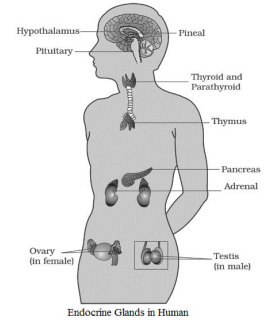
Question. List the hormones secreted by the following:
(a) Hypothalamus (b) Pituitary (c) Thyroid
(d) Parathyroid (e) Adrenal (f) Pancreas
(g) Testis (h) Ovary (i) Thymus
(j) Atrium (k) Kidney (l) G-I Tract
Answer
(a) Hypothalamus
-- Thyrotropin Releasing Hormone (TRH)
-- Gonadotrophin releasing hormone (GnRH)
-- Somatotropin-releasing hormone
-- Adrenocorticotrophin-releasing hormone
-- Prolactin releasing Hormone
-- Growth-inhibiting hormone
-- Melanocyte-inhibiting hormone
(b) Pituitary
-- Growth Hormone (GH)
-- Prolactin (PRL)
-- Thyroid Stimulating Hormone (TSH)
-- Adrenocorticotrophic Hormone (ACTH)
-- Luteinizing Hormone (LH)
-- Follicle Stimulating Hormone (FSH)
-- Melanocyte Stimulating hormone (MSH)
• Neurohypophysis also known as posterior pituitary
-- Oxytocin
-- Vasopressin
(c) Thyroid
-- Thyroxin
-- Triiodothyronin
-- Calcitonin
(d) Parathyroid
-- Parathyroid Hormone
(e) Adrenal
-- Mineralocorticoids (mainly aldosterone)
-- Glucocorticoids (mainly cortisol)
-- Adrenaline
-- Nor-adrenaline
(f) Pancreas
-- Insulin
-- Glucagon
(g) Testis
-- Testosterone
(h) Ovary
-- Estrogen
-- Progesterone
(i) Thymus
-- Thymosins
(j) Atrium
-- Atrial Natriuretic factor
(k) Kidney
-- Erythropoietin
(l) G-I Tract
-- Gastrin
-- Secretin
-- Cholecystokinin (CCK)
-- Gastric inhibitory peptide (GIP)
Question. Fill in the blanks:
Hormones Target gland
(a) Hypothalamic hormones __________________
Answer Pituitary
(b) Thyrotrophin (TSH) __________________
Answer Thyroid
(c) Corticotrophin (ACTH) __________________
Answer Adernal
(d) Gonadotrophins (LH, FSH) __________________
Answer Ovary, Testis
(e) Melanotrophin (MSH) __________________
Answer Melanoycte
Question. Write short notes on the functions of the following hormones,
(a) Parathyroid hormone (PTH)
(b) Thyroid hormones
(c) Thymosins
(d) Androgens
(e) Estrogens
(f) Insulin and Glucagon
Answer
(a) Parathyroid hormone (PTH): It is secreted by Parathyroid gland. It increases the Ca2+ levels in the blood. PTH promotes the reabsorption of calcium from nephrons and also, promotes the absorption of calcium from digested food. Thus, it plays an important role in calcium balance in the body.
(b) Thyroid hormones: Thyroid hormones play an important role in the regulation of the basal metabolic rate. These hormones also support the process of red blood cell formation. Thyroid hormones control the metabolism of carbohydrates, proteins and fats. Maintenance of water and electrolyte balance is also influenced by thyroid hormones. Thyroid gland also secretes a protein hormone called thyrocalcitonin (TCT) which regulates the blood calcium levels.
(c) Thymosins: It play a major role in the differentiation of T-lymphocytes, which provide cellmediated immunity. It also promote production of antibodies to provide humoral immunity.
(d) Androgens: It regulate the development, maturation and functions of the male accessory sex organs like epididymis, vas deferens, seminal vesicles, prostate gland, urethra etc. Androgens mainly testosterone stimulate muscular growth, growth of facial and axillary hair, aggressiveness, low pitch of voice etc. It stimulates spermatogenesis and formation of mature sperms and also influences male sexual behaviour. These hormones also produce synthetic effects on protein and carbohydrate metabolism.
(e) Estrogens: It produce wide ranging actions such as stimulation of growth and activities of female secondary sex organs, development of growing ovarian follicles, appearance of female secondary sex characters (e.g., high pitch of voice, etc.), mammary gland development. Estrogens also regulate female sexual behaviour.
(f) Insulin and Glucagon: These hormones are secreted by pancreas and helps in regulation of glucose level in body.
Insulin plays a major role in the regulation of glucose homeostasis. It acts mainly on hepatocytes and adipocytes (cells of adipose tissue), and enhances cellular glucose uptake and utilisation. It also stimulates conversion of glucose to glycogen (glycogenesis) in the target cells.
Glucagon plays an important role in maintaining the normal blood glucose levels. Glucagon acts mainly on the liver cells (hepatocytes) and stimulates glycogenolysis resulting in an increased blood sugar (hyperglycemia). It also stimulates the process of gluconeogenesis which also contributes to hyperglycemia.
Question. Give example(s) of:
(a) Hyperglycemic hormone and hypoglycemic hormone
(b) Hypercalcemic hormone
(c) Gonadotrophic hormones
(d) Progestational hormone
(e) Blood pressure lowering hormone
(f) Androgens and estrogens
Answer
(a) Hyperglycemic hormone -- Glucagon hypoglycemic hormone -- Insulin
(b) Hypercalcemic hormone -- Parathyroid hormone (PTH)
(c) Gonadotrophic hormones -- Luteinizing hormone and Follicle stimulating hormone
(d) Progestational hormone -- Progesterone
(e) Blood pressure lowering hormone -- Nor-adrenaline
(f) Androgens and estrogens -- Testosterone
Question. Which hormonal deficiency is responsible for the following:
(a) Diabetes mellitus (b) Goitre (c) Cretinism
Answer
(a) Diabetes mellitus -- Insulin
(b) Goitre -- Thyroxin hormone
(c) Cretinism -- Thyroxin hormone
Question. Briefly mention the mechanism of action of FSH.
Answer Follicle stimulating hormone (FSH) stimulates growth and development of the ovarian follicles in females.
FSH produces its effect by binding to its specific receptors present on the ovarian cell membrane. Binding of FSH hormone to its specific receptor present over the cell surface activates an enzyme called adenylate cyclase. This enzyme converts ATP into cyclicAMP. The cyclicAMP is called the second messenger and carries out various biochemical responses in the cell by activating the existing enzyme system in the cell. The biochemical responses then lead to physiological responses like ovarian growth.
Question. Match the following:
Column I Column II
(a) T4 (i) Hypothalamus
(b) PTH (ii) Thyroid
(c) GnRH (iii) Pituitary
(d) LH (iv) Parathyroid
Answer
(a) - (ii)
(b) - (iv)
(c) - (i)
(d) - (iii)
Free study material for Biology
Biology Class 11 Curriculum Solutions: Chapter 19 Chemical Coordination and Integration
Accessing Chapter 19 Chemical Coordination and Integration Solutions
Access structured NCERT textbook solutions for Chapter 19 Chemical Coordination and Integration. Designed in alignment with the latest academic curriculum for Class 11 Biology, these answers cover all end-of-chapter exercises to support daily learning and homework completion.
Concept-Driven Answers for Class 11 Biology
Beyond providing final answers, these guides offer step-by-step breakdowns for complex queries in the Class 11 Biology module. This approach helps students balance theoretical depth with practical problem-solving skills required for NCERT exams.
Maximizing Study Efficiency
Frequent review of these structured answers builds strong analytical capabilities and response efficiency. Maximize your academic readiness by combining these textbook solutions with our curated study materials and mock evaluations for Class 11 Biology.
FAQs
The complete and updated NCERT Solutions Class 11 Biology Chapter 22 Chemical Coordination and Integration is available for free on StudiesToday.com. These solutions for Class 11 Biology are as per latest NCERT curriculum.
Yes, our experts have revised the NCERT Solutions Class 11 Biology Chapter 22 Chemical Coordination and Integration as per 2026 exam pattern. All textbook exercises have been solved and have added explanation about how the Biology concepts are applied in case-study and assertion-reasoning questions.
Toppers recommend using NCERT language because NCERT marking schemes are strictly based on textbook definitions. Our NCERT Solutions Class 11 Biology Chapter 22 Chemical Coordination and Integration will help students to get full marks in the theory paper.
Yes, we provide bilingual support for Class 11 Biology. You can access NCERT Solutions Class 11 Biology Chapter 22 Chemical Coordination and Integration in both English and Hindi medium.
Yes, you can download the entire NCERT Solutions Class 11 Biology Chapter 22 Chemical Coordination and Integration in printable PDF format for offline study on any device.