

Practice CBSE Class 12 Biology Biotechnology Principles and Processes MCQs Set 02 provided below. The MCQ Questions for Class 12 Chapter 9 Biotechnology Principles and Processes Biology with answers and follow the latest CBSE/ NCERT and KVS patterns. Refer to more Chapter-wise MCQs for CBSE Class 12 Biology and also download more latest study material for all subjects
MCQ for Class 12 Biology Chapter 9 Biotechnology Principles and Processes
Class 12 Biology students should review the 50 questions and answers to strengthen understanding of core concepts in Chapter 9 Biotechnology Principles and Processes
Chapter 9 Biotechnology Principles and Processes MCQ Questions Class 12 Biology with Answers
Question. c-DNA probes are copied from the messenger RNA molecules with the help of
(a) restriction enzymes
(b) reverse transcriptase
(c) DNA polyermase
(d) adenosine deaminase
Answer : B
Question. The DNA molecule to which the gene of interest is integrated for cloning is called
(a) template
(b) carrier
(c) transformer
(d) vector.
Answer : D
Question. The introduction of T-DNA into plants involves
(a) exposing the plants to cold for a brief period
(b) allowing the plant roots to stand in water
(c) infection of the plant by Agrobacterium tumefaciens
(d) altering the pH of the soil, then heat-shocking the plants.
Answer : C
Question. Commonly used vectors for human genome sequencing are
(a) T – DNA
(b) BAC and YAC
(c) expression vectors
(d) T/A cloning vectors.
Answer : B
Question. A mutant strain of T4 – Bacteriophage, R-II, fails to lyse the E. coli but when two strains R-IIX and R-IIY are mixed then they lyse the E. coli. What may be the possible reason?
(a) Bacteriophage transforms in wild.
(b) It is not mutated.
(c) Both strains have similar cistrons.
(d) Both strains have different cistrons.
Answer : D
Question. Maximum number of bases in plasmids discovered so far
(a) 50 kilo base
(b) 500 kilo base
(c) 5000 kilo base
(d) 5 kilo base.
Answer : B
Question. There is a restriction endonuclease called EcoRI. What does “co” part in it stand for?
(a) Colon
(b) Coelom
(c) Coenzyme
(d) Coli
Answer : D
Question. In genetic engineering, a DNA segment (gene) of interest, is transferred to the host cell through a vector. Consider the following four agents (i-iv) in this regard and select the correct option about which one or more of these can be used as a vector/vectors.
(i) Bacterium
(ii) Plasmid
(iii) Plasmodium
(iv) Bacteriophage
(a) (i), (ii) & (iv)
(b) (i) only
(c) (i) & (iii)
(d) (ii) & (iv)
Answer : D
Question. Given below are four statements pertaining to separation of DNA fragments using gel electrophoresis. Identify the incorrect statements.
(i) DNA is negatively charged molecule and so it is loaded on gel towards the anode terminal.
(ii) DNA fragments travel along the surface of the gel whose concentration does not affect movement of DNA.
(iii) Smaller the size of DNA fragment larger is the distance it travels through it.
(iv) Pure DNA can be visualized directly by exposing UV radiation.
Choose the answer from the options given below.
(a) (i), (iii) and (iv)
(b) (i), (ii) and (iii)
(c) (ii), (iii) and (iv)
(d) (i), (ii) and (iv)
Answer : D
Question. The DNA fragments separated on an agarose gel can be visualised after staining with
(a) acetocarmine
(b) aniline blue
(c) ethidium bromide
(d) bromophenol blue.
Answer : C
Question. Which of the following are used in gene cloning?
(a) Nucleoids
(b) Lomasomes
(c) Mesosomes
(d) Plasmids
Answer : D
Question. Genetic engineering is possible, because
(a) we can cut DNA at specific sites by endonucleases like DNase I
(b) restriction endonucleases purified from bacteria can be used in vitro
(c) the phenomenon of transduction in bacteria is well understood
(d) we can see DNA by electron microscope.
Answer : B
Question. The most thoroughly studied of the known bacteriaplant interactions is the
(a) cyanobacterial symbiosis with some aquatic ferns
(b) gall formation on certain angiosperms by Agrobacterium
(c) nodulation of Sesbania stems by nitrogen fixing bacteria
(d) plant growth stimulation by phosphatesolubilising bacteria.
Answer : B
Question. Human Genome Project (HGP) is closely associated with the rapid development of a new area in biology called as
(a) biotechnology
(b) bioinformatics
(c) biogeography
(d) bioscience
Answer : B
Question. The process of separation and purification of expressed protein before marketing is called
(a) downstream processing
(b) bioprocessing
(c) postproduction processing
(d) upstream processing.
Answer : A
Question. Match the items in column I with their uses in column II and choose the right option.
Column I Column II
A. ELISA (i) Antigen-antibody interaction
B. PCR (ii) Gene amplification
C. Biolistics (iii) Direct introduction of recombinant DNA
D. Micro-injection (iv) Gold coated DNA
(a) A-(i), B-(ii), C-(iv), D-(iii)
(b) A-(ii), B-(i), C-(iv), D-(iii)
(c) A-(iv), B-(i), C-(ii), D-(iii)
(d) A-(i), B-(iv), C- (ii), D-(iii)
Answer : A
Question. Which one of the following is used as vector for cloning genes into higher organisms?
(a) Baculovirus
(b) Salmonella typhimurium
(c) Rhizopus nigricans
(d) Retrovirus
Answer : D
Question. Identify A, B, C and D in the given diagram.
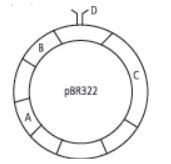
(a) A-ori, B-ampR, C-tetR, D-HindIII
(b) A-HindIII, B-tetR, C-ampR, D-ori
(c) A-ampR, B-tetR, C-HindIII, D-ori
(d) A-tetR, B-HindIII, C-ori, D-ampR
Answer : A
Question. In genetic engineering, the antibiotics are used
(a) as selectable markers
(b) to select healthy vectors
(c) as sequences from where replication starts
(d) to keep the cultures free of infection.
Answer : A
Question. There is a restriction endonuclease called EcoRI. What does “co” part in it stand for?
(a) colon
(b) coelom
(c) coenzyme
(d) coli
Answer : D
Question. What is the first step in the Southern blot technique?
(a) Denaturation of DNA on the gel for hybridization with specific probe.
(b) Production of a group of genetically identical cells.
(c) Digestion of DNA by restriction enzyme.
(d) Denaturation of DNA from a nucleated cell such as the one from the scene of crime.
Answer : D
Question. Which one is a true statement regarding DNA polymerase used in PCR?
(a) It is used to ligate introduced DNA in recipient cells.
(b) It serves as a selectable marker.
(c) It is isolated from a virus.
(d) It remains active at high temperature.
Answer : D
Question. The enzymes which are absolutely necessary for recombinant DNA technology are
(a) restriction endonucleases and topoisomerases
(b) endonucleases and polymerases
(c) restriction endonucleases and ligases
(d) peptidases and ligases.
Answer : C
Question. The DNA molecule to which the gene of interest is integrated for cloning is called
(a) template
(b) carrier
(c) transformer
(d) vector.
Answer : D
Question. DNA precipitation out of a mixture of biomolecules can be achieved by treatment with
(a) chilled chloroform
(b) isopropanol
(c) chilled ethanol
(d) methanol at room temperature.
Answer : C
Question. Restriction endonucleases are used as
(a) molecular build up at nucleotides.
(b) molecular degradation to DNA breakup.
(c) molecular knives for cutting DNA at specific sites.
(d) molecular cement to combine DNA sites.
Answer : C
Question. Which of the following restriction enzymes produces blunt ends?
(a) SalI
(b) EcoRV
(c) XhoI
(d) HindIII
Answer : B
Question. Gel electrophoresis is used for
(a) construction of recombinant DNA by joining with cloning vectors
(b) isolation of DNA molecules
(c) cutting of DNA into fragments
(d) separation of DNA fragments according to their size.
Answer : D
Question. Which one is a true statement regarding DNA polymerase used in PCR?
(a) It is used to ligate introduced DNA in recipient cells.
(b) It serves as a selectable marker.
(c) It is isolated from a virus.
(d) It remains active at high temperature.
Answer : D
Question. Which of the following is not a feature of the plasmids?
(a) Transferable
(b) Single-stranded
(c) Independent replication
(d) Circular structure
Answer : B
Question. The enzymes which are absolutely necessary for recombinant DNA technology are
(a) restriction endonucleases and topoisomerases
(b) endonucleases and polymerases
(c) restriction endonucleases and ligases
(d) peptidases and ligases.
Answer : C
Question. DNA precipitation out of a mixture of biomolecules can be achieved by treatment with
(a) chilled chloroform
(b) isopropanol
(c) chilled ethanol
(d) methanol at room temperature.
Answer : C
Free study material for Biology
MCQs for Chapter 9 Biotechnology Principles and Processes Biology Class 12
Students can use these MCQs for Chapter 9 Biotechnology Principles and Processes to quickly test their knowledge of the chapter. These multiple-choice questions have been designed as per the latest syllabus for Class 12 Biology released by CBSE. Our expert teachers suggest that you should practice daily and solving these objective questions of Chapter 9 Biotechnology Principles and Processes to understand the important concepts and better marks in your school tests.
Chapter 9 Biotechnology Principles and Processes NCERT Based Objective Questions
Our expert teachers have designed these Biology MCQs based on the official NCERT book for Class 12. We have identified all questions from the most important topics that are always asked in exams. After solving these, please compare your choices with our provided answers. For better understanding of Chapter 9 Biotechnology Principles and Processes, you should also refer to our NCERT solutions for Class 12 Biology created by our team.
Online Practice and Revision for Chapter 9 Biotechnology Principles and Processes Biology
To prepare for your exams you should also take the Class 12 Biology MCQ Test for this chapter on our website. This will help you improve your speed and accuracy and its also free for you. Regular revision of these Biology topics will make you an expert in all important chapters of your course.
FAQs
You can get most exhaustive CBSE Class 12 Biology Biotechnology Principles and Processes MCQs Set 02 for free on StudiesToday.com. These MCQs for Class 12 Biology are updated for the 2026-27 academic session as per CBSE examination standards.
Yes, our CBSE Class 12 Biology Biotechnology Principles and Processes MCQs Set 02 include the latest type of questions, such as Assertion-Reasoning and Case-based MCQs. 50% of the CBSE paper is now competency-based.
By solving our CBSE Class 12 Biology Biotechnology Principles and Processes MCQs Set 02, Class 12 students can improve their accuracy and speed which is important as objective questions provide a chance to secure 100% marks in the Biology.
Yes, Biology MCQs for Class 12 have answer key and brief explanations to help students understand logic behind the correct option as its important for 2026 competency-focused CBSE exams.
Yes, you can also access online interactive tests for CBSE Class 12 Biology Biotechnology Principles and Processes MCQs Set 02 on StudiesToday.com as they provide instant answers and score to help you track your progress in Biology.