

Download Class 11 Physics Concept Summaries: CBSE Class 11 Physics Unit and Measurement Notes Set 01
Access comprehensive revision notes for Chapter 01 Units and Measurement using the CBSE Class 11 Physics Unit and Measurement Notes Set 01. Designed to align with the 2026-27 academic syllabus for Class 11 Physics, these concept summaries help students streamline their exam preparation and review complex topics efficiently.
Access Chapter 01 Units and Measurement Notes and Study Material
Access the complete concept summary PDF for Chapter 01 Units and Measurement below. Regular review of these targeted notes builds familiarity with complex Class 11 Physics themes and helps secure higher marks in final school evaluations.
Key Learnings:
1. In India National Physical Laboratory maintains the standards of measurements.
2. The system of units used around the world is International System of SI.
3. The units for the base quantities are called fundamental or base units. The units of all other physical quantities can be expressed as a combination of base units. Such units obtained are called derived units.
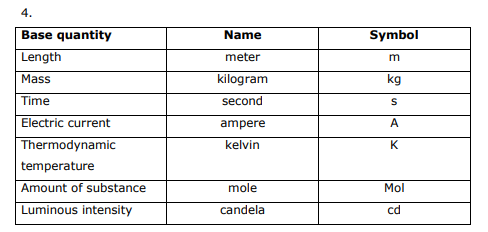
5. Other physical quantities, derived from the base quantities, can be expressed as a combination of the base units and are called derived units. A complete set of units, bother fundamental and derived, is called a system of units.
6. In computing any physical quantity, the units fro derived quantities involved in the relationship(s) are treated as though they were algebraic quantities till the desired units are obtained.
7. The apparent shift in the position of the object against the reference point in the background is called parallax.
8. Parallax is caused whenever there is change in the point of observation. The distance between the two points of observation is called the basis. Let the basis be b and angle subtended by this at some point is θ then and distance of the point D=b/θ
9. The size of the molecules of solution = volume of film / area of film
10. The unit used to measure the size of the nucleus of an atom is Fermi which is 10-15 m.
11. The unit used to measure the distance between the earth and the sun is the astronomical unit.
12. The smallest value measured by an instrument is called its least count. The least count of vernier calipers is 0.01 cm and that of screw gauge is 0.001 cm.
13. Different types of errors: absolute error, relative error and percentage error
14. True value is the mean of all the observed readings.
15. Absolute error is the magnitude of the difference between the individual measured value and the true value. Absolute error: Measured value - True value.
16. The fractional error is the ratio of mean absolute error to the true value.
It is also known as relative error.
Relative error = Mean absolute error / True value
17. Direct and indirect methods can be used for the measurement of physical quantities. In measured quantities, while expressing the result, the accuracy and precision of measuring instruments along with errors in measurements should be taken into account.
18. Significant Figures in a measured or observed value, is the number of reliable digits plus the first uncertain digit.
19. Rules to identify the significant figures
i. All non zero digits are significant. Powers of ten are not counted in significant figures. For example 1.7x10⁵ has 2 significant figures.
ii. In a number with a decimal, Zeroes appearing to the left of a digit are not counted in significant figures. For example 0.002 has only one significant figure in it.
iii. In a number with a decimal, the number of zeroes at the end is counted in significant figures. For example 1.700 has 4 significant figures.
iv. Shifting the position of the decimal does not change the number of significant figures. For example 2.340 and 234.0 have 4 significant figures.
v. All the zeros between two non-zero digits are significant, no matter where the decimal place is, if at all. For example, 203.4 cm has 4 significant digits, 2.05 has 3 significant digits
vi. The terminal or trailing zeros in a number without a decimal point are not significant. Thus 125 m=12500cm=125000 mm has three significant figures.
20. Changing the units do not change the number of significant figures
21. Dimensions of a physical quantity are the powers (or exponents) to which the base quantities are raised to represent that quantity.
22. Dimensional formula: The expression which shows how and which of the base quantities represent the dimensions of a physical quantity.
23. Applications of dimensional analysis
i. Dimensional analysis can be used to derive a physical equation
ii. Dimensional analysis can be used to verify if the given equation is dimensionally correct.
iii. Dimensional analysis can be used to find the dimensions of unknown parameter in the equation.
Top Formulae
1. Mean value: amean = (a1 + a2 +a3 +…+ an) / n
or,
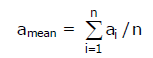
2. The errors in the individual measurement values from the true value
(Absolute Error):
Δa1 = a1 - amean
Δa2 = a2 – amean
…. = …. …..
…. = …. …..
Δan = an - amean
3. Mean absolute errors: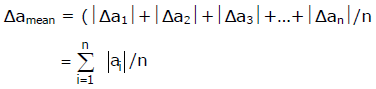
4. Relative error = Δamean / amean
5. Percentage error:
δa = (Δamean / amean) x 100%
6. Error of a sum or a difference:
± ΔZ = ± ΔA ± ΔB
or,
The maximum value of the error ΔZ is ΔA + ΔB.
7. Error of a product or a quotient:
ΔZ/ Z = (ΔA/ A) + (ΔB/ B)
8. Error in case of a measured quantity raised to a power
If Z = Ap Bq/ Cr
ΔZ/ Z = p (ΔA/ A) + q (ΔB/ B) + r (ΔC/ C)
Please click the link below to download pdf file for CBSE Class 11 Physics - Unit of Measurement Notes.
Free study material for Physics
Download CBSE Revision Notes: Class 11 Physics Chapter 01 Units and Measurement
Quick Revision Notes: Chapter 01 Units and Measurement (CBSE)
Access structured revision notes for Chapter 01 Units and Measurement designed in alignment with the latest CBSE curriculum for Class 11 Physics. These summaries help clarify core themes and support effective daily study.
Expert Study Material for Class 11 Physics
Each chapter summary is structured around standard CBSE textbooks, allowing students to check their understanding and clarify complex ideas early in their revision.
Complete Your Chapter Revision
Follow up your revision by attempting the interactive online Physics MCQ test and practice worksheets for this chapter to verify your mastery. All platform resources are free to access.
FAQs
You can download the teacher prepared revision notes for CBSE Class 11 Physics Unit and Measurement Notes Set 01 from StudiesToday.com. These notes are designed as per 2026-27 academic session to help Class 11 students get the best study material for Physics.
Yes, our CBSE Class 11 Physics Unit and Measurement Notes Set 01 include 50% competency-based questions with focus on core logic, keyword definitions, and the practical application of Physics principles which is important for getting more marks in 2026 CBSE exams.
Yes, our CBSE Class 11 Physics Unit and Measurement Notes Set 01 provide a detailed, topic wise breakdown of the chapter. Fundamental definitions, complex numerical formulas and all topics of CBSE syllabus in Class 11 is covered.
These notes for Physics are organized into bullet points and easy-to-read charts. By using CBSE Class 11 Physics Unit and Measurement Notes Set 01, Class 11 students fast revise formulas, key definitions before the exams.
No, all study resources on StudiesToday, including CBSE Class 11 Physics Unit and Measurement Notes Set 01, are available for immediate free download. Class 11 Physics study material is available in PDF and can be downloaded on mobile.