

Read and download the CBSE Class 9 Mathematics Number System Assignment Set 03 for the 2026-27 academic session. We have provided comprehensive Class 9 Mathematics school assignments that have important solved questions and answers for Chapter 1 Number Systems. These resources have been carefuly prepared by expert teachers as per the latest NCERT, CBSE, and KVS syllabus guidelines.
Solved Assignment for Class 9 Mathematics Chapter 1 Number Systems
Practicing these Class 9 Mathematics problems daily is must to improve your conceptual understanding and score better marks in school examinations. These printable assignments are a perfect assessment tool for Chapter 1 Number Systems, covering both basic and advanced level questions to help you get more marks in exams.
Chapter 1 Number Systems Class 9 Solved Questions and Answers
Question. Starting with 0, a growing number sequence is generated by the rule given below.
To get the next number:
Substitute 0 with 01. Substitute 1 with 10.
Accordingly, the first four terms of the sequence are 0---->01--------->0110------>01101001
What is the next number in the sequence?
A. 110000000000000
B. 0110100110010110
C. 11010011001
D. 11010010110
Answer : B
Question. In Nirmal Public school, 28 students have joined the Chess Club and 32 have joined the Carrom Club. Among these, there are 5 students who have joined both the clubs. Altogether how many students have joined these two clubs?
A. 50
B. 55
C. 60
D. 65
Answer : B
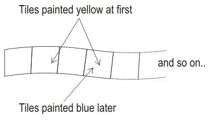
Question. A pathway in Manju's garden is made of 100 white tiles arranged in a single row. Manju decides to add some colour to her garden by painting some of the tiles. Starting from one end, she paints every second tile yellow. Still not happy with the result, she proceeds to paint every second one of the YELLOW tiles blue. How many yellow tiles are there in the pathway now?
A. 50
B. 55
C. 60
D. 65
Answer : C
Question. A deck of playing cards consists of 52 cards. How many levels high would the highest (complete) card house that can be made with a SINGLE deck be?
A. 4
B. 5
C. 6
D.8
Answer : B
Question. How many cards would be needed to make a n-level high card house?
A. 3n
B. 4n - 1
C. 3n/2 + 4
D. n/2 (3n+1)
Answer : D
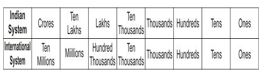
Question. The International system of naming big numbers is different from the Indian system. A comparative chart of the two systems is shown below:How will the number 'Forty million five hundred thousand and ten' be named in the Indian system?
A. Forty five lakhs and ten
B. Forty crores five lakhs and ten
C. Four crores fifty lakhs and ten
D. Four crores five lakhs and ten
Answer : D
Question. Ram: What is the relationship between 150% of a number and 50% of the same number?
Sheetal: 150% of the number will be three times 50% of the number - because 150 is three times 50.
Sarika: Of course not. It depends on the number of which you are taking 50% and 150%
Rohan: Wrong - 150% of a number will always be MORE than three times 50% of the same number.
Ahmed: Well, I think 150% would be less than three times 50% of that number.
Who has answered Ram's question correctly?
A. Sheetal
B. Sarika
C. Rohan
D. Ahmed
Answer : A
Question. If the ratio of Ravi's age to John's age is 2 : 3, which of the following is true about their actual ages?
A. John's age is 11/2 times Ravi's age
B. Ravi is a year younger than John
C. John is 3 times as old as Ravi
D. Ravi's age is half of John's age
Answer : A
Question. If n is a rational number other than 0, which of the following is NOT necessarily a rational number?
A. 13/n
B. n3
C. 3 - n
D. √n
Answer : D
Question. A number is called a perfect square if it is the square of a whole number. If m and n are two perfect squares, which of the following MUST also be a perfect square?
A. m + n
B. 2m
C. 4n
D. m2 + n2
Answer : C
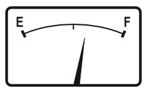
Question. The fuel tank of Shailaja's car has a capacity of 37 litres. One day, when she goes to the petrol station, the fuel gauge of her car looks like this: About how many litres of petrol are required to completely fill the fuel tank of Shailaja's car?
A. 10
B.14
C. 18
D. 23
Answer : B
Question. Bablu's height increased by 10% over the last year. What is the ratio of his last year's height to this year's?
A. 10:11
B. 9:10
C. 11:10
D. 1:10
Answer : A
Question. A number N is increased by 100%. The result is then decreased by 100%. The final result will be
A. 50N
B. N
C. N/2
D. 0
Answer : D
Question. Study the values in rows X, Y and Z below. If we choose numbers x, y and z from rows X, Y and Z respectively, what is the maximum possible value of z-y/x ?

A. 1.4
B. 5
C. 7
D. 11
Answer : D
Question. When written in decimal form, which of the following will be a non-terminating, non-recurring number?
A. 11/9
B. 21/9
C. 2-9
D. 91/2
Answer : B
Short Answer Type questions
Question. Is every real number is a rational number ?
Answer: No, every real number is not a rational number. Real numbers are made up of both rational and irrational numbers. Therefore, any irrational number (such as \( \sqrt{2} \) or \( \pi \)) is a real number but not a rational number.
In simple words: No, because real numbers also include irrational numbers, which cannot be written as simple fractions.
Exam Tip: Remember that the set of real numbers is divided into two distinct groups: rational and irrational numbers. Use a quick counter-example like \( \sqrt{3} \) to prove this statement false.
Question. Is 1.01001000100001 …… irrational? If so, why?
Answer: Yes, the number \( 1.01001000100001\dots \) is an irrational number. This is because its decimal expansion is non-terminating (it goes on forever) and non-repeating (there is no repeating cycle or block of digits).
In simple words: Yes, because the decimal goes on forever without repeating a fixed pattern of numbers.
Exam Tip: To show why a decimal is irrational, always mention the key characteristics: it must be non-terminating and non-recurring.
Question. Is every whole number is a natural number ?
Answer: No, every whole number is not a natural number. The whole number \( 0 \) is not included in the set of natural numbers.
In simple words: No, because 0 is a whole number but it is not a natural number.
Exam Tip: Natural numbers are counting numbers starting from 1, while whole numbers include all natural numbers plus 0.
Question. Look at the following examples of rational number in the form p/q (q != 0),where p and q integers with no common factors other than 1 and having terminating decimal representations. Can you guess the property which satisfy q ?
\[ \frac{7}{8} = \frac{7}{2^3} = \frac{7 \times 5^3}{2^3 \times 5^3} = \frac{875}{(2 \times 5)^3} = \frac{875}{10^3} = \frac{875}{1000} = 0.875 \]
\[ \frac{3}{40} = \frac{3}{2^3 \times 5} = \frac{3 \times 5^2}{2^3 \times 5^3} = \frac{75}{(2 \times 5)^3} = \frac{75}{1000} = 0.075 \]
\[ \frac{4}{25} = \frac{4 \times 2^2}{5^2 \times 2^2} = \frac{4 \times 4^2}{(5 \times 2^2)} = \frac{16}{100} = 0.16 \]
Answer: Based on these examples, we can see that the prime factorization of the denominator \( q \) consists only of powers of 2, powers of 5, or both. In other words, \( q \) must be of the form \( 2^n \cdot 5^m \), where \( n \) and \( m \) are non-negative integers.
In simple words: The bottom of the fraction must only have 2 or 5 as its prime factors for the decimal to stop.
Exam Tip: A rational number has a terminating decimal expansion if and only if its denominator (in simplest form) has no prime factors other than 2 and 5.
Question. Is zero a rational number? Explain it.
Answer: Yes, zero is a rational number. It can be written in the form \( \frac{p}{q} \) where \( p \) and \( q \) are integers and \( q \neq 0 \). For example, we can express zero as \( \frac{0}{1} \), \( \frac{0}{5} \), or \( \frac{0}{-3} \).
In simple words: Yes, because you can write zero as a fraction like 0/1, where the bottom number is not zero.
Exam Tip: The rational number definition only forbids the denominator from being 0. The numerator can be 0.
Question. If \( \frac{1}{x} = \frac{x^2}{27} \), then find x is rational or irrational number.
Answer: Given the equation: \[ \frac{1}{x} = \frac{x^2}{27} \] By cross-multiplying, we get: \[ x^3 = 27 \] Taking the cube root of both sides:
\implies \( x = \sqrt[3]{27} = 3 \) Since 3 is an integer, it can be written as \( \frac{3}{1} \). Therefore, \( x \) is a rational number.
In simple words: Solving the equation gives x = 3, which is a normal rational number.
Exam Tip: Show the step-by-step cross-multiplication and cube root calculations to earn full working marks.
Question. Insert three rational numbers between \( -\frac{13}{24} \) and \( -\frac{9}{24} \).
Answer: The two given fractions have the same denominator, 24. We can find rational numbers between them by looking at the integers between their numerators, \( -13 \) and \( -9 \). These integers are \( -12 \), \( -11 \), and \( -10 \). Thus, three rational numbers between the given fractions are: \[ -\frac{12}{24}, -\frac{11}{24}, \text{ and } -\frac{10}{24} \] Reducing these to their simplest forms, we get: \[ -\frac{1}{2}, -\frac{11}{24}, \text{ and } -\frac{5}{12} \]
In simple words: We can pick fractions with the same bottom number whose top numbers lie between -13 and -9.
Exam Tip: Always reduce your final fractional answers to their lowest terms for a professional presentation.
Question. Find two rational numbers between 1 and 2.
Answer: We can find rational numbers by expressing 1 and 2 as fractions with a common denominator. Let's choose a denominator of 3: \[ 1 = \frac{3}{3} \quad \text{and} \quad 2 = \frac{6}{3} \] The fractions lying between \( \frac{3}{3} \) and \( \frac{6}{3} \) are \( \frac{4}{3} \) and \( \frac{5}{3} \). Therefore, two rational numbers between 1 and 2 are \( \frac{4}{3} \) and \( \frac{5}{3} \).
In simple words: Write 1 as 3/3 and 2 as 6/3, then pick 4/3 and 5/3 as the numbers in between.
Exam Tip: You can also use the mean method \( \frac{a+b}{2} \) to find rational numbers, but scaling denominators is much quicker for multiple values.
Question. Is \( \sqrt{225} \) a rational number?
Answer: Yes, \( \sqrt{225} \) is a rational number. When we simplify the square root, we get: \[ \sqrt{225} = 15 \] Since 15 is an integer, it can be written as \( \frac{15}{1} \), which is a rational number.
In simple words: Yes, because the square root of 225 is exactly 15, which is a rational number.
Exam Tip: Do not assume a number is irrational just because it is written under a square root. Always evaluate the root first.
Question. Is it true that every integer is a rational Number ?
Answer: Yes, it is true. Any integer \( m \) can be written in the form \( \frac{m}{1} \). Since both \( m \) and \( 1 \) are integers and the denominator is not zero, this satisfies the definition of a rational number.
In simple words: Yes, because you can write any whole integer as a fraction with 1 at the bottom.
Exam Tip: Use a simple formula like \( \frac{m}{1} \) to formally justify why any integer counts as a rational number.
Question. Is every rational number is an Integer.
Answer: No, every rational number is not an integer. For example, \( \frac{3}{4} \) is a rational number, but it is not a whole integer.
In simple words: No, because fractional numbers like 3/4 are rational but they are not whole numbers.
Exam Tip: Integers are a subset of rational numbers, but rational numbers also include fractions and terminating/repeating decimals.
Question. Is \( \sqrt{23} \) a rational number?
Answer: No, \( \sqrt{23} \) is not a rational number. Since 23 is a prime number and not a perfect square, its square root is an irrational number.
In simple words: No, because 23 is not a perfect square, so its square root is a decimal that never ends or repeats.
Exam Tip: The square root of any positive integer that is not a perfect square is always an irrational number.
Question. Find the product of \( \sqrt[3]{2} \) and \( \sqrt[3]{24} \).
Answer: We can multiply these two cube roots by combining them under a single radical sign: \[ \sqrt[3]{2} \times \sqrt[3]{24} = \sqrt[3]{2 \times 24} = \sqrt[3]{48} \] Now, simplify the radical by finding perfect cube factors of 48: \[ \sqrt[3]{48} = \sqrt[3]{8 \times 6} = \sqrt[3]{8} \times \sqrt[3]{6} = 2\sqrt[3]{6} \]
In simple words: Multiply the numbers inside the cube roots to get cube root of 48, which simplifies to 2 times the cube root of 6.
Exam Tip: Use the identity \( \sqrt[n]{a} \times \sqrt[n]{b} = \sqrt[n]{ab} \) and simplify using prime factorization.
Question. Is 2 a rational number? Can you write it in the form \( \frac{p}{q} \), where p and q are integers?
Answer: Yes, 2 is a rational number. It can be written in the form \( \frac{p}{q} \) as \( \frac{2}{1} \), where both the numerator 2 and the denominator 1 are integers, and the denominator is not zero.
In simple words: Yes, 2 is rational because you can write it as the fraction 2/1.
Exam Tip: This is a fundamental concept. Every whole number \( x \) can be expressed as \( \frac{x}{1} \) to satisfy the rational form.
Question. Find the greatest among \( \sqrt[4]{5}, \sqrt[4]{7}, \sqrt[4]{3} \).
Answer: Since all three numbers have the same root index (the fourth root), we can compare the numbers inside the roots directly. Comparing the radicands: \[ 3 < 5 < 7 \] Therefore, taking the fourth root preserves this order: \[ \sqrt[4]{3} < \sqrt[4]{5} < \sqrt[4]{7} \] Thus, \( \sqrt[4]{7} \) is the greatest number.
In simple words: Since all of them are fourth roots, the one with the biggest number inside is the largest.
Exam Tip: When root indices are identical, compare the radicands directly to determine their relative sizes.
Question. Find, whether \( \frac{1}{625} \) is a terminating or non terminating decimal number.
Answer: To find out, let's analyze the prime factorization of the denominator: \[ 625 = 5^4 \] Since the prime factors of the denominator contain only the number 5 (with no other prime factors), the fraction \( \frac{1}{625} \) will have a terminating decimal representation.
In simple words: The bottom is 5 to the power of 4. Since it only has 5s, the decimal will terminate.
Exam Tip: A rational number in its simplest form terminates if and only if the denominator is of the form \( 2^n \cdot 5^m \).
Question. Find the value of x , if \( 5^{x-2} = 125 \).
Answer: Given the equation: \[ 5^{x-2} = 125 \] We can write 125 as a power of 5: \[ 125 = 5^3 \] So the equation becomes: \[ 5^{x-2} = 5^3 \] Since the bases are identical, we can equate their exponents:
\implies \( x - 2 = 3 \)
\implies \( x = 3 + 2 \)
\implies \( x = 5 \)
In simple words: Write 125 as 5 to the power of 3, then set the powers equal to each other to find that x is 5.
Exam Tip: Always convert both sides of an exponential equation to the same base to solve for the unknown exponent.
Question. Simplify:
(i) \( \left(3^{\frac{1}{5}}\right)^4 \)
(ii) \( 13^{\frac{1}{5}} \cdot 17^{\frac{1}{5}} \)
Answer:
(i) Using the law of exponents \( (a^m)^n = a^{m \cdot n} \): \[ \left(3^{\frac{1}{5}}\right)^4 = 3^{\frac{1}{5} \times 4} = 3^{\frac{4}{5}} \]
(ii) Using the law of exponents \( a^n \cdot b^n = (ab)^n \): \[ 13^{\frac{1}{5}} \cdot 17^{\frac{1}{5}} = (13 \times 17)^{\frac{1}{5}} = 221^{\frac{1}{5}} \]
In simple words: For the first part, multiply the inner and outer powers. For the second part, multiply the two base numbers together.
Exam Tip: Memorizing basic exponential rules helps solve indices problems quickly and prevents common mistakes.
Question. Rationalize the denominators of the following:
(i) \( \frac{1}{\sqrt{7}} \)
(ii) \( \frac{1}{\sqrt{2}} \)
Answer:
(i) To rationalize the denominator, multiply the numerator and the denominator by \( \sqrt{7} \): \[ \frac{1}{\sqrt{7}} \times \frac{\sqrt{7}}{\sqrt{7}} = \frac{\sqrt{7}}{7} \]
(ii) Multiply the numerator and the denominator by \( \sqrt{2} \): \[ \frac{1}{\sqrt{2}} \times \frac{\sqrt{2}}{\sqrt{2}} = \frac{\sqrt{2}}{2} \]
In simple words: Multiply the top and bottom of each fraction by the square root at the bottom to clear it.
Exam Tip: Rationalizing a single radical in the denominator is as simple as multiplying the top and bottom by that same radical.
Question. Simplify \( \sqrt{7}(\sqrt{35} + \sqrt{7}) \).
Answer: Distribute \( \sqrt{7} \) to both terms inside the parentheses: \[ \sqrt{7} \times \sqrt{35} + \sqrt{7} \times \sqrt{7} \] \[ = \sqrt{7 \times 35} + 7 \] \[ = \sqrt{7 \times 7 \times 5} + 7 \] \[ = 7\sqrt{5} + 7 \] Factoring out the common 7: \[ = 7(\sqrt{5} + 1) \]
In simple words: Multiply the outer term inside to get root of 245 plus 7, which simplifies to 7 times the square root of 5 plus 7.
Exam Tip: Look for perfect squares under your radicals (like \( 7 \times 7 = 49 \)) so you can pull them out and simplify the terms completely.
Question. Find two irrational numbers between 2 ad 2.5.
Answer: We can construct non-terminating and non-repeating decimals that lie between 2 and 2.5. For example, two such numbers are: \[ 2.1010010001\dots \] and \[ 2.2020020002\dots \]
In simple words: We can write down two decimals starting with 2.1 and 2.2 that never end and follow a pattern that does not repeat.
Exam Tip: When asked to create irrational numbers, using an increasing number of zeros (e.g., 10, 100, 1000) is a quick and foolproof way to ensure the decimal does not repeat.
Question. Insert a rational & an irrational number between 2 and 3.
Answer: (i) To find a rational number between 2 and 3, we can take their average: \[ \frac{2+3}{2} = 2.5 \]
(ii) To find an irrational number, we can look for a square root of a non-perfect square that lies between \( 2^2 = 4 \) and \( 3^2 = 9 \). Let's select 5. Since 5 is not a perfect square, \( \sqrt{5} \) is an irrational number that lies between 2 and 3.
In simple words: For a rational number, 2.5 works. For an irrational number, the square root of 5 is a perfect choice.
Exam Tip: If \( a \) and \( b \) are positive rational numbers, \( \sqrt{ab} \) is an irrational number between them, provided \( ab \) is not a perfect square.
Question. Identify \( \sqrt{45} \) as rational number or irrational number.
Answer: Let's simplify \( \sqrt{45} \) by factoring out perfect squares: \[ \sqrt{45} = \sqrt{9 \times 5} = \sqrt{9} \times \sqrt{5} = 3\sqrt{5} \] Since \( \sqrt{5} \) is an irrational number, any non-zero rational multiple of it (like \( 3\sqrt{5} \)) is also irrational. Thus, \( \sqrt{45} \) is an irrational number.
In simple words: Root 45 simplifies to 3 times root 5. Since root 5 cannot be written as a simple fraction, the number is irrational.
Exam Tip: Always simplify the square root first before making a final decision on whether a number is rational or irrational.
Question. Give examples of two irrational numbers the product of which is:
i) a raional number
Answer: Let our two irrational numbers be \( \sqrt{3} \) and \( \sqrt{3} \). Their product is: \[ \sqrt{3} \times \sqrt{3} = 3 \] Since 3 is an integer, it is a rational number.
In simple words: Multiplying root 3 by itself gives 3, which is a rational number.
Exam Tip: Multiplying any irrational square root \( \sqrt{a} \) by itself will always yield the rational number \( a \).
Question. identify \( \sqrt{80} \) as rational number or irrational number.
Answer: Let's simplify the radical expression \( \sqrt{80} \): \[ \sqrt{80} = \sqrt{16 \times 5} = 4\sqrt{5} \] Since 80 is not a perfect square, its square root \( \sqrt{80} \) is an irrational number.
In simple words: Since 80 is not a perfect square, its square root is irrational.
Exam Tip: Factorize the radicand into prime factors or perfect squares to evaluate its rationality clearly.
Question. How to insert irrational numbers between two given rational numbers.
Answer: To insert irrational numbers between two given rational numbers \( a \) and \( b \): 1. First, find the decimal values of \( a \) and \( b \). 2. Write down non-terminating, non-recurring decimals that lie between these values. Alternatively, if \( a \) and \( b \) are positive, find a non-perfect square number \( x \) such that \( a^2 < x < b^2 \). The value \( \sqrt{x} \) will then be an irrational number between \( a \) and \( b \).
In simple words: Write down decimal numbers between the two limits that go on forever without any repeating pattern.
Exam Tip: Explaining both the decimal method and the square root method shows a complete understanding of the topic.
Question. Find the decimal representation of \( \frac{8}{3} \).
Answer: By dividing 8 by 3 using long division, we get: \[ 8 \div 3 = 2.6666\dots \] So, the decimal representation is: \[ 2.\overline{6} \]
In simple words: Dividing 8 by 3 gives 2.666... where the 6 keeps repeating forever.
Exam Tip: Use a bar over the repeating digit to represent recurring decimals clearly.
Question. Express \( \frac{7}{8} \) in the decimal form by long division method.
Answer: Divide 7 by 8 using long division: 7 cannot be divided by 8, so we add a decimal point and write it as 7.0: \[ 7.0 \div 8 = 0.8 \quad \text{remainder } 6 \] Bring down a 0 to make it 60: \[ 60 \div 8 = 7 \quad \text{remainder } 4 \] Bring down another 0 to make it 40: \[ 40 \div 8 = 5 \quad \text{remainder } 0 \] Thus: \[ \frac{7}{8} = 0.875 \]
In simple words: When we divide 7 by 8, we get exactly 0.875.
Exam Tip: Terminating decimals have a remainder of 0 during the long division process.
Question. Find three rational numbers between -2 and 5.
Answer: We can choose any three integers between -2 and 5, as all integers are rational numbers. The integers between -2 and 5 are \( -1, 0, 1, 2, 3, 4 \). Let's select: \[ -1, 0, 1 \]
In simple words: We can easily pick whole numbers between -2 and 5, like -1, 0, and 1.
Exam Tip: Integers are the simplest rational numbers to use when filling a gap between a negative and positive integer.
Question. Insert 100 rational numbers between \( -\frac{3}{13} \) and \( \frac{9}{13} \).
Answer: To find 100 rational numbers, we should expand both fractions by multiplying their numerators and denominators by 10 (or any sufficiently large number): \[ -\frac{3}{13} = -\frac{30}{130} \] \[ \frac{9}{13} = \frac{90}{130} \] Now, we can choose any 100 fractions with denominator 130 whose numerators lie between -30 and 90. For example: \[ -\frac{29}{130}, -\frac{28}{130}, -\frac{27}{130}, \dots, \frac{70}{130} \]
In simple words: Multiply the top and bottom of both fractions by 10 to make space, then pick any 100 fractions in between.
Exam Tip: Scaling the fractions by multiplying by 10, 100, etc. is a quick way to insert large counts of rational numbers.
Question. Insert 10 rational numbers between \( -\frac{3}{11} \) and \( \frac{8}{11} \).
Answer: Since the denominators are the same, we look at the integers between the numerators \( -3 \) and \( 8 \). These are: \( -2, -1, 0, 1, 2, 3, 4, 5, 6, 7 \). Thus, the 10 rational numbers are: \[ -\frac{2}{11}, -\frac{1}{11}, 0, \frac{1}{11}, \frac{2}{11}, \frac{3}{11}, \frac{4}{11}, \frac{5}{11}, \frac{6}{11}, \frac{7}{11} \]
In simple words: Since there are enough numbers between -3 and 8, we can write down these ten fractions directly.
Exam Tip: Always count if the existing range of numerators is wide enough before multiplying to scale them up.
Question. State whether the following statements are true or false. Give reasons for your answers.
(i) Every integer is a whole number
(ii) Every rational number is a whole number.
Answer:
(i) False. Negative integers (like \( -3, -2, -1 \)) are integers but they are not whole numbers. Whole numbers only start from 0.
(ii) False. Rational numbers like \( \frac{2}{3} \) or \( 0.5 \) are rational, but they are not whole numbers.
In simple words: (i) False, because negative numbers are integers but not whole numbers. (ii) False, because fractions are rational but not whole numbers.
Exam Tip: Provide a clear counter-example to justify why a statement is false.
Question. Find five rational numbers between \( \frac{3}{5} \) and \( \frac{4}{5} \).
Answer: Since we need 5 rational numbers, let's multiply the numerator and denominator of both fractions by \( 5 + 1 = 6 \): \[ \frac{3}{5} = \frac{3 \times 6}{5 \times 6} = \frac{18}{30} \] \[ \frac{4}{5} = \frac{4 \times 6}{5 \times 6} = \frac{24}{30} \] Now, we can choose five rational numbers between \( \frac{18}{30} \) and \( \frac{24}{30} \): \[ \frac{19}{30}, \frac{20}{30}, \frac{21}{30}, \frac{22}{30}, \frac{23}{30} \] Simplifying these fractions gives: \[ \frac{19}{30}, \frac{2}{3}, \frac{7}{10}, \frac{11}{15}, \frac{23}{30} \]
In simple words: Multiply both fractions by 6 on the top and bottom to make space, then pick the five fractions in between.
Exam Tip: Multiplying by \( (n+1) \) when finding \( n \) rational numbers ensures there are exactly enough integer steps in the numerator.
Question. Find six rational numbers between 3 and 4.
Answer: To find 6 rational numbers, let's write 3 and 4 as fractions with a denominator of \( 6 + 1 = 7 \): \[ 3 = \frac{3 \times 7}{7} = \frac{21}{7} \] \[ 4 = \frac{4 \times 7}{7} = \frac{28}{7} \] Now we can pick six rational numbers between \( \frac{21}{7} \) and \( \frac{28}{7} \): \[ \frac{22}{7}, \frac{23}{7}, \frac{24}{7}, \frac{25}{7}, \frac{26}{7}, \frac{27}{7} \]
In simple words: Write 3 as 21/7 and 4 as 28/7, then list the fractions from 22/7 to 27/7.
Exam Tip: This method is highly systematic and guarantees you will get the correct number of terms immediately.
Question. Find five rational numbers between 1 and 2.
Answer: We can write 1 and 2 as fractions with denominator \( 5 + 1 = 6 \): \[ 1 = \frac{6}{6} \] \[ 2 = \frac{12}{6} \] The five rational numbers between \( \frac{6}{6} \) and \( \frac{12}{6} \) are: \[ \frac{7}{6}, \frac{8}{6}, \frac{9}{6}, \frac{10}{6}, \frac{11}{6} \] Simplifying these gives: \[ \frac{7}{6}, \frac{4}{3}, \frac{3}{2}, \frac{5}{3}, \frac{11}{6} \]
In simple words: Change 1 to 6/6 and 2 to 12/6, then write down the fractions that lie in between.
Exam Tip: Keep your work clean by showing both the unsimplified and simplified versions of your fractions.
Question. Express 0.8888 ………..in the form of p/q where p and are integers and q != 0.
Answer: Let \( x = 0.8888\dots \) (Equation 1) Since only one digit is repeating, we multiply both sides of the equation by 10: \[ 10x = 8.8888\dots \] (Equation 2) Subtracting Equation 1 from Equation 2: \[ 10x - x = (8.8888\dots) - (0.8888\dots) \]
\implies \( 9x = 8 \)
\implies \( x = \frac{8}{9} \)
In simple words: Let x be 0.888... and 10x be 8.888... Subtracting these gives 9x = 8, so x is 8/9.
Exam Tip: Always multiply by \( 10^n \) where \( n \) is the number of repeating digits under the bar.
Question. Rationalise the denominator of \( \frac{2}{\sqrt{7} + \sqrt{5}} \).
Answer: To rationalize, multiply both the numerator and denominator by the conjugate \( \sqrt{7} - \sqrt{5} \): \[ \frac{2}{\sqrt{7} + \sqrt{5}} \times \frac{\sqrt{7} - \sqrt{5}}{\sqrt{7} - \sqrt{5}} \] Using the identity \( (a+b)(a-b) = a^2 - b^2 \) in the denominator: \[ = \frac{2(\sqrt{7} - \sqrt{5})}{(\sqrt{7})^2 - (\sqrt{5})^2} \] \[ = \frac{2(\sqrt{7} - \sqrt{5})}{7 - 5} \] \[ = \frac{2(\sqrt{7} - \sqrt{5})}{2} \] \[ = \sqrt{7} - \sqrt{5} \]
In simple words: Multiply top and bottom by root 7 minus root 5. This simplifies the bottom to 2, which cancels out the 2 on top.
Exam Tip: The conjugate of \( \sqrt{a} + \sqrt{b} \) is \( \sqrt{a} - \sqrt{b} \). This is crucial for simplifying fractions of this type.
Question. Rationalise the denominator in each of the following:
(i) \( \frac{2}{\sqrt{3}} \)
(ii) \( \frac{1}{\sqrt{7}} \)
(iii) \( \frac{1}{\sqrt{2}} \)
Answer:
(i) Multiply numerator and denominator by \( \sqrt{3} \): \[ \frac{2}{\sqrt{3}} \times \frac{\sqrt{3}}{\sqrt{3}} = \frac{2\sqrt{3}}{3} \]
(ii) Multiply numerator and denominator by \( \sqrt{7} \): \[ \frac{1}{\sqrt{7}} \times \frac{\sqrt{7}}{\sqrt{7}} = \frac{\sqrt{7}}{7} \]
(iii) Multiply numerator and denominator by \( \sqrt{2} \): \[ \frac{1}{\sqrt{2}} \times \frac{\sqrt{2}}{\sqrt{2}} = \frac{\sqrt{2}}{2} \]
In simple words: Multiply top and bottom of each fraction by its bottom square root to rationalize it.
Exam Tip: Rationalization is done to make the denominator a rational number, which is a standard mathematical practice.
Question. Simplify \( \frac{6 - 4\sqrt{2}}{6 + 4\sqrt{2}} \).
Answer: Rationalize the denominator by multiplying by the conjugate \( 6 - 4\sqrt{2} \): \[ \frac{6 - 4\sqrt{2}}{6 + 4\sqrt{2}} \times \frac{6 - 4\sqrt{2}}{6 - 4\sqrt{2}} \] \[ = \frac{(6 - 4\sqrt{2})^2}{6^2 - (4\sqrt{2})^2} \] Expanding the numerator using \( (a-b)^2 = a^2 - 2ab + b^2 \): \[ (6 - 4\sqrt{2})^2 = 36 - 2(6)(4\sqrt{2}) + (4\sqrt{2})^2 \] \[ = 36 - 48\sqrt{2} + 32 \] \[ = 68 - 48\sqrt{2} \] The denominator is: \[ 36 - 32 = 4 \] So: \[ \frac{68 - 48\sqrt{2}}{4} = \frac{68}{4} - \frac{48\sqrt{2}}{4} \] \[ = 17 - 12\sqrt{2} \]
In simple words: Multiply the top and bottom by \( 6 - 4\sqrt{2} \), expand both sides, and divide by 4 to get \( 17 - 12\sqrt{2} \).
Exam Tip: Be careful when squaring term \( 4\sqrt{2} \) which is \( 16 \times 2 = 32 \). A very common mistake is squaring only the 4.
Question. Rationalize the denominators of the following:
(i) \( \frac{1}{\sqrt{7}-\sqrt{6}} \)
(ii) \( \frac{1}{\sqrt{5}+\sqrt{2}} \)
(iii) \( \frac{1}{\sqrt{7}-2} \)
Answer:
(i) Multiply numerator and denominator by \( \sqrt{7} + \sqrt{6} \): \[ \frac{1}{\sqrt{7}-\sqrt{6}} \times \frac{\sqrt{7}+\sqrt{6}}{\sqrt{7}+\sqrt{6}} = \frac{\sqrt{7}+\sqrt{6}}{7 - 6} = \sqrt{7}+\sqrt{6} \]
(ii) Multiply numerator and denominator by \( \sqrt{5} - \sqrt{2} \): \[ \frac{1}{\sqrt{5}+\sqrt{2}} \times \frac{\sqrt{5}-\sqrt{2}}{\sqrt{5}-\sqrt{2}} = \frac{\sqrt{5}-\sqrt{2}}{5 - 2} = \frac{\sqrt{5}-\sqrt{2}}{3} \]
(iii) Multiply numerator and denominator by \( \sqrt{7} + 2 \): \[ \frac{1}{\sqrt{7}-2} \times \frac{\sqrt{7}+2}{\sqrt{7}+2} = \frac{\sqrt{7}+2}{7 - 4} = \frac{\sqrt{7}+2}{3} \]
In simple words: Multiply top and bottom by the opposite sign of the bottom to make the bottom rational.
Exam Tip: Double-check that \( a^2 - b^2 \) in the denominator is calculated correctly, especially when one term is not inside a square root.
Question. Represent \( \sqrt{9.3} \) on the number line.
Answer: To represent \( \sqrt{9.3} \) geometrically: 1. Draw a line segment \( AB = 9.3 \) units. 2. Extend \( B \) to \( C \) such that \( BC = 1 \) unit. Now \( AC = 10.3 \) units. 3. Find the midpoint \( O \) of \( AC \) by constructing its perpendicular bisector. 4. With \( O \) as center and \( OA \) as radius, draw a semicircle. 5. Draw a line perpendicular to \( AC \) passing through \( B \) to meet the semicircle at point \( D \). The length \( BD \) represents \( \sqrt{9.3} \). 6. With \( B \) as center and radius \( BD \), draw an arc intersecting the number line at point \( E \). Point \( E \) represents \( \sqrt{9.3} \) from origin \( B \).
In simple words: Draw a line of 9.3 cm, add 1 cm, make a semicircle on it, draw a line straight up at the 9.3 mark, and swing that height down to the line.
Exam Tip: Label each point clearly on your diagram so the examiner can follow your steps of geometric construction easily.
Question. Visualize 3.765 on the number line using successive magnification.
Answer: To visualize 3.765: 1. Since 3.765 lies between 3 and 4, we divide the interval [3, 4] into 10 equal parts. 2. Locate the sub-interval [3.7, 3.8]. The number 3.765 lies inside this interval. 3. Magnify and divide [3.7, 3.8] into 10 equal parts. 4. Locate the sub-interval [3.76, 3.77]. The number 3.765 lies inside this interval. 5. Magnify and divide [3.76, 3.77] into 10 equal parts. The 5th division point corresponds to 3.765.
In simple words: We zoom in step-by-step: first between 3 and 4, then between 3.7 and 3.8, and finally between 3.76 and 3.77 to find 3.765.
Exam Tip: Draw the zoomed-in segments one below the other to show the process of magnification.
Question. State whether the following statements are true or false. Justify.
i) Every irrational number is a real number.
ii) Every point on the number line is of the form \( \sqrt{m} \), where m is a natural number.
iii) Every real number is an irrational number.
Answer:
i) True. The collection of real numbers consists of all rational and irrational numbers.
ii) False. Negative numbers on the number line cannot be expressed as the square root of any natural number \( m \).
iii) False. Rational numbers (like 2, 5, \( \frac{1}{2} \)) are real numbers, but they are not irrational numbers.
In simple words: (i) True, all irrationals are real. (ii) False, negative numbers can't be square roots of natural numbers. (iii) False, 2 is real but rational.
Exam Tip: Provide simple, direct justifications and keep your definitions of real, rational, and irrational numbers clear.
Question. Classify the following numbers as rational or irrational.
(i) \( \sqrt{23} \)
(ii) \( \sqrt{225} \)
(iii) 7.478
Answer:
(i) \( \sqrt{23} \): Irrational. Since 23 is not a perfect square, its square root is non-terminating and non-repeating.
(ii) \( \sqrt{225} \): Rational. Since \( \sqrt{225} = 15 \), which is an integer.
(iii) \( 7.478 \): Rational. Since it is a terminating decimal, it can be written as \( \frac{7478}{1000} \).
In simple words: (i) Irrational because 23 is not a perfect square. (ii) Rational because root 225 is exactly 15. (iii) Rational because the decimal stops.
Exam Tip: Check if the square root simplifies to a whole number before classifying it.
Question. Find three different irrational numbers between the rational numbers \( \frac{5}{7} \) and \( \frac{9}{11} \).
Answer: Let's convert both fractions into decimal form: \[ \frac{5}{7} \approx 0.714285\dots \] \[ \frac{9}{11} = 0.818181\dots \] We can choose three non-terminating, non-repeating decimals between 0.714285 and 0.818181: 1. \( 0.730730073000\dots \) 2. \( 0.750750075000\dots \) 3. \( 0.790790079000\dots \)
In simple words: Convert the fractions to decimals (roughly 0.714 and 0.818), then write three decimals between them that never end and don't repeat.
Exam Tip: Creating decimals with an increasing number of zeros ensures that the pattern is non-repeating.
Question. Prove that \( (3+\sqrt{2})^2 \) is an irrational number.
Answer: Let's expand the expression: \[ (3+\sqrt{2})^2 = 3^2 + 2(3)(\sqrt{2}) + (\sqrt{2})^2 \] \[ = 9 + 6\sqrt{2} + 2 \] \[ = 11 + 6\sqrt{2} \] Here, 11 is a rational number and \( 6\sqrt{2} \) is an irrational number (since it is a product of a non-zero rational 6 and an irrational \( \sqrt{2} \)). Since the sum of a rational and an irrational number is always irrational, \( 11 + 6\sqrt{2} \) is irrational. Therefore, \( (3+\sqrt{2})^2 \) is an irrational number.
In simple words: Square the expression to get \( 11 + 6\sqrt{2} \). Since this contains a square root of 2, it is irrational.
Exam Tip: Use the identity \( (a+b)^2 = a^2 + 2ab + b^2 \) first and state that the sum of a rational and an irrational number is irrational.
Question. Are square roots of all the +ve integers irrational? If not, give an example of the square root of a number that is a rational number.
Answer: No, the square roots of all positive integers are not irrational. For example, \( \sqrt{4} = 2 \) and \( \sqrt{9} = 3 \), both of which are rational numbers.
In simple words: No, because square roots of perfect squares like 4 or 9 are rational numbers (2 or 3).
Exam Tip: Clearly state that the square root of any positive integer that is a perfect square is a rational number.
Question 48. Simplify:
(i) \( 2^{\frac{2}{3}} \cdot 2^{\frac{1}{5}} \)
(ii) \( \left(\frac{1}{3^3}\right)^7 \)
(iii) \( \frac{11^{\frac{1}{2}}}{11^{\frac{1}{4}}} \)
(iv) \( 7^{\frac{1}{2}} \times 8^{\frac{1}{2}} \)
Answer:
(i) \( 2^{\frac{2}{3}} \cdot 2^{\frac{1}{5}} = 2^{\frac{2}{3} + \frac{1}{5}} = 2^{\frac{10+3}{15}} = 2^{\frac{13}{15}} \)
(ii) \( \left(\frac{1}{3^3}\right)^7 = (3^{-3})^7 = 3^{-21} = \frac{1}{3^{21}} \)
(iii) \( \frac{11^{\frac{1}{2}}}{11^{\frac{1}{4}}} = 11^{\frac{1}{2} - \frac{1}{4}} = 11^{\frac{2-1}{4}} = 11^{\frac{1}{4}} \)
(iv) \( 7^{\frac{1}{2}} \times 8^{\frac{1}{2}} = (7 \times 8)^{\frac{1}{2}} = 56^{\frac{1}{2}} = \sqrt{56} \)
In simple words: Use the rules of powers to add exponents for part (i), multiply them for part (ii), subtract them for part (iii), and multiply the bases for part (iv).
Exam Tip: Be precise when finding the common denominator for fractional exponents in addition and subtraction.
Question. Simplify:
(i) \( (625)^{-\frac{1}{4}} \)
(ii) \( \sqrt[5]{(32)^{-3}} \)
Answer:
(i) We know that \( 625 = 5^4 \). So: \[ (625)^{-\frac{1}{4}} = (5^4)^{-\frac{1}{4}} = 5^{4 \times \left(-\frac{1}{4}\right)} = 5^{-1} = \frac{1}{5} \]
(ii) We know that \( 32 = 2^5 \). So: \[ \sqrt[5]{(32)^{-3}} = \left((2^5)^{-3}\right)^{\frac{1}{5}} = (2^{-15})^{\frac{1}{5}} = 2^{-3} = \frac{1}{8} \]
In simple words: Change 625 to 5 to the power 4, and 32 to 2 to the power 5, then multiply the exponents to simplify.
Exam Tip: Expressing bases as powers of prime numbers makes simplifying fractional indices much easier.
Question. Simplify:
(i) \( (\sqrt{4})^{-3} \)
(ii) \( \left(\sqrt[3]{8}\right)^{-\frac{1}{2}} \)
Answer:
(i) First simplify the square root of 4: \[ \sqrt{4} = 2 \] So: \[ (2)^{-3} = \frac{1}{2^3} = \frac{1}{8} \]
(ii) First simplify the cube root of 8: \[ \sqrt[3]{8} = 2 \] So: \[ 2^{-\frac{1}{2}} = \frac{1}{\sqrt{2}} = \frac{\sqrt{2}}{2} \]
In simple words: (i) Square root of 4 is 2, and 2 to the power -3 is 1/8. (ii) Cube root of 8 is 2, and 2 to the power -1/2 is 1/root 2.
Exam Tip: Always perform operations inside parenthesis first to simplify complex roots and exponents.
Free study material for Mathematics
CBSE Class 9 Mathematics Chapter 1 Number Systems Assignment
Access the latest Chapter 1 Number Systems assignments designed as per the current CBSE syllabus for Class 9. We have included all question types, including MCQs, short answer questions, and long-form problems relating to Chapter 1 Number Systems. You can easily download these assignments in PDF format for free. Our expert teachers have carefully looked at previous year exam patterns and have made sure that these questions help you prepare properly for your upcoming school tests.
Benefits of solving Assignments for Chapter 1 Number Systems
Practicing these Class 9 Mathematics assignments has many advantages for you:
- Better Exam Scores: Regular practice will help you to understand Chapter 1 Number Systems properly and you will be able to answer exam questions correctly.
- Latest Exam Pattern: All questions are aligned as per the latest CBSE sample papers and marking schemes.
- Huge Variety of Questions: These Chapter 1 Number Systems sets include Case Studies, objective questions, and various descriptive problems with answers.
- Time Management: Solving these Chapter 1 Number Systems test papers daily will improve your speed and accuracy.
How to solve Mathematics Chapter 1 Number Systems Assignments effectively?
- Read the Chapter First: Start with the NCERT book for Class 9 Mathematics before attempting the assignment.
- Self-Assessment: Try solving the Chapter 1 Number Systems questions by yourself and then check the solutions provided by us.
- Use Supporting Material: Refer to our Revision Notes and Class 9 worksheets if you get stuck on any topic.
- Track Mistakes: Maintain a notebook for tricky concepts and revise them using our online MCQ tests.
Best Practices for Class 9 Mathematics Preparation
For the best results, solve one assignment for Chapter 1 Number Systems on daily basis. Using a timer while practicing will further improve your problem-solving skills and prepare you for the actual CBSE exam.
FAQs
You can download free PDF assignments for Class 9 Mathematics Chapter 1 Number Systems from StudiesToday.com. These practice sheets have been updated for the 2026-27 session covering all concepts from latest NCERT textbook.
Yes, our teachers have given solutions for all questions in the Class 9 Mathematics Chapter 1 Number Systems assignments. This will help you to understand step-by-step methodology to get full marks in school tests and exams.
Yes. These assignments are designed as per the latest CBSE syllabus for 2026. We have included huge variety of question formats such as MCQs, Case-study based questions and important diagram-based problems found in Chapter 1 Number Systems.
Practicing topicw wise assignments will help Class 9 students understand every sub-topic of Chapter 1 Number Systems. Daily practice will improve speed, accuracy and answering competency-based questions.
Yes, all printable assignments for Class 9 Mathematics Chapter 1 Number Systems are available for free download in mobile-friendly PDF format.