

ICSE Solutions Selina Concise Class 9 Mathematics Chapter 17 Circle have been provided below and is also available in Pdf for free download. The Selina Concise ICSE solutions for Class 9 Mathematics have been prepared as per the latest syllabus and ICSE books and examination pattern suggested in Class 9. Questions given in ICSE Selina Concise book for Class 9 Mathematics are an important part of exams for Class 9 Mathematics and if answered properly can help you to get higher marks. Refer to more Chapter-wise answers for ICSE Class 9 Mathematics and also download more latest study material for all subjects. Chapter 17 Circle is an important topic in Class 9, please refer to answers provided below to help you score better in exams
Selina Concise Chapter 17 Circle Class 9 Mathematics ICSE Solutions
Class 9 Mathematics students should refer to the following ICSE questions with answers for Chapter 17 Circle in Class 9. These ICSE Solutions with answers for Class 9 Mathematics will come in exams and help you to score good marks
Chapter 17 Circle Selina Concise ICSE Solutions Class 9 Mathematics
Exercise 17(A)
Question 1. A chord of length 6 cm is drawn in a circle of radius 5 cm. Calculate its distance from the centre of the circle.
Answer:
Let the chord be denoted by \( AB \) and the circle's center be \( O \).
Draw a line segment \( OC \) starting from \( O \) that is perpendicular to \( AB \).
Since a perpendicular from a circle's center to any chord always divides it into two equal halves, we get:
\( AC = CB = \frac{6}{2} = 3\text{ cm} \)
Considering the right-angled triangle \( OCA \), we can write:
\( OA^2 = OC^2 + AC^2 \) (Using the Pythagorean theorem)
Substituting the known values:
\( 5^2 = OC^2 + 3^2 \)
\( 25 = OC^2 + 9 \)
\( \implies OC^2 = 25 - 9 = 16 \)
\( \implies OC = 4\text{ cm} \)
Consequently, the perpendicular distance of the chord from the center is \( 4\text{ cm} \).
In simple words: A perpendicular from the center of a circle always cuts a chord in half. We can use this with the Pythagorean theorem to find any missing side of the right-angled triangle formed.
Exam Tip: Always state the theorem that the perpendicular from the center of a circle to a chord bisects the chord to secure full marks.
Question 2. A chord of length 8 cm is drawn at a distance of 3 cm from the centre of the circle. Calculate the radius of the circle.
Answer:
Assume \( AB \) represents the chord and \( O \) represents the circle's center.
Let \( OC \) be the line segment drawn perpendicular from \( O \) to \( AB \).
Using the geometric principle that a line drawn perpendicular from the center of a circle to a chord bisects that chord:
Given \( AB = 8\text{ cm} \), we have:
\( AC = CB = \frac{AB}{2} = \frac{8}{2} = 4\text{ cm} \)
In the right triangle \( OCA \), applying the Pythagorean theorem yields:
\( OA^2 = OC^2 + AC^2 \)
Substitute the respective values:
\( OA^2 = 4^2 + 3^2 \)
\( OA^2 = 16 + 9 = 25 \)
Taking the square root:
\( \implies OA = 5\text{ cm} \).
Thus, the circle has a radius of \( 5\text{ cm} \).
In simple words: Since the perpendicular cuts the chord into two equal halves of 4 cm, we use Pythagoras to find that the hypotenuse, which is the radius, is 5 cm.
Exam Tip: Make sure to clearly show the division of the chord length by 2 before applying the Pythagorean formula.
Question 3. The radius of a circle is 17.0 cm and the length of perpendicular drawn from its centre to a chord is 8.0 cm. Calculate the length of the chord.
Answer:
Let \( AB \) represent the chord of a circle with center \( O \).
Draw the perpendicular \( OC \) from the center \( O \) to the chord \( AB \).
Recall that a line drawn from the center of a circle perpendicular to a chord bisects the chord.
Thus, \( AC = CB \).
Applying the Pythagorean theorem in the right-angled triangle \( OCA \):
\( OA^2 = OC^2 + AC^2 \)
Substitute the given values \( OA = 17\text{ cm} \) and \( OC = 8\text{ cm} \):
\( 17^2 = 8^2 + AC^2 \)
\( 289 = 64 + AC^2 \)
\( \implies AC^2 = 289 - 64 = 225 \)
\( \implies AC = 15\text{ cm} \)
Since the perpendicular bisects the chord, the total length of the chord is:
\( AB = 2\text{ AC} = 2 \times 15 = 30\text{ cm} \).
In simple words: The perpendicular from the center cuts the chord into two equal parts of 15 cm each. Thus, the total length of the chord is 30 cm.
Exam Tip: Remember that the final answer is the full length of the chord, so do not forget to multiply the half-chord length by 2.
Question 4. A chord of length 24 cm is at a distance of 5 cm from the centre of the circle. Find the length of the chord of the same circle which is at a distance of 12 cm from the centre.
Answer:
Let the first chord of length \( 24\text{ cm} \) be \( AB \), and let \( O \) be the center of the circle.
We draw the perpendicular segment \( OC \) from the center \( O \) to the chord \( AB \).
Since a perpendicular from the center of a circle to a chord bisects it, we have:
\( AC = CB = \frac{24}{2} = 12\text{ cm} \)
Using the Pythagorean relation in the right-angled triangle \( OCA \):
\( OA^2 = OC^2 + AC^2 \)
With \( OC = 5\text{ cm} \) (the distance of the chord from the center) and \( AC = 12\text{ cm} \):
\( OA^2 = 5^2 + 12^2 = 25 + 144 = 169 \)
\( \implies OA = 13\text{ cm} \)
Thus, the radius of this circle is \( 13\text{ cm} \).
Now, let \( A'B' \) be another chord located at a distance of \( 12\text{ cm} \) from the center, with \( OC' = 12\text{ cm} \) representing the perpendicular distance.
For the new right triangle \( OC'A' \) (where \( OA' = 13\text{ cm} \) is the radius):
\( (OA')^2 = (OC')^2 + (A'C')^2 \)
\( 13^2 = 12^2 + (A'C')^2 \)
\( \implies (A'C')^2 = 13^2 - 12^2 = 169 - 144 = 25 \)
\( \implies A'C' = 5\text{ cm} \)
Since the perpendicular \( OC' \) bisects the chord \( A'B' \), the total length of the new chord is:
\( A'B' = 2 \times A'C' = 2 \times 5 = 10\text{ cm} \).
In simple words: We first find the circle's radius using the first chord's details, and then we use this radius with the distance of the second chord to calculate its length.
Exam Tip: Draw a rough sketch indicating both chords to avoid confusing their respective distances from the center.
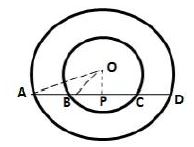
Question 5. In the following figure, AD is a straight line, OP ⊥ AD and O is the centre of both the circles. If OA = 34 cm, OB = 20 cm and OP = 16 cm; find the length of AB.
Answer:
For the smaller inner circle, the line segment \( BC \) acts as a chord and the perpendicular is \( OP \perp BC \).
Since any perpendicular line from the center to a chord bisects that chord:
\( BP = PC \)
Applying the Pythagorean theorem to triangle \( OPB \):
\( OB^2 = OP^2 + BP^2 \)
Given the inner radius \( OB = 20\text{ cm} \) and perpendicular distance \( OP = 16\text{ cm} \):
\( BP^2 = 20^2 - 16^2 = 400 - 256 = 144 \)
\( \implies BP = 12\text{ cm} \)
For the larger outer circle, the segment \( AD \) is a chord and \( OP \perp AD \).
Similarly, the perpendicular bisects this outer chord:
\( AP = PD \)
Using the Pythagorean theorem in triangle \( OPA \):
\( OA^2 = OP^2 + AP^2 \)
Given the outer radius \( OA = 34\text{ cm} \) and \( OP = 16\text{ cm} \):
\( AP^2 = 34^2 - 16^2 = 1156 - 256 = 900 \)
\( \implies AP = 30\text{ cm} \)
Finally, the length of segment \( AB \) is calculated as:
\( AB = AP - BP = 30 - 12 = 18\text{ cm} \).
In simple words: We use the perpendicular bisection property and Pythagoras' theorem on both circles separately to find half of the inner and outer chords, then subtract them to get the segment length.
Exam Tip: For concentric circle problems, work with the inner circle first to find any common perpendicular before analyzing the outer circle.
Question 6. In a circle of radius 17 cm, two parallel chords of lengths 30 cm and 16 cm are drawn. Find the distance between the chords, if both the chords are:
(i) on the opposite sides of the centre;
(ii) on the same side of the centre.
Answer:
Construct perpendiculars \( OE \) and \( OF \) from the circle's center \( O \) to the parallel chords \( AB \) and \( CD \) respectively.
Since a perpendicular line from the center to any chord bisects that chord:
\( AE = \frac{AB}{2} = \frac{30}{2} = 15\text{ cm} \)
\( CF = \frac{CD}{2} = \frac{16}{2} = 8\text{ cm} \)
In the right-angled triangle \( OAE \):
\( OA^2 = OE^2 + AE^2 \)
Given the radius \( OA = 17\text{ cm} \) and \( AE = 15\text{ cm} \):
\( OE^2 = OA^2 - AE^2 \)
\( OE^2 = 17^2 - 15^2 = 289 - 225 = 64 \)
\( \implies OE = 8\text{ cm} \)
Similarly, in the right-angled triangle \( OCF \):
\( OC^2 = OF^2 + CF^2 \)
Given the radius \( OC = 17\text{ cm} \) and \( CF = 8\text{ cm} \):
\( OF^2 = OC^2 - CF^2 \)
\( OF^2 = 17^2 - 8^2 = 289 - 64 = 225 \)
\( \implies OF = 15\text{ cm} \)
Now, we evaluate the two cases:
(i) If the chords are located on opposite sides of the center:
The total distance between them is the sum of their perpendicular distances:
\( EF = OE + OF = 8 + 15 = 23\text{ cm} \)
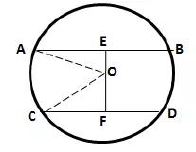
(ii) If the chords are located on the same side of the center:
The distance between them is the difference of their perpendicular distances:
\( EF = OF - OE = 15 - 8 = 7\text{ cm} \).
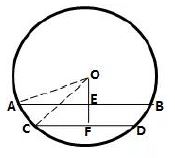
In simple words: When chords are on opposite sides, we add their distances from the center. When they are on the same side, we subtract them.
Exam Tip: Carefully read whether the parallel chords are on the same side or opposite sides of the center, as this completely changes the calculation.
Question 7. Two parallel chords are drawn in a circle of diameter 30.0 cm. The length of one chord is 24.0 cm and the distance between the two chords is 21.0 cm; find the length of another chord.
Answer:
The total distance between the two chords is given as \( 21\text{ cm} \). Since this distance exceeds the circle's radius of \( 15\text{ cm} \) (half of the \( 30\text{ cm} \) diameter), the two chords must lie on opposite sides of the center \( O \).
Let \( AB \) be the chord of length \( 24\text{ cm} \) and \( CD \) be the other parallel chord of length \( 2x\text{ cm} \).
Draw perpendicular lines \( OE \) and \( OF \) from the center \( O \) to \( AB \) and \( CD \) respectively.
By the bisecting property of perpendiculars from the center to chords:
\( AE = \frac{AB}{2} = \frac{24}{2} = 12\text{ cm} \)
\( CF = \frac{CD}{2} = \frac{2x}{2} = x\text{ cm} \)
In the right triangle \( OAE \) (with radius \( OA = 15\text{ cm} \)):
\( OA^2 = OE^2 + AE^2 \)
\( OE^2 = OA^2 - AE^2 \)
\( OE^2 = 15^2 - 12^2 = 225 - 144 = 81 \)
\( \implies OE = 9\text{ cm} \)
Since the total distance between the chords is \( EF = 21\text{ cm} \):
\( OF = EF - OE = 21 - 9 = 12\text{ cm} \)
Now, in the right triangle \( OCF \) (with radius \( OC = 15\text{ cm} \)):
\( OC^2 = OF^2 + CF^2 \)
\( 15^2 = 12^2 + x^2 \)
\( x^2 = 15^2 - 12^2 = 225 - 144 = 81 \)
\( \implies x = 9\text{ cm} \)
Thus, the length of chord \( CD \) is:
\( CD = 2x = 2 \times 9 = 18\text{ cm} \).
In simple words: Since the chords are on opposite sides, we find the center's distance to the known chord, subtract it from the total distance to find the other distance, and then find the second chord's length.
Exam Tip: Compare the distance between the parallel chords with the radius to mathematically justify why they lie on opposite sides of the center.
Question 8. A chord CD of a circle, whose centre is O, is bisected at P by a diameter AB. Given OA = OB = 15 cm and OP = 9 cm. Calculate the lengths of:
(i) CD;
(ii) AD;
(iii) CB.
Answer:
(i) Since the diameter \( AB \) bisects the chord \( CD \) at point \( P \), the line segment \( OP \) is perpendicular to \( CD \) (\( OP \perp CD \)).
Consequently, \( OP \) bisects \( CD \), so:
\( CP = PD = \frac{CD}{2} \)
In the right-angled triangle \( OPC \) (with radius \( OC = 15\text{ cm} \) and \( OP = 9\text{ cm} \)):
\( OC^2 = OP^2 + CP^2 \)
\( CP^2 = OC^2 - OP^2 \)
\( CP^2 = 15^2 - 9^2 = 225 - 81 = 144 \)
\( \implies CP = 12\text{ cm} \)
Since \( P \) is the midpoint of \( CD \), the entire length of the chord is:
\( CD = 2 \times CP = 2 \times 12 = 24\text{ cm} \)
(ii) Connect points \( B \) and \( D \).
The distance \( BP \) can be computed by subtracting \( OP \) from the radius \( OB \):
\( BP = OB - OP = 15 - 9 = 6\text{ cm} \)
Since \( PD = CP = 12\text{ cm} \), we apply the Pythagorean theorem in the right-angled triangle \( BPD \):
\( BD^2 = BP^2 + PD^2 \)
\( BD^2 = 6^2 + 12^2 = 36 + 144 = 180 \)
Since \( AB \) is a diameter, the angle \( \angle ADB \) in the semicircle is a right angle (\( \angle ADB = 90^\circ \)).
Using the Pythagorean theorem for the right triangle \( ADB \):
\( AB^2 = AD^2 + BD^2 \)
\( AD^2 = AB^2 - BD^2 \)
Since \( AB \) is the diameter, \( AB = 2 \times 15 = 30\text{ cm} \):
\( AD^2 = 30^2 - 180 = 900 - 180 = 720 \)
\( \implies AD = \sqrt{720} \approx 26.83\text{ cm} \)
(iii) By symmetry or by applying the Pythagorean theorem to right triangle \( BPC \), we have:
\( BC = BD = \sqrt{180} \approx 13.42\text{ cm} \).
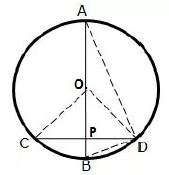
In simple words: We use the right-angled triangles created by the perpendicular and the radius to calculate the different segment lengths step by step using Pythagoras' theorem.
Exam Tip: Remember that any angle subtended by a diameter in a semicircle is a right angle (\( 90^\circ \)); citing this theorem is essential for the second part of the proof.
Question 9. The figure given below shows a circle with centre O in which diameter AB bisects the chord CD at point E. If CE = ED = 8 cm and EB = 4 cm, find the radius of the circle.
Answer:
Let \( r\text{ cm} \) represent the radius of the circle.
Since \( OB \) is a radius of the circle and \( EB = 4\text{ cm} \), the segment \( OE \) can be written as:
\( OE = OB - EB = r - 4 \)
Draw the radius \( OC \) (so \( OC = r \)).
In the right-angled triangle \( OEC \):
\( OC^2 = OE^2 + CE^2 \)
Substitute \( OE = r - 4 \), \( CE = 8\text{ cm} \), and \( OC = r \):
\( r^2 = (r - 4)^2 + 8^2 \)
Expand the quadratic term:
\( r^2 = r^2 - 8r + 16 + 64 \)
Subtract \( r^2 \) from both sides:
\( 0 = -8r + 80 \)
\( \implies 8r = 80 \)
\( \implies r = 10\text{ cm} \).
Thus, the radius of the circle is \( 10\text{ cm} \).
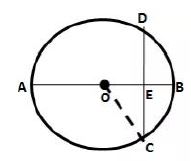
In simple words: We express the unknown distance from the center to the chord using the radius variable, then set up and solve a quadratic equation using Pythagoras' theorem.
Exam Tip: When setting up a variable like \( r \) for the radius, ensure you correctly write the other segment as \( r - \text{given distance} \) to form a valid quadratic equation.
Question 10. In the given figure, O is the centre of the circle. AB and CD are two chords of the circle. OM is perpendicular to AB and ON is perpendicular to CD. AB = 24 cm, OM = 5 cm, ON = 12 cm. Find the:
(i) radius of the circle.
(ii) length of chord CD.
Answer:
(i) Given that the line segment \( OM \) drawn from the center \( O \) is perpendicular to the chord \( AB \) (\( OM \perp AB \)):
By the perpendicular bisection theorem, the midpoint \( M \) divides \( AB \) into two equal parts:
\( AM = MB = \frac{AB}{2} = \frac{24}{2} = 12\text{ cm} \)
In the right triangle \( OMA \):
\( OA^2 = OM^2 + AM^2 \)
Using the given perpendicular distance \( OM = 5\text{ cm} \):
\( OA^2 = 5^2 + 12^2 = 25 + 144 = 169 \)
\( \implies OA = 13\text{ cm} \)
Hence, the radius of the circle is \( 13\text{ cm} \).
(ii) Since all radii in a circle are equal:
\( OC = OA = 13\text{ cm} \)
We are given that \( ON = 12\text{ cm} \) is the perpendicular distance from the center \( O \) to chord \( CD \).
In the right triangle \( ONC \):
\( NC^2 = OC^2 - ON^2 \)
\( NC^2 = 13^2 - 12^2 = 169 - 144 = 25 \)
\( \implies NC = 5\text{ cm} \)
Since the perpendicular \( ON \) bisects the chord \( CD \), the entire length is:
\( CD = 2 \times NC = 2 \times 5 = 10\text{ cm} \).
In simple words: By dividing the chords in half and applying Pythagoras' theorem, we find the radius of the circle first, which then helps us solve for the other chord.
Exam Tip: Keep track of which perpendicular distance belongs to which chord, as confusing the values of OM and ON is a common error.
Exercise 17(B)
Question 1. The figure shows two concentric circles and AD is a chord of larger circle. Prove that: AB = CD.
Answer:
Draw a line segment \( OP \) from the center \( O \) perpendicular to \( AD \) (\( OP \perp AD \)).
Since the perpendicular line drawn from a circle's center to any chord always bisects it:
\( OP \) bisects the chord \( AD \) of the larger outer circle:
\( AP = PD \qquad \text{--- (1)} \)
Similarly, \( BC \) acts as a chord for the smaller inner circle, with \( OP \perp BC \):
Thus, \( OP \) bisects the chord \( BC \):
\( \implies BP = PC \qquad \text{--- (2)} \)
Subtracting equation (2) from equation (1):
\( AP - BP = PD - PC \)
From the figure, we observe that \( AP - BP = AB \) and \( PD - PC = CD \).
\( \implies AB = CD \)
This completes the proof.
In simple words: A line from the center perpendicular to both circles bisects both of their chords. When we subtract the smaller bisected segment from the larger one, we prove the outer segments are equal.
Exam Tip: Always clearly label your equations and state what you are subtracting to make the geometric proof easy for the examiner to follow.
Question 2. A straight line is drawn cutting two equal circles and passing through the mid-point M of the line joining their centres O and O'. Prove that the chords AB and CD, which are intercepted by the two circles, are equal.
Answer:
Given: Two circles of identical radii are intersected by a straight line \( AD \) at points \( A \), \( B \), \( C \), and \( D \). The line segment joining their centers \( O \) and \( O' \) intersects \( AD \) at \( M \), which is the midpoint of \( OO' \).
To Prove: \( AB = CD \)
Construction: Draw perpendiculars \( OP \perp AB \) from center \( O \) and \( O'Q \perp CD \) from center \( O' \).
Proof:
Consider triangles \( OMP \) and \( O'MQ \):
1. \( \angle OMP = \angle O'MQ \) (They are vertically opposite angles)
2. \( \angle OPM = \angle O'QM = 90^\circ \) (By our perpendicular construction)
3. \( OM = O'M \) (Since \( M \) is the midpoint of \( OO' \), this is given)
By the Angle-Angle-Side (AAS) criterion of congruence, we have:
\( \implies \Delta OMP \cong \Delta O'MQ \)
Since congruent triangles have equal corresponding parts (CPCTC):
\( \implies OP = O'Q \)
We know that in equal circles, chords that are at an equal distance from the centers are equal in length.
Thus, the chords \( AB \) and \( CD \) must be equal:
\( \implies AB = CD \)
Hence proved.

In simple words: By showing that the two triangles formed by the perpendiculars are congruent, we prove that the chords are at the same distance from the center, making them equal.
Exam Tip: When proving congruence, list all three criteria (angles and sides) explicitly with their geometric justifications.
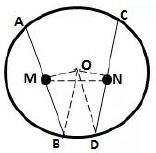
Question 3. M and N are the mid-points of two equal chords AB and CD respectively of a circle with centre O. Prove that:
(i) ∠BMN = ∠DNM
(ii) ∠AMN = ∠CNM
Answer:
Let \( OM \perp AB \) and \( ON \perp CD \) be the perpendiculars drawn from the center \( O \) to the equal chords \( AB \) and \( CD \).
Since a perpendicular line from the center bisects the chord:
\( BM = \frac{AB}{2} \) and \( DN = \frac{CD}{2} \)
Since the chords are given to be equal (\( AB = CD \)), their halves must also be equal:
\( BM = DN \qquad \text{--- (1)} \)
In right-angled triangles \( OMB \) and \( OND \), we can write by the Pythagorean theorem:
\( OM^2 = OB^2 - BM^2 \)
\( ON^2 = OD^2 - DN^2 \)
Since \( OB = OD \) (radii of the same circle) and \( BM = DN \) (from equation 1), we have:
\( \implies OM^2 = ON^2 \implies OM = ON \)
Since the sides \( OM \) and \( ON \) are equal in triangle \( OMN \), their opposite angles are also equal:
\( \implies \angle OMN = \angle ONM \qquad \text{--- (2)} \)
Now we prove the two sub-parts:
(i) To prove \( \angle BMN = \angle DNM \):
We know the perpendicular angles are equal:
\( \angle OMB = \angle OND = 90^\circ \)
Subtracting equation (2) from these right angles:
\( \angle OMB - \angle OMN = \angle OND - \angle ONM \)
\( \implies \angle BMN = \angle DNM \)
(ii) To prove \( \angle AMN = \angle CNM \):
Similarly, the perpendicular angles on the other side are also equal:
\( \angle OMA = \angle ONC = 90^\circ \)
Adding equation (2) to these:
\( \angle OMA + \angle OMN = \angle ONC + \angle ONM \)
\( \implies \angle AMN = \angle CNM \)
This completes both proofs.
In simple words: Since the chords are equal, their midpoints are at equal distances from the center, which helps us prove the requested angles are equal by adding or subtracting equal angles.
Exam Tip: When adding or subtracting angles in a proof, clearly write down the intermediate steps showing which angles are being combined.
Exercise 17(B)
Question 4. In the following figure, P and Q are the points of intersection of two circles with centres O and O'. If straight lines APB and CQD are parallel to OO', prove that:
(i) \( OO' = \frac{1}{2} AB \)
(ii) \( AB = CD \)
Answer:
(i) Let us construct perpendiculars \(OM\) and \(O'N\) from the centres \(O\) and \(O'\) onto the segment \(AB\). Since a line drawn perpendicular from the centre of a circle to a chord bisects it:
For the circle with centre \(O\), \(OM \perp AP \implies MP = \frac{1}{2} AP\).
For the circle with centre \(O'\), \(O'N \perp PB \implies PN = \frac{1}{2} BP\).
The total distance between the perpendiculars is:
\(MN = MP + PN = \frac{1}{2} AP + \frac{1}{2} BP = \frac{1}{2} (AP + BP) = \frac{1}{2} AB\).
Since \(OM\) and \(O'N\) are both perpendicular to \(AB\), they are parallel to each other. Because the line segments \(AB\) and \(OO'\) are also parallel, the quadrilateral \(OMNO'\) is a rectangle. Hence, the opposite sides must be equal:
\(MN = OO'\)
By substituting \(OO'\) for \(MN\), we get:
\(OO' = \frac{1}{2} AB\) - - - (i)
(ii) Similarly, let us drop perpendiculars \(OM'\) and \(O'N'\) from the centres \(O\) and \(O'\) onto the segment \(CD\). Following the same bisecting property:
\(M'Q = \frac{1}{2} CQ\) and \(QN' = \frac{1}{2} QD\).
The distance \(M'N'\) can be written as:
\(M'N' = M'Q + QN' = \frac{1}{2} CQ + \frac{1}{2} QD = \frac{1}{2} (CQ + QD) = \frac{1}{2} CD\).
Since \(OM'N'O'\) also forms a rectangle, we have:
\(M'N' = OO'\)
Therefore:
\(OO' = \frac{1}{2} CD\) - - - (ii)
Comparing equations (i) and (ii), we get:
\(\frac{1}{2} AB = \frac{1}{2} CD \implies AB = CD\).
This completes the proof.
In simple words: By drawing perpendicular lines from the centres to the parallel lines, we create rectangular shapes. This lets us show that the length of the parallel line segment is exactly double the distance between the centres, proving both lines are equal in length.
Exam Tip: Clearly state that the perpendicular lines from the centres form rectangles, which helps establish the equal relationship between the line segments.
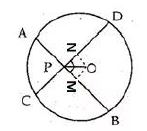
Question 5. Two equal chords AB and CD of a circle with centre O, intersect each other at a point P inside the circle. Prove that:
(i) \( AP = CP \)
(ii) \( BP = DP \)
Answer:
Let us construct perpendiculars \(OM\) and \(ON\) from the centre \(O\) onto the chords \(AB\) and \(CD\) respectively. Also, join \(OP\), \(OB\), and \(OD\).
Since a perpendicular from the centre of a circle to a chord bisects the chord:
\(MB = \frac{1}{2} AB\) and \(ND = \frac{1}{2} CD\).
Because the chords are equal, i.e., \(AB = CD\), we must have:
\(MB = ND\) - - - (i)
In the right-angled triangles \(\Delta OMB\) and \(\Delta OND\), using Pythagoras' theorem:
\(OM^2 = OB^2 - MB^2\) - - - (ii)
\(ON^2 = OD^2 - ND^2\) - - - (iii)
Since \(OB = OD\) (radii of the same circle) and \(MB = ND\) from (i), we can equate equations (ii) and (iii):
\(OM^2 = ON^2 \implies OM = ON\).
Now, let us compare the right-angled triangles \(\Delta OPM\) and \(\Delta OPN\):
1. \(\angle OMP = \angle ONP = 90^\circ\) (by construction)
2. \(OP = OP\) (common hypotenuse)
3. \(OM = ON\) (proved above)
Thus, by the Right Angle-Hypotenuse-Side (RHS) congruence criterion:
\(\Delta OPM \cong \Delta OPN\).
Since corresponding parts of congruent triangles (CPCT) are equal:
\(PM = PN\) - - - (iv)
Adding equations (i) and (iv), we get:
\(MB + PM = ND + PN \implies BP = DP\).
Now, since \(AB = CD\), subtracting the equal segments \(BP\) and \(DP\) yields:
\(AB - BP = CD - DP \implies AP = CP\).
Hence, both relations are successfully proved.
In simple words: Drawing perpendicular lines to equal chords shows they are at the same distance from the centre. This allows us to prove that the small segments of the intersecting chords are congruent and equal.
Exam Tip: Remember to state clearly that equal chords are always equidistant from the circle's centre. This is the key link to proving triangle congruence.
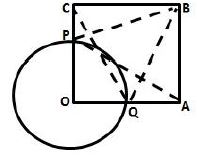
Question 6. In the following figure, OABC is a square. A circle is drawn with O as centre which meets OC at P and OA at Q. Prove that:
(i) \( \Delta OPA \cong \Delta OQC \)
(ii) \( \Delta BPC \cong \Delta BQA \)
Answer:
(i) Consider the triangles \(\Delta OPA\) and \(\Delta OQC\):
1. \(OP = OQ\) (being the radii of the same circle)
2. \(\angle AOP = \angle COQ = 90^\circ\) (since \(OABC\) is a square, the angle at the corner \(O\) is a right angle)
3. \(OA = OC\) (adjacent sides of the square)
Therefore, by the Side-Angle-Side (SAS) criterion of congruence:
\(\Delta OPA \cong \Delta OQC\).
(ii) We are given that \(OC\) and \(OA\) are equal sides of the square, and \(OP = OQ\) are equal radii of the circle.
Subtracting equal segments from equal sides:
\(OC - OP = OA - OQ \implies CP = AQ\) - - - (1)
Now, let us compare triangles \(\Delta BPC\) and \(\Delta BQA\):
1. \(BC = BA\) (adjacent sides of the square \(OABC\))
2. \(\angle PCB = \angle QAB = 90^\circ\) (each interior angle of a square is \(90^\circ\))
3. \(PC = QA\) (from equation 1)
Therefore, by the Side-Angle-Side (SAS) criterion of congruence:
\(\Delta BPC \cong \Delta BQA\).
In simple words: Since the circle's radii are equal and the square's sides are equal, we can use the SAS congruence rule. This lets us easily prove both pairs of triangles are identical.
Exam Tip: Be sure to write down the exact reasons for each step (e.g., "radii of the same circle" or "sides of the square") to secure full marks.
Question 7. The length of the common chord of two intersecting circles is 30 cm. If the radii of these two circles are 25 cm and 17 cm, find the distance between their centres.
Answer:
Let \(O\) and \(O'\) be the centres of the two intersecting circles of radii \(25\text{ cm}\) and \(17\text{ cm}\), respectively. Let \(AB\) be their common chord of length \(30\text{ cm}\).
The line joining the centres of two intersecting circles is the perpendicular bisector of their common chord. Thus, \(OO'\) is perpendicular to \(AB\) at point \(D\), and \(D\) is the midpoint of \(AB\).
Therefore:
\(AD = \frac{1}{2} \times AB = \frac{1}{2} \times 30\text{ cm} = 15\text{ cm}\).
In the right-angled triangle \(\Delta ADO\), applying Pythagoras' theorem:
\(OA^2 = AD^2 + OD^2\)
\(25^2 = 15^2 + OD^2 \implies OD^2 = 625 - 225 = 400\)
\(OD = \sqrt{400} = 20\text{ cm}\).
In the right-angled triangle \(\Delta ADO'\), applying Pythagoras' theorem:
\(O'A^2 = AD^2 + O'D^2\)
\(17^2 = 15^2 + O'D^2 \implies O'D^2 = 289 - 225 = 64\)
\(O'D = \sqrt{64} = 8\text{ cm}\).
Therefore, the distance between the two centres is:
\(OO' = OD + O'D = 20\text{ cm} + 8\text{ cm} = 28\text{ cm}\).
In simple words: The line joining the centres splits the common chord into two equal halves at right angles. This creates two right-angled triangles, allowing us to find the distances to the midpoint using Pythagoras' theorem and add them together.
Exam Tip: Mentioning that the line joining the centres is the perpendicular bisector of the common chord is essential to establish the right angles and midpoint segment length.
Question 8. The line joining the mid-points of two chords of a circle passes through its centre. Prove that the chords are parallel.
Answer:
Let \(AB\) and \(CD\) be two chords of a circle with centre \(O\). Let \(L\) and \(M\) be the midpoints of \(AB\) and \(CD\), respectively, such that the line joining them, \(LOM\), passes through the centre \(O\).
Since the line passing through the centre of a circle and bisecting a chord is perpendicular to the chord:
\(OL \perp AB \implies \angle ALO = 90^\circ\)
\(OM \perp CD \implies \angle OMD = 90^\circ\)
As the points \(L\), \(O\), and \(M\) are collinear (lying on the same straight line), we have:
\(\angle ALM = 90^\circ\)
\(\angle LMD = 90^\circ\)
These two angles form alternate interior angles.
Since the alternate interior angles are equal, i.e., \(\angle ALM = \angle LMD\), the chords must be parallel.
Therefore:
\(AB \parallel CD\).

In simple words: The line bisecting the chords goes through the centre, meaning it is perpendicular to both of them. Since both chords meet the line at \(90^\circ\), the alternate interior angles are equal, showing the chords are parallel.
Exam Tip: Remember to mention that alternate interior angles being equal is the condition required to prove the lines are parallel.
Question 9. In the given figure, the line ABCD is perpendicular to PQ, where P and Q are the centres of the two circles. Show that:
(i) \( AB = CD \)
(ii) \( AC = BD \)
Answer:
Let \(O\) be the point of intersection of the line joining the centres, \(PQ\), and the line segment \(ABCD\). Since \(PQ \perp ABCD\), we have \(QO \perp AD\) and \(PO \perp BC\).
(i) For the outer/larger circle with centre \(Q\):
The segment \(QO\) is perpendicular to the chord \(AD\). Since the perpendicular drawn from the centre of a circle to a chord bisects it:
\(OA = OD\) - - - (1)
For the inner/smaller circle with centre \(P\):
The segment \(PO\) is perpendicular to the chord \(BC\). Following the same bisecting property:
\(OB = OC\) - - - (2)
Subtracting equation (2) from equation (1):
\(OA - OB = OD - OC\)
\(\implies AB = CD\) - - - (3)
(ii) To prove the second part, let us add the common segment \(BC\) to both sides of equation (3):
\(AB + BC = CD + BC\)
\(\implies AC = BD\).
Both parts are successfully shown.
In simple words: The line segment from each centre to the chord bisects the respective chord. Subtracting the smaller segment from the larger segment leaves equal pieces on both sides.
Exam Tip: Be sure to write the general theorem "perpendicular drawn from the centre to a chord bisects the chord" to support the steps of bisection.
Question 10. AB and CD are two equal chords of a circle with centre O which intersect each other at right angles at a point P inside the circle. If \( OM \perp AB \) and \( ON \perp CD \), show that OMPN is a square.
Answer:
We are given that \(OM \perp AB\) and \(ON \perp CD\). Also, the chords \(AB\) and \(CD\) intersect each other at right angles at \(P\), meaning \(\angle MPN = 90^\circ\).
Thus, three angles of the quadrilateral \(OMPN\) are \(90^\circ\):
\(\angle OMP = 90^\circ\)
\(\angle ONP = 90^\circ\)
\(\angle MPN = 90^\circ\)
Since the sum of the angles in a quadrilateral is \(360^\circ\), the fourth angle must also be:
\(\angle MON = 360^\circ - (90^\circ + 90^\circ + 90^\circ) = 90^\circ\).
Therefore, \(OMPN\) is a rectangle.
Now, since \(OM \perp AB\) and \(ON \perp CD\), these perpendiculars bisect the chords:
\(BM = \frac{1}{2} AB\) and \(CN = \frac{1}{2} CD\).
Given that the chords are equal, \(AB = CD\), we have:
\(BM = CN\) - - - (i)
Since equal chords are equidistant from the centre, the adjacent sides of our rectangle are equal:
\(OM = ON\).
A rectangle with equal adjacent sides is a square.
Hence, \(OMPN\) is a square.

In simple words: Since all the angles are \(90^\circ\), the figure must be a rectangle. Knowing that equal chords are the same distance from the centre makes the adjacent sides equal, which turns the rectangle into a square.
Exam Tip: To get full marks, first show that the figure is a rectangle because of the right angles, then use the equal distance of chords to show adjacent sides are equal.
Exercise 17(C)
Question 1. In the given figure, an equilateral triangle ABC is inscribed in a circle with centre O. Find:
(i) \( \angle BOC \ )
(ii) \( \angle OBC \ )
Answer:
(i) We are given that \(\Delta ABC\) is an equilateral triangle. Since all the interior angles of an equilateral triangle are equal to \(60^\circ\):
\(\angle BAC = \angle ABC = \angle ACB = 60^\circ\).
The angle subtended by an arc at the centre is double the angle subtended by it at any point on the remaining part of the circle. Thus, for the arc \(BC\):
\(\angle BOC = 2 \times \angle BAC = 2 \times 60^\circ = 120^\circ\).
(ii) In \(\Delta OBC\), the sides \(OB\) and \(OC\) are the radii of the same circle, so \(OB = OC\). This makes \(\Delta OBC\) an isosceles triangle.
In an isosceles triangle, the angles opposite to the equal sides are equal:
\(\angle OBC = \angle OCB\).
The sum of all angles in \(\Delta OBC\) is \(180^\circ\):
\(\angle OBC + \angle OCB + \angle BOC = 180^\circ\)
\(\angle OBC + \angle OBC + 120^\circ = 180^\circ\)
\(2\angle OBC = 180^\circ - 120^\circ = 60^\circ\)
\(\angle OBC = 30^\circ\).
Thus, \(\angle BOC = 120^\circ\) and \(\angle OBC = 30^\circ\).
In simple words: An equilateral triangle has interior angles of \(60^\circ\). The angle at the centre is always twice the angle at the edge, and we use the isosceles properties of the radius lines to find the smaller base angles.
Exam Tip: Remember to use the central angle theorem: the angle subtended by an arc at the centre is twice the angle subtended at the circumference.
Question 2. In the given figure, a square is inscribed in a circle with centre O. Find:
(i) \( \angle BOC \ )
(ii) \( \angle OCB \ )
(iii) \( \angle COD \ )
(iv) \( \angle BOD \ )
Is BD a diameter of the circle?
Answer:
Let us consider a square \(ABCD\) inscribed in a circle with centre \(O\). Since the diagonals of a square are equal and bisect each other at right angles:
(i) The diagonals intersect at \(O\) at an angle of \(90^\circ\). Thus:
\(\angle BOC = 90^\circ\).
(ii) In triangle \(\Delta OBC\), \(OB = OC\) (as they are radii of the same circle). Therefore, \(\Delta OBC\) is an isosceles triangle with equal base angles:
\(\angle OBC = \angle OCB\).
The sum of the angles in \(\Delta OBC\) is \(180^\circ\):
\(\angle OBC + \angle OCB + \angle BOC = 180^\circ\)
\(\angle OCB + \angle OCB + 90^\circ = 180^\circ\)
\(2\angle OCB = 90^\circ \implies \angle OCB = 45^\circ\).
(iii) Since the diagonals of a square are perpendicular to each other:
\(\angle COD = 90^\circ\).
(iv) The angle \(\angle BOD\) is the sum of \(\angle BOC\) and \(\angle COD\):
\(\angle BOD = \angle BOC + \angle COD = 90^\circ + 90^\circ = 180^\circ\).
Since \(\angle BOD = 180^\circ\), \(BOD\) forms a straight line passing through the centre \(O\).
Therefore, \(BD\) is indeed a diameter of the circle.
In simple words: The diagonals of a square are perpendicular bisectors that meet at the centre of the circle. Since they meet at \(90^\circ\), they divide the central angles into \(90^\circ\) pieces and form straight lines of \(180^\circ\) across the circle, which acts as the diameter.
Exam Tip: Mention the properties of a square's diagonals intersecting at \(90^\circ\) and bisecting the corner angles to easily find the required angles.
Question 3. In the given figure, AB is a side of a regular pentagon and BC is a side of a regular hexagon. Find:
(i) \( \angle AOB \ )
(ii) \( \angle BOC \ )
(iii) \( \angle AOC \ )
(iv) \( \angle OBA \ )
(v) \( \angle OBC \ )
(vi) \( \angle ABC \ )
Answer:
(i) Since \(AB\) is a side of a regular pentagon (5 sides), the angle subtended by \(AB\) at the centre is:
\(\angle AOB = \frac{360^\circ}{5} = 72^\circ\).
(ii) Since \(BC\) is a side of a regular hexagon (6 sides), the angle subtended by \(BC\) at the centre is:
\(\angle BOC = \frac{360^\circ}{6} = 60^\circ\).
(iii) The total angle \(\angle AOC\) is the sum of \(\angle AOB\) and \(\angle BOC\):
\(\angle AOC = \angle AOB + \angle BOC = 72^\circ + 60^\circ = 132^\circ\).
(iv) In \(\Delta AOB\), \(OA = OB\) (radii of the same circle), making it an isosceles triangle. Thus:
\(\angle OBA = \angle OAB\).
The sum of angles in \(\Delta AOB\) is \(180^\circ\):
\(2\angle OBA + 72^\circ = 180^\circ \implies 2\angle OBA = 108^\circ \implies \angle OBA = 54^\circ\).
(v) In \(\Delta BOC\), \(OB = OC\) (radii of the same circle), making it an isosceles triangle. Thus:
\(\angle OBC = \angle OCB\).
The sum of angles in \(\Delta BOC\) is \(180^\circ\):
\(2\angle OBC + 60^\circ = 180^\circ \implies 2\angle OBC = 120^\circ \implies \angle OBC = 60^\circ\).
(vi) The total angle \(\angle ABC\) is given by:
\(\angle ABC = \angle OBA + \angle OBC = 54^\circ + 60^\circ = 114^\circ\).
In simple words: The central angle for any regular polygon side is \(360^\circ\) divided by the number of sides. We calculate these angles first and then apply the angle-sum properties of isosceles triangles to find the remaining angles.
Exam Tip: Calculate the central angle subtended by a regular polygon side using the formula \(\theta = \frac{360^\circ}{n}\) where \(n\) is the number of sides.
Question 4. In the given figure, arc AB and arc BC are equal in length. If \(\angle AOB = 48^\circ\), find:
(i) \( \angle BOC \ )
(ii) \( \angle OBC \ )
(iii) \( \angle AOC \ )
(iv) \( \angle OAC \ )
Answer:
(i) We know that arcs of equal lengths subtend equal angles at the centre. Since arc \(AB = \text{arc } BC\):
\(\angle BOC = \angle AOB = 48^\circ\).
(ii) In \(\Delta BOC\), the sides \(OB\) and \(OC\) are the radii of the circle, so \(OB = OC\). Thus, \(\Delta BOC\) is an isosceles triangle:
\(\angle OBC = \angle OCB\).
In \(\Delta BOC\), the sum of angles is \(180^\circ\):
\(2\angle OBC + 48^\circ = 180^\circ \implies 2\angle OBC = 132^\circ \implies \angle OBC = 66^\circ\).
(iii) The angle \(\angle AOC\) is:
\(\angle AOC = \angle AOB + \angle BOC = 48^\circ + 48^\circ = 96^\circ\).
(iv) In \(\Delta AOC\), \(OA = OC\) (radii of the same circle), making it an isosceles triangle:
\(\angle OAC = \angle OCA\).
The sum of angles in \(\Delta AOC\) is \(180^\circ\):
\(2\angle OAC + 96^\circ = 180^\circ \implies 2\angle OAC = 84^\circ \implies \angle OAC = 42^\circ\).
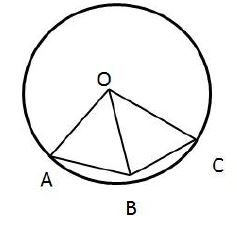
In simple words: Since the arcs are equal, they create equal angles at the centre. We then use the fact that radii are equal to set up isosceles triangles and solve for the unknown angles.
Exam Tip: Keep in mind that equal arc lengths correspond to equal angles at the circle's centre. State this theorem clearly before solving.
Question 5. In the given figure, arcs AB and BC are in the ratio 3:2. If \(\angle AOB = 96^\circ\), find:
(i) \( \angle BOC \ )
(ii) \( \angle OBA \ )
(iii) \( \angle OBC \ )
(iv) \( \angle ABC \ )
Answer:
(i) Since the lengths of arcs are proportional to the angles they subtend at the centre:
\(\angle AOB : \angle BOC = 3 : 2\).
Let \(\angle AOB = 3x\) and \(\angle BOC = 2x\).
Given \(\angle AOB = 96^\circ\):
\(3x = 96^\circ \implies x = 32^\circ\).
Thus, \(\angle BOC = 2 \times 32^\circ = 64^\circ\).
(ii) In \(\Delta AOB\), \(OA = OB\) (radii of the same circle), which means it is an isosceles triangle:
\(\angle OBA = \angle OAB\).
The sum of the angles in \(\Delta AOB\) is \(180^\circ\):
\(2\angle OBA + 96^\circ = 180^\circ \implies 2\angle OBA = 84^\circ \implies \angle OBA = 42^\circ\).
(iii) In \(\Delta BOC\), \(OB = OC\) (radii of the same circle), making it an isosceles triangle:
\(\angle OBC = \angle OCB\).
The sum of the angles in \(\Delta BOC\) is \(180^\circ\):
\(2\angle OBC + 64^\circ = 180^\circ \implies 2\angle OBC = 116^\circ \implies \angle OBC = 58^\circ\).
(iv) The total angle \(\angle ABC\) is given by:
\(\angle ABC = \angle OBA + \angle OBC = 42^\circ + 58^\circ = 100^\circ\).
In simple words: The central angles have the same ratio as the lengths of their corresponding arcs. This lets us find the unknown central angle and then use the isosceles triangle property to calculate the other angles.
Exam Tip: Set up a ratio equation \(\frac{\angle AOB}{\angle BOC} = \frac{\text{arc } AB}{\text{arc } BC}\) to find the missing central angle first.
Question 6. In a circle with centre \( O \), the arcs \( AB \), \( BC \), and \( CD \) are equal. If \( \angle AOB = 50^\circ \), find:
(i) \( \angle AOC \)
(ii) \( \angle BOD \)
(iii) \( \angle AOD \)
(iv) \( \angle OAC \)
(v) \( \angle OAD \)
Answer:
Because the lengths of arc \( AB \) and arc \( BC \) are equal, the angles they subtend at the center must also be equal.
Therefore,
\( \angle AOB = \angle BOC = 50^\circ \)
(i) Finding \( \angle AOC \):
The angle \( \angle AOC \) is the sum of the adjacent angles:
\( \angle AOC = \angle AOB + \angle BOC \)
\( \angle AOC = 50^\circ + 50^\circ = 100^\circ \)
(ii) Finding \( \angle BOD \):
Since arc \( AB \), arc \( BC \), and arc \( CD \) are all equal:
\( \angle AOB = \angle BOC = \angle COD = 50^\circ \)
Now, calculate \( \angle BOD \):
\( \angle BOD = \angle BOC + \angle COD \)
\( \angle BOD = 50^\circ + 50^\circ = 100^\circ \)
(iii) Finding \( \angle AOD \):
The total angle \( \angle AOD \) is:
\( \angle AOD = \angle AOB + \angle BOC + \angle COD \)
\( \angle AOD = 50^\circ + 50^\circ + 50^\circ = 150^\circ \)
(iv) Finding \( \angle OAC \):
In \( \Delta AOC \), the segments \( OA \) and \( OC \) represent the radii of the circle, making \( OA = OC \).
This implies \( \Delta AOC \) is an isosceles triangle, so the base angles are equal:
\( \angle OAC = \angle OCA \)
Using the angle sum property of triangles:
\( \angle AOC + \angle OAC + \angle OCA = 180^\circ \)
\( \implies 100^\circ + 2\angle OAC = 180^\circ \) (as \( \angle OCA = \angle OAC \))
\( \implies 2\angle OAC = 180^\circ - 100^\circ \)
\( \implies 2\angle OAC = 80^\circ \)
\( \implies \angle OAC = 40^\circ \)
Thus, \( \angle OCA = \angle OAC = 40^\circ \).
(v) Finding \( \angle OAD \):
Similarly, in \( \Delta AOD \), \( OA = OD \) because both are radii, which means \( \Delta AOD \) is isosceles.
Thus:
\( \angle OAD = \angle ODA \)
Applying the angle sum property:
\( \angle AOD + \angle OAD + \angle ODA = 180^\circ \)
\( \implies 150^\circ + 2\angle OAD = 180^\circ \)
\( \implies 2\angle OAD = 180^\circ - 150^\circ \)
\( \implies 2\angle OAD = 30^\circ \)
\( \implies \angle OAD = 15^\circ \)
Hence, \( \angle OAD = \angle ODA = 15^\circ \).
In simple words: Since equal arcs subtend equal angles at the center, each arc represents a \( 50^\circ \) angle. We find the angles in the triangles by using the property that radii are equal, making the triangles isosceles.
Exam Tip: Always remember that radii of the same circle are equal, which instantly creates isosceles triangles. Identifying these isosceles triangles is key to finding the unknown base angles.
Question 7. In a circle with centre \( O \), \( AB \) is the side of a regular hexagon and \( AC \) is the side of a regular eight-sided polygon (octagon). Find:
(i) \( \angle AOB \)
(ii) \( \angle AOC \)
(iii) \( \angle BOC \)
(iv) \( \angle OBC \)
Answer:
(i) Since \( AB \) forms one side of a regular hexagon, the angle it subtends at the center of the circle is:
\( \angle AOB = \frac{360^\circ}{6} = 60^\circ \)
(ii) Since \( AC \) is a side of a regular octagon (eight-sided polygon), the angle subtended by it at the center is:
\( \angle AOC = \frac{360^\circ}{8} = 45^\circ \)
(iii) The total angle \( \angle BOC \) is the sum of these two central angles:
\( \angle BOC = \angle AOB + \angle AOC = 60^\circ + 45^\circ = 105^\circ \)
(iv) In \( \Delta BOC \), the sides \( BO \) and \( OC \) are equal because they are both radii of the same circle.
Consequently, \( \Delta BOC \) is an isosceles triangle, which means:
\( \angle OBC = \angle OCB \)
Since the sum of interior angles in any triangle is \( 180^\circ \):
\( \angle OBC + \angle OCB + \angle BOC = 180^\circ \)
\( \implies 2\angle OBC + 105^\circ = 180^\circ \)
\( \implies 2\angle OBC = 180^\circ - 105^\circ \)
\( \implies 2\angle OBC = 75^\circ \)
\( \implies \angle OBC = 37.5^\circ = 37^\circ 30' \)
Therefore, the value of \( \angle OBC \) is \( 37^\circ 30' \).
In simple words: Each side of a regular polygon divides the \( 360^\circ \) around the center into equal parts. We find these central angles and add them to get \( \angle BOC \), then use the isosceles triangle property to find the base angles.
Exam Tip: Be comfortable converting decimal degrees to minutes. Remember that \( 1^\circ = 60' \), so \( 0.5^\circ \) is exactly \( 30' \). Writing the final angle in degrees and minutes is often required by examiners.
Question 8. In a circle with centre \( O \), the length of arc \( AB \) is twice the length of arc \( BC \). If \( \angle AOB = 100^\circ \), find:
(i) \( \angle BOC \)
(ii) \( \angle AOC \)
(iii) \( \angle OCA \ worldview\)
Answer:
The ratio of the lengths of two arcs of a circle is directly proportional to the ratio of the angles they subtend at the center.
Given that arc \( AB \) is double the length of arc \( BC \):
\( \text{arc } AB : \text{arc } BC = 2 : 1 \)
This gives:
\( \angle AOB : \angle BOC = 2 : 1 \)
(i) Since we are given that \( \angle AOB = 100^\circ \):
\( \angle BOC = \frac{1}{2} \angle AOB = \frac{1}{2} \times 100^\circ = 50^\circ \)
(ii) We can find \( \angle AOC \) by adding these two angles:
\( \angle AOC = \angle AOB + \angle BOC = 100^\circ + 50^\circ = 150^\circ \)
(iii) In \( \Delta AOC \), \( OA = OC \) because both lines represent radii of the same circle.
This makes \( \Delta AOC \) an isosceles triangle, meaning the angles opposite these sides are equal:
\( \angle OAC = \angle OCA \)
The sum of all angles in \( \Delta AOC \) is \( 180^\circ \):
\( \angle COA + \angle OAC + \angle OCA = 180^\circ \)
\( \implies 150^\circ + 2\angle OCA = 180^\circ \)
\( \implies 2\angle OCA = 180^\circ - 150^\circ \)
\( \implies 2\angle OCA = 30^\circ \)
\( \implies \angle OCA = 15^\circ \)
Hence, \( \angle OCA = \angle OAC = 15^\circ \).
In simple words: The angle subtended at the center changes in the same ratio as the length of the arc. Since arc AB is twice as long as BC, its angle is also twice as large.
Exam Tip: State the property clearly: 'The angle subtended by an arc at the centre is directly proportional to its length.' Writing this statement down secures full marks for the step.
Exercise 17(D)
Question 1. A chord of length 24 cm is drawn in a circle of radius 13 cm. Find the distance of this chord from the centre of the circle.
Answer:
Let \( O \) be the center of the circle and \( AB \) be the chord.
The given length of chord \( AB \) is \( 24 \text{ cm} \) and the radius \( OA = 13 \text{ cm} \).
A perpendicular segment \( OM \) is drawn from the center \( O \) to the chord \( AB \).
A key theorem states that a perpendicular dropped from the center of a circle to a chord bisects that chord.
Therefore,
\( AM = \frac{AB}{2} = \frac{24}{2} = 12 \text{ cm} \)
In the right-angled triangle \( OMA \), we apply the Pythagoras theorem:
\( OA^2 = OM^2 + AM^2 \)
Substitute the known values:
\( 13^2 = OM^2 + 12^2 \)
\( \implies OM^2 = 13^2 - 12^2 \)
\( \implies OM^2 = 169 - 144 \)
\( \implies OM^2 = 25 \)
\( \implies OM = 5 \text{ cm} \)
Thus, the perpendicular distance of the chord from the center is \( 5 \text{ cm} \).
In simple words: Since the perpendicular line from the center cuts the chord into two equal halves of 12 cm each, we can use a right-angled triangle with the 13 cm radius to calculate the missing distance using the Pythagorean theorem.
Exam Tip: Always state the theorem that the perpendicular from the center of a circle to a chord bisects the chord. Omitting this geometric justification can lead to a loss of marks.
Question 2. Prove that equal chords of congruent circles subtend equal angles at their respective centres.
Answer:
Let us consider two congruent circles with centers \( O \) and \( O' \). Two equal chords \( AB \) and \( CD \) are given in these circles respectively. We need to prove that the angles subtended by these chords at the center are equal, i.e., \( \angle AOB = \angle CO'D \).
Proof:
In triangles \( AOB \) and \( CO'D \):
1. \( OA = O'C \) (Radii of congruent circles are equal)
2. \( OB = O'D \) (Radii of congruent circles are equal)
3. \( AB = CD \) (This is given)
By the Side-Side-Side (SSS) congruence criterion:
\( \Delta AOB \cong \Delta CO'D \)
Since corresponding parts of congruent triangles (CPCT) are equal:
\( \implies \angle AOB = \angle CO'D \)
Hence proved.
In simple words: Since the two circles are identical, their radii are equal. With three sets of equal sides (radius, radius, and the given chord), the triangles are congruent, meaning their central angles must be identical.
Exam Tip: When dealing with congruent circles, remember that their radii are equal. Clearly write down the SSS congruence criterion to show how the triangles are identical.
Question 3. Draw different pairs of circles. How many points can they have in common? What is the maximum number of common points?
Answer:
Depending on how two circles are positioned in a plane, they can intersect in different ways:
1. **Zero common points:** The circles are completely separate or one lies entirely inside the other without touching.
2. **One common point:** The circles touch each other at exactly one point (either externally or internally).
3. **Two common points:** The circles overlap and intersect at two distinct points.
Therefore, a pair of circles can have either 0, 1, or 2 points in common. The highest number of points they can share is 2.
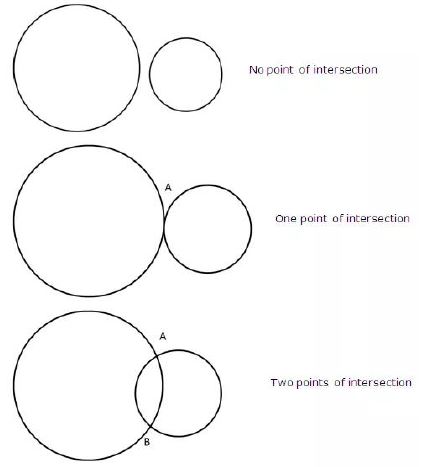
In simple words: Two circles can either not touch at all, touch at just one single point, or cross each other at two points. They can never intersect at three or more points.
Exam Tip: Support your answer with simple, neat diagrams illustrating each of the three intersection cases. Visual proofs are highly valued in geometry.
Question 4. Describe the steps to find the centre of a given circle using its chords.
Answer:
To locate the exact center of a given circle, follow these steps of construction:
1. Draw the circle whose center needs to be determined.
2. Draw any two non-parallel chords, \( AB \) and \( CD \), on this circle.
3. Construct the perpendicular bisectors of both chords \( AB \) and \( CD \).
4. Mark the point where these two perpendicular bisectors intersect as \( O \).
This intersection point \( O \) is the center of the circle.
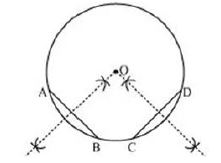
In simple words: Draw two different chords on the circle and find their midpoints. Draw lines straight up at right angles from these midpoints. The point where these two lines cross is the exact center of the circle.
Exam Tip: Remember that the perpendicular bisector of any chord always passes through the center of the circle. Thus, the intersection of two such bisectors uniquely pinpoints the center.
Question 5. If two equal chords of a circle intersect within the circle, prove that the segments of one chord are equal to the corresponding segments of the other chord.
Answer:
Let \( AB \) and \( CD \) be two equal chords of a circle with center \( O \) that intersect each other at point \( P \). Let us draw perpendiculars \( OM \perp AB \) and \( ON \perp CD \).
Proof:
In right-angled triangles \( OMP \) and \( ONP \):
1. \( OP = OP \) (Common side)
2. \( \angle OMP = \angle ONP = 90^\circ \) (By construction)
3. \( OM = ON \) (Equal chords of a circle are at an equal distance from the center)
Using the Right angle-Hypotenuse-Side (RHS) congruence criterion:
\( \Delta OMP \cong \Delta ONP \)
By corresponding parts of congruent triangles (CPCT):
\( \implies MP = PN \) ——— (1)
(i) Since the chords are equal, we have:
\( AB = CD \)
We know that the perpendicular drawn from the center of a circle bisects the chord:
\( AM = \frac{AB}{2} \) and \( CN = \frac{CD}{2} \)
Since \( AB = CD \), we get:
\( AM = CN \) ——— (2)
Adding equations (1) and (2):
\( AM + MP = CN + PN \)
\( \implies AP = CP \) ——— (3) (Proved)
(ii) We are given that:
\( AB = CD \)
Subtracting equation (3) from this:
\( AB - AP = CD - CP \)
\( \implies BP = DP \) (Proved)
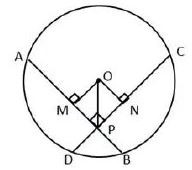
In simple words: By proving the small right triangles are identical, we establish that the segment parts near the center are equal. Combining this with the fact that equal chords are halved equally lets us prove the main segments are equal.
Exam Tip: The RHS congruence criterion is essential here. Make sure to clearly state that equal chords are equidistant from the center to justify \( OM = ON \).
Question 6. Two parallel chords of lengths 16 cm and 12 cm are drawn in a circle of radius 10 cm. Find the distance between the two chords if they lie:
(i) on the same side of the centre,
(ii) on opposite sides of the centre.
Answer:
We are given two parallel chords: \( AB = 16 \text{ cm} \) and \( CD = 12 \text{ cm} \). The radius of the circle is \( r = OA = OC = 10 \text{ cm} \). Let \( OL \) and \( OM \) be the perpendicular distances of these chords from the center \( O \).
Since the perpendicular from the center bisects the chord:
\( AL = \frac{AB}{2} = \frac{16}{2} = 8 \text{ cm} \)
\( CM = \frac{CD}{2} = \frac{12}{2} = 6 \text{ cm} \)
In the right-angled triangles \( OLA \) and \( OMC \), we apply the Pythagoras theorem:
For \( \Delta OLA \):
\( OA^2 = OL^2 + AL^2 \)
\( 10^2 = OL^2 + 8^2 \)
\( \implies OL^2 = 100 - 64 \)
\( \implies OL^2 = 36 \)
\( \implies OL = 6 \text{ cm} \)
For \( \Delta OMC \):
\( OC^2 = OM^2 + CM^2 \)
\( 10^2 = OM^2 + 6^2 \)
\( \implies OM^2 = 100 - 36 \)
\( \implies OM^2 = 64 \)
\( \implies OM = 8 \text{ cm} \)
Now we analyze the two relative configurations of the chords:
(i) **Case 1: When the chords lie on the same side of the center**
The distance between the two chords \( LM \) is the difference of their distances from the center:
\( LM = OM - OL = 8 - 6 = 2 \text{ cm} \)
(ii) **Case 2: When the chords lie on opposite sides of the center**
The distance between the two chords \( LM \) is the sum of their distances from the center:
\( LM = OM + OL = 8 + 6 = 14 \text{ cm} \)
In simple words: We find how far each chord is from the center using right triangles. If both are on the same side, we subtract these distances; if they are on opposite sides, we add them together.
Exam Tip: Parallel chord distance problems almost always have two cases unless specified. Don't forget to solve for both 'same side' (subtraction) and 'opposite sides' (addition) scenarios.
Question 7. In a circle of radius 20 cm, a chord AB of length 32 cm is drawn. If OD is a radius perpendicular to AB at point C, find the length of CD.
Answer:
The radius of the circle is \( OA = OD = 20 \text{ cm} \). The length of the chord \( AB \) is \( 32 \text{ cm} \).
A perpendicular segment \( OC \) is drawn from the center \( O \) to the chord \( AB \).
Since the perpendicular from the center bisects the chord:
\( AC = \frac{AB}{2} = \frac{32}{2} = 16 \text{ cm} \)
In the right-angled triangle \( OCA \), we apply the Pythagoras theorem:
\( OA^2 = OC^2 + AC^2 \)
Substitute the known values:
\( 20^2 = OC^2 + 16^2 \)
\( \implies OC^2 = 20^2 - 16^2 \)
\( \implies OC^2 = 400 - 256 \)
\( \implies OC^2 = 144 \)
\( \implies OC = 12 \text{ cm} \)
We are given that \( OD \) is the radius of the circle, so \( OD = 20 \text{ cm} \).
The length of the segment \( CD \) is:
\( CD = OD - OC \)
\( CD = 20 - 12 = 8 \text{ cm} \)
Hence, the length of \( CD \) is \( 8 \text{ cm} \).
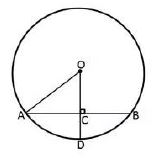
In simple words: The distance from the center to the chord is calculated as 12 cm using a right triangle. Subtracting this from the full 20 cm radius gives us the leftover piece CD, which is 8 cm.
Exam Tip: Be careful with labeling: make sure to identify that \( OD \) is a full radius, so its length is identical to the given radius \( OA \). This relation is the key to solving the final subtraction step.
Question 8. Two equal chords AB and CD of a circle with centre O intersect at a point. Let P and Q be the midpoints of AB and CD respectively. If \( \angle POQ = 150^\circ \), find \( \angle APQ \).
Answer:
Let \( O \) be the center of the circle. We are given that \( P \) and \( Q \) are the midpoints of equal chords \( AB \) and \( CD \) respectively.
A straight line drawn from the center of a circle to bisect a chord (that is not a diameter) is perpendicular to the chord. Therefore:
\( \angle APO = 90^\circ \)
We are also given that chords \( AB \) and \( CD \) are equal. Equal chords are equidistant from the center of the circle, which means:
\( PO = OQ \)
In triangle \( POQ \), since \( PO = OQ \), it is an isosceles triangle. Therefore, the angles opposite these sides are equal:
\( \angle OPQ = \angle OQP \)
We are given that \( \angle POQ = 150^\circ \). Using the angle sum property of triangles:
\( \angle POQ + \angle OPQ + \angle OQP = 180^\circ \)
\( \implies 150^\circ + 2\angle OPQ = 180^\circ \) (as \( \angle OQP = \angle OPQ \))
\( \implies 2\angle OPQ = 180^\circ - 150^\circ \)
\( \implies 2\angle OPQ = 30^\circ \)
\( \implies \angle OPQ = 15^\circ \)
Now, the total angle \( \angle APO \) is split into \( \angle APQ \) and \( \angle OPQ \):
\( \angle APO = \angle APQ + \angle OPQ \)
\( \implies 90^\circ = \angle APQ + 15^\circ \)
\( \implies \angle APQ = 90^\circ - 15^\circ = 75^\circ \)
Thus, the value of \( \angle APQ \) is \( 75^\circ \).
In simple words: The line from the center to the midpoint of a chord meets at a \( 90^\circ \) angle. Because the chords are equal, they are at equal distances from the center, forming an isosceles triangle with a \( 150^\circ \) top angle. This leaves \( 15^\circ \) for each base angle, which we subtract from \( 90^\circ \) to get \( 75^\circ \).
Exam Tip: State both properties clearly: (1) the line bisecting a chord from the center is perpendicular, and (2) equal chords are equidistant from the center. These are the twin foundations of this proof.
Question 9. In a circle with centre O, AOC is a diameter. If arc AXB is half of arc BYC, find \( \angle BOA \) and \( \angle BOC \).
Answer:
Let \( O \) be the center of the circle. We are given that \( AOC \) is a diameter, which forms a straight line. Thus:
\( \angle AOC = 180^\circ \)
We are also given that arc \( AXB = \frac{1}{2} \text{ arc } BYC \).
This can be written as:
\( \text{arc } AXB : \text{arc } BYC = 1 : 2 \)
Since the angles subtended at the center are proportional to the arc lengths:
\( \angle BOA : \angle BOC = 1 : 2 \)
Let \( \angle BOA = x \) and \( \angle BOC = 2x \).
Since \( AOC \) is a straight line:
\( \angle BOA + \angle BOC = 180^\circ \)
\( \implies x + 2x = 180^\circ \)
\( \implies 3x = 180^\circ \)
\( \implies x = 60^\circ \)
Therefore, the central angles are:
\( \angle BOA = 60^\circ \)
\( \angle BOC = 2x = 2 \times 60^\circ = 120^\circ \)
In simple words: A diameter forms a straight \( 180^\circ \) line. Since one arc is half the size of the other, its angle is also half. We divide the \( 180^\circ \) into three parts of \( 60^\circ \) each, giving us \( 60^\circ \) and \( 120^\circ \).
Exam Tip: Always make use of the straight-line property of a diameter to establish the \( 180^\circ \) sum. Using algebraic variables like \( x \) and \( 2x \) is the cleanest way to solve ratio problems.
Question 10. In a circle with centre O, three arcs APB, BQC, and CRA are such that:
\[ \frac{\text{Arc APB}}{2} = \frac{\text{Arc BQC}}{3} = \frac{\text{Arc CRA}}{4} \]
Find \( \angle BOC \).
Answer:
We are given that the three arcs \( APB \), \( BQC \), and \( CRA \) satisfy the relation:
\[ \frac{\text{arc } APB}{2} = \frac{\text{arc } BQC}{3} = \frac{\text{arc } CRA}{4} \]
Let this common ratio be equal to a constant \( k \):
\[ \frac{\text{arc } APB}{2} = \frac{\text{arc } BQC}{3} = \frac{\text{arc } CRA}{4} = k \]
This gives the arc lengths as:
\( \text{arc } APB = 2k \)
\( \text{arc } BQC = 3k \)
\( \text{arc } CRA = 4k \)
Since the angles subtended at the center are directly proportional to the lengths of the corresponding arcs, their central angles will be in the same ratio:
\( \angle AOB : \angle BOC : \angle AOC = 2 : 3 : 4 \)
Let:
\( \angle AOB = 2k \)
\( \angle BOC = 3k \)
\( \angle AOC = 4k \)
The sum of all angles around a point (the total angle in a circle) is \( 360^\circ \):
\( \angle AOB + \angle BOC + \angle AOC = 360^\circ \)
\( \implies 2k + 3k + 4k = 360^\circ \)
\( \implies 9k = 360^\circ \)
\( \implies k = 40^\circ \)
Now, calculate \( \angle BOC \):
\( \angle BOC = 3k = 3 \times 40^\circ = 120^\circ \)
Hence, \( \angle BOC \) is \( 120^\circ \).
In simple words: The three arcs divide the entire \( 360^\circ \) circle into parts in the ratio of \( 2:3:4 \). By dividing \( 360^\circ \) into 9 equal shares, we find each share is \( 40^\circ \). Since \( \angle BOC \) corresponds to 3 shares, it measures \( 120^\circ \).
Exam Tip: Remember that the complete angle subtended at the center of a circle by its entire circumference is always \( 360^\circ \). Equating the sum of the ratio parts to \( 360^\circ \) is the standard starting point.
ICSE Selina Concise Solutions Class 9 Mathematics Chapter 17 Circle
Students can now access the detailed Selina Concise Solutions for Chapter 17 Circle on our portal. These solutions have been carefully prepared as per latest ICSE Class 9 syllabus. Each solution given above has been updated based on the current year pattern to ensure Class 9 students have the most updated Mathematics content.
Master Selina Concise Textbook Questions
Our subject experts have provided detailed explanations for all the questions found in the Selina Concise textbook for Class 9 Mathematics. We have focussed on making the concepts easy for you in Chapter 17 Circle so that students can understand the concepts behind every answer. For all numerical problems and theoretical concepts these solutions will help in strengthening your analytical skill required for the ICSE examinations.
Complete Mathematics Exam Preparation
By using these Selina Concise Class 9 solutions, you can enhance your learning and identify areas that need more attention. We recommend solving the Mathematics Questions from the textbook first and then use our teacher-verified answers. For a proper revision of Chapter 17 Circle, students should also also check our Revision Notes and Sample Papers available on studiestoday.com.
FAQs
You can download the verified Selina Concise solutions for Chapter 17 Circle on StudiesToday.com. Our teachers have prepared answers for Class 9 Mathematics as per 2026-27 ICSE academic session.
Yes, our solutions for Chapter 17 Circle are designed as per new 2026 ICSE standards. 40% competency-based questions required for Class 9, are included to help students understand application-based logic behind every Mathematics answer.
Yes, every exercise in Chapter 17 Circle from the Selina Concise textbook has been solved step-by-step. Class 9 students will learn Mathematics conceots before their ICSE exams.
Yes, follow structured format of these Selina Concise solutions for Chapter 17 Circle to get full 20% internal assessment marks and use Class 9 Mathematics projects and viva preparation as per ICSE 2026 guidelines.