

ICSE Solutions Selina Concise Class 7 History Civics Chapter 9 Jahangir Shah Jahan and Aurangzeb have been provided below and is also available in Pdf for free download. The Selina Concise ICSE solutions for Class 7 History Civics have been prepared as per the latest syllabus and ICSE books and examination pattern suggested in Class 7. Questions given in ICSE Selina Concise book for Class 7 History Civics are an important part of exams for Class 7 History Civics and if answered properly can help you to get higher marks. Refer to more Chapter-wise answers for ICSE Class 7 History Civics and also download more latest study material for all subjects. Chapter 9 Jahangir Shah Jahan and Aurangzeb is an important topic in Class 7, please refer to answers provided below to help you score better in exams
Selina Concise Chapter 9 Jahangir Shah Jahan and Aurangzeb Class 7 History Civics ICSE Solutions
Class 7 History Civics students should refer to the following ICSE questions with answers for Chapter 9 Jahangir Shah Jahan and Aurangzeb in Class 7. These ICSE Solutions with answers for Class 7 History Civics will come in exams and help you to score good marks
Chapter 9 Jahangir Shah Jahan and Aurangzeb Selina Concise ICSE Solutions Class 7 History Civics
Important Words
- Chain of Justice: This was a gold chain with 60 bells put up by Emperor Jahangir. It stretched from his palace to the Yamuna River bank so anyone could pull it to ask the king for help.
- Engineer King: This is a special nickname for Shah Jahan because he built so many beautiful and famous structures during his rule.
- Shahjahanabad: This was a brand-new capital city constructed by Shah Jahan. Today, we know this area as Old Delhi.
Time To Learn
I. Fill in the blanks:
Question 1. _________, a symbol of love, shows a variety of cultural influences.
Answer: Taj Mahal
In simple words: The Taj Mahal is a famous monument that represents love and mixes different cultural styles.
Exam Tip: The Taj Mahal was built by Shah Jahan in memory of his wife Mumtaz Mahal.
Question 2. Jahangir installed a _________ for the seekers of justice.
Answer: chain of justice
In simple words: Jahangir set up a special golden chain with bells that anyone could pull to ask for a fair trial.
Exam Tip: Mention the 60 golden bells and its location near the Yamuna River to get full marks on this concept.
Question 3. The treaty of Purandhar was signed between Mughals and _________.
Answer: Rajput ruler Jain Singh
In simple words: The Mughals signed the Treaty of Purandhar with a Rajput leader named Jai Singh.
Exam Tip: Make sure to spell the names of historical treaties and leaders exactly as they are written in your textbook.
Question 4. The original name of Nur Jahan was _________.
Answer: Mehrunnisa
In simple words: Nur Jahan was born with the name Mehrunnisa before she married the emperor.
Exam Tip: Mehrunnisa was given the title "Nur Jahan" which means "Light of the World" by Jahangir.
Question 5. Bijapur was annexed in _________.
Answer: AD 1686
In simple words: The Mughal Empire took control of Bijapur in the year 1686.
Exam Tip: Double-check dates like AD 1686 to avoid losing easy marks on historical timelines.
Question 6. Aurangzeb reimposed _________.
Answer: Jazia and pilgrimage tax
In simple words: Aurangzeb brought back special taxes that non-Muslims had to pay.
Exam Tip: Be sure to write both "Jazia" and "pilgrimage tax" to get full marks for this question.
Question 7. _________, ninth Sikh guru, was executed on Aurangzeb’s order.
Answer: Guru Tegh Bahadur
In simple words: Aurangzeb ordered his soldiers to execute the ninth Sikh leader, Guru Tegh Bahadur.
Exam Tip: Always capitalize "Guru" and the full name "Tegh Bahadur" as a sign of historical accuracy.
Question 8. The Sikhs were organised into a military force called the _________.
Answer: Khalsa
In simple words: The Sikh community became a strong army group known as the Khalsa.
Exam Tip: The Khalsa was established by Guru Gobind Singh, the tenth Sikh Guru, to resist Mughal rule.
Question II. Match Column A with Column B:
| Column A | Column B |
|---|---|
| 1. Jahangir's son | (a) 1707 |
| 2. Guru Arjan Dev | (b) was the ruler of Marwar. |
| 3. Red Fort | (c) was martyred at Delhi. |
| 4. Nur Jahan | (d) Shah Jahan |
| 5. Death of Aurangzeb | (e) was the ambitious queen of Jahangir. |
| 6. Guru Tegh Bahadur | (f) Khusrau revolted during the first year of his reign. |
| 7. Ajit Singh | (g) the fifth Sikh guru, was tortured to death by Jahangir. |
Answer:
1. Jahangir's son - (f) Khusrau revolted during the first year of his reign.
2. Guru Arjan Dev - (g) the fifth Sikh guru, was tortured to death by Jahangir.
3. Red Fort - (d) Shah Jahan
4. Nur Jahan - (e) was the ambitious queen of Jahangir.
5. Death of Aurangzeb - (a) 1707
6. Guru Tegh Bahadur - (c) was martyred at Delhi.
7. Ajit Singh - (b) was the ruler of Marwar.
In simple words: This section pairs historical figures with their descriptions, such as linking Jahangir's son to his rebellion, and connecting Shah Jahan to the construction of the Red Fort.
Exam Tip: Draw straight lines or write the correct letter next to each number clearly during exams to avoid confusion.
III. State whether the following statements are True or False:
Question 1. Jahangir left the administration in the hands of his queen,Nur Jahan.
Answer: True
In simple words: Nur Jahan ran the daily work of the kingdom because the emperor trusted her completely.
Exam Tip: Remember that Nur Jahan's original name was Mehrunnisa, and she was the real power behind the throne.
Question 2. Nur Jahan’s influence was good and lasting for theMughal Empire.
Answer: False
In simple words: Her control over the administration ended up dividing the royal family and weakening the empire.
Exam Tip: Although she was capable, her personal ambition led to political clashes that harmed the empire.
Question 3. Shah Jahan had to fight for the throne.
Answer: True
In simple words: He had to fight against his own family members to become the emperor.
Exam Tip: Succession wars were very common in the Mughal dynasty as there was no fixed rule for who becomes the next king.
Question 4. Shah Jahan married Mumtaz Mahal, in whose memory the built the Taj.
Answer: True
In simple words: He constructed the Taj Mahal to show his deep love for his late wife.
Exam Tip: The construction of the Taj Mahal took more than 20 years to complete.
Question 5. Shah Jahan died in AD 1666, as a captive in the fort of Agra.
Answer: True
In simple words: His son Aurangzeb locked him up in Agra Fort, where he spent his final years.
Exam Tip: Aurangzeb kept his father imprisoned for eight years until Shah Jahan passed away in 1666.
Question 6. Aurangzeb had friendly relation with the Rajputs and theMarathas.
Answer: False
In simple words: Aurangzeb had a lot of conflicts and wars with both the Rajputs and the Marathas.
Exam Tip: This hostile relationship was a primary factor that eventually destroyed the Mughal Empire.
Question 7. The Sikhs were hostile to the Mughal Emperor after the execution of the ninth Sikh guru.
Answer: True
In simple words: The Sikh community fought back against the Mughals after Guru Tegh Bahadur was executed.
Exam Tip: This event led to the military organization of the Sikhs under Guru Gobind Singh.
Question 8. Aurangzeb died in 1707 in the Red Fort at Delhi.
Answer: False
In simple words: He passed away in the Deccan region while he was busy fighting there.
Exam Tip: Aurangzeb actually died in Ahmednagar, far from Delhi, after spending decades fighting in the South.
Question 9. Aurangzeb reimposed .
Answer: True
In simple words: This refers to Aurangzeb bringing back old taxes like Jazia.
Exam Tip: Even if a question contains a typographical error in the exam, always answer based on the general context of the lesson.
IV. Answer the following questions briefly:
Question 1. Jahangir is sometimes called a mixture of opposites. Discuss.
Answer: Jahangir had both good and bad qualities in his nature. On one hand, he was a kind and cultured ruler who loved justice. On the other hand, he could be very harsh and would order extremely severe punishments for small crimes. Because of these contrasting behaviors, historians often describe him as a mix of opposite traits.
In simple words: Jahangir had a double nature. He could be very caring and fair, but also extremely cruel and punishing.
Exam Tip: Use the phrase "combination of good and bad qualities" to explain why he is called a mixture of opposites.
Question 2. How did Jahangir deal with the European traders? Name two travellers who visited Jahangir’s court.
Answer: Jahangir kept friendly relations with the Portuguese merchants and offered them special benefits for trading. Two famous English travelers who visited his royal court were Captain Hawkins and Sir Thomas Roe.
In simple words: Jahangir was friendly to traders from Europe and gave them special rights. Captain Hawkins and Sir Thomas Roe came to visit him.
Exam Tip: Remember to name both Captain Hawkins and Sir Thomas Roe as the key English visitors.
Question 3. The age of Shah Jahan is the Golden Age of Mughal rule. Do you agree? Give reasons for your answer.
Answer: Yes, we can agree that his reign was a Golden Age for the following reasons:
1. There was complete peace inside the country, and trade grew rapidly, bringing massive wealth to the empire.
2. He built many useful things for the public like roads, bridges, water channels, and rest houses, and helped citizens during sickness and food shortage.
3. He was a great builder, making his rule the peak of Mughal architecture. His most famous creation is the beautiful Taj Mahal, constructed in memory of his beloved wife Mumtaz Mahal.
In simple words: His rule was a great time because the country was peaceful, wealthy, and full of beautiful buildings like the Taj Mahal.
Exam Tip: Divide your answer into three clear points - peace/wealth, public welfare, and grand architecture.
Question 4. Describe the religious policy of Aurangzeb. What were its results?
Answer: Aurangzeb's religious approach had two main parts:
1. He wanted to spread Islamic rules and make sure people lived strictly according to them.
2. He introduced strict rules against Hindus.
Because of his intolerance, he ended the peaceful approach of earlier rulers. This led to multiple revolts by the Jats, Satnamis, Sikhs, Rajputs, and Marathas. These wars damaged the country's peace, hurt the economy, weakened the army, and eventually brought down the empire.
In simple words: Aurangzeb was very strict about religion and upset many of his subjects. This caused major wars that broke the empire apart.
Exam Tip: Emphasize how Aurangzeb reversed Akbar's policy of religious toleration, which became a main cause for the Mughal downfall.
Question 5. Who were the Sikhs? How did they emerge as a political power?
Answer: The Sikhs were a religious community who organized themselves into a military force called the Khalsa. When Aurangzeb ordered the execution of their ninth leader, Guru Tegh Bahadur, open battles began between the Sikhs and the Mughals. Since Aurangzeb's successors were weak and could not stop them, the Sikhs slowly turned into a powerful political force.
In simple words: The Sikhs formed a strong military group called the Khalsa. They fought back against Mughal cruelty and became a powerful political group.
Exam Tip: Mention the execution of Guru Tegh Bahadur as the major turning point that forced the Sikhs to become a military power.
Question 6. Briefly describe aurangzeb’s clash with : (a) the Rajputs, (b) the Marathas, (c) the Sikhs.
Answer:
(a) The Rajputs: Aurangzeb treated Rajput leaders poorly. He kept loyal generals like Raja Jai Singh and Raja Jaswant Singh away from the court in Delhi and insulted Jai Singh after Shivaji escaped.
(b) The Marathas: Severe conflicts broke out between the Mughals and the Marathas over the control and conquest of the Deccan region.
(c) The Sikhs: Relations became bad after Jahangir executed the fifth Sikh leader, Guru Arjan Dev. Under their tenth leader, Guru Gobind Singh, the Sikhs fought open wars against the Mughals to resist their unfair rule.
In simple words: Aurangzeb upset the Rajputs by insulting their kings, fought the Marathas over southern land, and went to war with the Sikhs who refused to submit.
Exam Tip: Address all three groups - Rajputs, Marathas, and Sikhs - in separate sub-points to ensure a structured answer.
Question 7. Why do you think Aurangzeb reimposed some taxes?
Answer: Aurangzeb chose to bring back older taxes like Jazia and the pilgrimage tax because of his conservative and strict religious beliefs.
In simple words: He brought back special taxes on non-Muslims because of his orthodox religious views.
Exam Tip: Specifically name "Jazia" and "pilgrimage tax" as the taxes that were brought back by him.
Question 8. Explain the factors responsible for the decline of the Mughal empire.
Answer: The decline of the empire was caused by several key factors:
1. Intolerant Policies: Aurangzeb's orthodox religious choices and taxes turned communities like the Sikhs, Marathas, and Jats into enemies.
2. Deccan Campaigns: Trying to conquer southern states made the empire too huge to govern. He spent 25 years in the South, which caused him to neglect the North and allowed the Marathas to grow stronger.
3. Weak Rulers: The kings who came after Aurangzeb were incompetent and could not stop rebellions or control greedy nobles, allowing local governors to declare independence.
4. Lack of Funds: Maintaining a huge army for endless southern wars emptied the royal treasury, leaving later kings unable to pay their soldiers.
In simple words: The empire fell because of Aurangzeb's harsh rules, long expensive wars in the South, and weak rulers who followed him.
Exam Tip: Try to list all four factors - faulty policies, Deccan policy, weak successors, and empty treasury - for maximum marks.
V. Write a short note on
Question 1. Aurangzeb’s Deccan Campaigns
Answer: Aurangzeb wanted to completely stop the growing power of the Marathas, who were brave and refused to accept his rule. Since the southern region was very large and wealthy, Aurangzeb wanted to bring it fully under his control, leading to a long and costly military campaign.
In simple words: Aurangzeb spent a lot of time and money fighting in the South to defeat the brave Marathas and control their rich lands.
Exam Tip: Explain that his long stay in the Deccan kept him away from the North, which weakened his control over the rest of the empire.
Question 2. Abdali’s invasion on India
Answer: Ahmad Shah Abdali attacked India multiple times between 1747 and 1767. In 1761, he won a major victory against the Marathas in the Third Battle of Panipat, a defeat from which the Marathas could never recover their previous strength.
In simple words: Ahmad Shah Abdali attacked India many times and defeated the Marathas in 1761, ending their hope of ruling the country.
Exam Tip: Be sure to mention the year 1761 and the "Third Battle of Panipat" as key details.
Additional Questions (Jahangir, Shah Jahan and Aurangzeb)
A. Fill in the blanks:
Question 1. Nur Jahan became the _________ ruler of the Mughal empire.
Answer: virtual
In simple words: Nur Jahan became the actual power running the empire even though she was not the official emperor.
Exam Tip: The word "virtual" means she held all the actual powers of a ruler.
Question 2. During the final years of Jahangir’s reign, there was a power struggle between _________ and _________.
Answer: Nur Jahan and Shah Jahan
In simple words: As Jahangir's reign came to an end, Nur Jahan and Shah Jahan fought over who would control the kingdom.
Exam Tip: Make sure to write both names in the correct order as they appear in the lesson.
Question 3. Shah Jahan’s reign is often referred to as the _________ of the Mughal empire.
Answer: Golden Age
In simple words: Shah Jahan's rule is known as the best and most prosperous time of the Mughal Empire.
Exam Tip: This era is called the Golden Age primarily due to its incredible progress in architecture and art.
Question 4. Aurangzeb spent the first half of his reign in the _________ and the second half in the _________.
Answer: North and Deccan
In simple words: Aurangzeb lived and ruled in the northern part of India first, and then moved to the southern part called the Deccan.
Exam Tip: The division of Aurangzeb's reign into two geographic halves is a key feature of his rule.
Question 5. Aurangzeb spent the last _________ years of his reign fighting against the _________ and the Sultanates of _________ and Golconda.
Answer: twenty six, Marathas, Bijapur
In simple words: Aurangzeb spent his final twenty-six years in battle against the Maratha forces and the kingdoms of Bijapur and Golconda.
Exam Tip: Note the spelling of Golconda, Bijapur, and Marathas to ensure perfect accuracy.
B. Match the following:
Question B. Match the following:
| Column A | Column B |
|---|---|
| 1. Salim | (a) son of Jahangir |
| 2. Khusrau | (b) wife of Shah Jahan |
| 3. Nur Jahan | (c) red sandstone |
| 4. Taj Mahal | (d) son of Akbar |
| 5. Mumtaz Mahal | (e) wife of Jahangir |
| 6. Red Fort | (f) white marble |
Answer:
1. Salim - (d) son of Akbar
2. Khusrau - (a) son of Jahangir
3. Nur Jahan - (e) wife of Jahangir
4. Taj Mahal - (f) white marble
5. Mumtaz Mahal - (b) wife of Shah Jahan
6. Red Fort - (c) red sandstone
In simple words: This section connects famous Mughal personalities and monuments with their descriptions, like linking Salim to Akbar, and matching the Taj Mahal to white marble.
Exam Tip: Practice linking materials (like red sandstone for Red Fort and white marble for Taj Mahal) so you can match them quickly.
C. Choose the correct answer:
Question 1. The foundations laid by Akbar/Babur/Humayun were so strong that Jahangir did not have any major problems maintaining the empire.
(a) Akbar
(b) Babur
(c) Humayun
Answer: (a) Akbar
In simple words: Akbar built such a strong kingdom that his son Jahangir was able to rule without major problems.
Exam Tip: Akbar's strong administration and military reforms served as the backbone for Jahangir's stable rule.
Question 2. Shah Jahan built the magnificent Agra Fort/Taj Mahal/ Red Fort in the memory of his wife Mumtaz Mahal.
(a) Agra Fort
(b) Taj Mahal
(c) Red Fort
Answer: (b) Taj Mahal
In simple words: Shah Jahan built the beautiful Taj Mahal to remember his wife Mumtaz Mahal.
Exam Tip: The Taj Mahal is widely considered the finest example of Mughal architecture.
Question 3. Shah Jahan built a new city called Fatehpur Sikri/ Daulatabad/Shahjahanabad.
(a) Fatehpur Sikri
(b) Daulatabad
(c) Shahjahanabad
Answer: (c) Shahjahanabad
In simple words: Shah Jahan created a brand-new city named Shahjahanabad, which is now known as Old Delhi.
Exam Tip: Remember that Shahjahanabad became the new capital city of the Mughal Empire under Shah Jahan.
Question 4. Aurangzeb’s reign can be roughly divided into four/ three/two
(a) four
(b) three
(c) two
Answer: (c) two
In simple words: We can divide Aurangzeb's long rule into two main parts.
Exam Tip: The two periods represent his time spent ruling in the North and his long campaigns in the South (Deccan).
Question 5. One of the most serious challenges faced by Aurangzeb came from the Sikhs/Marathas/Rajputs in the Deccan.
(a) Sikhs
(b) Marathas
(c) Rajputs
Answer: (b) Marathas
In simple words: Aurangzeb's hardest fight in the South was against the brave Maratha warriors.
Exam Tip: The Marathas, under leaders like Shivaji, used guerrilla warfare which proved very difficult for the Mughal army to defeat.
D. State whether the following are true or false:
Question 1. Jahangir defeated the Rana of Mewar.
Answer: True
In simple words: Jahangir's forces successfully defeated Mewar's leader.
Exam Tip: Although Mewar was defeated, Jahangir treated the Rana with great respect and allowed him to keep his land.
Question 2. Jahangir is said to have installed a chain of justice.
Answer: True
In simple words: He put up a golden chain with bells so citizens could call for his help.
Exam Tip: This chain was a direct link between the ordinary people and the emperor's courtroom.
Question 3. The Peacock Throne was taken to Persia by Nadir Shah.
Answer: True
In simple words: A Persian king named Nadir Shah invaded and took away the famous golden throne.
Exam Tip: This event occurred in 1739 CE and marked a huge loss of Mughal wealth and prestige.
Question 4. The Jama Masjid is said to be the most perfect of Jahangir’s buildings.
Answer: False
In simple words: The Jama Masjid was actually built by Shah Jahan, not Jahangir.
Exam Tip: Always associate the grand Jama Masjid in Delhi with the "Engineer King," Shah Jahan.
E. Answer the following questions in one or two words/ sentences:
Question 1. Why did Jahangir not face any major problems in maintaining his large empire?
Answer: Jahangir did not face severe difficulties because his father, Akbar, had already established a highly stable and strong foundation for the empire.
In simple words: His father Akbar left behind a very strong and well-run kingdom.
Exam Tip: Keep your answer brief and focus on the strong foundation laid by Akbar.
Question 2. Name Jahangir’s son who rebelled against him.
Answer: The eldest son of Jahangir who revolted against his father was Prince Khusrau.
In simple words: His oldest son, Khusrau, rebelled against him.
Exam Tip: Do not confuse Prince Khusrau with Prince Khurram (who later became Shah Jahan).
Question 3. Why is Shah Jahan known as the Engineer King?
Answer: Shah Jahan is called the Engineer King because of his deep interest in design and architecture, which led to the creation of magnificent structures like the Taj Mahal, Moti Masjid, and Jama Masjid.
In simple words: He got this name because he built some of the most beautiful and famous buildings in history.
Exam Tip: Name at least two buildings constructed by Shah Jahan to support your answer.
Question 4. Which fort did Shah Jahan build in the new city of Shahjahanabad?
Answer: He constructed the famous Red Fort in his new capital city.
In simple words: He built the Red Fort.
Exam Tip: Keep the answer simple: the Red Fort is the correct monument.
Question 5. Who succeeded Shah Jahan as the Mughal emperor?
Answer: Shah Jahan was succeeded by his third son, Aurangzeb.
In simple words: His third son, Aurangzeb, became the next emperor.
Exam Tip: Aurangzeb seized power after winning a war of succession against his brothers.
Question 6. State any one major cause of the decline of the Mughal empire.
Answer: One main reason was that too much money was spent on expensive wars and building massive monuments, which completely emptied the royal savings.
In simple words: The empire ran out of money because of too many expensive buildings and wars.
Exam Tip: An empty treasury is a classic and very strong point to mention for the decline of any empire.
Question 7. What was the nature of Aurangzeb’s Rajput policy in the early years of his reign?
Answer: In the early part of his rule, Aurangzeb followed Akbar's friendly approach toward the Rajputs, giving them high military ranks and trying to secure their support.
In simple words: At first, Aurangzeb was friendly to the Rajputs and gave them good jobs to win their trust.
Exam Tip: Emphasize that his policy was friendly "at first" before it changed later in his reign.
Question 8. What were the objectives of Aurangzeb’s Deccan policy?
Answer: Aurangzeb aimed to completely crush the rising power of the brave Marathas and take control of the vast and wealthy kingdoms in the southern region.
In simple words: He wanted to defeat the brave Marathas and rule over the rich lands in the South.
Exam Tip: Make sure to mention both crushing the Maratha power and conquering the southern territory.
Question 9. Why did the annexation of Bijapur and Golconda prove harmful for the Mughal empire?
Answer: Taking over these states made the empire too large to manage easily and brought the Mughals into direct conflict with the Marathas.
In simple words: It made the empire too big to run and brought them into a direct fight with the Marathas.
Exam Tip: Use the words "too vast" and "direct contact with the Marathas" as they are key exam terms.
F. Answer the following questions briefly:
Question 1. Jahangir fulfilled Akbar’s unrealized imperial dreams by conquering Mewar. Explain.
Answer: Jahangir sent a military force against Rana Amar Singh of Mewar, who had refused to bow to the Mughals just like his father, Rana Pratap Singh. After his defeat, the Rana promised his loyalty to Jahangir. Jahangir treated him with respect, letting him keep his territory and appointing his son, Karan, as a commander in the Mughal army. This ended Mewar's long resistance and established Mughal rule over the region.
In simple words: Jahangir defeated the ruler of Mewar but was kind to him, letting him keep his land. This finally brought Mewar under Mughal control.
Exam Tip: Mention how Jahangir's polite treatment of the defeated Rana helped turn an old enemy into a loyal ally.
Question 2. To what extent were Jahangir’s Deccan campaigns successful?
Answer: Jahangir sent an army under Prince Khurram, who successfully recaptured the fort of Ahmadnagar. For this success, Prince Khurram received the grand title of Shah Jahan. However, the victory was temporary, as Ahmadnagar declared its independence again by the end of Jahangir's reign.
In simple words: The campaign started well when Prince Khurram took back Ahmadnagar, but the success did not last because Ahmadnagar became independent again later.
Exam Tip: Be sure to state both the short-term success (recapturing the fort) and the long-term failure (independence of Ahmadnagar).
Question 3. What qualities did Nur Jahan possess to make her worthy of her name?
Answer: Nur Jahan, which means "light of the world," lived up to her name by being beautiful, intelligent, and highly educated. She wrote poetry, designed creative clothing and jewelry, and had the strength and courage to help Jahangir make major decisions for the country.
In simple words: She was beautiful and smart. She wrote poetry, designed pretty jewelry, and helped run the government.
Exam Tip: To get full marks, list her artistic talents (poetry and fashion) alongside her political skills.
Question 4. Nur Jahan was very ambitious and eventually became the power behind the throne. Explain.
Answer: Nur Jahan was highly ambitious and soon became the real ruler. Jahangir asked for her advice on all government matters, eventually leaving the administration in her hands. Coins were made with both of their names, and she gave top government posts to her own relatives, including marrying her niece, Mumtaz Mahal, to Prince Khurram.
In simple words: Because Jahangir relied on her, Nur Jahan took control of the government, put her family in power, and put her name on coins.
Exam Tip: Mention key evidence of her power, such as joint coins and appointing her family to high posts.
Question 5. Shah Jahan’s reign was an age of splendour and cultural brilliance. In this context, discuss: (a) Taj Mahal (b) Red Fort
Answer:
(a) Taj Mahal: This famous monument took over twenty years to finish and cost about ten million rupees. Built from pure white marble, it features a majestic dome, four slender towers, and beautiful gardens.
(b) Red Fort: Made from red sandstone, this fort contains magnificent halls like the Diwan-i-Khas, which has marble walls, a silver ceiling, and designs made of gold and precious stones.
In simple words: Shah Jahan created incredible monuments, using white marble for the Taj Mahal and red sandstone for the grand Red Fort.
Exam Tip: Keep your descriptions focused on materials used (white marble for Taj Mahal, red sandstone for Red Fort).
Question 6. Why did Aurangzeb’s Deccan campaign against the Marathas prove to be a ruinous misadventure? What were the long-term consequences of this campaign?
Answer: The campaign failed because Aurangzeb was too suspicious to trust his own generals, causing him to interfere constantly. His long war in the South drained all of the empire's money and left the administration in the North weak. Consequently, the great Mughal Empire began to fall apart, shrinking eventually to just a few miles around Delhi.
In simple words: Spending 25 years fighting in the South used up all the empire's money and left the North ignored, causing the empire to collapse.
Exam Tip: Focus on how spending 25 years in the Deccan led to the neglect of the administration in the North.
Question 7. Why did Aurangzeb fail as a ruler?
Answer: Even though Aurangzeb had strong personal discipline, he failed as a ruler because he lacked religious tolerance. He made enemies of the Rajputs, Sikhs, and Marathas, and his highly suspicious nature made his own officials dislike him.
In simple words: He failed because he was too strict, didn't trust his officers, and treated people of other religions poorly.
Exam Tip: Highlight his suspicious nature and lack of religious tolerance as the main reasons for his failure.
Question 8. Briefly explain the negative aspects of Shah Jahan’s reign that eventually led to the decline of the Mughal empire.
Answer: Behind the beauty of his reign, several major problems arose:
1. Huge building projects and expensive military campaigns drained the royal savings.
2. Heavy taxes were placed on poor farmers to gather more money.
3. Many farming villages were ruined, hurting the country's agriculture.
4. Failed military campaigns showed that the army was getting weaker.
5. The government grew too large, and corruption began to spread.
In simple words: Shah Jahan spent too much money on buildings and wars, leading to heavy taxes on farmers and a weakened army.
Exam Tip: Remember to mention the heavy tax burden on the peasantry and the rise of corruption as key points.
G Picture study:
This is a picture of a 17th century-CE monument, built in red sandstone by a Mughal emperor.
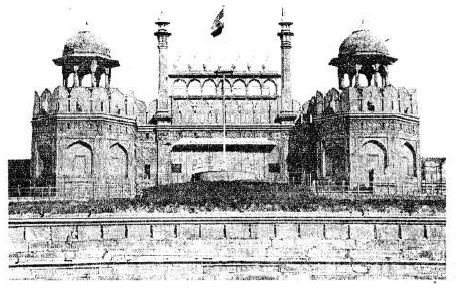
Question 1. Identify the monument.
Answer: The monument shown in the picture is the Red Fort.
In simple words: This is the Red Fort.
Exam Tip: The Red Fort is made of red sandstone, which is its most defining visual feature.
Question 2. Where is it located?
Answer: It is located in Old Delhi.
In simple words: It is in Old Delhi.
Exam Tip: Old Delhi was originally called Shahjahanabad when the fort was built.
Question 3. Who built this monuments?
Answer: This monument was constructed by Emperor Shah Jahan.
In simple words: Shah Jahan built it.
Exam Tip: Keep the exact spelling of the question, even if it contains minor typos like "this monuments."
Question 4. Name two important buildings inside this monument.
Answer: Two famous buildings inside the fort are:
(a) Diwan-i-Khas
(b) Diwan-i-Aam
In simple words: The Diwan-i-Khas and the Diwan-i-Aam are two important halls inside.
Exam Tip: Remember that Diwan-i-Khas was for private meetings, and Diwan-i-Aam was for the general public.
Question 5. Mention its important features.
Answer: The Diwan-i-Khas is the most beautiful hall, with a silver ceiling and marble walls decorated with gold and gems. The Diwan-i-Aam once held Shah Jahan's famous golden Peacock Throne, which was covered in jewels and took seven years to build before being carried away to Persia in 1739 CE.
In simple words: It has beautiful halls with silver ceilings and once held the famous jewel-covered Peacock Throne.
Exam Tip: Be sure to write about the decorative features of the Diwan-i-Khas and the historical importance of the Peacock Throne.
Free study material for History Civics
ICSE Selina Concise Solutions Class 7 History Civics Chapter 9 Jahangir Shah Jahan and Aurangzeb
Students can now access the detailed Selina Concise Solutions for Chapter 9 Jahangir Shah Jahan and Aurangzeb on our portal. These solutions have been carefully prepared as per latest ICSE Class 7 syllabus. Each solution given above has been updated based on the current year pattern to ensure Class 7 students have the most updated History Civics content.
Master Selina Concise Textbook Questions
Our subject experts have provided detailed explanations for all the questions found in the Selina Concise textbook for Class 7 History Civics. We have focussed on making the concepts easy for you in Chapter 9 Jahangir Shah Jahan and Aurangzeb so that students can understand the concepts behind every answer. For all numerical problems and theoretical concepts these solutions will help in strengthening your analytical skill required for the ICSE examinations.
Complete History Civics Exam Preparation
By using these Selina Concise Class 7 solutions, you can enhance your learning and identify areas that need more attention. We recommend solving the History Civics Questions from the textbook first and then use our teacher-verified answers. For a proper revision of Chapter 9 Jahangir Shah Jahan and Aurangzeb, students should also also check our Revision Notes and Sample Papers available on studiestoday.com.
FAQs
You can download the verified Selina Concise solutions for Chapter 9 Jahangir Shah Jahan and Aurangzeb on StudiesToday.com. Our teachers have prepared answers for Class 7 History Civics as per 2026-27 ICSE academic session.
Yes, our solutions for Chapter 9 Jahangir Shah Jahan and Aurangzeb are designed as per new 2026 ICSE standards. 40% competency-based questions required for Class 7, are included to help students understand application-based logic behind every History Civics answer.
Yes, every exercise in Chapter 9 Jahangir Shah Jahan and Aurangzeb from the Selina Concise textbook has been solved step-by-step. Class 7 students will learn History Civics conceots before their ICSE exams.
Yes, follow structured format of these Selina Concise solutions for Chapter 9 Jahangir Shah Jahan and Aurangzeb to get full 20% internal assessment marks and use Class 7 History Civics projects and viva preparation as per ICSE 2026 guidelines.