

Read and download the CBSE Class 11 Mathematics Conic Sections Worksheet Set 04 in PDF format. We have provided exhaustive and printable Class 11 Mathematics worksheets for Chapter 10 Conic Sections, designed by expert teachers. These resources align with the 2026-27 syllabus and examination patterns issued by NCERT, CBSE, and KVS, helping students master all important chapter topics.
Chapter-wise Worksheet for Class 11 Mathematics Chapter 10 Conic Sections
Students of Class 11 should use this Mathematics practice paper to check their understanding of Chapter 10 Conic Sections as it includes essential problems and detailed solutions. Regular self-testing with these will help you achieve higher marks in your school tests and final examinations.
Class 11 Mathematics Chapter 10 Conic Sections Worksheet with Answers
CBSE Class 11 Mathematics Conic Sections Worksheet (4). The Relations And Functions questions in the worksheets have been specifically designed by best mathematics teachers so that the students can practice them to clear their Relations And Functions concepts and get better marks in class 11 mathematics tests and examinations. Students can free download these Relations And Functions worksheets in pdf and practice them. This will help them to get better marks in examinations. Also refer to other worksheets for the Relations And Functions chapter and other subjects too. Use them for better understanding of the subjects.
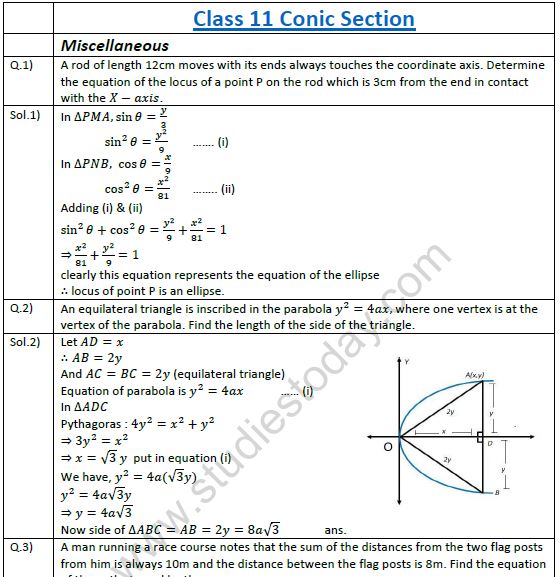
Question 1. A rod of length 12cm moves with its ends always touches the coordinate axis. Determine the equation of the locus of a point P on the rod which is 3cm from the end in contact with the X - axis.
Answer: Let \( P(x, y) \) be the point on the rod. In triangle \( PMA \), we have:
\( \sin\theta = \frac{y}{3} \)
\( \Rightarrow \sin^2\theta = \frac{y^2}{9} \dots(i) \)
In triangle \( PNB \), the remaining length of the rod is \( 12 - 3 = 9\text{ cm} \). Therefore:
\( \cos\theta = \frac{x}{9} \)
\( \Rightarrow \cos^2\theta = \frac{x^2}{81} \dots(ii) \)
By adding equations \( (i) \) and \( (ii) \), we find:
\( \sin^2\theta + \cos^2\theta = \frac{y^2}{9} + \frac{x^2}{81} = 1 \)
\( \Rightarrow \frac{x^2}{81} + \frac{y^2}{9} = 1 \)
This relation represents the standard equation of an ellipse. Consequently, the path traced by point \( P \) is an ellipse.
In simple words: As the 12 cm rod slides along the axes, any point on it traces an elliptical path. By setting up trigonometric ratios for the two segments of the rod, we get the standard equation of an ellipse.
Exam Tip: Always identify the lengths of the two segments of the rod correctly based on which axis the distance is measured from. Using the identity \( \sin^2\theta + \cos^2\theta = 1 \) is the standard approach to eliminate \( \theta \) and find the locus.
Question 2. An equilateral triangle is inscribed in the parabola \( y^2 = 4ax \), where one vertex is at the vertex of the parabola. Find the length of the side of the triangle.
Answer: Let \( O(0,0) \) be the vertex of the parabola, and let the equilateral triangle be \( OAB \), where \( A(x, y) \) and \( B(x, -y) \) are points on the parabola. Let \( D \) be the point where the line \( AB \) intersects the axis of the parabola, so \( OD = x \).
Therefore, we have \( AB = 2y \).
Since \( OAB \) is an equilateral triangle:
\( OA = OB = AB = 2y \)
In the right-angled triangle \( ODA \), by Pythagoras' theorem:
\( OA^2 = OD^2 + AD^2 \)
\( \Rightarrow (2y)^2 = x^2 + y^2 \)
\( \Rightarrow 4y^2 = x^2 + y^2 \)
\( \Rightarrow 3y^2 = x^2 \)
\( \Rightarrow x = \sqrt{3}y \)
Substituting \( x = \sqrt{3}y \) into the equation of the parabola \( y^2 = 4ax \):
\( y^2 = 4a(\sqrt{3}y) \)
Since \( y \neq 0 \):
\( y = 4a\sqrt{3} \)
Thus, the length of the side of the equilateral triangle is:
\( \text{Side} = AB = 2y = 2(4a\sqrt{3}) = 8a\sqrt{3} \)
In simple words: Since the triangle is equilateral, its sides are of equal length. We can use the geometry of the triangle to find a relation between its horizontal and vertical coordinates, then plug this into the parabola's formula to solve for the side length.
Exam Tip: Remember that the side of an equilateral triangle inscribed in a parabola \( y^2 = 4ax \) with one vertex at the origin always forms an angle of \( 30^\circ \) with the axis of symmetry, meaning \( x = y\sqrt{3} \).
Question 3. A man running a race course notes that the sum of the distances from the two flag posts from him is always 10m and the distance between the flag posts is 8m. Find the equation of the paths traced by the man.
Answer: Let the two flag posts represent the foci of an ellipse, \( S \) and \( S' \).
The distance between the two foci is given by:
\( SS' = 2ae = 8 \)
\( \Rightarrow ae = 4 \)
By definition, the sum of the focal distances to any point on an ellipse is equal to the length of the major axis \( 2a \):
\( SP + S'P = 2a = 10 \)
\( \Rightarrow a = 5 \)
We know the relation between the semi-major axis \( a \), semi-minor axis \( b \), and eccentricity \( e \) is:
\( ae = \sqrt{a^2 - b^2} \)
Substituting the known values:
\( 4 = \sqrt{25 - b^2} \)
Squaring both sides:
\( 16 = 25 - b^2 \)
\( \Rightarrow b^2 = 9 \)
Thus, the equation of the ellipse representing the path traced by the man is:
\( \frac{x^2}{25} + \frac{y^2}{9} = 1 \)
In simple words: When the sum of the distances from two fixed points (foci) is constant, the path traced is an ellipse. By using the distance between the flag posts and the sum of distances, we can easily find the major and minor axes to write the equation.
Exam Tip: Always remember that the constant sum of focal distances of a point on an ellipse is equal to the length of the major axis (\( 2a \)), and the distance between the foci is \( 2ae \).
Question 4. An arc is in the form of a semi-ellipse. It is 8m wide and 2m high at the centre. Find the height of the arc at a point 1.5m from one end.
Answer: Let the height of the arc at the given point be \( y\text{ m} \).
Since the total width of the semi-ellipse is \( 8\text{ m} \), the semi-major axis is \( a = \frac{8}{2} = 4\text{ m} \). The height at the center is the semi-minor axis \( b = 2\text{ m} \).
The equation of the ellipse is:
\( \frac{x^2}{4^2} + \frac{y^2}{2^2} = 1 \)
\( \Rightarrow \frac{x^2}{16} + \frac{y^2}{4} = 1 \)
A point on the arc that is \( 1.5\text{ m} \) from one end is at a distance of \( 4 - 1.5 = 2.5\text{ m} \) from the center (origin). Thus, the point \( A(2.5, y) \) lies on the ellipse:
\( \frac{2.5^2}{16} + \frac{y^2}{4} = 1 \)
\( \Rightarrow \frac{6.25}{16} + \frac{y^2}{4} = 1 \)
Multiplying the entire equation by 16:
\( 6.25 + 4y^2 = 16 \)
\( \Rightarrow 4y^2 = 16 - 6.25 \)
\( \Rightarrow 4y^2 = 9.75 \)
\( \Rightarrow y^2 = \frac{9.75}{4} = 2.4375 \)
\( \Rightarrow y = \sqrt{2.4375} \approx 1.56\text{ m} \).
Thus, the height of the arc at a distance of 1.5 m from one end is approximately \( 1.56\text{ m} \).
In simple words: The center of the arch is treated as our starting point (0,0). With a width of 8m and height of 2m, we set up the ellipse equation. Since the target point is 1.5m from one end, it is 2.5m away from the center. We use this as our x-value to calculate the height.
Exam Tip: Be careful with coordinates! The height is requested at 1.5 m from *one end*, which means the distance from the center (the x-coordinate) is \( 4 - 1.5 = 2.5\text{ m} \), not \( 1.5\text{ m} \).
Question 5. Find the area of the riangle formed by the lines joining the vertex of the parabola \( x^2 = 12y \) to the ends of its latus rectum.
Answer: The equation of the parabola is given as:
\( x^2 = 12y \)
Comparing this with the standard vertical parabola \( x^2 = 4ay \), we have:
\( 4a = 12 \Rightarrow a = 3 \)
The vertex of the parabola is at the origin \( (0,0) \).
The focus is at \( (0, a) = (0, 3) \).
The latus rectum is the line segment passing through the focus parallel to the x-axis, and its length (which serves as the base of the triangle) is:
\( \text{Base} = 4a = 12 \)
The altitude (height) of the triangle is the distance from the vertex \( (0,0) \) to the focus \( (0, 3) \), which is \( a = 3 \).
The area of the triangle \( \Delta ABC \) is:
\( \text{Area} = \frac{1}{2} \times \text{base} \times \text{height} \)
\( \Rightarrow \text{Area} = \frac{1}{2} \times 12 \times 3 = 18\text{ square units} \).
In simple words: The base of the triangle is the latus rectum of the parabola, and its height is the distance from the vertex to the focus. Using the standard triangle area formula gives us the final answer of 18 square units.
Exam Tip: For any vertical parabola \( x^2 = 4ay \), the area of the triangle formed by connecting the vertex to the ends of the latus rectum is always \( 2a^2 \).
Question 6. The focus of a parabolic mirror is at a distance of 5cm from its vertex. If the mirror is 45cm deep. Find the distance AB(diameter).
Answer: Let the vertex of the parabolic mirror be placed at the origin \( (0,0) \) and its axis of symmetry lie along the positive x-axis. Let \( AB \) represent the diameter of the circular opening of the mirror, where \( AC = y \) and \( AB = 2y \).
The focus of the mirror is at \( (5, 0) \), which means \( a = 5 \).
The equation of the parabola is:
\( y^2 = 4ax \)
\( \Rightarrow y^2 = 4(5)x \Rightarrow y^2 = 20x \)
Since the mirror is \( 45\text{ cm} \) deep, the point \( A(45, y) \) lies on the parabola:
\( y^2 = 20 \times 45 \)
\( \Rightarrow y^2 = 900 \)
\( \Rightarrow y = 30\text{ cm} \)
Therefore, the diameter \( AB \) is:
\( AB = 2y = 2 \times 30 = 60\text{ cm} \).
In simple words: Positioning the vertex at the origin, the parabolic equation is based on the 5 cm distance to the focus. We plug in the depth of 45 cm to find the radius of the mirror's opening, then double it to get the total diameter.
Exam Tip: Placing the vertex at \( (0,0) \) is always the best way to handle parabolic mirror problems. The depth of the mirror represents the x-coordinate, while the radius of the circular opening is the y-coordinate.
Question 7. An arc is in the form of a parabola with its axis vertical. The arc is 10m high and 5m wide at the base. How wide is it 2m from the vertex of the parabola?
Answer: Let the vertex of the vertical parabola be at the origin \( (0,0) \), opening upwards, so its equation is:
\( x^2 = 4ay \dots(i) \)
The arc is \( 10\text{ m} \) high and \( 5\text{ m} \) wide at the base. This means at \( y = 10\text{ m} \), the horizontal span is \( 5\text{ m} \) (from \( x = -2.5 \) to \( x = 2.5 \)). Therefore, the point \( A\left(\frac{5}{2}, 10\right) \) lies on the parabola:
\( \left(\frac{5}{2}\right)^2 = 4a(10) \)
\( \Rightarrow \frac{25}{4} = 40a \Rightarrow a = \frac{25}{160} = \frac{5}{32} \)
Substituting \( a \) back into equation \( (i) \):
\( x^2 = 4\left(\frac{5}{32}\right)y \Rightarrow x^2 = \frac{5}{8}y = \frac{25}{40}y \)
We need to find the width of the arc \( 2\text{ m} \) from the vertex (i.e., at \( y = 2\text{ m} \)). Let the point be \( B(x, 2) \). Since \( B \) lies on the parabola:
\( x^2 = \frac{25}{40} \times 2 \)
\( \Rightarrow x^2 = \frac{25}{20} = 1.25 \)
\( \Rightarrow x = \sqrt{1.25} \approx 1.12\text{ m} \).
Therefore, the required width \( 2x \) is:
\( 2x = 2 \times 1.12 \approx 2.24\text{ m} \approx 2.2\text{ m} \).
In simple words: We place the top of the arch at (0,0) and set up our parabola equation. Using the dimensions of the base, we solve for the constant in the equation. Finally, we plug in a height of 2m to find the half-width and double it.
Exam Tip: Be careful to use the half-width (\( 2.5\text{ m} \)) as the x-coordinate of the base point, not the full width of the base (\( 5\text{ m} \)), since the parabola is symmetric about the y-axis.
Shifting Parabola
Question 8. Given equation of parabola \( y^2 - 8y - x + 19 = 0 \). Find vertex, focus, axis, directrix, latus rectum.
Answer: The given equation of the parabola is:
\( y^2 - 8y - x + 19 = 0 \)
Rearranging the terms:
\( y^2 - 8y = x - 19 \)
Completing the square on the left-hand side:
\( (y - 4)^2 - 16 = x - 19 \)
\( \Rightarrow (y - 4)^2 = x - 3 \)
Let \( Y = y - 4 \) and \( X = x - 3 \), so \( y = Y + 4 \) and \( x = X + 3 \).
The equation simplifies to the standard form:
\( Y^2 = X \)
Comparing this with \( Y^2 = 4aX \), we find:
\( 4a = 1 \Rightarrow a = \frac{1}{4} \)
We now determine the parameters with respect to both the new and old axes:
i) Vertex:
- New axes: \( (X, Y) = (0, 0) \)
- Old axes: \( (x, y) = (0 + 3, 0 + 4) = (3, 4) \)
ii) Focus:
- New axes: \( (X, Y) = (a, 0) = \left(\frac{1}{4}, 0\right) \)
- Old axes: \( (x, y) = \left(\frac{1}{4} + 3, 0 + 4\right) = \left(\frac{13}{4}, 4\right) \)
iii) Directrix:
- New axes: \( X = -a \Rightarrow X = -\frac{1}{4} \)
- Old axes: \( x = X + 3 \Rightarrow x = -\frac{1}{4} + 3 \Rightarrow x = \frac{11}{4} \)
iv) Latus Rectum:
- \( \text{Length} = 4a = 4 \times \frac{1}{4} = 1 \)
v) Axis of Symmetry:
- New axes: \( Y = 0 \)
- Old axes: \( y = Y + 4 \Rightarrow y = 0 + 4 = 4 \).
In simple words: By completing the square on the y-terms, we rewrite the equation in the standard form \( Y^2 = X \) centered at \( (3, 4) \). This makes it easy to find the directrix, focus, and other properties before shifting them back to the original coordinate system.
Exam Tip: Take extra care when translating coordinates back to the original system. For example, adding the shift \( 3 \) to the new x-coordinate of the focus (\( \frac{1}{4} \)) gives \( \frac{13}{4} \).
Question 9. Find vertex, focus, directrix and axis of the parabola \( 4y^2 + 12x - 12y + 39 = 0 \).
Answer: The equation of the parabola is:
\( 4y^2 + 12x - 12y + 39 = 0 \)
Isolating the quadratic terms on the left side:
\( 4y^2 - 12y = -12x - 39 \)
\( \Rightarrow 4(y^2 - 3y) = -12x - 39 \)
Completing the square inside the parenthesis:
\( 4 \left[ \left(y - \frac{3}{2}\right)^2 - \frac{9}{4} \right] = -12x - 39 \)
\( \Rightarrow 4 \left(y - \frac{3}{2}\right)^2 - 9 = -12x - 39 \)
\( \Rightarrow 4 \left(y - \frac{3}{2}\right)^2 = -12x - 30 \)
Factoring out \( -12 \) from the right-hand side:
\( 4 \left(y - \frac{3}{2}\right)^2 = -12 \left(x + \frac{5}{2}\right) \)
\( \Rightarrow \left(y - \frac{3}{2}\right)^2 = -3 \left(x + \frac{5}{2}\right) \)
Let \( X = x + \frac{5}{2} \) and \( Y = y - \frac{3}{2} \), which gives \( x = X - \frac{5}{2} \) and \( y = Y + \frac{3}{2} \).
The transformed equation is:
\( Y^2 = -3X \)
Comparing with the standard form \( Y^2 = -4aX \), we find:
\( 4a = 3 \Rightarrow a = \frac{3}{4} \)
Now, we calculate the key properties:
i) Vertex:
- New axes: \( (X, Y) = (0, 0) \)
- Old axes: \( (x, y) = \left(0 - \frac{5}{2}, 0 + \frac{3}{2}\right) = \left(-\frac{5}{2}, \frac{3}{2}\right) \)
ii) Focus:
- New axes: \( (X, Y) = (-a, 0) = \left(-\frac{3}{4}, 0\right) \)
- Old axes: \( (x, y) = \left(-\frac{3}{4} - \frac{5}{2}, 0 + \frac{3}{2}\right) = \left(-\frac{13}{4}, \frac{3}{2}\right) \)
iii) Directrix:
- New axes: \( X = a \Rightarrow X = \frac{3}{4} \)
- Old axes: \( x = X - \frac{5}{2} \Rightarrow x = \frac{3}{4} - \frac{5}{2} = -\frac{7}{4} \)
iv) Axis of Symmetry:
- New axes: \( Y = 0 \)
- Old axes: \( y = Y + \frac{3}{2} \Rightarrow y = 0 + \frac{3}{2} = \frac{3}{2} \).
In simple words: We factor out the 4 from the y-terms and complete the square to get the equation into the form \( Y^2 = -4aX \). Since the coefficient is negative, the parabola opens to the left, and its vertex is shifted to \( \left(-\frac{5}{2}, \frac{3}{2}\right) \).
Exam Tip: Be sure to factor out the leading coefficient of \( y^2 \) (which is 4) before attempting to complete the square on the left-hand side, otherwise the algebra becomes very prone to mistakes.
Shifting Ellipse
Question 10. Find e, centre, vertices, foci, minor axis, major axis, directrix and latus rectum of the ellipse \( 25x^2 + 9y^2 - 150x - 90y + 225 = 0 \).
Answer: The given equation of the ellipse is:
\( 25x^2 + 9y^2 - 150x - 90y + 225 = 0 \)
Grouping the \( x \) and \( y \) terms:
\( (25x^2 - 150x) + (9y^2 - 90y) + 225 = 0 \)
\( \Rightarrow 25(x^2 - 6x) + 9(y^2 - 10y) + 225 = 0 \)
Completing the square for both variables:
\( 25[(x - 3)^2 - 9] + 9[(y - 5)^2 - 25] + 225 = 0 \)
\( \Rightarrow 25(x - 3)^2 - 225 + 9(y - 5)^2 - 225 + 225 = 0 \)
\( \Rightarrow 25(x - 3)^2 + 9(y - 5)^2 = 225 \)
Dividing by 225:
\( \frac{(x - 3)^2}{9} + \frac{(y - 5)^2}{25} = 1 \)
Let \( X = x - 3 \) and \( Y = y - 5 \), which gives \( x = X + 3 \) and \( y = Y + 5 \). The equation becomes:
\( \frac{X^2}{9} + \frac{Y^2}{25} = 1 \)
Comparing this with the standard vertical ellipse equation \( \frac{X^2}{a^2} + \frac{Y^2}{b^2} = 1 \), we get \( a^2 = 9 \Rightarrow a = 3 \), and \( b^2 = 25 \Rightarrow b = 5 \). Since \( b > a \), the major axis is vertical.
i) Eccentricity (\( e \)):
\( e = \sqrt{1 - \frac{a^2}{b^2}} = \sqrt{1 - \frac{9}{25}} = \sqrt{\frac{16}{25}} = \frac{4}{5} \)
ii) Centre:
- New axes: \( (X, Y) = (0, 0) \)
- Old axes: \( (x, y) = (0 + 3, 0 + 5) = (3, 5) \)
iii) Vertices:
- New axes: \( (0, \pm b) = (0, \pm 5) \)
- Old axes: \( (0 + 3, 5 + 5) = (3, 10) \) and \( (0 + 3, -5 + 5) = (3, 0) \)
iv) Foci:
- New axes: \( (0, \pm be) = (0, \pm 4) \)
- Old axes: \( (0 + 3, 4 + 5) = (3, 9) \) and \( (0 + 3, -4 + 5) = (3, 1) \)
v) Directrices:
- New axes: \( Y = \pm \frac{b}{e} \Rightarrow Y = \pm \frac{5}{4/5} = \pm \frac{25}{4} \)
- Old axes: \( y = Y + 5 \Rightarrow y = \frac{25}{4} + 5 = \frac{45}{4} \) and \( y = -\frac{25}{4} + 5 = -\frac{5}{4} \)
vi) Length of Major Axis:
\( 2b = 2(5) = 10 \)
vii) Length of Minor Axis:
\( 2a = 2(3) = 6 \)
viii) Length of Latus Rectum:
\( \frac{2a^2}{b} = \frac{2(9)}{5} = \frac{18}{5} \).
In simple words: By completing the squares, we find that the center of the ellipse is shifted to \( (3, 5) \). Since the denominator under the y-term is larger, it is a vertical ellipse with eccentricity 4/5, which allows us to find all its translated parameters.
Exam Tip: Remember that since \( b > a \), the major axis is vertical. All key coordinates like vertices \( (0, \pm b) \), foci \( (0, \pm be) \), and directrices \( Y = \pm \frac{b}{e} \) lie along the vertical axis of the shifted ellipse.
Please click the link below to download CBSE Class 11 Mathematics Conic Sections Worksheet (4).
Free study material for Mathematics
CBSE Mathematics Class 11 Chapter 10 Conic Sections Worksheet
Students can use the practice questions and answers provided above for Chapter 10 Conic Sections to prepare for their upcoming school tests. This resource is designed by expert teachers as per the latest 2026 syllabus released by CBSE for Class 11. We suggest that Class 11 students solve these questions daily for a strong foundation in Mathematics.
Chapter 10 Conic Sections Solutions & NCERT Alignment
Our expert teachers have referred to the latest NCERT book for Class 11 Mathematics to create these exercises. After solving the questions you should compare your answers with our detailed solutions as they have been designed by expert teachers. You will understand the correct way to write answers for the CBSE exams. You can also see above MCQ questions for Mathematics to cover every important topic in the chapter.
Class 11 Exam Preparation Strategy
Regular practice of this Class 11 Mathematics study material helps you to be familiar with the most regularly asked exam topics. If you find any topic in Chapter 10 Conic Sections difficult then you can refer to our NCERT solutions for Class 11 Mathematics. All revision sheets and printable assignments on studiestoday.com are free and updated to help students get better scores in their school examinations.
FAQs
You can download the latest chapter-wise printable worksheets for Class 11 Mathematics Chapter 10 Conic Sections for free from StudiesToday.com. These have been made as per the latest CBSE curriculum for this academic year.
Yes, Class 11 Mathematics worksheets for Chapter 10 Conic Sections focus on activity-based learning and also competency-style questions. This helps students to apply theoretical knowledge to practical scenarios.
Yes, we have provided solved worksheets for Class 11 Mathematics Chapter 10 Conic Sections to help students verify their answers instantly.
Yes, our Class 11 Mathematics test sheets are mobile-friendly PDFs and can be printed by teachers for classroom.
For Chapter 10 Conic Sections, regular practice with our worksheets will improve question-handling speed and help students understand all technical terms and diagrams.