

Read and download the CBSE Class 11 Mathematics Conic Sections Worksheet Set 03 in PDF format. We have provided exhaustive and printable Class 11 Mathematics worksheets for Chapter 10 Conic Sections, designed by expert teachers. These resources align with the 2026-27 syllabus and examination patterns issued by NCERT, CBSE, and KVS, helping students master all important chapter topics.
Chapter-wise Worksheet for Class 11 Mathematics Chapter 10 Conic Sections
Students of Class 11 should use this Mathematics practice paper to check their understanding of Chapter 10 Conic Sections as it includes essential problems and detailed solutions. Regular self-testing with these will help you achieve higher marks in your school tests and final examinations.
Class 11 Mathematics Chapter 10 Conic Sections Worksheet with Answers
CBSE Class 11 Mathematics Conic Sections Worksheet (3). The Relations And Functions questions in the worksheets have been specifically designed by best mathematics teachers so that the students can practice them to clear their Relations And Functions concepts and get better marks in class 11 mathematics tests and examinations. Students can free download these Relations And Functions worksheets in pdf and practice them. This will help them to get better marks in examinations. Also refer to other worksheets for the Relations And Functions chapter and other subjects too. Use them for better understanding of the subjects.
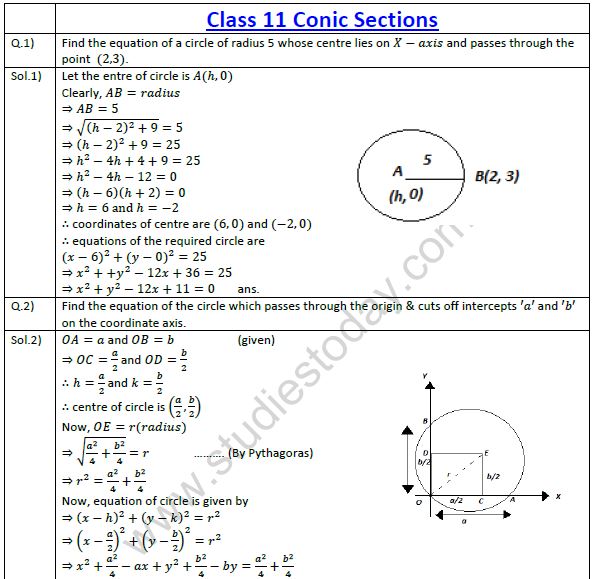
Question 1. Find the equation of a circle of radius 5 whose centre lies on X - axis and passes through the point (2,3).
Answer: Let the coordinates of the centre of the circle be \( A(h, 0) \).
The circle passes through the point \( B(2, 3) \), and its radius is given as 5. Therefore, the distance between \( A \) and \( B \) is equal to the radius:
\( AB = 5 \)
Using the distance formula:
\( \sqrt{(h - 2)^2 + (3 - 0)^2} = 5 \)
\( \Rightarrow (h - 2)^2 + 9 = 25 \)
\( \Rightarrow h^2 - 4h + 4 + 9 = 25 \)
\( \Rightarrow h^2 - 4h - 12 = 0 \)
\( \Rightarrow (h - 6)(h + 2) = 0 \)
This quadratic equation gives two possible values: \( h = 6 \) or \( h = -2 \).
Consequently, there are two possible centres for the circle: \( (6, 0) \) and \( (-2, 0) \).
We can now determine the equations of the circles for both cases:
For the centre \( (6, 0) \):
\( (x - 6)^2 + (y - 0)^2 = 25 \)
\( \Rightarrow x^2 + y^2 - 12x + 36 = 25 \)
\( \Rightarrow x^2 + y^2 - 12x + 11 = 0 \)
For the centre \( (-2, 0) \):
\( (x + 2)^2 + (y - 0)^2 = 25 \)
\( \Rightarrow x^2 + y^2 + 4x + 4 = 25 \)
\( \Rightarrow x^2 + y^2 + 4x - 21 = 0 \). In simple words: Since the centre of the circle lies on the X-axis, its y-coordinate is 0. By using the distance formula between the centre and the given point, we can solve for the x-coordinate of the centre to get the equations.
Exam Tip: Since the centre of the circle lies on the X-axis, its coordinates are of the form \( (h,0) \). Always remember that there will be two possible circles because the quadratic equation in \( h \) yields two distinct values.
Question 2. Find the equation of the circle which passes through the origin & cuts off intercepts 'a' and 'b' on the coordinate axis.
Answer: Let the circle pass through the origin \( O(0,0) \) and cut off intercepts \( a \) and \( b \) on the X and Y axes respectively. This means the circle passes through the points \( A(a, 0) \) and \( B(0, b) \).
Let the centre of this circle be \( C(h, k) \). Since the perpendicular from the centre to any chord bisects it, the coordinates of the centre are:
\( h = \frac{a}{2} \) and \( k = \frac{b}{2} \)
Thus, the centre of the circle is \( \left(\frac{a}{2}, \frac{b}{2}\right) \).
The radius \( r \) of the circle is the distance from the centre to the origin \( (0,0) \). By Pythagoras' theorem:
\( r^2 = \left(\frac{a}{2}\right)^2 + \left(\frac{b}{2}\right)^2 = \frac{a^2}{4} + \frac{b^2}{4} \)
Now, the standard equation of the circle is given by:
\( (x - h)^2 + (y - k)^2 = r^2 \)
\( \Rightarrow \left(x - \frac{a}{2}\right)^2 + \left(y - \frac{b}{2}\right)^2 = \frac{a^2}{4} + \frac{b^2}{4} \)
\( \Rightarrow x^2 - ax + \frac{a^2}{4} + y^2 - by + \frac{b^2}{4} = \frac{a^2}{4} + \frac{b^2}{4} \)
\( \Rightarrow x^2 + y^2 - ax - by = 0 \). In simple words: Since the circle cuts off intercepts \( a \) and \( b \) on the axes and passes through the origin, we can find its centre by taking half of each intercept. The radius is the distance from this centre back to the origin.
Exam Tip: A circle passing through the origin and cutting off intercepts \( a \) and \( b \) always has its centre at \( \left(\frac{a}{2}, \frac{b}{2}\right) \). You can quickly write down the equation \( x^2 + y^2 - ax - by = 0 \) as a standard result.
Question 3. Find the equation of the circle which passes through the points (1, -2) and (4, -3) and has its centre on the line 3x + 4y = 7.
Answer: Let the standard equation of the circle be:
\( (x - h)^2 + (y - k)^2 = r^2 \)
Since the point \( A(1, -2) \) lies on the circle:
\( (1 - h)^2 + (-2 - k)^2 = r^2 \)
\( \Rightarrow 1 + h^2 - 2h + 4 + k^2 + 4k = r^2 \)
\( \Rightarrow h^2 + k^2 - 2h + 4k + 5 = r^2 \dots(i) \)
Similarly, since the point \( B(4, -3) \) lies on the circle:
\( (4 - h)^2 + (-3 - k)^2 = r^2 \)
\( \Rightarrow 16 - 8h + h^2 + 9 + 6k + k^2 = r^2 \)
\( \Rightarrow h^2 + k^2 - 8h + 6k + 25 = r^2 \dots(ii) \)
The centre \( C(h, k) \) lies on the given line \( 3x + 4y = 7 \), which gives:
\( 3h + 4k = 7 \dots(iii) \)
Equating equations \( (i) \) and \( (ii) \) as they both equal \( r^2 \):
\( h^2 + k^2 - 2h + 4k + 5 = h^2 + k^2 - 8h + 6k + 25 \)
\( \Rightarrow 6h - 2k = 20 \)
\( \Rightarrow 3h - k = 10 \dots(iv) \)
Subtracting equation \( (iv) \) from \( (iii) \):
\( (3h + 4k) - (3h - k) = 7 - 10 \)
\( \Rightarrow 5k = -3 \Rightarrow k = -\frac{3}{5} \)
Substituting \( k = -\frac{3}{5} \) into \( (iv) \):
\( 3h - \left(-\frac{3}{5}\right) = 10 \)
\( \Rightarrow 3h = 10 - \frac{3}{5} = \frac{47}{5} \Rightarrow h = \frac{47}{15} \)
Hence, the centre of the circle is \( \left(\frac{47}{15}, -\frac{3}{5}\right) \).
Now, we substitute \( h \) and \( k \) into \( (i) \) to calculate \( r^2 \):
\( r^2 = \left(1 - \frac{47}{15}\right)^2 + \left(-2 + \frac{3}{5}\right)^2 \)
\( \Rightarrow r^2 = \left(-\frac{32}{15}\right)^2 + \left(-\frac{7}{5}\right)^2 \)
\( \Rightarrow r^2 = \frac{1024}{225} + \frac{49}{25} = \frac{1024 + 441}{225} = \frac{1465}{225} \)
Therefore, the equation of the circle is:
\( \left(x - \frac{47}{15}\right)^2 + \left(y + \frac{3}{5}\right)^2 = \frac{1465}{225} \). In simple words: Since the circle passes through two given points, we can write down two distance equations. By equating them and using the condition that the centre lies on the given line, we can solve for the coordinates of the centre and then find the radius.
Exam Tip: Substituting the coordinates of the center \( (h, k) \) directly into the equation of the line \( 3x + 4y = 7 \) gives you your first linear equation. Equating the radial distances from the center to the two points on the circle provides the second linear equation.
Question 4. Find the equation of the circle which passes through the point (3,7), (5,5) and has its centre on the line x - 4y = 1.
Answer: Let the general equation of the circle be:
\( x^2 + y^2 + 2gx + 2fy + c = 0 \dots(1) \)
The coordinates of the centre are \( (-g, -f) \). Since this centre lies on the line \( x - 4y = 1 \), substituting these coordinates into the line's equation gives:
\( -g - 4(-f) = 1 \)
\( \Rightarrow 4f - g = 1 \dots(2) \)
Since the circle passes through the points \( (3, 7) \) and \( (5, 5) \), these coordinates must satisfy the circle's equation:
For \( (3, 7) \):
\( 3^2 + 7^2 + 2g(3) + 2f(7) + c = 0 \)
\( \Rightarrow 58 + 6g + 14f + c = 0 \dots(a) \)
For \( (5, 5) \):
\( 5^2 + 5^2 + 2g(5) + 2f(5) + c = 0 \)
\( \Rightarrow 50 + 10g + 10f + c = 0 \dots(b) \)
Subtracting equation \( (b) \) from \( (a) \):
\( (58 - 50) + (6g - 10g) + (14f - 10f) = 0 \)
\( \Rightarrow 8 - 4g + 4f = 0 \)
\( \Rightarrow 4f - 4g = -8 \)
\( \Rightarrow f - g = -2 \dots(3) \)
Now, we solve equations \( (2) \) and \( (3) \) simultaneously:
From \( (3) \), we have \( g = f + 2 \). Substituting this into \( (2) \):
\( 4f - (f + 2) = 1 \)
\( \Rightarrow 3f = 3 \Rightarrow f = 1 \)
Then, \( g = 1 + 2 = 3 \).
Now, substitute \( g = 3 \) and \( f = 1 \) into equation \( (a) \) to find \( c \):
\( 58 + 6(3) + 14(1) + c = 0 \)
\( \Rightarrow 58 + 18 + 14 + c = 0 \)
\( \Rightarrow c = -90 \)
Thus, the equation of the circle is:
\( x^2 + y^2 + 6x + 2y - 90 = 0 \).
In simple words: By using the general equation of a circle, we can form equations using the two points it passes through. Combining these with the equation for the line containing the centre lets us solve for all the unknown coefficients.
Exam Tip: Using the general equation of a circle \( x^2 + y^2 + 2gx + 2fy + c = 0 \) is often much faster than using the standard equation \( (x-h)^2 + (y-k)^2 = r^2 \) when you are given points and a line containing the centre.
Question 5. Find the centre and radius of the following equation
i) x^2 + y^2 - 4x + 6y = 12
ii) 2x^2 + 2y^2 - 6y = 2
Answer: We can find the centre and radius of each circle by converting the equations into standard form:
(i) For the equation \( x^2 + y^2 - 4x + 6y = 12 \):
Rearranging the terms:
\( x^2 - 4x + y^2 + 6y = 12 \)
Completing the square for both variables:
\( (x - 2)^2 - 4 + (y + 3)^2 - 9 = 12 \)
\( \Rightarrow (x - 2)^2 + (y + 3)^2 - 13 = 12 \)
\( \Rightarrow (x - 2)^2 + (y + 3)^2 = 25 \)
Comparing this with the standard form \( (x - h)^2 + (y - k)^2 = r^2 \), we get:
\( h = 2 \), \( k = -3 \), and \( r^2 = 25 \Rightarrow r = 5 \)
Thus, the centre is \( (2, -3) \) and the radius is \( 5 \).
(ii) For the equation \( 2x^2 + 2y^2 - 6y = 2 \):
Divide the entire equation by 2:
\( x^2 + y^2 - 3y = 1 \)
Completing the square for the \( y \) terms:
\( x^2 + \left(y - \frac{3}{2}\right)^2 - \frac{9}{4} = 1 \)
\( \Rightarrow x^2 + \left(y - \frac{3}{2}\right)^2 = 1 + \frac{9}{4} \)
\( \Rightarrow x^2 + \left(y - \frac{3}{2}\right)^2 = \frac{13}{4} \)
Comparing this with the standard form, we find:
\( h = 0 \), \( k = \frac{3}{2} \), and \( r^2 = \frac{13}{4} \Rightarrow r = \frac{\sqrt{13}}{2} \)
Thus, the centre is \( \left(0, \frac{3}{2}\right) \) and the radius is \( \frac{\sqrt{13}}{2} \).
In simple words: To find the centre and radius, we rearrange each equation and complete the square for the terms. This puts them in the standard format where the coordinates of the centre and the length of the radius can be read off directly.
Exam Tip: Always make sure that the coefficients of \( x^2 \) and \( y^2 \) are equal to 1 before completing the squares. In part (ii), this required dividing the entire equation by 2 first.
Question 6. Find the equation of the circle which passes through the points (5, -8), (2, -9) and (2,1).
Answer: Let the standard equation of the circle be:
\( (x - h)^2 + (y - k)^2 = r^2 \)
Since the point \( (5, -8) \) lies on the circle:
\( (5 - h)^2 + (-8 - k)^2 = r^2 \)
\( \Rightarrow 25 - 10h + h^2 + 64 + 16k + k^2 = r^2 \)
\( \Rightarrow h^2 + k^2 - 10h + 16k + 89 = r^2 \dots(i) \)
Since the point \( (2, -9) \) lies on the circle:
\( (2 - h)^2 + (-9 - k)^2 = r^2 \)
\( \Rightarrow 4 - 4h + h^2 + 81 + 18k + k^2 = r^2 \)
\( \Rightarrow h^2 + k^2 - 4h + 18k + 85 = r^2 \dots(ii) \)
Since the point \( (2, 1) \) lies on the circle:
\( (2 - h)^2 + (1 - k)^2 = r^2 \)
\( \Rightarrow 4 - 4h + h^2 + 1 - 2k + k^2 = r^2 \)
\( \Rightarrow h^2 + k^2 - 4h - 2k + 5 = r^2 \dots(iii) \)
Equating equations \( (i) \) and \( (ii) \):
\( h^2 + k^2 - 10h + 16k + 89 = h^2 + k^2 - 4h + 18k + 85 \)
\( \Rightarrow -6h - 2k = -4 \)
\( \Rightarrow 3h + k = 2 \dots(iv) \)
Equating equations \( (ii) \) and \( (iii) \):
\( h^2 + k^2 - 4h + 18k + 85 = h^2 + k^2 - 4h - 2k + 5 \)
\( \Rightarrow 20k = -80 \Rightarrow k = -4 \)
Substitute \( k = -4 \) into \( (iv) \):
\( 3h - 4 = 2 \Rightarrow 3h = 6 \Rightarrow h = 2 \)
Thus, the centre of the circle is \( (2, -4) \).
Substitute \( h = 2 \), \( k = -4 \) into \( (i) \) to find \( r^2 \):
\( r^2 = 2^2 + (-4)^2 - 10(2) + 16(-4) + 89 \)
\( \Rightarrow r^2 = 4 + 16 - 20 - 64 + 89 = 25 \)
\( \Rightarrow r = 5 \)
Thus, the equation of the circle is:
\( (x - 2)^2 + (y + 4)^2 = 25 \)
\( \Rightarrow x^2 - 4x + 4 + y^2 + 8y + 16 = 25 \)
\( \Rightarrow x^2 + y^2 - 4x + 8y - 5 = 0 \).
In simple words: We set up equations using the three given points. By equating them in pairs, we eliminate the squared terms and solve the resulting linear system to find the centre and radius of the circle.
Exam Tip: Since two of the points have the same x-coordinate \( (2, -9) \) and \( (2, 1) \), the perpendicular bisector of the chord joining them is a horizontal line \( y = -4 \), which immediately tells us that the y-coordinate of the centre \( k = -4 \).
Question 7. Find all data of the following parabolas: i) y^2 = -12x ii) 16y = -4x^2
Answer: (i) For the parabola \( y^2 = -12x \):
Comparing this with the standard equation \( y^2 = -4ax \):
\( 4a = 12 \Rightarrow a = 3 \)
- **Direction of opening**: Leftwards
- **Vertex**: \( (0, 0) \)
- **Focus**: \( (-a, 0) = (-3, 0) \)
- **Equation of the directrix**: \( x = a \Rightarrow x = 3 \)
- **Length of the latus rectum**: \( 4a = 12 \)
- **Equation of the axis**: \( y = 0 \) (X-axis)
(ii) For the parabola \( 16y = -4x^2 \):
Dividing by \( -4 \):
\( x^2 = -4y \)
Comparing this with the standard equation \( x^2 = -4ay \):
\( 4a = 4 \Rightarrow a = 1 \)
- **Direction of opening**: Downwards
- **Vertex**: \( (0, 0) \)
- **Focus**: \( (0, -a) = (0, -1) \)
- **Equation of the directrix**: \( y = a \Rightarrow y = 1 \)
- **Length of the latus rectum**: \( 4a = 4 \)
- **Equation of the axis**: \( x = 0 \) (Y-axis).
In simple words: We rewrite each parabola in its standard form. By comparing coefficients, we identify the value of the constant \( a \), which gives us the focus, directrix, vertex, and axis of symmetry.
Exam Tip: Make sure to rearrange the equation so that the squared variable is on one side with a coefficient of 1 before comparing it to standard forms like \( y^2 = -4ax \) or \( x^2 = -4ay \).
Question 8. Find the equation of parabola whose focus = (6,0) and directrix x = -6.
Answer: Since the focus \( (6, 0) \) lies on the positive X-axis and the directrix \( x = -6 \) is a vertical line to the left of the origin, the parabola opens to the right and is of the form:
\( y^2 = 4ax \)
By comparing the focus with \( (a, 0) \) and the directrix with \( x = -a \), we find:
\( a = 6 \)
Substituting this value of \( a \) into our standard equation:
\( y^2 = 4(6)x \)
\( \Rightarrow y^2 = 24x \).
In simple words: The focus and directrix are symmetrical about the origin, showing that the vertex is at \( (0,0) \). Because the focus is on the positive x-axis, the parabola opens to the right, giving us the standard equation \( y^2 = 24x \).
Exam Tip: The vertex is always the midpoint between the focus and the point where the directrix intersects the axis of the parabola. Here, the midpoint of \( (6,0) \) and \( (-6,0) \) is \( (0,0) \).
Question 9. Find the equation of parabola with vertex (0,0) and passing through (5,2) and symmetric w.r.t y-axis.
Answer: Since the parabola is symmetric with respect to the Y-axis, its axis of symmetry is vertical, meaning the equation is of the form \( x^2 = 4ay \) or \( x^2 = -4ay \).
Since the parabola passes through the point \( (5, 2) \), which lies in the first quadrant, it must open upwards. Thus, the equation is of the form:
\( x^2 = 4ay \)
Substituting the coordinates \( (5, 2) \) into this equation:
\( 5^2 = 4a(2) \)
\( \Rightarrow 25 = 8a \Rightarrow a = \frac{25}{8} \)
Substituting \( a \) back into the standard equation:
\( x^2 = 4\left(\frac{25}{8}\right)y \)
\( \Rightarrow x^2 = \frac{25}{2}y \).
In simple words: Since the axis is vertical and the point lies in the upper-right quadrant, the parabola must open upwards. Substituting the coordinates of the point lets us calculate the constant \( a \) and complete the equation.
Exam Tip: When a parabola is symmetric with respect to the Y-axis, its equation contains \( x^2 \). If it is symmetric with respect to the X-axis, its equation contains \( y^2 \).
Question 10. Find vertex, foci, e, LR, Major axis and Minor axis 36x^2 + 4y^2 = 144.
Answer: We are given the equation of the ellipse:
\( 36x^2 + 4y^2 = 144 \)
Dividing both sides by 144 to convert it to standard form:
\( \frac{x^2}{4} + \frac{y^2}{36} = 1 \)
\( \Rightarrow \frac{x^2}{2^2} + \frac{y^2}{6^2} = 1 \)
Comparing this with the standard equation \( \frac{x^2}{a^2} + \frac{y^2}{b^2} = 1 \), we get:
\( a = 2 \) and \( b = 6 \)
Since \( b > a \), the major axis lies along the Y-axis. Now, we find the required properties:
(i) **Eccentricity (\( e \))**:
\( e = \sqrt{1 - \frac{a^2}{b^2}} = \sqrt{1 - \frac{4}{36}} = \sqrt{1 - \frac{1}{9}} = \sqrt{\frac{8}{9}} = \frac{2\sqrt{2}}{3} \)
(ii) **Vertices**:
\( (0, \pm b) = (0, \pm 6) \)
(iii) **Foci**:
\( (0, \pm be) = \left(0, \pm 6 \times \frac{2\sqrt{2}}{3}\right) = (0, \pm 4\sqrt{2}) \)
(iv) **Length of Latus Rectum (LR)**:
\( \text{LR} = \frac{2a^2}{b} = \frac{2(4)}{6} = \frac{4}{3} \)
(v) **Length of Major Axis**:
\( 2b = 2(6) = 12 \)
(vi) **Length of Minor Axis**:
\( 2a = 2(2) = 4 \).
In simple words: We divide the entire equation by 144 to get the standard form. Because the denominator under \( y^2 \) is larger, this is a vertical ellipse, from which we can calculate the focal coordinates, eccentricity, and axis lengths.
Exam Tip: Be careful with vertical ellipses where \( b > a \). The vertices are on the Y-axis \( (0, \pm b) \), the foci are \( (0, \pm be) \), and the latus rectum is calculated as \( \frac{2a^2}{b} \).
Shifting Hyperbola
Question 11. Find centre, e, foci, vertices, LR, directrix, length of the axis (transverse & conjugate axis) of the hyperbola 9x^2 - 16y^2 - 18x + 32y - 151 = 0.
Answer: The given equation of the hyperbola is:
\( 9x^2 - 16y^2 - 18x + 32y - 151 = 0 \)
Grouping the terms of \( x \) and \( y \):
\( 9(x^2 - 2x) - 16(y^2 - 2y) - 151 = 0 \)
Completing the square for both variables:
\( 9[(x - 1)^2 - 1] - 16[(y - 1)^2 - 1] - 151 = 0 \)
\( \Rightarrow 9(x - 1)^2 - 9 - 16(y - 1)^2 + 16 - 151 = 0 \)
\( \Rightarrow 9(x - 1)^2 - 16(y - 1)^2 = 144 \)
Dividing both sides by 144:
\( \frac{(x - 1)^2}{16} - \frac{(y - 1)^2}{9} = 1 \)
Let \( X = x - 1 \) and \( Y = y - 1 \), which gives \( x = X + 1 \) and \( y = Y + 1 \).
The equation becomes:
\( \frac{X^2}{16} - \frac{Y^2}{9} = 1 \)
This represents a horizontal hyperbola with \( a = 4 \) and \( b = 3 \). We now calculate the required parameters:
(i) **Eccentricity (\( e \))**:
\( e = \sqrt{1 + \frac{b^2}{a^2}} = \sqrt{1 + \frac{9}{16}} = \sqrt{\frac{25}{16}} = \frac{5}{4} \)
(ii) **Centre**:
- New axes: \( (X, Y) = (0, 0) \)
- Old axes: \( (x, y) = (0 + 1, 0 + 1) = (1, 1) \)
(iii) **Vertices**:
- New axes: \( (\pm a, 0) = (\pm 4, 0) \)
- Old axes: \( (4 + 1, 0 + 1) = (5, 1) \) and \( (-4 + 1, 0 + 1) = (-3, 1) \)
(iv) **Foci**:
- New axes: \( (\pm ae, 0) = (\pm 5, 0) \)
- Old axes: \( (5 + 1, 0 + 1) = (6, 1) \) and \( (-5 + 1, 0 + 1) = (-4, 1) \)
(v) **Length of Latus Rectum (LR)**:
\( \text{LR} = \frac{2b^2}{a} = \frac{2(9)}{4} = \frac{9}{2} \)
(vi) **Directrix**:
- New axes: \( X = \pm \frac{a}{e} \Rightarrow X = \pm \frac{16}{5} \)
- Old axes: \( x = X + 1 \Rightarrow x = \frac{16}{5} + 1 = \frac{21}{5} \) and \( x = -\frac{16}{5} + 1 = -\frac{11}{5} \)
(vii) **Length of Transverse Axis**:
\( 2a = 2(4) = 8 \)
(viii) **Length of Conjugate Axis**:
\( 2b = 2(3) = 6 \).
In simple words: By grouping the terms and completing the squares, we shift the center of the hyperbola to \( (1,1) \). We then solve for eccentricity and all the other properties in the standard shifted system before translating them back to the original coordinates.
Exam Tip: Be sure to keep track of the shift when finding the final coordinates. Add \( +1 \) to the x-coordinates and \( +1 \) to the y-coordinates of the shifted points to get the correct positions relative to the old axes.
Click on link below to download the pdf file for CBSE Class 11 Mathematics Conic Sections Worksheet (3).
Free study material for Mathematics
CBSE Mathematics Class 11 Chapter 10 Conic Sections Worksheet
Students can use the practice questions and answers provided above for Chapter 10 Conic Sections to prepare for their upcoming school tests. This resource is designed by expert teachers as per the latest 2026 syllabus released by CBSE for Class 11. We suggest that Class 11 students solve these questions daily for a strong foundation in Mathematics.
Chapter 10 Conic Sections Solutions & NCERT Alignment
Our expert teachers have referred to the latest NCERT book for Class 11 Mathematics to create these exercises. After solving the questions you should compare your answers with our detailed solutions as they have been designed by expert teachers. You will understand the correct way to write answers for the CBSE exams. You can also see above MCQ questions for Mathematics to cover every important topic in the chapter.
Class 11 Exam Preparation Strategy
Regular practice of this Class 11 Mathematics study material helps you to be familiar with the most regularly asked exam topics. If you find any topic in Chapter 10 Conic Sections difficult then you can refer to our NCERT solutions for Class 11 Mathematics. All revision sheets and printable assignments on studiestoday.com are free and updated to help students get better scores in their school examinations.
FAQs
You can download the latest chapter-wise printable worksheets for Class 11 Mathematics Chapter 10 Conic Sections for free from StudiesToday.com. These have been made as per the latest CBSE curriculum for this academic year.
Yes, Class 11 Mathematics worksheets for Chapter 10 Conic Sections focus on activity-based learning and also competency-style questions. This helps students to apply theoretical knowledge to practical scenarios.
Yes, we have provided solved worksheets for Class 11 Mathematics Chapter 10 Conic Sections to help students verify their answers instantly.
Yes, our Class 11 Mathematics test sheets are mobile-friendly PDFs and can be printed by teachers for classroom.
For Chapter 10 Conic Sections, regular practice with our worksheets will improve question-handling speed and help students understand all technical terms and diagrams.