

Download Class 11 Mathematics Worksheets for Chapter 08 Sequences and Series
Explore reliable practice materials for Chapter 08 Sequences and Series tailored for Class 11 learners. Utilizing these Mathematics worksheets ensures thorough preparation and strengthens problem-solving speed for upcoming school assessments.
Access Chapter 08 Sequences and Series Questions and Exercises
View or download the dedicated Chapter 08 Sequences and Series practice resource below. Engaging with these objective and subjective questions daily ensures continuous academic progress and mastery of the 2026-27 curriculum.
Multiple Choice Questions
Question. The number of terms in the AP 20, 25, 30, …… 100 are
(a) 16
(b) 17
(c) 18
(d) 19
Answer : B
Question. The sum of three consecutive terms of an AP is 15, and their product is 105, then the common difference is
(a) ±1
(b) ±2
(c) ±3
(d) ±4
Answer : B
Question. If in an AP, first term is 2 and the sum of first five terms is one-fourth of the next five terms, then the 20th terms is
(a) −140
(b) −100
(c) −112
(d) −138
Answer : C
Question. If n terms of GP 3, 32 , 33 , ..... are needed to give the sum 120, then the value of n is
(a) 2
(b) 3
(c) 4
(d) 5
Answer : C
Question. The rth term of an AP sum of whose first n terms is 2n + 3n2 is given by
(a) 6r + 1
(b) 6r −1
(c) 6r
(d) 3r −1
Answer : B
Question. In an AP, if mth term is n and the nth term is m, where m ≠ n, then pth term is
(a) m+n −p
(b) m−n + p
(c) n −m+ p
(d) m+n + p
Answer : A
Question. If the 8th term of a GP is 192 with the common ratio 2, then the 12th term is
(a) 1640
(b) 2084
(c) 3072
(d) 3126
Answer : C
Question. If the third term of GP is 4, then the product of its first 5 terms is
(a) 43
(b) 44
(c) 45
(d) None of these
Answer : C
Question. The 5th term from the end of the sequence 16, 8, 4, 2, ……1/16 is
(a) 1
(b) 2
(c) 3
(d) 4
Answer : A
Question. 6 arithmetic means between 3 and 24 are
(a) 6, 9, 12, 15, 18 and 21
(b) 6, 9, 10, 15, 18 and 21
(c) 6, 8, 10, 15, 18 and 21
(d) 6, 9, 12, 13, 18 and 21
Answer : A
Question. The sum of an infinite GP is 80/9 and its common ratio is −4/5 then its first term is equal to
(a) 10
(b) 14
(c) 15
(d) 16
Answer : D
Asserion-Reasoning MCQs
Directions Each of these questions contains two statements Assertion (A) and Reason (R). Each of the questions has four alternative choices, any one of the which is the correct answer. You have to select one of the codes (a), (b), (c) and
(d) given below.
(a) A is true, R is true; R is a correct explanation of A.
(b) A is true, R is true; R is not a correct explanation of A.
(c) A is true; R is false
(d) A is false; R is true.
Question. Assertion (A) The sum of first 20 terms of an AP, 4, 8, 12, … is equal to 840.
Reason (R) Sum of first n terms of an AP is given by Sn = n/2 [2a + (n - 1)d], where a = first term and d = common difference
Answer : A
Question. Assertion (A) The sum of the series 3/√5 + 4/√5 + √5 + …… 25 terms is 75√5.
Reason (R) If 27, x, 3 are in GP, then x = ± 4.
Answer : C
Question. Assertion (A) If nth term of a sequence is an = n2/2n, then its 7th term is 49/128
Reason (R) If nth term of a sequence is an = n(n - 2) / n + 3, then its 20th term is 323/22
Answer : C
Question. Assertion (A) The fourth term of a GP is the square of its second term and the first term is −3, then its 7th term is equal to 2187.
Reason (R) Sum of first 10 terms of the AP 6, 8, 10, ……… is equal to 150.
Answer : D
Question. Assertion (A) If 5th and 8th term of a GP be 48 and 384 respectively, then the common ratio of GP is 2.
Reason (R) If 18, x, 14 are in AP, then x = 16.
Answer : B
Question. Assertion (A) If the nth term of a sequence is an = 4n − 3. Here, a17 and a24 are 65 and 93 respectively.
Reason (R) If the nth term of a sequence is an dn = (−1)n − 1 n3 . Here, 9th term is 729.
Answer : B
Question. Assertion (A) The sum of first n terms of the series 5 + 55 + 555 + … is 5/9 [10(10n - 1) / 9 - n ]
Reason (R) General term of an AP is Tn = a + (n − 1)d , where a = first term and d = common difference.
Answer : B
Case Based MCQs
A sequence whose terms increases or decreases by a fixed number, is called an Arithmetic Progression (AP). In other words, we can say that, a sequence is called an arithmetic progression if the difference of a term and the previous term is always same i.e. an+1 − an = constant for all n. This constant or same difference is called the common difference of an AP and it is denoted by d. In an AP, we usually denote the first term by a, common difference by d and the nth term by an or Tn defined as Tn = an = a + (n - 1)d Also, l = a + (n −1)d, where l is the last term of the sequence. The sum of n terms, Sn of this AP is given by Sn = n/2 [2a + (n - 1)d] Also, if l be the last term, then the sum of n terms of this AP is Sn = n/2 (a + l)
Based on the above information, answer the following questions.
Question. If nth term of an AP is given by an = 2n2 +1, then its 10th term is equal to
(a) 200
(b) 301
(c) 400
(d) Given sequence is not an AP
Answer : D
Question. 11th term of an AP 11, 18, 25, … is equal to
(a) 80
(b) 81
(c) 71
(d) 70
Answer : B
Question. If the sum of n terms of an AP is given by Sn = 3n + 2n2 , then the common difference of the AP is
(a) 3
(b) 2
(c) 6
(d) 4
Answer : D
Question. If 9 times the 9th term of an AP is equal to 13 times the 13th term, then the 22nd term of the AP is
(a) 0
(b) 22
(c) 198
(d) 220
Answer : A
Question. Let Sn denote the sum of the first n terms of an AP, if S2n = 3Sn , then S3n : Sn is equal to
(a) 4
(b) 6
(c) 8
(d) 10
Answer : B
A student of class XI draw a square of side 10 cm. Another student join the mid-point of this square to form new square. Again, the mid-points of the sides of this new square are joined to form another square by another student. This process is continued indefinitely.
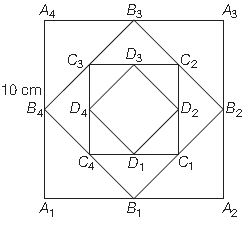
Based on above information, answer the following questions.
Question. The side of fourth square is (in cm)
(a) 5
(b) √5/2
(c) √5
(d) None of these
Answer : D
Question. The area of the fifth square is (in sq cm)
(a) 25/2
(b) 50
(c) 25
(d) 25/4
Answer : D
Question. The perimeter of the 7th square is (in cm)
(a) 10
(b) 20
(c) 5
(d) 5/2
Answer : C
Question. The sum of areas of all the square formed is (in sq cm)
(a) 150
(b) 200
(c) 250
(d) None of these
Answer : B
Question. The sum of the perimeter of all the square formed is (in cm)
(a) 80 + 40√2
(b) 40 + 40√2
(c) 40
(d) None of these
Answer : A
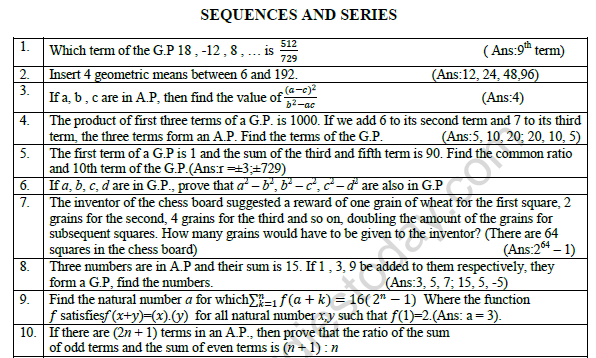
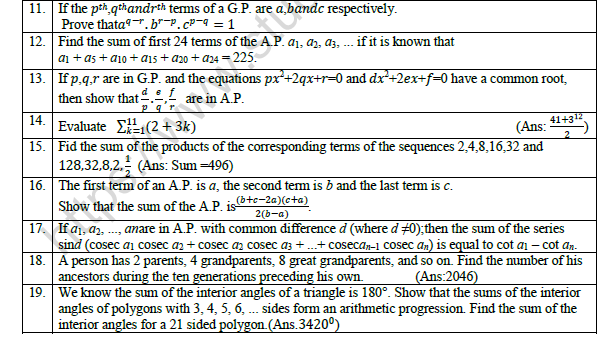
Please click on below link to download CBSE Class 11 Mathematics Sequences And Series Worksheet Set A
Free study material for Mathematics
Exam Preparation Worksheet for Class 11 Mathematics Chapter 08 Sequences and Series
CBSE Practice Material: Class 11 Mathematics Chapter 08 Sequences and Series
Access structured practice worksheets for Chapter 08 Sequences and Series designed in alignment with the latest CBSE curriculum for Class 11 Mathematics. These printable problem sets help students build accuracy and prepare effectively for school tests.
NCERT-Aligned Questions and Solutions
Built using the official NCERT book for Class 11 Mathematics, these practice materials provide reliable academic guidance. Pair your practice with our recommended NCERT solutions to master optimal problem-solving approaches.
Next Steps in Your Exam Preparation
Explore our broader library of printable assignments, chapter notes, and mock tests designed to support continuous revision and secure higher marks in CBSE assessments.
FAQs
You can download the teacher-verified PDF for CBSE Class 11 Mathematics Sequences And Series Worksheet Set 01 from StudiesToday.com. These practice sheets for Class 11 Mathematics are designed as per the latest CBSE academic session.
Yes, our CBSE Class 11 Mathematics Sequences And Series Worksheet Set 01 includes a variety of questions like Case-based studies, Assertion-Reasoning, and MCQs as per the 50% competency-based weightage in the latest curriculum for Class 11.
Yes, we have provided detailed solutions for CBSE Class 11 Mathematics Sequences And Series Worksheet Set 01 to help Class 11 and follow the official CBSE marking scheme.
Daily practice with these Mathematics worksheets helps in identifying understanding gaps. It also improves question solving speed and ensures that Class 11 students get more marks in CBSE exams.
All our Class 11 Mathematics practice test papers and worksheets are available for free download in mobile-friendly PDF format. You can access CBSE Class 11 Mathematics Sequences And Series Worksheet Set 01 without any registration.