

ICSE Solutions Voyage Class 7 Geography Chapter 7 Types Of Rocks have been provided below and is also available in Pdf for free download. The Voyage ICSE solutions for Class 7 Geography have been prepared as per the latest syllabus and ICSE books and examination pattern suggested in Class 7. Questions given in ICSE Voyage book for Class 7 Geography are an important part of exams for Class 7 Geography and if answered properly can help you to get higher marks. Refer to more Chapter-wise answers for ICSE Class 7 Geography and also download more latest study material for all subjects. Chapter 7 Types Of Rocks is an important topic in Class 7, please refer to answers provided below to help you score better in exams
Voyage Chapter 7 Types Of Rocks Class 7 Geography ICSE Solutions
Class 7 Geography students should refer to the following ICSE questions with answers for Chapter 7 Types Of Rocks in Class 7. These ICSE Solutions with answers for Class 7 Geography will come in exams and help you to score good marks
Chapter 7 Types Of Rocks Voyage ICSE Solutions Class 7 Geography
Question. Why is diamond clear and hard while graphite is soft ? Why is coal hard and chunky ?
Answer: In a diamond, carbon atoms join together in a very strong four-sided shape. This makes the diamond clear and extremely tough. But in graphite, carbon atoms have weak bonds. This makes graphite soft, dark, and easy to break. Coal is a type of rock that can burn. It forms deep underground in layers called coal beds. Over a long time, high heat and heavy weight from the ground squeeze the carbon. This makes the coal turn into solid, chunky pieces.
In simple words: Diamond is hard because its atoms are tightly locked, while graphite is soft because its atoms are loosely held. Coal gets hard and thick when heat and weight squeeze it underground.
Exam Tip: Remember to mention that diamond has a strong structure, whereas graphite has weak bonds. For coal, focus on the roles of heat and pressure.
Discuss
Question. Discuss the importance of rocks for the contruction business.
Answer: Rocks like granite and marble are very helpful for builders. People cut these rocks to build homes, roads, and large dams. Some rocks also give us materials like gypsum and limestone. These are used to make cement.
In simple words: Builders use strong rocks like granite and marble to make buildings and roads. They also use other rocks to make cement.
Exam Tip: When discussing construction, always give examples of specific rocks like granite, marble, and limestone to score full marks.
Values & Life Skills
Question. Rocks and minerals play a very important role in our lives. Can you imagine modern life without minerals ? What problems would you face in their absence ?
Answer: Living without rocks and minerals would cause terrible trouble. These materials are highly valuable to us. Here are the key ways they help us:
- Rocks slowly break down through natural and chemical ways to create soil.
- Rocks hold many kinds of minerals. These minerals give us useful metals like copper, iron, and manganese. Factories need these metals to make goods.
If we run out of these materials, we will face severe issues:
- Life on Earth would stop. We need soil to grow food, and we would have no soil without rocks.
- Factories that rely on minerals would have to close down.
In simple words: We cannot live without rocks and minerals. They make the soil we use to grow food, and they provide the metals we use to build things.
Exam Tip: Remember to explain how rocks create soil, and how minerals are crucial for factories. Stating both points ensures you cover all aspects of the answer.
Exercises
Question 1. Granite is an example of intrusive __________ rocks.
Answer: igneous
In simple words: Granite is a rock that forms deep underground from cooled magma, which makes it an intrusive igneous rock.
Exam Tip: Remember that granite forms inside the earth, so it is an intrusive igneous rock.
Question 2. A category of rock which is formed by the alteration of the parent rock due to heat and pressure is called: __________.
Answer: metamorphic rocks
In simple words: When intense heat and squeezing change an old rock, it turns into a metamorphic rock.
Exam Tip: "Metamorphic" means change of form. Heat and pressure are the two main factors that cause this change.
Question 3. Conglomerate is an example of __________ rocks.
Answer: sedimentary
In simple words: Conglomerate is a rock made from smaller bits and pebbles stuck together over time.
Exam Tip: Remember that conglomerate has rounded fragments that have been cemented together, which is a classic sedimentary feature.
Question 4. Sedimentary rocks are formed from __________ accumulated over long periods.
Answer: sediments
In simple words: Small bits of sand and mud pile up over many years and eventually turn into solid rock.
Exam Tip: The word "sedimentary" comes from "sediment", which refers to the small pieces that settle at the bottom of water bodies.
Question 5. Sedimentary rock such as limestone change into __________.
Answer: marble
In simple words: When limestone is heated and squeezed deep underground, it changes into marble.
Exam Tip: Always associate limestone with marble when studying metamorphic changes.
B. Write True or False. Rewrite the false statements correctly:
Question 1. Minerals are organic substances.
Answer: False.
The correct statement is: Minerals are inorganic materials.
In simple words: Minerals do not come from plants or animals, so they are not organic.
Exam Tip: Remember that minerals are natural and inorganic, meaning they are made from non-living matter.
Question 2. Basalt is an example of an intrusive igneous rock.
Answer: False.
The correct statement is: Basalt is a type of extrusive igneous rock.
In simple words: Basalt forms on the outside of the earth from cooled lava, not deep inside.
Exam Tip: Granite is intrusive (inside), while basalt is extrusive (outside/surface).
Question 3. Sedimentary rocks are formed by the cooling and solidification of molten rock called magma.
Answer: False.
The correct statement is: Igneous rocks are created when liquid magma cools down and hardens.
In simple words: Molten magma cools down to make igneous rocks, not sedimentary ones.
Exam Tip: Think of "ignite" (fire) to remember that igneous rocks form from hot, molten magma.
Question 4. Igneous and sedimentary rocks can change into metamorphic rocks.
Answer: True.
In simple words: Both igneous and sedimentary rocks can turn into metamorphic rocks if they are heated and squeezed.
Exam Tip: Any rock can undergo metamorphism if subjected to intense heat and pressure over time.
Question 5. Rocks are used in construction industries.
Answer: True.
In simple words: We use rocks like granite and marble to build homes, roads, and dams.
Exam Tip: Rocks are essential raw materials in construction and cement-making.
C. Answer the following questions in brief:
Question 1. What is crust ?
Answer: The crust is the very outside layer of our planet. It is also the thinnest of all the Earth's layers.
In simple words: The crust is the hard, thin, outer shell of the Earth that we live on.
Exam Tip: Always mention that the crust is both the outermost layer and the thinnest layer of the Earth.
Question 2. Differentiate between SIAL and SIMA.
Answer:
| Feature | SIAL | SIMA |
|---|---|---|
| Position | This is the top part of the Earth's crust. | This is the bottom part of the Earth's crust. |
| Composition | It consists of silica and aluminium. | It consists of silica and magnesium. |
In simple words: SIAL is the upper crust layer made of silica and aluminium. SIMA is the lower crust layer made of silica and magnesium.
Exam Tip: Use the letters in the names to remember their composition: SI (Silica) + AL (Aluminium) and SI (Silica) + MA (Magnesium).
Question 3. State two characteristics of the mantle.
Answer:
- This layer is in a semi-solid state.
- It contains a lot of magnesium and iron.
- It has a thickness of around 2,850 km, and its density ranges from 3.5 to 5.5.
In simple words: The mantle is the thick, semi-solid middle layer of the Earth. It is full of iron and magnesium.
Exam Tip: Memorize at least two traits of the mantle, such as its semi-solid nature and its high iron and magnesium content, to get full marks.
Question 4. What is the difference between the inner and the outer core ?
Answer:
| Feature | Inner Core | Outer Core |
|---|---|---|
| Position | This is the deepest and central part of our planet. | This layer wraps around the inner core. |
| State & Materials | It is a solid ball composed of nickel and iron. | It consists of liquid nickel and iron. |
| Size | Its radius is about 1220 km. | Its thickness is around 2300 km. |
In simple words: The inner core is a solid ball at the center of the Earth. The outer core is a liquid layer that surrounds it.
Exam Tip: The key difference to highlight is that the inner core is solid while the outer core is liquid, despite both being made of iron and nickel.
Question 5. What are minerals?
Answer: Minerals are natural, non-living substances that have a crystal-like structure and their own set of physical and chemical traits. Some of the most frequent minerals found in the ground include quartz, silica, mica, and gypsum. There are around 2,000 different types of minerals in our planet's crust, which mix in various ways to make different rocks.
In simple words: Minerals are natural, non-living materials with a crystal shape. They combine together in different ways to build rocks.
Exam Tip: Define minerals as natural and inorganic substances with a crystal structure, and mention that they are the building blocks of rocks.
Question 6. Give an example of an intrusive igneous rock.
Answer: Granite is a prime example of an intrusive igneous rock. These rocks develop large crystals deep beneath the surface of the Earth.
In simple words: Granite is a rock that cools very slowly deep underground, allowing large crystals to grow.
Exam Tip: Granite is the most common example of an intrusive igneous rock, while basalt is an extrusive one.
Question 7. Classify the following rocks as igneous, sedimentary, and metamorphic: gneiss, coal, shale, granite, gypsum, marble, sandstone, basalt, limestone, schist
Answer:
| Igneous Rocks | Sedimentary Rocks | Metamorphic Rocks |
|---|---|---|
| Granite Basalt | Coal Shale Gypsum Sandstone Limestone | Gneiss Marble Schist |
In simple words: Rocks are divided into three groups: igneous (like granite and basalt), sedimentary (like sandstone and limestone), and metamorphic (like marble and schist).
Exam Tip: Try to remember at least two examples for each of the three major rock families for quick recall during exams.
D. Answer the following questions in one or two paragraphs:
Question 1. Explain the structure of the earth’s interior ?
Answer: The inside of our planet is made of three major layers. First, the crust forms the outermost surface. Next, the mantle acts as the middle layer. Finally, the core forms the deepest part at the center of the Earth.
In simple words: The Earth has three layers inside: the outer crust, the middle mantle, and the deep core.
Exam Tip: Draw a simple labeled diagram showing the crust, mantle, and core to illustrate the Earth's interior clearly.
Question 2. How are rocks different from minerals?
Answer: Minerals are pure, natural, and non-living materials that have a crystal shape and specific physical and chemical traits. On the other hand, rocks are mixtures made of several minerals pressed tightly together. While there are around 2,000 minerals in the ground, they join together in various ways to create the many kinds of rocks we see.
In simple words: Minerals are the pure, single ingredients, while rocks are like recipes made by mixing different minerals together.
Exam Tip: Remember that minerals have a definite chemical composition, whereas rocks are variable mixtures of minerals.
Question 3. How are igneous rocks formed?
Answer: These rocks are created when hot, liquid rock called magma cools and turns solid. This magma sits below the crust of the Earth. Igneous rocks have a crystal-like and tightly packed structure. They do not have layers and never contain any fossils.
This cooling process can happen deep inside the ground or right on the surface. When liquid magma erupts onto the surface, it is known as lava. Based on where they cool down, these rocks are grouped into two kinds:
- Intrusive rocks, which harden deep beneath the surface.
- Extrusive rocks, which cool and solidify on or near the Earth's surface.
In simple words: Igneous rocks form when hot liquid magma cools down and hardens. If it cools deep inside the earth, it makes intrusive rocks; if it cools on the surface, it makes extrusive rocks.
Exam Tip: Be sure to mention that igneous rocks lack layers and fossils, and clearly define the difference between intrusive (magma) and extrusive (lava) types.
Question 4. How do acidic igneous rocks differ from basic igneous rocks ?
Answer: We can group igneous rocks into acidic or basic types depending on what they are made of:
- Acidic rocks have more than 65% silica and very little metal oxide. They are light-colored and have a lower density. An example is granite.
- Basic rocks have a low amount of silica and a high amount of metal oxides. They are dark-colored and quite dense. An example is basalt.
In simple words: Acidic rocks have lots of silica, are light in color, and are not very heavy, like granite. Basic rocks have less silica, are dark, and are heavy, like basalt.
Exam Tip: Use a comparative table or bullet points showing silica percentage, density, color, and examples to make your answer easy for the examiner to read.
Question 5. How are sedimentary rocks formed ?
Answer: These rocks develop when small pieces of debris settle and pile up over many years, mostly underwater at the bottom of lakes, shallow seas, and rivers. They are not crystalline, are arranged in distinct layers, and often contain ancient fossils. Examples include sandstone, conglomerate, chalk, limestone, dolomite, and calcite.
Depending on their origin, they are grouped into three types:
- Mechanically formed sedimentary rocks: These form when bits of older rocks build up and get glued together over time. Examples include conglomerate (made of round pieces) and breccia (made of sharp, angular pieces).
- Organically formed sedimentary rocks: These are made from the piled-up remains of ancient plants and animals. Examples include chalk and limestone.
- Chemically formed sedimentary rocks: These form when water containing dissolved salts evaporates and leaves solid minerals behind. Examples include rock salt, gypsum, nitrates, potash, calcite, and dolomite.
In simple words: Sedimentary rocks form when layers of sand, mud, or old shells pile up under water and get squeezed together over a long time.
Exam Tip: Clearly list the three sub-types (mechanical, organic, and chemical) with at least one correct example for each to maximize your score.
Question 6. What are metamorphic rocks ?
Answer: Metamorphic rocks are created when existing rocks change form because of high heat, intense squeezing, or both. Over many years, geological shifts, volcanic actions, and mountain building squeeze and heat sedimentary and igneous rocks until they transform completely.
We can divide this change into two types:
- When rocks change due to intense heat, it is called thermal metamorphism.
- When rocks change due to high pressure from ground movements, it is called dynamic metamorphism.
In simple words: Metamorphic rocks are old rocks that have been completely changed by extreme heat or pressure. Heat changes them thermally, while pressure changes them dynamically.
Exam Tip: Make sure to define both thermal metamorphism (caused by heat) and dynamic metamorphism (caused by pressure) to provide a complete definition.
E. Picture study
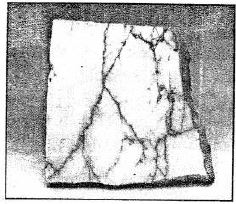
Question 1. Name the type of rock.
Answer: This rock is marble, which is a metamorphic rock that forms when limestone changes.
In simple words: The rock shown in the picture is marble, which is used for building and sculpture.
Exam Tip: Remember that marble is a metamorphic rock, which originates from the sedimentary rock limestone.
Question 2. How is it formed ?
Answer: It forms when limestone, a sedimentary rock made from accumulated sediments, is altered. Under intense heat and pressure deep underground, the mineral structure changes and recrystallizes into marble.
In simple words: When sedimentary limestone is heated and squeezed deep inside the Earth, it transforms into marble.
Exam Tip: Always describe the parent rock (limestone) and the agents of change (heat and pressure) when explaining the formation of metamorphic rocks.
Let's Do Something
Question. With the help of your teacher, collect different types of rocks such as granite, sandstone, limestone, marble, slate, graphite, etc. and prepare a chart containing information about their colour, hardness, texture, and permeability.
Answer: This is a practical activity to be done by the student.
In simple words: You should collect different rocks with your teacher and make a chart of their colors and textures.
Exam Tip: Active projects like rock collections help you identify rock textures and weights in real life.
Free study material for Geography
ICSE Voyage Solutions Class 7 Geography Chapter 7 Types Of Rocks
Students can now access the detailed Voyage Solutions for Chapter 7 Types Of Rocks on our portal. These solutions have been carefully prepared as per latest ICSE Class 7 syllabus. Each solution given above has been updated based on the current year pattern to ensure Class 7 students have the most updated Geography content.
Master Voyage Textbook Questions
Our subject experts have provided detailed explanations for all the questions found in the Voyage textbook for Class 7 Geography. We have focussed on making the concepts easy for you in Chapter 7 Types Of Rocks so that students can understand the concepts behind every answer. For all numerical problems and theoretical concepts these solutions will help in strengthening your analytical skill required for the ICSE examinations.
Complete Geography Exam Preparation
By using these Voyage Class 7 solutions, you can enhance your learning and identify areas that need more attention. We recommend solving the Geography Questions from the textbook first and then use our teacher-verified answers. For a proper revision of Chapter 7 Types Of Rocks, students should also also check our Revision Notes and Sample Papers available on studiestoday.com.
FAQs
You can download the verified Voyage solutions for Chapter 7 Types Of Rocks on StudiesToday.com. Our teachers have prepared answers for Class 7 Geography as per 2026-27 ICSE academic session.
Yes, our solutions for Chapter 7 Types Of Rocks are designed as per new 2026 ICSE standards. 40% competency-based questions required for Class 7, are included to help students understand application-based logic behind every Geography answer.
Yes, every exercise in Chapter 7 Types Of Rocks from the Voyage textbook has been solved step-by-step. Class 7 students will learn Geography conceots before their ICSE exams.
Yes, follow structured format of these Voyage solutions for Chapter 7 Types Of Rocks to get full 20% internal assessment marks and use Class 7 Geography projects and viva preparation as per ICSE 2026 guidelines.