

Here is the CBSE Class 11 Mathematics Permutations and Combinations Assignment Set 02 for your homework and practice. Download Class 11 Mathematics school assignments for the 2026-27 session, complete with answers for Chapter 6 Permutations And Combinations. These expert-curated exercises match current curriculum rules from NCERT, CBSE, and KVS.
Solved Assignment for Class 11 Mathematics Chapter 6 Permutations And Combinations
Check out these Class 11 Mathematics problems for daily practice to boost your school exam results. Designed as an ideal assessment tool for Chapter 6 Permutations And Combinations, these printable assignment sheets mix basic questions with advanced problems to secure your success.
Get Chapter 6 Permutations And Combinations Assignment PDF for Class 11 Mathematics
Question. A college offers 7 courses in the morning and 5 in the evening. The number of ways a student can select exactly one course, either in the morning or in the evening:
a. 27
b. 15
c. 12
d. 35
Answer : C
Question. The number of arrangement of the letters of the word “CALCUTTA”?
a. 2520
b. 5040
c. 10080
d. 40320
Answer : B
Question. How many words can be made from the letters of the word ‘COMMITTEE?’
a. 9!/(2!)2
b. 9!/(2!)3
c. 9!/2!
d. 9 !
Answer : B
Question. If eleven members of a committee sit at a round table so that the President and Secretary always sit together, then the number of arrangements is:
a. 10! × 2
b. 10!
c. 9! × 2
d. None of these
Answer : C
Question. If the letters of the word ‘KRISNA’ are arranged in all possible ways and these words are written out as in a dictionary, then the rank of the word ‘KRISNA’ is:
a. 324
b. 341
c. 359
d. None of these
Answer : A
Question. We are to form different words with the letters of the word ‘INTEGER’. Let 1 m be the number of words in which I and N are never together, and 2 m be the number of words which begin with I and end with R. Then 1 2 m /m is equal to:
a. 30
b. 60
c. 90
d. 180
Answer : A
Question. 20 persons are invited for a party. In how many different ways can they and the host be seated at a circular table, if the two particular persons are to be seated on either side of the host?
a. 20!
b. 2.18!
c. 18!
d. None of these
Answer : B
Question. The number of numbers that can be formed with the help of the digits 1, 2, 3, 4, 3, 2, 1 so that odd digits always occupy odd places, is:
a. 24
b. 18
c. 12
d. 30
Answer : B
Question. How many numbers can be made with the help of the digits 0, 1, 2, 3, 4, 5 which are greater than 3000: (repetition is not allowed)
a. 180
b. 360
c. 1380
d. 1500
Answer : C
Question. m men and n women are to be seated in a row, so that no two women sit together. If m > n , then the number of ways in which they can be seated is:
a. m!(m + 1)! / (m - n + 1)!
b. m!(m - 1)! / (m - n + 1)!
c. (m - 1)!(m + 1)! / (m - n + 1)!
d. None of these
Answer : A
Question. In a monthly test, the teacher decides that there will be three questions, one from each of exercise 7, 8 and 9 of the text book. If there are 12 questions in exercise 7, 18 in exercise 8 and 9 in exercise 9, in how many ways can three questions be selected?
a. 1944
b. 1499
c. 4991
d. None of these
Answer : A
Question. An n digit number is a positive number with exactly n digits. Nine hundred distinct n-digit numbers are to be formed using only the three digits 2, 5 and 7. The smallest value of n for which this is possible is:
a. 6
b. 7
c. 8
d. 9
Answer : B
Question. The number of ways in which 5 male and 2 female members of a committee can be seated around a round table so that the two female are not seated together is:
a. 480
b. 600
c. 720
d. 840
Answer : A
Question. The number of ways that 8 beads of different colours be string as a necklace is:
a. 2520
b. 2880
c. 5040
d. 4320
Answer : A
Question. In how many ways 7 men and 7 women can be seated around a round table such that no two women can sit together:
a. (7!)2
b. 7!×6!
c. (6!)2
d. 7!
Answer : B
Question. In how many ways a team of 10 players out of 22 players can be made if 6 particular players are always to be included and 4 particular players are always excluded:
a. 22C10
b. 18C3
c. 12C4
d. 18C4
Answer : C
Question. If 15C3r = 15Cr+3, then the value of r is:
a. 3
b. 4
c. 5
d. 8
Answer :
Question. nCr / nCr-1 = ?
a. n - r / r
b. n + r - 1 / r
c. n - r - 1 / r
d. n - r - 1 / r
Answer : C
Question. In how many ways can a girl and a boy be selected from a group of 15 boys and 8 girls?
a. 15 x 8
b. 15 + 8
c. 23P2
d. 23C2
Answer : A
Question. There are 10 lamps in a hall. Each one of them can be switched on independently. The number of ways in which the hall can be illuminated is?
a. 102
b. 1023
c. 210
d. 10!
Answer : B
Question. In how many ways can 5 boys and 5 girls sit in a circle so that no two boys sit together?
a. 5!×5!
b. 4!× 5!
c. 5 ! x 5 ! / 2
d. None of these
Answer : B
Question. In how many ways can 15 members of a council sit along a circular table, when the Secretary is to sit on one side of the Chairman and the Deputy Secretary on the other side?
a. 2×12!
b. 24
c. 2×15!
d. None of these
Answer : A
Question. If n+1C3 = 2nC2, then n = ?
a. 3
b. 4
c. 5
d. 6
Answer : C
Question. The number of ways in which 5 beads of different colours form a necklace is:
a. 12
b. 24
c. 120
d. 60
Answer : A
Question. The number of ways in which 9 persons can be divided into three equal groups is:
a. 1680
b. 840
c. 560
d. 280
Answer : D
Question. A man has 7 friends. In how many ways he can invite one or more of them for a tea party:
a. 128
b. 256
c. 127
d. 130
Answer : C
Question. In a city no two persons have identical set of teeth and there is no person without a tooth. Also no person has more than 32 teeth. If we disregard the shape and size of tooth and consider only the positioning of the teeth, then the maximum population of the city is:
a. 232
b. (32)2 −1
c. 232 − 1
d. 232−1
Answer : C
Question. If : 2nC3 , nC2 = 44 : 3, then for which of the following values of r , the value of nCr will be 15?
a. r = 3
b. r = 4
c. r = 6
d. r = 5
Answer : B
Question. If n2-nC2 = n2-nC10 then n = ?
a. 12
b. 4 only
c. −3 only
d. 4 or −3
Answer : D
Question. Numbers greater than 1000 but not greater than 4000 which can be formed with the digits 0, 1, 2, 3, 4 (repetition of digits is allowed), are:
a. 350
b. 375
c. 450
d. 576
Answer : B
Question. In the 13 cricket players 4 are bowlers, then how many ways can form a cricket team of 11 players in which at least 2 bowlers included:
a. 55
b. 72
c. 78
d. None of these
Answer : C
Question. If 8Cr = 8Cr+2 , then the value of C2 is:
a. 8
b. 3
c. 5
d. 2
Answer : B
Question. In how many ways can 5 prizes be distributed among four students when every student can take one or more prizes?
a. 1024
b. 625
c. 120
d. 60
Answer : A
Question. In an examination there are three multiple choice questions and each question has 4 choices. Number of ways in which a student can fail to get all answers correct, is:
a. 11
b. 12
c. 27
d. 63
Answer : D
Question. In an election there are 8 candidates, out of which 5 are to be choosen. If a voter may vote for any number of candidates but not greater than the number to be choosen, then in how many ways can a voter vote:
a. 216
b. 114
c. 218
d. None of these
Answer : C
Question. In a touring cricket team there are 16 players in all including 5 bowlers and 2 wicket-keepers. How many teams of 11 players from these, can be chosen, so as to include three bowlers and one wicket-keeper:
a. 650
b. 720
c. 750
d. 800
Answer : B
Question. If 10Cr = 10C3r+2 , then 5Cr equals ?
a. 120
b. 10
c. 360
d. 5
Answer : D
Question. If , nC3 + nC4 > n+1C3 then:
a. n > 6
b. n > 7
c. n < 6
d .None of these
Answer : A
Question. In a conference of 8 persons, if each person shake hand with the other one only, then the total number of shake hands shall be:
a. 64
b. 56
c. 49
d. 28
Answer : D
Question. If n and r are two positive integers such that n ≥ r, then nCr−1 + nCr = ?
a. nCn-r
b. nCr
c. n-1Cr
d. n+1Cr
Answer : D
Question. In how many ways a team of 11 players can be formed out of 25 players, if 6 out of them are always to be included and 5 are always to be excluded:
a. 2020
b. 2002
c. 2008
d. 8002
Answer : B
Question. Out of 10 white, 9 black and 7 red balls, the number of ways in which selection of one or more balls can be made, is:
a. 881
b. 891
c. 879
d. 892
Answer : C
Question. There are four balls of different colours and four boxes of colurs same as those of the balls. The number of ways in which the balls, one in each box, could be placed such that a ball doesn't go to box of its own colour is:
a. 8
b. 7
c. 9
d. None of these
Answer : C
Question. To fill 12 vacancies there are 25 candidates of which five are from scheduled caste. If 3 of the vacancies are reserved for scheduled caste candidates while the rest are open to all, then the number of ways in which the selection can be made:
a. 5C3 x 22C9
b. 22C9 - 5C3
c. 22C3 + 5C3
d. None of these
Answer : A
Question. There are 9 chairs in a room on which 6 persons are to be seated, out of which one is guest with one specific chair. In how many ways they can sit:
a. 6720
b. 60480
c. 30
d. 346
Answer : A
Question. Everybody in a room shakes hand with everybody else. The total number of hand shakes is 66. The total number of persons in the room is:
a. 11
b. 12
c. 13
d. 14
Answer : B
Question. The least value of natural number n satisfying C(n, 5) + C(n, 6) > C(n + 1, 5) is:
a. 11
b. 10
c. 12
d. 13
Answer : A
Question. A father with 8 children takes them 3 at a time to the Zoological gardens, as often as he can without taking the same 3 children together more than once. The number of times he will go to the garden is:
a. 336
b. 112
c. 56
d. None of these
Answer : C
Question. In how many ways can 21 English and 19 Hindi books be placed in a row so that no two Hindi books are together?
a. 1540
b. 1450
c. 1504
d. 1405
Answer : A
Question. The number of ways in which 10 persons can go in two boats so that there may be 5 on each boat, supposing that two particular persons will not go in the same boat is
a. 1/2(10C5)
b. 2(8C4)
c. 1/2(8C5)
d. None of these
Answer : B
Question. The number of diagonals in a octagon will be:
a. 28
b. 20
c. 10
d. 16
Answer : B
Question. How many triangles can be formed by joining four points on a circle?
a. 4
b. 6
c. 8
d. 10
Answer : A
Question. The number of straight lines that can be formed by joining 20 points no three of which are in the same straight line except 4 of them which are in the same line:
a. 183
b. 186
c. 197
d. 185
Answer : D
Question. The number of straight lines joining 8 points on a circle is:
a. 8
b. 16
c. 24
d. 28
Answer : D
Question. In a plane there are 10 points out of which 4 are collinear, then the number of triangles that can be formed by joining these points are:
a. 60
b. 116
c. 120
d. None of these
Answer : B
Question. There are n straight lines in a plane, no two of which are parallel and no three pass through the same point. Their points of intersection are joined. Then the number of fresh lines thus obtained is:
a. n(n - 1)(n - 2) / 8
b. n(n - 1)(n - 2)(n - 3) / 6
c. n(n - 1)(n - 2)(n - 3) / 8
d. None of these
Answer : C
Question. In a plane there are 37 straight lines of which 13 pass through the point A and 11 pass through the point B. Besides no three lines pass through one point, no line passes through both points A and B and no two are parallel. Then the number of intersection points the lines have is equal to:
a. 535
b. 601
c. 728
d. None of these
Answer : A
Question. The straight lines I1 , I2 , I3 are parallel and lie in the same plane. A total number of m points are taken on I1 , n points on I2 , k points on I3. The maximum number of triangles formed with vertices at these points are:
a. m+n+kC3
b. m+n+kC3 − mC3 − nC3 − kC3
c. mC3 + nC3 + kC3
d. None of these
Answer : B
Question. Out of 18 points in a plane, no three are in the same straight line except five points which are collinear. The number of:
(i) Straight lines
a. 140
b. 142
c. 144
d. 146
Answer : C
Question. How many triangles can be drawn by means of 9 noncollinear points?
a. 84
b. 72
c. 144
d. 126
Answer : A
Question. There are 16 points in a plane, no three of which are in a straight line except 8 which are all in a straight line. The number of triangles that can be formed by joining them equals:
a. 504
b. 552
c. 560
d. 1120
Answer : A
(ii) Triangles which can be formed by joining them
a. 816
b. 806
c. 800
d. 750
Answer : D
Question. Six points in a plane be joined in all possible ways by indefinite straight lines, and if no two of them be coincident or parallel, and no three pass through the same point (with the exception of the original 6 points). The number of distinct points of intersection is equal to:
a. 105
b. 45
c. 51
d. None of these
Answer : C
Question. A student is allowed to select utmost n books from a collection of (2n +1) books. If the total number of ways in which he can select one book is 63, then the value of n is:
a. 2
b. 3
c. 4
d. None of these
Answer : B
Comprehension Based
Different words are being formed by arranging the letters of the word “SUCCESS”. All the words obtained by written in the form of a dictionary.
Question. The number of words in which the consonants appear in alphabetic order is:
a. 42
b. 40
c. 420
d. 280
Answer : A
Question. The number of words in which the two C are together but no two S are together is:
a. 120
b. 96
c. 24
d. 420
Answer : C
Question. The rank of the word ‘SUCCESS’ in the dictionary is:
a. 328
b. 329
c. 330
d. 331
Answer : D
Question. The number of words in which no two C and no two S are together is:
a. 120
b. 96
c. 24
d. 420
Answer : B
Question. The number of words in which the relative positions of vowels and consonants unaltered is:
a. 20
b. 60
c. 180
d. 540
Answer : A
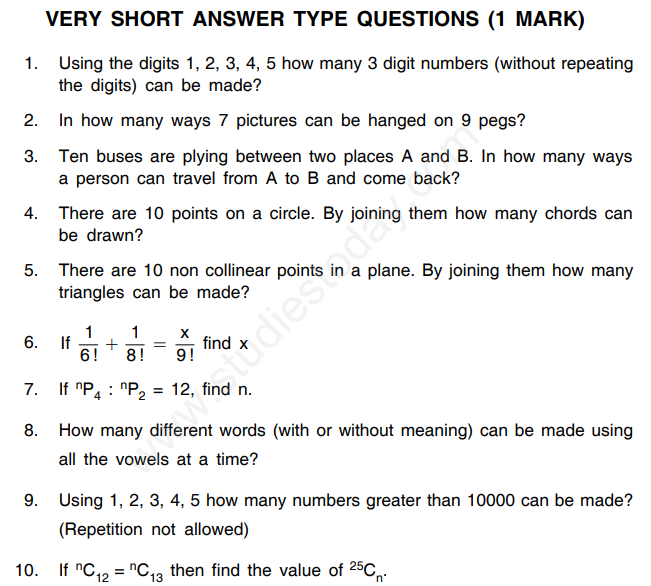
Free study material for Mathematics
CBSE Class 11 Mathematics Assignments for Chapter 6 Permutations And Combinations
Chapter Practice Questions for Class 11 Mathematics
Explore active Chapter 6 Permutations And Combinations assignments structured according to the latest CBSE guidelines for Class 11. These sets feature diverse problems ranging from MCQs, short answer questions, and long-form problems focused on Chapter 6 Permutations And Combinations. Conveniently download them as a PDF format file at no cost. Designed by expert teachers following historical exam trends, these exercises ensure solid preparation for school tests.
Why Practice Class 11 Mathematics Assignments?
- Academic Growth: Consistent revision of Chapter 6 Permutations And Combinations ensures deep comprehension and accurate responses during tests.
- Syllabus Compliance: Questions strictly follow current CBSE sample papers and official marking frameworks.
- Diverse Question Types: Each Chapter 6 Permutations And Combinations assignment integrates Case Studies, objective items, and descriptive problems with answers.
- Efficiency & Speed: Routine problem-solving on Chapter 6 Permutations And Combinations sets builds critical speed and calculation precision.
Maximizing Results from Class 11 Mathematics Practice Sets
- Read the Chapter First: Start with the NCERT book for Class 11 Mathematics before attempting the assignment.
- Self-Assessment: Try solving the Chapter 6 Permutations And Combinations questions by yourself and then check the solutions provided by us.
- Use Supporting Material: Refer to our Revision Notes and Class 11 worksheets if you get stuck on any topic.
- Track Mistakes: Maintain a notebook for tricky concepts and revise them using our online MCQ tests.
Daily Study Guidelines for Class 11 Mathematics
To achieve top academic results, commit to completing one assignment for Chapter 6 Permutations And Combinations each day. Practicing with a strict timer enhances your execution speed and prepares you effectively for real CBSE testing conditions.
FAQs
You can download free PDF assignments for Class 11 Mathematics Chapter 6 Permutations And Combinations from StudiesToday.com. These practice sheets have been updated for the 2026-27 session covering all concepts from latest NCERT textbook.
Yes, our teachers have given solutions for all questions in the Class 11 Mathematics Chapter 6 Permutations And Combinations assignments. This will help you to understand step-by-step methodology to get full marks in school tests and exams.
Yes. These assignments are designed as per the latest CBSE syllabus for 2026. We have included huge variety of question formats such as MCQs, Case-study based questions and important diagram-based problems found in Chapter 6 Permutations And Combinations.
Practicing topicw wise assignments will help Class 11 students understand every sub-topic of Chapter 6 Permutations And Combinations. Daily practice will improve speed, accuracy and answering competency-based questions.
Yes, all printable assignments for Class 11 Mathematics Chapter 6 Permutations And Combinations are available for free download in mobile-friendly PDF format.