

Read and download the CBSE Class 11 Physics Work Energy Power Basic Problems. Designed for 2026-27, this advanced study material provides Class 11 Physics students with detailed revision notes, sure-shot questions, and detailed answers. Prepared by expert teachers and they follow the latest CBSE, NCERT, and KVS guidelines to ensure you get best scores.
Advanced Study Material for Class 11 Physics Chapter 5 Work Energy and Power
To achieve a high score in Physics, students must go beyond standard textbooks. This Class 11 Chapter 5 Work Energy and Power study material includes conceptual summaries and solved practice questions to improve you understanding.
Class 11 Physics Chapter 5 Work Energy and Power Notes and Questions
BASIC LEVEL ASSIGNMENT
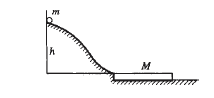
1. A small disc of mass m slides down a smooth hill of height h without initial velocity and gets onto a plank of mass M lying on the horizontal plane at the base of hill as shown in the figure. Due to friction between the disc and the plank, disc slows down and beginning with a certain moment, moves in one piece with the plank. Find out total work performed by the frictional forces in this process.
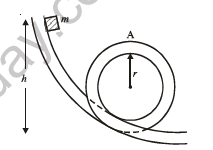
2. A block of mass m starts from rest to slide along a smooth frictionless track of the shape shown in the figure. What should be height h so that when the mass reaches point A on the track, it pushes the track with a force equal to thrice its weight ?
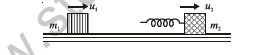
3. Two blocks of masses m1 = 2 kg and m2 = 5 kg are moving in the same direction along a frictionless surface with speeds 10 m/s and 3 m/s respectively, m2 being ahead of m1. An ideal spring with k = 1120 N/m is attached to the back side of m2. Find the maximum compression of the spring when the blocks collide.
4. An automobile of mass m accelerates, starting from rest, while the engine supplies constant power P ; show that :
(a) The velocity is given as a function of time by v = (2 Pt/m)1/2
(b) The position is given as a function of time by s = (8 P/9m)1/2 t3/2.
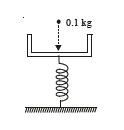
5. A massless platform is kept on a light elastic spring, as shown in the figure. When a sand particle of mass 0.1 kg is dropped on the pan from a height of 0.2 m, the particle strikes the pan and sticks to it while the spring compresses by 0.01 m. From what height should the particle be dropped to cause a compression of 0.04 m ?
6. A spring gun has spring constant 100 N/m. A small ball of mass 0.1 kg is put in its barrel by compressing the spring through 0.05 m as shown in the figure
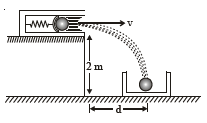
(a) Find the velocity of the ball when the spring acquires normal after length after being released.
(b) Where should a box be placed on the ground so that the ball falls in it, if the ball leaves the gun horizontally at a height of 2 m above the ground ? (g = 10 m/s2)
7. Two blocks are connected by a string as shown in the figure. They are released from rest. Show that after they have moved a distance L, their common speed is given by√2(m2-μm1)gL/(m1+m2)
where μ is the coefficient of friction between the floor and the blocks.
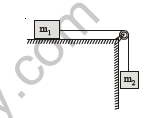
8. A particle of mass m is moving in a circular path of constant radius r such that its centripetal acceleration ac is varying with time t as ac = k2 rt2 when k is a constant. What is the power delivered to the particle by the forces acting on it ?
9. A stone with weight w is thrown vertically upward into the air with initial speed v0. If a constant force f due to air drag acts on the stone throughout its flight :
(a) Show that the maximum height reached by the stone is h = v2/2 g[1 +( f/w )]
(b) Show that the speed of the stone upon impact with the ground is v = v0(w-f/w+f)1/2
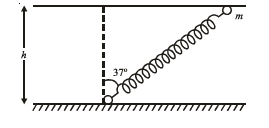
10. One end of a spring of natural length h is fixed at the ground and the other end is fitted with a smooth ring of mass m which is allowed to slide on a horizontal rod fixed at a height h as shown in figure. Initially, the spring makes an angle of 37º with the vertical when the system is released from rest. Find the speed of the ring when the spring becomes vertical.
Free study material for Physics
CBSE Class 11 Physics Chapter 5 Work Energy and Power Study Material
Students can find all the important study material for Chapter 5 Work Energy and Power on this page. This collection includes detailed notes, Mind Maps for quick revision, and Sure Shot Questions that will come in your CBSE exams. This material has been strictly prepared on the latest 2026 syllabus for Class 11 Physics. Our expert teachers always suggest you to use these tools daily to make your learning easier and faster.
Chapter 5 Work Energy and Power Expert Notes & Solved Exam Questions
Our teachers have used the latest official NCERT book for Class 11 Physics to prepare these study material. We have included previous year examination questions and also step-by-step solutions to help you understand the marking scheme too. After reading the above chapter notes and solved questions also solve the practice problems and then compare your work with our NCERT solutions for Class 11 Physics.
Complete Revision for Physics
To get the best marks in your Class 11 exams you should use Physics Sample Papers along with these chapter notes. Daily practicing with our online MCQ Tests for Chapter 5 Work Energy and Power will also help you improve your speed and accuracy. All the study material provided on studiestoday.com is free and updated regularly to help Class 11 students stay ahead in their studies and feel confident during their school tests.
FAQs
Our advanced study package for Chapter 5 Work Energy and Power includes detailed concepts, diagrams, Mind Maps, and explanation of complex topics to ensure Class 11 students learn as per syllabus for 2026 exams.
The Mind Maps provided for Chapter 5 Work Energy and Power act as visual anchors which will help faster recall during high-pressure exams.
Yes, teachers use our Class 11 Physics resources for lesson planning as they are in simple language and have lot of solved examples.
Yes, You can download the complete, mobile-friendly PDF of the Physics Chapter 5 Work Energy and Power advanced resources for free.
Yes, our subject matter experts have updated the Chapter 5 Work Energy and Power material to align with the rationalized NCERT textbooks and have removed deleted topics and added new competency-based questions.