

Official CBSE Study Materials for Class 12 Physics
Explore structured advanced study materials through the CBSE Class 12 Physics Interference of Light Solved Examples. Tailored for Class 12 learners, utilizing these Physics resources ensures thorough preparation and strengthens foundational knowledge before final CBSE evaluations.
Advanced Resources for Physics
Navigate directly to the advanced Physics study materials using the digital viewer below. Each resource pack includes detailed conceptual summaries and solved practice questions, allowing students to instantly reinforce their learning.
CBSE Class 12 Physics Interference of Light Solved Examples. Please refer to the examination notes which you can use for preparing and revising for exams. These notes will help you to revise the concepts quickly and get good marks.
Ex.1 Consider interference between waves from two sources of Intensites I & 4I. Find intensities at points where the phase difference is π.
(A) I (B) 5I (C) 4I (D) 3I
Sol. I = R2 = a1 2 + a2 2 + 2a1 a2 cos δ = I + 4I + 4I cos π I = 5I – 4I = I
Ex.2 The width of one of the two slits in a Young's double slit experiment is double of the other slit. Assuming that the amplitude of the light coming from a slit is proportional to slit-width. Find the ratio of the maximum to the minimum intensity in the interference pattern.
(A) 34 : 1 (B) 9 : 1 (C) 4 : 1 (D) 16 : 1
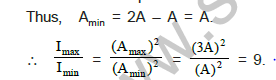
Sol. Suppose the amplitude of the light wave coming from the narrower slit is A and that coming from the wider slit is 2A. The maximum intensity occurs at a place where constructive interference takes place. Then the resultant amplitude is the sum of the individual amplitudes. Thus, Amax = 2A + A = 3A The minimum intensity occurs at a place where destructive interference takes place. The resultant amplitude is then difference of the individual amplitudes.
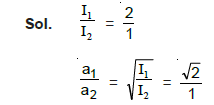
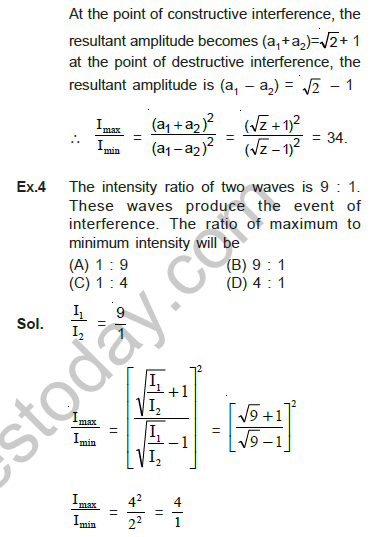
Ex.3 The intensity of the light coming from one of the slits in a young's double slit experiment is double the intensity from the other slit. Find the ratio of the maximum intensity to the minimum intensity in the interference fringe pattern observed.
(A) 9 : 1 (B) 34 : 1 (C) 4 : 1 (D) 16 : 1
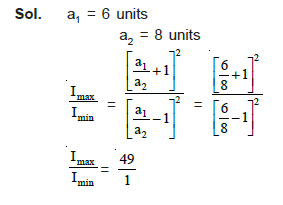
Ex. 5 The equation of two light waves are y1 = 6coswt, y2 = 8cos(wt + φ). The ratio of maximum to minimum intensities produced by the superposition of these waves will be
(A) 49 : 1 (B) 1 : 49 (C) 1 : 7 (D) 7 : 1
Ex. 6 In a Young's slit experiment, the separation between the slits is 0.10 mm, the wavelength of light used is 600 nm and the interference pattern is observed on a screen 1.0 m away.Find the separation between the successive bright fringes.
(A) 6.6 mm (B) 6.0 mm (C) 6 m (D) 6 cm.
Sol. The separation between the sucessive bright fringes is-
β =Dλ/d
β = 6.0 mm.
Ex. 7 Two waves originating from source S1 and S2 having zero phase difference and common wavelength λ will show completely destructive interference at a point P if (S1 P – S2 P) is- [MP PMT, 87]
(A) 5λ (B) 3λ/4 (C) 2λ (D) 11λ/2
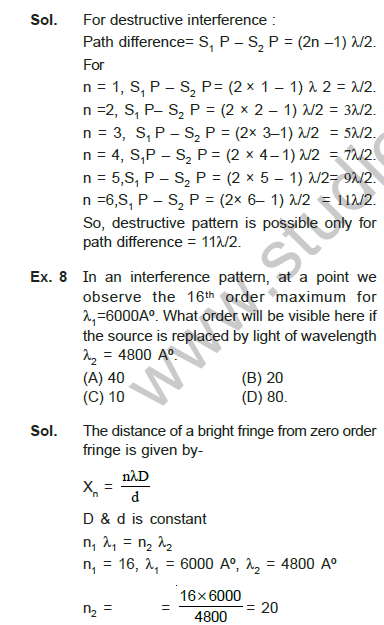
Ex. 9 In Young's experiment the wavelength of red light is 7.5 × 10⁻⁵ cm. and that of blue light 5.0 × 10⁻⁵ cm. The value of n for which (n + 1)th the blue bright band coincides with nth red band is-
(A) 8 (B) 4 (C) 2 (D) 1
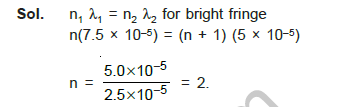
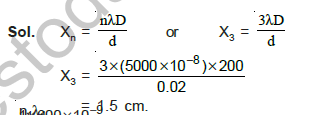
Ex. 10 In Young's double slit experiment, carried out with light of wavelength λ = 5000 Aº, the distance between the slits is 0.2 mm and the screen is at 200 cm from the slits. The central maximum is at x = 0. The third maximum will be at x equal to.
(A) 1.67 cm (B) 1.5 cm (C) 0.5 cm (D) 5.0 cm.
Ex. 11 Two slits separated by a distance of 1mm are illieminated with red light of wavelength 6.5 × 10⁻⁷ m. The interference fringes are observed on a screen placed 1m from the slits. The distance between third dark fringe & the fifth bright fringe is equal to.
(A) .65 mm (B) 1.63 mm (C) 3.25 mm (D) 4.87 mm.
Sol. β =λD/d = 3= 6.5 ×10-7 ×1
β = .65 × 10–3 m = .65 mm
The distance between fifth bright fringe from third dark fringe = 2.5 β=2.5×.65 = 1.63 mm.
Ex. 12 In an experiment the two slits are 0.5 mm apart and the fringes are observed to 100 cm from the plane of the slits. The distance of the 11th bright fringe from the Ist bright fringe is 9.72 mm. Calculate the wavelength.
(A) 4.85 × 10⁻⁵ cm (B) 4.85 × 10⁻⁵ m (C) 4.86 × 10⁻⁷ m (D) 4.86 × 10⁻⁵ cm
Please click on below link to download pdf file for CBSE Class 12 Physics Interference of Light Solved Examples
Free study material for Physics
Useful Resources and Notes for Class 12 Physics Interference of Light
Essential Notes for Class 12 Physics
Review targeted study resources for Interference of Light tailored for Class 12 learners. Utilizing these structured notes and quick-revision tools ensures complete alignment with current CBSE evaluation standards.
Verified Solutions for Class 12 Physics
Each resource draws directly from authorized textbooks to maintain academic accuracy. Evaluating solved examples allows Class 12 students to master the formal presentation and answer-writing standards expected in upcoming school exams.
Enhance Accuracy with Online Tests
Wrap up your chapter revision by testing your knowledge against standard objective question formats. Explore our full library of free, up-to-date sample papers and online assessments to secure top grades in your CBSE examinations.
FAQs
Our advanced study package for Interference of Light includes detailed concepts, diagrams, Mind Maps, and explanation of complex topics to ensure Class 12 students learn as per syllabus for 2026 exams.
The Mind Maps provided for Interference of Light act as visual anchors which will help faster recall during high-pressure exams.
Yes, teachers use our Class 12 Physics resources for lesson planning as they are in simple language and have lot of solved examples.
Yes, You can download the complete, mobile-friendly PDF of the Physics Interference of Light advanced resources for free.
Yes, our subject matter experts have updated the Interference of Light material to align with the rationalized NCERT textbooks and have removed deleted topics and added new competency-based questions.