

ICSE Solutions Selina Concise Class 6 Physics Chapter 3 Force have been provided below and is also available in Pdf for free download. The Selina Concise ICSE solutions for Class 6 Physics have been prepared as per the latest syllabus and ICSE books and examination pattern suggested in Class 6. Questions given in ICSE Selina Concise book for Class 6 Physics are an important part of exams for Class 6 Physics and if answered properly can help you to get higher marks. Refer to more Chapter-wise answers for ICSE Class 6 Physics and also download more latest study material for all subjects. Chapter 3 Force is an important topic in Class 6, please refer to answers provided below to help you score better in exams
Selina Concise Chapter 3 Force Class 6 Physics ICSE Solutions
Class 6 Physics students should refer to the following ICSE questions with answers for Chapter 3 Force in Class 6. These ICSE Solutions with answers for Class 6 Physics will come in exams and help you to score good marks
Chapter 3 Force Selina Concise ICSE Solutions Class 6 Physics
Synopsis
An object is at rest when it stays in the same place over time compared to a fixed object nearby.
An object is in motion when it keeps changing its position over time compared to a fixed object nearby.
A force is a push or pull. It can change whether an object is moving or staying still. It can also change how big or what shape an object is.
When you apply a force to an object, it can:
- start moving it if it is still,
- stop it if it is moving,
- make it go faster or slower,
- change the way it is moving,
- change its shape or size if it cannot move.
A force has both magnitude (how strong it is) and direction (where it is pointing).
If two forces pull or push in opposite directions, the total force is the difference between them. The object moves in the direction of the stronger force.
If two equal forces pull or push in opposite directions, they cancel each other out. The total force is zero.
There are two main types of forces:
- Contact forces (where things touch)
- Non-contact forces (where things act from a distance)
Examples of contact forces include:
- Muscle force (pushing or pulling with your body)
- Friction (the force that resists sliding)
- Normal reaction force (the push back from a surface)
- Tension (the pull in a tight string holding a weight)
Examples of non-contact forces include:
- Gravity (pulling objects down)
- Electrostatic force (static cling or attraction)
- Magnetic force (attraction or repulsion between magnets)
Weight is the gravitational pull of the Earth on an object.
Weight is measured in kilograms-force (kgf), not kilograms (kg), which is the unit of mass.
Friction is a force that slows down or stops movement. It always acts in the opposite direction of the motion.
Friction happens because tiny bumps on two touching surfaces lock into each other.
The amount of friction depends on:
- (a) how rough or smooth the touching surfaces are,
- (b) how heavy the sliding or rolling object is.
Friction does not change based on how much surface area is touching.
Some downsides of friction are:
- (a) It slows down movement.
- (b) It creates heat.
- (c) It causes parts to wear out.
- (d) It makes machines less efficient.
We can lower friction by:
- (a) making the surfaces smoother,
- (b) using lubricants like oil or grease,
- (c) using ball bearings,
- (d) shaping the moving object to be streamlined (aerodynamic).
Static friction is the highest force that keeps an object from starting to slide.
Sliding friction is the force needed to keep an object sliding at a steady speed.
Rolling friction is the force needed to keep an object rolling.
Rolling friction is weaker than sliding friction, and sliding friction is weaker than static friction.
Friction is helpful in nearly everything we do in daily life.
Test Yourself
A. Objective Questions
Question 1. Write true or false for each statement
(a) The frictional force acts in the direction of motion of body
(b) The unit of weight is kilogram
(c) A force can change the direction of motion of a moving body.
(d) A force increases the mass of the body when applied on it.
(e) The force of friction is always disadvantageous.
(f) The sliding friction is more than the rolling friction.
(g) Liquids offer more friction than the gases.
(h) A wet oily road offers more friction than a dry rough road.
Answer:
(a) False
(b) False
(c) True
(d) False
(e) False
(f) True
(g) True
(h) False
In simple words: This section checks if statements about forces and friction are correct or incorrect. For example, friction always resists movement, and sliding friction is higher than rolling friction.
Exam Tip: Remember that friction always acts in the opposite direction of motion, and rolling friction is always the lowest type of friction.
Question 2. Fill in the blanks
(a) Force is applied as ______ or ______.
(b) On squeezing a gum tube, its ______ changes.
(c) On pulling a string, its ______ increases.
(d) A moving football when kicked, its ______ of ______ changes.
(e) On applying brakes on a moving car, its speed ______ ______.
(f) We use ball bearings to ______ the friction.
(g) Friction ______ the motion.
(h) Lubricants are used to ______ friction.
(i) Friction causes ______ and ______ of moving parts of machine.
Answer:
(a) push, pull
(b) shape
(c) length
(d) direction, motion
(e) slows down
(f) reduce
(g) opposes
(h) reduce
(i) wear, tear
In simple words: Squeezing changes an object's shape, while pulling a string makes it longer. Friction slows things down, and we can use oil or ball bearings to make it weaker.
Exam Tip: Pay close attention to how everyday actions like braking or squeezing illustrate the effects of force and friction.
Question 3. Match the following columns
| Column A | Column B |
|---|---|
| (a) Non contact force | (i) repel |
| (b) Like poles | (ii) kg |
| (c) Contact force | (iii) Gravitational force |
| (d) Mass | (iv) wear and tear |
| (e) Weight | (v) force of friction |
| (f) Friction | (vi) kgf |
Answer:
| Column A | Column B |
|---|---|
| (a) Non contact force | (iii) Gravitational force |
| (b) Like poles | (i) repel |
| (c) Contact force | (v) force of friction |
| (d) Mass | (ii) kg |
| (e) Weight | (vi) kgf |
| (f) Friction | (iv) wear and tear |
In simple words: This matching pairs physical concepts with their units or examples. For instance, weight is measured in kgf while mass is measured in kg.
Exam Tip: Be careful not to confuse mass (measured in kg) with weight (measured in kgf or Newtons).
Question 4(a). A body falls downwards because of
(a) electrical force
(b) gravitational force
(c) mechanical force
(d) magnetic force
Answer: (b) gravitational force
In simple words: Earth pulls everything down toward its center using gravity. This is why things fall when you drop them.
Exam Tip: Gravity is a non-contact force that pulls all objects toward the Earth's center.
Question 4(b). A force does not change
(a) mass
(b) length
(c) shape
(d) state of motion
Answer: (a) mass
In simple words: The amount of matter in an object stays the same no matter how much you push or pull it. Force can only alter shape, size, or speed.
Exam Tip: Mass is an intrinsic property of a body and cannot be altered by applying an external force.
Question 4(c). A force to be expressed correctly requires
(a) only the magnitude
(b) only the direction
(c) both the magnitude and direction
(d) none of the options
Answer: (c) both the magnitude and direction
In simple words: To fully describe a force, you need to state how strong it is and which way it is pushing or pulling.
Exam Tip: Since force has both a value and a direction, it is classified as a vector quantity.
Question 4(d). Friction
(a) promotes motion
(b) opposes motion
(c) acts in the direction of motion
(d) is always a nuisance
Answer: (b) opposes motion
In simple words: Friction is a resistive force. It always acts in the opposite direction to stop or slow things down.
Exam Tip: Remember that friction acts parallel to the contact surfaces and directly resists the relative movement between them.
Question 4(e). Friction is reduced by
(a) making the surfaces wet
(b) making the surfaces dry
(c) making the surfaces rough
(d) sprinkling sand on the surface
Answer: (a) making the surfaces wet
In simple words: Adding water or oil fills the tiny rough gaps on a surface. This makes things slippery and reduces friction.
Exam Tip: Wetting a surface acts like a lubricant, which helps smooth out micro-irregularities and lowers resistance.
Question 4(f). Friction
(a) causes wear and tear
(b) produces heat
(c) stops a moving body
(d) has all of the options
Answer: (d) has all of the options
In simple words: Friction makes moving parts rub out, generates heat, and stops movement. These are all its major drawbacks.
Exam Tip: Be ready to list the negative aspects of friction, which include wearing out materials, energy loss as heat, and opposing motion.
Question 4(g). Friction is increased if
(a) an oil is sprayed
(b) the surfaces are made wet
(c) the surfaces are made dry
(d) the surfaces are polished
Answer: (c) the surfaces are made dry
In simple words: Dry surfaces have more interlocking bumps, which makes it harder for them to slide past each other.
Exam Tip: Moisture or oils act as lubricants to lower friction, so keeping surfaces completely dry will maximize friction.
B. Short/Long Answer Questions
Question 1. Name the term used for the push or pull ?
Answer: We use the word force to describe any push or pull on an object.
In simple words: A push or pull is called a force.
Exam Tip: Simply define force as a push or a pull acting upon an object.
Question 2. Give one example each of a force as
(i) a push
(ii) as pull
(iii) a stretch and
(iv) a squeeze.
Answer:
(i) A push - Pushing a heavy door to open it.
(ii) A pull - A gardener pulling a grass roller across the lawn.
(iii) A stretch - Pulling both ends of a rubber band to make it longer.
(iv) A squeeze - Pressing a soft sponge in your hand to change its shape.
In simple words: These are daily examples of how we use force. We push doors, pull carts, stretch rubber bands, and squeeze sponges.
Exam Tip: Use simple, everyday examples that clearly show the mechanical action being asked for in each sub-part.
Question 3. Explain the meaning of the term force.
Answer: A force is a push or pull that can make a still object move or stop a moving object. It can also change the speed, direction, or shape of a body. In the international system, the standard unit to measure force is called the Newton (N).
In simple words: Force is what makes things move, stop, or change shape. It is measured in Newtons.
Exam Tip: Always state both the definition (as a cause of motion or deformation) and its S.I. unit (Newton) to secure full marks.
Question 4. What effect can a force have on a stationary body ?
Answer: Applying force to a still object can make it start moving. For example, kicking a resting football makes it roll.
In simple words: A force can make a still object start to move.
Exam Tip: Clearly state that force initiates motion in an object that is at rest.
Question 5. What effects can a force have on a moving body ?
Answer: If you apply a force to an object that is already moving, you can make it stop. You can also make it go faster, make it go slower, or change the direction it is traveling.
In simple words: A force can stop a moving object, make it change direction, or alter its speed.
Exam Tip: Mention multiple effects such as changing speed (accelerating/decelerating) and changing the path of motion.
Question 6. What effect can a force produce on a body which is not allowed to move ?
Answer: If an object is fixed in place and cannot move, applying force will change its size or shape. This is called deformation, like when you press down on a lump of clay.
In simple words: If an object cannot move, a force will squeeze or stretch it out of shape.
Exam Tip: Remember to use the term "deformation" or "change in shape and size" when describing force acting on a fixed body.
Question 7. Give one example each to indicate that the application of a force
1. produces motion
2. stops motion
3. slows down motion
4. changes the direction of motion
5. deforms a body
Answer:
1. Starting motion - Pushing a toy car that is sitting still to make it roll.
2. Stopping motion - Catching a flying cricket ball to bring it to rest.
3. Slowing down motion - Pulling back slightly on a moving dog leash to slow the dog down.
4. Changing direction - Using a bat to hit an incoming ball in a different direction.
5. Deforming a body - Squeezing an empty plastic bottle so it collapses.
In simple words: These examples show how a force can start, stop, slow down, redirect, or reshape an object.
Exam Tip: Match each sub-part with a simple, distinct physical action that directly demonstrates the specific effect of the force.
Question 8. State the effect produced by a force in the following cases :
(a) The sling of a rubber catapult is stretched
(b) A man pushes a heavy cart
(c) A player uses his stick to deflect the ball .
(d) A cyclist applies brakes
(e) A spring is compressed.
Answer:
(a) The elastic band of the catapult grows longer, which changes its size and shape.
(b) The still cart starts to roll forward.
(c) The moving ball changes its path of travel.
(d) The moving bicycle slows down and eventually stops.
(e) The spring gets shorter and changes its shape.
In simple words: Forces act in different ways: stretching or compressing changes shape, pushing starts movement, deflecting changes direction, and braking slows things down.
Exam Tip: For each case, identify whether the force changes the state of motion (speed, direction) or the physical shape/size of the object.
Question 9. Name the two kinds of forces in nature.
Answer: The two primary categories of forces are contact forces and non-contact forces (which act from a distance).
In simple words: Forces can either touch things directly (contact) or act from a distance without touching (non-contact).
Exam Tip: Clearly state "contact forces" and "non-contact forces" as the two primary classifications.
Question 10. Name the type of force which acts in the following cases:
(a) A coolie lifts a luggage
(b) A bicycle comes to rest slowly when the cyclist stops pedalling
(c) A stone falls from a roof
(d) A comb rubbed with silk attracts the bits of paper
(e) A string hangs with a load
(f) A horse moves a cart
(g) A magnet attracts an iron pin
(h) A boy opens the door
(i) An apple falls from a tree
(j) A man rows a boat.
Answer:
(a) Muscle force (Muscular force)
(b) Friction (Frictional force)
(c) Gravity (Gravitational force)
(d) Static electric force (Electrostatic force)
(e) Pulling force (Tension)
(f) Muscle force (Muscular force)
(g) Magnetic force
(h) Muscle force (Muscular force)
(i) Gravity (Gravitational force)
(j) Muscle force (Muscular force)
In simple words: This list shows how different actions use either contact forces like muscles and friction, or non-contact forces like gravity, static electricity, and magnetism.
Exam Tip: Be ready to identify whether a force is contact (like muscular or friction) or non-contact (like magnetic or gravitational) based on the situation described.
Question 11. What do you mean by the gravitational force? Give an example to illustrate it.
Answer: Gravitational force is the invisible pull that the Earth exerts on every object to draw it toward its center. For example, when an apple falls off a tree branch, it drops straight to the ground because of this force.
In simple words: Gravity is the Earth's natural pull that makes things fall down to the ground instead of floating away.
Exam Tip: Define gravity as an attractive force and provide a clear, relatable example like a falling stone or fruit to illustrate it.
Question 12. Define the term “weight of a body”
Answer: The weight of an object is the measure of the gravitational pull acting on it towards the center of the Earth. This value changes depending on how strong the local gravity is.
In simple words: Weight is how hard gravity pulls down on an object.
Exam Tip: Do not confuse mass with weight. Weight is a force, so it is dependent on the local acceleration due to gravity.
Question 13. What do you understand by the term friction?
Answer: Friction is a resistive force that develops when two surfaces rub against each other. It always acts to oppose their relative movement.
In simple words: Friction is the force that fights against sliding, slowing down objects that rub together.
Exam Tip: Always emphasize that friction is an "opposing force" that acts at the contact boundary of two surfaces.
Question 14. Give an example to illustrate the existence of force of friction.
Answer: When you stop pedaling a bicycle, it does not roll forever. It slowly loses speed and eventually stops because of the friction acting between the rubber tires and the road surface.
In simple words: A rolling bike slows down and stops on its own when you stop pedaling because of friction from the ground.
Exam Tip: Use the classic bicycle coasting example or a rolling ball on the floor to explain how friction stops motion.
Question 15. What is the cause of friction?
Answer: All surfaces, even smooth ones, have tiny bumps and grooves. When two surfaces touch, these microscopic irregularities lock into one another, making it hard to slide them past each other.
In simple words: Friction happens because tiny bumps on surfaces get caught on each other when they rub together.
Exam Tip: Use keywords like "surface irregularities" or "interlocking of projections" to explain the microscopic cause of friction.
Question 16. State two factors which directly affect the force of friction.
Answer: The amount of friction depends on:
1. How rough or smooth the touching surfaces are.
2. The weight of the object that is sliding or rolling.
In simple words: Friction changes based on how rough the surfaces are and how heavy the object is.
Exam Tip: The main factors affecting friction are surface roughness and the normal force (weight), while surface area does not affect it.
Question 17. In which case will there be more friction between the truck and the road : when the truck is empty or when it is loaded ?
Answer: There will be significantly more friction when the truck is carrying a heavy load. A heavier truck presses down harder on the road, which makes the surface bumps lock together more tightly.
In simple words: A loaded truck has more friction because its extra weight presses it down harder onto the road.
Exam Tip: Explain that higher weight increases the normal force, causing deeper interlocking between the road and tires, which increases friction.
Question 18. Which offers more friction on a body : a glass surface or a wooden surface ?
Answer: A wooden surface creates much more friction than glass. Wood is naturally rougher and has many more tiny bumps, whereas glass is extremely smooth.
In simple words: Wood is rougher than glass, so it creates more friction.
Exam Tip: Rougher materials like wood offer greater friction compared to smooth materials like glass due to increased surface irregularities.
Question 19. Name the three kinds of friction.
Answer: The three main forms of friction are static friction, sliding friction, and rolling friction.
In simple words: Friction comes in three types: static (holding still), sliding (moving across), and rolling (spinning over a surface).
Exam Tip: List the three types in order of strength: static friction is the strongest, sliding friction is intermediate, and rolling friction is the weakest.
Question 20. List three disadvantages of friction.
Answer:
1. It produces heat which can damage the moving parts of a machine.
2. It causes wear and tear on touching surfaces, which shortens the life of tires, shoe soles, and machinery.
3. It wastes a lot of energy because extra effort is needed to overcome it before things can move.
In simple words: Friction can wear out our shoes, waste a lot of energy, and make machines too hot.
Exam Tip: Remember to explain both mechanical wear and wasted energy when listing the drawbacks of friction.
Question 21. When you apply the brakes, the bicycle stops and the rim of the wheel becomes hot. Explain the reason.
Answer: This happens because the brakes press against the outer edge of the wheel. The rubbing force, which is called friction, slows down the bicycle and creates heat that makes the metal rim feel hot.
In simple words: Rubbing the brakes against the spinning wheel creates friction, which stops the bike and generates heat.
Exam Tip: Ensure you mention that kinetic energy is converted into heat due to friction.
Question 22. The eraser gets smaller and smaller as you use it more and more. Explain the reason.
Answer: As you rub the eraser against paper, friction acts between them. This rubbing force slowly wears away small bits of the rubber, making the eraser shrink over time.
In simple words: Rubbing the eraser on paper creates friction, which scrapes off tiny pieces of rubber and makes it smaller.
Exam Tip: Highlight that friction always acts at the surface of contact, causing physical particles to wear away.
Question 23. List three ways of reducing friction.
Answer:
1. Placing small round ball bearings or wheels between moving parts, since rolling creates less resistance than sliding.
2. Using lubricants like oil, grease, or smooth powder to make the surfaces slippery.
3. Polishing rough surfaces so they become smooth.
4. Giving vehicles like planes and boats a streamlined shape so they slide easily through air or water.
In simple words: We can make things slide easier by using wheels, adding slippery oil, or making surfaces smooth.
Exam Tip: Lubricating, streamlining, and using ball bearings are highly-scored key terms for friction reduction.
Question 24. It is difficult to open an inkpot with greasy or oily hands. Explain.
Answer: When your hands are covered in oil, it acts as a slippery lubricant. This greatly lowers the friction between your skin and the cap, making it hard to get a firm grip to twist the lid open.
In simple words: Oil makes your hands too slippery to get a good grip on the cap.
Exam Tip: Lubricants reduce friction by filling the microscopic irregularities of the contacting surfaces.
Question 25. It is difficult to walk on a wet road. Explain.
Answer: Water on a rainy day acts as a slippery layer between your shoes and the ground. This reduces the friction, making the road slick and hard to walk on without slipping.
In simple words: Rainwater makes the ground very slippery by reducing the grip of your shoes.
Exam Tip: Examiners look for the term "friction is reduced" as the main cause of slippage.
Question 26. Give three examples to illustrate that friction is a necessary evil.
Answer:
1. Without friction, we would constantly slip and would not be able to walk.
2. We need friction to strike and light a matchstick.
3. It allows us to write on a blackboard using chalk.
In simple words: Friction is helpful because it lets us walk, write, and light matches, even though it also wears things out.
Exam Tip: The phrase "necessary evil" means friction is harmful but absolutely essential for everyday activities like walking.
Question 27. Define
1. static friction
2. sliding friction and
3. rolling friction
Answer:
1. Static friction: The highest rubbing force that keeps an object completely still on a surface.
2. Sliding friction: The constant force needed to keep an object sliding at a steady speed across a surface.
3. Rolling friction: The force that resists the motion of an object when it rolls over a surface.
In simple words: Static friction holds still objects in place, sliding friction acts when things slide, and rolling friction acts when things roll.
Exam Tip: Clearly distinguish that static friction is for stationary bodies, while sliding is for bodies in motion.
Question 28. Arrange the following in descending order :
1. static friction
2. sliding friction and
3. rolling friction?
Answer: Static friction is the strongest force, followed by sliding friction, while rolling friction is the weakest of the three.
Order: Static friction > Sliding friction > Rolling friction
In simple words: It is hardest to start moving a still object, easier to slide it, and easiest to roll it.
Exam Tip: Remember the order: Static > Sliding > Rolling. Rolling friction is always the easiest to overcome.
Question 29. A body needs a force F1 just to start motion on a surface, a force F2 to continue its motion and a force F3 to roll on the surface. What is
1. the static friction
2. sliding friction and
3. rolling friction ? State whether F2 is equal, less than or greater than (1) F1 and (2) F3.
Answer:
1. \( F_1 \) represents the force of static friction.
2. \( F_2 \) represents the force of sliding friction.
3. \( F_3 \) represents the force of rolling friction.
The force \( F_2 \) is smaller than \( F_1 \), but it is larger than \( F_3 \) (written as \( F_1 > F_2 > F_3 \)).
In simple words: \( F_1 \) is the start-up force, \( F_2 \) is the sliding force, and \( F_3 \) is the rolling force. Sliding force is less than starting force but more than rolling force.
Exam Tip: Keep the direction of inequality signs correct: \( F_1 > F_2 > F_3 \) representing Static > Sliding > Rolling.
Check in your Progress (Force)
Answer the following.
Question 1. What do you understand by a force ?
Answer: A force is a push or pull on an object that occurs when it interacts with another object.
In simple words: A force is just pushing or pulling something.
Exam Tip: Always define force as a push or a pull resulting from an interaction to score full marks.
Question 2. Define weight.
Answer: Weight is the downward gravitational pull acting on an object's mass.
In simple words: Weight is how hard gravity pulls down on an object.
Exam Tip: Never confuse mass with weight. Weight is a force, so its unit is the newton.
Exercises
A. Tick the most appropriate answer.
Question 1. Which of the following is not an effect of force ?
(a) Change in the direction of an object
(b) Change in the shape and size of an object
(c) Change in the mass of an object
(d) Change in the position of a stationary object.
Answer: (c) Change in the mass of an object
In simple words: Pushing or pulling an object can change how fast it goes, its shape, or its direction, but it cannot change how much matter is inside it.
Exam Tip: Remember, mass is an intrinsic property and cannot be altered by applying an external force.
Question 2. Which of the following is a contact force ?
(a) Gravitational force
(b) Frictional force
(c) Electrostatic force
(d) Magnetic force.
Answer: (b) Frictional force
In simple words: Friction is a contact force because two objects must physically touch each other for it to happen.
Exam Tip: Frictional force is a classic contact force because physical touching of surfaces is required.
B. Fill in the blanks.
Question 1. __________ is the SI unit of force.
Answer: Newton is the standard SI unit used to measure force.
In simple words: We measure force using a unit called the Newton.
Exam Tip: Always write the correct symbol "N" along with the unit "newton".
Question 2. Magnetic force is a __________ force.
Answer: Magnetic force is a non-contact force because magnets can pull or push without touching.
In simple words: Magnetic force works over a distance without any physical contact.
Exam Tip: Magnetic force is classified as non-contact because it acts through a magnetic field without touching.
Question 3. The force acting on a mango falling from a tree is an example of __________ force.
Answer: The pull acting on a mango falling from a tree is an example of gravitational force.
In simple words: Gravity is the invisible force that pulls a falling mango down to the ground.
Exam Tip: Any object falling freely under gravity is experiencing gravitational force.
C. Match the following.
Question. Match the items in Column A with Column B.
| Column A | Column B |
|---|---|
| 1. Non-contact forces | a. perpendicular to surface |
| 2. Catapult | b. an act of push or pull |
| 3. Force | c. unit of force |
| 4. Normal force | d. action-at-a-distance forces |
| 5. Newton | e. contact force |
Answer:
| Column A | Column B (Matched) |
|---|---|
| 1. Non-contact forces | d. action-at-a-distance forces |
| 2. Catapult | e. contact force |
| 3. Force | b. an act of push or pull |
| 4. Normal force | a. perpendicular to surface |
| 5. Newton | c. unit of force |
In simple words: This table links each science term to its correct definition, like pairing forces that touch with contact forces.Exam Tip: Crosscheck your matches by ensuring the unit matches the physical quantity correctly.
D. State if the following statements are true or false. Correct the statement if it is false.
Question 1. If two forces acting in opposite directions on a body are of equal magnitude, then the body will not move.
Answer: True.
In simple words: When two equal forces pull in opposite directions, they cancel out and the object stays still.
Exam Tip: Forces of equal magnitude acting in opposite directions are called balanced forces.
Question 2. Gravitational force is a contact force.
Answer: False. Gravitational force is a non-contact force.
In simple words: Gravity can pull objects without touching them, so it is a non-contact force.
Exam Tip: Always provide the correct justification if the statement is false to secure full marks.
Question 3. Like charges always attract each other.
Answer: False. Like charges always repel each other.
In simple words: Similar charges push each other away, while opposite charges pull together.
Exam Tip: Remember the basic rule of electrostatics: Like charges repel, unlike charges attract.
Question 4. It is possible that a force applied to an object may not bring any change in it.
Answer: True.
In simple words: If you push a heavy brick wall, it will not move, so your force caused no visible change.
Exam Tip: An applied force might only create internal stress or be balanced by friction without causing movement.
Question 5. Two equal and opposite forces acting on an object balance out each other.
Answer: True.
In simple words: Forces of the same size pulling opposite ways balance each other.
Exam Tip: Balanced forces result in a net force of zero, meaning there is no change in the object's motion.
Question 6. Force applied on an object can increase its mass.
Answer: False. Force applied on an object cannot increase its mass.
In simple words: Pushing or pulling an object will never make it contain more matter.
Exam Tip: Mass is constant and depends only on the matter in the object, regardless of external forces.
Question 7. Friction always acts in the direction of motion of an object.
Answer: False. Friction always acts in the direction opposite to the direction of motion of an object.
In simple words: Friction always tries to slow things down by acting against the direction they are moving.
Exam Tip: Friction is a resistive force that always opposes relative motion between surfaces.
E. Answer the following in a word or two or in a sentence.
Question 1. Give an example in which a force can change the direction of an object.
Answer: A force applied to steer the handle of a moving bicycle changes its direction.
In simple words: Turning the handlebars of a bike changes the way it is rolling.
Exam Tip: Any deflection example, such as hitting a cricket ball with a bat, is also correct.
Question 2. Which force is responsible for supporting the weight of a book placed on a table ?
Answer: The normal force (which is a contact force) supports the weight.
In simple words: The normal force of the table pushes upward to hold the book up.
Exam Tip: Specify that normal force acts perpendicular to the surface of the table.
Question 3. Which type of force acts on a string pulled from both ends ?
Answer: Tension (which is a contact force) acts on the string.
In simple words: Tension is the pulling force that travels along a tight string.
Exam Tip: Tension always acts along the length of the string, pulling away from the ends.
Question 4. Name the force that is responsible for the falling of a stone from a height to the ground.
Answer: Gravitational force.
In simple words: Gravity is what pulls a dropped stone down to the earth.
Exam Tip: Gravitational force is a non-contact force exerted by the Earth on all objects.
Question 5. What do you understand by magnetic force ?
Answer: Magnetic force is the pull or push that occurs between magnets, or between a magnet and a magnetic metal like iron.
In simple words: It is the invisible force that lets magnets attract or repel things.
Exam Tip: Mention that magnetic force is a non-contact force that can be both attractive and repulsive.
Question 6. Why does a rolling ball stop after moving some distance?
Answer: A rolling ball stops due to the force of friction acting between the ball and the ground, which resists its movement.
In simple words: Friction from the floor rubs against the rolling ball and slows it down until it stops.
Exam Tip: Remember to specify the surfaces involved - in this case, the surface of the ball and the ground.
F. Answer the following in short.
Question 1. Define force. Write its SI unit.
Answer: A force is a push or pull that acts on an object when it interacts with another object. The SI unit of force is the newton (N).
In simple words: Pushing or pulling something is a force, and we measure it in newtons.
Exam Tip: Include both parts of the definition (push/pull and interaction) and the SI unit symbol (N) for full marks.
Question 2. What will happen to an object if two equal forces act on it in opposite directions ?
Answer: If two forces of equal strength act on an object in opposite directions, they balance each other out, and the object does not move.
In simple words: When two equal forces pull against each other, the object stays completely still.
Exam Tip: Use the term "balanced forces" to describe this state where the net force is zero.
Question 3. What do you understand by normal force ?
Answer: A normal force is the upward supporting force that a surface exerts on an object resting on it. This force always acts perpendicular (at a right angle) to the surface. For example, a table pushes straight upward to balance a book's downward weight.
In simple words: It is the upward push from a surface that stops objects from falling through it.
Exam Tip: The word "normal" in physics means perpendicular - always state that this force acts at 90 degrees to the surface.
Question 4. Why does a charged balloon stick to a wall ?
Answer: A charged balloon sticks to a wall because of electrostatic force, which causes the opposite charges on the balloon and the wall to pull toward each other.
In simple words: Electric charges on the balloon and the wall attract each other, making the balloon stick.
Exam Tip: Clearly mention "electrostatic force" and "attraction between opposite charges" in your answer.
Question 5. Why is magnetic force considered as an action-at-a-distance force ?
Answer: Magnetic force is an action-at-a-distance force because a magnet can pull or push on objects (such as iron nails) without needing to touch them.
In simple words: Magnets can move things from a distance without physically touching them.
Exam Tip: Define "action-at-a-distance" by pointing out that physical contact is not required for the force to work.
G. Answer the following in detail.
Question 1. What are the various effects of force ? State one example of each.
Answer: A force can produce several different effects on objects:
1. Move a stationary object: Pulling a suitcase on its wheels to make it roll.
2. Stop a moving object: Friction stopping a rolling ball on a rough floor.
3. Change speed: Pushing a moving swing to make it go faster.
4. Change direction: Turning a bicycle's handlebars to change its path.
5. Change shape and size: Rolling a flat rolling pin over a ball of dough to make a flat chapati.
In simple words: Forces can start motion, stop motion, change how fast or which way something goes, and even change its shape.
Exam Tip: Use everyday examples like bicycle brakes or rolling dough to make your detailed answers easy to follow.
Question 2. Differentiate between contact and non-contact force. Support your answer with suitable examples.
Answer:
| Contact Forces | Non-Contact Forces |
|---|---|
| These forces require physical contact to act on an object. | These forces can act on an object without any physical contact. |
| They can be both natural forces or forces created by living beings. | They are always natural forces. |
| They cannot act from a distance. | They are capable of working across a distance. |
| Examples include applied force, tension, friction, and normal force. | Examples include magnetic force, electrostatic force, and gravitational force. |
| Examples: A player kicking a ball, a horse pulling a cart, or a book resting on a table. | Examples: A magnet attracting iron nails, an apple falling from a tree, or a charged balloon sticking to a wall. |
In simple words: Contact forces need physical touching to work, while non-contact forces can act from a distance without touching.
Exam Tip: Draw a neat, labeled table to present differences clearly for maximum marks.
Question 3. List all the forces acting on a boy sitting on a chair with the help of a suitable diagram.
Answer: Two opposite forces act on a boy sitting on a chair:
1. Gravitational force (\( F_{\text{grav}} \)): A non-contact force pulling the boy downward toward the earth.
2. Normal contact force (\( F_{\text{norm}} \)): A contact force from the chair pushing the boy upward.
These two equal forces balance each other perfectly, allowing the boy to remain still.
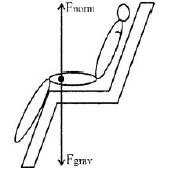
In simple words: Gravity pulls the sitting boy down, and the chair pushes him up with equal force, keeping him balanced.
Exam Tip: Ensure your free-body diagram has opposing force arrows of roughly equal lengths to show balance.
Question 4. Why do all objects have a tendency to fall towards the centre of the earth ?
Answer: The Earth possesses a powerful gravitational field. This gravitational force pulls all nearby objects directly toward the center of the Earth.
In simple words: The Earth is very heavy, so its gravity pulls everything toward its center.
Exam Tip: Always state that gravity acts towards the center of the earth, not just "downwards".
Question 5. Differentiate between mass and weight of an object.
Answer: Mass and weight represent different properties in science:
1. Mass is the measure of the total matter contained within an object, and it remains unchanged everywhere.
2. Weight is the force of gravitational pull acting on that mass, which can change depending on gravity. For instance, an astronaut weighs six times less on the moon than on Earth because the moon's gravity is much weaker, even though their body mass is exactly the same.
In simple words: Mass is how much stuff is in an object, which never changes. Weight is the pull of gravity on that stuff, which can change.
Exam Tip: Use the astronaut example to illustrate how weight changes on different celestial bodies while mass stays constant.
H. Identify the agent exerting the force, the object on which the force is acting and the effect of force in the following situations
Question 1. Squeezing out the juice from an orange.
Answer:
- Agent exerting the force: A person's hand (or a mechanical squeezer).
- Object on which the force is acting: The orange.
- Effect of the force: The orange changes shape as it is squeezed, and the juice is pushed out.
In simple words: Your hand squeezes the orange, which changes its shape to press the juice out.
Exam Tip: Break down the answer clearly into the three requested parts: agent, object, and effect.
Question 2. Taking out ointment from a medicinal tube.
Answer: Our fingers apply the force here. The force acts on the medicine tube. This force changes the shape of the tube. It also pushes the cream out.
In simple words: When you squeeze a tube, your fingers push it. This changes its shape and makes the cream come out.
Exam Tip: Always name three things: the thing pushing, the thing being pushed, and what the push does.
Question 3. A child jumping to a height.
Answer: The child's own muscles apply the force. The force acts on the child's own body. This force lifts the child up into the air from the ground.
In simple words: A child uses their own muscles to jump. This push moves their body upwards.
Exam Tip: Remember that our own muscles can act as the agent of force on our own body.
I. Solve the following numerical problems.
Question 1. Two horses pull a cart in the same direction with a force of 500 N each. Find the resultant force acting on the cart.
Answer: Since both horses pull the cart in the same way, we add their forces together. Resultant force = \( 500 \text{ N} + 500 \text{ N} = 1000 \text{ N} \). This total force of \( 1000 \text{ N} \) acts in that same direction.
In simple words: When forces work in the exact same direction, just add them up.
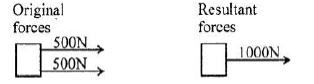
Exam Tip: Always mention the unit 'N' (Newton) and specify the direction of the final force.
Question 2. Two force of 12 N and 25 N act on a body to the left hand side, while another force of 35 N acts on it to the right hand side. Find the resultant of the forces.
Answer: First, find the total force pushing left: \( 12 \text{ N} + 25 \text{ N} = 37 \text{ N} \). The force pushing right is \( 35 \text{ N} \). Subtract these values to find the final force: \( 37 \text{ N} - 35 \text{ N} = 2 \text{ N} \). Since the left push is stronger, the body moves left with a force of \( 2 \text{ N} \).
In simple words: Add the forces going left, then subtract the force going right. The object moves in the direction of the stronger side

Exam Tip: Group forces going in the same direction first before subtracting the opposing force.
Question 3. Two persons are pushing a car with a force of 30 N and 70 N in opposite directions. Calculate the resultant force and its direction.
Answer: One force pushes with \( 30 \text{ N} \). The opposing force pushes with \( 70 \text{ N} \). Since they push against each other, subtract them: \( 70 \text{ N} - 30 \text{ N} = 40 \text{ N} \). The car moves toward the side where the stronger \( 70 \text{ N} \) force is pushing.
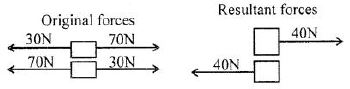
In simple words: Since two people push in opposite directions, subtract the smaller force from the larger one. The car moves the way the stronger person pushes.
Exam Tip: When two forces act in opposite directions, the resultant force is their difference.
Question 4. The forces acting on a wooden block are shown in the figure given alongside. Find the resultant of the forces and the direction of the resultant force.
Answer: First, find the total downward force: \( 2 \text{ N} + 22 \text{ N} = 24 \text{ N} \). Next, find the total upward force: \( 8 \text{ N} + 14 \text{ N} = 22 \text{ N} \). Find the difference between them: \( 24 \text{ N} - 22 \text{ N} = 2 \text{ N} \). The block moves downward because the downward force is greater.
In simple words: Combine the forces going up and those going down. Subtract the smaller sum from the larger one to find where the block moves
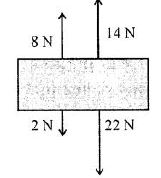
Exam Tip: For vertical forces, add all upward forces together and all downward forces together before comparing them.
Check Your Progress
Fill in the blanks.
Question 1. More the roughness of a surface, greater is the _______.
Answer: friction
In simple words: A rough surface makes it harder for things to slide.
Exam Tip: Roughness increases the interlocking of microscopic irregularities between two surfaces.
Question 2. Rolling friction offers _______ resistance than sliding friction.
Answer: less
In simple words: It is easier to roll an object than to drag it.
Exam Tip: Always remember that rolling resistance is much lower than sliding resistance.
Question 3. Weight remaining the same, friction is independent of _______ of surface in contact.
Answer: area
In simple words: The amount of contact area does not affect friction if the weight is constant.
Exam Tip: Friction depends on normal force and surface nature, not the contact area.
Question 4. The force of friction acting between two bodies in contact while at rest is known as _______ friction.
Answer: static
In simple words: Static friction stops things from starting to slide.
Exam Tip: Static friction adjusts itself to match the applied force up to a certain limit.
Question 5. Sliding friction and rolling friction are types of _______ friction.
Answer: kinetic
In simple words: Kinetic friction acts when objects are moving.
Exam Tip: Kinetic friction is also called dynamic friction and is active during relative motion.
Exercises
A. Tick the most appropriate answer.
Question 1. Force of friction comes into play when a/an
(a) object attempts motion
(b) moving object tries to stop
(c) object is at rest
(d) all of the options
Answer: (d) all of the options
In simple words: Friction is always present, whether things are still, trying to move, or stopping.
Exam Tip: Friction exists in static, limiting, and kinetic states.
Question 2. Friction always
(a) supports motion
(b) starts motion
(c) encourages motion
(d) opposes motion
Answer: (d) opposes motion
In simple words: Friction always works against the direction of movement.
Exam Tip: Remember that the force of friction acts in a direction opposite to the direction of motion.
Question 3. Friction is offered by
(a) solids
(b) liquids
(c) gases
(d) all of the options
Answer: (d) all of the options
In simple words: Everything - solids, liquids, and gases - can cause friction.
Exam Tip: Friction in fluids (liquids and gases) is specifically referred to as drag.
Question 4. A car skids on a wet or muddy road due to
(a) increased friction between the road and the tyres.
(b) lubrication of brakes on a wet road.
(c) reduced friction between the road and the tyres.
(d) streamlined shape of the car
Answer: (c) reduced friction between the road and the tyres.
In simple words: A wet road is slippery because there is less grip between the tyres and the ground.
Exam Tip: Water fills the tiny gaps on the road, lowering the friction level.
Question 5. Friction for an object can be reduced by
(a) providing wheels
(b) lubricating
(c) streamlining
(d) all of the options
Answer: (d) all of the options
In simple words: You can reduce rubbing by using wheels, adding oil, or using a smooth shape.
Exam Tip: Be ready to name all three methods of reducing friction in descriptive questions.
Question 6. Friction produces
(a) heat
(b) change of state
(c) electricity
(d) pressure
Answer: (a) heat
In simple words: When things rub against each other, they get warm.
Exam Tip: Rubbing hands in winter is a common daily-life example of friction creating heat.
Question 7. If you pour some oil onto a floor, the friction would
(a) increase
(b) decrease
(c) remain the same
(d) none of the options
Answer: (b) decrease
In simple words: Oil makes the floor very smooth, so there is much less rubbing.
Exam Tip: Lubricants like oil form a thin layer between surfaces to prevent direct contact.
B. Fill in the blanks.
Question 1. Rolling friction is _______ than sliding friction.
Answer: less
In simple words: Moving an object on wheels takes less force than sliding it.
Exam Tip: Rolling resistance is always less than sliding resistance.
Question 2. Smoother the surface, _______ is the frictional force offered by it.
Answer: lesser
In simple words: A smooth surface has very little rub.
Exam Tip: A smooth surface has fewer bumps to lock together, reducing friction.
Question 3. Friction depends upon the _______ of an object.
Answer: weight
In simple words: Heavier things rub harder against the ground.
Exam Tip: Greater weight increases the normal reaction force, which directly increases friction.
Question 4. Friction is a type of _______ force.
Answer: contact
In simple words: Friction only happens when two things are touching.
Exam Tip: Friction cannot act at a distance, making it a contact force.
Question 5. Bicycles use _______ to reduce friction between the pedals and the crank.
Answer: ball bearings
In simple words: Small round metal balls are used to help parts move smoothly.
Exam Tip: Ball bearings are crucial mechanical components that convert sliding to rolling.
C. State if the following statements are true or false. Correct the statement if it is false.
Question 1. Friction wears down the parts of machi
Answer: True
In simple words: Rubbing parts in a machine will slowly damage them over time.
Exam Tip: Wear and tear is a major disadvantage of friction in engineering.
Question 2. Friction has no relation with our walking or running.
Answer: False. Friction helps us with our walking or running.
In simple words: Without friction, we would slip and fall down every time we try to walk.
Exam Tip: Our feet push backwards against the ground, and friction provides the forward reaction force.
Question 3. Friction helps us to grip the objects in our hand.
Answer: True
In simple words: Friction allows us to hold things like pens or glasses without dropping them.
Exam Tip: Holding a glass depends on the static friction between your fingers and the glass surface.
Question 4. Tyres of vehicles are provided with grooved designs to decrease friction.
Answer: False. Tyres of vehicles are provided with grooved designs to increase friction.
In simple words: Tyres have deep patterns to help them hold the road better.
Exam Tip: Grooves allow water to escape, maintaining solid contact between rubber and road.
Question 5. Friction is offered by all the three states of matter.
Answer: True
In simple words: All three forms of matter - solids, liquids, and gases - can cause friction.
Exam Tip: Air resistance is a common example of gaseous friction.
D. Match the following.
| Column A | Column B (Correct Match) |
|---|---|
| 1. Rolling friction | d. wheels of a car |
| 2. Static friction | c. a book placed on a table top |
| 3. Reducing friction | b. regular oiling |
| 4. Increasing friction | a. making grooved designs |
In simple words: This table pairs different situations with the correct type or action of friction.
Exam Tip: Match the following sections are highly scoring; verify each pair individually.
E. Answer the following in a word or two or in a sentence.
Question 1. A child tries to slide a wooden block on the top of a table, but she is unable to get a smooth movement. What material do you suggest she should use in between the block and the table to get a smooth movement?
Answer: She can place round pencils under the block to act as rollers.
In simple words: Put round pencils under the wooden block to let it roll.
Exam Tip: Rollers convert sliding friction into rolling friction, which is much weaker.
Question 2. Why is difficult for a pen to leave a mark on a highly smooth plastic sheet?
Answer: A very smooth surface does not have enough friction to make the ink stick or the pen tip roll.
In simple words: The sheet is so slippery that the pen cannot grip it to write.
Exam Tip: Ink adhesion and ballpoint rotation both require a minimum level of friction.
Question 3. Name the force responsible for opposing the motion between two bodies in contact.
Answer: The opposing force is called friction.
In simple words: Friction is the force that stops things from moving easily when they touch.
Exam Tip: Friction always acts parallel to the contact surfaces in a direction opposing the relative motion.
Question 4. Name a method used to reduce friction.
Answer: Applying oil or lubricants is a great way to decrease friction.
In simple words: Put oil or grease on moving parts to make them slippery.
Exam Tip: Lubricants separate the moving surfaces, replacing solid-to-solid friction with much lower fluid-to-fluid friction.
F. Answer the following in short.
Question 1. When you push something heavy, the resistance you feel decreases as soon as the object starts moving. Explain the reason.
Answer: When an object is still, static friction acts on it. This static resistance is strongest right before the object begins to slide. Once it is in motion, kinetic friction takes over, which is weaker than maximum static friction. Therefore, you feel less resistance once movement starts.
In simple words: It is harder to start moving a heavy box than to keep it moving because starting friction is higher than sliding friction.
Exam Tip: The maximum value of static friction is called limiting friction, and it is always greater than kinetic friction.
Question 2. Define rolling friction and give an example where rolling. friction comes into play.
Answer: Rolling friction is the resistance that occurs when an object rolls over a surface. For example, pulling heavy suitcases on wheels involves rolling friction. The rolling wheels experience very little resistance, making it much easier to move the bag than dragging it.
In simple words: Rolling friction is the low rubbing force created when a round object rolls on a surface, like wheels on a suitcase.
Exam Tip: Remember that rolling friction is significantly less than sliding friction, which is why wheels are so useful.
Question 3. How can sliding friction be changed into rolling friction easily ?
Answer: We can convert sliding friction into rolling friction by adding wheels, rollers, or ball bearings. This allows parts to roll past one another rather than slide, leading to smoother and easier movement.
In simple words: Add wheels or round metal bearings to the object so it can roll instead of slide.
Exam Tip: Ball bearings are a classic industrial solution used to turn sliding contact into rolling contact.
Question 4. Why do wrestlers rub powder on their hands before getting into the ring ?
Answer: Wrestlers rub dry powder on their hands to absorb sweat. This makes their hands rougher and increases friction, giving them a better grip so they do not slip when holding an opponent.
In simple words: Powder dries up sweat and makes hands rougher so wrestlers can get a firm grip.
Exam Tip: Absorbing moisture and increasing surface roughness are direct ways to elevate friction.
Question 5. List the various states of matter that offer frictional force.
Answer: All three physical states - solids, liquids, and gases - produce friction when objects move against or through them.
In simple words: Frictional resistance can come from solid surfaces, liquids, and gases.
Exam Tip: Be sure to mention that gases (like air) and liquids (like water) offer friction, which is called fluid friction or drag.
G Answer the following in detail.
Question 1. Define friction and explain how it is useful to us.
Answer: Friction is the force that resists the relative movement of two contacting surfaces. Even though it opposes motion, it is necessary to make movement possible. Friction is highly useful in daily life because: 1. It allows us to walk safely on the ground without slipping and falling. 2. It helps vehicles like cars and buses travel safely by providing grip between tyres and the road. 3. It lets us hold onto things firmly with our hands. 4. It makes writing on paper with a pen or pencil possible. 5. It generates heat, such as when we rub our hands to stay warm in cold weather.
In simple words: Friction is the force that opposes rubbing. It is useful because it stops us from slipping, lets us hold things, and helps cars drive safely.
Exam Tip: Always describe friction as a "necessary evil" because it opposes motion but is essential for daily actions like walking and writing.
Question 2. Write the characteristics of the force of friction.
Answer: The main features of friction are: 1. It always acts in the opposite direction to the movement. 2. It depends on how rough or smooth the touching surfaces are. Rougher surfaces create more friction than smooth ones. 3. It depends on the weight of the object. Heavier objects experience more friction because they press down harder. 4. It does not depend on the size of the contact area, as long as the weight stays the same.
In simple words: Friction always works against movement, depends on how rough a surface is and how heavy an object is, but does not care about the size of the surface touching.
Exam Tip: Remember that friction does not change when the contact area changes, provided the normal force remains constant.
Question 3. How is friction harmful to us ? Write some ways by which one can reduce friction.
Answer: Harmful effects of friction: 1. It generates unwanted heat, which can damage the moving parts of machinery. 2. It causes wear and tear, shortening the lifespan of tires, shoe soles, and mechanical parts. 3. It wastes energy, as extra power is needed to overcome resistance before movement can start. Methods to decrease friction: 1. Use wheels, rollers, or ball bearings, because rolling friction is much weaker than sliding friction. 2. Apply lubricants like oil, grease, or graphite powder to make moving parts slippery. 3. Polish rough surfaces to make them smoother. 4. Streamline the bodies of vehicles, like airplanes and boats, to reduce drag through air and water.
In simple words: Friction is bad because it wastes energy, creates heat, and wears out machine parts. We can lower it using oil, wheels, or smooth shapes.
Exam Tip: Be prepared to list at least three disadvantages and three methods of reduction for five-mark questions.
Question 4. Describe three different ways by which friction can be increased to help us in various situations.
Answer: We can increase friction in the following ways: 1. Making vehicle tyres with grooved or treaded designs to improve road grip and stop them from slipping on wet streets. 2. Adding spikes or deep treads to the soles of sports shoes to give athletes a better grip on the ground. 3. Wrapping motorbike handles in bumpy, spiked rubber to help riders hold onto the handles securely.
In simple words: We can make friction higher by adding grooves to tyres, spikes to shoes, or rough rubber grips to handles.
Exam Tip: Mentioning "treading", "spiking", and "rubber grips" as key terms will earn full marks.
H. Give reasons for the following.
Question 1. Vehicles skid on muddy and wet roads. Suggest what type of tyres can prevent skidding of vehicles.
Answer: Vehicles slip on wet and muddy roads because water makes the surface very smooth, which lowers the friction on the tires. To stop this, vehicles should use heavily grooved or treaded tires. These rough patterns improve grip, allowing the vehicle to brake safely when needed.
In simple words: Mud and water make the road slippery. Using tyres with deep grooves helps them grip the road better so the car does not slip.
Exam Tip: A thin layer of water acts as a lubricant; deep tyre treads help disperse this water to restore contact.
Question 2. Boats and ships have streamlined shapes.
Answer: Water offers a lot of fluid resistance, which is called drag. Boats and ships are given narrow, streamlined shapes to cut through the water easily and minimize this resistance.
In simple words: Ships have a pointed, smooth shape to help them slice through water with less resistance.
Exam Tip: Streamlining is a structural design used specifically to minimize fluid drag in liquids and gases.
Question 3. Brake handles of motorcycles are generally covered with a towelled cloth.
Answer: A rough, towelled cloth cover absorbs sweat from the rider's hands and creates a rougher surface. This increases friction, giving the rider a firmer grip and better control over the brakes.
In simple words: Towel cloth absorbs sweat and makes the handles rougher so the rider's hands do not slip off the brakes.
Exam Tip: Towelled cloth increases friction by both raising surface roughness and removing moisture.
I. Solve the crossword puzzle.
| Direction & Number | Clue | Answer |
|---|---|---|
| Across 3 | The force of friction caused due to fluids | DRAG |
| Across 4 | Type of friction acting between two bodies at rest | STATIC |
| Across 5 | Type of friction which occurs when applied force overcomes static friction | KINETIC |
| Across 6 | A special body design to enable minimum drag | STREAMLINE |
| Down 1 | Type of force which depends upon the roughness of a surface | FRICTION |
| Down 2 | An effect of friction | HEAT |
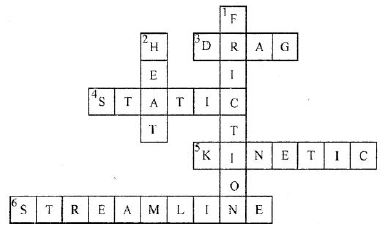
In simple words: This crossword puzzle covers key terms related to friction, fluid resistance, and motion.
Exam Tip: Memorizing these core vocabulary words is highly helpful for quick-answer questions in exams.
Free study material for Physics
ICSE Selina Concise Solutions Class 6 Physics Chapter 3 Force
Students can now access the detailed Selina Concise Solutions for Chapter 3 Force on our portal. These solutions have been carefully prepared as per latest ICSE Class 6 syllabus. Each solution given above has been updated based on the current year pattern to ensure Class 6 students have the most updated Physics content.
Master Selina Concise Textbook Questions
Our subject experts have provided detailed explanations for all the questions found in the Selina Concise textbook for Class 6 Physics. We have focussed on making the concepts easy for you in Chapter 3 Force so that students can understand the concepts behind every answer. For all numerical problems and theoretical concepts these solutions will help in strengthening your analytical skill required for the ICSE examinations.
Complete Physics Exam Preparation
By using these Selina Concise Class 6 solutions, you can enhance your learning and identify areas that need more attention. We recommend solving the Physics Questions from the textbook first and then use our teacher-verified answers. For a proper revision of Chapter 3 Force, students should also also check our Revision Notes and Sample Papers available on studiestoday.com.
FAQs
You can download the verified Selina Concise solutions for Chapter 3 Force on StudiesToday.com. Our teachers have prepared answers for Class 6 Physics as per 2026-27 ICSE academic session.
Yes, our solutions for Chapter 3 Force are designed as per new 2026 ICSE standards. 40% competency-based questions required for Class 6, are included to help students understand application-based logic behind every Physics answer.
Yes, every exercise in Chapter 3 Force from the Selina Concise textbook has been solved step-by-step. Class 6 students will learn Physics conceots before their ICSE exams.
Yes, follow structured format of these Selina Concise solutions for Chapter 3 Force to get full 20% internal assessment marks and use Class 6 Physics projects and viva preparation as per ICSE 2026 guidelines.