

ICSE Solutions Selina Concise Class 9 Mathematics Chapter 20 Area And Perimeter Of Plane Figures have been provided below and is also available in Pdf for free download. The Selina Concise ICSE solutions for Class 9 Mathematics have been prepared as per the latest syllabus and ICSE books and examination pattern suggested in Class 9. Questions given in ICSE Selina Concise book for Class 9 Mathematics are an important part of exams for Class 9 Mathematics and if answered properly can help you to get higher marks. Refer to more Chapter-wise answers for ICSE Class 9 Mathematics and also download more latest study material for all subjects. Chapter 20 Area And Perimeter Of Plane Figures is an important topic in Class 9, please refer to answers provided below to help you score better in exams
Selina Concise Chapter 20 Area And Perimeter Of Plane Figures Class 9 Mathematics ICSE Solutions
Class 9 Mathematics students should refer to the following ICSE questions with answers for Chapter 20 Area And Perimeter Of Plane Figures in Class 9. These ICSE Solutions with answers for Class 9 Mathematics will come in exams and help you to score good marks
Chapter 20 Area And Perimeter Of Plane Figures Selina Concise ICSE Solutions Class 9 Mathematics
Exercise 20(A)
Question 1. Find the area of a triangle whose sides are \( 18\text{ cm} \), \( 24\text{ cm} \), and \( 30\text{ cm} \). Also, find the length of the altitude corresponding to the largest side.
Answer: We are given the three side lengths of the triangle as \(18\text{ cm}\), \(24\text{ cm}\), and \(30\text{ cm}\).
The semi-perimeter \(s\) is computed as:
\[ s = \frac{18 + 24 + 30}{2} = 36\text{ cm} \]
Using Heron's formula, the area \(A\) is calculated as:
\[ A = \sqrt{s(s-a)(s-b)(s-c)} \]
\[ A = \sqrt{36(36-18)(36-24)(36-30)} \]
\[ A = \sqrt{36 \times 18 \times 12 \times 6} \]
\[ A = \sqrt{46656} \]
\[ A = 216\text{ cm}^2 \]
To find the altitude \(h\) corresponding to the longest side, we can also write the area as:
\[ A = \frac{1}{2} \times \text{base} \times \text{altitude} \]
Substituting the base of \(30\text{ cm}\) into this relation:
\[ 216 = \frac{1}{2} \times 30 \times h \]
\[ h = 14.4\text{ cm} \]
In simple words: First, we find half of the perimeter and use Heron's formula to get the area of the triangle. After that, we use the basic area formula with the longest side as the base to find the corresponding height.
Exam Tip: Remember to use the longest side as the base when finding the corresponding altitude, and always specify the correct units such as \(\text{cm}\) and \(\text{cm}^2\).
Question 2. The sides of a triangle are in the ratio \( 3 : 4 : 5 \). Find the area of the triangle if its perimeter is \( 144\text{ cm} \).
Answer: Let us represent the three sides of the triangle as:
\[ a = 3x \]
\[ b = 4x \]
\[ c = 5x \]
Since the total perimeter is \(144\text{ cm}\), we have:
\[ 3x + 4x + 5x = 144 \]
\[ 12x = 144 \implies x = 12 \]
Thus, the lengths of the sides are:
\[ a = 3(12) = 36\text{ cm} \]
\[ b = 4(12) = 48\text{ cm} \]
\[ c = 5(12) = 60\text{ cm} \]
The semi-perimeter \(s\) of the triangle is:
\[ s = \frac{a+b+c}{2} = \frac{144}{2} = 72\text{ cm} \]
Now, we can compute the area using Heron's formula:
\[ A = \sqrt{s(s-a)(s-b)(s-c)} \]
\[ A = \sqrt{72(72-36)(72-48)(72-60)} \]
\[ A = \sqrt{72 \times 36 \times 24 \times 12} \]
\[ A = \sqrt{746496} \]
\[ A = 864\text{ cm}^2 \]
In simple words: Find the exact side lengths using the ratio and the given perimeter. Then, use Heron's formula to calculate the total area of the triangle.
Exam Tip: Double check your subtraction when calculating \((s-a)\), \((s-b)\), and \((s-c)\) to avoid any arithmetic errors under the square root.
Question 3. ABC is a triangle in which \( AB = AC = 4\text{ cm} \) and \( \angle A = 90^\circ \). Calculate:
(i) the area of \( \Delta ABC \).
(ii) the length of the perpendicular from \( A \) to \( BC \).
Answer:
(i) For a right-angled isosceles triangle, the area can be written as:
\[ A = \frac{1}{2} \times AB \times AC \]
\[ A = \frac{1}{2} \times 4 \times 4 = 8\text{ cm}^2 \]
(ii) Using the Pythagoras theorem on right-angled \(\Delta ABC\), we find the hypotenuse \(BC\):
\[ BC = \sqrt{AB^2 + AC^2} = \sqrt{4^2 + 4^2} = \sqrt{32} \approx 5.66\text{ cm} \]
We can express the same area using \(BC\) as the base and \(h\) as the perpendicular height:
\[ A = \frac{1}{2} \times BC \times h \]
\[ 8 = \frac{1}{2} \times \sqrt{32} \times h \]
\[ h = \frac{16}{\sqrt{32}} \approx 2.83\text{ cm} \]
In simple words: Since the triangle is right-angled, its area is half the product of its perpendicular sides. To find the height from the right-angled vertex to the hypotenuse, use the hypotenuse as the base.
Exam Tip: When rounding off decimal values like \(2.83\text{ cm}\), show the intermediate square root values to indicate precise working.
Question 4. The area of an equilateral triangle is \( 36\sqrt{3}\text{ cm}^2 \). Find its perimeter.
Answer: The formula for the area of an equilateral triangle is:
\[ \frac{\sqrt{3}}{4} \times (\text{side})^2 = A \]
We substitute the given area of \(36\sqrt{3}\text{ cm}^2\) into this equation:
\[ \frac{\sqrt{3}}{4} \times (\text{side})^2 = 36\sqrt{3} \ ]
Canceling \(\sqrt{3}\) from both sides:
\[ (\text{side})^2 = 144 \implies \text{side} = 12\text{ cm} \]
Therefore, the perimeter is calculated by multiplying the side length by 3:
\[ \text{Perimeter} = 3 \times 12 = 36\text{ cm} \]
In simple words: Use the area formula of an equilateral triangle to find its side length. Then, multiply this side length by three to get the perimeter.
Exam Tip: Always cancel the \(\sqrt{3}\) term first from both sides of the equation to simplify the calculation of the side.
Question 5. Find the area of an isosceles triangle with a perimeter of \( 36\text{ cm} \) and a base of \( 16\text{ cm} \).
Answer: An isosceles triangle is given with a perimeter of \(36\text{ cm}\) and a base of \(16\text{ cm}\).
The sum of the two equal sides is the perimeter minus the base:
\[ \text{Length of each equal side } a = \frac{36 - 16}{2} = 10\text{ cm} \]
Let \(h\) be the height of the triangle. The altitude drawn from the vertex to the base divides the base into two equal halves perpendicularly. Applying Pythagoras Theorem:
\[ h = \sqrt{a^2 - \left(\frac{b}{2}\right)^2} = \sqrt{10^2 - 8^2} = \sqrt{100 - 64} = 6\text{ cm} \]
The area is given by:
\[ \text{Area} = \frac{1}{2} \times \text{base} \times \text{altitude} \]
\[ \text{Area} = \frac{1}{2} \times 16 \times 6 = 48\text{ cm}^2 \]
In simple words: Subtract the base from the perimeter and divide by 2 to find the equal sides. Find the height using the Pythagorean theorem, and then compute the area.
Exam Tip: Remember that the altitude of an isosceles triangle bisects the base. Using Pythagoras theorem is much faster than using Heron's formula here.
Question 6. Find the perimeter of an isosceles triangle whose base is \( 24\text{ cm} \) and area is \( 192\text{ cm}^2 \).
Answer: The area of the isosceles triangle is \(192\text{ cm}^2\) and its base \(b\) is \(24\text{ cm}\).
Let \(a\) represent the length of one of the equal sides. The area is given by the formula:
\[ A = \frac{1}{4} \times b \times \sqrt{4a^2 - b^2} \]
Plugging in the values:
\[ 192 = \frac{1}{4} \times 24 \times \sqrt{4a^2 - 24^2} \]
\[ 192 = 6 \times \sqrt{4a^2 - 576} \]
Dividing both sides by 6:
\[ 32 = \sqrt{4a^2 - 576} \]
Squaring both sides:
\[ 1024 = 4a^2 - 576 \]
\[ 4a^2 = 1600 \implies a^2 = 400 \implies a = 20\text{ cm} \]
Consequently, the perimeter is:
\[ \text{Perimeter} = 2a + b = 20 + 20 + 24 = 64\text{ cm} \ ]
In simple words: Use the area formula for an isosceles triangle to solve for the unknown side. Then add all three sides together to get the perimeter.
Exam Tip: When squaring both sides of the radical equation, ensure you square the entire number on the other side correctly (e.g., \(32^2 = 1024\)).
Question 7. The given figure shows a right-angled triangle ABC and an equilateral triangle BCD. Find the area of the shaded portion.
Answer: In the right-angled triangle \(ABC\), we find the perpendicular side \(AB\) using Pythagoras Theorem:
\[ AB = \sqrt{AC^2 - BC^2} = \sqrt{16^2 - 8^2} = \sqrt{256 - 64} = \sqrt{192} = 8\sqrt{3}\text{ cm} \ ]
The area of the right-angled triangle \(ABC\) is:
\[ \text{Area}(\Delta ABC) = \frac{1}{2} \times BC \times AB = \frac{1}{2} \times 8 \times \sqrt{192} = 4\sqrt{192} = 32\sqrt{3}\text{ cm}^2 \]
The area of the equilateral triangle \(BCD\) with side \(8\text{ cm}\) is:
\[ \text{Area}(\Delta BCD) = \frac{\sqrt{3}}{4} \times BC^2 = \frac{\sqrt{3}}{4} \times 8^2 = 16\sqrt{3}\text{ cm}^2 \]
The area of the shaded portion is the difference between these two areas:
\[ \text{Area}(\text{Shaded Portion}) = \text{Area}(\Delta ABC) - \text{Area}(\Delta BCD) \]
\[ \text{Area}(\text{Shaded Portion}) = 32\sqrt{3} - 16\sqrt{3} = 16\sqrt{3}\text{ cm}^2 \approx 27.71\text{ cm}^2 \]
In simple words: Find the perpendicular side of the right-angled triangle first. Then, subtract the area of the equilateral triangle from the right-angled triangle to find the remaining shaded area.
Exam Tip: Always keep your answers in terms of \(\sqrt{3}\) first, and then convert to decimals if required by the question, using \(\sqrt{3} \approx 1.732\).
Question 8. Find the area and the perimeter of quadrilateral ABCD, if AB = 8 cm, AD = 10 cm, BD = 12 cm, DC = 13 cm and \( \angle DBC = 90^\circ \).
Answer: In quadrilateral \(ABCD\), we have \(AB = 8\text{ cm}\), \(AD = 10\text{ cm}\), \(BD = 12\text{ cm}\), \(DC = 13\text{ cm}\), and \(\angle DBC = 90^\circ\).
In the right-angled triangle \(\Delta DBC\), we determine the length of the side \(BC\):
\[ BC = \sqrt{DC^2 - BD^2} = \sqrt{13^2 - 12^2} = \sqrt{169 - 144} = 5\text{ cm} \]
Now, we can compute the total perimeter of the quadrilateral:
\[ \text{Perimeter} = AB + AD + DC + BC = 8 + 10 + 13 + 5 = 36\text{ cm} \ ]
For \(\Delta ABD\), the sides are \(8\text{ cm}\), \(10\text{ cm}\), and \(12\text{ cm}\). The semi-perimeter is:
\[ s = \frac{8 + 10 + 12}{2} = 15\text{ cm} \ ]
Using Heron's formula, the area of \(\Delta ABD\) is:
\[ \text{Area}(\Delta ABD) = \sqrt{15(15-8)(15-10)(15-12)} = \sqrt{15 \times 7 \times 5 \times 3} = 15\sqrt{7} \approx 39.7\text{ cm}^2 \]
The area of the right-angled triangle \(\Delta DBC\) is:
\[ \text{Area}(\Delta DBC) = \frac{1}{2} \times BD \times BC = \frac{1}{2} \times 12 \times 5 = 30\text{ cm}^2 \]
The total area of quadrilateral \(ABCD\) is the sum of these two triangular areas:
\[ \text{Area}(ABCD) = \text{Area}(\Delta ABD) + \text{Area}(\Delta DBC) \approx 39.7 + 30 = 69.7\text{ cm}^2 \]
In simple words: Find the unknown side of the right triangle using Pythagoras' theorem. Use that side to find the perimeter, and sum the areas of the two triangles to get the total area.
Exam Tip: Dividing a complex quadrilateral into two simpler triangles is a key strategy for finding its area when a diagonal is given.
Question 9. The base of a triangular field is three times its height. If the cost of cultivating the field at Rs. 36.72 per \( 100\text{ m}^2 \) is Rs. 49,572; find its base and height.
Answer: The rate of cultivation is given as Rs. \(36.72\) per \(100\text{ m}^2\), and the total expenditure is Rs. \(49,572\).
We calculate the area of this triangular field as follows:
\[ \text{Area} = \frac{\text{Total Cost}}{\text{Rate}} \times 100 \]
\[ \text{Area} = \frac{49572}{36.72} \times 100 = 135,000\text{ m}^2 \]
Let us assume the height of the triangle is \(x\text{ m}\). This means the base of the triangle is \(3x\text{ m}\).
The area is expressed by the formula:
\[ \text{Area} = \frac{1}{2} \times \text{base} \times \text{height} \]
\[ 135,000 = \frac{1}{2} \times 3x \times x \]
\[ 270,000 = 3x^2 \]
\[ x^2 = 90,000 \implies x = 300\text{ m} \]
Therefore, the dimensions of the triangular field are:
\[ \text{Height} = 300\text{ m} \]
\[ \text{Base} = 3 \times 300 = 900\text{ m} \]
In simple words: Find the area of the field from the total cultivation cost and the rate. Then, use the relationship between the base and height to solve for their actual lengths.
Exam Tip: Be careful with the unit of rate: since the rate is per \(100\text{ m}^2\), you must multiply by 100 when calculating the area from the total cost.
Question 10. The sides of a triangular field are in the ratio \( 5 : 3 : 4 \) and its perimeter is \( 180\text{ m} \). Find:
(i) its area.
(ii) the altitude of the triangle corresponding to its largest side.
(iii) the cost of levelling the field at the rate of Rs. 10 per square metre.
Answer: Let the three sides of the triangle be \(5x\), \(3x\), and \(4x\).
We are given that the perimeter is \(180\text{ m}\):
\[ 5x + 3x + 4x = 180 \]
\[ 12x = 180 \implies x = 15 \]
This gives the side lengths as:
\[ a = 5(15) = 75\text{ m} \]
\[ b = 3(15) = 45\text{ m} \]
\[ c = 4(15) = 60\text{ m} \ ]
Since the sides \(45\text{ m}\), \(60\text{ m}\), and \(75\text{ m}\) form a Pythagorean triplet (\(45^2 + 60^2 = 75^2\)), the triangle is right-angled.
(i) The area of this right-angled triangle is:
\[ \text{Area} = \frac{1}{2} \times \text{base} \times \text{height} \]
\[ \text{Area} = \frac{1}{2} \times 45 \times 60 = 1350\text{ m}^2 \]
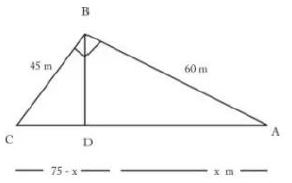
(ii) Now, we consider the altitude \(BD\) drawn to the hypotenuse \(AC = 75\text{ m}\).
Let \(AD = x\text{ m}\), which means \(CD = (75 - x)\text{ m}\).
Applying Pythagoras Theorem in right \(\Delta BCD\):
\[ BC^2 = CD^2 + BD^2 \]
\[ 45^2 = (75 - x)^2 + BD^2 \]
\[ BD^2 = 2025 - (5625 + x^2 - 150x) \]
\[ BD^2 = -3600 - x^2 + 150x \ ] - (1)
Applying Pythagoras Theorem in right \(\Delta ABD\):
\[ AB^2 = AD^2 + BD^2 \]
\[ 60^2 = x^2 + BD^2 \]
\[ BD^2 = 3600 - x^2 \ ] - (2)
Equating (1) and (2):
\[ -3600 - x^2 + 150x = 3600 - x^2 \]
\[ 150x = 7200 \implies x = 48\text{ m} \]
Therefore, \(AD = 48\text{ m}\) and \(CD = 75 - 48 = 27\text{ m}\).
Substituting the value of \(x\) in (2):
\[ BD^2 = 3600 - 48^2 = 3600 - 2304 = 1296 \]
\[ BD = 36\text{ m} \]
Thus, the altitude corresponding to the longest side is \(36\text{ m}\).
(iii) The cost of levelling the field at Rs. 10 per square metre is:
\[ \text{Cost} = 1350 \times 10 = \text{Rs. } 13,500 \]
In simple words: First, calculate the sides from the perimeter and ratio. Next, use the right-triangle properties to find the area and set up equations to find the altitude on the hypotenuse.
Exam Tip: Remember that altitude BD can be found directly using the formula \(BD = \frac{\text{base} \times \text{height}}{\text{hypotenuse}}\), which is a useful shortcut to verify your simultaneous equation result.
Question 11. Each of the equal sides of an isosceles triangle is \( 4\text{ cm} \) greater than its height. If the base of the triangle is \( 24\text{ cm} \); calculate the perimeter and the area of the triangle.
Answer: Let the altitude of the isosceles triangle be \(x\text{ cm}\).
Since each of the equal sides is \(4\text{ cm}\) longer than the height, they are represented as \((x + 4)\text{ cm}\).
The base of the triangle is \(24\text{ cm}\). The altitude from the vertex of an isosceles triangle divides the base into two equal segments of \(12\text{ cm}\) each.
Applying Pythagoras Theorem:
\[ (x + 4)^2 = x^2 + 12^2 \]
\[ x^2 + 8x + 16 = x^2 + 144 \]
\[ 8x = 128 \implies x = 16\text{ cm} \]
So, the height is \(16\text{ cm}\), and the length of each equal side is:
\[ a = 16 + 4 = 20\text{ cm} \ ]
Thus, the perimeter is:
\[ \text{Perimeter} = 20 + 20 + 24 = 64\text{ cm} \ ]
The area is computed as:
\[ \text{Area} = \frac{1}{2} \times \text{base} \times \text{height} = \frac{1}{2} \times 24 \times 16 = 192\text{ cm}^2 \]
In simple words: The height divides the isosceles triangle into two right-angled triangles. Use the Pythagorean theorem on one half to solve for the height, then find the perimeter and area.
Exam Tip: When applying Pythagoras theorem to an isosceles triangle, always remember to halve the base length first.
Question 12. Calculate the area and the height of an equilateral triangle whose perimeter is \( 60\text{ cm} \).
Answer: For an equilateral triangle with a perimeter of \(60\text{ cm}\), each side length is:
\[ \text{Side} = \frac{60}{3} = 20\text{ cm} \ ]
The area of this equilateral triangle is:
\[ A = \frac{\sqrt{3}}{4} \times (\text{side})^2 = \frac{\sqrt{3}}{4} \times 20^2 = 100\sqrt{3} \approx 173.2\text{ cm}^2 \]
Let \(h\) be the height of the triangle. The area is also given by:
\[ \text{Area} = \frac{1}{2} \times \text{base} \times h \]
\[ 173.2 = \frac{1}{2} \times 20 \times h \]
\[ h = 17.32\text{ cm} \]
In simple words: Divide the perimeter by 3 to find the side of the equilateral triangle. Use this side to find the area and height.
Exam Tip: The height of an equilateral triangle can also be directly found using \(h = \frac{\sqrt{3}}{2} \times \text{side}\). Double-check your result with this formula.
Question 13. In triangle ABC; angle A \( = 90^\circ \), side AB \( = x\text{ cm} \), AC \( = (x + 5)\text{ cm} \) and area \( = 150\text{ cm}^2 \). Find the sides of the triangle.
Answer: The area of the right-angled triangle is \(150\text{ cm}^2\).
Using the sides \(AB = x\text{ cm}\) and \(AC = (x + 5)\text{ cm}\):
\[ \text{Area} = \frac{1}{2} \times AB \times AC \]
\[ 150 = \frac{1}{2} \times x(x + 5) \]
\[ x(x + 5) = 300 \implies x^2 + 5x - 300 = 0 \]
Factoring the quadratic equation:
\[ (x + 20)(x - 15) = 0 \implies x = 15 \]
(Since side length cannot be negative, we discard \(x = -20\).)
Thus, the perpendicular sides are:
\[ AB = 15\text{ cm} \]
\[ AC = 15 + 5 = 20\text{ cm} \ ]
Using Pythagoras theorem, the hypotenuse \(BC\) is:
\[ BC = \sqrt{AB^2 + AC^2} = \sqrt{15^2 + 20^2} = \sqrt{225 + 400} = \sqrt{625} = 25\text{ cm} \ ]
In simple words: Set up a quadratic equation using the area formula, solve for the positive value of \(x\), and find the third side using the Pythagorean theorem.
Exam Tip: Always discard the negative root of a quadratic equation when solving for physical dimensions like side lengths.
Question 14. If the difference between the sides of a right-angled triangle is \( 3\text{ cm} \) and its area is \( 54\text{ cm}^2 \); find its perimeter.
Answer: Let the two perpendicular sides of the right-angled triangle be \(x\text{ cm}\) and \((x - 3)\text{ cm}\).
The area of the triangle is \(54\text{ cm}^2\):
\[ \text{Area} = \frac{1}{2} \times x \times (x - 3) \]
\[ 54 = \frac{1}{2} \times (x^2 - 3x) \implies x^2 - 3x - 108 = 0 \]
Solving the quadratic equation by splitting the middle term:
\[ (x - 12)(x + 9) = 0 \implies x = 12 \]
(discarding the negative value \(x = -9\))
This gives the side lengths as \(12\text{ cm}\) and \(9\text{ cm}\).
The hypotenuse is:
\[ \text{Hypotenuse} = \sqrt{12^2 + 9^2} = \sqrt{144 + 81} = \sqrt{225} = 15\text{ cm} \ ]
Hence, the perimeter of the triangle is:
\[ \text{Perimeter} = 12 + 9 + 15 = 36\text{ cm} \ ]
In simple words: Represent the two perpendicular sides using a variable, set up an area equation to find their lengths, and calculate the perimeter.
Exam Tip: Make sure to clearly state that the negative value of \(x\) is rejected because lengths must be positive.
Question 15. AD is the altitude of an isosceles triangle ABC in which AB = AC = \( 30\text{ cm} \) and BC = \( 36\text{ cm} \). A point O is marked on AD in such a way that \( \angle BOC = 90^\circ \). Find the area of quadrilateral ABOC.
Answer: The isosceles triangle \(ABC\) has \(AB = AC = 30\text{ cm}\) and base \(BC = 36\text{ cm}\).
Using the formula for the area of an isosceles triangle:
\[ \text{Area}(\Delta ABC) = \frac{1}{4} \times BC \times \sqrt{4AB^2 - BC^2} \]
\[ \text{Area}(\Delta ABC) = \frac{1}{4} \times 36 \times \sqrt{4(30^2) - 36^2} \]
\[ \text{Area}(\Delta ABC) = 9 \times \sqrt{3600 - 1296} = 9 \times \sqrt{2304} = 9 \times 48 = 432\text{ cm}^2 \]
Since \(AB = AC\), the altitude \(AD\) is the perpendicular bisector of \(BC\), so \(BD = CD = 18\text{ cm}\).
We are given \(\angle BOC = 90^\circ\). Since \(O\) lies on the altitude \(AD\) (which is also the line of symmetry), \(\Delta BOC\) is a right-angled isosceles triangle at \(O\).
Therefore, \(\angle OBD = \angle OCD = 45^\circ\), which implies:
\[ OD = BD = 18\text{ cm} \ ]
The area of \(\Delta BOC\) is:
\[ \text{Area}(\Delta BOC) = \frac{1}{2} \times BC \times OD = \frac{1}{2} \times 36 \times 18 = 324\text{ cm}^2 \]
The area of quadrilateral \(ABOC\) is found by subtracting the area of \(\Delta BOC\) from the area of \(\Delta ABC\):
\[ \text{Area}(ABOC) = \text{Area}(\Delta ABC) - \text{Area}(\Delta BOC) \]
\[ \text{Area}(ABOC) = 432 - 324 = 108\text{ cm}^2 \]
In simple words: Calculate the total area of the isosceles triangle. Then, use the properties of the right-angled triangle at the bottom to find its area, and subtract the two.
Exam Tip: Using symmetry of isosceles triangles is crucial to deducing that \(OD = BD = 18\text{ cm}\) quickly.
Exercise 20(B)
Question 1. Find the area of a quadrilateral in which the length of one diagonal is 30 cm and the perpendiculars drawn on it from the opposite vertices are 11 cm and 19 cm.
Answer: The area of a quadrilateral when a diagonal and the perpendiculars from the remaining vertices are given is calculated as:
\( \text{Area} = \frac{1}{2} \times \text{diagonal} \times (\text{sum of the perpendiculars}) \)
Substituting the given values into the formula:
\( \text{Area} = \frac{1}{2} \times 30 \times (11 + 19) \)
\( \implies \text{Area} = 15 \times 30 \)
\( \implies \text{Area} = 450\text{ sq. cm} \)
Thus, the area of the quadrilateral is 450 sq. cm.
In simple words: To find the area of this quadrilateral, multiply half of the diagonal length by the sum of both perpendicular heights.
Exam Tip: Always state the formula clearly before substituting the values to secure step-marks in your exam.
Question 2. Find the area of a quadrilateral whose diagonals are of lengths 16 cm and 13 cm and intersect each other at right angles.
Answer: When the diagonals of a quadrilateral are perpendicular, its area is calculated using the following relation:
\( \text{Area} = \frac{1}{2} \times \text{product of the diagonals} \)
Using the given lengths of the diagonals:
\( \text{Area} = \frac{1}{2} \times 16 \times 13 \)
\( \implies \text{Area} = 8 \times 13 \)
\( \implies \text{Area} = 104\text{ cm}^2 \)
Consequently, the area of the quadrilateral is 104 sq. cm.
In simple words: If the diagonals cross at right angles, you can find the area by multiplying the two diagonals together and then dividing by two.
Exam Tip: This formula is specifically applicable when diagonals are perpendicular to each other; make sure to mention this condition.
Question 3. Calculate the area of the quadrilateral ABCD shown in the given figure, where \(\angle B = 90^\circ\) in \(\triangle ABD\), AD = 26 cm, BD = 24 cm, and \(\triangle BCD\) is an equilateral triangle with side 24 cm.
Answer: From the right-angled triangle ABD, we can find the side AB using the Pythagorean theorem:
\( AB = \sqrt{AD^2 - BD^2} \)
\( \implies AB = \sqrt{26^2 - 24^2} \)
\( \implies AB = \sqrt{676 - 576} \)
\( \implies AB = \sqrt{100} = 10\text{ cm} \)
Now, the area of this right-angled triangle ABD is given by:
\( \text{Area}(\triangle ABD) = \frac{1}{2} \times AB \times BD \)
\( \implies \text{Area}(\triangle ABD) = \frac{1}{2} \times 10 \times 24 \)
\( \implies \text{Area}(\triangle ABD) = 120\text{ cm}^2 \)
Next, in the equilateral triangle BCD, let CP be the perpendicular drawn from C to BD. This height CP bisects BD, so:
\( BP = PD = 12\text{ cm} \)
In the right-angled triangle BPC:
\( PC = \sqrt{BC^2 - BP^2} \)
\( \implies PC = \sqrt{24^2 - 12^2} \)
\( \implies PC = \sqrt{576 - 144} \)
\( \implies PC = \sqrt{432} = 12\sqrt{3}\text{ cm} \)
The area of the triangle BCD is:
\( \text{Area}(\triangle BCD) = \frac{1}{2} \times BD \times PC \)
\( \implies \text{Area}(\triangle BCD) = \frac{1}{2} \times 24 \times 12\sqrt{3} \)
\( \implies \text{Area}(\triangle BCD) = 144\sqrt{3}\text{ cm}^2 \)
Using \( \sqrt{3} \approx 1.732 \):
\( \text{Area}(\triangle BCD) \approx 144 \times 1.732 = 249.41\text{ cm}^2 \)
Adding the areas of both triangles gives the total area of quadrilateral ABCD:
\( \text{Total Area} = \text{Area}(\triangle ABD) + \text{Area}(\triangle BCD) \)
\( \implies \text{Total Area} = 120 + 249.41 \)
\( \implies \text{Total Area} = 369.41\text{ cm}^2 \)
Thus, the total area of the shape is 369.41 sq. cm.
In simple words: This shape is made of two triangles. We find the area of the right-angled triangle and the equilateral triangle separately and then add them together to get the total area.
Exam Tip: Remember that the altitude of an equilateral triangle bisects its base, which allows you to use the Pythagorean theorem directly on either half.
Question 4. Find the area of the quadrilateral ABCD in which \(\angle A = 90^\circ\), AD = 24 cm, AB = 32 cm, and BC = CD = 52 cm.
Answer: First, since ABD is a right-angled triangle at A, we find its area:
\( \text{Area}(\triangle ABD) = \frac{1}{2} \times AB \times AD \)
\( \implies \text{Area}(\triangle ABD) = \frac{1}{2} \times 32 \times 24 \)
\( \implies \text{Area}(\triangle ABD) = 384\text{ cm}^2 \)
Now, we calculate the length of the diagonal BD using the Pythagorean theorem:
\( BD = \sqrt{AB^2 + AD^2} \)
\( \implies BD = \sqrt{32^2 + 24^2} \)
\( \implies BD = \sqrt{1024 + 576} \)
\( \implies BD = \sqrt{1600} = 40\text{ cm} \)
For the isosceles triangle BCD, the perpendicular CP from C to BD bisects BD at P. Therefore, we have:
\( DP = \frac{1}{2} \times BD = \frac{1}{2} \times 40 = 20\text{ cm} \)
In the right-angled triangle DPC, we use the Pythagorean theorem to find CP:
\( PC = \sqrt{CD^2 - DP^2} \)
\( \implies PC = \sqrt{52^2 - 20^2} \)
\( \implies PC = \sqrt{2704 - 400} \)
\( \implies PC = \sqrt{2304} = 48\text{ cm} \)
Now, we find the area of triangle BCD using BD as the base and PC as the height:
\( \text{Area}(\triangle BCD) = \frac{1}{2} \times BD \times PC \)
\( \implies \text{Area}(\triangle BCD) = \frac{1}{2} \times 40 \times 48 \)
\( \implies \text{Area}(\triangle BCD) = 960\text{ cm}^2 \)
Finally, we add the areas of both triangles to find the total area of the quadrilateral:
\( \text{Total Area} = \text{Area}(\triangle ABD) + \text{Area}(\triangle BCD) \)
\( \implies \text{Total Area} = 384 + 960 \)
\( \implies \text{Total Area} = 1344\text{ cm}^2 \)
Hence, the area of the quadrilateral is 1344 sq. cm.
In simple words: First find the area of the right triangle ABD and the diagonal BD. Then use BD to find the height of the isosceles triangle BCD, calculate its area, and add both areas together.
Exam Tip: Splitting the quadrilateral into two triangles is a very useful technique in mensuration; ensure you clearly label each part to avoid calculation errors.
Question 5. The length of a rectangular field is twice its width. If the perimeter of the field is \(\frac{3}{5}\) km, find its area in square metres.
Answer: Let the width of the rectangular field be \( x \) km. Therefore, its length is \( 2x \) km.
The perimeter of a rectangle is given by the formula:
\( \text{Perimeter} = 2 \times (\text{length} + \text{width}) \)
Using the given perimeter of \(\frac{3}{5}\) km:
\( 2 \times (2x + x) = \frac{3}{5} \)
\( \implies 2 \times (3x) = \frac{3}{5} \)
\( \implies 6x = \frac{3}{5} \)
\( \implies x = \frac{3}{30} = \frac{1}{10}\text{ km} \)
Converting the width into metres:
\( x = \frac{1}{10} \times 1000\text{ m} = 100\text{ m} \)
So, the width is 100 m, and the length of the field is:
\( \text{Length} = 2 \times 100 = 200\text{ m} \)
The area of the field is calculated as:
\( \text{Area} = \text{length} \times \text{width} \)
\( \implies \text{Area} = 200 \times 100 \)
\( \implies \text{Area} = 20000\text{ sq. m} \)
Therefore, the area of the rectangular field is 20,000 sq. m.
In simple words: If you know the perimeter in kilometres, convert it to metres first. Then set up an equation to find the width and length, and multiply them to get the area.
Exam Tip: Be careful with unit conversion; converting kilometres to metres early on prevents working with difficult fractions.
Question 6. A rectangular plot of land measures 85 m by 60 m. A path of uniform width 5 m is laid all around the inside of the plot. The remaining inner part is laid with grass. Find the area of the grassy lawn.
Answer: The dimensions of the outer rectangular plot are 85 m and 60 m.
Since a path of 5 m is laid inside along all sides, the dimensions of the inner grassy lawn are reduced by 5 m from both ends:
\( \text{Length of the grassy lawn} = 85 - 5 - 5 = 75\text{ m} \)
\( \text{Width of the grassy lawn} = 60 - 5 - 5 = 50\text{ m} \)
The area of the grassy lawn is calculated by multiplying these inner dimensions:
\( \text{Area} = \text{Length} \times \text{Width} \)
\( \implies \text{Area} = 75 \times 50 \)
\( \implies \text{Area} = 3750\text{ sq. m} \)
Thus, the area of the grassy lawn is 3750 sq. m.
In simple words: Since the path is inside the plot, subtract twice the path's width (5 m + 5 m = 10 m) from both the length and width to find the grass area.
Exam Tip: Always subtract twice the width of the path for an inner border because the path reduces the length and width from both ends.
Question 7. The length and breadth of a rectangle are 6 cm and 4 cm respectively. A triangle with a base of 6 cm has an area equal to three times the area of the rectangle. Find the height of the triangle.
Answer: First, find the area of the rectangle:
\( \text{Area of the rectangle} = \text{length} \times \text{breadth} \)
\( \implies \text{Area of the rectangle} = 6 \times 4 = 24\text{ sq. cm} \)
According to the given condition, the area of the triangle is three times this area:
\( \text{Area of the triangle} = 3 \times 24 = 72\text{ sq. cm} \)
Let \( h \) be the height of the triangle. The formula for the area of a triangle with base 6 cm is:
\( \frac{1}{2} \times \text{base} \times h = 72 \)
\( \implies \frac{1}{2} \times 6 \times h = 72 \)
\( \implies 3h = 72 \)
\( \implies h = \frac{72}{3} = 24\text{ cm} \)
Therefore, the height of the triangle is 24 cm.
In simple words: Find the rectangle's area first, then multiply it by three to get the triangle's area, and use the triangle formula to solve for the height.
Exam Tip: Write down both the rectangle and triangle area formulas separately to make your steps clear and easy to follow.
Question 8. A rectangular grassy lawn of dimensions 25 m by 13 m is surrounded externally by a footpath of width 2 m. Find the area of the footpath. Also, find the number of square tiles of side 20 cm required to pave the footpath.
Answer: Let the inner rectangular grass field be ABCD with dimensions 25 m by 13 m.
Since it is surrounded externally by a footpath of 2 m width, the outer dimensions are:
\( \text{Outer Length} = 25 + 2 + 2 = 29\text{ m} \)
\( \text{Outer Width} = 13 + 2 + 2 = 17\text{ m} \)
We can calculate the area of the footpath by dividing it into rectangular regions as shown in the figure:
\( \text{Area of the footpath} = 2 \times \text{Area of horizontal blue paths} + 2 \times \text{Area of vertical red paths} \)
\( \implies \text{Area} = 2 \times (25 \times 2) + 2 \times (17 \times 2) \)
\( \implies \text{Area} = 2 \times 50 + 2 \times 34 \)
\( \implies \text{Area} = 100 + 68 = 168\text{ sq. m} \)
To find the number of square tiles needed, first convert the area of the footpath into square centimetres:
\( 168\text{ sq. m} = 168 \times 10000 = 1680000\text{ sq. cm} \)
The side of each square tile is 20 cm, so its area is:
\( \text{Area of one tile} = 20 \times 20 = 400\text{ sq. cm} \)
The total number of tiles required is:
\( \text{Number of tiles} = \frac{1680000}{400} \)
\( \implies \text{Number of tiles} = 4200 \)
Consequently, the area of the footpath is 168 sq. m and 4200 tiles are needed.
In simple words: First calculate the area of the path around the grass field. Convert this area to square centimetres, and then divide it by the area of one tile to find how many tiles you need.
Exam Tip: Be sure to keep units consistent: convert either the path area to square centimetres or the tile area to square metres before dividing.
Question 9. The cost of fencing a rectangular garden at the rate of 75 paise per metre is Rs. 300. If the length of the garden is 120 m, find its breadth and area.
Answer: First, we find the perimeter of the rectangular garden by dividing the total fencing cost by the cost per metre:
\( \text{Perimeter} = \frac{\text{Total Cost}}{\text{Rate per metre}} \)
The rate of fencing is 75 paise = Rs. 0.75 per metre:
\( \text{Perimeter} = \frac{300}{0.75} = 400\text{ m} \)
Let the breadth of the garden be \( b \) m. The length is given as 120 m. The perimeter formula is:
\( 2 \times (\text{length} + \text{breadth}) = \text{Perimeter} \)
\( 2 \times (120 + b) = 400 \)
\( \implies 120 + b = 200 \)
\( \implies b = 80\text{ m} \)
Now, we calculate the area of the garden:
\( \text{Area} = \text{length} \times \text{breadth} \)
\( \implies \text{Area} = 120 \times 80 \)
\( \implies \text{Area} = 9600\text{ sq. m} \)
Thus, the breadth of the garden is 80 m and its area is 9600 sq. m.
In simple words: Find the total fence distance first by dividing the cost by the price per metre. Use that distance to find the width, and then multiply length by width to get the area.
Exam Tip: Make sure to convert paise to Rupees (75 paise = Rs. 0.75) before using the values in your division.
Question 10. The width of a rectangle is \(\frac{4}{7}\) of its length. If its perimeter is 4400 cm, find its length and width in metres.
Answer: Let the length of the rectangle be \( x \) cm. Therefore, the width is \( \frac{4}{7}x \) cm.
The formula for the perimeter of a rectangle is:
\( \text{Perimeter} = 2 \times (\text{length} + \text{width}) \)
Substituting the given values:
\( 2 \times \left(x + \frac{4}{7}x\right) = 4400 \)
\( \implies 2 \times \left(\frac{11x}{7}\right) = 4400 \)
\( \implies \frac{22x}{7} = 4400 \)
\( \implies x = \frac{4400 \times 7}{22} \)
\( \implies x = 200 \times 7 = 1400\text{ cm} \)
Converting the length to metres:
\( \text{Length} = \frac{1400}{100} = 14\text{ m} \)
Now, find the width of the rectangle:
\( \text{Width} = \frac{4}{7} \times 1400\text{ cm} = 800\text{ cm} \)
Converting the width to metres:
\( \text{Width} = \frac{800}{100} = 8\text{ m} \)
Thus, the length of the rectangle is 14 m and its width is 8 m.
In simple words: Set up a fraction equation using the perimeter formula to find the length in centimetres. Finally, divide by 100 to change the final measurements into metres.
Exam Tip: Pay close attention to the final unit requested in the question (metres) and convert from centimetres accordingly.
Question 11. The length of a rectangular verandah is 3 m more than its breadth.
(i) If its perimeter is equal to its area (in numerical value), form a quadratic equation representing this condition.
(ii) Solve the equation to find the dimensions of the verandah.
Answer:
(i) Let the breadth of the verandah be \( x \) m. Thus, the length is \( x + 3 \) m.
The perimeter is:
\( \text{Perimeter} = 2 \times (x + (x + 3)) = 2 \times (2x + 3) = 4x + 6 \)
The area is:
\( \text{Area} = x \times (x + 3) = x^2 + 3x \)
According to the given condition, the perimeter is numerically equal to the area:
\( 4x + 6 = x^2 + 3x \)
\( \implies x^2 + 3x - 4x - 6 = 0 \)
\( \implies x^2 - x - 6 = 0 \)
This is the required quadratic equation.
(ii) We solve the quadratic equation by splitting the middle term:
\( x^2 - x - 6 = 0 \)
\( \implies x^2 - 3x + 2x - 6 = 0 \)
\( \implies x(x - 3) + 2(x - 3) = 0 \)
\( \implies (x - 3)(x + 2) = 0 \)
This gives \( x = 3 \) or \( x = -2 \). Since a dimension cannot be negative, we discard \( x = -2 \).
So, the breadth is \( x = 3\text{ m} \).
The length is \( 3 + 3 = 6\text{ m} \).
Thus, the dimensions of the verandah are 6 m by 3 m.
In simple words: Write down the formulas for perimeter and area using a variable, set them equal to each other to make an equation, and solve it to find the size.
Exam Tip: Always state why you reject a negative value when solving geometry-based quadratic equations, as lengths cannot be negative.
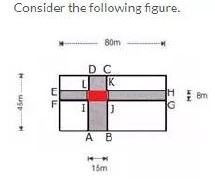
Question 12. A rectangular park of dimensions 80 m by 45 m has two crossroads running through its centre, one parallel to its length and the other parallel to its breadth. The width of the road parallel to the length is 8 m and the width of the road parallel to the breadth is 15 m. Find the area of these crossroads.
Answer: Let ABCD be the vertical road running parallel to the park's breadth, and EFGH be the horizontal road running parallel to its length. The area where the two roads intersect is represented by the rectangle IJKL.
We find the area of each section as follows:
The dimensions of the vertical road ABCD are 45 m by 15 m:
\( \text{Area}(ABCD) = 45 \times 15 = 675\text{ m}^2 \)
The dimensions of the horizontal road EFGH are 80 m by 8 m:
\( \text{Area}(EFGH) = 80 \times 8 = 640\text{ m}^2 \)
The common intersection region IJKL has dimensions 15 m by 8 m:
\( \text{Area}(IJKL) = 15 \times 8 = 120\text{ m}^2 \)
To find the total area of the crossroads, we sum the areas of both roads and subtract the area of the overlapping intersection region:
\( \text{Total Area} = \text{Area}(ABCD) + \text{Area}(EFGH) - \text{Area}(IJKL) \)
\( \implies \text{Total Area} = 675 + 640 - 120 \)
\( \implies \text{Total Area} = 1195\text{ m}^2 \)
Thus, the total area of the crossroads is 1195 sq. m.
In simple words: Find the area of the vertical road and the horizontal road separately. Add them together, and subtract the middle area where they cross so that you do not count it twice.
Exam Tip: Do not forget to subtract the area of the overlapping central square/rectangle, as it is counted twice when you calculate the area of both roads.
Question 13. A hall is 45 m long and 32 m wide. Find the cost of carpeting the hall with:
(i) a carpet of width 1.2 m at the rate of Rs. 40 per metre.
(ii) a carpet of width 80 cm at the rate of Rs. 25 per metre.
Answer:
First, find the total area of the hall:
\( \text{Area} = 45 \times 32 = 1440\text{ m}^2 \)
(i) For a carpet of width 1.2 m:
\( \text{Length of carpet required} = \frac{\text{Area of the hall}}{\text{Width of the carpet}} \)
\( \implies \text{Length} = \frac{1440}{1.2} = 1200\text{ m} \)
The cost at the rate of Rs. 40 per metre is:
\( \text{Cost} = 1200 \times 40 = \text{Rs. } 48000 \)
(ii) For a carpet of width 80 cm, first convert the width into metres:
\( \text{Width} = 80\text{ cm} = 0.8\text{ m} \)
Now, calculate the length of the carpet required:
\( \text{Length of carpet required} = \frac{1440}{0.8} = 1800\text{ m} \)
The cost at the rate of Rs. 25 per metre is:
\( \text{Cost} = 1800 \times 25 = \text{Rs. } 45000 \)
Thus, the cost of carpeting is Rs. 48,000 for the first case and Rs. 45,000 for the second case.
In simple words: Divide the room's total area by the width of the carpet to find how long the carpet needs to be, then multiply this length by the price per metre.
Exam Tip: Ensure that the carpet width is in the same unit (metres) as the dimensions of the hall before you divide to find the required length.
Question 14. The diagonal of a square is 15 m. Find its area and perimeter correct to two decimal places.
Answer: Let \( a \) be the length of each side of the square. The relationship between the side and the diagonal is:
\( 2a^2 = (\text{diagonal})^2 \)
Given that the diagonal is 15 m:
\( 2a^2 = 15^2 \)
\( \implies 2a^2 = 225 \)
\( \implies a^2 = \frac{225}{2} = 112.5\text{ sq. m} \)
Since the area of a square is \( a^2 \), we have:
\( \text{Area} = 112.5\text{ sq. m} \)
To find the side length \( a \):
\( a = \sqrt{112.5} \approx 10.607\text{ m} \)
We can find the perimeter of the square using:
\( \text{Perimeter} = 4a \)
\( \implies \text{Perimeter} \approx 4 \times 10.607 \approx 42.43\text{ m} \)
Therefore, the area of the square is 112.5 sq. m and its perimeter is 42.43 m.
In simple words: Use the diagonal to find the side length of the square first. The area is half of the diagonal squared, and multiplying the side length by four gives the perimeter.
Exam Tip: You can calculate the area of a square directly using the formula \( \text{Area} = \frac{1}{2} \times d^2 \), which saves time during exams.
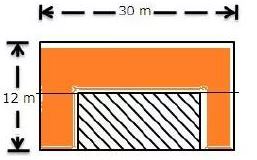
Question 15. A rectangular plot of land has dimensions 30 m by 12 m. A flower bed of constant width 2 m is laid along three of its sides (two shorter sides and one longer side) inside the plot, leaving the remaining portion as a lawn.
(i) Find the dimensions of the lawn.
(ii) Find the area of the flower bed.
Answer:
(i) Since the flower bed of width 2 m is laid inside along the two shorter sides, the length of the lawn is reduced from both ends:
\( \text{Length of the lawn} = 30 - 2 - 2 = 26\text{ m} \)
Since the flower bed is laid along only one of the longer sides (at the top), the breadth of the lawn is reduced by 2 m from only one end:
\( \text{Breadth of the lawn} = 12 - 2 = 10\text{ m} \)
Thus, the dimensions of the lawn are 26 m by 10 m.
(ii) The area of the flower bed can be calculated by subtracting the area of the lawn from the total area of the plot:
\( \text{Total Area} = 30 \times 12 = 360\text{ sq. m} \)
\( \text{Area of the lawn} = 26 \times 10 = 260\text{ sq. m} \)
The area of the flower bed is:
\( \text{Area of flower bed} = \text{Total Area} - \text{Area of the lawn} \)
\( \implies \text{Area} = 360 - 260 \)
\( \implies \text{Area} = 100\text{ sq. m} \)
Alternatively, we can calculate the area by dividing the flower bed into three parts:
\( \text{Area} = (10 \times 2) + (10 \times 2) + (30 \times 2) = 20 + 20 + 60 = 100\text{ sq. m} \)
Hence, the area of the flower bed is 100 sq. m.
In simple words: Subtract the border width to get the new lawn size. The flower bed's area is the big rectangle's area minus the smaller inner lawn's area.
Exam Tip: Pay close attention to how many sides have the border. Since only one longer side has a flower bed, subtract 2 m once instead of twice for the breadth.
Question 16. The floor of a room measuring 15 m by 8 m is to be paved with tiles of size 50 cm by 25 cm.
(i) Find the number of tiles required.
(ii) If a carpet is laid in the centre of the room leaving a border of 1 m wide all around, find the area of the floor left uncovered and the fraction of the floor that is uncovered.
Answer:
(i) First, calculate the total area of the room's floor:
\( \text{Area of the floor} = 15 \times 8 = 120\text{ sq. m} \)
Next, convert the dimensions of one tile into metres:
\( \text{Length of tile} = 50\text{ cm} = 0.50\text{ m} \)
\( \text{Width of tile} = 25\text{ cm} = 0.25\text{ m} \)
The area of a single tile is:
\( \text{Area of one tile} = 0.50 \times 0.25 = 0.125\text{ sq. m} \)
The number of tiles needed is:
\( n = \frac{\text{Area of the floor}}{\text{Area of one tile}} \)
\( \implies n = \frac{120}{0.125} \)
\( \implies n = 960 \)
So, 960 tiles are required.
(ii) Since the carpet leaves a 1 m wide border all around the room, the dimensions of the carpet are:
\( \text{Length of carpet} = 15 - 2 = 13\text{ m} \)
\( \text{Width of carpet} = 8 - 2 = 6\text{ m} \)
The area of the floor covered by the carpet is:
\( \text{Area of carpet} = 13 \times 6 = 78\text{ sq. m} \)
The area of the floor left uncovered is:
\( \text{Uncovered Area} = \text{Total Floor Area} - \text{Carpet Area} \)
\( \implies \text{Uncovered Area} = 120 - 78 \)
\( \implies \text{Uncovered Area} = 42\text{ sq. m} \)
The fraction of the floor that remains uncovered is:
\( \text{Fraction} = \frac{\text{Uncovered Area}}{\text{Total Floor Area}} = \frac{42}{120} = \frac{7}{20} \)
Thus, the uncovered area is 42 sq. m and the fraction of the floor left uncovered is \(\frac{7}{20}\).
In simple words: Divide the room's area by the tile's area to find the total tiles. Subtract the border to find the carpet's area, then subtract that from the floor to see what is uncovered.
Exam Tip: Be sure to divide the final fraction to its simplest form (\(\frac{7}{20}\)) to ensure you receive full marks on the fraction portion of the question.
Question 17. The adjacent sides of a parallelogram are 24 m and 18 m. If the distance between the longer sides is 12 m, find the distance between the shorter sides.
Answer: The area of a parallelogram is calculated using the formula:
\( \text{Area} = \text{Base} \times \text{Height} \)
First, we use the longer sides as the base, where the base is 24 m and the distance between them (height) is 12 m:
\( \text{Area} = 24 \times 12 = 288\text{ sq. m} \)
Next, we use the shorter sides as the base, where the base is 18 m and the distance between them (height) is \( h \):
\( \text{Area} = 18 \times h \)
Since the area remains constant, we set these two expressions equal to each other:
\( 18 \times h = 24 \times 12 \)
\( \implies h = \frac{24 \times 12}{18} \)
\( \implies h = 16\text{ m} \)
Therefore, the distance between the shorter sides is 16 m.
In simple words: The area of a parallelogram is base times height. Calculate the area using the longer base first, then use that area to find the height for the shorter base.
Exam Tip: Remember that a parallelogram has two sets of bases and heights, but its area is always the same regardless of which base you use to calculate it.
Question 18. The adjacent sides of a parallelogram are 10 cm and 12 cm, and the diagonal is 16 cm. Find the area of the parallelogram. Also, find its height corresponding to the base of 10 cm.
Answer:
We first find the semi-perimeter and area of the triangle with sides 10 cm, 12 cm, and 16 cm. Let the semi-perimeter be \( S \) and area be \( A \).
\( S = \frac{10 + 12 + 16}{2} = 19\text{ cm} \)
Using Heron's formula, the area of the triangle is:
\( A = \sqrt{S(S-a)(S-b)(S-c)} \)
\( A = \sqrt{19 \times (19 - 10) \times (19 - 12) \times (19 - 16)} \)
\( A = \sqrt{19 \times 9 \times 7 \times 3} \approx 59.9\text{ cm}^2 \)
Since the diagonal divides the parallelogram into two congruent triangles of equal area:
Area of the parallelogram = \( 2 \times A = 2 \times 59.9 = 119.8\text{ cm}^2 \)
We know that the area of a parallelogram is also given by the formula:
Area = base \(\times\) height
Given that the base is 10 cm, we can calculate the height as follows:
height = \( \frac{\text{Area}}{\text{base}} = \frac{119.8}{10} = 11.98\text{ cm} \)
In simple words: We find the area of one triangle using its three sides, and then double it to find the area of the whole parallelogram. Finally, dividing this area by the base gives us the height.
Exam Tip: Keep in mind that a diagonal divides a parallelogram into two congruent triangles of equal area. Remember to double the triangular area before solving for height.
Question 19. The area of a rhombus is 216 sq. cm and one of its diagonals is 24 cm. Find:
(i) the length of the other diagonal,
(ii) the length of each side of the rhombus,
(iii) the perimeter of the rhombus.
Answer:
(i) Let the diagonals of the rhombus be \( AC \) and \( BD \). We are given that the area \( A = 216\text{ cm}^2 \) and \( AC = 24\text{ cm} \).
The formula for the area of a rhombus is:
\( A = \frac{1}{2} \times AC \times BD \)
Substituting the given values:
\( 216 = \frac{1}{2} \times 24 \times BD \)
\( \implies 216 = 12 \times BD \)
\( \implies BD = \frac{216}{12} = 18\text{ cm} \)
Thus, the other diagonal is 18 cm.
(ii) The diagonals of a rhombus bisect each other at right angles. Let \( a \) be the side length of the rhombus:
\( a^2 = \left(\frac{AC}{2}\right)^2 + \left(\frac{BD}{2}\right)^2 \)
\( a^2 = \left(\frac{24}{2}\right)^2 + \left(\frac{18}{2}\right)^2 \)
\( a^2 = 12^2 + 9^2 \)
\( a^2 = 144 + 81 = 225 \)
\( a = \sqrt{225} = 15\text{ cm} \)
The side of the rhombus is 15 cm.
(iii) The perimeter of the rhombus is given by:
Perimeter = \( 4 \times a = 4 \times 15 = 60\text{ cm} \)
In simple words: Use the area of the rhombus and one diagonal to find the other diagonal. Then, use the half-lengths of the diagonals with Pythagoras' theorem to find the side, and multiply the side by four to get the perimeter.
Exam Tip: Remember that the diagonals of a rhombus bisect each other at right angles, which allows you to use the Pythagorean theorem on the half-diagonals to find the side length.
Question 20. The perimeter of a rhombus is 52 cm and one of its diagonals is 24 cm. Find:
(i) the length of its other diagonal,
(ii) its area.
Answer:
Let \( a \) be the side length of the rhombus.
Since the perimeter is 52 cm:
\( 4a = 52 \)
\( \implies a = 13\text{ cm} \)
(i) Let the given diagonal be \( AC = 24\text{ cm} \). We need to determine the other diagonal \( BD \).
Using the relation between the side and diagonals of a rhombus:
\( a^2 = \left(\frac{AC}{2}\right)^2 + \left(\frac{BD}{2}\right)^2 \)
\( 13^2 = \left(\frac{24}{2}\right)^2 + \left(\frac{BD}{2}\right)^2 \)
\( 169 = 12^2 + \left(\frac{BD}{2}\right)^2 \)
\( 169 = 144 + \left(\frac{BD}{2}\right)^2 \)
\( \left(\frac{BD}{2}\right)^2 = 169 - 144 \)
\( \left(\frac{BD}{2}\right)^2 = 25 \)
\( \frac{BD}{2} = 5 \)
\( \implies BD = 10\text{ cm} \)
Hence, the other diagonal is 10 cm.
(ii) The area of the rhombus is calculated as:
Area = \( \frac{1}{2} \times AC \times BD \)
Area = \( \frac{1}{2} \times 24 \times 10 = 120\text{ cm}^2 \)
In simple words: Divide the perimeter by 4 to get the side length. Use this side length and half of the given diagonal to find half of the other diagonal, and then double it. Finally, calculate the area using both diagonals.
Exam Tip: Make sure to divide the given diagonal by two before applying Pythagoras' theorem, as the relationship relies on the half-diagonal lengths.
Question 21. Find the area of a rhombus whose perimeter is 46 cm and height is 8 cm.
Answer:
Let \( a \) represent the side of the rhombus.
Since the perimeter is 46 cm:
\( 4a = 46 \)
\( \implies a = 11.5\text{ cm} \)
The side of the rhombus acts as its base. Given that the height is 8 cm, the area is:
Area = base \(\times\) height
Area = \( 11.5 \times 8 = 92\text{ cm}^2 \)
In simple words: First, divide the perimeter by 4 to find the length of each side. Since the side of a rhombus is its base, multiply it by the height to find the area.
Exam Tip: When a height is given, you can treat a rhombus like a standard parallelogram and use the formula Area = base - height, where the base is equal to the side length.
Question 22. Find the area of the polygon ABCDEF shown in the figure, where AF = 1.2 m, EF = 0.3 m, DC = 0.6 m, and AB = 1.8 m. The height of the middle section is 2 m, and the angles at A, H, E, D are right angles.
Answer:
To find the area of the polygon ABCDEF, we divide it into three simpler shapes:
1. Rectangle AHEF
2. Rectangle HKCD
3. Right-angled triangle KBC
Given dimensions:
- \( AF = 1.2\text{ m} \) and \( EF = 0.3\text{ m} \) (so \( AH = 0.3\text{ m} \))
- \( CD = 0.6\text{ m} \) (so \( HK = 0.6\text{ m} \))
- The height of the middle section is \( HC = 2\text{ m} \)
- The total length of the base \( AB = 1.8\text{ m} \)
First, let's find the base \( KB \) of the triangle:
\( KB = AB - AH - HK = 1.8 - 0.3 - 0.6 = 0.9\text{ m} \)
Now we calculate the individual areas:
- Area of rectangle AHEF = \( 1.2 \times 0.3 = 0.36\text{ m}^2 \)
- Area of rectangle HKCD = \( 2 \times 0.6 = 1.2\text{ m}^2 \)
- Area of triangle KBC = \( \frac{1}{2} \times \text{base} \times \text{height} = \frac{1}{2} \times 0.9 \times 2 = 0.9\text{ m}^2 \)
Total Area of ABCDEF:
\( \text{Total Area} = \text{Area of AHEF} + \text{Area of HKCD} + \text{Area of }\Delta\text{KBC} \)
\( \text{Total Area} = 0.36 + 1.2 + 0.9 = 2.46\text{ m}^2 \) In simple words: We can find the total area by splitting the polygon into two rectangles and one triangle, calculating their individual areas, and adding them together.
Exam Tip: Clearly show the division of the complex polygon into standard shapes like rectangles and triangles, and write down the separate calculation for each part to secure step-by-step marks.
Question 23. Find the area of a field composed of a triangle and a right-angled trapezium. The triangle has a base of 12 m and a height of 25 m. The trapezium shares its 25 m side as one of its parallel sides, while the other parallel side is 15 m, and its slant side is 26 m.
Answer:
The given figure is composed of two geometric shapes: a triangle and a trapezium.
1. Area of the triangle:
With a base of 12 m and a height of 25 m:
\( \text{Area of triangle} = \frac{1}{2} \times \text{base} \times \text{height} \)
\( \text{Area of triangle} = \frac{1}{2} \times 12 \times 25 = 150\text{ m}^2 \)
2. Area of the trapezium:
The parallel sides are \( a = 25\text{ m} \) and \( b = 15\text{ m} \), and the slant side is \( 26\text{ m} \).
First, we find the height \( h \) of the trapezium using the Pythagorean theorem:
\( h = \sqrt{26^2 - (25 - 15)^2} \)
\( h = \sqrt{676 - 10^2} \)
\( h = \sqrt{676 - 100} = \sqrt{576} = 24\text{ m} \)
Now, we calculate the area of the trapezium:
\( \text{Area of trapezium} = \frac{1}{2} \times (a + b) \times h \)
\( \text{Area of trapezium} = \frac{1}{2} \times (25 + 15) \times 24 \)
\( \text{Area of trapezium} = 20 \times 24 = 480\text{ m}^2 \)
3. Total Area:
Adding the two areas together:
\( \text{Total Area} = \text{Area of triangle} + \text{Area of trapezium} \)
\( \text{Total Area} = 150 + 480 = 630\text{ m}^2 \)
In simple words: Find the area of the triangle using its base and height. For the trapezium, first find its vertical height using the slant side, then calculate its area and add it to the triangle's area.
Exam Tip: Double check your calculations when using Pythagoras' theorem to find the height of a trapezium. Always verify that the sum of the individual shapes equals the whole area.
Question 24. Find the area of a field from the following survey notes. All measurements are in meters:
- The main diagonal of the field is AD, which has points F, G, H on it such that AF = 50 m, FG = 40 m, GH = 15 m, and HD = 25 m.
- On one side of AD, there is a perpendicular offset GE = 60 m at point G.
- On the other side of AD, there are perpendicular offsets BF = 50 m at F and CH = 25 m at H.
Answer:
We can find the total area of the field by dividing it into four distinct parts:
1. A large triangle on one side of diagonal \( AD \), which is \( \Delta AED \) (labeled region A) with base \( AD \) and height \( GE \).
2. On the other side of \( AD \), we have:
- Triangle \( ABF \) (region B)
- Trapezium \( BFHC \) (region D)
- Triangle \( CHD \) (region C)
Let us compute the area of each region:
- **Total length of the diagonal \( AD \):**
\( AD = AF + FG + GH + HD = 50 + 40 + 15 + 25 = 130\text{ m} \)
- **Area of region A (\( \Delta AED \)):**
\( \text{Area} = \frac{1}{2} \times AD \times GE = \frac{1}{2} \times 130 \times 60 = 3900\text{ m}^2 \)
- **Area of region B (\( \Delta ABF \)):**
\( \text{Area} = \frac{1}{2} \times AF \times BF = \frac{1}{2} \times 50 \times 50 = 1250\text{ m}^2 \)
- **Area of region C (\( \Delta CHD \)):**
\( \text{Area} = \frac{1}{2} \times HD \times CH = \frac{1}{2} \times 25 \times 25 = 312.5\text{ m}^2 \)
- **Area of region D (Trapezium \( BFHC \)):**
The parallel sides are \( BF = 50\text{ m} \) and \( CH = 25\text{ m} \).
The perpendicular distance between them is \( FH = FG + GH = 40 + 15 = 55\text{ m} \).
\( \text{Area} = \frac{1}{2} \times (BF + CH) \times FH = \frac{1}{2} \times (50 + 25) \times 55 = 2062.5\text{ m}^2 \)
- **Total Area of the Field:**
\( \text{Total Area} = \text{Area of A} + \text{Area of B} + \text{Area of C} + \text{Area of D} \)
\( \text{Total Area} = 3900 + 1250 + 312.5 + 2062.5 = 7525\text{ m}^2 \)
In simple words: Divide the field into three triangles and one trapezium along the central line. Calculate each of their areas using the given measurements and add them up to find the total field area.
Exam Tip: In field-book problems, carefully calculate the heights of the trapeziums by subtracting the consecutive points along the main diagonal.
Question 25. A footpath of uniform width is constructed all around the outside of a rectangular lawn measuring 30 m by 24 m. If the area of the footpath is 360 sq. m, find the width of the footpath.
Answer:
Let \( x \) (in meters) represent the uniform width of the footpath.
The dimensions of the rectangular lawn are:
- Length = 30 m
- Width = 24 m
The total area of the footpath can be calculated by subtracting the area of the lawn from the total area including the path:
\( \text{Area of footpath} = (30 + 2x)(24 + 2x) - (30 \times 24) \)
\( \text{Area of footpath} = 720 + 60x + 48x + 4x^2 - 720 \)
\( \text{Area of footpath} = 4x^2 + 108x \)
We are given that the area of the footpath is 360 m\(^2\):
\( 4x^2 + 108x = 360 \)
Dividing the entire equation by 4:
\( x^2 + 27x = 90 \)
\( \implies x^2 + 27x - 90 = 0 \)
Solving this quadratic equation by factoring:
\( x^2 + 30x - 3x - 90 = 0 \)
\( x(x + 30) - 3(x + 30) = 0 \)
\( (x - 3)(x + 30) = 0 \)
This gives two possible values:
\( x = 3 \) or \( x = -30 \)
Since width cannot be negative, we discard \( x = -30 \).
Thus, the width of the footpath is 3 m.
In simple words: Write an equation for the path's area by subtracting the lawn's area from the total outer area. Set this equal to 360 and solve the quadratic equation to find the path's width.
Exam Tip: When solving quadratic equations for physical dimensions like width, always state why you are discarding the negative value.
Question 26. A wire encloses a square of area 484 sq. m. If the same wire is bent to form:
(i) an equilateral triangle, find its area.
(ii) a rectangle of length 16 m, find its area.
Answer:
Let \( a \) be the side length of the square.
The area of the square is 484 m\(^2\):
\( a^2 = 484 \)
\( \implies a = \sqrt{484} = 22\text{ m} \)
The total length of the wire is equal to the perimeter of the square:
\( \text{Length of wire} = 4 \times a = 4 \times 22 = 88\text{ m} \)
(i) If the wire is reshaped into an equilateral triangle:
The perimeter of the triangle is 88 m.
Side of the equilateral triangle = \( \frac{88}{3} \approx 29.33\text{ m} \)
The area of an equilateral triangle is:
\( \text{Area} = \frac{\sqrt{3}}{4} \times (\text{side})^2 \)
\( \text{Area} = \frac{\sqrt{3}}{4} \times (29.33)^2 \approx 372.58\text{ m}^2 \)
(ii) If the wire is reshaped into a rectangle with one side of 16 m:
Let the other side (breadth) be \( x \).
The perimeter of the rectangle is 88 m:
\( 2(16 + x) = 88 \)
\( 16 + x = 44 \)
\( \implies x = 28\text{ m} \)
The area of this rectangle is:
\( \text{Area} = \text{length} \times \text{breadth} = 16 \times 28 = 448\text{ m}^2 \)
In simple words: Find the side and perimeter of the square from its area. Use this perimeter to find the side of the equilateral triangle and the missing side of the rectangle, and then compute their areas.
Exam Tip: Since the wire is just reshaped, its total length (perimeter) remains constant across all shapes. Always make this perimeter equivalence your starting point.
Question 27. Find the area of each of the trapeziums shown below:
(i) A trapezium ABCD where AB || CD, CD = 12 cm, AB = 20 cm, AD = 10 cm, and BC = 10 cm.
(ii) A trapezium ABCD where AD is perpendicular to AB, CD = 8 cm, AB = 14 cm, and BC = 10 cm.
(iii) A trapezium ABCD where AB || CD, CD = 20 cm, AB = 32 cm, AD = 10 cm, and BC = 16 cm.
(iv) An isosceles trapezium ABCD where AB || CD, CD = 18 cm, AB = 30 cm, and AD = BC = 12 cm.
Answer:
(i) In the given trapezium ABCD, \( AB \parallel CD \).
We draw a line \( CE \) parallel to \( DA \) meeting \( AB \) at \( E \). This forms:
- A parallelogram AECD where \( AE = CD = 12\text{ cm} \) and \( CE = DA = 10\text{ cm} \).
- A triangle EBC with sides \( CE = 10\text{ cm} \), \( BC = 10\text{ cm} \), and \( EB = AB - AE = 20 - 12 = 8\text{ cm} \).
Since \( CE = BC = 10\text{ cm} \), \( \Delta EBC \) is an isosceles triangle. Using the area formula for an isosceles triangle:
\( \text{Area of }\Delta EBC = \frac{1}{4} \times b \times \sqrt{4a^2 - b^2} \) (where \( a = 10 \), \( b = 8 \))
\( \text{Area} = \frac{1}{4} \times 8 \times \sqrt{4(10)^2 - 8^2} \)
\( \text{Area} = 2 \times \sqrt{400 - 64} = 2 \times \sqrt{336} \approx 2 \times 18.33 = 36.66\text{ cm}^2 \)
Also, Area of \( \Delta EBC = \frac{1}{2} \times \text{base} \times \text{height} = \frac{1}{2} \times 8 \times h = 4h \)
\( 4h = 36.66 \)
\( \implies h = 9.165\text{ cm} \)
Now, the area of trapezium ABCD is:
\( \text{Area} = \frac{1}{2} \times (\text{sum of parallel sides}) \times \text{height} \)
\( \text{Area} = \frac{1}{2} \times (12 + 20) \times 9.165 \)
\( \text{Area} = \frac{1}{2} \times 32 \times 9.165 = 146.64\text{ cm}^2 \) (ii) In the right trapezium ABCD, \( AD \perp AB \).
Let us drop a perpendicular from C to AB meeting it at E. Here, \( AECD \) is a rectangle, so \( AE = CD = 8\text{ cm} \).
Since \( AB = 14\text{ cm} \), we have:
\( EB = AB - AE = 14 - 8 = 6\text{ cm} \)
In the right-angled triangle CEB:
\( CE = \sqrt{BC^2 - EB^2} \)
\( CE = \sqrt{10^2 - 6^2} = \sqrt{100 - 36} = \sqrt{64} = 8\text{ cm} \)
Since \( CE \) is the perpendicular distance between the parallel sides, the area of the trapezium ABCD is:
\( \text{Area} = \frac{1}{2} \times (AB + CD) \times CE \)
\( \text{Area} = \frac{1}{2} \times (14 + 8) \times 8 \)
\( \text{Area} = 11 \times 8 = 88\text{ cm}^2 \) (iii) In the trapezium ABCD, \( AB \parallel CD \).
We draw a line \( CE \parallel AD \) meeting \( AB \) at \( E \). This forms:
- A parallelogram AECD where \( AE = CD = 20\text{ cm} \) and \( CE = AD = 10\text{ cm} \).
- A triangle EBC with sides \( CE = 10\text{ cm} \), \( BC = 16\text{ cm} \), and \( EB = AB - AE = 32 - 20 = 12\text{ cm} \).
First, let's find the area of \( \Delta EBC \) using Heron's formula:
Semi-perimeter \( S = \frac{10 + 16 + 12}{2} = 19\text{ cm} \)
\( \text{Area of }\Delta EBC = \sqrt{S(S-a)(S-b)(S-c)} \)
\( \text{Area} = \sqrt{19 \times (19 - 16) \times (19 - 12) \times (19 - 10)} \)
\( \text{Area} = \sqrt{19 \times 3 \times 7 \times 9} = \sqrt{3591} \approx 59.9\text{ cm}^2 \)
Also, Area of \( \Delta EBC = \frac{1}{2} \times \text{base} \times \text{height} = \frac{1}{2} \times 12 \times h = 6h \)
\( 6h = 59.9 \)
\( \implies h \approx 9.98\text{ cm} \)
Now, the area of trapezium ABCD is:
\( \text{Area} = \frac{1}{2} \times (AB + CD) \times h \)
\( \text{Area} = \frac{1}{2} \times (32 + 20) \times 9.98 \)
\( \text{Area} = 26 \times 9.98 \approx 259.48\text{ cm}^2 \) (iv) In the isosceles trapezium ABCD, the non-parallel sides are equal (\( AD = BC = 12\text{ cm} \)).
We draw perpendiculars \( DE \) and \( CF \) from \( D \) and \( C \) to \( AB \). Thus, \( EF = CD = 18\text{ cm} \).
Since it is an isosceles trapezium, the right triangles ADE and BCF are congruent, which means:
\( AE = FB \)
Given \( AB = 30\text{ cm} \):
\( AE + EF + FB = 30 \)
\( 2AE + 18 = 30 \)
\( 2AE = 12 \)
\( \implies AE = 6\text{ cm} \)
In the right-angled triangle ADE:
\( DE^2 + AE^2 = AD^2 \)
\( DE^2 + 6^2 = 12^2 \)
\( DE^2 + 36 = 144 \)
\( DE^2 = 108 \)
\( \implies DE = \sqrt{108} = 6\sqrt{3}\text{ cm} \)
Now we calculate the area of the trapezium ABCD:
\( \text{Area} = \frac{1}{2} \times (AB + CD) \times DE \)
\( \text{Area} = \frac{1}{2} \times (30 + 18) \times 6\sqrt{3} \)
\( \text{Area} = 24 \times 6\sqrt{3} = 144\sqrt{3}\text{ cm}^2 \approx 144 \times 1.732 \approx 249.41\text{ cm}^2 \) In simple words: For trapeziums without a direct height, draw a line to split them into a parallelogram and a triangle. Find the triangle's height first, which is also the trapezium's height, and then calculate the total area.
Exam Tip: Drawing an auxiliary line parallel to one of the non-parallel sides is a standard method to solve non-right trapeziums. Clearly state this step in your working.
Question 28. The perimeter of a rectangular field is 70 cm and its area is 300 sq. cm. Find the dimensions (length and breadth) of the rectangle.
Answer:
Let the length of the rectangle be \( x \) and the breadth be \( b \).
The perimeter of the rectangle is 70 cm:
\( 2(x + b) = 70 \)
\( x + b = 35 \)
\( \implies b = 35 - x \)
The area of the rectangle is given as 300 cm\(^2\):
\( x \times b = 300 \)
Substitute \( b = 35 - x \) into the equation:
\( x(35 - x) = 300 \)
\( 35x - x^2 = 300 \)
\( \implies x^2 - 35x + 300 = 0 \)
Now, let us solve this quadratic equation by splitting the middle term:
\( x^2 - 20x - 15x + 300 = 0 \)
\( x(x - 20) - 15(x - 20) = 0 \)
\( (x - 15)(x - 20) = 0 \)
Thus, the roots are:
\( x = 15 \) or \( x = 20 \)
If the length \( x = 20\text{ cm} \), then the breadth \( b = 35 - 20 = 15\text{ cm} \).
If the length \( x = 15\text{ cm} \), then the breadth \( b = 35 - 15 = 20\text{ cm} \).
Typically, we define length as the longer dimension. Therefore, the length of the rectangle is 20 cm and the width is 15 cm.
In simple words: Use the perimeter to write the width in terms of length. Multiply them to set up a quadratic equation for the area, and solve it to find both dimensions.
Exam Tip: After solving the quadratic equation, present both possible sets of dimensions clearly and state which value corresponds to the length and which to the breadth.
Question 29. The area of a rectangular plot is 640 sq. m and its perimeter is 104 m. Find the dimensions of the rectangular plot.
Answer:
Let \( x \) represent the length and \( b \) represent the width of the rectangular plot.
The area is given as 640 m\(^2\):
\( x \times b = 640 \)
\( \implies b = \frac{640}{x} \)
The perimeter of the rectangle is 104 m:
\( 2(x + b) = 104 \)
Substitute \( b = \frac{640}{x} \) into this formula:
\( 2\left(x + \frac{640}{x}\right) = 104 \)
Divide by 2:
\( x + \frac{640}{x} = 52 \)
Multiply both sides by \( x \):
\( x^2 + 640 = 52x \)
\( \implies x^2 - 52x + 640 = 0 \)
Solving this quadratic equation by factoring:
\( x^2 - 32x - 20x + 640 = 0 \)
\( x(x - 32) - 20(x - 32) = 0 \)
\( (x - 32)(x - 20) = 0 \)
This gives the roots:
\( x = 32 \) or \( x = 20 \)
If length \( x = 32\text{ m} \), then width \( b = \frac{640}{32} = 20\text{ m} \).
Therefore, the length of the rectangular plot is 32 m and the width is 20 m.
In simple words: Express the width using the area and length. Put this into the perimeter formula to form a quadratic equation, then factor it to get the length and width of the plot.
Exam Tip: Always check your final factored values by multiplying them to confirm they equal the given area, and adding them to confirm they match the perimeter.
Question 30. A rectangle is formed by doubling one side of a square and increasing its adjacent side by 6 cm. If the area of the resulting rectangle is 3 times the area of the square, find the side length of the square and the dimensions of the rectangle.
Answer:
Let \( a \) represent the side length of the square.
The area of the square is:
\( \text{Area of square} = a^2 \)
According to the given condition, a rectangle is constructed where:
- One side is doubled: \( 2a \)
- The adjacent side is increased by 6 cm: \( a + 6 \)
The area of this rectangle is given as 3 times the area of the square:
\( 2a \times (a + 6) = 3a^2 \)
\( 2a^2 + 12a = 3a^2 \)
Subtract \( 2a^2 \) from both sides:
\( 12a = a^2 \)
Since the side length \( a \neq 0 \), we divide by \( a \):
\( a = 12\text{ cm} \)
Thus:
- The side length of the square is 12 cm.
- The length of the rectangle is \( 2a = 2 \times 12 = 24\text{ cm} \).
- The width of the rectangle is \( a + 6 = 12 + 6 = 18\text{ cm} \).
In simple words: Create expressions for the rectangle's sides based on the square's side. Set the rectangle's area equal to three times the square's area, solve for the side, and then find all dimensions.
Exam Tip: Be careful with algebraic setup. Ensure you translate "doubling one side" as 2a and "increasing by 6" as a + 6 correctly before equating the areas.
Question 31. In a square ABCD of side 12 cm, a point P lies on the side BC. If the ratio of the area of triangle ABP to the area of trapezium APCD is 1 : 5, find the length of CP.
Answer:
Let ABCD be the square with side length 12 cm.
Point P lies on side BC. Let the length of CP be \( CP \).
Since the total length of side BC is 12 cm, the length of BP is:
\( BP = 12 - CP \)
We can write the areas of the two regions as follows:
- **Area of triangle ABP:**
\( \text{Area of }\Delta ABP = \frac{1}{2} \times \text{base} \times \text{height} = \frac{1}{2} \times AB \times BP \)
\( \text{Area of }\Delta ABP = \frac{1}{2} \times 12 \times (12 - CP) \)
- **Area of trapezium APCD:**
The parallel sides of the trapezium APCD are \( AD \) and \( CP \). The perpendicular height is \( CD \).
Since ABCD is a square, \( AD = 12\text{ cm} \) and \( CD = 12\text{ cm} \).
\( \text{Area of trapezium APCD} = \frac{1}{2} \times (AD + CP) \times CD \)
\( \text{Area of trapezium APCD} = \frac{1}{2} \times (12 + CP) \times 12 \)
Given the ratio of the areas is \( 1 : 5 \):
\( \frac{\text{Area of }\Delta ABP}{\text{Area of trapezium APCD}} = \frac{1}{5} \)
\( \frac{\frac{1}{2} \times 12 \times (12 - CP)}{\frac{1}{2} \times (12 + CP) \times 12} = \frac{1}{5} \)
The term \( \frac{1}{2} \times 12 \) cancels out from both the numerator and denominator:
\( \frac{12 - CP}{12 + CP} = \frac{1}{5} \)
Cross-multiplying:
\( 5(12 - CP) = 1(12 + CP) \)
\( 60 - 5CP = 12 + CP \)
Combine like terms:
\( 60 - 12 = CP + 5CP \)
\( 48 = 6CP \)
\( \implies CP = \frac{48}{6} = 8\text{ cm} \)
Therefore, the length of CP is 8 cm. In simple words: Find the areas of the triangle and trapezium in terms of the segment CP. Set up their ratio as 1 to 5, simplify the fraction, and solve for CP.
Exam Tip: Working with ratios of areas is simplified when you cancel common factors like 1/2 and 12 before cross-multiplying, which reduces the chance of arithmetic errors.
Question 32. Find the area of the inner surface of a wall built around a rectangular field of size 45 m by 30 m, where the wall's height is 2.4 m and its thickness increases the dimensions by 2 m on each side.
Answer: We first determine the outer length and breadth of the boundary wall: Outer length of the wall: \( L = 45\text{ m} + 2\text{ m} = 47\text{ m} \) Outer breadth of the wall: \( B = 30\text{ m} + 2\text{ m} = 32\text{ m} \) The total area of the inner surface of this wall is calculated as follows: \( A = (47 \times 2 \times 2.4) + (32 \times 2 \times 2.4) \)
\( \implies A = 225.6 + 153.6 \)
\( \implies A = 379.2\text{ m}^2 \)
In simple words: To find the inner wall area, we add the areas of the outer dimensions multiplied by twice the wall height. This gives us the total surface area.
Exam Tip: Remember to add the wall thickness to both sides of the dimensions before multiplying by the height to find the surface area.
Question 33. A wire is bent in the form of a square of area 576 sq cm. If the same wire is bent in the form of:
(i) an equilateral triangle, find its area.
(ii) a rectangle whose adjacent sides differ by 4 cm, find its area.
Answer: Let \( a \) represent the side length of the square. The area is given as \( a^2 = 576 \implies a = 24\text{ cm} \). Thus, the perimeter of this square is \( 4a = 4 \times 24 = 96\text{ cm} \). This perimeter represents the total length of the wire, which is \( 96\text{ cm} \). (i) When the wire is reshaped into an equilateral triangle: Each side of the triangle \( = \frac{96}{3} = 32\text{ cm} \). The area of the equilateral triangle is given by: \( \text{Area} = \frac{\sqrt{3}}{4} \times (\text{side})^2 \)
\( \implies \text{Area} = \frac{\sqrt{3}}{4} \times 32^2 \)
\( \implies \text{Area} = 256\sqrt{3}\text{ sq cm} \) (ii) Let the two adjacent sides of the rectangle be denoted by \( x \) and \( y \) (in cm). Since the perimeter of the rectangle matches the length of the wire, we have: \( 2(x + y) = 96 \implies x + y = 48 \) We are given that the difference between the sides is \( 4\text{ cm} \): \( x - y = 4 \) Solving these two linear equations simultaneously: \( x = 26 \) and \( y = 22 \) Therefore, the area of this rectangle is: \( \text{Area} = 26 \times 22 = 572\text{ sq cm} \)
In simple words: First find the total length of the wire from the square's area. Then, use this length as the perimeter to calculate the dimensions and areas of the triangle and the rectangle.
Exam Tip: When a wire is bent into different shapes, its length remains constant. Equating the perimeter of the new shapes to the original perimeter is the key to solving such problems.
Question 34. The area of a parallelogram is y sq cm and its height is h cm. If the base of another parallelogram is x cm longer than the base of the first parallelogram, and its area is twice the area of the first parallelogram, find the height of the second parallelogram.
Answer: Let the first parallelogram have an area of \( y \) and a height of \( h \). Let \( H \) represent the height of the second parallelogram. The base of the first parallelogram is given by: \( \text{Base}_1 = \frac{y}{h}\text{ cm} \) According to the problem, the base of the second parallelogram is: \( \text{Base}_2 = \left(\frac{y}{h} + x\right)\text{ cm} \) Since the area of the second parallelogram is twice that of the first (i.e., \( 2y \)): \( \left(\frac{y}{h} + x\right) \times H = 2y \)
\( \implies \left(\frac{y + hx}{h}\right) \times H = 2y \)
\( \implies H = \frac{2hy}{y + hx} \)
In simple words: Find the base of the first shape, add the extra length to get the second shape's base, and use the double area to solve for the new height.
Exam Tip: Express all terms algebraically step-by-step and simplify the final fraction carefully to avoid errors during variable substitution.
Question 35. In a trapezium ABCD, AD is parallel to BC. E and F are the midpoints of the non-parallel sides AB and CD respectively, such that EF = 26 cm. If the distance between the parallel sides is 15 cm, find the area of the trapezium.
Answer: The segment joining the midpoints of the non-parallel sides is given as: \( EF = \frac{1}{2}(AD + BC) = 26\text{ cm} \) The formula for the area of a trapezium is: \( \text{Area} = \frac{1}{2}(AD + BC) \times h \) Substituting the known values: \( \text{Area} = 26 \times 15 \)
\( \implies \text{Area} = 390\text{ cm}^2 \) In simple words: The area of a trapezium can be found by multiplying the length of its middle line (the median EF) by its height.
Exam Tip: Remember that the line joining the midpoints of the non-parallel sides of a trapezium is always equal to half the sum of its parallel sides.
Question 36. The perimeter of a rectangle is 92 m and its diagonal is 34 m. Find the area of the rectangle.
Answer: Let \( a \) and \( b \) denote the side lengths of the rectangle. Given that the perimeter is \( 92\text{ m} \): \( 2(a + b) = 92 \)
\( \implies a + b = 46\text{ m} \) ---(1) Using the diagonal length of \( 34\text{ m} \), by the Pythagorean theorem we have: \( a^2 + b^2 = 34^2 \) ---(2) Applying the algebraic identity: \( (a + b)^2 - (a^2 + b^2) = 2ab \) Substituting values from equations (1) and (2): \( 46^2 - 34^2 = 2ab \)
\( \implies 2116 - 1156 = 2ab \)
\( \implies 2ab = 960 \)
\( \implies ab = \frac{960}{2} \)
\( \implies ab = 480\text{ m}^2 \) The area of the rectangle is thus \( 480\text{ m}^2 \).
In simple words: Use the perimeter and the diagonal to create two simple algebraic relationships. Then, solve for the product of the two sides, which represents the area of the rectangle.
Exam Tip: Instead of finding the individual side lengths, use the identity \( (a+b)^2 - (a^2+b^2) = 2ab \) directly to get the area \( ab \). This saves time and avoids complex quadratic equations.
Exercise 20(C)
Question 1. The diameter of a circle is 28 cm. Find:
(i) its circumference
(ii) its area
(Leave your answers in terms of \(\pi\).)
Answer: Let the radius of the circle be represented by \( r \). (i) The diameter is \( 2r = 28\text{ cm} \). The formula for the circumference is: \( \text{Circumference} = 2\pi r = 28\pi\text{ cm} \) (ii) The area of the circle is given by: \( \text{Area} = \pi r^2 \) Since \( r = \frac{28}{2} = 14\text{ cm} \): \( \text{Area} = \pi \times (14)^2 \)
\( \implies \text{Area} = 196\pi\text{ cm}^2 \)
In simple words: The circumference is found by multiplying the diameter by pi. The area is found by multiplying pi by the square of the radius (which is half the diameter).
Exam Tip: When the question asks to leave answers in terms of pi, do not substitute \( \frac{22}{7} \) or \( 3.14 \). Keep \( \pi \) as a symbol throughout the calculations.
Question 2. The circumference of a circular field is 308 m. Find:
(i) its radius
(ii) its area
(Take \(\pi = \frac{22}{7}\))
Answer: Let \( r \) be the radius of the circular field. (i) We are given that the circumference is \( 308\text{ m} \): \( 2\pi r = 308 \)
\( \implies r = \frac{308}{2\pi} \)
\( \implies r = \frac{308}{2} \times \frac{7}{22} \)
\( \implies r = 49\text{ m} \) (ii) The area of this circular field is: \( \text{Area} = \pi r^2 \)
\( \implies \text{Area} = \frac{22}{7} \times 49 \times 49 \)
\( \implies \text{Area} = 7546\text{ m}^2 \)
In simple words: Use the circumference formula to solve for the radius first. Then, insert this radius into the area formula to get the final area.
Exam Tip: Be careful with unit labels: radius is in meters (\(\text{m}\)), while area must be in square meters (\(\text{m}^2\)).
Question 3. The sum of the circumference and diameter of a circle is 116 cm. Find its radius.
Answer: Let \( r \) be the radius of the circle. The sum of the circumference and the diameter is: \( 2\pi r + 2r = 116 \) Factoring out \( 2r \): \( 2r(\pi + 1) = 116 \) Substituting \( \pi = \frac{22}{7} \): \( 2r \left(\frac{22}{7} + 1\right) = 116 \)
\( \implies 2r \left(\frac{29}{7}\right) = 116 \)
\( \implies \frac{58r}{7} = 116 \)
\( \implies r = \frac{116 \times 7}{58} \)
\( \implies r = 2 \times 7 = 14\text{ cm} \)
In simple words: Write the formula for the sum of the boundary and diameter. Factor out the radius, plug in the value of pi, and solve the equation.
Exam Tip: Factoring out common terms early simplifies the equation and reduces the chances of arithmetic mistakes when working with fractions.
Question 4. Find the radius of a circle whose circumference is equal to the sum of the circumferences of two circles of radii 25 cm and 18 cm.
Answer: The circumference of the first circle with a radius of \( 25\text{ cm} \) is: \( C_1 = 2\pi \times 25 = 50\pi\text{ cm} \) The circumference of the second circle with a radius of \( 18\text{ cm} \) is: \( C_2 = 2\pi \times 18 = 36\pi\text{ cm} \) Let \( r \) represent the radius of the new circle. Its circumference is equal to the sum of the two individual circumferences: \( 2\pi r = C_1 + C_2 \)
\( \implies 2\pi r = 50\pi + 36\pi \)
\( \implies 2\pi r = 86\pi \)
\( \implies r = \frac{86\pi}{2\pi} \)
\( \implies r = 43\text{ cm} \)
In simple words: Find the perimeter of both circles first. Add them together to get the perimeter of the new circle, and then calculate its radius.
Exam Tip: Keep \( \pi \) as a variable throughout the steps because it cancels out at the end, saving you from complex calculations.
Question 5. The radii of two circles are 48 cm and 13 cm. Find the area of the circle whose circumference is equal to the difference of the circumferences of these two circles.
Answer: The boundary length of the first circle is: \( C_1 = 2\pi \times 48 = 96\pi\text{ cm} \) The boundary length of the second circle is: \( C_2 = 2\pi \times 13 = 26\pi\text{ cm} \) Let \( r \) be the radius of the new circle. Its circumference is the difference between the two boundary lengths: \( 2\pi r = 96\pi - 26\pi \)
\( \implies 2\pi r = 70\pi \)
\( \implies r = \frac{70\pi}{2\pi} = 35\text{ cm} \) The area of this resulting circle is calculated as: \( \text{Area} = \pi r^2 \)
\( \implies \text{Area} = \frac{22}{7} \times 35 \times 35 \)
\( \implies \text{Area} = 22 \times 5 \times 35 \)
\( \implies \text{Area} = 3850\text{ cm}^2 \)
In simple words: Find the circumferences of both circles. Subtract them to find the new circle's circumference, use that to get its radius, and then calculate its area.
Exam Tip: Be careful to read the question details: here, we subtract the circumferences (difference) rather than adding them.
Question 6. Find the radius of a circle whose area is equal to the sum of the areas of two circles of radii 16 cm and 12 cm.
Answer: Let \( r \) denote the radius of the new circle. Since its area is equal to the sum of the areas of the two given circles, we set up the equation: \( \pi \times 16^2 + \pi \times 12^2 = \pi r^2 \)
\( \implies 256\pi + 144\pi = \pi r^2 \)
\( \implies 400\pi = \pi r^2 \)
\( \implies r^2 = 400 \)
\( \implies r = 20\text{ cm} \) Thus, the radius of the new circle is \( 20\text{ cm} \).
In simple words: Add the areas of both smaller circles together to get the total area of the new circle, then solve for its radius.
Exam Tip: Since \( \pi \) appears on both sides of the equation, we can divide the entire equation by \( \pi \) to simplify it directly to \( r^2 = r_1^2 + r_2^2 \).
Question 7. The radius of a circle is 5 m. Find the circumference of another circle whose area is 49 times the area of the given circle.
Answer: The area of the given circle with a radius of \( 5\text{ m} \) is: \( \text{Area}_1 = \pi \times 5^2 = 25\pi\text{ m}^2 \) Let \( r \) be the radius of the larger circle whose area is \( 49 \) times the area of this given circle: \( \pi r^2 = 49 \times 25\pi \)
\( \implies r^2 = 49 \times 25 \)
\( \implies r = \sqrt{1225} = 35\text{ m} \) The circumference of this new circle is given by: \( C = 2\pi r \)
\( \implies C = 2 \times \frac{22}{7} \times 35 \)
\( \implies C = 220\text{ m} \)
In simple words: Calculate the area of the first circle, multiply it by 49 to find the area of the second circle, determine its radius, and then find its circumference.
Exam Tip: When solving problems involving multiples of area, you can use the relation \( r_{\text{new}} = \sqrt{k} \times r_{\text{old}} \), where \( k \) is the area multiplier.
Question 8. From a rectangular cardboard of dimensions 55 cm by 42 cm, the largest possible circle is cut out. Find the ratio of the area of the circle to the area of the remaining cardboard. (Take \(\pi = 3.14\))
Answer: The area of the rectangular cardboard is calculated as: \( \text{Area}_{\text{rectangle}} = 55 \times 42 = 2310\text{ cm}^2 \) To cut out the largest possible circle, its diameter must equal the shorter side of the rectangle: \( \text{Diameter} = 42\text{ cm} \implies r = 21\text{ cm} \) Using \( \pi \approx 3.14 \), the area of this circle is: \( \text{Area}_{\text{circle}} = 3.14 \times 21^2 = 1384.74\text{ cm}^2 \) The leftover area of the cardboard after cutting out the circle is: \( \text{Remaining Area} = 2310 - 1384.74 = 925.26\text{ cm}^2 \) The ratio of the area of the circle to the remaining area is: \( \text{Ratio} = \frac{1384.74}{925.26} \approx \frac{3}{2} \) Thus, the ratio is \( 3 : 2 \).
In simple words: Find the area of both the rectangle and the largest circle that can fit inside it. Subtract the circle's area from the rectangle's area to find the leftover space, and then find the ratio.
Exam Tip: The diameter of the largest circle that can be cut from a rectangle is always equal to the width (shorter side) of that rectangle.
Question 9. Four identical circles are drawn inside a square cardboard of side 28 cm such that they touch each other and the sides of the square. Find the area of the remaining cardboard.
Answer: The total area of the square cardboard is: \( \text{Area}_{\text{square}} = 28^2 = 784\text{ cm}^2 \) Because four identical circles are arranged inside the square, the radius of each circle is one-fourth of the square's side length: \( r = \frac{28}{4} = 7\text{ cm} \) The area of a single circle is: \( \text{Area}_{\text{one circle}} = \frac{22}{7} \times 7^2 = 154\text{ cm}^2 \) The combined area of all four circles is: \( \text{Area}_{\text{four circles}} = 4 \times 154 = 616\text{ cm}^2 \) Therefore, the remaining area of the cardboard is: \( \text{Remaining Area} = 784 - 616 = 168\text{ cm}^2 \)
In simple words: Find the total area of the square. Next, calculate the size of one circle using its radius (which is one-fourth of the square's side), multiply it by four, and subtract that from the square's area.
Exam Tip: Visualize the four circles as a 2x2 grid inside the square. This confirms why the diameter of each circle is half the side of the square, making the radius one-fourth of the side.
Question 10. The radii of two circles are in the ratio 3 : 8. If the difference between their areas is 2695\(\pi\) sq cm, find the area of the smaller circle.
Answer: Let the radii of the two circles be represented as \( 3k \) and \( 8k \) respectively. The area of the smaller circle is: \( \text{Area}_{\text{smaller}} = \pi \times (3k)^2 = 9\pi k^2 \) The area of the larger circle is: \( \text{Area}_{\text{larger}} = \pi \times (8k)^2 = 64\pi k^2 \) We are given that the difference in their areas is \( 2695\pi\text{ cm}^2 \): \( 64\pi k^2 - 9\pi k^2 = 2695\pi \)
\( \implies 55\pi k^2 = 2695\pi \)
\( \implies 55k^2 = 2695 \)
\( \implies k^2 = 49 \)
\( \implies k = 7\text{ cm} \) Thus, the radius of the smaller circle is: \( R_{\text{smaller}} = 3 \times 7 = 21\text{ cm} \) The area of this smaller circle is: \( \text{Area} = \frac{22}{7} \times 21^2 \)
\( \implies \text{Area} = 22 \times 3 \times 21 \)
\( \implies \text{Area} = 1386\text{ cm}^2 \)
In simple words: Express the areas of both circles using a common variable, subtract them to find the variable's value, and then use it to find the smaller circle's radius and area.
Exam Tip: Always use a constant variable like \( k \) or \( x \) to represent ratio terms to keep your algebraic steps clear and mathematically rigorous.
Question 11. The diameters of three circles are in the ratio 3 : 5 : 6. If the sum of their circumferences is 308 cm, find the difference between the areas of the largest and the smallest circles.
Answer: Let the diameters of the three circles be represented as \( 3d \), \( 5d \), and \( 6d \) respectively. The sum of their circumferences is given as \( 308\text{ cm} \): \( \pi(3d) + \pi(5d) + \pi(6d) = 308 \)
\( \implies 14\pi d = 308 \)
\( \implies 14 \times \frac{22}{7} \times d = 308 \)
\( \implies 44d = 308 \)
\( \implies d = 7 \) The diameter of the smallest circle is \( 3 \times 7 = 21\text{ cm} \), so its radius is: \( r_{\text{smallest}} = \frac{21}{2} = 10.5\text{ cm} \) Its area is: \( \text{Area}_{\text{smallest}} = \frac{22}{7} \times (10.5)^2 = 346.5\text{ cm}^2 \) The diameter of the largest circle is \( 6 \times 7 = 42\text{ cm} \), so its radius is: \( r_{\text{largest}} = \frac{42}{2} = 21\text{ cm} \) Its area is: \( \text{Area}_{\text{largest}} = \frac{22}{7} \times 21^2 = 1386\text{ cm}^2 \) The difference between these two areas is: \( \text{Difference} = 1386 - 346.5 = 1039.5\text{ cm}^2 \)
In simple words: Use the sum of circumferences to solve for the multiplier, find the radii of the largest and smallest circles, calculate their individual areas, and subtract them.
Exam Tip: Notice that circumference is \( \pi \times \text{diameter} \). Using this formula directly saves you from converting to radius in the first step.
Question 12. The inner and outer radii of a circular ring are 15 cm and 20 cm respectively. Find the area of the ring.
Answer: The area of a circular ring is the difference between the outer area and the inner area: \( \text{Area} = \pi R^2 - \pi r^2 \) Given outer radius \( R = 20\text{ cm} \) and inner radius \( r = 15\text{ cm} \): \( \text{Area} = \pi(20)^2 - \pi(15)^2 \)
\( \implies \text{Area} = 400\pi - 225\pi \)
\( \implies \text{Area} = 175\pi \) Using \( \pi = \frac{22}{7} \): \( \text{Area} = 175 \times \frac{22}{7} = 550\text{ cm}^2 \)
In simple words: To find the area of a ring, subtract the area of the inner circle from the area of the outer circle.
Exam Tip: Use the algebraic identity \( R^2 - r^2 = (R-r)(R+r) \) to quickly calculate \( 20^2 - 15^2 = (20-15)(20+15) = 5 \times 35 = 175 \).
Question 13. A path of width 3.5 m runs around a circular park whose circumference is 55 m. Find the area of the path.
Answer:
Let the circular park have a radius of \( r \).
We know that the perimeter is:
\( 2\pi r = 55 \)
\( \implies r = \frac{55}{2\pi} = 8.75\text{ m} \)
The area of this park is calculated as:
\( \text{Area of the park} = \pi \times (8.75)^2 = 240.625\text{ m}^2 \)
When we include the path, the total radius \( R \) becomes:
\( R = 8.75 + 3.5 = 12.25\text{ m} \)
The total area of this larger circular region is:
\( A = \pi \times (12.25)^2 = 471.625\text{ m}^2 \)
Subtracting the inner area gives the area of the path:
\( \text{Area of the path} = 471.625 - 240.625 = 231\text{ m}^2 \)
In simple words: First, use the park's boundary length to find its radius and calculate its area. Then, add the path's width to get the larger radius and find the overall area. The difference between these two areas gives the space covered by the path.
Exam Tip: Remember to add the width of the path to the inner radius to find the outer radius. Double-check your decimal multiplications carefully to avoid losing marks on calculation errors.
Question 14. The circumference of a circular garden A is 1.760 km. Another circular garden B has an area 25 times that of garden A. Find the circumference of garden B.
Answer:
Let the radius of the first circular garden, A, be \( r \).
Given that the circumference of garden A is \( 1.760\text{ km} = 1760\text{ m} \), we can write:
\( 2\pi r = 1760\text{ m} \)
\( \implies r = \frac{1760 \times 7}{2 \times 22} = 280\text{ m} \)
The area of garden A is:
\( \text{Area of garden A} = \pi r^2 = \frac{22}{7} \times 280^2\text{ m}^2 \)
Now, let \( R \) represent the radius of the second circular garden, B.
Since B has an area 25 times larger than A:
\( \pi R^2 = 25 \times \pi r^2 \)
\( \implies \pi R^2 = 25 \times \pi \times 280^2 \)
\( \implies R^2 = 1960000 \)
\( \implies R = 1400\text{ m} \)
Consequently, the circumference of garden B is:
\( 2\pi R = 2 \times \frac{22}{7} \times 1400 = 8800\text{ m} = 8.8\text{ km} \)
In simple words: Find the radius of the first garden from its perimeter, then set up the equation for the second garden's area. Solve for the new radius and use it to find the final boundary length.
Exam Tip: Be sure to convert kilometers to meters before starting your calculations to keep units consistent, and convert back to kilometers for the final answer if required.
Question 15. The diameter of a wheel is 84 cm. How many revolutions will it make to cover a distance of 3.168 km?
Answer:
The diameter of the wheel is \( 84\text{ cm} \).
This gives a radius of \( 42\text{ cm} \).
Now, we find the circumference of the wheel:
\( \text{Circumference} = 2 \times \frac{22}{7} \times 42 = 264\text{ cm} \)
This means the wheel covers a distance of \( 264\text{ cm} \) in a single complete rotation.
To cover a total distance of \( 3.168\text{ km} = 3.168 \times 100000\text{ cm} \):
\( \text{Number of rotations} = \frac{3.168 \times 100000}{264} = 1200 \)
In simple words: First, find how far the wheel rolls in one full turn by calculating its circumference. Then, divide the total journey distance by this single-turn distance to find the total turns needed.
Exam Tip: Remember that \(1\text{ km} = 100,000\text{ cm}\). Converting all values to centimeters first avoids decimal placement mistakes during division.
Question 16. The wheels of a car are of diameter 80 cm each. How many complete revolutions does each wheel make in 10 minutes, when the car is travelling at a speed of 66 km per hour?
Answer:
The distance the car covers over a span of 10 minutes is:
\( \text{Distance} = \frac{66}{6} = 11\text{ km} = 1100000\text{ cm} \)
We know that the perimeter of the wheel represents the distance traveled in one full rotation.
Since the wheel's diameter is \( 80\text{ cm} \), its radius is \( \frac{80}{2} = 40\text{ cm} \).
\( \text{Circumference} = 2 \times \frac{22}{7} \times 40 \approx 251.43\text{ cm} \)
Dividing the total distance by the distance of one rotation yields:
\( \text{Number of rotations} = \frac{1100000}{251.43} \approx 4375 \)
In simple words: Find the distance covered by the car in 10 minutes, and also find the distance the wheel travels in one rotation. Divide the total distance by the single rotation distance to get the number of spins.
Exam Tip: When dividing by decimals like 251.43, round to two decimal places and compute carefully to get the approximate integer value of revolutions.
Question 17. The diameter of each wheel of a train is 42 cm. If each wheel makes 1200 revolutions per minute, find the speed of the train in km/hr.
Answer:
The wheel's radius is:
\( r = \frac{42}{2} = 21\text{ cm} \)
This gives a circumference of:
\( \text{Circumference} = 2 \times \pi \times 21 = 132\text{ cm} \)
The total distance covered during a single minute is:
\( \text{Distance in 1 minute} = 132 \times 1200 = 158400\text{ cm} = 1.584\text{ km} \)
Therefore, the speed of the train is calculated as:
\( \text{Speed} = \frac{1.584}{\frac{1}{60}}\text{ km/h} = 95.04\text{ km/h} \)
In simple words: Find the distance covered in one spin by calculating the perimeter. Multiply by the number of spins per minute to get the distance per minute, then convert this speed to kilometers per hour.
Exam Tip: Be careful with time conversions - multiplying the distance per minute by 60 is a quick way to convert the speed from per-minute to per-hour.
Question 18. Find the area swept by the minute hand of a clock of length 8 cm between 8:30 AM and 9:05 AM.
Answer:
The duration of time elapsed between 8:30 and 9:05 is:
\( \text{Time interval} = 35\text{ minutes} \)
The total area swept by the hand in a full hour (60 minutes) is:
\( \text{Area in 60 minutes} = \pi \times 8^2 \approx 201\text{ cm}^2 \)
Thus, the area swept over the course of 35 minutes is:
\( A = \frac{201}{60} \times 35 = 117\frac{1}{3}\text{ cm}^2 \)
In simple words: First, calculate the total area of the full circle the minute hand covers in an hour. Then, find the fraction of the circle covered in 35 minutes to get the final area.
Exam Tip: Use the unitary method to find the area for any given minutes: \(\text{Area} = \frac{\pi r^2}{60} \times \text{time in minutes}\).
Question 19. Two concentric circles have circumferences 396 cm and 374 cm respectively. Find the area of the shaded region between them.
Answer:
Let the radii of the larger and smaller circles be represented by \( R \) and \( r \).
We are given that the outer circle has a perimeter of \( 396\text{ cm} \):
\( 2\pi R = 396 \)
\( \implies R = \frac{396 \times 7}{2 \times 22} \)
\( \implies R = 63\text{ cm} \)
This gives the area of the larger circle:
\( \text{Area of the larger circle} = \frac{22}{7} \times 63^2 = 12474\text{ cm}^2 \)
The perimeter of the smaller circle is given as \( 374\text{ cm} \):
\( 2\pi r = 374 \)
\( \implies r = \frac{374 \times 7}{2 \times 22} \)
\( \implies r = 59.5\text{ cm} \)
This gives the area of the smaller circle:
\( \text{Area of the smaller circle} = \frac{22}{7} \times 59.5^2 = 11126.5\text{ cm}^2 \)
Subtracting the two areas gives the space of the shaded region:
\( \text{Area of the shaded portion} = 12474 - 11126.5 = 1347.5\text{ cm}^2 \)
In simple words: Find the radii of both circles using their circumferences. Use these to calculate the areas of both circles, then subtract the smaller area from the larger area.
Exam Tip: Be precise when working with decimal values like 59.5. Squaring decimals can lead to minor arithmetic mistakes if not done carefully.
Question 20. The circumference of the outer circle of a shaded ring-shaped region is 132 cm. If the area of the shaded portion is 770 cm^2, find the width of this shaded region.
Answer:
Using the provided values, we can find the area of both the inner and outer circles to determine the width of the shaded ring.
The boundary of the outer circle is \( 132\text{ cm} \):
\( 2\pi R = 132 \)
\( \implies R = \frac{132 \times 7}{2 \times 22} \)
\( \implies R = 21\text{ cm} \)
We can now calculate the area of this larger circle:
\( \text{Area of the outer circle} = \frac{22}{7} \times 21^2 = 1386\text{ cm}^2 \)
Subtracting the given shaded area of \( 770\text{ cm}^2 \) gives the inner circle's area:
\( \text{Area of the inner circle} = 1386 - 770 = 616\text{ cm}^2 \)
We can set up the area equation for the smaller circle:
\( \pi r^2 = 616 \)
\( \implies r^2 = \frac{616 \times 7}{22} \)
\( \implies r^2 = 196 \)
\( \implies r = 14\text{ cm} \)
Therefore, the width of the shaded ring is:
\( \text{Width} = 21 - 14 = 7\text{ cm} \)
In simple words: Use the outer boundary to get the larger radius and its area. Subtract the shaded area to find the inner area, which gives the smaller radius. The difference between the two radii is the width.
Exam Tip: Clearly write down the relationship: \(\text{Width} = R - r\). This formula is key to scoring full marks on such geometry problems.
Question 21. The cost of fencing a circular field at the rate of Rs. 240 per metre is Rs. 52,800. Find the cost of ploughing the field at the rate of Rs. 12.50 per m^2.
Answer:
Let the circular field have a radius of \( r \) meters.
Its total perimeter is represented by \( 2\pi r \) meters.
The total cost of fencing is Rs. 52,800 at a rate of Rs. 240 per meter.
This allows us to write:
\( 2\pi r \cdot 240 = 52800 \)
\( \implies r = \frac{52800 \times 7}{2 \times 240 \times 22} = 35 \)
Hence, the radius of the field is \( 35\text{ m} \).
The total surface area of this field is:
\( \text{Area} = \frac{22}{7} \times 35^2 = 3850\text{ m}^2 \)
Therefore, the cost of cultivating the field at Rs. 12.50 per square meter is:
\( \text{Cost} = 3850 \times 12.5 = 48,125\text{ rupees} \)
In simple words: First, find the boundary length of the field by dividing the total fencing cost by the cost per meter. Use this length to find the radius and the total area, then multiply the area by the ploughing rate.
Exam Tip: Remember that fencing relates to the boundary (circumference) of the circle, whereas ploughing relates to the surface (area) of the circle.
Question 22. The sum of the radii of two circles is 10 cm and the sum of their areas is \(58\pi\text{ cm}^2\). Find the radii of the two circles.
Answer:
Let the radii of the two circles be denoted as \( r \) and \( R \).
From the given information:
\( r + R = 10 \) ...(1)
\( \pi r^2 + \pi R^2 = 58\pi \) ...(2)
Dividing equation (2) by \( \pi \), we get:
\( r^2 + R^2 = 58 \)
We substitute \( r = 10 - R \) into this equation:
\( (10 - R)^2 + R^2 = 58 \)
\( 100 - 20R + R^2 + R^2 = 58 \)
\( 2R^2 - 20R + 42 = 0 \)
Dividing the quadratic equation by 2:
\( R^2 - 10R + 21 = 0 \)
Factoring the equation gives:
\( (R-3)(R-7) = 0 \)
\( \implies R = 3 \text{ or } R = 7 \)
Therefore, the radii of these two circles are \( 3\text{ cm} \) and \( 7\text{ cm} \).
In simple words: Set up two equations: one for the sum of the radii and one for the sum of the areas. Solve the resulting quadratic equation to find the two radii values.
Exam Tip: Be careful when factoring the quadratic equation. Verify your answers by checking if both values sum to 10 and their squares sum to 58.
Question 23. A rectangle ABCD with sides AB = 28 cm and BC = 21 cm is inscribed in a circle. Find the area of the shaded region (the region of the circle outside the rectangle).
Answer:
According to the given dimensions:
\( AB = 28\text{ cm} \)
\( BC = 21\text{ cm} \)
We find the diagonal of the rectangle using Pythagoras' theorem:
\( AC = \sqrt{AB^2 + BC^2} = \sqrt{28^2 + 21^2} = 35\text{ cm} \)
Since the diagonal of an inscribed rectangle is also the diameter of the circumscribed circle, the diameter of the circle is \( 35\text{ cm} \).
The area of this circle is:
\( \text{Area of the circle} = \pi \times \left(\frac{35}{2}\right)^2 = 962.5\text{ cm}^2 \)
The area of the inscribed rectangle is:
\( \text{Area of the rectangle} = 28 \times 21 = 588\text{ cm}^2 \)
Subtracting the rectangle's area from the circle's area gives the shaded region:
\( A = 962.5 - 588 = 374.5\text{ cm}^2 \)
In simple words: Find the diagonal of the rectangle to get the circle's diameter. Compute the total circular area, then subtract the rectangle's area to find the remaining shaded space.
Exam Tip: A key geometric concept to remember is that any rectangle inscribed in a circle has its diagonal passing through the center, meaning the diagonal is equal to the circle's diameter.
Question 24. A square is inscribed in a circle of radius 7 cm. Find the area of the square.
Answer:
Let \( a \) represent the side length of the inscribed square.
The diagonal of a square inscribed in a circle is equal to the circle's diameter.
Since the circle's radius is \( 7\text{ cm} \), its diameter is \( 2 \times 7 = 14\text{ cm} \).
Using the relation for the diagonal of a square:
\( \sqrt{2}a = 2 \times 7 = 14 \)
\( \implies a = 7\sqrt{2}\text{ cm} \)
We can now calculate the area of the square:
\( \text{Area of the square} = a^2 = (7\sqrt{2})^2 = 98\text{ sq. cm.} \)
In simple words: The diagonal of the square is equal to the circle's diameter. Find the diagonal, use it to solve for the side of the square, and square it to find the area.
Exam Tip: You can also use the direct formula for the area of an inscribed square: \(\text{Area} = 2r^2\), where \(r\) is the radius of the circumscribed circle.
Question 25. An equilateral triangle of area \(484\sqrt{3}\text{ cm}^2\) is formed by bending a wire. If the same wire is bent into the shape of a circle, find the area of the circle.
Answer:
Let \( a \) be the length of each side of the equilateral triangle.
We are given that the area of the triangle is \( 484\sqrt{3}\text{ cm}^2 \):
\( \frac{\sqrt{3}}{4} a^2 = 484\sqrt{3} \)
\( \implies a^2 = 1936 \)
\( \implies a = 44\text{ cm} \)
Using the perimeter calculation from the solution, the length of the wire is:
\( 4a = 176\text{ cm} \)
Now, let \( r \) be the radius of the circle formed by bending this wire.
We equate the perimeter of the circle to the wire length:
\( 2\pi r = 176 \)
\( \implies r = 28\text{ cm} \)
Finally, the area of the circle is calculated as:
\( \text{Area} = \pi r^2 = \frac{22}{7} \times 28^2 = 2464\text{ cm}^2 \)
In simple words: First, find the side of the triangle using its area formula. Use this to determine the length of the wire, then find the radius of the circle with that same length, and finally compute its area.
Exam Tip: Make sure to state both the triangle area formula \(\frac{\sqrt{3}}{4}s^2\) and the circle area formula \(\pi r^2\) clearly to secure step-wise marks.
Question 26. The diameters of the front and rear wheels of a tractor are 63 cm and 1.54 m respectively. The rear wheel makes \(24\frac{6}{11}\) revolutions per minute. Find:
(i) the number of revolutions made by the front wheel in one minute.
(ii) the distance travelled by the tractor in 40 minutes.
Answer:
The given diameters for the front and rear wheels are \( 63\text{ cm} = 0.63\text{ m} \) and \( 1.54\text{ m} \) respectively.
This gives the following radii:
\( \text{Radius of the rear wheel} = \frac{1.54}{2} = 0.77\text{ m} \)
\( \text{Radius of the front wheel} = \frac{0.63}{2} = 0.315\text{ m} \)
The distance covered by the tractor during a single turn of the larger rear wheel is its perimeter:
\( \text{Perimeter of the rear wheel} = 2 \times \frac{22}{7} \times 0.77 = 4.84\text{ m} \)
The rotation rate of the rear wheel is \( 24\frac{6}{11} = \frac{270}{11} \) rotations per minute.
The total distance covered by the vehicle in one minute is:
\( \text{Distance in 1 minute} = \frac{270}{11} \times 4.84 = 118.8\text{ m} \)
(i) Let \( x \) represent the total rotations made by the front wheel in one minute.
Since the distance covered in one minute must be identical for both wheels:
\( x \times 2 \times \frac{22}{7} \times 0.315 = 118.8 \)
\( \implies x = \frac{118.8 \times 7}{2 \times 22 \times 0.315} = 60 \)
(ii) The total distance covered by the tractor over a duration of 40 minutes is:
\( \text{Distance in 40 minutes} = \frac{270}{11} \times 40 \times 4.84 = 4752\text{ m} \)
In simple words: First, find the distance the tractor travels in one minute using the rear wheel's size and speed. Then, use this distance to find how many times the smaller front wheel must turn, and multiply the one-minute distance by 40 to find the total distance.
Exam Tip: Be very careful with mixed units like centimeters and meters. Convert all measurements to meters at the very start to avoid calculation mistakes.
Question 27. The sum of the radii of two circles is 12 cm and the sum of their areas is \(74\pi\text{ cm}^2\). Find the diameters of the two circles.
Answer:
Let the radii of the two circles be denoted as \( r_1 \) and \( r_2 \).
Given:
\( r_1 + r_2 = 12 \)
\( \implies r_2 = 12 - r_1 \)
The total sum of their areas is \( 74\pi \):
\( \pi r_1^2 + \pi r_2^2 = 74\pi \)
\( \implies r_1^2 + r_2^2 = 74 \)
Substituting the expression for \( r_2 \):
\( r_1^2 + (12 - r_1)^2 = 74 \)
\( \implies r_1^2 + 144 - 24r_1 + r_1^2 = 74 \)
\( \implies 2r_1^2 - 24r_1 + 70 = 0 \)
Dividing the equation by 2 yields:
\( r_1^2 - 12r_1 + 35 = 0 \)
\( \implies (r_1 - 7)(r_1 - 5) = 0 \)
\( \implies r_1 = 7 \text{ or } r_1 = 5 \)
If we choose \( r_1 = 7\text{ cm} \), then \( r_2 = 5\text{ cm} \).
If we choose \( r_1 = 5\text{ cm} \), then \( r_2 = 7\text{ cm} \).
Thus, the diameters of the two circles are \( 10\text{ cm} \) and \( 14\text{ cm} \).
In simple words: Set up algebraic equations for the sum of the radii and the sum of the areas. Substitute one radius into the other equation to get a quadratic equation, solve it for the radii, and then double them to find the diameters.
Exam Tip: Read the question carefully—it asks for "diameters", so multiplying the radii by 2 at the end is an essential step to get full marks.
Question 28. Find the ratio of the area of a circle to the area of a square inscribed in it.
Answer:
Let the side of the square be \( AB = x \).
The diagonal \( AC \) of the square is:
\( AC = x\sqrt{2} \)
Since the diagonal of the inscribed square corresponds to the circle's diameter:
\( \text{Diameter of the circle} = \text{diagonal of the square} \)
\( \implies 2r = x\sqrt{2} \)
\( \implies r = \frac{x\sqrt{2}}{2} \)
The area of this circle is:
\( \text{Area of the circle} = \pi r^2 = \pi \left(\frac{x\sqrt{2}}{2}\right)^2 = \frac{\pi x^2}{2} \)
The area of the square is:
\( \text{Area of the square} = x^2 \)
Therefore, the ratio of their areas is:
\( \text{Required ratio} = \frac{\frac{\pi x^2}{2}}{x^2} = \frac{\pi}{2} = \frac{22}{7} \times \frac{1}{2} = \frac{11}{7} \)
Thus, the calculated ratio of the area of the circle to the square is \( 11 : 7 \).
In simple words: Express the radius of the circle in terms of the square's side length. Find the area of both shapes using this common variable, then divide the circle's area by the square's area to find the constant ratio.
Exam Tip: Since \(x^2\) cancels out during division, the ratio is a constant independent of the actual side length. Always substitute \(\pi = \frac{22}{7}\) to simplify to the final integer ratio.
ICSE Selina Concise Solutions Class 9 Mathematics Chapter 20 Area And Perimeter Of Plane Figures
Students can now access the detailed Selina Concise Solutions for Chapter 20 Area And Perimeter Of Plane Figures on our portal. These solutions have been carefully prepared as per latest ICSE Class 9 syllabus. Each solution given above has been updated based on the current year pattern to ensure Class 9 students have the most updated Mathematics content.
Master Selina Concise Textbook Questions
Our subject experts have provided detailed explanations for all the questions found in the Selina Concise textbook for Class 9 Mathematics. We have focussed on making the concepts easy for you in Chapter 20 Area And Perimeter Of Plane Figures so that students can understand the concepts behind every answer. For all numerical problems and theoretical concepts these solutions will help in strengthening your analytical skill required for the ICSE examinations.
Complete Mathematics Exam Preparation
By using these Selina Concise Class 9 solutions, you can enhance your learning and identify areas that need more attention. We recommend solving the Mathematics Questions from the textbook first and then use our teacher-verified answers. For a proper revision of Chapter 20 Area And Perimeter Of Plane Figures, students should also also check our Revision Notes and Sample Papers available on studiestoday.com.
FAQs
You can download the verified Selina Concise solutions for Chapter 20 Area And Perimeter Of Plane Figures on StudiesToday.com. Our teachers have prepared answers for Class 9 Mathematics as per 2026-27 ICSE academic session.
Yes, our solutions for Chapter 20 Area And Perimeter Of Plane Figures are designed as per new 2026 ICSE standards. 40% competency-based questions required for Class 9, are included to help students understand application-based logic behind every Mathematics answer.
Yes, every exercise in Chapter 20 Area And Perimeter Of Plane Figures from the Selina Concise textbook has been solved step-by-step. Class 9 students will learn Mathematics conceots before their ICSE exams.
Yes, follow structured format of these Selina Concise solutions for Chapter 20 Area And Perimeter Of Plane Figures to get full 20% internal assessment marks and use Class 9 Mathematics projects and viva preparation as per ICSE 2026 guidelines.