

ICSE Solutions Selina Concise Class 9 Mathematics Chapter 15 Construction Of Polygons have been provided below and is also available in Pdf for free download. The Selina Concise ICSE solutions for Class 9 Mathematics have been prepared as per the latest syllabus and ICSE books and examination pattern suggested in Class 9. Questions given in ICSE Selina Concise book for Class 9 Mathematics are an important part of exams for Class 9 Mathematics and if answered properly can help you to get higher marks. Refer to more Chapter-wise answers for ICSE Class 9 Mathematics and also download more latest study material for all subjects. Chapter 15 Construction Of Polygons is an important topic in Class 9, please refer to answers provided below to help you score better in exams
Selina Concise Chapter 15 Construction Of Polygons Class 9 Mathematics ICSE Solutions
Class 9 Mathematics students should refer to the following ICSE questions with answers for Chapter 15 Construction Of Polygons in Class 9. These ICSE Solutions with answers for Class 9 Mathematics will come in exams and help you to score good marks
Chapter 15 Construction Of Polygons Selina Concise ICSE Solutions Class 9 Mathematics
Question 1. Construct a quadrilateral \( ABCD \) in which \( AB = 3.2\text{ cm} \), \( AD = 4.2\text{ cm} \), \( BD = 5.2\text{ cm} \), \( CD = 6.2\text{ cm} \), and \( BC = 5.2\text{ cm} \).
Answer:
1. Draw a base line segment \( AB = 3.2\text{ cm} \).
2. Using \( A \) as a center with a radius of \( 4.2\text{ cm} \), draw an arc. With \( B \) as a center and a radius of \( 5.2\text{ cm} \), draw another arc to intersect the first arc at point \( D \).
3. Connect the points \( AD \) and \( DB \).
4. Using \( D \) as a center with a radius of \( 6.2\text{ cm} \), and \( B \) as a center with a radius of \( 5.2\text{ cm} \), draw arcs that intersect each other at point \( C \).
5. Connect \( BC \) and \( DC \) to complete the figure.
\( ABCD \) is the constructed quadrilateral.
In simple words: First draw the base AB. Use a compass to find the third corner D from both A and B, then repeat the step to find the fourth corner C.
Exam Tip: When given all four sides and one diagonal, construct the triangle first to ensure a stable framework for the final vertices.
Question 2. Construct a quadrilateral \( ABCD \) in which \( AB = 7.2\text{ cm} \), \( \angle A = 75^\circ \), \( AD = 4.3\text{ cm} \), \( CD = 6.2\text{ cm} \), and \( BC = 5.8\text{ cm} \).
Answer:
1. Draw a line segment \( AB = 7.2\text{ cm} \).
2. Construct a ray \( AP \) from \( A \) such that \( \angle A = 75^\circ \).
3. Cut off a length \( AD = 4.3\text{ cm} \) from the ray \( AP \).
4. With \( D \) and \( B \) as centers, and radii of \( 6.2\text{ cm} \) and \( 5.8\text{ cm} \) respectively, draw arcs intersecting each other at point \( C \).
5. Connect points \( DC \) and \( BC \) to finish.
\( ABCD \) is the desired quadrilateral.
In simple words: Start with the bottom line AB, draw a 75-degree angle at A to find point D, then use your compass to find point C where the remaining two sides meet.
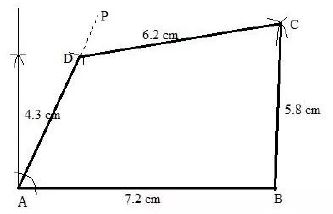
Exam Tip: Be sure to label the angle construct clearly on the diagram, as partial credit is awarded for accurate angle creation using a compass.
Question 3. Construct a quadrilateral \( ABCD \) in which \( AB = 4.6\text{ cm} \), \( \angle A = 90^\circ \), \( BD = 6.4\text{ cm} \), \( CD = 4.2\text{ cm} \), and \( AC = 6\text{ cm} \).
Answer:
1. Draw a line segment \( AB = 4.6\text{ cm} \).
2. Construct a perpendicular ray \( AP \) through point \( A \) such that \( \angle A = 90^\circ \).
3. With \( B \) as a center and a radius of \( 6.4\text{ cm} \), draw an arc that intersects the ray \( AP \) at point \( D \).
4. Using \( D \) and \( A \) as centers, draw arcs with radii of \( 4.2\text{ cm} \) and \( 6\text{ cm} \) respectively, which cross at point \( C \).
5. Connect \( BD \), \( AC \), and \( CB \) to finish.
\( ABCD \) is the required quadrilateral.
In simple words: Draw the base, make a 90-degree corner at A, find point D with an arc from B, then locate C by drawing arcs from A and D.
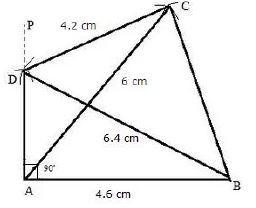
Exam Tip: Be precise when intersecting the 6.4 cm diagonal arc with the perpendicular ray at point D - always mark the intersection point clearly.
Question 4. Construct a quadrilateral \( ABCD \) in which \( AD = 2.8\text{ cm} \), \( AB = 3.8\text{ cm} \), \( \angle A = 105^\circ \), \( \angle B = 60^\circ \), and \( AC = 4.8\text{ cm} \).
Answer:
1. Draw the base segment \( AD = 2.8\text{ cm} \).
2. From \( A \), construct a segment \( AB = 3.8\text{ cm} \) such that the angle \( \angle DAB = 105^\circ \).
3. At point \( B \), construct a ray \( BP \) making an angle of \( 60^\circ \) with \( AB \).
4. With \( A \) as a center and a radius of \( 4.8\text{ cm} \), draw an arc intersecting the ray \( BP \) at point \( C \).
5. Connect points \( AC \) and \( CD \).
\( ABCD \) is the desired quadrilateral.
In simple words: Draw the bottom side AD, then draw side AB at an angle of 105 degrees. From B, construct a 60-degree angle, and find point C with a compass sweep from A.
Exam Tip: Be sure to measure the 105-degree angle carefully with your compass - clean construction marks here will help secure full marks.
Question 5. Construct a quadrilateral \( ABCD \) in which \( AD = 3.6\text{ cm} \), \( \angle A = 120^\circ \), \( AC = 5.8\text{ cm} \), \( CD = 4.2\text{ cm} \), and \( BC = 7.5\text{ cm} \).
Answer:
1. Draw the base segment \( AD = 3.6\text{ cm} \).
2. Construct a ray \( AP \) through \( A \) making an angle of \( 120^\circ \).
3. Using \( A \) and \( D \) as centers with radii of \( 5.8\text{ cm} \) and \( 4.2\text{ cm} \) respectively, draw arcs that cross at point \( C \).
4. Connect \( AC \) and \( CD \).
5. Using \( C \) as a center and a radius of \( 7.5\text{ cm} \), draw an arc that meets the ray \( AP \) at point \( B \).
6. Connect \( CB \) to complete the quadrilateral.
\( ABCD \) is the constructed quadrilateral.
In simple words: Draw AD first, make a 120-degree angle from A, locate C by intersecting two arcs from A and D, and finally locate B using an arc from C.
Exam Tip: Be careful to draw the 120-degree angle from the correct side of the vertex to avoid drawing the line in the wrong direction.
Question 6. Construct a quadrilateral \( ABCD \) in which \( AD = 4\text{ cm} \), \( \angle A = 45^\circ \), \( AB = 4\text{ cm} \), \( BC = 2.8\text{ cm} \), and \( CD = 2.5\text{ cm} \).
Answer:
1. Draw the base line segment \( AD = 4\text{ cm} \).
2. Construct a ray \( AP \) from point \( A \) such that \( \angle A = 45^\circ \).
3. Set the compass to a radius of \( 4\text{ cm} \) and sweep an arc from \( A \) to locate point \( B \) on the ray \( AP \).
4. With \( B \) and \( D \) as centers, and radii of \( 2.8\text{ cm} \) and \( 2.5\text{ cm} \) respectively, draw arcs that intersect each other at point \( C \).
5. Connect the points \( BC \) and \( CD \).
\( ABCD \) is the required quadrilateral.
In simple words: Start with the bottom line AD, construct a 45-degree angle to place B, then draw arcs of 2.8 cm from B and 2.5 cm from D to locate C.
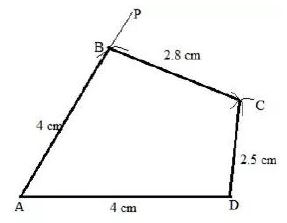
Exam Tip: Always make a small mark or cross where the arcs intersect to clearly highlight the positions of vertices like C.
Question 7. Construct a quadrilateral \( ABCD \) in which \( AB = 6.3\text{ cm} \), \( \angle B = 90^\circ \), \( BC = 4.2\text{ cm} \), \( CD = 4.2\text{ cm} \), and \( \angle C = 90^\circ \).
Answer:
1. Draw a line segment \( AB = 6.3\text{ cm} \).
2. Construct a perpendicular ray \( BP \) from point \( B \) such that \( \angle B = 90^\circ \).
3. With \( B \) as the center and a radius of \( 4.2\text{ cm} \), draw an arc intersecting \( BP \) at point \( C \).
4. At point \( C \), construct a segment \( CD \) of length \( 4.2\text{ cm} \) perpendicular to \( BC \).
5. Connect the points \( A \) and \( D \).
This completes the construction of quadrilateral \( ABCD \).
In simple words: Draw AB first. Go straight up from B by 4.2 cm to find C. From C, turn left at a 90-degree angle and draw CD. Join D to A to finish.
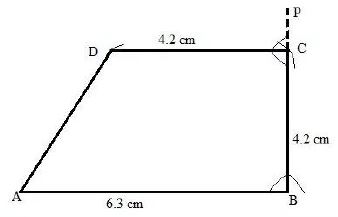
Exam Tip: Be sure to indicate both 90-degree angles with small square markers in your drawing to show they are exactly right angles.
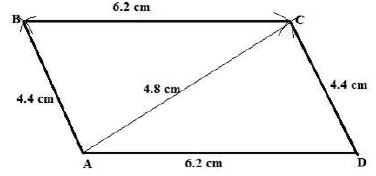
Question 8. Construct a parallelogram \( ABCD \) in which \( AD = 6.2\text{ cm} \), \( CD = 4.4\text{ cm} \), and diagonal \( AC = 4.8\text{ cm} \).
Answer:
1. Draw the base segment \( AD = 6.2\text{ cm} \).
2. Construct triangle \( ACD \) by drawing an arc of radius \( 4.8\text{ cm} \) from \( A \) and an arc of radius \( 4.4\text{ cm} \) from \( D \) to intersect at \( C \). Join \( AC \) and \( CD \).
3. Because opposite sides of a parallelogram are equal, draw an arc of radius \( 4.4\text{ cm} \) from \( A \) and an arc of radius \( 6.2\text{ cm} \) from \( C \). Let these arcs intersect at point \( B \).
4. Connect the points \( AB \) and \( BC \).
\( ABCD \) is the constructed parallelogram.
In simple words: Draw AD, then use your compass from A and D to find C. Since the opposite sides are equal, use the side measurements to find B from A and C.
Exam Tip: Remember that opposite sides in any parallelogram are equal. Use this property to find the last point without needing extra measurements.
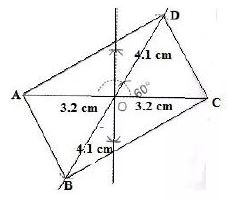
Question 9. Construct a parallelogram \( ABCD \) whose diagonals are \( 6.4\text{ cm} \) and \( 8.2\text{ cm} \), and the angle between them is \( 60^\circ \).
Answer:
1. Draw the diagonal line segment \( AC = 6.4\text{ cm} \) and locate its midpoint \( O \).
2. Construct a line \( BOD \) passing through \( O \) such that \( \angle DOC = 60^\circ \).
3. Along this line, mark points \( B \) and \( D \) on either side of \( O \) such that \( OB = OD = 4.1\text{ cm} \) (which is half of the diagonal length of \( 8.2\text{ cm} \)).
4. Connect the points \( AB \), \( BC \), \( CD \), and \( DA \) to complete the figure.
\( ABCD \) is the desired parallelogram.
In simple words: Draw one diagonal and find its exact middle. Draw a line through the middle at 60 degrees, and mark half of the other diagonal on each side. Join the outer points.
Exam Tip: Since diagonals of a parallelogram bisect each other, make sure you divide the total diagonal length of 8.2 cm into two equal halves of 4.1 cm.
Question 10. Construct a parallelogram \( ABCD \) with side \( AB = 5.8\text{ cm} \) and diagonals \( AC = 8.2\text{ cm} \) and \( BD = 6.2\text{ cm} \).
Answer:
1. Because the diagonals of a parallelogram bisect each other, first construct triangle \( OAB \). Use \( AB = 5.8\text{ cm} \), \( OA = 4.1\text{ cm} \) (half of \( AC \)), and \( OB = 3.1\text{ cm} \) (half of \( BD \)).
2. Extend the line segment \( AO \) to a point \( C \) such that \( OC = OA = 4.1\text{ cm} \).
3. Extend the line segment \( BO \) to a point \( D \) such that \( OD = OB = 3.1\text{ cm} \).
4. Connect points \( AD \), \( DC \), and \( CB \) to complete the parallelogram.
\( ABCD \) is the required parallelogram.
In simple words: Build a small triangle OAB using the base and half of both diagonals. Then double the lengths of the diagonals through the middle point O to find the remaining corners C and D.
Exam Tip: Be sure to extend the diagonals with clean, thin dashed lines through the midpoint O to show correct construction methodology.
Question 11. Construct a parallelogram \( ABCD \) in which \( AB = 6\text{ cm} \), \( AD = 5\text{ cm} \), and \( \angle A = 45^\circ \).
Answer:
1. Draw the base segment \( AB = 6\text{ cm} \).
2. Construct a ray \( AP \) through point \( A \) such that \( \angle A = 45^\circ \).
3. Cut off a length of \( AD = 5\text{ cm} \) from the ray \( AP \).
4. From \( D \), draw an arc of radius \( 6\text{ cm} \). From \( B \), draw an arc of radius \( 5\text{ cm} \). Let these two arcs meet at point \( C \).
5. Connect points \( CD \) and \( BC \).
\( ABCD \) is the required parallelogram.
In simple words: Draw the base line of 6 cm. Measure a 45-degree corner at A and make it 5 cm long to find D. Find C using arcs of 6 cm and 5 cm from D and B.
Exam Tip: Label all lengths and angles carefully. Use clear cross-arcs to show that you found point C using a compass rather than guessing.
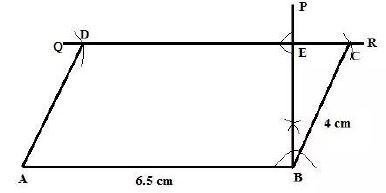
Question 12. Construct a parallelogram \( ABCD \) with base \( AB = 6.5\text{ cm} \), altitude \( 3.1\text{ cm} \), and adjacent sides of length \( 4\text{ cm} \).
Answer:
1. Draw a line segment \( AB = 6.5\text{ cm} \).
2. At point \( B \), construct a perpendicular line \( BP \).
3. Cut off \( BE = 3.1\text{ cm} \) along \( BP \).
4. Draw a parallel line \( QR \) through point \( E \) that is parallel to \( AB \).
5. Using \( B \) as a center with a radius of \( 4\text{ cm} \), draw an arc cutting the line \( QR \) at point \( C \).
6. Using \( A \) as a center with a radius of \( 4\text{ cm} \), draw an arc cutting the line \( QR \) at point \( D \).
7. Connect \( BC \), \( AD \), and \( CD \) to complete the shape.
\( ABCD \) is the desired parallelogram.
In simple words: Draw a 6.5 cm line at the bottom. Draw a parallel line 3.1 cm above it. Swing a 4 cm arc from both ends of the bottom line to find the top corners.
Exam Tip: Clearly show the helper perpendicular line used to establish the altitude of 3.1 cm, as this is a key step in parallel-line constructions.
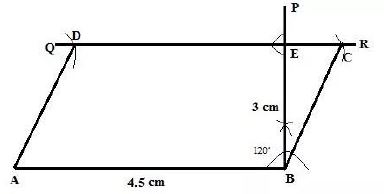
Question 13. Construct a parallelogram \( ABCD \) in which \( AB = 4.5\text{ cm} \), the altitude is \( 3\text{ cm} \), and \( \angle B = 120^\circ \).
Answer:
1. Draw the base segment \( AB = 4.5\text{ cm} \).
2. From point \( B \), draw a perpendicular line \( BP \).
3. Cut off a length of \( BE = 3\text{ cm} \) from \( BP \).
4. Draw a straight line \( QR \) through point \( E \) that is parallel to \( AB \).
5. Construct a ray from point \( B \) at an angle of \( 120^\circ \), intersecting the parallel line \( QR \) at point \( C \).
6. From point \( A \), draw a line parallel to \( BC \) to meet the line \( QR \) at point \( D \).
This completes the parallelogram \( ABCD \).
In simple words: Draw a 4.5 cm line. Make a parallel line 3 cm above it. Create a 120-degree angle from B to cross the parallel line at C, then copy this slant at A to find D.
Exam Tip: When given an angle and an altitude, make sure to construct the parallel line at the correct height first before constructing the angle ray.
Question 14. Construct a parallelogram \( ABCD \) in which base \( BC = 5.6\text{ cm} \), altitude is \( 3.2\text{ cm} \), and diagonal \( BD = 6.5\text{ cm} \).
Answer:
1. Draw the base segment \( BC = 5.6\text{ cm} \).
2. At point \( C \), construct a perpendicular line \( CX \).
3. Cut off a length of \( CY = 3.2\text{ cm} \) from \( CX \).
4. Draw a line \( PQ \) through \( Y \) parallel to \( BC \).
5. With \( B \) as a center and a radius of \( 6.5\text{ cm} \), draw an arc intersecting \( PQ \) at point \( D \).
6. With \( D \) as a center and a radius equal to \( 5.6\text{ cm} \), draw an arc intersecting \( PQ \) at point \( A \).
7. Connect points \( BA \), \( BD \), and \( CD \) to complete the figure.
\( ABCD \) is the desired parallelogram.
In simple words: Draw a 5.6 cm line. Make a parallel line 3.2 cm above it. From B, swing a 6.5 cm arc to find D on that top line, then measure 5.6 cm from D to locate A.
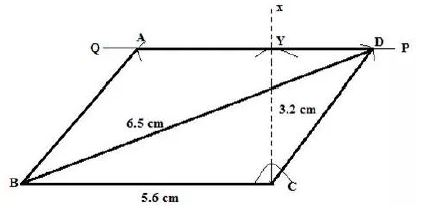
Exam Tip: Make sure to clearly draw the diagonal line BD to show the 6.5 cm distance as instructed by the problem.
Question 15. Construct a rectangle \( ABCD \) with side \( BC = 7.2\text{ cm} \) and adjacent side \( AB = 6\text{ cm} \).
Answer:
1. Draw the base segment \( BC = 7.2\text{ cm} \).
2. At point \( B \), construct a line \( BX \) perpendicular to \( BC \).
3. With \( B \) as the center and a radius of \( 6\text{ cm} \), draw an arc on \( BX \) to find point \( A \).
4. From point \( A \), draw a line \( AY \) parallel to \( BC \).
5. With \( A \) as the center and a radius of \( 7.2\text{ cm} \), draw an arc to find point \( D \) on \( AY \).
6. Connect points \( C \) and \( D \).
This completes the rectangle \( ABCD \).
In simple words: Draw a 7.2 cm bottom line. Go straight up from B by 6 cm to find A. Draw a horizontal line from A, and measure 7.2 cm along it to locate D. Join D to C.
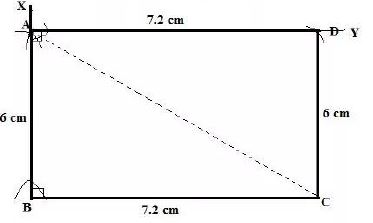
Exam Tip: Ensure that all four angles are exactly 90 degrees and opposite sides are equal to verify that the constructed figure is indeed a rectangle.
Question 16. Construct a rectangle \( ABCD \) with side \( BC = 4\text{ cm} \) and diagonal \( AC = 5\text{ cm} \).
Answer:
1. Draw the base segment \( BC = 4\text{ cm} \).
2. From point \( B \), draw a perpendicular ray (angle \( 90^\circ \)).
3. With \( C \) as the center and a radius of \( 5\text{ cm} \), draw an arc to intersect the perpendicular ray at point \( A \).
4. Connect points \( AB \) and \( AC \).
5. Using \( A \) as the center and a radius of \( 4\text{ cm} \), and \( C \) as the center and a radius equal to \( AB \), draw arcs to intersect at \( D \).
6. Connect \( AD \) and \( CD \) to complete the rectangle.
This completes the rectangle \( ABCD \).
In simple words: Draw a 4 cm line BC. Make a perpendicular line at B. From C, swing a 5 cm arc to cross it at A. Since opposite sides are equal, locate D and join the points.
Exam Tip: Using the Pythagorean theorem, you can verify that side AB must be 3 cm. Checking this measurement helps ensure your drawing is accurate.
Question 17. Construct a rectangle \( ABCD \) whose diagonals are each \( 6\text{ cm} \) and intersect at an angle of \( 45^\circ \).
Answer:
1. Draw the diagonal line segment \( AC = 6\text{ cm} \) and find its midpoint \( O \).
2. Draw a straight line through \( O \) making an angle of \( 45^\circ \) with \( AC \).
3. Measure \( 3\text{ cm} \) (half of the diagonal length) on either side of \( O \) along this line to locate points \( B \) and \( D \).
4. Connect points \( AB \), \( BC \), \( CD \), and \( DA \) to complete the rectangle.
\( ABCD \) is the desired rectangle.
In simple words: Draw a 6 cm line and mark the exact middle. Draw another line through the middle at a 45-degree angle. Mark 3 cm on both sides from the center, then connect all four ends.
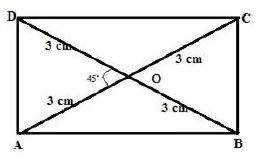
Exam Tip: Since diagonals of a rectangle are equal and bisect each other, make sure both segments are divided exactly in half from O.
Question 18. Construct a rectangle \( ABCD \) with base \( AB = 4.8\text{ cm} \) and area \( 24\text{ cm}^2 \).
Answer:
We know that:
\( \text{Area of a rectangle} = \text{base} \times \text{height} \)
Therefore,
\( 24 = 4.8 \times \text{height} \)
\( \text{height} = 5\text{ cm} \).
We construct the rectangle with base \( AB = 4.8\text{ cm} \) and height \( 5\text{ cm} \):
1. Draw the base segment \( AB = 4.8\text{ cm} \).
2. From both point \( A \) and point \( B \), draw perpendicular arcs to locate points \( D \) and \( C \) at a distance of \( 5\text{ cm} \).
3. Connect the points \( AD \), \( BC \), and \( DC \) to complete the figure.
\( ABCD \) is the constructed rectangle.
In simple words: First calculate the height using the area formula (24 divided by 4.8 is 5 cm). Draw a 4.8 cm base line, then draw two vertical lines of 5 cm from its ends and connect them.
Exam Tip: Always show the arithmetic calculation for the height step before starting the physical geometry construction.
Question 19. Construct a rectangle \( ABCD \) with height \( 4.5\text{ cm} \) and area \( 36\text{ cm}^2 \).
Answer:
Using the formula:
\( \text{Area of a rectangle} = \text{base} \times \text{height} \)
Therefore,
\( 36 = \text{base} \times 4.5 \)
\( \text{base} = 8\text{ cm} \).
We construct the rectangle using base \( AB = 8\text{ cm} \) and height \( 4.5\text{ cm} \):
1. Draw the base segment \( AB = 8\text{ cm} \).
2. Construct perpendicular rays from point \( A \) and point \( B \).
3. Cut off lengths of \( 4.5\text{ cm} \) along these rays to find points \( D \) and \( C \) respectively.
4. Connect points \( AD \), \( BC \), and \( DC \).
\( ABCD \) is the finished rectangle.
In simple words: Find the base length first (36 divided by 4.5 is 8 cm). Draw an 8 cm line, go straight up from both ends by 4.5 cm to find the top corners, and connect them.
Exam Tip: Be precise with your division arithmetic so you do not carry a rounding error into your geometry work.
Question 20. Construct a trapezium ABCD, when: AB = 4.8 cm, BC = 6.8 cm, CD = 5.4 cm, \( \angle B = 60^\circ \) and \( AD \parallel BC \).
Answer:
1. Construct a line segment \( BC \) with a length of \( 6.8\text{ cm} \).
2. Set the compass to \( 4.8\text{ cm} \), place the pointer at \( B \), and draw an arc to mark point \( A \) such that \( \angle B = 60^\circ \).
3. From \( A \), construct a line \( AP \) parallel to \( BC \).
4. Place the compass point at \( C \) with a radius of \( 5.4\text{ cm} \) and mark an arc intersecting the line \( AP \) at \( D \).
5. Complete the figure by joining \( AB \) and \( CD \) to obtain the required trapezium \( ABCD \).
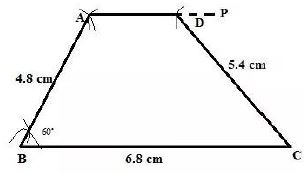
In simple words: First, draw the base. Then make a 60-degree angle and measure the left side. Draw a parallel line along the top, and find the last corner by measuring from the bottom-right corner.
Exam Tip: Ensure that the parallel line AP is drawn accurately using a set square or equal angles, and clearly show the arc of radius 5.4 cm intersecting it.
Question 21. Construct a trapezium ABCD, when: AB = CD = 3.2 cm, BC = 6.0 cm, AD = 4.1 cm and AD || BC.
Answer:
1. Draw the base line segment \( BC \) of length \( 6\text{ cm} \).
2. Measure and cut a length \( BE = 4.1\text{ cm} \) along \( BC \) from point \( B \), representing the length of \( AD \).
3. Using \( E \) and \( C \) as centers, draw arcs with radius \( 3.2\text{ cm} \) to intersect at \( D \), completing triangle \( DEC \) where \( DE = CD = 3.2\text{ cm} \).
4. With \( B \) and \( D \) as centers, draw arcs of radii \( 3.2\text{ cm} \) and \( 4.1\text{ cm} \) respectively, which intersect at point \( A \).
5. Connect \( AB \) and \( AD \) to finish the construction of the required trapezium \( ABCD \).
In simple words: Draw a 6 cm base, then mark a point at 4.1 cm. Use this point to construct a small triangle on the right side. Finally, find the top-left corner by crossing arcs measured from the bottom-left and top-right points.
Exam Tip: Remember that cutting \( BE = AD \) creates a parallelogram \( ABED \) and a triangle \( DEC \). Constructing triangle \( DEC \) first is the key to solving this type of trapezium problem.
Question 22. Construct a rhombus ABCD, when: One side = 6 cm and ∠ A = 60°.
Answer:
1. Construct a horizontal segment \( AB \) of length \( 6\text{ cm} \).
2. At vertex \( A \), use a compass or protractor to construct an angle \( \angle BAP = 60^\circ \).
3. From the ray \( AP \), mark off point \( D \) such that \( AD = 6\text{ cm} \).
4. Through point \( B \), construct a line \( BQ \) parallel to \( AD \).
5. Through point \( D \), construct a line parallel to \( AB \), intersecting \( BQ \) at \( C \) to complete the rhombus \( ABCD \).
In simple words: First, draw a 6 cm line segment at the bottom. Then, make a 60-degree angle from the left end and measure 6 cm along that angled line to find the top-left corner. Complete the shape by drawing parallel lines of the same length.
Exam Tip: Since all sides of a rhombus are equal, make sure to set your compass to exactly 6 cm for drawing both the sides and construction arcs.
Question 23. Construct a rhombus ABCD, when: One side = 5.4 cm and one diagonal is 7.0 cm.
Answer:
1. Draw the diagonal line segment \( AC \) of length \( 7\text{ cm} \).
2. Set the compass to a radius of \( 5.4\text{ cm} \). With \( A \) as the center, draw arcs on both sides of \( AC \).
3. Using the same radius of \( 5.4\text{ cm} \) and with \( C \) as the center, draw arcs that intersect the previous ones at points \( B \) and \( D \).
4. Connect \( AB \), \( BC \), \( CD \), and \( DA \) to construct the required rhombus \( ABCD \).
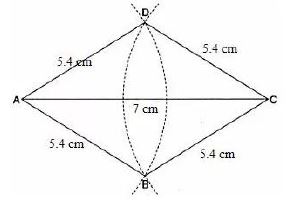
In simple words: Start by drawing a horizontal line 7 cm long to act as the diagonal. From each end of this line, draw intersecting arcs 5.4 cm wide both above and below. Connect these intersection points to the ends of the diagonal to finish.
Exam Tip: Label the diagonal length clearly and draw the intersecting arcs distinctly on both sides of the diagonal to show proper use of a compass.
Question 24. Construct a rhombus ABCD, when: Diagonals AC = 6.3 cm and BD = 5.8 cm.
Answer:
1. Draw the first diagonal \( AC \) of length \( 6.3\text{ cm} \).
2. Construct the perpendicular bisector of \( AC \), which meets \( AC \) at its midpoint \( O \).
3. From \( O \), mark off lengths \( OD \) and \( OB \) along the bisector such that \( OD = OB = \frac{1}{2} BD = 2.9\text{ cm} \).
4. Connect the points \( A \), \( B \), \( C \), and \( D \) to complete the rhombus \( ABCD \).
In simple words: First, draw a horizontal line 6.3 cm long. Construct a perpendicular line straight through its center, and measure 2.9 cm both up and down from the center point. Join the four outer tips to complete the rhombus.
Exam Tip: Since diagonals of a rhombus bisect each other at right angles, always construct a highly accurate perpendicular bisector of the first diagonal before laying out the second one.
Question 25. Construct a rhombus ABCD, when: One side = 5.0 cm and height = 2.6 cm.
Answer:
1. Draw the base segment \( AB \) with a length of \( 5\text{ cm} \).
2. At vertex \( B \), construct a perpendicular line \( BP \) to \( AB \).
3. From the line \( BP \), mark off a segment \( BE = 2.6\text{ cm} \), representing the altitude of the rhombus.
4. Draw a line \( QR \) parallel to \( AB \) by constructing a line perpendicular to \( BP \) through point \( E \).
5. With \( A \) and \( B \) as centers and a radius of \( 5\text{ cm} \), draw arcs that intersect \( QR \) at points \( D \) and \( C \) respectively.
6. Connect \( BC \), \( CD \), and \( DA \) to finish the construction.
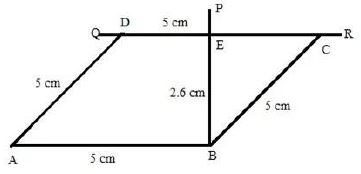
In simple words: Draw a 5 cm base line segment. Construct a vertical line 2.6 cm high from the right end, and draw a parallel line across the top at that level. From each bottom corner, draw 5 cm arcs that intersect this top line to find the upper corners.
Exam Tip: Be sure to construct and label the perpendicular distance (height) of 2.6 cm carefully, and keep your parallel line long enough to easily find the intersections with the 5 cm arcs.
Question 26. Construct a rhombus ABCD, when: ∠ A = 60° and height = 3.0 cm.
Answer:
1. Construct a base line \( AP \).
2. Draw a line \( AF \) from point \( A \) making an angle \( \angle A = 60^\circ \) with \( AP \).
3. At a point \( S \) on \( AP \), erect a perpendicular \( SE \) of height \( 3\text{ cm} \).
4. Through the point where this perpendicular height intersects \( AF \), label it \( D \) and draw a parallel line \( QR \) to \( AP \).
5. With the compass set to the length of \( AD \), place the pointer at \( A \) and mark point \( B \) on the base line \( AP \).
6. Using the same radius (equal to \( AD \)) and with centers \( D \) and \( B \), draw arcs that intersect each other at \( C \).
7. Connect \( B \) and \( C \) to complete the rhombus \( ABCD \).
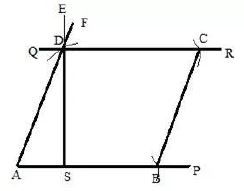
In simple words: Draw a bottom horizontal line and another line at a 60-degree angle from the left end. Mark a height of 3 cm straight up from the base line, draw a parallel line there, and let it cut the angled line to find the top-left point. The remaining corners are found using the same side length.
Exam Tip: Use the trigonometric relation \( \sin 60^\circ = \frac{\text{height}}{\text{side}} \) to understand why the side length \( AD \) is determined by where the parallel line intersects the 60° angled ray.
Question 27. Construct a rhombus ABCD, when: Diagonal AC = 6.0 cm and height = 3.5 cm.
Answer:
1. Draw a straight baseline \( AP \).
2. Locate a point \( C \) at a perpendicular distance of \( 3.5\text{ cm} \) above \( AP \) such that diagonal \( AC = 6\text{ cm} \).
3. Determine point \( B \) on the line \( AP \) by constructing \( BC \) such that \( AB = BC \) (using a perpendicular bisector of \( AC \) meeting \( AP \)).
4. Through \( C \), draw a line \( CY \) parallel to \( AP \).
5. With the compass set to the length of \( AB \), draw arcs from centers \( A \) and \( C \) that intersect at \( D \) along the line \( CY \).
6. Connect \( AD \) and \( CD \) to complete the required rhombus \( ABCD \).
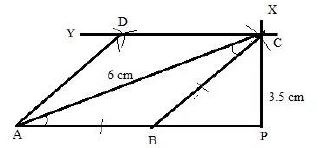
In simple words: Draw a baseline at the bottom. Position the top-right corner 3.5 cm above this line so that the diagonal measures exactly 6 cm. Find the other corners by creating equal side lengths on the top and bottom parallel lines.
Exam Tip: Remember to locate point B using the perpendicular bisector of the diagonal AC, since any point on the bisector is equidistant from A and C, ensuring \( AB = BC \).
Question 28. Construct a square ABCD, when: One side = 4.5 cm.
Answer:
1. Draw a horizontal line segment \( AB \) of length \( 4.5\text{ cm} \).
2. At \( A \), construct a perpendicular line \( AP \) to \( AB \).
3. From \( AP \), measure and cut off a segment \( AD = 4.5\text{ cm} \).
4. With \( B \) as the center and a radius of \( 4.5\text{ cm} \), draw an arc in the upper right region.
5. With \( D \) as the center and the same radius of \( 4.5\text{ cm} \), draw another arc that intersects the first arc at point \( C \).
6. Complete the square by connecting \( BC \) and \( CD \).
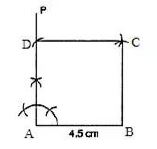
In simple words: Draw a horizontal line 4.5 cm long. Erect a vertical line of the same length from the left end to find the top-left corner. From the other two corners, draw 4.5 cm arcs that cross to mark the remaining corner.
Exam Tip: Always make sure to construct a precise 90° angle at vertex A using a compass, and verify that all four sides are exactly equal to 4.5 cm.
Question 29. Construct a square ABCD, when: One diagonal = 5.4 cm.
Answer:
1. Draw the diagonal segment \( AC \) of length \( 5.4\text{ cm} \).
2. Construct the perpendicular bisector \( XY \) of \( AC \), intersecting \( AC \) at point \( O \).
3. From the center \( O \), measure and cut off lengths of \( 2.7\text{ cm} \) on both sides of the bisector to locate vertices \( B \) (along \( OY \)) and \( D \) (along \( OX \)).
4. Connect \( AB \), \( BC \), \( CD \), and \( DA \) to construct the required square \( ABCD \).
In simple words: Draw a diagonal line 5.4 cm long, then construct a vertical perpendicular line right through its center. Measure 2.7 cm both straight up and straight down from the center, and join those four outer points.
Exam Tip: Use the property that square diagonals are equal and perpendicular bisectors of each other. Show the perpendicular bisector construction clearly with intersecting arcs.
Question 30. Construct a square ABCD, when: Perimeter = 24 cm.
Answer:
First, let us calculate the side length of the square:
The perimeter of a square is given by \( P = 4a \), where \( a \) is the length of one side.
Given, \( P = 24\text{ cm} \).
\( \implies 24 = 4a \)
\( \implies a = 6\text{ cm} \)
Thus, each side of the square measures \( 6\text{ cm} \).
Steps of construction:
1. Draw a horizontal segment \( AB \) with a length of \( 6\text{ cm} \).
2. Construct a perpendicular ray \( AP \) from point \( A \).
3. From \( AP \), mark off a length \( AD = 6\text{ cm} \).
4. With \( B \) as the center, draw an arc of radius \( 6\text{ cm} \) in the upper right quadrant.
5. With \( D \) as the center and a radius of \( 6\text{ cm} \), draw another arc that intersects the previous arc at \( C \).
6. Join \( BC \) and \( CD \) to complete the required square \( ABCD \).
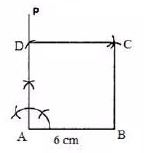
In simple words: Since the perimeter is 24 cm, each of the four sides must be 6 cm long. Draw a 6 cm baseline, raise a 6 cm perpendicular line at one end, and cross 6 cm arcs from the corners to find the final corner.
Exam Tip: Show the calculation of the side length \( a = 6\text{ cm} \) from the perimeter at the beginning of your answer, as it carries separate marks in the marking scheme.
Question 31. Construct a rhombus, having given one side = 4.8 cm and one angle = 75°.
Answer:
1. Draw the base segment \( AB \) of length \( 4.8\text{ cm} \).
2. At \( A \), construct a ray \( AX \) making an angle of \( 75^\circ \) with \( AB \).
3. With \( A \) as the center and a radius of \( 4.8\text{ cm} \), draw an arc to cut the ray \( AX \) at point \( D \).
4. Keeping the same radius of \( 4.8\text{ cm} \), draw intersecting arcs with centers at \( D \) and \( B \) respectively to find point \( C \).
5. Connect \( CD \) and \( BC \) to finish the construction of the required rhombus \( ABCD \).
In simple words: Draw a 4.8 cm line at the bottom. Create a 75-degree angle on the left side and mark 4.8 cm up that line to find the top-left point. Finally, draw equal 4.8 cm arcs from the other corners to meet at the top-right corner.
Exam Tip: Rhombus construction relies heavily on the fact that all four sides are equal. Double check that your compass doesn't slip from the 4.8 cm measurement while drawing all the arcs.
Question 32. Using ruler and compasses only, construct a rectangle each of whose diagonals measures 6 cm and the diagonals intersect at an angle of 45°.
Answer:
1. Draw the diagonal line segment \( AC \) of length \( 6\text{ cm} \).
2. Construct the perpendicular bisector of \( AC \) to determine its midpoint \( O \).
3. At point \( O \), construct an angle of \( 45^\circ \) with \( AC \) and extend a line in both directions.
4. From \( O \), mark off segments \( OD = 3\text{ cm} \) and \( OB = 3\text{ cm} \) along this line.
5. Join the points \( AB \), \( BC \), \( CD \), and \( DA \) to construct the required rectangle \( ABCD \).
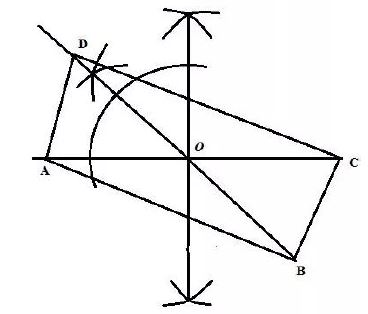
In simple words: Draw a 6 cm horizontal line to represent the first diagonal and find its exact center. Draw another line through this center at a 45-degree angle, measure 3 cm out in both directions, and connect the outer endpoints.
Exam Tip: Remember that diagonals of a rectangle are equal in length and bisect each other. So the distance of each vertex from the intersection point O must be exactly half the diagonal length, i.e., 3 cm.
Question 33. Using ruler and compasses only, construct the quadrilateral ABCD, having given AB = 5 cm, BC = 2.5 cm, CD = 6 cm, angle BAD = 90° and the diagonal AC = 5.5 cm.
Answer:
1. Draw the baseline \( AB \) with a length of \( 5\text{ cm} \).
2. At vertex \( A \), construct a perpendicular ray \( AX \) making a \( 90^\circ \) angle.
3. With \( B \) and \( A \) as centers, draw arcs of radii \( 2.5\text{ cm} \) and \( 5.5\text{ cm} \) respectively, to intersect at point \( C \).
4. Connect points \( BC \) and \( AC \) to form the triangle \( ABC \).
5. With \( C \) as the center and a radius of \( 6\text{ cm} \), draw an arc that cuts the perpendicular ray \( AX \) at point \( D \).
6. Join \( CD \) to complete the quadrilateral \( ABCD \).
In simple words: Draw a 5 cm baseline and erect a vertical line at its left end. Locate the bottom-right and top-right points by crossing arcs of 2.5 cm and 5.5 cm, then find the top-left corner by swinging a 6 cm arc from the top-right point onto the vertical line.
Exam Tip: Be sure to construct the right triangle ABC first using the given base AB and diagonal AC, as this establishes the position of point C from which the rest of the shape is constructed.
Question 34. Using ruler and compasses only, construct a trapezium ABCD, in which the parallel sides AB and DC are 3.3 cm apart; AB = 4.5 cm, angle A = 120°, BC = 3.6 cm and angle B is obtuse.
Answer:
1. Draw the base segment \( AB \) of length \( 4.5\text{ cm} \).
2. At vertex \( A \), construct an angle of \( 120^\circ \) using ray \( AS \), and also construct a perpendicular line \( EA \) to \( AB \) with a height \( AX = 3.3\text{ cm} \).
3. Draw a line \( QR \) parallel to \( AB \) passing through \( X \), which intersects the ray \( AS \) at point \( D \).
4. With \( B \) as the center and a radius of \( 3.6\text{ cm} \), draw an arc to intersect \( QR \) at point \( C \).
5. Complete the trapezium by joining \( BC \) and \( CD \).
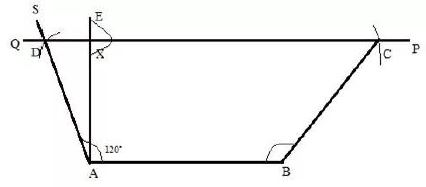
In simple words: Draw a 4.5 cm baseline. Construct a 120-degree angle from the left end, and set a parallel ceiling line 3.3 cm high. The top-left corner is where the angled line meets the ceiling, and the top-right corner is found by swinging a 3.6 cm arc from the bottom-right corner.
Exam Tip: Be sure to verify that the angle B is indeed obtuse in your final constructed figure, which occurs when you choose the correct intersection point on line QR.
Question 35. Using ruler and compasses only, construct the quadrilateral ABCD, having given AB = 5 cm, BC = 2.5 cm, CD = 6 cm, angle BAD = 90° and diagonal BD = 5.5 cm.
Answer:
1. Draw the baseline \( AB \) with a length of \( 5\text{ cm} \).
2. From point \( A \), draw a perpendicular ray \( AY \) representing a \( 90^\circ \) angle with \( AB \).
3. With \( B \) as the center and a radius of \( 5.5\text{ cm} \), draw an arc that cuts the ray \( AY \) at point \( D \).
4. Using \( D \) and \( B \) as centers, draw arcs with radii of \( 6\text{ cm} \) and \( 2.5\text{ cm} \) respectively, which intersect at point \( C \).
5. Join \( DC \) and \( BC \) to complete the quadrilateral \( ABCD \)
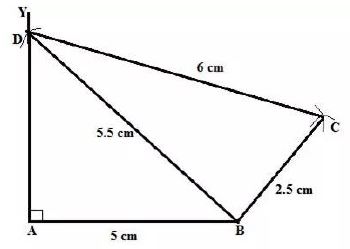
In simple words: Draw a 5 cm baseline and erect a vertical line on its left side. From the bottom-right corner, draw a 5.5 cm arc to cross the vertical line and find the top-left corner. Then, draw intersecting arcs of 6 cm and 2.5 cm to locate the remaining corner.
Exam Tip: Since diagonal BD is given instead of AC, construct the right triangle ABD first at vertex A, then use vertices B and D as centers for constructing the rest of the quadrilateral.
Question 36. Using ruler and compasses only, construct a parallelogram ABCD using the following data: AB = 6 cm, AD = 3 cm and ∠DAB = 45°. If the bisector of ∠DAB meets DC at P, prove that ∠APB is a right angle.
Answer:
Steps of construction:
1. Draw the base segment \( AB \) of length \( 6\text{ cm} \).
2. At point \( A \), construct a ray \( AX \) making an angle \( \angle BAX = 45^\circ \).
3. Cut a segment \( AD = 3\text{ cm} \) along \( AX \) using a compass.
4. With \( D \) and \( B \) as centers, draw arcs of radii \( 6\text{ cm} \) and \( 3\text{ cm} \) respectively, intersecting at point \( C \).
5. Connect \( CD \) and \( BC \) to finish drawing the parallelogram \( ABCD \).
Proof:
Let \( AP \) be the angle bisector of \( \angle DAB \).
Thus, \( \angle DAP = \angle PAB \).
Since \( AB \parallel CD \), the alternate interior angles are equal:
\( \angle APD = \angle PAB \)
Therefore, in triangle \( APD \), since \( \angle DAP = \angle APD \), the opposite sides are equal:
\( AD = DP = 3\text{ cm} \)
Since \( CD = AB = 6\text{ cm} \), we have:
\( CP = CD - DP = 6 - 3 = 3\text{ cm} \)
Since \( BC = AD = 3\text{ cm} \), in triangle \( BCP \), we have \( CP = BC = 3\text{ cm} \), which implies:
\( \angle CPB = \angle PBC \)
Because \( AB \parallel CD \), we also have:
\( \angle CPB = \angle PBA \) (alternate angles)
Thus, \( \angle PBC = \angle PBA \), showing that \( BP \) is the bisector of \( \angle B \).
In any parallelogram, the sum of adjacent angles is \( 180^\circ \):
\( \angle DAB + \angle ABC = 180^\circ \)
Dividing both sides by 2:
\( \frac{1}{2}\angle DAB + \frac{1}{2}\angle ABC = 90^\circ \)
\( \implies \angle PAB + \angle PBA = 90^\circ \)
In triangle \( APB \):
\( \angle PAB + \angle PBA + \angle APB = 180^\circ \)
\( \implies 90^\circ + \angle APB = 180^\circ \)
\( \implies \angle APB = 90^\circ \)
Hence, \( \angle APB \) is a right angle.
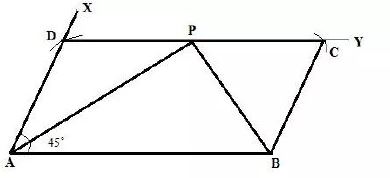
In simple words: First construct the parallelogram with a 6 cm base, 3 cm side, and a 45-degree angle. Draw the angle bisector from the bottom-left corner to meet the top side at P. The geometry of a parallelogram ensures the lines from the bottom corners to P form a 90-degree angle at P.
Exam Tip: When proving angle APB is 90°, always state clearly that the sum of consecutive interior angles of a parallelogram is 180° and use their bisectors to complete the proof.
Question 37. The perpendicular distances between the pair of opposite sides of a parallelogram are 3 cm and 4 cm, and one of its angles measures 60°. Using ruler and compasses only, construct the parallelogram.
Answer:
Steps of Construction:
1. Construct a reference line designated as AQ.
2. Set the compass to an arbitrary radius and construct arcs both above and below line AQ with A as a reference point. Keeping the compass width constant, repeat from another position along the line to find two intersection points.
3. Construct a straight line through these intersecting arcs to establish a perpendicular line to AQ.
4. Adjust the compass to a width of 4 cm and mark an arc on the perpendicular line. Create a parallel line to AQ that passes through this newly marked position.
5. Project a 60-degree angle from point A to intersect the parallel line, designating the intersection point as D.
6. Reapply the perpendicular construction method from step 2 to create a perpendicular line starting from AD.
7. Set the compass to 3 cm and mark a point on this perpendicular. Construct a parallel line to AD passing through this point, intersecting line AQ at point B and the other parallel line at point C.
The resulting shape ABCD is the required parallelogram.
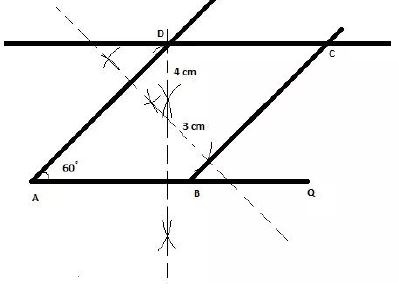
In simple words: First draw a flat line and a perpendicular to find a height of 4 cm. Draw a line parallel to the base. Draw a 60-degree angle from A to locate D on that parallel line. Next, find a perpendicular distance of 3 cm from AD to draw a parallel line that gives you the remaining corners B and C.
Exam Tip: Be precise when drawing the parallel lines. Clearly show your construction arcs for both perpendiculars, as examiners look for clean intersection marks to award full marks.
Question 38. Draw parallelogram ABCD with the following data: AB = 6 cm, AD = 5 cm and ∠DAB = 45°. Let AC and DB meet in O and let E be the mid-point of BC. Join OE. Prove that:
(i) OE // AB.
(ii) OE = 1/2 AB.
Answer:
Steps of Construction:
1. Begin by constructing a line segment AB with a length of 6 cm. From end-point A, lay off a 45-degree angle to establish a segment AD measuring 5 cm, making \( \angle DAB = 45^\circ \).
2. Next, construct a line segment CD parallel to AB, also with a length of 6 cm. Complete the figure by drawing segment BC to produce the required parallelogram.
Proof:
We are given that point E is the midpoint of segment BC. Connecting O and E gives segment OE. Our goal is to demonstrate that OE is parallel to AB and equal to half its length.
The diagonals of a parallelogram bisect each other, which implies that O is the midpoint of the diagonal AC. Additionally, E is specified as the midpoint of side BC. By applying the midpoint theorem to triangle ABC, the line segment joining the midpoints of two sides must be parallel to the third side and equal to half of its length. Thus, we have:
\( OE \parallel AB \) and \( OE = \frac{1}{2} AB \).
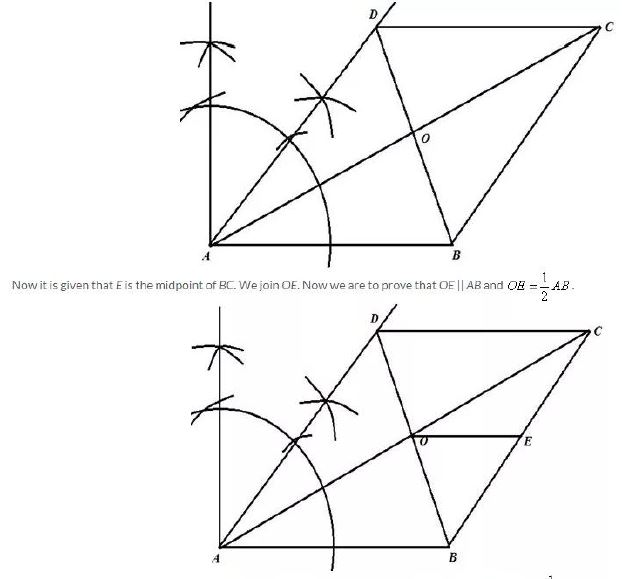
In simple words: Draw the parallelogram with the given measurements first. Since diagonals cut each other in half, O is the middle point of AC. E is already given as the middle point of BC. In triangle ABC, connecting the midpoints of two sides means the line must be parallel to the third side and half its length.
Exam Tip: State the midpoint theorem clearly in your proof and mention that the diagonals of a parallelogram bisect each other, which establishes O as the midpoint of AC.
Question 39. Using ruler and compasses only, construct a rectangle each of whose diagonals measure 6 cm and the diagonals intersect at an angle of 45°.
Answer:
Steps of Construction:
1. To start, construct a line segment AC with a length of 6 cm.
2. Next, construct the perpendicular bisector of AC, designating its midpoint as O.
3. At point O, measure a 45-degree angle. Extend this line to mark segments OD of 3 cm and OB of 3 cm in opposite directions.
4. Finally, connect the points A, B, C, and D sequentially to complete the rectangle.
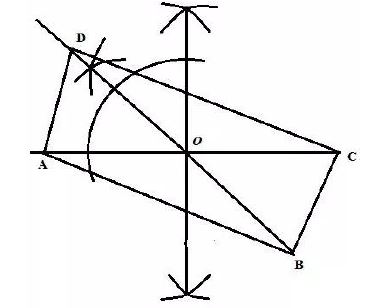
In simple words: First, draw a diagonal of 6 cm and find its midpoint. Next, draw a second line of 6 cm crossing through that midpoint at a 45-degree angle. Connect all four outer ends to get your rectangle.
Exam Tip: Remember that a rectangle's diagonals are equal in length and bisect each other. Always show the construction arcs used to bisect the first diagonal and to measure the 45-degree angle.
ICSE Selina Concise Solutions Class 9 Mathematics Chapter 15 Construction Of Polygons
Students can now access the detailed Selina Concise Solutions for Chapter 15 Construction Of Polygons on our portal. These solutions have been carefully prepared as per latest ICSE Class 9 syllabus. Each solution given above has been updated based on the current year pattern to ensure Class 9 students have the most updated Mathematics content.
Master Selina Concise Textbook Questions
Our subject experts have provided detailed explanations for all the questions found in the Selina Concise textbook for Class 9 Mathematics. We have focussed on making the concepts easy for you in Chapter 15 Construction Of Polygons so that students can understand the concepts behind every answer. For all numerical problems and theoretical concepts these solutions will help in strengthening your analytical skill required for the ICSE examinations.
Complete Mathematics Exam Preparation
By using these Selina Concise Class 9 solutions, you can enhance your learning and identify areas that need more attention. We recommend solving the Mathematics Questions from the textbook first and then use our teacher-verified answers. For a proper revision of Chapter 15 Construction Of Polygons, students should also also check our Revision Notes and Sample Papers available on studiestoday.com.
FAQs
You can download the verified Selina Concise solutions for Chapter 15 Construction Of Polygons on StudiesToday.com. Our teachers have prepared answers for Class 9 Mathematics as per 2026-27 ICSE academic session.
Yes, our solutions for Chapter 15 Construction Of Polygons are designed as per new 2026 ICSE standards. 40% competency-based questions required for Class 9, are included to help students understand application-based logic behind every Mathematics answer.
Yes, every exercise in Chapter 15 Construction Of Polygons from the Selina Concise textbook has been solved step-by-step. Class 9 students will learn Mathematics conceots before their ICSE exams.
Yes, follow structured format of these Selina Concise solutions for Chapter 15 Construction Of Polygons to get full 20% internal assessment marks and use Class 9 Mathematics projects and viva preparation as per ICSE 2026 guidelines.