

ICSE Solutions Selina Concise Class 9 Mathematics Chapter 12 Mid Point And Its Converse have been provided below and is also available in Pdf for free download. The Selina Concise ICSE solutions for Class 9 Mathematics have been prepared as per the latest syllabus and ICSE books and examination pattern suggested in Class 9. Questions given in ICSE Selina Concise book for Class 9 Mathematics are an important part of exams for Class 9 Mathematics and if answered properly can help you to get higher marks. Refer to more Chapter-wise answers for ICSE Class 9 Mathematics and also download more latest study material for all subjects. Chapter 12 Mid Point And Its Converse is an important topic in Class 9, please refer to answers provided below to help you score better in exams
Selina Concise Chapter 12 Mid Point And Its Converse Class 9 Mathematics ICSE Solutions
Class 9 Mathematics students should refer to the following ICSE questions with answers for Chapter 12 Mid Point And Its Converse in Class 9. These ICSE Solutions with answers for Class 9 Mathematics will come in exams and help you to score good marks
Chapter 12 Mid Point And Its Converse Selina Concise ICSE Solutions Class 9 Mathematics
Exercise 12(A)
Question 1. In the given triangle \( ABC \), \( M \) is the midpoint of \( AB \) and \( MN \parallel BC \). If \( AC = 5\text{ cm} \) and \( BC = 7\text{ cm} \), find the lengths of \( MN \) and \( AN \).
Answer: We are given that \( M \) is the middle point of side \( AB \) and \( MN \parallel BC \). According to the converse of the midpoint theorem, \( N \) must be the middle point of side \( AC \).
Consequently, we can write:
\( MN = \frac{1}{2} BC = \frac{1}{2} \times 7 = 3.5\text{ cm} \)
Also, since \( N \) bisects \( AC \):
\( AN = \frac{1}{2} AC = \frac{1}{2} \times 5 = 2.5\text{ cm} \)
In simple words: If a line starts at the midpoint of one side and runs parallel to the base, it cuts the other side exactly in half. Its length is also half of the base.
Exam Tip: State the Midpoint Theorem or its converse clearly before using it to calculate lengths to ensure full marks.
Question 2. Let \( ABCD \) be a rectangle where \( P \), \( Q \), \( R \), and \( S \) are the midpoints of the sides \( AB \), \( BC \), \( CD \), and \( DA \) respectively. Prove that the quadrilateral \( PQRS \) formed by joining these midpoints is a rhombus.
Answer: Let \( ABCD \) be a rectangle, with points \( P \), \( Q \), \( R \), and \( S \) being the midpoints of sides \( AB \), \( BC \), \( CD \), and \( DA \) respectively. We construct the diagonals \( BD \) and \( AC \).
Since the diagonals of a rectangle are equal in length, we have:
\( BD = AC \)
In \( \triangle ABD \) and \( \triangle BCD \):
Using the midpoint theorem, \( S \) and \( P \) are the midpoints of \( DA \) and \( AB \), which gives:
\( PS = \frac{1}{2} BD \) and \( PS \parallel BD \)
Similarly, for \( \triangle BCD \), \( R \) and \( Q \) are midpoints of \( CD \) and \( BC \), so:
\( QR = \frac{1}{2} BD \) and \( QR \parallel BD \)
From these relations, we get:
\( PS = QR \) and \( PS \parallel QR \)
Thus, \( 2PS = 2QR = BD \) and \( PS \parallel BD \parallel QR \) - (1)
By applying the same theorem to \( \triangle ABC \) and \( \triangle ADC \), we obtain:
\( 2PQ = 2SR = AC \) and \( PQ \parallel SR \) - (2)
Since \( AC = BD \), equations (1) and (2) give:
\( PQ = QR = RS = PS \)
Because all four sides of quadrilateral \( PQRS \) are equal, \( PQRS \) is a rhombus.
Hence proved.
In simple words: We draw the diagonals of the rectangle, which are equal. By the midpoint theorem, each side of the inner shape is exactly half of a diagonal, making all four inner sides equal.
Exam Tip: Don't forget to mention that the diagonals of a rectangle are equal; this is the key step to prove that all four sides of the inner quadrilateral are equal.
Question 3. In an isosceles triangle \( ABC \) where \( AB = AC \), points \( D \), \( E \), and \( F \) are the midpoints of sides \( AB \), \( BC \), and \( CA \) respectively. Prove that \( \triangle DEF \) is also an isosceles triangle.
Answer: We are given an isosceles triangle \( ABC \) where \( AB = AC \).
The points \( D \), \( E \), and \( F \) are the midpoints of the sides \( AB \), \( BC \), and \( CA \).
By the midpoint theorem, the line joining the midpoints of two sides is half the length of the third side:
\( DE = \frac{1}{2} AC \implies 2DE = AC \)
\( EF = \frac{1}{2} AB \implies 2EF = AB \)
Since \( AB = AC \), it follows that:
\( 2DE = 2EF \implies DE = EF \)
Since two sides of \( \triangle DEF \) are equal, \( \triangle DEF \) is an isosceles triangle.
Hence proved.
In simple words: The midpoint theorem tells us that each side of the inner triangle is half the length of the outer triangle's corresponding side. Since two outer sides are equal, the two corresponding inner sides must also be equal.
Exam Tip: State clearly that the midpoint theorem relates the segment joining the midpoints to the parallel opposite side.
Question 4. In a trapezium \( ABCD \) with \( AB \parallel CD \), \( P \) is the midpoint of the non-parallel side \( AD \). A line is drawn through \( P \) parallel to \( AB \), intersecting the diagonal \( BD \) at \( Q \) and the side \( BC \) at \( R \). Prove that \( PR = \frac{1}{2}(AB + CD) \).
Answer: Consider \( \triangle ABD \). Here, \( P \) is the midpoint of \( AD \) and \( PR \parallel AB \) (which implies \( PQ \parallel AB \)). By the converse of the midpoint theorem, \( Q \) must be the midpoint of diagonal \( BD \).
Therefore:
\( PQ = \frac{1}{2} AB \implies 2PQ = AB \) - (1)
Similarly, \( R \) is the midpoint of \( BC \) because \( PR \parallel CD \parallel AB \).
In \( \triangle BCD \), \( Q \) is the midpoint of \( BD \) and \( QR \parallel CD \). By the midpoint theorem:
\( QR = \frac{1}{2} CD \implies 2QR = CD \) - (2)
Adding equations (1) and (2):
\( 2PQ + 2QR = AB + CD \)
\( \implies 2(PQ + QR) = AB + CD \)
Since \( PQ + QR = PR \):
\( 2PR = AB + CD \)
\( \implies PR = \frac{1}{2}(AB + CD) \)
Hence proved.
In simple words: We split the shape using a diagonal. The midpoint theorem applied to both resulting triangles shows that the two segments of the middle line are half of the top and bottom bases. Adding them gives half the sum of both bases.
Exam Tip: Remember that the converse of the midpoint theorem is used first to prove that \( Q \) is the midpoint of the diagonal \( BD \).
Question 5. In a trapezium \( ABCD \), \( AB \parallel CD \) and \( M, N \) are the midpoints of the non-parallel sides \( AD \) and \( BC \) respectively. Diagonal \( AC \) intersects \( MN \) at point \( O \).
(i) If \( AB = 11\text{ cm} \) and \( CD = 8\text{ cm} \), calculate the length of \( MN \).
(ii) If \( CD = 20\text{ cm} \) and \( MN = 27\text{ cm} \), find the length of \( AB \).
(iii) If \( AB = 23\text{ cm} \) and \( MN = 15\text{ cm} \), find the length of \( CD \).
Answer: First, we construct the diagonal \( AC \), which crosses \( MN \) at \( O \). Since \( M \) and \( N \) are the midpoints of \( AD \) and \( BC \), and \( MN \parallel AB \parallel CD \), by the midpoint theorem, \( O \) is the midpoint of \( AC \).
(i) Given that \( AB = 11\text{ cm} \) and \( CD = 8\text{ cm} \):
In \( \triangle ABC \), \( O \) and \( N \) are midpoints of \( AC \) and \( BC \), so:
\( ON = \frac{1}{2} AB = \frac{1}{2} \times 11 = 5.5\text{ cm} \)
In \( \triangle ACD \), \( O \) and \( M \) are midpoints of \( AC \) and \( AD \), so:
\( OM = \frac{1;}{2} CD = \frac{1}{2} \times 8 = 4\text{ cm} \)
Thus, the total length of \( MN \) is:
\( MN = OM + ON = 4 + 5.5 = 9.5\text{ cm} \)
(ii) Given that \( CD = 20\text{ cm} \) and \( MN = 27\text{ cm} \):
In \( \triangle ACD \):
\( OM = \frac{1}{2} CD = \frac{1}{2} \times 20 = 10\text{ cm} \)
This allows us to find \( ON \):
\( ON = MN - OM = 27 - 10 = 17\text{ cm} \)
In \( \triangle ABC \):
\( AB = 2 \times ON = 2 \times 17 = 34\text{ cm} \)
(iii) Given that \( AB = 23\text{ cm} \) and \( MN = 15\text{ cm} \):
In \( \triangle ABC \):
\( ON = \frac{1}{2} AB = \frac{1}{2} \times 23 = 11.5\text{ cm} \)
This allows us to find \( OM \):
\( OM = MN - ON = 15 - 11.5 = 3.5\text{ cm} \)
In \( \triangle ACD \):
\( CD = 2 \times OM = 2 \times 3.5 = 7\text{ cm} \)
In simple words: The segment joining the midpoints of the non-parallel sides is made of two parts. Each part is exactly half of one of the parallel bases. Adding these two parts gives the total segment length.
Exam Tip: Clearly state that the midpoint of the diagonal divides the segment into two parts, each related to one parallel base of the trapezium.
Question 6. In a quadrilateral \( ABCD \), the diagonals \( AC \) and \( BD \) intersect at right angles at point \( O \). If \( P \), \( Q \), \( R \), and \( S \) are the midpoints of the sides \( AB \), \( BC \), \( CD \), and \( DA \) respectively, prove that the quadrilateral \( PQRS \) is a rectangle.
Answer: Let \( ABCD \) be a quadrilateral whose diagonals \( AC \) and \( BD \) intersect perpendicularly at \( O \). The points \( P \), \( Q \), \( R \), and \( S \) are the midpoints of the sides \( AB \), \( BC \), \( CD \), and \( DA \) respectively.
First, let us examine \( \triangle ABC \) and \( \triangle ADC \).
By the midpoint theorem:
\( PQ \parallel AC \) and \( 2PQ = AC \) - (1)
\( RS \parallel AC \) and \( 2RS = AC \) - (2)
Comparing these, we get:
\( PQ = RS \) and \( PQ \parallel RS \)
By symmetry, we can also establish that:
\( PS = RQ \) and \( PS \parallel RQ \)
Since both pairs of opposite sides are equal and parallel, \( PQRS \) is a parallelogram.
Now, let us analyze the angles. Since \( PQ \parallel AC \), the corresponding angles are equal:
\( \angle AOD = \angle PXO = 90^\circ \) (where \( X \) is the intersection point of \( PQ \) and the diagonal \( BD \))
Additionally, since \( BD \parallel RQ \), we have:
\( \angle PXO = \angle RQX = 90^\circ \) [Corresponding angles]
Similarly, it can be shown that all other interior angles of the parallelogram are right angles:
\( \angle QRS = \angle RSP = \angle SPQ = 90^\circ \)
Since \( PQRS \) is a parallelogram with all angles equal to \( 90^\circ \), \( PQRS \) is a rectangle.
Hence proved.
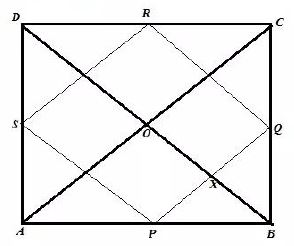
In simple words: We first show the inner shape is a parallelogram using the midpoint theorem. Then, because the main diagonals cross at \( 90^\circ \) and the sides of the inner shape are parallel to these diagonals, the corners of the inner shape must also meet at \( 90^\circ \), making it a rectangle.
Exam Tip: Clearly state that a parallelogram with one right angle (or all right angles) is a rectangle, and use corresponding angles of parallel lines to transfer the \( 90^\circ \) angle from the diagonals to the corner.
Question 7. In a parallelogram \( ABCD \), \( L \) and \( M \) are the midpoints of the sides \( AB \) and \( CD \) respectively. The line segments \( DL \) and \( BM \) intersect the diagonal \( AC \) at points \( X \) and \( Y \) respectively. Prove that the diagonal \( AC \) is trisected by these line segments, i.e., \( AX = XY = YC \).
Answer: In the given parallelogram \( ABCD \):
Since \( L \) and \( M \) are the midpoints of \( AB \) and \( CD \) respectively, and \( AB = CD \), we have:
\( BL = \frac{1}{2} AB \) and \( DM = \frac{1}{2} CD \implies BL = DM \)
Also, since \( AB \parallel CD \), we have \( BL \parallel DM \).
Since one pair of opposite sides is both equal and parallel, \( BLMD \) is a parallelogram.
Therefore:
\( BM \parallel DL \) (which means \( BY \parallel XL \) and \( DX \parallel MY \))
Now, let us consider \( \triangle ABY \):
Here, \( L \) is the midpoint of \( AB \) and \( XL \parallel BY \).
By the converse of the midpoint theorem, \( X \) must be the midpoint of \( AY \):
\( AX = XY \) - (1)
Next, let us consider \( \triangle CDX \):
Since \( M \) is the midpoint of \( CD \) and \( MY \parallel DX \), by the converse of the midpoint theorem, \( Y \) must be the midpoint of \( CX \):
\( CY = XY \) - (2)
Comparing equations (1) and (2), we get:
\( AX = XY = CY \)
Thus, the diagonal \( AC \) is expressed as:
\( AC = AX + XY + CY \)
This proves that the diagonal is divided into three equal parts.
Hence proved.
In simple words: We first show that the lines \( DL \) and \( BM \) are parallel by proving the shape they form is a parallelogram. Then, using the converse of the midpoint theorem on two separate triangles, we prove that the diagonal is cut into three equal pieces.
Exam Tip: Clearly establish that \( BLMD \) is a parallelogram first, as the parallel relationship of \( DL \) and \( BM \) is essential for applying the midpoint converse theorem in the triangles.
Question 8. In a quadrilateral \( ABCD \), the opposite sides \( AD \) and \( BC \) are equal in length (\( AD = BC \)). If \( E \), \( F \), \( G \), and \( H \) are the midpoints of the sides \( AB \), \( BC \), \( CD \), and \( DA \) respectively, prove that the quadrilateral \( EFGH \) is a rhombus.
Answer: We are given a quadrilateral \( ABCD \) where:
\( AD = BC \) - (1)
Let \( E, F, G, H \) be the midpoints of sides \( AB, BC, CD, DA \) respectively.
In \( \triangle ADC \) and \( \triangle ABD \):
Using the midpoint theorem:
\( 2GH = AD \) and \( 2EF = AD \implies 2GH = 2EF = AD \) - (2)
In \( \triangle BCD \) and \( \triangle ABC \):
Using the midpoint theorem:
\( 2GF = BC \) and \( 2EH = BC \implies 2GF = 2EH = BC \) - (3)
From equations (1), (2), and (3), since \( AD = BC \), we can equate their halves:
\( 2GH = 2EF = 2GF = 2EH \)
Dividing by 2:
\( GH = EF = GF = EH \)
Since all four sides of the quadrilateral \( EFGH \) are equal, \( EFGH \) is a rhombus.
Hence proved.
In simple words: By using the midpoint theorem on different triangles formed by the diagonals, we find that the sides of the inner shape are half of the outer sides \( AD \) and \( BC \). Since \( AD \) and \( BC \) are equal, all four inner sides must also be equal, which makes the inner shape a rhombus.
Exam Tip: Make sure to state that a quadrilateral with all four sides equal is defined as a rhombus, which completes the proof after showing \( GH = EF = GF = EH \).
Question 9. In a parallelogram \( ABCD \), diagonals \( AC \) and \( BD \) intersect at \( X \). \( P \) is the midpoint of \( CD \). A line through \( P \) parallel to diagonal \( BD \) meets \( AC \) at \( Q \) and \( BC \) at \( R \).
Prove that:
(i) \( R \) is the midpoint of \( BC \).
(ii) \( PR = \frac{1}{2} BD \).
Answer: Let us draw the diagonal \( BD \), which intersects diagonal \( AC \) at \( X \). Since the diagonals of a parallelogram bisect each other, we have:
\( AX = CX \) and \( BX = DX \implies AC = 2CX \)
We are given:
\( CQ = \frac{1}{4} AC \)
Substituting \( AC = 2CX \):
\( CQ = \frac{1}{4} \times 2CX = \frac{1}{2} CX \)
This shows that \( Q \) is the midpoint of the segment \( CX \).
(i) In \( \triangle CDX \):
\( P \) is the midpoint of \( CD \) and \( PQ \parallel DX \) (since \( PR \parallel BD \)).
Now, let us look at \( \triangle CBX \):
We established that \( Q \) is the midpoint of \( CX \). Also, \( QR \parallel BX \) because \( PR \parallel BD \).
By the converse of the midpoint theorem, \( R \) must be the midpoint of \( BC \).
(ii) In \( \triangle BCD \):
Since \( P \) is the midpoint of \( CD \) and \( R \) is the midpoint of \( BC \), the segment joining them is parallel to the third side and half its length by the midpoint theorem:
\( PR = \frac{1}{2} DB \)
Hence proved.
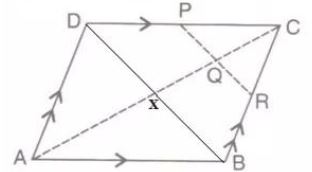
In simple words: Since the diagonals cut each other in half, the given fraction means point \( Q \) is halfway along the half-diagonal. Using the midpoint theorem on the triangles inside the parallelogram, we prove that \( R \) is the midpoint of side \( BC \) and that line \( PR \) is half the diagonal \( BD \).
Exam Tip: Begin by writing down the bisection property of parallelogram diagonals, as showing \( Q \) is the midpoint of \( CX \) is the crucial first step.
Question 10. In a triangle \( ABC \), \( D \) and \( F \) are the midpoints of sides \( AB \) and \( AC \) respectively. \( O \) is any point on the line segment \( AE \) (where \( E \) is on \( BC \)). If \( P \) and \( Q \) are the midpoints of \( OB \) and \( OC \) respectively, prove that \( PQFD \) is a parallelogram.
Answer: Let \( D \) and \( F \) be the midpoints of the sides \( AB \) and \( AC \) of \( \triangle ABC \) respectively. Let \( P \) and \( Q \) be the midpoints of the segments \( OB \) and \( OC \) respectively, where \( O \) is a point inside the triangle.
In \( \triangle ABC \):
Since \( D \) and \( F \) are the midpoints of \( AB \) and \( AC \), by the midpoint theorem:
\( DF \parallel BC \) and \( 2DF = BC \)
In \( \triangle OBC \):
Since \( P \) and \( Q \) are the midpoints of \( OB \) and \( OC \), by the midpoint theorem:
\( PQ \parallel BC \) and \( 2PQ = BC \)
From these two results, we get:
\( DF \parallel PQ \) and \( DF = PQ \) - (1)
Now consider \( \triangle ABO \):
Since \( D \) is the midpoint of \( AB \) and \( P \) is the midpoint of \( BO \), we have:
\( DP \parallel AO \) and \( 2DP = AO \)
Similarly, in \( \triangle ACO \):
Since \( F \) is the midpoint of \( AC \) and \( Q \) is the midpoint of \( CO \), we have:
\( FQ \parallel AO \) and \( 2FQ = AO \)
From these, we get:
\( DP \parallel FQ \) and \( DP = FQ \) - (2)
Since both pairs of opposite sides of the quadrilateral \( PQFD \) are equal and parallel, \( PQFD \) is a parallelogram.
Hence proved.
In simple words: We apply the midpoint theorem to four different triangles. We show that both pairs of opposite sides of the inner four-sided shape are parallel to and half the length of the main line segments (\( BC \) and \( AO \)), which proves it is a parallelogram.
Exam Tip: Remember to define the relation for both pairs of opposite sides (\( DF \parallel PQ \) and \( DP \parallel FQ \)) to completely prove that the quadrilateral is a parallelogram.
Question 11. In a triangle \( ABC \), \( P \) is the midpoint of side \( BC \). A line through \( P \) parallel to \( AC \) meets \( AB \) at \( Q \), and a line through \( Q \) parallel to \( BC \) meets \( AP \) at \( R \).
(i) Prove that \( AP = 2AR \).
(ii) If \( QR \) is produced to meet \( AC \) at \( S \), prove that \( BC = 4QR \).
Answer: We are given that \( P \) is the midpoint of \( BC \). Also, \( PQ \parallel AC \) and \( QR \parallel BC \).
In \( \triangle ABC \):
Since \( P \) is the midpoint of \( BC \) and \( PQ \parallel AC \), by the converse of the midpoint theorem, \( Q \) is the midpoint of \( AB \).
(i) Now consider \( \triangle ABP \):
Since \( Q \) is the midpoint of \( AB \) and \( QR \parallel BP \) (as \( QR \parallel BC \)), by the converse of the midpoint theorem, \( R \) must be the midpoint of \( AP \).
Therefore:
\( AP = 2AR \)
(ii) Let us extend \( QR \) to intersect \( AC \) at point \( S \).
(iii) Now, let us compare \( \triangle PQR \) and \( \triangle ARS \):
- \( \angle PQR = \angle ARS \) [Vertically opposite angles]
- \( PR = AR \) [Since \( R \) is the midpoint of \( AP \)]
- \( PQ = AS \) [Since \( Q \) and \( S \) are the midpoints of \( AB \) and \( AC \), \( PQ = AS = \frac{1}{2} AC \)]
By the SAS (Side-Angle-Side) congruence postulate:
\( \triangle PQR \cong \triangle ARS \)
This implies:
\( QR = RS \)
Since \( Q \) and \( S \) are the midpoints of \( AB \) and \( AC \):
\( BC = 2QS \)
Since \( S \) lies on the extension of \( QR \) such that \( QR = RS \), we have \( QS = 2QR \).
Substituting this back:
\( BC = 2 \times (2QR) \)
\( \implies BC = 4QR \)
Hence proved.
In simple words: We use the converse of the midpoint theorem to show that \( Q \) and \( R \) are midpoints. By extending \( QR \) to \( S \) on \( AC \), we prove two small triangles are identical, which tells us \( QS \) is twice as long as \( QR \). Since \( QS \) is half of \( BC \), \( BC \) must be four times \( QR \).
Exam Tip: Be careful to show the congruence of \( \triangle PQR \) and \( \triangle ARS \) step-by-step using the SAS criterion to justify why \( QR = RS \).
Question 12. In a trapezium \( ABCD \) with \( AB \parallel CD \), \( P \) is the midpoint of side \( AD \). \( BP \) is joined and produced to meet \( CD \) produced at \( E \). If \( Q \) is the midpoint of \( BC \), prove that:
(i) \( PE = PB \)
(ii) \( PQ \parallel AB \)
Answer: Let \( ABCD \) be a trapezium where \( AB \parallel CD \). Let \( P \) be the midpoint of \( AD \). We produce \( BP \) to meet the extension of \( CD \) at \( E \).
(i) In \( \triangle PED \) and \( \triangle ABP \):
- \( PD = AP \) [Since \( P \) is the midpoint of \( AD \)]
- \( \angle DPE = \angle APB \) [Vertically opposite angles]
- \( \angle PED = \angle PBA \) [Alternate interior angles, since \( AB \parallel CE \)]
By the ASA (Angle-Side-Angle) congruence postulate:
\( \triangle PED \cong \triangle ABP \)
Therefore, by CPCTC (Corresponding Parts of Congruent Triangles):
\( EP = BP \)
(ii) Now consider \( \triangle ECB \):
We have shown that \( P \) is the midpoint of \( EB \) (\( EP = BP \)), and we are given that \( Q \) is the midpoint of \( BC \).
By the midpoint theorem:
\( PQ \parallel EC \)
Since \( EC \) is the line along \( CD \) and \( CD \parallel AB \), we have:
\( PQ \parallel AB \)
Hence proved.
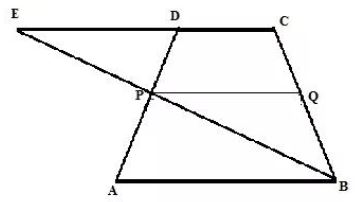
In simple words: By proving that the two triangles at the corner are congruent, we show that \( P \) is the midpoint of the extended line \( EB \). Since \( Q \) is already the midpoint of \( BC \), the line \( PQ \) must be parallel to the base of the triangle, which is parallel to \( AB \).
Exam Tip: Clearly state the alternate interior angle relation (\( \angle PED = \angle PBA \)) which arises from \( AB \parallel CD \) to establish the ASA congruence.
Question 13. In \( \triangle ABC \), \( AD \) is a median (so \( D \) is the midpoint of \( BC \)). \( E \) is the midpoint of \( AD \). \( BE \) is produced to meet \( AC \) at \( F \). Prove that \( AF = \frac{1}{3} AC \).
Answer: In \( \triangle ABC \), \( AD \) is the median to side \( BC \) (meaning \( D \) is the midpoint of \( BC \)), and \( E \) is the midpoint of \( AD \). The line \( BE \) is extended to meet \( AC \) at \( F \).
To prove this, we perform a construction: draw a line \( DG \parallel BF \) intersecting \( AC \) at \( G \).
Now, let us analyze \( \triangle ADG \):
Since \( E \) is the midpoint of \( AD \) and \( EF \parallel DG \) (as \( BF \parallel DG \)), by the converse of the midpoint theorem, \( F \) is the midpoint of \( AG \):
\( AF = GF \) - (1)
Next, let us analyze \( \triangle BCF \):
Since \( D \) is the midpoint of \( BC \) and \( DG \parallel BF \), by the converse of the midpoint theorem, \( G \) is the midpoint of \( CF \):
\( GF = CF \) - (2)
Combining equations (1) and (2), we get:
\( AF = GF = CF \)
The total segment \( AC \) is:
\( AC = AF + GF + CF \)
\( \implies AC = 3AF \)
Hence proved.
In simple words: We draw a helper line from \( D \) parallel to \( BF \). By applying the converse of the midpoint theorem to two different triangles, we find that the segment \( AC \) is divided into three equal parts, meaning \( AF \) is exactly one-third of the whole side.
Exam Tip: The auxiliary line \( DG \parallel BF \) is essential; clearly state this construction step at the beginning of your proof.
Question 14. In \( \triangle ABC \), \( D \) and \( F \) are the midpoints of \( AB \) and \( AC \) respectively. A line through \( F \) parallel to \( AB \) meets \( BC \) at \( E \).
(i) Prove that \( BDEF \) is a parallelogram.
(ii) If \( EF = 4.8\text{ cm} \), find the length of \( AB \).
Answer: We are given a triangle \( ABC \). Points \( D \) and \( F \) are the midpoints of sides \( AB \) and \( AC \) respectively. A line drawn through \( F \) parallel to \( AB \) meets side \( BC \) at \( E \).
(i) In \( \triangle ABC \):
Since \( F \) is the midpoint of \( AC \) and \( EF \parallel AB \), by the converse of the midpoint theorem, \( E \) must be the midpoint of \( BC \).
Using the midpoint theorem:
\( BE = \frac{1}{2} BC \) and \( EF = \frac{1}{2} AB \) - (1)
Since \( D \) and \( F \) are the midpoints of \( AB \) and \( AC \):
\( DF = \frac{1}{2} BC \) and \( DB = \frac{1}{2} AB \) - (2)
Comparing (1) and (2), we get:
\( BE = DF \) and \( BD = EF \)
Since both pairs of opposite sides of the quadrilateral \( BDEF \) are equal, \( BDEF \) is a parallelogram.
(ii) We are given that \( EF = 4.8\text{ cm} \).
From the relation above:
\( AB = 2EF \)
\( \implies AB = 2 \times 4.8 = 9.6\text{ cm} \)
In simple words: We use the converse of the midpoint theorem to prove that \( E \) is the midpoint of \( BC \). By comparing the side relationships, we show that opposite sides of the inner four-sided shape are equal, making it a parallelogram.
Exam Tip: When showing that a quadrilateral is a parallelogram, you can prove either that opposite sides are parallel, or that they are equal. Using equal lengths is very straightforward here.
Question 15. In \( \triangle ABC \), \( AD \) is a median of side \( BC \). A line is drawn through \( D \) parallel to \( AB \), which intersects \( AC \) at \( E \). Prove that \( BE \) is also a median of the triangle.
Answer: In \( \triangle ABC \), we are given that \( AD \) is the median to the side \( BC \). This means \( D \) is the midpoint of side \( BC \).
We are also given that \( DE \parallel AB \).
By the converse of the midpoint theorem:
Since \( D \) is the midpoint of \( BC \) and \( DE \parallel AB \), the line \( DE \) must bisect side \( AC \).
Therefore, \( E \) is the midpoint of side \( AC \).
Since \( E \) is the midpoint of \( AC \), the line segment \( BE \) joining the vertex \( B \) to the midpoint of the opposite side is a median.
Thus, \( BE \) is also a median of the triangle.
Hence proved.
In simple words: Since \( AD \) is a median, \( D \) is the midpoint of the bottom side. A parallel line drawn from a midpoint must hit the other side at its midpoint. Since \( E \) is the midpoint of that side, \( BE \) is also a median.
Exam Tip: Remember that a median is defined as the line segment joining any vertex to the midpoint of the opposite side; proving \( E \) is the midpoint of \( AC \) directly makes \( BE \) a median.
Question 16. In \( \triangle ABC \), \( D \) is the midpoint of \( BC \) and \( E \) is the midpoint of \( AD \). If \( BE \) is produced to intersect \( AC \) at \( Q \), prove that \( BE : EQ = 3 : 1 \).
Answer:
To prove this relation, we begin with a construction: draw a line \( DY \) parallel to \( BQ \).
Now, let us examine the triangles \( BCQ \) and \( DCY \).
The angle \( \angle C \) is shared by both triangles, so \( \angle BCQ = \angle DCY \).
Additionally, because \( DY \) is parallel to \( BQ \), the corresponding angles \( \angle BQC \) and \( \angle DYC \) are equal.
By the AA similarity criterion, this means:
\( \triangle BCQ \sim \triangle DCY \)
Since similar triangles have proportional corresponding sides:
\( \frac{BQ}{DY} = \frac{BC}{DC} \)
We know that \( D \) is the midpoint of \( BC \), so we can substitute \( BC = 2CD \):
\( \frac{BQ}{DY} = \frac{2CD}{CD} = 2 \) - (i)
Next, let us consider the triangles \( AEQ \) and \( ADY \). In a similar manner, we can establish that:
\( \triangle AEQ \sim \triangle ADY \)
The ratio of their corresponding sides is:
\( \frac{EQ}{DY} = \frac{AE}{AD} \)
Since \( E \) is the midpoint of the line segment \( AD \), we have \( AE = \frac{1}{2}AD \), which gives:
\( \frac{EQ}{DY} = \frac{1}{2} \) - (ii)
Now, divide equation (i) by equation (ii):
\( \frac{BQ}{EQ} = \frac{2}{1/2} = 4 \)
This can be rewritten as:
\( BQ = 4EQ \)
Since the segment \( BQ \) is made of \( BE + EQ \), we substitute this in:
\( BE + EQ = 4EQ \)
Subtracting \( EQ \) from both sides yields:
\( BE = 3EQ \)
Thus, we find the required ratio:
\( \frac{BE}{EQ} = \frac{3}{1} \)
In simple words: By drawing a helper line parallel to one of the segments, we create pairs of similar triangles. Using the midpoint properties, we can relate the lengths of different segments and show that one part is three times as long as the other.
Exam Tip: Always label auxiliary construction lines clearly in your diagram and state which lines are parallel to justify your angle relationships.
Question 17. If \( M \) and \( N \) are points such that in \( \triangle EDF \), \( M \) is the midpoint of \( AB \) and \( N \) is the midpoint of \( DE \), and in \( \triangle ABC \), \( M \) is the midpoint of \( AB \) and \( N \) is the midpoint of \( BC \), prove that \( EF = AC \).
Answer:
Let us look at \( \triangle EDF \). Here, \( M \) serves as the midpoint of \( AB \) and \( N \) is the midpoint of \( DE \).
Applying the midpoint theorem, we get:
\( MN = \frac{1}{2}EF \)
Multiplying both sides by 2, we have:
\( EF = 2MN \) - (i)
Next, let us observe \( \triangle ABC \). In this triangle, \( M \) is the midpoint of \( AB \) and \( N \) is the midpoint of \( BC \).
Using the midpoint theorem again, we find:
\( MN = \frac{1}{2}AC \)
This can be rewritten as:
\( AC = 2MN \) - (ii)
By comparing equation (i) and equation (ii), we can conclude:
\( EF = AC \)
In simple words: By using the midpoint theorem in two different triangles, we find that both line segments \( EF \) and \( AC \) are exactly twice the length of the same segment \( MN \). Since they are both equal to the same value, they must be equal to each other.
Exam Tip: State the midpoint theorem clearly whenever you use it to relate a line segment joining midpoints to the third side of a triangle.
Exercise 12(B)
Question 1. In the given figure, three parallel lines are cut by two transversals such that \( CD = DE \). If \( AB = 7.2\text{ cm} \), \( EF = 4\text{ cm} \), \( BD = 4.1\text{ cm} \), and \( CG = 11\text{ cm} \), find:
(i) \( BC \)
(ii) \( GE \)
(iii) \( AE \)
(iv) \( DF \)
Answer:
Since \( CD = DE \) and the lines are parallel, we can use the equal intercept theorem. This tells us that:
\( AB = BC \) and \( EF = GF \)
(i) Thus, we have:
\( BC = AB = 7.2\text{ cm} \)
(ii) Since \( GF = EF = 4\text{ cm} \), the total length of \( GE \) is:
\( GE = EF + GF = 2EF = 2 \times 4 = 8\text{ cm} \)
(iii) Since \( B, D, \) and \( F \) are midpoints and \( AE \parallel BF \parallel CG \), we can use the properties of these segments to relate them:
\( AE = 2BD \)
Substituting the value of \( BD \):
\( AE = 2 \times 4.1 = 8.2\text{ cm} \)
(iv) Similarly, the relation for \( CG \) and \( DF \) is:
\( CG = 2DF \implies DF = \frac{1}{2}CG \)
Substituting the value of \( CG \):
\( DF = \frac{1}{2} \times 11 = 5.5\text{ cm} \)
In simple words: The equal intercept theorem states that if parallel lines cut off equal segments on one line, they do the same on any other. Using this rule along with midpoint relations, we can find all the missing lengths directly from the given values.
Exam Tip: When applying the equal intercept theorem, always explicitly state which lines are parallel and which segments are given as equal intercepts.
Question 2. In \( \triangle ABC \), \( P \) is the midpoint of \( AB \). A line through \( P \) parallel to \( BC \) meets \( AC \) at \( R \). If \( D \) is a point on \( BA \) produced such that \( AD = AP \), and \( DR \) is intersected by \( AQ \) parallel to \( PR \) (where \( Q \) is a point on \( DR \) and \( S \) is a point on \( BC \) produced), prove that:
(i) \( AQ \parallel BS \)
(ii) \( DS = 3RS \)
Answer:
(i) Let us analyze \( \triangle DPR \). We are given that \( A \) and \( Q \) represent the midpoints of \( DP \) and \( DR \) respectively.
Using the midpoint theorem, we can write:
\( AQ \parallel PR \)
Since \( PR \) is parallel to \( BS \), it follows that:
\( AQ \parallel BS \)
(ii) Now, let us look at \( \triangle ABC \). Here, \( P \) is the midpoint of the side \( AB \) and \( PR \parallel BC \) (since \( S \) lies on \( BC \) produced).
By the converse of the midpoint theorem, \( R \) must be the midpoint of the side \( BC \), which gives:
\( BR = RC \)
Next, let us compare \( \triangle BRS \) and \( \triangle QRC \):
- \( \angle BRS = \angle QRC \) (vertically opposite angles)
- \( BR = RC \) (as proved above)
- \( \angle RBS = \angle RCQ \) (alternate interior angles, since \( BS \parallel AQ \))
By the Angle-Side-Angle (ASA) congruence criterion, we have:
\( \triangle BRS \cong \triangle QRC \)
This implies their corresponding sides are equal:
\( QR = RS \)
Since \( Q \) is the midpoint of \( DR \), we also have:
\( DQ = QR \)
Combining these relationships, we find:
\( DQ = QR = RS \)
Therefore, the total length of \( DS \) is:
\( DS = DQ + QR + RS = RS + RS + RS = 3RS \)
In simple words: We first prove that two lines are parallel using midpoint properties. Then, by showing that two triangles are congruent, we can prove that three smaller line segments are equal to each other, making the entire line three times as long as one of the parts.
Exam Tip: When proving segments are equal, look for congruent triangles that share those segments or have them as corresponding parts.
Question 3. In the given figure, \( D \) is the midpoint of \( BC \). \( DP \parallel AB \) meets \( AC \) at \( P \). In \( \triangle AEF \), \( AB \parallel PD \parallel CR \) and \( AP = \frac{1}{3}AE \). Prove that:
(i) \( 3DF = EF \)
(ii) \( 4CR = AB \)
Answer:
In this problem, \( D \) is the midpoint of \( BC \) and \( DP \parallel AB \). This implies that \( P \) is the midpoint of \( AC \), which gives:
\( PD = \frac{1}{2}AB \)
(i) Now, let's look at \( \triangle AEF \). Since the lines \( AB, PD, \) and \( CR \) are all parallel to each other, and we are given that \( AP = \frac{1}{3}AE \) (which means \( AP = PC = CE \)), the parallel lines divide the transversal \( FE \) in the same ratio.
Therefore, the intercepts on \( FE \) are also equal:
\( FD = DR = RE \)
This means:
\( DF = \frac{1}{3}EF \)
Multiplying both sides by 3, we get:
\( 3DF = EF \)
(ii) Next, let us focus on \( \triangle PED \). In this triangle, \( CR \parallel PD \) and \( C \) is the midpoint of \( PE \).
Applying the midpoint theorem, we have:
\( CR = \frac{1}{2}PD \)
Since we already established that \( PD = \frac{1}{2}AB \), we substitute this value in:
\( CR = \frac{1}{2} \left( \frac{1}{2}AB \right) = \frac{1}{4}AB \)
Multiplying both sides by 4 gives:
\( 4CR = AB \)
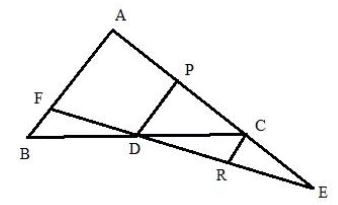
In simple words: By using the properties of parallel lines and equal intercepts, we can prove that three segments on a line are equal, which gives us the first ratio. Then, applying the midpoint theorem on a smaller triangle helps us relate the remaining segments to the main base.
Exam Tip: When dealing with multiple parallel lines cutting across transversals, remember that if they make equal intercepts on one transversal, they must make equal intercepts on any other transversal as well.
Question 4. In the given figure, \( P \) is the midpoint of \( AB \) and also of \( NC \). Similarly, \( Q \) is the midpoint of \( AC \) and also of \( MB \).
(i) Prove that \( M \), \( A \), and \( N \) are collinear.
(ii) Show that \( A \) is the midpoint of \( MN \).
Answer:
(i) Let's compare the triangles \( BPC \) and \( APN \):
- \( \angle BPC = \angle APN \) (vertically opposite angles)
- \( BP = AP \) (since \( P \) is the midpoint of \( AB \))
- \( PC = PN \) (since \( P \) is the midpoint of \( NC \))
By the Side-Angle-Side (SAS) congruence criterion:
\( \triangle BPC \cong \triangle APN \)
From CPCTC (Corresponding Parts of Congruent Triangles are Congruent), we have:
\( \angle PBC = \angle PAN \) - (1)
and
\( BC = AN \) - (3)
In a similar way, we can prove that \( \triangle QCB \cong \triangle QAM \), which gives:
\( \angle QCB = \angle QAM \) - (2)
and
\( BC = AM \) - (4)
Now, let's consider the sum of angles around point \( A \):
We know that the sum of the angles inside \( \triangle ABC \) is \( 180^\circ \):
\( \angle ABC + \angle ACB + \angle BAC = 180^\circ \)
Since \( \angle PBC \) is the same as \( \angle ABC \) and \( \angle QCB \) is the same as \( \angle ACB \), we can substitute equations (1) and (2) into this:
\( \angle PAN + \angle QAM + \angle BAC = 180^\circ \)
Since the sum of these three adjacent angles is \( 180^\circ \), the points \( M, A, \) and \( N \) must lie on a straight line, meaning they are collinear.
(ii) From equations (3) and (4), we have:
\( AN = BC \) and \( AM = BC \)
This directly implies:
\( AM = AN \)
Since \( M, A, \) and \( N \) are collinear and \( AM = AN \), it is proved that \( A \) is the midpoint of the segment \( MN \).
In simple words: We prove that the triangles on the sides are congruent to the main triangle. This allows us to show that the angles at the top add up to a straight line of 180 degrees, and the two top segments are equal in length.
Exam Tip: To prove that three points are collinear, show that the adjacent angles they form at a point sum up to exactly \( 180^\circ \).
Question 5. In \( \triangle ABC \), \( D \), \( E \), and \( F \) are the midpoints of sides \( AB \), \( BC \), and \( AC \) respectively. Prove that \( BEFD \) is a parallelogram.
Answer:
In \( \triangle ABC \), since \( E \) and \( F \) are the midpoints of the sides \( BC \) and \( AC \) respectively, we can apply the midpoint theorem.
This gives us:
\( EF \parallel AB \) and \( EF = \frac{1}{2}AB \)
Since \( D \) is the midpoint of the side \( AB \), we also have:
\( BD = \frac{1}{2}AB \)
Therefore:
\( EF \parallel BD \) and \( EF = BD \)
In any quadrilateral, if one pair of opposite sides is both parallel and equal, then the quadrilateral is a parallelogram.
Thus, \( BEFD \) is a parallelogram.
In simple words: The line connecting two midpoints in a triangle is parallel to and half as long as the third side. This makes the opposite sides of our quadrilateral both parallel and equal, which proves it is a parallelogram.
Exam Tip: A quick way to prove a quadrilateral is a parallelogram is to show that just one pair of opposite sides is both equal in length and parallel.
Question 6. In a parallelogram \( ABCD \), \( E \) is the midpoint of \( AB \) and \( F \) is the midpoint of \( CD \). The line segments \( AF \) and \( DE \) intersect at \( G \), while \( BF \) and \( CE \) intersect at \( H \). Prove that:
(i) \( \triangle HEB \cong \triangle FHC \)
(ii) \( GEHF \) is a parallelogram.
Answer:
(i) Let us examine \( \triangle HEB \) and \( \triangle FHC \).
Since \( ABCD \) is a parallelogram, we have \( AB = CD \).
Given that \( E \) and \( F \) are the midpoints of \( AB \) and \( CD \) respectively, we can write:
\( BE = \frac{1}{2}AB \) and \( FC = \frac{1}{2}CD \)
This means:
\( BE = FC \)
Next, since \( AB \parallel CD \), the alternate interior angles must be equal:
\( \angle HBE = \angle HFC \)
Also, we have vertically opposite angles:
\( \angle EHB = \angle FHC \)
Using the Angle-Angle-Side (AAS) congruence criterion, we get:
\( \triangle HEB \cong \triangle FHC \)
By CPCTC, the corresponding sides are equal:
\( EH = CH \) and \( BH = FH \)
This shows that \( H \) is the midpoint of both \( CE \) and \( BF \).
(ii) Similarly, by considering the triangles on the left side, we can show:
\( AG = GF \) and \( EG = DG \) - (1)
This means \( G \) is the midpoint of \( DE \) and \( AF \).
Now, let us look at \( \triangle ECD \). Since \( F \) is the midpoint of \( CD \) and \( H \) is the midpoint of \( EC \), we can apply the midpoint theorem to get:
\( HF \parallel DE \) and \( HF = \frac{1}{2}DE \) - (2)
Since \( G \) is the midpoint of \( DE \) (from equation 1), we have \( EG = \frac{1}{2}DE \).
Substituting this into equation (2), we obtain:
\( HF = EG \) and \( HF \parallel EG \)
Since one pair of opposite sides of the quadrilateral \( GEHF \) is both equal and parallel, it must be a parallelogram.
Thus, \( GEHF \) is a parallelogram.
In simple words: We first prove that the smaller triangles on the right are congruent, showing that their intersection point is a midpoint. Using this and the midpoint theorem on the larger triangle, we find that opposite sides of the inner shape are parallel and equal.
Exam Tip: When proving that a quadrilateral formed by intersecting lines is a parallelogram, use the midpoint theorem on the surrounding triangles to establish parallel and equal relationships.
Question 7. In the given figure, \( D \) and \( E \) are points on \( AB \) such that \( AD = DE = EB \). Lines through \( D \) and \( E \) parallel to \( BC \) meet \( AC \) at \( F \) and \( G \) respectively. Lines through \( F \) and \( G \) parallel to \( AB \) meet \( BC \) at \( M \) and \( N \) respectively. Prove that:
(i) \( AF = GF = GC \)
(ii) \( BM = MN = NC \)
Answer:
(i) Let us focus on \( \triangle AEG \). We are given that \( D \) is the midpoint of the side \( AE \) and the line \( DF \) is parallel to \( EG \).
By the converse of the midpoint theorem, the point \( F \) must be the midpoint of \( AG \):
\( AF = GF \) - (1)
Now, since \( DF \parallel EG \parallel BC \) and the transversal \( AB \) has equal intercepts \( AD = DE = EB \), by the equal intercept theorem, these parallel lines must also cut off equal intercepts on the transversal \( AC \):
\( AF = GF = GC \) - (2)
From (1) and (2), we get:
\( AF = GF = GC \)
(ii) Similarly, we are given that the lines \( GN \), \( FM \), and \( AB \) are parallel to each other.
Since \( AF = GF \) on the transversal \( AC \), by applying the equal intercept theorem, these parallel lines will cut equal intercepts on the transversal \( BC \):
\( BM = MN = NC \)
This completes the proof.
In simple words: If a set of parallel lines cuts off equal segments on one side of a triangle, they will also cut off equal segments on any other side. By applying this rule twice, we prove that both sides and the base are divided into three equal parts.
Exam Tip: Clearly state both the transversal line and the set of parallel lines when applying the equal intercept theorem to earn full steps.
Question 8. In \( \triangle ABC \), \( M \) and \( N \) are the midpoints of sides \( AB \) and \( AC \) respectively. A line segment \( AD \) intersects \( MN \) at \( X \). Prove that \( AX = DX \).
Answer:
In \( \triangle ABC \), since \( M \) and \( N \) are the midpoints of \( AB \) and \( AC \) respectively, we can apply the midpoint theorem:
\( MN \parallel BC \)
Now, let us look at \( \triangle ABD \).
The line \( MX \) is a part of \( MN \), which means \( MX \parallel BD \).
We know that \( M \) is the midpoint of \( AB \) (so \( AM = BM \)).
By applying the converse of the midpoint theorem to \( \triangle ABD \), since a line is drawn through the midpoint \( M \) of \( AB \) parallel to \( BD \), it must bisect the third side \( AD \).
Therefore, \( X \) is the midpoint of \( AD \):
\( AX = DX \)
Hence proved.
In simple words: Since the line connecting the midpoints is parallel to the base of the triangle, it is also parallel to the base of any smaller triangle inside it. Thus, it must bisect the vertical line at its midpoint.
Exam Tip: When a line is parallel to the base of a triangle, it is also parallel to any segment of that base. Use this to apply the midpoint theorem to inner triangles.
Question 9. In a quadrilateral \( ABCD \), the midpoints of sides \( AB \), \( BC \), \( CD \), and \( DA \) are \( P \), \( Q \), \( R \), and \( S \) respectively. If \( PQRS \) is a rectangle, prove that the diagonals \( AC \) and \( BD \) intersect at right angles.
Answer:
Let us consider the quadrilateral \( ABCD \).
By the midpoint theorem in \( \triangle ABC \), since \( P \) and \( Q \) are the midpoints of \( AB \) and \( BC \) respectively:
\( PQ \parallel AC \)
Similarly, in \( \triangle BCD \), since \( Q \) and \( R \) are the midpoints of \( BC \) and \( CD \) respectively:
\( QR \parallel BD \)
We are given that \( PQRS \) is a rectangle, which means its adjacent sides are perpendicular:
\( \angle PQR = 90^\circ \) (or \( \angle RQX = 90^\circ \) where \( X \) is the intersection of \( BD \) and \( PQ \))
Since \( PQ \parallel AC \), the corresponding angles formed with the transversal line \( BD \) are equal:
\( \angle AOD = \angle PXO \) - (1)
Similarly, since \( BD \parallel RQ \), we have another set of equal corresponding angles:
\( \angle PXO = \angle RQX = 90^\circ \) - (2)
By combining equations (1) and (2), we find:
\( \angle AOD = 90^\circ \)
Since the angle at their intersection is a right angle, it follows that:
\( \angle AOB = \angle BOC = \angle DOC = 90^\circ \)
Therefore, the diagonals \( AC \) and \( BD \) intersect each other at right angles.
Hence proved.
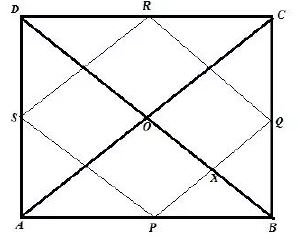
In simple words: Since the midpoints form a rectangle, their sides are perpendicular to each other. Because these sides are parallel to the main diagonals of the quadrilateral, the diagonals must also be perpendicular to each other.
Exam Tip: To show that lines are perpendicular, relate their angle of intersection to the 90-degree corner of a known rectangle using parallel line properties.
Question 10. In \( \triangle ABC \), \( D \), \( E \), and \( F \) are the midpoints of the sides \( AB \), \( AC \), and \( BC \) respectively. If \( AB = 16\text{ cm} \) and \( BC = 18\text{ cm} \), find the perimeter of the parallelogram \( BDEF \).
Answer:
Since \( E \) and \( F \) are given as the midpoints of \( AC \) and \( BC \) respectively, we can use the midpoint theorem to find:
\( EF \parallel AB \) and \( EF = \frac{1}{2}AB \)
Since \( D \) is the midpoint of \( AB \), we also have:
\( BD = \frac{1}{2}AB = EF \)
This means:
\( EF \parallel BD \) and \( EF = BD \)
Therefore, the quadrilateral \( BDEF \) is a parallelogram.
Now, let us calculate the lengths of the adjacent sides of this parallelogram:
- The side \( BD \) is half of the side \( AB \):
\( BD = EF = \frac{1}{2}AB = \frac{1}{2} \times 16\text{ cm} = 8\text{ cm} \)
- The side \( BF \) is half of the side \( BC \):
\( BF = DE = \frac{1}{2}BC = \frac{1}{2} \times 18\text{ cm} = 9\text{ cm} \)
Finally, the perimeter of the parallelogram \( BDEF \) is calculated as:
\( \text{Perimeter} = 2(BF + EF) = 2(9 + 8) = 2 \times 17 = 34\text{ cm} \)
In simple words: Each side of the inner parallelogram is exactly half as long as one of the main sides of the triangle. By finding these two lengths and adding them up, we can find the total perimeter of the inner shape.
Exam Tip: In perimeter calculations, clearly show the application of the midpoint theorem to establish the side lengths before summing them up.
Question 11. In \( \triangle ABC \), \( AD \) and \( BE \) are medians. A line through \( D \) is drawn parallel to \( CE \) to meet \( AB \) at \( F \). Prove that \( FB = \frac{1}{4}AB \).
Answer:
We are given that \( AD \) and \( BE \) are the medians of \( \triangle ABC \), and the line \( DF \) is parallel to \( CE \).
Let us analyze \( \triangle BCE \). Since \( AD \) is a median, \( D \) is the midpoint of the side \( BC \).
Additionally, we are given that \( DF \parallel CE \).
By the converse of the midpoint theorem, a line drawn through the midpoint of one side of a triangle parallel to another side bisects the third side.
Thus, \( F \) must be the midpoint of \( BE \), which gives:
\( FB = \frac{1}{2}BE \) - (1)
Since \( BE \) is a median of \( \triangle ABC \), \( E \) is the midpoint of \( AB \), meaning:
\( BE = \frac{1}{2}AB \) - (2)
Substituting the value of \( BE \) from equation (2) into equation (1):
\( FB = \frac{1}{2} \left( \frac{1}{2}AB \right) = \frac{1}{4}AB \)
Hence Proved.
In simple words: Since one line is a median, it cuts a side in half. By drawing a parallel line, we apply the midpoint rule again to show that another segment is cut in half, which makes the final piece exactly a quarter of the whole side.
Exam Tip: When working with medians, remember they always divide the opposite side into two equal halves, which is a key starting point for midpoint theorem proofs.
Question 12. Let \( ABCD \) be a parallelogram. If \( E \) is the midpoint of \( AB \) and \( EC \parallel AP \) where \( P \) is a point on \( AD \) produced, show that:
(i) \( BP = 2AD \)
(ii) \( O \) is the midpoint of \( AP \), where \( O \) is the intersection of \( AC \) and \( BD \).
Answer:
We are given a parallelogram \( ABCD \), which means:
\( AD = BC \) and \( AB = CD \)
(i) Let us examine \( \triangle APB \).
We are given that \( E \) is the midpoint of the side \( AB \) and the line \( EC \) is parallel to \( AP \).
By the converse of the midpoint theorem, since a line is drawn through the midpoint of one side parallel to another side, it must bisect the third side.
Thus, \( C \) is the midpoint of \( BP \), which gives:
\( BP = 2BC \)
Since \( ABCD \) is a parallelogram, we can substitute \( BC = AD \):
\( BP = 2AD \)
(ii) Now, consider \( \triangle APB \) again.
Since \( ABCD \) is a parallelogram, \( AB \parallel CD \), which implies \( AB \parallel OC \).
Using the midpoint theorem, since \( C \) is the midpoint of \( BP \) and \( OC \parallel AB \), \( O \) must be the midpoint of the side \( AP \).
Hence Proved.
In simple words: By using the midpoint theorem in a triangle created by extending the parallelogram's sides, we can prove that a point is a midpoint, which then helps us show the required side length and midpoint relationships.
Exam Tip: Remember that opposing sides of a parallelogram are always parallel. This allows you to easily find parallel lines to use with the midpoint theorem.
Question 13. In a trapezium \( ABCD \), \( E \) and \( F \) are the midpoints of the non-parallel sides \( AD \) and \( BC \) respectively. Prove that \( AB + CD = 2EF \).
Answer:
Let us consider the trapezium \( ABCD \) where the parallel sides are \( AB \) and \( CD \).
We draw perpendicular lines from \( A \) and \( B \) to meet \( CD \) at \( I \) and \( J \) respectively.
These lines intersect the midpoint line \( EF \) at points \( G \) and \( H \).
From this construction, we have:
\( AB = GH = IJ \)
Now, let us apply the midpoint theorem:
- In \( \triangle ADI \), since \( E \) is the midpoint of \( AD \) and \( EG \parallel DI \), we have:
\( EG = \frac{1}{2}DI \implies DI = 2EG \)
- In \( \triangle BCJ \), since \( F \) is the midpoint of \( BC \) and \( HF \parallel JC \), we have:
\( HF = \frac{1}{2}JC \implies JC = 2HF \)
Let us look at the sum of the parallel sides \( AB + CD \):
\( AB + CD = AB + (DI + IJ + JC) \)
Substitute \( IJ = AB \), \( DI = 2EG \), and \( JC = 2HF \) into this equation:
\( AB + CD = AB + 2EG + AB + 2HF \)
Combine the terms:
\( AB + CD = 2AB + 2EG + 2HF = 2(EG + AB + HF) \)
Since \( AB = GH \), we can substitute \( GH \) in:
\( AB + CD = 2(EG + GH + HF) \)
Looking at the segment \( EF \), it is made of \( EG + GH + HF \), so:
\( AB + CD = 2EF \)
Hence Proved.
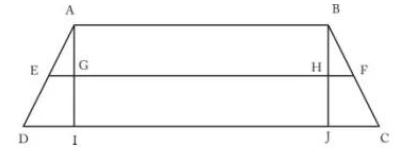
In simple words: By splitting the trapezium with helper lines, we can express the bottom base in terms of the middle segment's parts. Adding the top and bottom bases together shows they are exactly twice the length of the middle segment.
Exam Tip: Using vertical projections to break a trapezium into rectangles and triangles is a powerful technique for proving segment relationships.
Question 14. In \( \triangle ABC \), \( AD \) is a median. A line is drawn through \( D \) parallel to \( AB \), meeting \( AC \) at \( E \). Prove that \( BE \) is also a median of \( \triangle ABC \).
Answer:
We are given \( \triangle ABC \), with \( AD \) serving as the median, which means \( D \) is the midpoint of the side \( BC \).
We are also given that the line \( DE \) is parallel to \( AB \).
Applying the converse of the midpoint theorem to \( \triangle ABC \): since \( D \) is the midpoint of \( BC \) and \( DE \parallel AB \), the point \( E \) must be the midpoint of the side \( AC \).
By definition, a line segment that connects a vertex of a triangle to the midpoint of its opposite side is called a median.
Since \( E \) is the midpoint of \( AC \), the segment \( BE \) connects the vertex \( B \) to the midpoint of \( AC \).
Therefore, \( BE \) is also a median of \( \triangle ABC \).
In simple words: Since one line is a median, we know where the midpoint of the base is. Drawing a parallel line helps us find the midpoint of the other side, which proves that the line drawn to it is also a median.
Exam Tip: Be sure to state the formal definition of a median - the line segment connecting a vertex to the midpoint of the opposite side - to complete your proof rigorously.
ICSE Selina Concise Solutions Class 9 Mathematics Chapter 12 Mid Point And Its Converse
Students can now access the detailed Selina Concise Solutions for Chapter 12 Mid Point And Its Converse on our portal. These solutions have been carefully prepared as per latest ICSE Class 9 syllabus. Each solution given above has been updated based on the current year pattern to ensure Class 9 students have the most updated Mathematics content.
Master Selina Concise Textbook Questions
Our subject experts have provided detailed explanations for all the questions found in the Selina Concise textbook for Class 9 Mathematics. We have focussed on making the concepts easy for you in Chapter 12 Mid Point And Its Converse so that students can understand the concepts behind every answer. For all numerical problems and theoretical concepts these solutions will help in strengthening your analytical skill required for the ICSE examinations.
Complete Mathematics Exam Preparation
By using these Selina Concise Class 9 solutions, you can enhance your learning and identify areas that need more attention. We recommend solving the Mathematics Questions from the textbook first and then use our teacher-verified answers. For a proper revision of Chapter 12 Mid Point And Its Converse, students should also also check our Revision Notes and Sample Papers available on studiestoday.com.
FAQs
You can download the verified Selina Concise solutions for Chapter 12 Mid Point And Its Converse on StudiesToday.com. Our teachers have prepared answers for Class 9 Mathematics as per 2026-27 ICSE academic session.
Yes, our solutions for Chapter 12 Mid Point And Its Converse are designed as per new 2026 ICSE standards. 40% competency-based questions required for Class 9, are included to help students understand application-based logic behind every Mathematics answer.
Yes, every exercise in Chapter 12 Mid Point And Its Converse from the Selina Concise textbook has been solved step-by-step. Class 9 students will learn Mathematics conceots before their ICSE exams.
Yes, follow structured format of these Selina Concise solutions for Chapter 12 Mid Point And Its Converse to get full 20% internal assessment marks and use Class 9 Mathematics projects and viva preparation as per ICSE 2026 guidelines.