

ICSE Solutions Selina Concise Class 7 Mathematics Chapter 19 Congruency Congruent Triangles have been provided below and is also available in Pdf for free download. The Selina Concise ICSE solutions for Class 7 Mathematics have been prepared as per the latest syllabus and ICSE books and examination pattern suggested in Class 7. Questions given in ICSE Selina Concise book for Class 7 Mathematics are an important part of exams for Class 7 Mathematics and if answered properly can help you to get higher marks. Refer to more Chapter-wise answers for ICSE Class 7 Mathematics and also download more latest study material for all subjects. Chapter 19 Congruency Congruent Triangles is an important topic in Class 7, please refer to answers provided below to help you score better in exams
Selina Concise Chapter 19 Congruency Congruent Triangles Class 7 Mathematics ICSE Solutions
Class 7 Mathematics students should refer to the following ICSE questions with answers for Chapter 19 Congruency Congruent Triangles in Class 7. These ICSE Solutions with answers for Class 7 Mathematics will come in exams and help you to score good marks
Chapter 19 Congruency Congruent Triangles Selina Concise ICSE Solutions Class 7 Mathematics
1. Meaning of Congruency
If we can place one geometric figure over another and they match exactly, we say they are congruent to each other. For two straight lines AB and CD to be congruent, they must coincide perfectly when placed on top of one another. This is possible only when they have identical lengths.
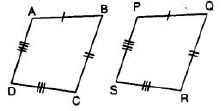
Two figures ABCD and PQRS are congruent if they match perfectly when laid over each other. This means point A matches P, B matches Q, C matches R, and D matches S. This happens when:
\( AB = PQ \), \( BC = QR \), \( CD = RS \), and \( AD = PS \)
Also, \( \angle A = \angle P \), \( \angle B = \angle Q \), \( \angle C = \angle R \), and \( \angle D = \angle S \).
2. Congruency in Triangles
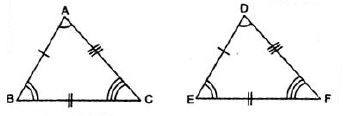
If we place triangle ABC on top of triangle DEF such that point A lands on point D and side AB lies along side DE, and the two triangles match exactly (meaning B falls on E, C falls on F, side BC matches EF, and side AC matches DF), then the triangles are congruent.
The mathematical symbol for congruency is " \( \equiv \) " or " \( \cong \) ".
Therefore, we write " \( \Delta ABC \) is congruent to \( \Delta DEF \) " as:
\( \Delta ABC \cong \Delta DEF \) or \( \Delta ABC \equiv \Delta DEF \).
3. Corresponding Sides and Corresponding Angles
In congruent triangles ABC and DEF, when we place \( \Delta ABC \) over \( \Delta DEF \) to cover it completely, the sides that align with each other are called corresponding sides. For instance, AB matches DE, BC matches EF, and AC matches DF.
Similarly, the angles that align are called corresponding angles. Here, they are \( \angle A \) and \( \angle D \), \( \angle B \) and \( \angle E \), and \( \angle C \) and \( \angle F \).
Note: The matching components of congruent triangles are always equal. This principle is known as CPCTC (corresponding parts of congruent triangles are congruent).
Thus:
(i) \( AB = DE \), \( BC = EF \), and \( AC = DF \) (corresponding sides are equal).
Also (ii) \( \angle A = \angle D \), \( \angle B = \angle E \), and \( \angle C = \angle F \) (corresponding angles are equal).
4. Conditions of Congruency
1. S.S.S. (Side-Side-Side) Criterion: If all three sides of one triangle are equal to the corresponding three sides of another triangle, the triangles are congruent.
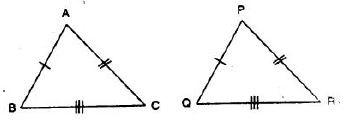
In \( \Delta ABC \) and \( \Delta PQR \):
If \( AB = PQ \), \( BC = QR \), and \( AC = PR \),
then \( \Delta ABC \cong \Delta PQR \) by S.S.S. rule.
Consequently, their corresponding angles are also equal:
\( \angle A = \angle P \), \( \angle B = \angle Q \), and \( \angle C = \angle R \).
2. S.A.S. (Side-Angle-Side) Criterion: If two sides and the included angle (the angle between them) of one triangle are equal to two sides and the included angle of another triangle, the triangles are congruent.
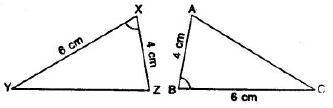
Note: Triangles are congruent by S.A.S. only when the equal angles are located between the equal sides.
3. A.S.A. (Angle-Side-Angle) Criterion: If two angles and the included side of one triangle are equal to two angles and the included side of another triangle, the triangles are congruent.
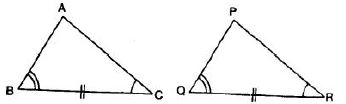
In the above figure:
If \( BC = QR \), \( \angle B = \angle Q \), and \( \angle C = \angle R \),
then \( \Delta ABC \cong \Delta PQR \) by A.S.A. rule.
4. R.H.S. (Right angle-Hypotenuse-Side) Criterion: If the hypotenuse and one side of a right-angled triangle are equal to the hypotenuse and one side of another right-angled triangle, the triangles are congruent.
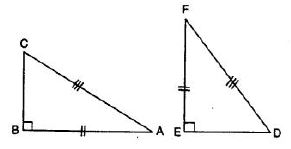
Note: Having three equal angles (A.A.A.) does not guarantee congruency. At least one pair of matching sides must be equal to establish congruence.
Exercise 19
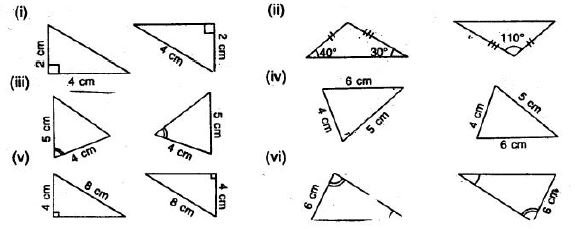
Question 1. State, whether the pairs of triangles given in the following figures are congruent or not:
(i) Two triangles where one has sides of 2 cm and 4 cm, and the other has a side of 2 cm and hypotenuse of 4 cm.
(ii) Two triangles with marked angles of 40° and 30° on one, and a single angle of 110° on the other, with identical matching sides.
(iii) Two triangles with sides of 4 cm and 5 cm, but different angle positions.
(iv) Two triangles with matching sides of 4 cm, 5 cm, and 6 cm.
(v) Two right-angled triangles with matching sides of 4 cm and hypotenuse of 8 cm.
(vi) Two triangles with two equal sides and an angle.
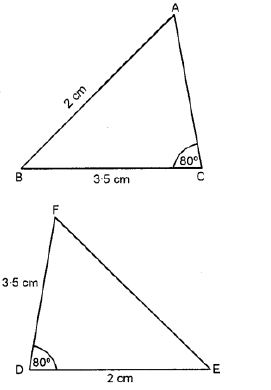
(vii) \( \Delta ABC \) in which \( AB = 2 \text{ cm} \), \( BC = 3.5 \text{ cm} \) and \( \angle C = 80^\circ \). and, \( \Delta DEF \) in which \( DE = 2 \text{ cm} \), \( DF = 3.5 \text{ cm} \) and \( \angle D = 80^\circ \).
Answer:
(i) These triangles are not congruent because their corresponding sides are unequal.
(ii) In the first triangle, the third angle is calculated as \( 180^\circ - (40^\circ + 30^\circ) = 110^\circ \). Comparing both triangles, two sides and their enclosed angle are equal, meaning they are congruent by the S.A.S. criterion.
(iii) These triangles are not congruent since the angles enclosed by the equal sides are not matching.
(iv) These triangles are congruent under the S.S.S. rule because all three pairs of corresponding sides are equal in length.
(v) These right-angled triangles are congruent under the R.H.S. rule since their hypotenuse and one matching side are equal.
(vi) These triangles are congruent under the S.S.A. rule as given in the figures since two sides and a corresponding angle are equal.
(vii) These triangles are not congruent because the angles enclosed by the equal sides are not equal.
In simple words: To see if two triangles are identical, check if they have matching side lengths and angles in the correct positions. If the matching parts do not line up perfectly, the triangles are not congruent.
Exam Tip: Remember that A.A.A. (Angle-Angle-Angle) and S.S.A. (Side-Side-Angle in general) are not reliable tests for congruence. Always look for S.S.S., S.A.S., A.S.A., or R.H.S. rules.
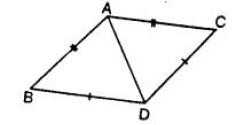
Question 2. In the given figure, prove that: \( \Delta ABD \cong \Delta ACD \
Answer:
In \( \Delta ABD \) and \( \Delta ACD \):
1. \( AD = AD \) (Common side shared by both triangles)
2. \( AB = AC \) (Given)
3. \( BD = DC \) (Given)
\( \implies \Delta ABD \cong \Delta ACD \) by the S.S.S. rule.
Hence proved.
In simple words: Since both triangles share the middle side and have two other pairs of sides that are equal, all three sides match. This makes the two triangles congruent.
Exam Tip: Clearly state which sides are given as equal and identify the shared common side to get full marks for the proof.
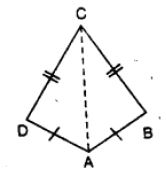
Question 3. Prove that:
(i) \( \Delta ABC \cong \Delta ADC \)
(ii) \( \angle B = \angle D \)
(iii) AC bisects angle DCB
Answer:
In \( \Delta ABC \) and \( \Delta ADC \):
1. \( AC = AC \) (Common side)
2. \( AB = AD \) (Given in the figure)
3. \( CB = CD \) (Given in the figure)
\( \implies \Delta ABC \cong \Delta ADC \) by the S.S.S. rule. (This proves part i)
Since the triangles are congruent, their corresponding parts are equal (C.P.C.T.):
\( \angle B = \angle D \) (This proves part ii)
Also, \( \angle BCA = \angle DCA \) (by C.P.C.T.).
Since these two angles are equal, the line AC must bisect \( \angle DCB \). (This proves part iii)
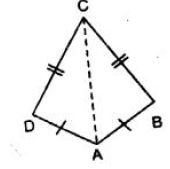
In simple words: The two triangles are identical because all three of their sides are equal. Since they are identical, their corresponding angles must also match, proving the remaining parts of the question.
Exam Tip: Don't forget to write "(by C.P.C.T.)" when concluding that corresponding angles or sides are equal after proving triangle congruence.
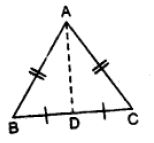
Question 4. Prove that:
(i) \( \Delta ABD \cong \Delta ACD \)
(ii) \( \angle B = \angle C \)
(iii) \( \angle ADB = \angle ADC \)
(iv) \( \angle ADB = 90^\circ \)
Answer:
In \( \Delta ABD \) and \( \Delta ACD \):
1. \( AD = AD \) (Common side)
2. \( AB = AC \) (Given)
3. \( BD = CD \) (Given)
\( \implies \Delta ABD \cong \Delta ACD \) by the S.S.S. rule. (This proves part i)
Since these triangles are congruent:
\( \angle B = \angle C \) (by C.P.C.T.) (This proves part ii)
\( \angle ADB = \angle ADC \) (by C.P.C.T.) (This proves part iii)
Since B, D, and C lie on a straight line:
\( \angle ADB + \angle ADC = 180^\circ \) (Linear pair of angles)
Since \( \angle ADB = \angle ADC \):
\( 2 \cdot \angle ADB = 180^\circ \)
\( \implies \angle ADB = 90^\circ \) (This proves part iv)
Hence proved.
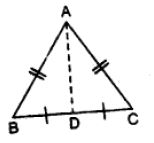
In simple words: The two triangles share a side and have two other matching sides, so they are identical. Since they are identical, the two angles where they meet at the bottom must be equal. Since those two angles form a straight line, each must be exactly 90 degrees.
Exam Tip: For proving the 90-degree angle, always invoke the "linear pair" axiom to show that the sum of the adjacent angles on the straight line equals 180 degrees.
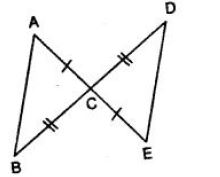
Question 5. In the given figure, prove that:
(i) \( \Delta ACB \cong \Delta ECD \)
(ii) AB = ED
Answer:
(i) In \( \Delta ACB \) and \( \Delta ECD \):
1. \( AC = CE \) (Given)
2. \( \angle ACB = \angle ECD \) (Vertically opposite angles are equal)
3. \( BC = CD \) (Given)
\( \implies \Delta ACB \cong \Delta ECD \) by the S.A.S. rule.
(ii) Since the triangles are congruent:
\( AB = ED \) (by C.P.C.T.)
Hence proved.
In simple words: The two triangles share a vertex in the middle, making their opposite angles equal. Since the sides surrounding these angles are also equal, the triangles are identical, which means their outer sides must be equal too.
Exam Tip: When two straight lines cross, the opposite angles formed are always equal. Clearly label these as "vertically opposite angles" in your proof.
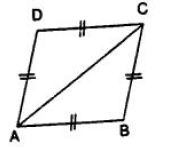
Question 6. Prove that:
(i) \( \Delta ABC \cong \Delta ADC \)
(ii) \( \angle B = \angle D \)
Answer:
In \( \Delta ABC \) and \( \Delta ADC \):
1. \( AC = AC \) (Common side)
2. \( AB = CD \) (Given)
3. \( BC = AD \) (Given)
\( \implies \Delta ABC \cong \Delta ADC \) by S.S.S. rule. (This proves part i)
Consequently:
\( \angle B = \angle D \) (by C.P.C.T.) (This proves part ii)
Hence proved.
In simple words: The diagonal split divides the shape into two triangles. Because they share this diagonal and have equal opposite sides, the two triangles are identical, making their corresponding angles equal.
Exam Tip: Ensure that you map the vertices correctly when stating congruence (e.g., matching A with C and B with D) to show logical precision.
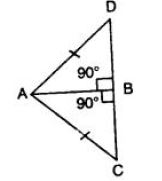
Question 7. In the given figure, prove that: BD = BC.
Answer:
In right-angled triangles ABD and ABC:
1. \( AB = AB \) (Common side)
2. Hypotenuse \( AD = \) Hypotenuse \( AC \) (Given)
3. \( \angle ABD = \angle ABC = 90^\circ \) (Each is a right angle)
\( \implies \Delta ABD \cong \Delta ABC \) by the R.H.S. rule.
Since corresponding parts of congruent triangles are equal:
\( BD = BC \) (by C.P.C.T.)
Hence proved.
In simple words: Since both right-angled triangles share a side and have equal hypotenuses, they are completely identical. Therefore, their remaining sides at the base must also be equal.
Exam Tip: R.H.S. can only be applied when you have right-angled triangles. Always state the 90-degree angles explicitly before applying this criterion.
Question 8. In the given figure ;
\( \angle 1 = \angle 2 \) and AB = AC. Prove that:
(i) \( \angle B = \angle C \)
(ii) BD = DC
(iii) AD is perpendicular to BC.
Answer:
In \( \Delta ADB \) and \( \Delta ADC \):
1. \( AB = AC \) (Given)
2. \( \angle 1 = \angle 2 \) (Given)
3. \( AD = AD \) (Common side)
\( \implies \Delta ADB \cong \Delta ADC \) by the S.A.S. rule.
Using corresponding parts of congruent triangles (C.P.C.T.):
(i) \( \angle B = \angle C \)
(ii) \( BD = DC \)
(iii) Also, \( \angle ADB = \angle ADC \) (by C.P.C.T.)
Since B, D, and C form a straight line:
\( \angle ADB + \angle ADC = 180^\circ \) (Linear pair)
Since \( \angle ADB = \angle ADC \):
\( 2 \cdot \angle ADB = 180^\circ \)
\( \implies \angle ADB = 90^\circ \)
Hence, AD is perpendicular to BC.
Hence proved.
In simple words: By showing that the two triangles are mirror images of each other, we know their bottom sides match and their bottom angles match. Since those bottom angles add up to 180 degrees, they must both be 90 degrees, making the line perpendicular.
Exam Tip: Remember to solve this multi-part question systematically, as proving the congruence in the beginning is the key to unlocking parts (i), (ii), and (iii).
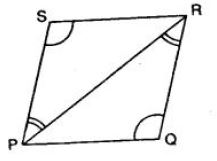
Question 9. In the given figure prove tlyat:
(i) PQ = RS
(ii) PS = QR
Answer:
In \( \Delta PQR \) and \( \Delta PSR \):
1. \( PR = PR \) (Common side)
2. \( \angle PRQ = \angle RPS \) (Given)
3. \( \angle PQR = \angle PSR \) (Given)
\( \implies \Delta PQR \cong \Delta PSR \) by the A.S.A. rule (Angle-Side-Angle).
Therefore, by C.P.C.T.:
(i) \( PQ = RS \)
(ii) \( PS = QR \)
Hence proved.
In simple words: The diagonal splits the quadrilateral into two triangles that share the diagonal. Because they have two pairs of equal angles, the triangles are identical, which means their outer opposite sides are equal.
Exam Tip: Be careful to identify which angles are equal to verify whether they enclose the shared side for the A.S.A. rule.
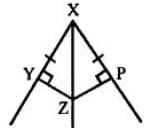
Question 10.
(i) \( \Delta XYZ \cong \Delta XPZ \)
(ii) YZ = PZ
(iii) \( \angle YXZ = \angle PXZ \)
Answer:
In right-angled triangles XYZ and XPZ:
1. \( XY = XP \) (Given)
2. Hypotenuse \( XZ = \) Hypotenuse \( XZ \) (Common side)
3. \( \angle XYZ = \angle XPZ = 90^\circ \) (Given)
\( \implies \Delta XYZ \cong \Delta XPZ \) by the R.H.S. rule. (This proves part i)
By C.P.C.T.:
(ii) \( YZ = PZ \)
(iii) \( \angle YXZ = \angle PXZ \)
Hence proved.
In simple words: Since these two right-angled triangles share a hypotenuse and have one other pair of equal sides, they match completely. As a result, their remaining sides and angles must be equal.
Exam Tip: R.H.S. congruent triangles always have their corresponding sides (base/perpendicular) and angles equal via C.P.C.T.
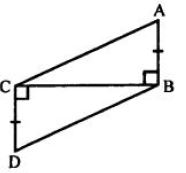
Question 11. In the given figure, prove that:
(i) \( \Delta ABC \cong \Delta DCB \)
(ii) AC = DB
Answer:
In \( \Delta ABC \) and \( \Delta DCB \):
1. \( CB = CB \) (Common side)
2. \( \angle ABC = \angle BCD = 90^\circ \) (Given right angles)
3. \( AB = CD \) (Given)
\( \implies \Delta ABC \cong \Delta DCB \) by S.A.S. rule. (This proves part i)
By C.P.C.T.:
\( AC = DB \) (This proves part ii)
Hence proved.
In simple words: Both triangles share the horizontal bottom side and have vertical sides of the same height. Since they also have 90-degree corners, they are identical, making their diagonal lines equal.
Exam Tip: Be precise when establishing which side is common and which sides are given as equal to successfully apply the S.A.S. rule.
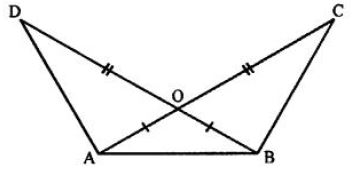
Question 12. In the given figure, prove that:
(i) \( \Delta AOD \cong \Delta BOC \)
(ii) AD = BC
(iii) \( \angle ADB = \angle ACB \)
(iv) \( \Delta ADB \cong \Delta BCA \)
Answer:
In \( \Delta AOD \) and \( \Delta BOC \):
1. \( OA = OB \) (Given)
2. \( \angle AOD = \angle BOC \) (Vertically opposite angles)
3. \( OD = OC \) (Given)
\( \implies \Delta AOD \cong \Delta BOC \) by S.A.S. rule. (This proves part i)
Using corresponding parts of congruent triangles (C.P.C.T.):
(ii) \( AD = BC \)
(iii) \( \angle ADB = \angle ACB \)
For part (iv), consider \( \Delta ADB \) and \( \Delta BCA \):
1. \( AD = BC \) (Proven in part ii)
2. \( AB = AB \) (Common side)
3. \( BD = AC \) (Since \( BD = OB + OD \), \( AC = OA + OC \), and we are given \( OA = OB \), \( OC = OD \))
\( \implies \Delta ADB \cong \Delta BCA \) by S.S.S. rule.
Hence proved.
In simple words: First, we show the two smaller opposite triangles are identical. From this, we establish that the outer vertical sides are equal, which then helps us prove the two larger overlapping triangles at the base are also identical.
Exam Tip: For part (iv), remember that adding equal segments (like \( OA + OC \) and \( OB + OD \)) produces equal total lengths (\( AC = BD \)), which is crucial to complete the S.S.S. proof.
Question 13. ABC is an equilateral triangle, AD and BE are perpendiculars to BC and AC respectively. Prove that:
(i) AD = BE
(ii) BD = CE
Answer:
In \( \Delta ADC \) and \( \Delta BEC \):
1. \( \angle ADC = \angle BEC = 90^\circ \) (Since AD and BE are altitudes/perpendiculars)
2. \( \angle ACD = \angle BCE \) (Common angle C)
3. \( AC = BC \) (Sides of an equilateral triangle are equal)
\( \implies \Delta ADC \cong \Delta BEC \) by the A.A.S. rule.
By C.P.C.T.:
(i) \( AD = BE \)
And \( CD = CE \) (by C.P.C.T.).
Since AD is an altitude of an equilateral triangle, it bisects the base BC, meaning \( BD = CD \).
Substituting this:
(ii) \( BD = CE \)
Hence proved.
In simple words: Since the main triangle has three equal sides and angles, any altitudes drawn from its corners must be equal. These altitudes split the base lines in half, meaning the smaller cut-off segments are also equal to each other.
Exam Tip: Remember that in an equilateral triangle, all three sides are equal, and any perpendicular drawn to a side also bisects that side.
Question 14. Use the informations given in the following figure to prove triangles ABD and CBD are congruent. Also, find the values of x and y.
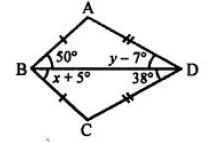
Answer:
In \( \Delta ABD \) and \( \Delta CBD \):
1. \( BD = BD \) (Common side)
2. \( AB = BC \) (Given in the figure)
3. \( AD = CD \) (Given in the figure)
\( \implies \Delta ABD \cong \Delta CBD \) by S.S.S. rule.
Since corresponding parts of congruent triangles are equal (C.P.C.T.):
\( \angle ABD = \angle CBD \)
\( \implies 50^\circ = x + 5^\circ \)
\( \implies x = 45^\circ \)
Also:
\( \angle ADB = \angle CDB \)
\( \implies y - 7^\circ = 38^\circ \)
\( \implies y = 45^\circ \)
Thus, the values are \( x = 45^\circ \) and \( y = 45^\circ \).
In simple words: The two triangles share a side and have matching outer sides, so they are identical. By setting their corresponding angles equal to each other, we can solve simple equations to find that both variables are 45.
Exam Tip: When setting up equations from congruent triangles, make sure you match the correct angles opposite to equal sides.
Question 15. The given figure shows a triangle ABC in which AD is perpendicular to side BC and BD = CD. Prove that:
(i) \( \Delta ABD \cong \Delta ACD \)
(ii) AB=AC
(iii) \( \angle B = \angle C \)
Answer:
(i) In \( \Delta ABD \) and \( \Delta ACD \):
1. \( AD = AD \) (Common side)
2. \( \angle ADB = \angle ADC = 90^\circ \) (Since \( AD \perp BC \))
3. \( BD = CD \) (Given)
\( \implies \Delta ABD \cong \Delta ACD \) by the S.A.S. rule.
Using corresponding parts of congruent triangles (C.P.C.T.):
(ii) \( AB = AC \)
(iii) \( \angle B = \angle C \)
Hence proved.
In simple words: The line going straight down the middle splits the base in half at a 90-degree angle. This splits the main triangle into two congruent side-by-side triangles, proving their outer sides and base angles are equal.
Exam Tip: Since both sides of a perpendicular line on a straight segment form 90-degree angles, state this clearly to establish S.A.S. congruence.
Free study material for Mathematics
ICSE Selina Concise Solutions Class 7 Mathematics Chapter 19 Congruency Congruent Triangles
Students can now access the detailed Selina Concise Solutions for Chapter 19 Congruency Congruent Triangles on our portal. These solutions have been carefully prepared as per latest ICSE Class 7 syllabus. Each solution given above has been updated based on the current year pattern to ensure Class 7 students have the most updated Mathematics content.
Master Selina Concise Textbook Questions
Our subject experts have provided detailed explanations for all the questions found in the Selina Concise textbook for Class 7 Mathematics. We have focussed on making the concepts easy for you in Chapter 19 Congruency Congruent Triangles so that students can understand the concepts behind every answer. For all numerical problems and theoretical concepts these solutions will help in strengthening your analytical skill required for the ICSE examinations.
Complete Mathematics Exam Preparation
By using these Selina Concise Class 7 solutions, you can enhance your learning and identify areas that need more attention. We recommend solving the Mathematics Questions from the textbook first and then use our teacher-verified answers. For a proper revision of Chapter 19 Congruency Congruent Triangles, students should also also check our Revision Notes and Sample Papers available on studiestoday.com.
FAQs
You can download the verified Selina Concise solutions for Chapter 19 Congruency Congruent Triangles on StudiesToday.com. Our teachers have prepared answers for Class 7 Mathematics as per 2026-27 ICSE academic session.
Yes, our solutions for Chapter 19 Congruency Congruent Triangles are designed as per new 2026 ICSE standards. 40% competency-based questions required for Class 7, are included to help students understand application-based logic behind every Mathematics answer.
Yes, every exercise in Chapter 19 Congruency Congruent Triangles from the Selina Concise textbook has been solved step-by-step. Class 7 students will learn Mathematics conceots before their ICSE exams.
Yes, follow structured format of these Selina Concise solutions for Chapter 19 Congruency Congruent Triangles to get full 20% internal assessment marks and use Class 7 Mathematics projects and viva preparation as per ICSE 2026 guidelines.