

ICSE Solutions Selina Concise Class 9 History Civics Chapter 12 The Renaissance have been provided below and is also available in Pdf for free download. The Selina Concise ICSE solutions for Class 9 History Civics have been prepared as per the latest syllabus and ICSE books and examination pattern suggested in Class 9. Questions given in ICSE Selina Concise book for Class 9 History Civics are an important part of exams for Class 9 History Civics and if answered properly can help you to get higher marks. Refer to more Chapter-wise answers for ICSE Class 9 History Civics and also download more latest study material for all subjects. Chapter 12 The Renaissance is an important topic in Class 9, please refer to answers provided below to help you score better in exams
Selina Concise Chapter 12 The Renaissance Class 9 History Civics ICSE Solutions
Class 9 History Civics students should refer to the following ICSE questions with answers for Chapter 12 The Renaissance in Class 9. These ICSE Solutions with answers for Class 9 History Civics will come in exams and help you to score good marks
Chapter 12 The Renaissance Selina Concise ICSE Solutions Class 9 History Civics
Question 1. What it meant by Renaissance ?
Answer: The word 'Renaissance' comes from 'Renascence', a Latin term. It signifies a rebirth, specifically referring to the resurgence of classical Greco-Roman intellect and education, along with the rejuvenation of artistic expression and the rise of humanism.
In simple words: Renaissance means a rebirth of ideas, art, and learning based on ancient Greek and Roman culture.
Exam Tip: Remember that 'Renaissance' literally means rebirth. Highlight the revival of Greco-Roman classics and the rise of humanism to secure full marks.
Question 2. Why is Renaissance known as an Intellectual Movement?
Answer: The Renaissance is regarded as an intellectual shift because it sparked fresh advancements across various domains, including science, literature, politics, philosophy, art, and religion.
In simple words: It is called an intellectual movement because it brought new ways of thinking to science, art, and writing.
Exam Tip: Focus on how this movement brought changes to multiple academic areas like science, philosophy, and literature, rather than just art alone.
Question 3. Mention any two causes that led to the advent of Renaissance.
Answer: Two factors that contributed to the rise of the Renaissance are:
1. The fall of Constantinople to Turkish forces.
2. The breakdown of the feudal system.
In simple words: The Renaissance started because Constantinople fell to the Turks, and the old system of feudalism ended.
Exam Tip: Be precise with the two main causes: the fall of Constantinople in 1453 and the decline of the feudal system.
Question 4. Name the country where the scholars took refuge after the siege of Constantinople.
Answer: Following the fall of Constantinople, Italy became the place where academic refugees sought safety.
In simple words: Italian cities welcomed the scholars who fled Constantinople after it was captured.
Exam Tip: Name Italy specifically as the country where scholars fled, as its pre-existing literary culture made it a welcoming refuge.
Question 5. What caused the Greek scholars to come to Italy? Or Give an important reason why the Renaissance began in Italy.
Answer: When the Ottoman Turks captured the city of Constantinople in 1453, Greek academics escaped and migrated to Italy.
In simple words: Greek scholars ran away to Italy after the Turks attacked their city in 1453.
Exam Tip: Mention 1453 and the Ottoman Turks clearly, as historical dates and names show examiners your precise understanding.
Question 6. Who reached Kerala’s coastal town of Calicut in 1498?
Answer: The Portuguese navigator Vasco da Gama arrived at the coastal settlement of Calicut in Kerala in the year 1498.
In simple words: In 1498, a Portuguese explorer named Vasco da Gama sailed to Calicut in India.
Exam Tip: Note both the explorer's name (Vasco da Gama) and the exact year (1498) to get full credit.
Question 7. How did the invention of printing press bring new awakening in Europe?
Answer: The creation of the printing press enabled the mass production of written works. This allowed copies of the Bible along with ancient classical and religious texts to be distributed widely across the European continent.
In simple words: The printing press made books cheap and easy to make, so many people could read the Bible and other texts.
Exam Tip: Emphasize that the printing press made books available in large numbers, which broke the monopoly on knowledge.
Question 8. Mention an outstanding impact of the Renaissance ii the field of literature.
Answer: Authors began using regional vernacular languages rather than Latin to compose their literary works.
In simple words: Writers started using their own local languages instead of Latin to write books.
Exam Tip: Use terms like "vernacular" or "native languages" when discussing the literary shift from Latin.
Question 9. Who wrote ‘The Prince’? What is its importance?
Answer: Niccolò Machiavelli authored the book 'The Prince'. This work significantly shaped contemporary statecraft by advocating for the decoupling of political affairs from religious influence.
In simple words: Machiavelli wrote 'The Prince' to argue that politics should be kept separate from religion.
Exam Tip: Clearly state Machiavelli's main political thesis: the total separation of politics and statecraft from religious authority.
Question 10. Who was the famous English poet and dramatist the 16th century?
Answer: William Shakespeare stood out as the most prominent playwright and poet in sixteenth-century England.
In simple words: William Shakespeare was a very famous English writer and playwright in the 1500s.
Exam Tip: Spell Shakespeare's name correctly and specify the "16th century" to match standard marking schemes.
Question 11. Name any two literary works of Shakespeare.
Answer: Among his extensive collection of 38 plays, over 150 sonnets, and numerous poems, his notable works include history plays like Henry V and tragic masterpieces like Hamlet and Macbeth.
In simple words: Two famous plays by William Shakespeare are Hamlet and Macbeth.
Exam Tip: Mentioning specific tragedy plays like Hamlet or Macbeth is a reliable way to gain full marks for Shakespeare's works.
Question 12. Who translated the Holy Bible into German Language
Answer: The translation of the sacred Bible into the German vernacular was accomplished by Martin Luther.
In simple words: Martin Luther translated the Bible into German so regular people could read it.
Exam Tip: Associate Martin Luther directly with the German translation of the Bible when answering questions on religious reform.
Question 13. Mention the names of two celebrated artists of the 16th century?
Answer: Two of the most renowned creators of the sixteenth century were Michelangelo Buonarroti and Leonardo da Vinci.
In simple words: Two famous artists from this time were Leonardo da Vinci and Michelangelo.
Exam Tip: Leonardo da Vinci and Michelangelo are the most common correct answers; spelling them correctly is crucial.
Question 14. Mention the contributions of: (a) Leonardo de Vinci. (b) Mithaelangelo in the field of painting.
Answer:
(a) Leonardo da Vinci excelled as both a painter and a sculptor, creating legendary paintings such as "Mona Lisa" and "The Last Supper".
(b) Michelangelo was another master of painting and sculpture whose crowning achievement was painting the expansive ceiling of the Sistine Chapel located in the Vatican.
In simple words: Leonardo da Vinci painted the Mona Lisa, while Michelangelo painted the ceiling of the Sistine Chapel.
Exam Tip: Mention "Mona Lisa" for Leonardo and "Sistine Chapel" for Michelangelo as these are highly valued keywords in evaluations.
Question 15. Name two famous sculptors of Italy.
Answer: Michelangelo and Lorenzo Ghiberti are recognized as two premier Italian sculptors from this era.
In simple words: Two famous Italian sculptors were Lorenzo Ghiberti and Michelangelo.
Exam Tip: Clearly distinguish between Italian painters and sculptors; Lorenzo Ghiberti is a key name for sculpture.
Question 16. Mention the contributions of Lorenzo Ghiberti in the field of sculpture.
Answer: The celebrated Italian sculptor Lorenzo Ghiberti dedicated two decades of craftsmanship to designing and casting two magnificent sets of bronze gates for the Florence Baptistery.
In simple words: Lorenzo Ghiberti spent twenty years creating beautiful bronze doors for a baptistery in Florence.
Exam Tip: Specify that Ghiberti worked on the "bronze doors" of the "Baptistery at Florence" to earn maximum marks.
Question 17. Name the finest example of the Renaissance architecture in Rome.
Answer: St. Peter's Basilica serves as the supreme illustration of architectural design from this period in Rome.
In simple words: St. Peter's Church is the best example of Renaissance building design in Rome.
Exam Tip: St. Peter's Church in Rome is the absolute benchmark for Renaissance architectural questions.
Question 18. What was the famous theory introduced by Copernicus?
Answer: Nicolaus Copernicus, a clergyman from Poland, proposed the heliocentric concept. He asserted that the Earth turns on its own axis and orbits the Sun, rather than the Sun and stellar bodies revolving around a stationary Earth.
In simple words: Copernicus showed that the Earth rotates and goes around the Sun, instead of the Sun going around the Earth.
Exam Tip: Clearly explain the heliocentric theory - that the Earth revolves around the Sun, not the other way around.
Question 19. Who invented the Telescope?
Answer: The invention of the telescope is credited to the Italian star-gazer Galileo Galilei.
In simple words: An Italian scientist named Galileo invented the telescope to look at the stars.
Exam Tip: Mention both the instrument (telescope) and the scientist (Galileo) to satisfy the prompt requirements.
Question 20. Who proved the theory of Law of Gravitation?
Answer: The mathematical proof and formulation of the universal Law of Gravitation were provided by the English physicist Sir Isaac Newton.
In simple words: Sir Isaac Newton was the English scientist who proved how gravity works.
Exam Tip: Isaac Newton is the primary figure associated with proving the law of gravitation; always prefix with "Sir" for formal accuracy.
Question 21. Mention two important effects or consequences of the Renaissance.
Answer: Two significant outcomes of the Renaissance include:
1. It laid the groundwork for the religious Protestant Reformation.
2. It triggered an immense rise in literature written in native regional languages.
In simple words: The Renaissance helped start the Protestant Reformation and led to many books being written in everyday languages.
Exam Tip: Cite the Reformation and the rise of vernacular literature as the two major long-term impacts of the Renaissance.
Question 22. Who discovered the Eastern Coast of Canada? What did it lead to?
Answer: The Italian navigator John Cabot mapped the eastern shoreline of Canada, which subsequently provided a basis for Britain to assert territorial claims over vast regions of North America.
In simple words: John Cabot found the east coast of Canada, which let Britain claim a large part of North America.
Exam Tip: Clearly link John Cabot's exploration of Canada to the subsequent territorial claims of the British.
Question 23. Name the rulers who patronised the works of literature and art in Europe.
Answer: Prominent monarchs who supported creative and literary endeavors across Europe included King Francis I of France, Spain's Charles V, Christian II of Denmark, along with King Henry VIII and Queen Elizabeth I of England.
In simple words: Monarchs in France, England, Spain, and Denmark gave money and support to artists and writers.
Exam Tip: Ensure you can name at least two major European monarchs, such as King Henry VIII or Queen Elizabeth I, who funded artists.
Structured Questions
Question 1. The 15th and 16th centuries are by and large regarded as the ‘Renaissance Period’. In this context explain how each of the following led to the advent and growth of Renaissance: (a) Capture of Constantinople by the Turks (b) Decline of Feudalism
Answer:
(a) Capture of Constantinople by the Turks: The Ottoman Turks took control of Constantinople, the Byzantine Empire's capital, in 1453 after it had been under Christian governance for over a millennium. The city's archives housed priceless writings by ancient Roman and Greek authors. When the military siege commenced, academics and pupils escaped, carrying numerous invaluable texts to different European regions. Italy offered them an exceptionally warm reception because, as noted by George Guest, “that land had already given birth to famous men of letters- Dante Petrarch and Boccaccio”. Wealthy aristocrats, traders, and clergy gathered around these newly arrived educators.
(b) Decline of Feudalism: Under the feudal system, land-owning lords controlled massive territories and took advantage of the peasantry, which severely restricted social advancement and mobility. Individual liberties and equal rights were virtually non-existent. By the thirteenth and fourteenth centuries, this system began to crumble. Its dissolution encouraged people to think more independently. This newly found intellectual freedom laid the foundation for modern education, ultimately fostering major progress in science, philosophy, literature, and the arts.
In simple words: The fall of Constantinople forced educated scholars to flee to Italy with ancient books, while the end of feudalism gave regular people the freedom to think for themselves.
Exam Tip: Structure your answer clearly using headings for (a) the Capture of Constantinople and (b) the Decline of Feudalism to present a neat paper.
Question 2. The word ‘Renaissance’ signifies the freedom-loving thoughts of man. In this context explain the role of (a) Original thinkers, and (b) Men with advanced scientific ideas in bringing about a spirit of Inquiry among people of Europe.
Answer:
(a) Throughout the medieval period, ecclesiastical authorities actively suppressed independent thought, demanding that academics adhere strictly to established doctrines. Nevertheless, intellectual freedom could not be contained indefinitely. Fearless scholars began questioning church teachings and urged the public to cultivate personal reasoning. Intellectuals such as Peter Abelard, Thomas Aquinas, and Roger Bacon transformed the intellectual landscape by emphasizing the supreme value of logical analysis.
(b) Roger Bacon, a scholar of the thirteenth century, demonstrated remarkably progressive ideas for his era, declaring: "Machines for navigating are possible without rowers, so that great ships, guided by one man may be borne with greater speed than if they were full of men… Likewise cars may be made." Furthermore, he envisioned that "flying machines are possible, so that a man may sit in the middle turning some device by which artificial wings may beat the air in the manner of a flying bird." Pioneers like him paved the path for the intellectual awakening that followed.
In simple words: Bold thinkers in the Middle Ages challenged the Church by telling people to use logic. Scholars like Roger Bacon even predicted modern inventions like cars, motorboats, and airplanes.
Exam Tip: Use Roger Bacon, Abelard, and Thomas Aquinas as examples of early scholars who promoted logical reasoning over dogmatic belief.
Question 3. How did the following factors help in the advent and growth of Renaissance: (a) New Trade routes between Europe and the East (b)Invention of the Printing Press
Answer:
(a) New Trade routes between Europe and the East: The expansion of Ottoman power made the traditional trade pathways in the eastern Mediterranean highly hazardous. Consequently, European nations sought alternative sea routes to access Asian markets. Prince Henry the Navigator of Portugal spearheaded these maritime efforts, establishing a specialized academy for sailors. These navigators learned to utilize tools like the astrolabe and the mariner's compass. Portuguese crews embarked on numerous missions along Africa's western shore, reaching Sudan, Senegal, and discovering islands like the Azores and Madeira. In 1488, Bartolomeu Dias reached the southern tip of the African continent, naming it the 'Cape of Good Hope'. By 1497, Vasco da Gama traversed the Indian Ocean, landing at Calicut on India's Malabar coast in 1498. Shortly after, in 1500, a Portuguese expedition led by Cabral made landfall in Brazil. This period of intense exploration also saw Ferdinand Magellan's crew accomplish the first circumnavigation of the Earth from 1520 to 1522, while Italy transformed into a major mercantile hub. Meanwhile, the Genoese explorer Christopher Columbus crossed the Atlantic under the Spanish flag in 1492 with three vessels - the Santa Maria, the Niña, and the Pinta. After a two-month crossing, they reached the Bahamas, which he called San Salvador, as well as Cuba and Haiti, erroneously naming the inhabitants "Indians". Over subsequent voyages, he reached Jamaica, Puerto Rico, Trinidad, and Venezuela, unaware he had stumbled upon an entirely new landmass. Amerigo Vespucci later explored these regions, writing detailed accounts that led to the continents being named "America" in his honor. In 1519, Magellan navigated the southern tip of South America through the strait that now bears his name, eventually arriving in the Philippines where he was slain in a battle with local inhabitants. Spanish conquistadors like Hernán Cortés also launched campaigns in the Americas, defeating the Aztec civilization in Mexico. On behalf of England's King Henry VII, Italian navigator John Cabot crossed the North Atlantic to reach Newfoundland and Cape Breton, establishing British claims to North America. Later, the English captain Sir Francis Drake sailed around the entire planet between 1577 and 1580.
(b) Invention of the Printing Press: During the mid-fifteenth century, the introduction of movable type printing transformed European society by spreading knowledge and spiritual awareness. It permitted the rapid, large-scale manufacturing of literature. Consequently, the Bible alongside various classical works and philosophical treatises were printed and distributed across the continent.
In simple words: Ottoman conquests forced Europeans to find new sea routes, leading to the discovery of the Americas and a sea route to India. Meanwhile, the printing press allowed books to be mass-produced, making knowledge accessible to everyone.
Exam Tip: In long answers about trade routes, list key explorers like Vasco da Gama, Columbus, and Magellan with their respective voyages.
Question 4. The Renaissance was a period of great intellectual activity. Given an account of the outstanding works of the following writers: (a) Machivelli (b) Shakespeare
Answer:
(a) Machiavelli: Hailing from Florence, this historian is widely celebrated as the founder of modern political science. His landmark treatise, "The Prince", analyzed the political dynamics of Italian city-states at the turn of the sixteenth century. His pragmatic advice deeply affected contemporary European monarchs and politicians, particularly his core argument that statecraft should operate independently of religious doctrines.
(b) Shakespeare: While writers like Geoffrey Chaucer had earlier crafted "The Canterbury Tales", and John Milton would later compose "Paradise Lost", William Shakespeare remains England's most legendary playwright and poet. His masterful contributions during the sixteenth century raised English literature to a global standard, providing immense momentum to the nation's literary tradition.
In simple words: Machiavelli wrote 'The Prince' to explain that rulers should separate politics from religion. Shakespeare wrote brilliant plays and poems that made English literature famous worldwide.
Exam Tip: Highlight the impact of Machiavelli's "The Prince" on statecraft and Shakespeare's contribution to elevating English literature.
Question 5. The Renaissance artists tried to put life in canvas and stone. Describe their achievements in the fields of:(a) Painting (b)Architecture
Answer:
(a) Painting: During the latter half of the fifteenth century, Florence emerged as a vibrant center for exceptional artistic talent.
1. Leonardo da Vinci: A true polymath, he worked as a painter, sculptor, musician, and scientist. His paintings, including "The Last Supper" and the "Mona Lisa", represent the pinnacle of European art. He pioneered innovative techniques to capture lifelike depth and realism.
2. Michelangelo: Renowned as a brilliant painter and sculptor, his ultimate triumph was painting the ceiling of the Vatican's Sistine Chapel. His works drew heavily on Biblical stories, and his majestic fresco "The Last Judgment" is celebrated worldwide.
3. Raphael: A prominent member of the Florentine artistic tradition, his most famous creation is the "Sistine Madonna". He spent many years in Rome working for the Pope, beautifying the Vatican and contributing to the design of St. Peter's Basilica. Initially, Renaissance painters focused almost exclusively on scriptural themes to decorate palaces and churches. However, as interest in classical Greek and Roman myths grew, they began blending Christian narratives with Greco-Roman artistic styles.
(b) Architecture: Designers of the era moved away from medieval Gothic styles to embrace classical Greco-Roman forms. Key features included large domes, rounded archways, and monumental pillars. The grandest showcase of this style is St. Peter's Basilica in Rome, which can accommodate 80,000 worshippers and boasts a massive dome designed by Michelangelo that towers over 400 feet high.
In simple words: Artists like Leonardo da Vinci and Michelangelo painted extremely lifelike pictures of religious and classical scenes, while architects built massive churches like St. Peter's with huge domes and pillars.
Exam Tip: Clearly separate the achievements of Leonardo da Vinci, Michelangelo, and Raphael in painting from the structural features of Renaissance architecture.
Question 6. There was a splendind galaxy of scientific persons whose discoveries revolutionised our ideas of the universe. In this context mention the discoveries of the following men: (a) Copernicus (b) Galileo
Answer:
(a) Copernicus: This Polish astronomer and mathematician proposed a revolutionary cosmic model where the Sun, not the Earth, occupied the central position. The release of his groundbreaking treatise, "De revolutionibus orbium coelestium" ("On the Revolutions of the Heavenly Spheres"), in 1543 set off what is now known as the Copernican Revolution. His heliocentric model rested on several key ideas:
1. The universe does not revolve around a single common center.
2. The Earth is merely the center of gravity and the orbit of the Moon, not the entire cosmos.
3. All heavenly bodies orbit the Sun, which acts as the cosmic center.
4. The Earth experiences multiple movements, spinning on its own axis and orbiting the Sun.
(b) Galileo: Working as an astronomer in Italy, Galileo used the newly invented telescope to observe astronomical movements that supported the Copernican model. His discoveries brought him into conflict with the Church, which prosecuted him for heresy and ordered his writings to be destroyed. Around the same time, other bold scholars like Giordano Bruno suffered even harsher fates, with Bruno being executed by fire in Rome for defending heliocentrism.
In simple words: Copernicus proved that the Earth and other planets orbit the Sun, and Galileo used a telescope to back up this theory, despite facing severe punishment from the Church.
Exam Tip: Detail Copernicus's four points regarding heliocentrism and mention how Galileo and Bruno were punished by the Church for supporting these views.
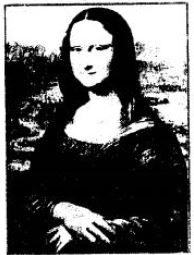
Question 7. Study this picture carefully and answer the questions that follow: (a) Give the name by which the portrait is known. (b) Name the artist who portrayed it ? (c) Mention the main features of this painting ?
Answer:
(a) The painting is called "Mona Lisa".
(b) The masterpiece was created by Leonardo da Vinci.
(c) This work is celebrated as an exquisite portrayal of natural grace and balance. The subject features a gentle, mysterious smile, with eyes that are partially closed yet expressive, conveying a sense of unspoken thoughts that captivates viewers.
In simple words: The portrait is the Mona Lisa, painted by Leonardo da Vinci. It is famous for her mysterious, gentle smile and beautiful, lifelike details.
Exam Tip: When describing the "Mona Lisa", highlight the delicate smile and half-closed eyes to demonstrate a comprehensive aesthetic analysis.
Question 8. What were the effects of the Renaissance?
Answer: The consequences of the Renaissance were far-reaching and diverse:
1. The Renaissance led to the Reformation Movement: A strong desire to explore the unknown through observation, questioning, and experimentation broke the absolute control of the Church. This shift in thinking directly paved the way for the Reformation.
2. Great overflow of Vernacular Literature: The movement greatly boosted local regional languages. In England, William Shakespeare produced his famous plays, while his Spanish contemporary Miguel de Cervantes penned 'Don Quixote'. In France, Moliere established the 'Comedie Francaise', which became the National Theatre.
3. Consequences of Geographical Explorations: New geographical discoveries helped build trade links between Eastern countries and Europe. This commerce generated massive wealth for European nations, especially England and Spain, which extracted vast riches from the Americas. Consequently, this spurred colonialism as European powers dominated territories in Asia, Africa, and the Americas to exploit their resources.
4. The Humanist's Belief in Man: Historically, people placed the demands of their social class or the Church above their own. During this era, they started recognizing themselves as distinct individuals. There was a growing conviction that humans could attain liberty and joy independently of religious institutions. This focus on human experiences was mirrored in contemporary art and literature.
5. Rise and Growth of Nation-States: A rising sense of patriotism, alongside the development of distinct regional literatures, fueled the emergence of modern nation-states.
In simple words: The Renaissance sparked the Reformation, boosted local languages, encouraged explorers to find new lands, made people believe in individual freedom, and helped create modern countries.
Exam Tip: When listing the effects of the Renaissance, write under distinct headings like 'Reformation Movement' and 'Humanism' to ensure your answer is well-structured and easy to read.
Additional Questions
Short Answer Questions
Question 1. What is meant by the term ‘Renaissance’ ?
Answer: The word 'Renaissance' translates to rebirth or revival. It represents a major period of transition in Europe, linking the Middle Ages to modern times, which started during the 14th century in Italy and continued until the 17th century.
In simple words: The Renaissance was a time of rebirth in Europe from the 1400s to the 1600s, marking the transition from the medieval era to modern times.
Exam Tip: In exams, define 'Renaissance' as 'rebirth' and mention both its starting place (Italy) and its timeframe (14th to 17th century) to secure full marks.
Question 2. Mention any two causes of the Renaissance.
Answer: Two main causes were:
1. The decay of the feudal system allowed for greater social mobility.
2. Support from rulers, aristocrats, and wealthy merchants helped fund the movement - for instance, Florence's famous Medici family acted as patrons for many artists.
In simple words: Two causes were the collapse of feudalism, which let people change their social standing, and rich people like the Medici family paying artists to create masterworks.
Exam Tip: Be sure to name the Medici family of Florence as an example of wealthy patrons supporting artists.
Question 3. What role did the victory of the Turks over Constantipole play in the rise of Renaissance.
Answer: The city of Constantinople was captured by the Ottoman Turks in 1453. This forced numerous Greek and Roman academics to flee to Rome and other European regions, bringing along rare ancient manuscripts. Consequently, they introduced classical Greek culture and learning to Western Europe.
In simple words: When the Turks took Constantinople in 1453, scholars fled to Europe with their ancient books. This helped spread classical Greek and Roman knowledge.
Exam Tip: Mention the year 1453 and how fleeing scholars carried classical manuscripts to Italy and other parts of Europe.
Question 4. How did the decline of feudalism contribute to the rise of Renaissance ?
Answer: The decay of feudalism during the thirteenth and fourteenth centuries encouraged independent thought. The resulting peace and personal freedom allowed the 'New Learning' to flourish. This shift inspired fresh advancements in philosophy, science, literature, and art, directly fueling the Renaissance.
In simple words: When feudalism ended, people had more peace and freedom to think for themselves. This led to new ideas in science, art, and literature.
Exam Tip: Explain how the end of feudalism brought peace and freedom, which were essential for the development of new learning and creative thinking.
Question 5. Why did the Renaissance began in Italy ? Give two reasons.
Answer:
1. Italy served as the heart of the ancient Roman Empire, preserving many physical ruins and historical artifacts. These remnants drew numerous artists and intellectuals to the region.
2. The vast wealth built up by Italian city-states through Eastern trade provided the financial means to sponsor the cultural movement.
In simple words: Italy was the center of the old Roman Empire, so it had many ancient ruins that inspired artists. Also, Italy grew very rich from trading with the East, which helped pay for new art and learning.
Exam Tip: Focus on two aspects: Italy's physical connection to Roman heritage and the wealth generated through trade with Eastern nations.
Question 6. How did the invention of the printing press bring in a new awakening in Europe ?
Answer: Johannes Gutenberg established the first printing press in Germany around 1456, and William Caxton later brought this technology to England. This mid-fifteenth-century innovation allowed books to be mass-produced for the first time. Consequently, copies of the Bible, along with classical and religious texts, became widely available throughout the continent.
In simple words: Gutenberg invented the printing press in Germany, which let people make thousands of books quickly. This allowed normal people all over Europe to read the Bible and other classic works.
Exam Tip: Make sure to name Gutenberg (Germany, 1456) and Caxton (England) when describing how the printing press made books accessible and cheap.
Question 7. Explain briefly the term ‘Humanism’
Answer: The term 'Humanism' comes from the Latin phrase 'Studia humanitatis', translating to the study of humanity. It represented a major shift in focus from purely religious matters to human-centered concerns. This philosophy celebrated the inherent worth and dignity of human beings, challenging strict religious self-denial while defending the pursuit of happiness and the fulfillment of physical needs.
In simple words: Humanism is about focusing on human life and happiness on Earth rather than just religious duties. It celebrates human dignity and our right to enjoy life.
Exam Tip: Highlight the shift from divine to human concerns and mention 'Studia humanitatis' as the linguistic origin of the term.
Question 8. Who is known as the Father of Humanism ?
Answer: Francesco Petrarch, a renowned writer and scholar, is widely regarded as the father of humanism. His lyric poetry and sonnets gained immense popularity across Europe.
In simple words: Petrarch is called the father of humanism. He wrote famous poems and sonnets that people loved all over Europe.
Exam Tip: Simply write 'Petrarch' and mention his popular sonnets and lyrics as his main contribution.
Question 9. Mention any two factors that led to the growth of the spirit of enquiry among the people of Europe.
Answer: Two primary factors that fostered a questioning mindset among Europeans were:
(a) Crusades: These religious military campaigns aimed to secure access to sacred sites in Jerusalem for the Church. They placed Europeans in direct contact with Asian societies, bringing Eastern ideas back to Western Europe. This interaction expanded people's perspectives, challenged rigid dogmas, and prompted individuals to value reason over unquestioning faith.
(b) Scientific Advancements: Science had limited opportunities to grow during the deeply religious Middle Ages. However, some medieval scholars adopted an observational approach, encouraging students to study the natural world directly. This led to numerous inventions and discoveries, fostering a scientific temper. Thinkers like Roger Bacon envisioned flying machines, Copernicus demonstrated that the Earth orbits the Sun, and Galileo constructed the telescope. Such breakthroughs challenged traditional superstitions and broadened intellectual horizons.
In simple words: Two things that made people ask questions were the Crusades, which brought new ideas from Asia, and scientific discoveries by people like Galileo and Copernicus, which proved old beliefs wrong.
Exam Tip: Clearly distinguish between the cultural impact of the Crusades and the intellectual impact of scientific inventions when answering.
Question 10. Mention the impact of the Renaissance in the field of English literature.
Answer: The most notable outcome of the Renaissance was the shift from Latin to local vernacular languages. In England, this period saw the rise of many celebrated writers, poets, and playwrights. Geoffrey Chaucer, known as the 'Father of English Poetry', created his masterpiece 'The Canterbury Tales'. Thomas More authored 'Utopia', describing an ideal society. Other prominent figures included Francis Bacon, William Shakespeare, Ben Jonson, and Christopher Marlowe. Additionally, John Milton wrote the legendary epic 'Paradise Lost', and Edmund Spenser composed 'The Faerie Queene'.
In simple words: During the Renaissance, English writers started writing in English instead of Latin. Famous authors like Shakespeare, Chaucer, and Milton wrote classic books and plays that we still read today.
Exam Tip: List at least three major English writers and their corresponding works (such as Chaucer's Canterbury Tales or Milton's Paradise Lost) to get full credit.
Question 11. Mention the theory introduced by Copernicus.
Answer: Nicolaus Copernicus proposed the heliocentric theory, demonstrating that the Earth and other planets revolve around the Sun.
In simple words: Copernicus showed that the Earth moves around the Sun, rather than the Sun moving around the Earth.
Exam Tip: Identify his idea as the heliocentric theory, which placed the Sun at the center of the solar system.
Question 12. How did Renaissance lead to the rise of monarchical form of governments in Europe.
Answer: The Renaissance gave a significant boost to the development of powerful monarchies across Europe. As the influence of feudal lords and Church authorities weakened, the public increasingly sought order, safety, and political harmony. Consequently, citizens willingly backed their rulers, which significantly consolidated the power of kings.
In simple words: As the Church and feudal lords lost power, people wanted peace and stability. They started supporting their kings, making monarchs much stronger.
Exam Tip: Explain how the decline of Church and feudal power led people to seek security under a central king.
Question 13. Mention two outstanding features of the Renaissance Art.
Answer:
1. The creation of lifelike bronze sculptures, such as Michelangelo's 'Pieta' and Donatello's statue of David.
2. The production of exquisite architectural elements, such as the two pairs of bronze doors crafted by Lorenzo Ghiberti for Florence's Baptistery.
In simple words: Two features of Renaissance art are beautiful bronze statues like Michelangelo's Pieta and highly detailed bronze doors like the ones Lorenzo Ghiberti made in Florence.
Exam Tip: Mention specific examples of art, such as works by Donatello, Michelangelo, or Ghiberti, to support your answer.
Question 14. Mention any two consequences of the geographical explorations.
Answer: European exploration, led primarily by Spanish and Portuguese sailors, expanded rapidly after the fall of Constantinople in 1453 closed traditional trade routes. Key outcomes and discoveries included:
1. Prince Henry the Navigator of Portugal helped chart routes down the African coast, and Bartolomeu Dias reached the Cape of Good Hope.
2. Vasco da Gama successfully sailed to India in 1498, and Christopher Columbus reached the Americas in 1492, opening up new global trade routes.
In simple words: Because old land routes to Asia were closed, explorers went by sea. This led to Vasco da Gama reaching India and Columbus reaching America, connecting the whole world through trade.
Exam Tip: Give examples of key explorers like Columbus or Vasco da Gama and their discoveries when explaining the outcomes of these journeys.
Question 15. Who wrote “The Canterbury Tales” ?
Answer: The famous collection 'The Canterbury Tales' was written by the English poet Geoffrey Chaucer.
In simple words: Geoffrey Chaucer wrote 'The Canterbury Tales'.
Exam Tip: Remember that Geoffrey Chaucer is often called the 'Father of English Poetry'.
Question 16. Mention two of the paintings of Michelangelo.
Answer: Two of Michelangelo's legendary frescoes are 'The Last Judgment' and 'The Fall of Man'.
In simple words: Two famous paintings by Michelangelo are 'The Last Judgment' and 'The Fall of Man'.
Exam Tip: Spelling is important; make sure to write 'The Last Judgment' correctly.
Question 17. Mention any two statues sculpted by Michelangelo.
Answer: Michelangelo was highly skilled as a painter, sculptor, architect, and poet. Two of his most celebrated sculptures are 'David' and the 'Pieta' (with 'Moses' being another famous example).
In simple words: Michelangelo was a genius who created famous statues like 'David' and 'Pieta'.
Exam Tip: Name 'David' and 'Pieta' as two of Michelangelo's most famous statues.
II. Structured Questions
Question 1. Many factors contributed to usher in the spirit of Renaissance, which had far-reaching consequences for the entire world. In this context, write short notes on:
(a) Invention of the printing press
(b) Decline of Feudalism.
(c) Capture of Constantinople.
Answer:
(a) The emergence of the movable type printing press in mid-fifteenth-century Europe enabled the large-scale production of books, such as the Bible and classical literature. This democratization of knowledge ignited an intellectual awakening and transformed European thought.
(b) Decline of Feudalism - The collapse of the feudal order during the thirteenth and fourteenth centuries opened up space for free thought. The stability and personal freedom that followed encouraged the rise of 'New Learning', sparking developments across science, philosophy, literature, and art.
(c) Capture of Constantinople - As the capital of the Byzantine Empire, Constantinople served as a vital hub for preserving Greek and Roman heritage. When Ottoman Turks captured the city in 1453, academic elites fled to Italy and other European regions, bringing priceless ancient texts with them. This influx turned cities like Rome into new centers of classical learning. These scholars, known for their liberal and logical outlooks, spread their ideas widely, revitalizing interest in classical philosophy, art, and science, which ultimately paved the way for the Renaissance.
In simple words: (a) The printing press let people mass-produce books, making reading and learning accessible to everyone. (b) The collapse of feudalism brought peace and freedom, letting people think freely and explore art and science. (c) When Constantinople fell in 1453, scholars fled to Europe with old Greek and Roman books, sparking a rebirth of classical learning.
Exam Tip: For structured questions, write clear, distinct paragraphs for each part (a, b, and c) and highlight key dates like 1453 for the fall of Constantinople.
2. Renaissance brought in a spirit of enquiry among the people of Europe. In this context, answer the following questions
Question 2(a). How did the development of science create the spirit of inquiry ?
Answer: Scientific advancements nurtured a questioning mindset and an analytical approach to life. Early thinkers like Roger Bacon conceptualized advanced ideas like flying machines and mechanical carriages. Later, Nicolaus Copernicus demonstrated that the Earth orbits the Sun, and Galileo Galilei constructed the telescope. These scientific milestones expanded the public's intellectual perspective and dismantled traditional superstitions and unproven dogma.
In simple words: Scientific discoveries showed people that they could use observation to find the truth. Inventions like Galileo's telescope proved that old religious beliefs about the universe were wrong.
Exam Tip: Cite the contributions of Copernicus and Galileo to illustrate how scientific observation replaced blind faith.
Question 2(b). Explain briefly the role of original thinkers in promoting the spirit of enquiry among the people of Europe.
Answer: In the Middle Ages, the established Church suppressed independent thought, demanding absolute adherence to its doctrines. Nevertheless, this suppression could not last indefinitely, as courageous scholars rose to challenge Church dogmas, encouraging people to form their own opinions. Intellectuals such as Roger Bacon, Peter Abelard, and Thomas Aquinas transformed how people thought by placing a strong emphasis on logical reasoning and questioning.
In simple words: During the Middle Ages, the Church told everyone what to believe, but bold thinkers like Roger Bacon and Thomas Aquinas challenged this. They taught people to use logic and reason instead of just believing everything they were told.
Exam Tip: Be sure to mention key medieval thinkers like Abelard, Aquinas, and Roger Bacon to show who spearheaded the shift toward reasoning.
Question 2(c). What was the role of Crusades in ushering in the spirit of inquiry ?
Answer: The Crusades were a series of holy wars aimed at regaining Christian control over sacred sites in and around Jerusalem. These military campaigns brought Europeans into direct contact with the rich cultures of Asia. Consequently, Crusaders brought advanced scientific and philosophical ideas back to Western Europe, which broadened people's horizons and weakened unquestioning belief in dogma.
In simple words: The Crusades were holy wars that connected Europeans with people in Asia. This contact brought new ideas to Europe, which helped destroy old, narrow-minded ways of thinking.
Exam Tip: Focus on how the direct contact between Eastern and Western cultures during these campaigns facilitated the transfer of knowledge.
3. Renaissance of lists tried to depict life on canvas and stone. With reference to this statement, describe the following:
Question 3(a). Progress in the art of painting
Answer: During the Renaissance, painting evolved dramatically, capturing realistic scenes of daily life that deeply moved and inspired viewers. Artists began employing precise mathematical proportions and studying human anatomy to render realistic facial expressions and physical gestures.
Prominent artists and their creations included:
1. Leonardo da Vinci (1452-1519): Renowned for 'Virgin of the Rocks', 'The Last Supper', and the 'Mona Lisa'.
2. Michelangelo Buonarroti (1475-1564): Famous for 'The Last Judgment' and 'The Fall of Man'.
3. Raphael Sanzio (1483-1520): Celebrated for the 'Sistine Madonna' and his architectural designs for St. Peter's Basilica.
In simple words: Paintings became much more lifelike because artists studied the human body and used math for proportions. Famous painters like Leonardo da Vinci (Mona Lisa), Michelangelo (The Last Judgment), and Raphael created masterpieces during this time.
Exam Tip: Be ready to list major painters and their works. Note that Michelangelo painted 'The Last Judgment' while Leonardo da Vinci painted 'The Last Supper' - do not mix these two up.
Question 3(b). Progress in the art of sculpture.
Answer: A renewed interest in classical antiquity profoundly influenced Renaissance sculpture. While some artists focused on replicating classical Greek and Roman masterpieces, others created original, highly detailed works that stood on par with ancient creations.
Key sculptors of this era included:
1. Donatello (1386-1466): Sculpted the iconic bronze statue of 'David'.
2. Lorenzo Ghiberti: Crafted the celebrated bronze doors for the Florence Baptistery.
3. Michelangelo: Created the emotional 'Pieta' depicting Mary and Jesus, along with his famous statues of 'David' and 'Moses'.
4. Numerous Italian sculptors also collaborated to adorn churches and palaces, closely linking the progress of sculpture with architectural development during this period.
In simple words: Sculptors looked back at ancient Greek and Roman art to make incredibly lifelike statues. Masterpieces like Donatello's David, Ghiberti's bronze doors, and Michelangelo's Pieta showed a level of skill that matched the ancient world.
Exam Tip: Group your answer by sculptor (Donatello, Ghiberti, Michelangelo) and list their signature works clearly to help the examiner grade your answer quickly.
Question 4. Renaissance was a period of intellectual activity. In the context, write briefly on the impact of Renaissance on Science under the following heads:
(a) Progress in astronomy
(b) Progress in medicine.
(c) Progress in mathematics.
Answer:
(a) In astronomy, Nicolaus Copernicus (1473-1543) asserted that the Earth is spherical and that the Earth, Moon, and planets orbit the Sun in circular paths. Following him, the German astronomer Johannes Kepler (1571-1630) demonstrated that planetary orbits are actually elliptical rather than perfectly circular. Additionally, Galileo Galilei (1564-1642) developed the astronomical telescope, and Sir Isaac Newton (1642-1727) formulated the law of universal gravitation.
(b) Significant breakthroughs occurred in the medical field: 1. Andreas Vesalius (1514-1564) authored a groundbreaking text on human anatomy. 2. William Harvey (1578-1657) mapped out the cardiovascular system, explaining how blood circulates from the heart throughout the body and returns. 3. Paracelsus (1493-1541) established clear links between chemistry and medical treatments. 4. Valerius Cordus (1515-1544) successfully synthesized ether using alcohol and sulfuric acid. 5. Jan Baptist van Helmont (1577-1644) identified carbon dioxide.
(c) In mathematics, Arab scholars introduced algebraic concepts and numerals to Europe. Later, Girard Desargues (1593-1662) helped standardize projective geometry, and Simon Stevin promoted the practical use of the decimal system for currency, weights, and measurements.
In simple words: (a) In astronomy, Copernicus showed planets orbit the Sun, Kepler proved these orbits are oval-shaped, Galileo built telescopes, and Newton discovered gravity. (b) In medicine, scientists mapped the human body, discovered how blood circulates, and found new chemical treatments. (c) In math, Europeans adopted Arabic numerals and algebra, while new systems for geometry and decimals were created.
Exam Tip: For each section, remember to link the scientist's name with their major discovery (e.g., Harvey for blood circulation, Kepler for elliptical orbits, Desargues for geometry).
Free study material for History Civics
ICSE Selina Concise Solutions Class 9 History Civics Chapter 12 The Renaissance
Students can now access the detailed Selina Concise Solutions for Chapter 12 The Renaissance on our portal. These solutions have been carefully prepared as per latest ICSE Class 9 syllabus. Each solution given above has been updated based on the current year pattern to ensure Class 9 students have the most updated History Civics content.
Master Selina Concise Textbook Questions
Our subject experts have provided detailed explanations for all the questions found in the Selina Concise textbook for Class 9 History Civics. We have focussed on making the concepts easy for you in Chapter 12 The Renaissance so that students can understand the concepts behind every answer. For all numerical problems and theoretical concepts these solutions will help in strengthening your analytical skill required for the ICSE examinations.
Complete History Civics Exam Preparation
By using these Selina Concise Class 9 solutions, you can enhance your learning and identify areas that need more attention. We recommend solving the History Civics Questions from the textbook first and then use our teacher-verified answers. For a proper revision of Chapter 12 The Renaissance, students should also also check our Revision Notes and Sample Papers available on studiestoday.com.
FAQs
You can download the verified Selina Concise solutions for Chapter 12 The Renaissance on StudiesToday.com. Our teachers have prepared answers for Class 9 History Civics as per 2026-27 ICSE academic session.
Yes, our solutions for Chapter 12 The Renaissance are designed as per new 2026 ICSE standards. 40% competency-based questions required for Class 9, are included to help students understand application-based logic behind every History Civics answer.
Yes, every exercise in Chapter 12 The Renaissance from the Selina Concise textbook has been solved step-by-step. Class 9 students will learn History Civics conceots before their ICSE exams.
Yes, follow structured format of these Selina Concise solutions for Chapter 12 The Renaissance to get full 20% internal assessment marks and use Class 9 History Civics projects and viva preparation as per ICSE 2026 guidelines.