

ICSE Solutions Selina Concise Class 7 History Civics Chapter 7 Foundation of Mughal Empire have been provided below and is also available in Pdf for free download. The Selina Concise ICSE solutions for Class 7 History Civics have been prepared as per the latest syllabus and ICSE books and examination pattern suggested in Class 7. Questions given in ICSE Selina Concise book for Class 7 History Civics are an important part of exams for Class 7 History Civics and if answered properly can help you to get higher marks. Refer to more Chapter-wise answers for ICSE Class 7 History Civics and also download more latest study material for all subjects. Chapter 7 Foundation of Mughal Empire is an important topic in Class 7, please refer to answers provided below to help you score better in exams
Selina Concise Chapter 7 Foundation of Mughal Empire Class 7 History Civics ICSE Solutions
Class 7 History Civics students should refer to the following ICSE questions with answers for Chapter 7 Foundation of Mughal Empire in Class 7. These ICSE Solutions with answers for Class 7 History Civics will come in exams and help you to score good marks
Chapter 7 Foundation of Mughal Empire Selina Concise ICSE Solutions Class 7 History Civics
Foundation of Mughal Empire - Important Words
- Sarkars: These were the main provinces in Sher Shah's kingdom. The entire empire had forty-seven of these areas, which were then divided into parganas.
- Shiqdars: These officials maintained law and order. They also ran the general administration of each pargana.
- Munsifs: These officers collected land taxes and handled civil court cases.
- Patwaris: These people were in charge of collecting taxes on land at the village level.
- Muqaddams: These village officers had the duty to keep peace and order in their local area.
- Sarais: These were special rest houses that Sher Shah built along roads.
- Dak chaukis: These were postal stations. At each station, two riders on horseback waited to carry mail to the next station. Rest houses often served this role.
- Rupia: This was the official silver coin that Sher Shah brought into use.
- Patta: This was a legal paper that proved a person's ownership of land.
- Qubuliat: This was a written agreement about the land and its taxes.
Question 1. Fill in the blanks:
(i) Babur’s eldest son assumed the title Humayun which means ________.
(ii) Humayun reconquered the throne of Delhi in ________ AD.
(iii) Humayun was in ________ after 1540.
(iv) Sher Shah ruled Delhi for ________ years.
Answer:
(i) fortunate
(ii) 1555
(iii) Persia
(iv) five
In simple words: This section teaches us key facts. Humayun's name meant lucky, he regained Delhi in 1555, stayed in Persia after 1540, and Sher Shah ruled for five years.
Exam Tip: Remember that Humayun's name means fortunate, even though his life had many struggles. Memorizing key years like 1555 is very important for history exams.
Question 2. Match Column A with Column B:
| Column A | Column B |
|---|---|
| 1. 1526 | (a) Use of artillery |
| 2. 1529 | (b) was defeated in the First Battle of Panipat. |
| 3. 1539 | (c) Ruler of Gujarat |
| 4. Humayun re-established Mughal power in India | (d) Battle of Chausa |
| 5. Babur won victory due to | (e) in 1555 |
| 6. Ibrahim Lodi | (f) First Battle of Panipat |
| 7. Bahadur Shah | (g) Battle of Ghagra |
Answer:
1. 1526 - (f) First Battle of Panipat
2. 1529 - (g) Battle of Ghagra
3. 1539 - (d) Battle of Chausa
4. Humayun re-established Mughal power in India - (e) in 1555
5. Babur won victory due to - (a) Use of artillery
6. Ibrahim Lodi - (b) was defeated in the First Battle of Panipat.
7. Bahadur Shah - (c) Ruler of Gujarat
In simple words: These pairs link famous events and rulers with their respective years or causes. For example, the First Battle of Panipat happened in 1526, and Babur won because of his big guns.
Exam Tip: Matching questions often test your memory of dates and key historical associations. Double-check that every year matches its exact event.
Question 3. State whether the following statements are True or False:
1. The First Battle of Panipat decided once for all the fate of the Lodi dynasty.
2. The Battle of Khanwa was fought between Rana Sanga and Babur.
3. Babur introduced many new reforms for the administration of his new empire in India.
4. Humayun died in 1550 AD.
5. Sher Shah built the Grand Trunk Road.
Answer:
1. True
2. True
3. False. Sher Shah Suri was the one who brought in many administrative changes to his newly formed empire in India.
4. False. Humayun passed away in the year 1556 AD.
5. True
In simple words: This test checks if we know real facts. Babur fought Rana Sanga, and Sher Shah made the Grand Trunk Road. But it was Sher Shah, not Babur, who made administrative changes, and Humayun died in 1556.
Exam Tip: When a statement is false, write the correct fact underneath to gain full marks from the examiner.
Question 4. Why was the First Battle of Panipat fought? What were its results?
Answer:
1. This battle took place in 1526 between the forces of Babur and Ibrahim Lodi.
2. The conflict arose because Lodi's harsh rule turned his own nobles against him.
3. The nobles deeply disliked Lodi's bad behavior toward his officers.
4. He also put to death those nobles who dared to stand up to him.
5. Because of this, leaders like Daulat Khan Lodi and Alma Khan invited Babur to invade and fight Lodi. As a result of his victory, Babur declared himself the "Emperor of Hindustan" on April 27, 1526.
In simple words: Ibrahim Lodi was a cruel ruler, so his own people asked Babur to come and fight him. Babur won the battle in 1526 and became the new leader of India.
Exam Tip: Clearly state 1526 as the year of the battle and mention Babur and Ibrahim Lodi as the main opponents to secure full marks.
Question 5. What were the reasons for Babur’s victory in the First Battle of Panipat?
Answer:
1. Babur deployed cannons and firearms, which were completely new to the Indian forces.
2. His soldiers had superior training, and his horse-riding cavalry was far better than Lodi's horsemen.
3. He quickly captured the city of Agra to make it his capital, declaring himself the ruler of India on April 27, 1526.
In simple words: Babur won because he used guns and cannons that Indians did not have. His army was also highly skilled and had better horses.
Exam Tip: Underline "artillery" and "superior cavalry" as the two main military factors that helped Babur defeat the larger army of the Sultan.
Question 6. What difficulties did Humayun face in the beginning?When and how did Humayun reconquer India?
Answer:
When Humayun became king in 1530 AD, he faced many problems left by Babur:
1. Political trouble: The large kingdom was not fully united or stable.
2. Empty treasury: There was no money because land taxes were not collected in a proper way.
3. Unruly brothers: His own relatives rebelled against him to take the throne.
4. Division of land: Distributing the empire into jagirs created more administrative hurdles.
5. Weak setup: The administration was poorly run, making it hard for him to secure his rule.
How he won it back:
After Sher Shah died in 1545 AD, his heirs turned out to be weak. Humayun took advantage of this weakness and marched back to take Delhi in 1555 AD.
In simple words: Humayun had a hard start in 1530 because he had no money, his brothers fought him, and the land was not peaceful. Later, when the enemy rulers grew weak, he came back and took his throne again in 1555.
Exam Tip: Focus on listing the main problems like the empty treasury and troublesome brothers, then explain how he seized the opportunity to return in 1555 AD.
Question 7. Why is Sher Shah known as a-good administrator?
Answer:
Sher Shah ran his kingdom very effectively due to several key steps:
1. He split his entire empire into forty-seven large zones called sarkars.
2. Every zone had a governor and a staff of officers to run daily affairs.
3. These zones were split further into smaller districts called parganas, made up of multiple villages. The village was the smallest administrative level.
4. Inside each district, two main leaders called the shiqdar and the munsif were appointed. The shiqdar looked after safety, while the munsif gathered taxes and handled civil issues.
5. A local council of elders, or panchayat, managed each village's affairs.
6. Two village officers, the patwari (tax collector) and the muqaddam (peacekeeper), ran the local village administration.
In simple words: Sher Shah set up a neat system of rule by dividing his land into small areas. He put honest officers in charge of safety and taxes at every level.
Exam Tip: Be sure to write down the names of the officers like the patwari, muqaddam, shiqdar, and munsif, as these terms are crucial for scoring full marks.
Question 8. Sher Khan was able to strengthen his position in Bengal and Bihar.
Answer:
Sher Khan built a powerful base in Bengal and Bihar due to these factors:
1. He personally managed the hiring and drilling of his soldiers, keeping them under strict discipline.
2. He brought back older military rules like marking horses (dagh) and keeping written descriptions of every soldier (chehra).
3. He paid his men regular wages based on their actual abilities.
4. He built strong military forts and camps everywhere to move his army quickly in times of war.
5. He kept a careful eye on all state officers using secret spies, and he moved these officers to new stations every two or three years to stop corruption.
In simple words: Sher Khan made his army strong by training soldiers well and paying them on time. He also watched his officers using spies to keep them honest.
Exam Tip: Mention the special military rules "dagh" and "chehra" as they are key historical terms that examiners look for.
Question 9. Sher Shah was named so.
Answer:
His real name was Farid Khan, and his father was a landholder in Sasaram, Bihar. While working for the king of Bihar, he fought and killed a tiger all alone. For this act of bravery, he was given the title Sher Khan. Later, after winning many kingdoms, he took the name Sher Shah.
In simple words: His real name was Farid. He killed a tiger by himself, so he was named Sher (which means tiger). Later, he became the king and was called Sher Shah.
Exam Tip: Explain the story of how his original name, Farid Khan, changed to Sher Khan after killing the tiger, and then to Sher Shah when he became king.
Question 10. We say that Sher Shah looked after the welfare of his people.
Answer:
We can see his care for his subjects through these deeds:
1. He built a wonderful system of highways, like the Grand Trunk Road linking Peshawar with Sonargaon in Bengal. He also made routes from Agra to Chittor and Jodhpur, and from Lahore to Multan.
2. He set up rest shelters and dug water wells along the paths to make trips comfortable.
3. He had shady trees planted on both sides of the roads. He built nearly 1,700 rest houses (sarais), which eventually became active centers for buying and selling goods.
4. He chose special local guards, called Muqaddams, to ensure that travelers were safe from robbers.
5. This great road system enabled a fast mail system and boosted business within his kingdom.
6. These roads and rest shelters were so useful that people called them the main lifelines of his empire.
7. He divided his empire into 47 large provinces called sarkars, dividing them further into parganas and villages to manage everything smoothly.
In simple words: Sher Shah built long roads, planted trees, dug wells, and made 1,700 rest houses for travelers. He kept the roads safe so people could travel and trade easily.
Exam Tip: Highlighting his construction of the Grand Trunk Road and the 1,700 sarais is key to showing how he worked for the welfare of his people.
Question 11. Fill in the blanks:
(i) Babur lost both ________ and ________ and became a homeless wanderer. In 1504 ce, he became the ruler of ________.
(ii) Humayun lacked the ________ necessary to ________ the vast empire he had inherited.
(iii) Sher Shah based his administration on the principle of a ________ state. Sher Shah went on regular ________ of inspection and set up an efficient ________ system.
(iv) Sher Shah established a large standing army and introduced several reforms to make it disciplined, ________ and ________.
Answer:
(i) Farghana, Samarkand, Kabul
(ii) qualities, consolidate
(iii) welfare, tours, spy
(iv) efficient, strong
In simple words: These blanks teach us about Babur losing his early lands, Humayun struggling to hold his empire, and Sher Shah building a strong army and caring for his people's well-being.
Exam Tip: Learn the names of the places Babur ruled (Farghana, Samarkand, Kabul) and the style of Sher Shah's rule (welfare state) as these are very common exam questions.
Question 12. Match the following:
| Column A | Column B |
|---|---|
| 1. First Battle of Panipat | (a) Defeat of the Rajput confederacy |
| 2. Battle of Khanwa | (b) Humayun's son |
| 3. Battle of Ghagra | (c) Humayun's brother |
| 4. Akbar | (d) 1526 CE |
| 5. Kamran | (e) Babur's victory over the Afghans |
Answer:
1. First Battle of Panipat - (d) 1526 CE
2. Battle of Khanwa - (a) Defeat of the Rajput confederacy
3. Battle of Ghagra - (e) Babur's victory over the Afghans
4. Akbar - (b) Humayun's son
5. Kamran - (c) Humayun's brother
In simple words: This matching list connects key battles with their dates or results, and names the relatives of Emperor Humayun.
Exam Tip: Remember that the Battle of Khanwa defeated the Rajputs, while the Battle of Ghagra was Babur's victory over the Afghan chiefs.
Question 13. In 1522 ce, who invited Babur to invade India?
(a) Ibrahim Lodi
(b) Sher Khan Suri
(c) Daulat Khan Lodi
Answer: (c) Daulat Khan Lodi
In simple words: In 1522, Daulat Khan Lodi asked Babur to come and attack India to remove Ibrahim Lodi.
Exam Tip: Be careful not to confuse Ibrahim Lodi (the ruler) with Daulat Khan Lodi (the governor who invited Babur).
Question 14. With the help of the Shah of which country did Humayun return to India in the year 1555?
(a) Persia
(b) Afghanistan
(c) Sind
Answer: (a) Persia
In simple words: The King of Persia lent military help to Humayun so he could win back his lands in 1555.
Exam Tip: Persian support was crucial for the restoration of the Mughal empire in India.
Question 15. Sher Shah divided his empire into 47:
(a) sarkars
(b) parganas
(c) villages
Answer: (a) sarkars
In simple words: Sher Shah split his entire kingdom into forty-seven large districts called sarkars.
Exam Tip: Under Sher Shah, sarkars were the main provincial units, which were further split into parganas.
Question 16. The rupia introduced by Sher Shah was made of:
(a) gold
(b) silver
(c) copper
Answer: (b) silver
In simple words: The rupia was the official silver coin brought in by Sher Shah.
Exam Tip: This silver rupia was so well made that it became the basis for modern currency in India.
Question 17. Sher Shah’s greatest achievement was:
(a) the construction of new roads
(b) issuing of coins
(c) his revenue system
Answer: (c) his revenue system
In simple words: Sher Shah did many great things, but his system of gathering land taxes was his best work.
Exam Tip: While roads and coins were important, his scientific system of land assessment and taxation is considered his finest administrative legacy.
Question 18. State whether the following are true or false:
1. Babur was a descendant of Timur and Chenghiz Khan.
2. Babur’s war-weary and homesick soldiers wanted to return to Kabul after the Battle of Panipat.
3. Babur won the Battle of Khanwa through treachery and cunning.
4. Sher Shah ruled for 15 years.
5. To prevent the officers from becoming corrupt, Sher Shah introduced the system of periodical transfers.
Answer:
1. True
2. True
3. False. Babur actually won the Battle of Khanwa because of his better cannons and protective strategies.
4. False. Sher Shah's reign lasted only for 5 years.
5. True
In simple words: This exercise checks our facts. Babur had famous ancestors and tired soldiers. He won his battles with guns, not tricks. Also, Sher Shah ruled for only five years and rotated his officers to avoid corruption.
Exam Tip: For False statements, write the corrected version to show clear understanding and gain maximum points.
Question 19. Why did Daulat Khan Lodi invite Babur to invade India?
Answer: In 1522 CE, Daulat Khan Lodi asked Babur to attack India to help him remove Ibrahim Lodi, the harsh and disliked ruler of Delhi.
In simple words: Daulat Khan Lodi invited Babur because he wanted to get rid of Delhi's mean king, Ibrahim Lodi.
Exam Tip: Mention the year 1522 CE and describe Ibrahim Lodi as "cruel" or "unpopular" to explain the motive behind the invitation.
Question 20. Between whom was the First Battle of Panipat fought?
Answer: This famous fight took place between Babur and Ibrahim Lodi in the year 1526 CE.
In simple words: The battle was fought between Babur and Ibrahim Lodi in 1526.
Exam Tip: Memorize the year 1526 CE along with the names of both rulers for this direct question.
Question 21. What was the significance of the Battle of Panipat (1526 ce)?
Answer: This clash placed Delhi under Babur's rule, and he went on to name himself the Emperor of Hindustan.
In simple words: This battle allowed Babur to take over Delhi and become the ruler of India.
Exam Tip: Highlight that this victory established the foundation of the Mughal Empire in India.
Question 22. What is the name of Babur’s autobiography?
Answer: It is called Tuzuk-i-Baburi. Written in beautiful Turkish, it is widely regarded as one of the greatest life memoirs in the world.
In simple words: Babur wrote his own life story in a book called Tuzuk-i-Baburi.
Exam Tip: Spelling "Tuzuk-i-Baburi" correctly is important. Also, remember it was written in Turkish.
Question 23. Who was Humayun’s most dangerous enemy?
Answer: Humayun's most threatening rival was Sher Khan.
In simple words: Sher Khan (Sher Shah Suri) was the biggest enemy of Humayun.
Exam Tip: Use the name Sher Khan or Sher Shah Suri to identify his primary Afghan opponent.
Question 24. How did Humayun escape after his deafeat in the Battle of Chausa (1539 ce)?
Answer: Humayun dived into the Ganga river and escaped by floating down using a leather water bag lent by a water carrier.
In simple words: Humayun jumped into the Ganga river and stayed afloat with a leather bag used for carrying water.
Exam Tip: Mentioning the "Ganga river" and the "water carrier's bag" makes this answer complete.
Question 25. How many years did Humayun spend in exile?
Answer: He spent fifteen years (from 1540 to 1555 CE) moving around from one place to another to find shelter.
In simple words: Humayun had to live away from his home for fifteen years, looking for a safe place to stay.
Exam Tip: Write down both the duration (15 years) and the years (1540-55 CE) to secure full marks.
Question 26. Who helped Humayan to recover Kabul and Kandahar?
Answer: The Shah of Persia assisted Humayun, helping him win back Kabul and Kandahar from his brother Kamran.
In simple words: The King of Persia helped Humayun take back Kabul and Kandahar from his brother.
Exam Tip: Name the Shah of Persia as the helper and Kamran as the brother from whom he took the territories.
Question 27. What is the significance of the Battle of Kanauj (1540 CE)?
Answer: This clash temporarily ended the unstable Mughal empire, replacing it with the rule of the Afghans.
In simple words: After this battle, the Mughal empire stopped for a while, and Afghan rulers took over.
Exam Tip: Explain that this battle led to the temporary downfall of the Mughal dynasty and started Sher Shah Suri's Afghan rule.
Question 28. How were the affairs of the villages managed during Sher Shah’s reign?
Answer: Village councils made of elderly people, called panchayats, managed local matters. Sher Shah kept in touch with these areas through local officers like patwaris and muqaddams.
In simple words: Elderly village councils called panchayats ran the villages, while officers helped the king stay informed.
Exam Tip: Mention the "panchayats of village elders" and officers like "patwaris" and "muqaddams" to show how village rule worked.
Question 29. Explain the Chehra system in Sher Shah’s military administration.
Answer: Sher Shah brought back the practice of keeping written descriptions of every soldier (chehra), along with marking horses (dagh). He also split his army into smaller units, placing each under a specific officer.
In simple words: The Chehra system was keeping a detailed physical record of every soldier to avoid fraud in the army.
Exam Tip: Explain clearly that "chehra" means keeping descriptive records of the soldiers to prevent proxy soldiers.
Question 30. Mention one reason why Sher Shah built an excellent network of good roads?
Answer: He constructed these roads to help his soldiers and officers move quickly across the empire, while also boosting trade and making travel easier.
In simple words: He built roads so his army could move fast, trade could grow, and travel could be easy.
Exam Tip: Mention troop movement or promotion of trade as the main reasons behind his road-building projects.
Question 31. Give a brief account of Babur’s early life.
Answer: Babur lost his father at the young age of eleven, inheriting a small Central Asian territory named Farghana. By the time he was fourteen, he successfully captured Samarkand. However, he quickly lost control of both regions and was left homeless. With great courage and strong will, he eventually won the throne of Kabul.
In simple words: Babur became king of a small place at age eleven. He lost his land and had no home, but he was brave and eventually became the ruler of Kabul.
Exam Tip: Mention the names of the places Farghana, Samarkand, and Kabul, along with the ages 11 and 14, to write a complete answer.
Question 32. Give an account of the causes, events and consequences of the First Battle of Panipat.
Answer: Babur and Ibrahim Lodi met in battle at Panipat in 1526 CE. Lodi's huge army was easily beaten by Babur's smaller, highly disciplined troops, who possessed superior cannons and rapid horses. Babur's excellent leadership led to a swift defeat of Lodi's forces. By the end of the day, Lodi and 15,000 of his troops lay dead on the field. The very next day, Babur entered Delhi as the newly declared Emperor of Hindustan.
In simple words: In 1526, Babur fought Ibrahim Lodi's large army with a small but skilled force and won. Lodi was killed, and Babur became the ruler of Delhi.
Exam Tip: Outline three main parts: the year (1526 CE), the military factors (cannons and discipline), and the outcome (death of Lodi and Babur taking Delhi).
Question 33. How many battles did Babur have to fight after the Battle of Panipat? Mention the significance of his victory in each of these battles.
Answer: Babur fought three major battles after Panipat:
1. Battle of Khanwa: Babur defeated Rana Sanga of Mewar, establishing solid control over central India and removing major threats to Mughal rule.
2. Battle of Chanderi: He defeated Medini Rai of Malwa and took Chanderi, which stopped other Rajput chiefs from challenging him.
3. Battle of Ghagra: He crushed the Afghan chiefs who held Bengal and Bihar, securing his authority over Punjab, Delhi, and the plains near Bihar.
In simple words: Babur fought three more battles. He beat the Rajputs at Khanwa and Chanderi, and the Afghans at Ghagra, making his rule safe and strong.
Exam Tip: List all three battles (Khanwa, Chanderi, Ghagra) and write one main outcome for each to get full marks.
Question 34. Give a brief account of Sher Shah’s early life.
Answer: Sher Shah was born as Farid Khan, the son of a landowner in Sasaram, Bihar. He was named Sher Khan after killing a tiger single-handedly. He also served in Babur's Mughal army, which helped him learn advanced ways of fighting wars.
In simple words: Sher Shah's real name was Farid. He became known as Sher Khan after killing a tiger alone, and he learned how to fight by joining the Mughal army.
Exam Tip: Mention his birth name (Farid Khan), where his father was a jagirdar (Sasaram), and his experience in the Mughal army under Babur.
Question 35. With reference to Sher Shah’s enlightened rule, explain: (a)How was the central government organized? (b) The important features of provincial administration.
Answer:
(a) Central Government: Sher Shah was the supreme head of the central administration. He split the government into many branches, putting each department under a minister who was helped by other staff.
(b) Provincial Administration: The entire empire was split into 47 districts called sarkars, which were further divided into smaller parts called parganas. Each district was made up of multiple villages. These villages were managed by local panchayats. An Afghan chief ran each province. In the parganas, the Shiqdar kept peace and order, while the Munsif gathered taxes and handled civil court matters.
In simple words: Sher Shah was the main boss of the government. He divided the land into 47 districts, and used different officers to keep peace and collect taxes.
Exam Tip: Differentiate clearly between the central government (led by Sher Shah) and the provincial administration (divided into sarkars and parganas run by Shiqdars and Munsifs).
Question 36. Sher Shah introduced several measures to make the army disciplined, efficient and strong. Explain?
Answer: Sher Shah brought in many military changes. He took a personal interest in selecting and training his men. Salaries were based strictly on a soldier's skills. He split his troops into smaller units, placing each under a commander. Both foot soldiers and horse riders were highly trained and had cannons for battle.
In simple words: Sher Shah made his army strong by hand-picking and training his men. He paid them according to how good they were and divided them into clear groups.
Exam Tip: Emphasize his personal involvement in military training and the fact that salaries were given based on skill and ability.
Question 37. Discuss the important measures taken by Sher Shah to boost the growth of trade and commerce.
Answer: Trade thrived because of his newly built roads and rest houses. To encourage more buying and selling, he removed all taxes except for two. He ordered his staff to treat business people well and help them. To protect traders, he made village chiefs responsible for keeping them safe. He also brought in standard weights and uniform gold, silver, and copper coins.
In simple words: Sher Shah made trade easy by building roads, removing extra taxes, and keeping traders safe. He also introduced standard weights and coins.
Exam Tip: Mention the removal of all but two trade duties, standardizing weights and measures, and making village chiefs responsible for the safety of merchants.
Question 38. What steps did Sher Shah take to maintain law and order in his kingdom?
Answer: Sher Shah believed in equal justice for all his people. He used very strict laws and gave tough punishments. He made local chiefs and village headmen responsible for any crimes committed in their territory, punishing them if they failed to catch thieves or killers.
In simple words: Sher Shah had strict laws and punishments. He made village leaders responsible for finding any criminals in their area.
Exam Tip: Explain the concept of collective responsibility, where village headmen were punished if they failed to solve a crime in their area.
Question 39. Sher Shah’s greatest achievement was his land revenue system. In this context explain: (a) Land assessments (b) Taxation policy and its impact
Answer:
(a) Land assessments: He made sure that land was measured and inspected yearly. The average harvest was calculated based on how good the soil was.
(b) Taxation policy and its impact: One-third of the total harvest had to be paid as tax, either in coins or in grain. Land was split into three categories—good, average, and poor—and taxes were collected based on these ratings.
In simple words: Land was measured every year to see how fertile it was. Farmers had to pay one-third of their crop as tax, based on how good their land was.
Exam Tip: Be sure to mention the fraction "one-third" and the three land categories (good, average, and poor) when describing the tax policy.
Question 40. Sher Shah is one of the most striking personalities in medieval India. In this context, briefly state the important achievements of his 5-years reign.
Answer: During his five years on the throne, Sher Shah accomplished many great things:
1. He created a vast and wealthy empire with a strong central rule and a clean administration.
2. He built a massive, disciplined, and highly skilled standing army.
3. He set up a fair and progressive land tax system that protected the interests of poor farmers.
4. He built many long roads and rest houses to help travelers and traders.
5. He introduced new, uniform weights and measures throughout the kingdom.
6. He practiced religious tolerance and chose several Hindus for highly trusted government positions.
In simple words: In just five years, Sher Shah built roads, made a strong army, created fair taxes, introduced standard weights, and hired people of all religions.
Exam Tip: Try to list at least four distinct achievements, such as his military, tax, road, and religious policies, to score full marks.
Picture Study - Tomb of the Successor of Babur
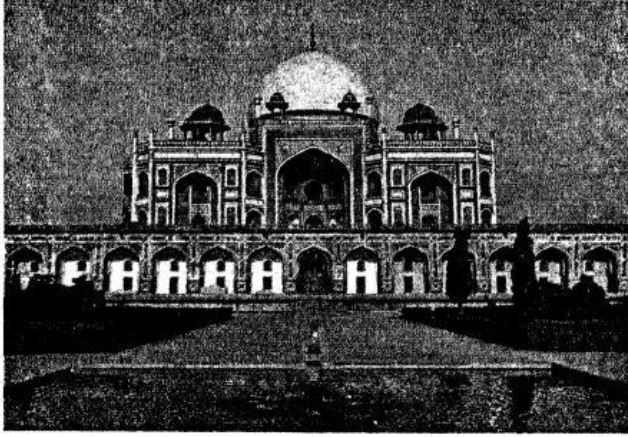
Question 41. Name the Mughal emperor who is buried in this tomb.
Answer: Emperor Humayun is buried in this tomb.
In simple words: This tomb belongs to the Mughal king, Humayun.
Exam Tip: This monument is Humayun's Tomb, built for the second Mughal Emperor.
Question 42. Where is this monument located?
Answer: This building is located in Nizamuddin, Delhi.
In simple words: The tomb is in Nizamuddin, Delhi.
Exam Tip: Be sure to write both Nizamuddin and Delhi for a complete answer.
Question 43. In which book could you find a detailed account of his life? Who wrote it?
Answer: A detailed description of his life is in the book Humayunnama, written by Gulbadan Begum.
In simple words: His sister, Gulbadan, wrote about his life in a book called Humayunnama.
Exam Tip: Spell both the book's name "Humayunnama" and the author's name "Gulbadan" correctly.
Question 44. Why did he spend 15 years in exile?
Answer: After his defeat by Sher Khan, Humayun had to wander for 15 years seeking safety because his brother would not help him. During this hard time, his son Akbar was born to his wife Hamida Banu in Amarkot, Sind, in 1542 CE.
In simple words: After losing to Sher Khan, Humayun was forced to run away for 15 years. During this time, his son Akbar was born.
Exam Tip: Explain both his defeat by Sher Khan and his brother's refusal to help as the reasons for his long years of wandering.
Question 45. How did he reconquer his lost empire?
Answer: Humayun received military support from the Shah of Persia, enabling him to reclaim Kabul and Kandahar from Kamran, who was subsequently blinded and exiled to Mecca. By 1554 CE, Humayun had made his hold over Afghanistan firm. Since Sher Shah had passed away in 1545 CE and left behind weak successors, Humayun acted quickly. He returned to India, regaining Delhi and Agra in 1555 CE. However, he died shortly after in an accidental fall down his library staircase.
In simple words: Humayun got help from the King of Persia to win back his lands. Since the enemy rulers were weak, he took Delhi and Agra back in 1555, but died soon after from falling down library stairs.
Exam Tip: Detail the role of the Persian Shah, the weakness of Sher Shah's successors after 1545 CE, and his victory in 1555 CE to explain his return to power.
Free study material for History Civics
ICSE Selina Concise Solutions Class 7 History Civics Chapter 7 Foundation of Mughal Empire
Students can now access the detailed Selina Concise Solutions for Chapter 7 Foundation of Mughal Empire on our portal. These solutions have been carefully prepared as per latest ICSE Class 7 syllabus. Each solution given above has been updated based on the current year pattern to ensure Class 7 students have the most updated History Civics content.
Master Selina Concise Textbook Questions
Our subject experts have provided detailed explanations for all the questions found in the Selina Concise textbook for Class 7 History Civics. We have focussed on making the concepts easy for you in Chapter 7 Foundation of Mughal Empire so that students can understand the concepts behind every answer. For all numerical problems and theoretical concepts these solutions will help in strengthening your analytical skill required for the ICSE examinations.
Complete History Civics Exam Preparation
By using these Selina Concise Class 7 solutions, you can enhance your learning and identify areas that need more attention. We recommend solving the History Civics Questions from the textbook first and then use our teacher-verified answers. For a proper revision of Chapter 7 Foundation of Mughal Empire, students should also also check our Revision Notes and Sample Papers available on studiestoday.com.
FAQs
You can download the verified Selina Concise solutions for Chapter 7 Foundation of Mughal Empire on StudiesToday.com. Our teachers have prepared answers for Class 7 History Civics as per 2026-27 ICSE academic session.
Yes, our solutions for Chapter 7 Foundation of Mughal Empire are designed as per new 2026 ICSE standards. 40% competency-based questions required for Class 7, are included to help students understand application-based logic behind every History Civics answer.
Yes, every exercise in Chapter 7 Foundation of Mughal Empire from the Selina Concise textbook has been solved step-by-step. Class 7 students will learn History Civics conceots before their ICSE exams.
Yes, follow structured format of these Selina Concise solutions for Chapter 7 Foundation of Mughal Empire to get full 20% internal assessment marks and use Class 7 History Civics projects and viva preparation as per ICSE 2026 guidelines.