

ICSE Solutions Selina Concise Class 6 History Civics Chapter 5 The Vedic Civilisation have been provided below and is also available in Pdf for free download. The Selina Concise ICSE solutions for Class 6 History Civics have been prepared as per the latest syllabus and ICSE books and examination pattern suggested in Class 6. Questions given in ICSE Selina Concise book for Class 6 History Civics are an important part of exams for Class 6 History Civics and if answered properly can help you to get higher marks. Refer to more Chapter-wise answers for ICSE Class 6 History Civics and also download more latest study material for all subjects. Chapter 5 The Vedic Civilisation is an important topic in Class 6, please refer to answers provided below to help you score better in exams
Selina Concise Chapter 5 The Vedic Civilisation Class 6 History Civics ICSE Solutions
Class 6 History Civics students should refer to the following ICSE questions with answers for Chapter 5 The Vedic Civilisation in Class 6. These ICSE Solutions with answers for Class 6 History Civics will come in exams and help you to score good marks
Chapter 5 The Vedic Civilisation Selina Concise ICSE Solutions Class 6 History Civics
I. Fill in the blanks:
Question 1. The Aryans came to India from __________.
Answer: Central Asia
In simple words: The early Aryans moved into India from the middle part of Asia.
Exam Tip: Central Asia is widely accepted as the place where Aryans came from before settling in India.
Question 2. The Aryans settled down first in the region now called the __________.
Answer: Punjab
In simple words: The first place where the Aryans made their homes was the Punjab region.
Exam Tip: Remember that Punjab was also known as the land of five rivers, where they first settled.
Question 3. The two historical sources of the Vedic Age are __________ and __________.
Answer: Literary, Archaeological
In simple words: We learn about this time from old books and from things dug up from the ground.
Exam Tip: Literary sources mean books like the Vedas, while archaeological sources are physical items like old tools.
Question 4. The word Varna means __________.
Answer: Fair skin
In simple words: The term Varna was used to refer to the light color of someone's skin.
Exam Tip: Be careful as Varna also came to mean social classes later, but its earliest meaning was related to color.
Question 5. The two popular assemblies of the Aryans were called __________, __________.
Answer: Sabha, Samiti
In simple words: The two groups of people who met to talk about tribal issues were the Sabha and the Samiti.
Exam Tip: The Sabha was a smaller council of elders, while the Samiti was a larger gathering of the common people.
Question 6. The __________ was discovered in the Vedic period which led to development in agriculture and making of implements.
Answer: Iron
In simple words: Finding iron helped the Aryans make better farm tools and clear lands.
Exam Tip: The discovery of iron marked a huge shift from the early copper-bronze tools, helping agriculture grow.
Question 7. The __________ is the most important Veda.
Answer: Rigveda
In simple words: The Rigveda is the oldest and most significant holy book of this period.
Exam Tip: The Rigveda is not only the most important but also the oldest of all the four Vedas.
II. Match Column A with Column B:
Question 1. Match the items in Column A with their correct descriptions in Column B.
| Column A | Column B |
|---|---|
| 1. Samiti | (a) Highest priest |
| 2. Brahmans | (b) Early Vedic Period |
| 3. The Kshatriyas | (c) Amusement of the Aryans |
| 4. The Vaishyas | (d) Commander of the army |
| 5. The Shudras | (e) Was an assembly made up of all the people of the village |
| 6. Rajan | (f) Traders and cultivators |
| 7. Purohit | (g) King or head of a tribe |
| 8. Senani | (h) Warriors |
| 9. Chariot racing | (i) Priests |
| 10. 1500BC - 1000BC | (j) Lowest varna in the Vedic Period |
Answer:
1. Samiti - (e) Was an assembly made up of all the people of the village
2. Brahmans - (i) Priests
3. The Kshatriyas - (h) Warriors
4. The Vaishyas - (f) Traders and cultivators
5. The Shudras - (j) Lowest varna in the Vedic Period
6. Rajan - (g) King or head of a tribe
7. Purohit - (a) Highest priest
8. Senani - (d) Commander of the army
9. Chariot racing - (c) Amusement of the Aryans
10. 1500BC - 1000BC - (b) Early Vedic Period
In simple words: This matching pairs the correct terms of the Vedic era, like classes of people and their roles, with their meanings.
Exam Tip: Focus on matching the social groups (Varnas) like Brahmans, Kshatriyas, Vaishyas, and Shudras to their respective occupations first, as these are easy marks.
III. State whether the following statements are True or False.
Question 1. The Aryans were the original inhabitants of India.
Answer: False
In simple words: The Aryans were not the first people living in India; they migrated here from another region.
Exam Tip: Most historians agree that Aryans came to India from Central Asia, making this statement false.
Question 2. The Aryans called their settlements ‘Arpavaria’.
Answer: True
In simple words: According to this text, the Aryans named the places where they settled Arpavaria.
Exam Tip: Follow the exact terms mentioned in your textbook for True/False questions even if they contain spelling variations.
Question 3. The knowledge of early Vedic society comes from the two Epics.
Answer: False
In simple words: The information about the early Vedic times comes mainly from the Rigveda, not from the two great epics.
Exam Tip: Remember that the two epics (Ramayana and Mahabharata) give information about the Later Vedic Period, not the Early Vedic Period.
Question 4. The Aryans worshiped nature and believed in
Answer: True
In simple words: Early Aryans worshiped things in nature like the sun, wind, and rain.
Exam Tip: This statement is incomplete in the paper, but we mark it as True because they did worship nature forces.
Question 5. The Upanishads are philosophic works which lay stress on ‘Karma’ and ”Moksha’.
Answer: True
In simple words: The Upanishads are holy books of philosophy that teach about actions (karma) and gaining freedom (moksha).
Exam Tip: The core teachings of the Upanishads focus heavily on spiritual ideas like Karma and Moksha.
Question 6. The ‘Sabha’ was a powerful body which advised the king on all matters.
Answer: True
In simple words: The Sabha was an important council that gave advice and guidance to the king.
Exam Tip: In the Early Vedic Period, both the Sabha and Samiti held strong influence over the ruler's choices.
Question 7. The Aryans knew mathematics and about its two branches, algebra and geometry.
Answer: True
In simple words: The ancient Aryans had knowledge of math, including basic geometry and algebra.
Exam Tip: Vedic mathematics was quite advanced and featured early forms of geometry used for building fire altars.
Question 8. Mahabharata was written by Valmiki.
Answer: False
In simple words: The Mahabharata was written by Sage Vyas, while Valmiki wrote the Ramayana.
Exam Tip: Do not confuse the authors of the two great epics: Valmiki wrote the Ramayana, and Vyas wrote the Mahabharata.
IV. Answer the following questions
Question 1. Which theory about the original home of the Aryans is most popular?
Answer: Out of all the theories about the birthplace of the Aryans, the most widely accepted one is by Max Mueller. In his view, the Aryans traveled to India from Central Asia near 1500 BC.
In simple words: Most people believe the theory by Max Mueller. It says the Aryans arrived from Central Asia around 1500 BC.
Exam Tip: Be sure to mention the scholar Max Mueller and the specific year of 1500 BC to score full marks.
Question 2. Which gods and goddesses were worshiped by the Aryans during the Early Vedic Period? Describe the changes that took place in their religion in the Later Vedic Period.
Answer: In the early era, the Aryans praised the forces of nature like the sun, sky, wind, fire, rain, and earth. Their major gods included Indra, who ruled rain and war, Varun, the god of water, Agni, the god of fire, and Surya, the sun god. They held prayers, chanted hymns, and performed holy sacrifices. Over time, in the later era, their religious rituals became far more complex. The old gods lost their primary status. They were replaced by Brahma the creator, Vishnu the preserver, and Shiva the destroyer. Ceremonies also became much more elaborate.
In simple words: At first, Aryans worshiped natural forces like fire and rain, and prayed to gods like Indra. Later, they started worshiping Brahma, Vishnu, and Shiva, and their rituals became very complicated.
Exam Tip: Clearly divide your answer into two parts: the natural forces/gods of the Early period, and the Trinity of Brahma-Vishnu-Shiva in the Later period.
Question 3. On what basis was the Aryan society divided? Mention the functions of each social group.
Answer: The social structure was based on the Varna system, which split people into four main groups. The Brahmanas served as priests and teachers. The Kshatriyas were responsible for ruling and fighting battles. The Vaishyas consisted of traders, merchants, and farmers. The Shudras were the lowest group, performing daily chores and serving the other three classes as craftspeople and laborers. By the end of this era, these social divisions became fixed by birth, making the whole system very strict.
In simple words: Society was divided into four groups by their work: teachers (Brahmanas), rulers (Kshatriyas), traders (Vaishyas), and laborers (Shudras). Later, this became fixed by birth.
Exam Tip: Make sure to list all four Varnas in order and define the exact role of each to get complete marks.
Question 4. How did the Aryans amuse themselves?
Answer: For fun, the Aryans enjoyed activities like chasing wild animals, racing chariots, singing, dancing, and playing music. They were also very fond of playing dice games. Some of their favorite musical instruments included the flute, drum, and lute.
In simple words: The Aryans had fun by racing chariots, hunting, singing, dancing, and playing games with dice. They also loved music.
Exam Tip: Mentioning at least three to four recreational activities, including chariot racing and playing dice, will ensure a high score.
Question 5. Describe the political organisation of the Aryans during the ‘Later Vedic Period.
Answer: In this era, small tribal groups grew into large, powerful kingdoms. The king, known as the Rajan, became much stronger, gained absolute power, and made his title hereditary. To show their might, great kings performed grand sacrifices like the Ashwamedha, Vajapeya, and Rajasuya. Officers like the military chief (Senani) and the tax gatherer (Sangrihitri) played crucial roles. Meanwhile, the Sabha and Samiti assemblies lost their influence, and the king took away their power, leaving them dominated by rich nobles.
In simple words: Small tribes became big kingdoms with powerful, hereditary kings. The assemblies lost their power, while officers like the tax collector and army general became important.
Exam Tip: Be sure to highlight the decrease in the power of Sabha and Samiti, and the names of the grand sacrifices (Ashwamedha, Rajasuya).
Question 6. Compare the position of women during the Early Vedic Period and the Later Vedic Period.
Answer: In the early era, women were highly respected and held a noble place in society. They participated in public debates, attended political assemblies, and partnered with their husbands in holy ceremonies. Girls even had the freedom to select their husbands through the Swayamvara practice. Conversely, in the later era, their social status dropped. Society became patriarchal, and families mostly prayed to have sons. Women were denied the right to education, had their freedom limited, and were expected to stay indoors and run the household, while practice of polygamy began.
In simple words: In early times, women had high status, freedom to study, and chose their husbands. In later times, their rights were taken away, and they were mostly kept at home.
Exam Tip: Structure this comparison clearly by using terms like "Early Vedic Period" and "Later Vedic Period" to highlight the contrast in freedom and education.
Question 7. What difference do you find in the position of the King of the Early Vedic Age as compared to the King of the Later Vedic Age?
Answer: In the early era, the Rajan was merely a tribal chief selected by tribal elders for his courage and wisdom. His main job was to defend the tribe, his role was not hereditary, and his power was kept in check by the Sabha and Samiti. In the later era, the king's power became absolute and hereditary. He claimed to represent God on Earth, took grand titles like 'Samrat' and 'Mahadhiraj', and performed royal sacrifices like Ashwamedha and Rajasuya to display his supremacy.
In simple words: The early king was a chosen tribal leader with limited powers. The later king had total, hereditary power, ruled big kingdoms, and took grand titles.
Exam Tip: Make sure to compare the hereditary nature of kingship, the role of assemblies, and the grand titles between both periods.
V. Write short notes on
Question 1. The Vedas
Answer: These four texts are known as the Rigveda, the Samaveda, the Yajurveda, and the Atharvaveda. These books are filled with hymns praising various deities. The Rigveda is the oldest, compiled near 1500 BC, whereas the remaining three were written between 1000 BC and 600 BC. The Atharvaveda contains chants and spells to drive away evil forces, while the Yajurveda lays out instructions for rituals and sacrifices, and the Samaveda is a book of musical chants.
In simple words: The Vedas are four ancient books of prayers and hymns. The oldest is the Rigveda, while others teach about rituals, music, and spells.
Exam Tip: List all four Vedas by name and briefly state what each contains, along with their general time periods.
Question 2. The Epics
Answer: The two great Indian epics are the Ramayana and the Mahabharata, both compiled during the later era. They provide valuable details about the social and economic life of that period. The Ramayana, composed by Sage Valmiki, narrates the life of Rama and presents an ideal societal model. The Mahabharata, composed by Sage Vyas, tells of the massive war fought between the Pandavas and the Kauravas. Both works are crucial for understanding the history of this age.
In simple words: The Ramayana and Mahabharata are the two great epics. They teach us about the life and society of the Later Vedic Period.
Exam Tip: Mention the names of both epics along with their authors (Valmiki and Vyas) to secure complete marks.
Question 3. Archaeological Sources
Answer: Archaeological sources help us understand how people lived in the Vedic Age through physical items found in the ground. These include iron tools like axes, weapons, and farming equipment, which show that people knew how to farm. Scientists have also found painted grey pots and old ruins from this time. These objects show us the trade, daily work, and craft skills of the early people.
In simple words: Physical things dug up from the ground, like iron tools and grey pots, help us learn how Vedic people farmed and lived.
Exam Tip: Mention iron tools and Painted Grey Ware (PGW) as key archaeological sources of the Later Vedic Period.
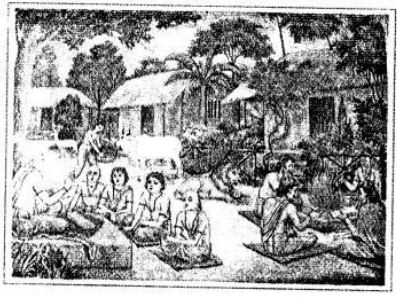
Picture study
Question 1. Identify and name the institution shown in the picture.
Answer: It is a Gurukul.
In simple words: This picture shows a Gurukul, which was an ancient Indian school.
Exam Tip: A Gurukul was the home of the teacher where students lived and studied.
Question 2. Describe this system/institution.
Answer: In this system, a young student around seven years of age went to live with his teacher, or Guru. While residing there, the student learned various subjects like math, medicine, astronomy, and holy scriptures. They were also taught skills like wrestling and archery to prepare for the battlefield. After finishing their education, they served their teacher and offered a gift called Guru Dakshina according to their family's means.
In simple words: Children aged seven lived with their teacher to learn scriptures, math, and combat. In the end, they paid the teacher with a gift they could afford.
Exam Tip: Be sure to explain the age of entry (7 years), the subjects taught, and the concept of Guru Dakshina.
Question 3. Which Ashrama did it belong to?
Answer: Brahmacharya.
In simple words: It belongs to Brahmacharya, which is the first stage of life focused on learning.
Exam Tip: Brahmacharya is the very first of the four stages of human life in the ancient Vedic system.
Textbook Keywords
- Indo-Aryans: The group of Aryans who traveled and settled in the Indian subcontinent from Central Asia.
- Sapta Sindhu: The land of seven rivers, which was the first territory where the Aryans settled upon arriving in India.
- Brahmavarta: Meaning the land of the gods, this was the area where the Aryans lived during the Early Vedic Period.
- Aryavarta: Meaning the land of the Aryans, this refers to the Gangetic plains where they settled during the Later Vedic Period.
- Janas: The various tribes into which the Aryan people were divided.
- Gramas: The small village settlements of the Aryans.
- Gramaniwas: The leader or headman of a village.
- Rajan: The ruler or leader of an Aryan tribe.
- Purohita: The priest who carried out holy rites and gave advice to the king on crucial affairs.
- Senani: The army general who led the soldiers in times of conflict.
- Sabha: A small group of senior tribal members who guided and advised the ruler.
- Samiti: A large tribal gathering where any member could voice their views on matters of the clan.
- Grihapati: The senior-most male member who acted as the head of the household.
- Monogamy: The practice of being married to only one spouse at a time.
- Swayamwara: A special ceremony where a woman could pick her own husband from a group of suitors.
- Soma and Sura: Popular drinks of the Aryans that had an intoxicating effect.
- Varnas: The four social groups - Brahmanas, Kshatriyas, Vaishyas, and Shudras.
- Hereditary: Something that is handed down from parents to their children across generations.
- Rajasuya Yagna: A grand ritual held when a new king came to the throne to grant him supreme power.
- Ashvamedha Yagna: A royal horse sacrifice performed to claim a king's unchallenged rule over territories.
- Brahmacharya: The first stage of a man's life focused entirely on staying with a teacher to gain knowledge.
- Grihastha: The second stage of life when a person marries, raises a family, and manages a household.
- Vanaprastha: The third stage of life when a person leaves worldly comforts to live and meditate in the woods.
- Sanyasa: The final stage of life where a person gives up all worldly ties to become a wandering holy person.
- Gurukul: The home of a spiritual teacher where young boys stayed to receive their education.
- Guru Dakshina: A respectful offering or fee given to the teacher after completing studies, based on one's ability to pay.
- Dharma: The moral duty of every individual to act correctly and lead an honest life.
- Karma: The belief that every action has a result - good deeds bring rewards, and bad deeds bring punishments.
- Transmigration of the soul: The belief that the soul passes into a new body after a person dies.
Questions Based on Early Vedic Civilization
A. Fill in the blanks.
Question 1. The Aryans who settled in India were called __________.
Answer: Indo-Aryans
In simple words: The group of Aryans who made India their home are known as Indo-Aryans.
Exam Tip: This term helps distinguish the Indian branch of Aryans from other Indo-European groups.
Question 2. Labourers who served people and did menial jobs were the __________.
Answer: Shudras
In simple words: The Shudras were the people who did daily labor and served the higher classes.
Exam Tip: Shudras formed the fourth and lowest tier of the Varna hierarchy in Vedic society.
Question 3. The region of seven river is called the __________.
Answer: Sapta Sindhu
In simple words: The land with seven rivers where the Aryans first lived is called the Sapta Sindhu.
Exam Tip: The word "Sapta" means seven, and "Sindhu" refers to the rivers, chiefly the Indus and its tributaries.
Question 4. The four Vedas are __________, __________, __________, and __________.
Answer: Rig Veda, Atharva Veda, Sama Veda, Yajur Veda
In simple words: The four holy books of the Aryans are the Rig Veda, Atharva Veda, Sama Veda, and Yajur Veda.
Exam Tip: Be sure to spell all four Vedas correctly as they are the primary literary sources of this period.
Question 5. The two councils, the __________ and the __________ exercised control over the king.
Answer: Sabha, Samiti
In simple words: The two assemblies called Sabha and Samiti held power to keep the king's decisions in check.
Exam Tip: The presence of Sabha and Samiti shows that the early Vedic king did not have absolute, unchecked power.
Question 6. The most important god of the early Aryans was __________.
Answer: Indra
In simple words: Lord Indra was the chief god whom the early Aryans prayed to for rain and victory in war.
Exam Tip: Indra, also known as Purandara or the rain god, is mentioned in the highest number of Rigvedic hymns.
B. Match the following.
Question 1. Match the terms with their correct descriptions.
| Column A | Column B |
|---|---|
| 1. Aryavarta | commander-in-chief |
| 2. Senani | god of rain and thunder |
| 3. Jana | land of the Aryans |
| 4. Gramani | tribe of the Vedic Period |
| 5. Sabha | headman of the village |
| 6. Indra | smaller assembly of selected people |
Answer:
1. Aryavarta - land of the Aryans
2. Senani - commander-in-chief
3. Jana - tribe of the Vedic Period
4. Gramani - headman of the village
5. Sabha - smaller assembly of selected people
6. Indra - god of rain and thunder
In simple words: This matching pairs key historical words like roles, tribes, and gods with their correct definitions.
Exam Tip: Remember that "Gramani" specifically means the village head, while "Senani" is the military leader.
C. Answer the following questions.
Question 1. When did the Aryans arrive in India?
Answer: The Aryans migrated and settled in India between 1500 BCE and 1000 BCE.
In simple words: The Aryans reached India around 1500 BCE to 1000 BCE.
Exam Tip: State the timeline (1500 BCE - 1000 BCE) clearly as it represents the Early Vedic Period.
Question 2. Describe the various stages in which the Aryans entered India.
Answer: The arrival of the Aryans occurred in two major phases over many centuries. Initially, they made their homes in the Sapta Sindhu region, also called Brahmavarta (land of the gods). This phase lasted from 1500 BCE to 1000 BCE, known as the Early Vedic Period. Later, they expanded into the Gangetic Valley, which they called Aryavarta. This second phase occurred between 1000 BCE and 600 BCE, marked as the Later Vedic Period.
In simple words: First, Aryans settled in the land of seven rivers (1500-1000 BCE). Second, they moved to the Gangetic Valley (1000-600 BCE).
Exam Tip: Clearly name both geographical areas (Brahmavarta and Aryavarta) and their corresponding dates for a complete answer.
Question 3. Name the four Vedas. How have they come down to us?
Answer: The four sacred Vedas are:
1. Rig Veda
2. Atharva Veda
3. Sama Veda
4. Yajur Veda
For a long time, these Vedas were not written. Instead, priests memorized them and passed them down orally through generations before they were finally recorded in books.
In simple words: The four Vedas are Rig, Atharva, Sama, and Yajur. They were preserved by spoken word for generations before being written down.
Exam Tip: Make sure to explain that the Vedas were originally oral literature passed down through listening (Shruti).
Question 4. Who was a rajan? What were his duties?
Answer: The Rajan was the chief or leader of the tribe, chosen as the strongest and most capable man. His primary duties were to defend his tribe from enemies and to look after the welfare of all tribal members.
In simple words: The Rajan was the tribal king. He had to protect his people from danger and make sure they were happy and safe.
Exam Tip: State both aspects of his duties: defending the tribe and ensuring public welfare.
Question 5. The rajan did not have absolute power. Explain.
Answer: The ruler did not hold unchecked authority because the Sabha and Samiti assemblies kept his power in control. These two councils gave advice and guidance to the king, and ordinary members of the tribe could voice their thoughts on key issues. This prevented the Rajan from making single-handed decisions.
In simple words: The king could not do whatever he wanted because two tribal groups, the Sabha and Samiti, guided him and checked his power.
Exam Tip: Always highlight the roles of the Sabha and Samiti as checks and balances on the king's authority.
Question 6. How did the caste system start in Early Vedic society?
Answer: The caste division began when Aryans classified themselves according to their specific skills and occupations. This division of labor gradually turned into the four main classes of early Vedic life.
In simple words: The system started when people were grouped by the jobs they were good at. This later became the four social classes.
Exam Tip: Emphasize that in the Early Vedic Period, the system was flexible and based on occupation/skills, not birth.
Question 7. Name the four classes in the Rig Vedic Period. Who were the members of each of these classes?
Answer: The four social divisions of this era were:
1. Brahmanas - These were the learned priests and teachers who performed holy ceremonies and taught students.
2. Kshatriyas - These were the warriors and soldiers whose duty was to defend the tribe from outside threats.
3. Vaishyas - These were the merchants, farmers, and artisans who took care of the economic duties of the community.
4. Shudras - These made up the lowest tier, serving the other three groups and doing manual tasks.
In simple words: The four classes were the priests (Brahmanas), warriors (Kshatriyas), traders and farmers (Vaishyas), and laborers (Shudras).
Exam Tip: Be sure to name all four classes and briefly state the specific occupation assigned to each one.
Question 8. What were the main occupations of the Aryans?
Answer: Farming and raising crops were the chief occupations of the Aryans, and owning cows was a major symbol of wealth. They traded goods over land and water routes using the barter system. Other common jobs included carpentry, weaving, pottery, blacksmithing, leatherworking, and medical practice.
In simple words: Most Aryans were farmers and raised cattle, especially cows. They also traded using barter and worked as weavers, carpenters, and potters.
Exam Tip: Mention agriculture, cow rearing (pastoralism), barter trade, and at least three crafts to write a comprehensive answer.
Question 9. What were the main forms of recreation of the Aryans?
Answer: The primary leisure activities of the Aryans included chariot racing, horse racing, and hunting wild animals. They were very fond of playing dice games. They also loved outdoor sports, dancing, and playing music.
In simple words: The Aryans had fun by racing horses and chariots, hunting, dancing, singing, and playing dice games.
Exam Tip: List a mix of outdoor activities (racing, hunting) and indoor activities (music, dance, dice) to get full marks.
Question 10. Name the gods worshiped by the Rig Vedic Aryans. How did they worship their gods?
Answer: The Rig Vedic Aryans worshiped natural forces as gods and goddesses, including Indra, Agni, Surya, Varuna, Vayu, Soma, Prithvi, Usha, and Yama. They did not build temples for worship. Instead, they prayed in the open air, chanting hymns and making offerings of ghee, milk, and grain. Whole families participated together in these sacred rituals and sacrifices (yagnas).
In simple words: Aryans worshiped nature gods like fire, wind, and sun. They did not have temples, but prayed outside, offering milk and ghee into holy fires.
Exam Tip: Clearly state that they did NOT build temples, and that they worshiped nature gods in the open air with offerings like ghee and milk.
Question 11. What was the position of the women in the Rig Vedic Period?
Answer: In this early era, women held an honored and respected place in society. They had access to education, and some even wrote verses that are part of the Rig Veda. Women could select their own husbands, child marriage did not exist, and widows were permitted to marry again. Furthermore, no religious ceremony was considered complete without a wife's participation.
In simple words: Women were highly respected and educated. They chose their own husbands, could remarry if widowed, and were necessary for holy rituals.
Exam Tip: Mention key points such as access to education, freedom in marriage (no child marriage, widow remarriage), and participation in religious rituals.
Question 12. Mention two important differences between the Aryans and the people of the Indus Valley.
Answer: The major differences between these two groups are:
1. The people of the Indus Valley worshiped idols and lived in brick-built cities, making theirs an urban culture. In contrast, the Aryans worshiped natural forces and had a rural, village-based culture.
2. Indus Valley inhabitants were peaceful and did not use swords or battle gear, whereas the Aryans were skilled warriors who used various weapons of war.
In simple words: The Indus Valley people lived in cities and were peaceful. The Aryans lived in villages, worshiped nature, and were skilled warriors.
Exam Tip: Use a contrast-based structure (comparing rural vs urban, or peaceful vs warrior) to clearly present the differences.
D. State whether the following are true or false.
Question 1. Rice was the staple diet of the Aryans.
Answer: False
In simple words: Rice was not the main food of the Aryans; barley was their primary grain in early times.
Exam Tip: Barley (Yava) was the most important grain during the early Vedic days, not rice.
Question 2. The Aryans drank intoxicating drinks like soma and sura.
Answer: True
In simple words: The Aryans used drinks called soma and sura during festivals and ceremonies.
Exam Tip: Soma was considered a sacred drink offered to the gods, while Sura was a common intoxicating drink.
Question 3. The dress of the Aryans consisted of a three-piece garment.
Answer: False
In simple words: The clothing of the Aryans was typically made of two main pieces, not three.
Exam Tip: Their clothing generally consisted of an undergarment (Nivi) and an outer garment (Vasa).
Question 4. Both men and women wore jewellery.
Answer: True
In simple words: In Vedic times, both males and females wore ornaments like necklaces and bands.
Exam Tip: Both genders loved wearing ornaments, which were often made of gold, beads, and precious metals.
Question 5. The Aryans believed in one supreme God.
Answer: True
In simple words: Even though they worshiped many nature gods, they believed there was one single supreme power behind them all.
Exam Tip: The Rigveda states that "Truth is one, but sages call it by different names," showing their belief in one ultimate power.
Questions Based on Early Vedic Civilization
A. Fill in blanks.
Question 1. The Later Vedic Period is also known as the __________.
Answer: Epic Age
In simple words: The Later Vedic Period is also called the Epic Age because the two great epics were written then.
Exam Tip: The term "Epic Age" comes from the creation of the Ramayana and Mahabharata during this period.
Question 2. The two Indian epics of this period are __________ and the __________.
Answer: Ramayana, Mahabharata
In simple words: The two major story-books of this time are the Ramayana and the Mahabharata.
Exam Tip: Be sure to write the full names of both epics clearly and capitalize them.
Question 3. In ancient times, Varanasi was known as __________ and Awadh was known as __________.
Answer: Kashi, Kosala
In simple words: Long ago, the city of Varanasi was called Kashi, and the region of Awadh was called Kosala.
Exam Tip: Kashi and Kosala were two of the major kingdoms (Mahajanapadas) that grew in northern India.
Question 4. When a king ascended the throne, the purohita performed the __________.
Answer: Rajasuya
In simple words: The Rajasuya sacrifice was done by the priest when a new king took the throne.
Exam Tip: The Rajasuya sacrifice was specifically meant to crown a king and grant him royal power.
Question 5. During the __________ stage of his life an Aryan stayed in a gurukul and received education from a guru.
Answer: first
In simple words: In the first phase of life, a boy lived with his teacher in a Gurukul to study.
Exam Tip: The first stage of life is known as Brahmacharya, during which education was received.
Question 6. A guru treated his students like his __________ and the students regarded the guru as their __________.
Answer: own children, spiritual father
In simple words: Teachers cared for their students like their own kids, and students respected their teacher as a holy father.
Exam Tip: The relationship between Guru and Shishya in a Gurukul was deeply personal and sacred.
Question 7. __________ and __________ were two highly educated women of the Early Vedic Period.
Answer: Maitreyi, Gargi
In simple words: Maitreyi and Gargi were famous, highly educated women from the early Vedic era.
Exam Tip: These two names show that women had high intellectual freedom and received education in early Vedic times.
Question 8. In the Later Vedic Age, the classification of society into four varnas became __________ and __________.
Answer: rigid, hereditary
In simple words: During the Later Vedic Age, the division of society became very strict and was determined by birth.
Exam Tip: The shift from work-based divisions to birth-based divisions is the most important social change of the Later Vedic Period.
B. Match the following.
Question 1. Match the items below with their correct definitions.
| Column A | Column B |
|---|---|
| 1. Magadha | creator |
| 2. Ashvamedha yagna | destroyer |
| 3. Grihastha | householder |
| 4. Shiva | Patna and Gaya |
| 5. Brahma | horse sacrifice |
Answer:
1. Magadha - Patna and Gaya
2. Ashvamedha yagna - horse sacrifice
3. Grihastha - householder
4. Shiva - destroyer
5. Brahma - creator
In simple words: This pairs historical terms like kingdoms, sacrifices, stages of life, and gods with their meanings.
Exam Tip: Remember that Brahma, Vishnu, and Shiva represent the Creator, Preserver, and Destroyer respectively in the Hindu Trinity.
C. Answer the following questions.
Question 1. Name the four kingdoms that developed from small tribal organizations.
Answer: The four prominent kingdoms that emerged from small tribes were:
1. Kuru (located near modern-day Delhi)
2. Kosala (situated in the Awadh region)
3. Magadha (covering the regions of Patna and Gaya)
4. Kashi (centered around the city of Varanasi)
In simple words: The four major kingdoms that grew from small tribal lands were Kuru, Kosala, Magadha, and Kashi.
Exam Tip: List both the ancient names of the kingdoms and their modern geographical locations to show deep understanding.
Question 2. How did the king become more powerful during this period?
Answer: Rulers gained immense power in this period because the kingship became hereditary, meaning it stayed in the family. The old assemblies of Sabha and Samiti lost most of their authority over the king. To help him rule, new administrative officers like treasurers, tax collectors, and chamberlains were appointed. Finally, the king was elevated to the position of God's representative on Earth, giving him absolute power.
In simple words: Kings became very powerful because their children automatically inherited the throne, the public assemblies lost control over them, and they were seen as representatives of God.
Exam Tip: Mention three key factors: hereditary succession, loss of power of assemblies (Sabha and Samiti), and the divine right theory of kingship.
Question 3. How did the society get sharply divided during the Later Vedic Period?
Answer: During this later phase, society became deeply divided because caste was decided by birth rather than a person's profession. The Brahmanas and Kshatriyas formed the ruling elite. The Vaishyas worked as craftsmen, traders, and farmers. The Shudras were the uneducated working class who had to serve the other three groups.
In simple words: Society got strictly divided because people were born into their castes. The upper classes ruled, while the lowest class had to do hard labor and serve them.
Exam Tip: Highlight the crucial transition from work-based classes to birth-based castes as the reason for the sharp social divide.
Question 4. Briefly describe the four ashramas.
Answer: An Aryan's life was divided into four distinct stages or Ashramas:
1. Brahmacharya - The first stage where a young man lived with his teacher to receive education.
2. Grihastha - The second stage where he married, managed a household, and raised a family.
3. Vanaprastha - The third stage where he retired from worldly comforts and moved to the forest to meditate.
4. Sanyasa - The final stage where he gave up all earthly attachments to live as a wandering holy ascetic, spreading truth.
In simple words: Life was divided into four steps: student life (study), householder life (family), retired life (forest meditation), and holy life (renouncing everything).
Exam Tip: List the four Ashramas in correct order and write a one-sentence description of the main focus of each stage.
Question 5. What was the position of women during the Later Vedic Period?
Answer: The status of women declined significantly in the Later Vedic Period. They were barred from political life, and the practice of Swayamvara was stopped. They were no longer given respect or high status in social and religious gatherings, and were forbidden from studying Vedic literature. Furthermore, the birth of a baby girl was not welcomed by families.
In simple words: In later times, women lost their freedom, were not allowed to study holy books or join politics, and families preferred to have boys over girls.
Exam Tip: Mention at least three indicators of their lower status, such as lack of political participation, ban on studying Vedas, and the end of Swayamvaras.
Question 6. At what age was a boy sent to gurukul? What was the relationship between the guru and his students?
Answer: A boy was sent to study at a Gurukul when he turned 7 years old, and he stayed there until the age of 25. The Guru treated his students with the care of a father, and the young students respected their teacher as their spiritual father.
In simple words: Boys went to school at age 7 and stayed till they were 25. The teacher treated them like his own kids, and they saw him as a spiritual father.
Exam Tip: Be sure to state both the entry age (7 years) and the leaving age (25 years) alongside describing their family-like bond.
Question 7. What did the students do during their stay in the gurukul?
Answer: The pupils lived simple and disciplined lives. They helped their Guru by performing daily chores, which included cleaning the house, pulling water from the well, collecting firewood, and working in the fields. They had to memorize their lessons, which were taught entirely through speech.
In simple words: Students lived simple, disciplined lives. They helped clean the house, gather wood, and work on the farm, and they memorized all their lessons by listening.
Exam Tip: Mention both the manual chores they performed and the oral method of learning and memorization.
Question 8. What was the method of teaching in a gurukul?
Answer: The teaching in a Gurukul was entirely oral. Students listened to their Guru and memorized the lessons by heart. Upon finishing their studies, students offered Guru Dakshina to their teacher as a gift based on their family's financial capability.
In simple words: Lessons were taught by speaking, and students had to memorize them. When they graduated, they gave their teacher a gift they could afford.
Exam Tip: Clearly mention the "oral" method of instruction and the custom of giving "Guru Dakshina" at the end.
Question 9. What were the main occupations of the people of the Later Vedic Period?
Answer: Farming was the main occupation during the Later Vedic Period. The discovery of iron and better farming tools brought wealth and growth to agriculture. People also made painted grey pottery, and this period saw the emergence of towns and cities, with trade expanding through the barter system.
In simple words: Farming was the main job, and using iron tools made it much better. People also made special grey pots, built early towns, and traded using barter.
Exam Tip: Highlight the role of iron tools in farming prosperity and the rise of early urban centers and trade.
Question 10. Mention the important features of the religion of the Later Vedic Period.
Answer: Religion in the Later Vedic Period became highly complex with new ceremonies and detailed rituals gaining daily importance. The principal deities of worship became the Trinity: Brahma (the creator), Vishnu (the preserver), and Shiva (the destroyer). Due to the complicated nature of these new rites, the status of the priestly class (Brahmanas) rose significantly.
In simple words: Rituals became very complicated, and the priests became very powerful. People began worshiping Brahma, Vishnu, and Shiva instead of nature gods.
Exam Tip: State the emergence of the Trinity (Brahma-Vishnu-Shiva) and the rise of the priestly class due to complex rituals.
Question 11. What is the impact of the Aryan civilization on India?
Answer: The Aryan civilization formed the bedrock of Indian culture. Modern Hinduism is deeply rooted in the philosophical teachings of the Vedas and the Upanishads. This vast Vedic literature serves as a cultural thread that binds the diverse people of India together.
In simple words: The Aryans laid the foundation of Indian culture. Today's Hinduism is based on their holy books, which still unite the country.
Exam Tip: Mention the foundation of Indian culture, the roots of modern Hinduism in the Vedas/Upanishads, and the unifying role of Vedic literature.
State whether the following are true or false.
Question 1. The Upanishads were composed during the Later Vedic Period.
Answer: False
In simple words: According to this worksheet, the statement is marked as false.
Exam Tip: Follow your specific school textbook's timeline regarding when the Upanishads were written.
Question 2. Excavations indicate the use of iron during this period.
Answer: True
In simple words: Digging up old sites shows that people during this time used iron tools and weapons.
Exam Tip: Iron findings from archaeological sites like Atranjikhera confirm the widespread use of iron in the Later Vedic Period.
Question 3. The sabha and samiti became very powerful during this period.
Answer: False
In simple words: In the Later Vedic Period, these public assemblies actually lost their authority to the king.
Exam Tip: The political assemblies (Sabha and Samiti) declined in power as the king's authority became absolute and hereditary.
Question 4. The caste system became flexible in the Later Vedic Period.
Answer: False
In simple words: In later times, the caste system became much more rigid and strict, fixed by birth.
Exam Tip: Remember that the social system grew very rigid and inflexible during the Later Vedic Period.
Question 5. Education in a gurukul was very expensive.
Answer: False
In simple words: Studying at a Gurukul did not cost money; students paid only what they could afford at the end of their studies.
Exam Tip: Gurukul education was free of cost, and students gave voluntary Guru Dakshina only after finishing their studies.
Free study material for History Civics
ICSE Selina Concise Solutions Class 6 History Civics Chapter 5 The Vedic Civilisation
Students can now access the detailed Selina Concise Solutions for Chapter 5 The Vedic Civilisation on our portal. These solutions have been carefully prepared as per latest ICSE Class 6 syllabus. Each solution given above has been updated based on the current year pattern to ensure Class 6 students have the most updated History Civics content.
Master Selina Concise Textbook Questions
Our subject experts have provided detailed explanations for all the questions found in the Selina Concise textbook for Class 6 History Civics. We have focussed on making the concepts easy for you in Chapter 5 The Vedic Civilisation so that students can understand the concepts behind every answer. For all numerical problems and theoretical concepts these solutions will help in strengthening your analytical skill required for the ICSE examinations.
Complete History Civics Exam Preparation
By using these Selina Concise Class 6 solutions, you can enhance your learning and identify areas that need more attention. We recommend solving the History Civics Questions from the textbook first and then use our teacher-verified answers. For a proper revision of Chapter 5 The Vedic Civilisation, students should also also check our Revision Notes and Sample Papers available on studiestoday.com.
FAQs
You can download the verified Selina Concise solutions for Chapter 5 The Vedic Civilisation on StudiesToday.com. Our teachers have prepared answers for Class 6 History Civics as per 2026-27 ICSE academic session.
Yes, our solutions for Chapter 5 The Vedic Civilisation are designed as per new 2026 ICSE standards. 40% competency-based questions required for Class 6, are included to help students understand application-based logic behind every History Civics answer.
Yes, every exercise in Chapter 5 The Vedic Civilisation from the Selina Concise textbook has been solved step-by-step. Class 6 students will learn History Civics conceots before their ICSE exams.
Yes, follow structured format of these Selina Concise solutions for Chapter 5 The Vedic Civilisation to get full 20% internal assessment marks and use Class 6 History Civics projects and viva preparation as per ICSE 2026 guidelines.