

Read and download the CBSE Class 11 Mathematics Straight Lines Worksheet Set 04 in PDF format. We have provided exhaustive and printable Class 11 Mathematics worksheets for Chapter 9 Straight Lines, designed by expert teachers. These resources align with the 2026-27 syllabus and examination patterns issued by NCERT, CBSE, and KVS, helping students master all important chapter topics.
Chapter-wise Worksheet for Class 11 Mathematics Chapter 9 Straight Lines
Students of Class 11 should use this Mathematics practice paper to check their understanding of Chapter 9 Straight Lines as it includes essential problems and detailed solutions. Regular self-testing with these will help you achieve higher marks in your school tests and final examinations.
Class 11 Mathematics Chapter 9 Straight Lines Worksheet with Answers
Q1. Prove that lines 3x + y – 14 = 0, x – 2y = 0 & 3x – 8y + y = 0 are concurrent. Also find co-ordinates of pt of concurrence.
Q2. Find eq of line which passes through pt. (3, 2) if the portion of line intercepted between the axes is bisected at the point.
Q3. Find the equation of two straight line passing through (4, -2) and making an angle of 450 with the line 8x + 7y -1 = 0. Show that those two lines are at right angles to one another.
Q4. The mid points of the sides of a triangle are (2, 1), (-5, 7) and (-5, -5). Find the equations of the sides.
Q5. Prove that the perpendicular drawn from the point (4, 1) on the join of (2, -1) and (6, 5) divides it in the ratio 5:13.
Q6. Find eq of straight line which passes through pt (22, -6) & is such that intercept on x-axis exceeds intercept on y axis by 5.
Q7. Find the angle between the lines which have intercept 3, 4 and 1, 8 on the axis respectively.
Q8. Find eq of the straight line which cuts off intercept on x axis twice that on y-axis and is at a unit distance from origin.
Q9. Find the equation of a line parallel to 2x + 3y + 11 = 0 and the sum of its intercepts on the axis is 15.
Q10. Find the image of the point (-8, 12) with respect to the line mirror 4x + 7y + 13 = 0
Q11. Find the equation of a line which divides the join of (1, 0) and (3, 0) in the ratio 2:1 and perpendicular to it.
Q12. A line through the points (a, 2a) and (-2, 3) is perpendicular to the line 4x + 3y + 5 = 0, find the value of ‘a’.
Q13. If lines ax + 2y + 1 = 0, bx + 3y + 1 = 0 and cx + 4y + 1 = 0 are concurrent, show that a, b, c are in A.P.
Q14. Prove that the points (1, 3), (3, 5) and (5, 7) are collinear. Also find the equation of the line.
Q15. Transform the equation of the line x + y + 4 = 0 to (i) slope intercept form and find its slope and y intercept
(ii) intercept from and find intercepts on the coordinate axes (iii) normal form and find the inclination of the perpendicular segment from the origin on the line with x=axis and also find its length.
Q16. Find equation of line passing through interaction of lines x + y + 3 = 0 & x – y + 2 = 0 and having y – intercept equal to 4.
Q17. One side of a rectangle is along line 4x + 7y + 5 = 0. Two of its vertices are (-3, 1) & (1, 1). Find eqs of other three sides.
Q18. The vertices of a triangle are A (-2, 1), B(6, -2) and C (4, 3). Find the lengths of the altitudes of the triangle.
Q19. Find the equations of the lines which are at a distance of ½ from the origin and pass through the point (0,1).
Q20. Find the equation of the line joining the points (3, -1) and (2, 3). Also find equation of line perpendicular to this line and passing through point (5, 2).
Q21 Find the new co-ordinates of the point in each of the following cases if the origin is shifted to the point (-1, -2 ) by translation of axes.
a) (2,3)
b) ( -5, -4)
c) ( -1, 4)
Q22 Find what the following equation becomes when the origin is shifted to ( 2,3)
a) x2 = 4ay
b) x2 – y2 =4
c) x + 2y =7
Q.1 The length L (in centimetre) of a copper rod is a linear function of its Celsius temperature C. In an experiment, if L = 124.942 when C = 20 and L = 125.134 when C = 110, express L in terms of C.
Q.2 Write the equation of a line parallel to x-axis and passing through (-2,3).
Q.3 Point R (h, k) divides a line segment between the axes in the ratio 1:2. Find equation of the line.
Q.4 Find the equation of the straight lien which makes an angle of 60° with the x - axis and cuts of an intercept -2 from the y - axis.
Q.5 Find the equation of the straight line joining the points (a,b) and {(a+b),(a-b)}.
Q.6 Find the slope of a line which passes through (1,2) and (-3,4)?
Q.7 Find the coordinates of point C, which divides the line segment joining the points D (-2, 5) and E (4, 6) in the ratio 2 : 3.
Q.8 If three lines whose equations are y = m1 x + c1, y = m2x + c2, y = m3x + c3 are concurrent, then show that m1(c2 – c3) + m2(c3 – c1) + m3(c1 – c2) = 0.
Q.9 Find the equation of a line which is equidistant from the lines x = - 4 and x = 8.
Q.10 The vertices of ΔPQR are P (2, 1), Q (–2, 3) and R (4, 5). Find equation of the median through the vertex R.
Q.11 Find the value of p so that the three lines 3x + y - 2 = 0, px + 2y - 3 = 0 and 2x - y - 3 = 0 may intersect at one point.
Q.12 Reduce 4x – 3y -12 = 0 to the ‘intercept form''.
Q.13 Find the equation of the line perpendicular to the line 2x – 3y + 7 = 0 and having x-intercept 4.
Q.14 By using the concept of equation of a line, prove that the three points (3, 0), (–2, –2) and (8, 2) are collinear.
Q.15 Find the equation of the right bisector of the line segment joining the points (3, 4) and (–1, 2).
Q.16 Find the equation of the straight line passing through (2, 3) and cutting off intercepts equal in magnitude and opposite in sign.
Q.17 Prove that the product of the lengths of the perpendiculars drawn from the points (√a2 - b2, 0) and ( - √a2 - b2, 0) to the line x/a cos θ + y/b sin θ = 1 is b2 .
Q.18 Find equation of the line perpendicular to the line x – 7y + 5 = 0 and having x intercept 3.
Q.19 A line passes through (x1, y1) and (h, k). If slope of the line is m, show that k - y1 = m(h – x1).
Q.20 Write the equation of a line passing through (2,3) and makes an angle of 45° with x-axis.
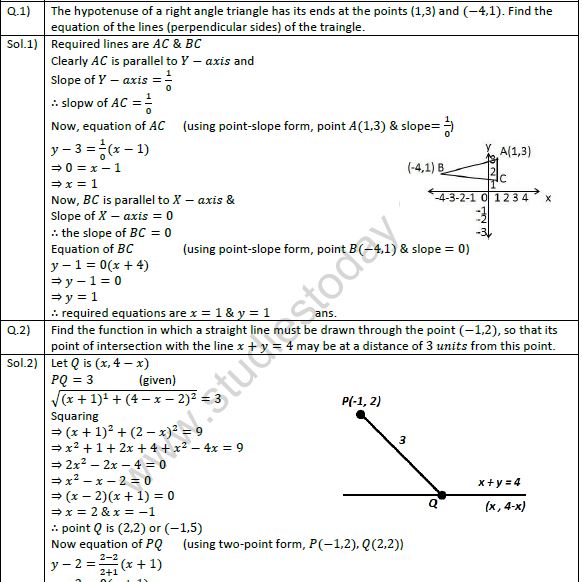
Question 1. The hypotenuse of a right angle triangle has its ends at the points (1,3) and (−4,1). Find the equation of the lines (perpendicular sides) of the traingle.
Answer: Let the required perpendicular sides of the triangle be \(AC\) and \(BC\).
Evidently, the line \(AC\) runs parallel to the y-axis.
The gradient of the y-axis is represented as \(\frac{1}{0}\).
Consequently, the gradient of \(AC\) is also \(\frac{1}{0}\).
Applying the point-slope formula with the point \(A(1,3)\) and slope \(m = \frac{1}{0}\):
\(y - 3 = \frac{1}{0}(x - 1)\)
\(\implies 0 = x - 1\)
\(\implies x = 1\)
Similarly, the side \(BC\) runs parallel to the x-axis.
The slope of the x-axis is \(0\).
As a result, the slope of \(BC\) is \(0\).
Applying the point-slope formula with the point \(B(-4,1)\) and a slope of \(0\):
\(y - 1 = 0(x + 4)\)
\(\implies y - 1 = 0\)
\(\implies y = 1\)
Hence, the equations of the required perpendicular sides are \(x = 1\) and \(y = 1\).
In simple words: Since the triangle is right-angled and the hypotenuse goes between two points, the other two perpendicular sides must run horizontally and vertically. This means one side is a vertical line through \(x=1\), and the other is a horizontal line through \(y=1\).
Exam Tip: Whenever the perpendicular sides of a right-angled triangle are parallel to the coordinate axes, their equations can be written directly as \(x = x_1\) and \(y = y_2\) without using the point-slope form.
Question 2. Find the direction in which a straight line must be drawn through the point (−1,2), so that its point of intersection with the line 𝑥 + 𝑦 = 4 may be at a distance of 3 𝑢𝑛𝑖𝑡𝑠 from this point.
Answer: Let the point of intersection on the line \(x + y = 4\) be denoted as \(Q(x, 4 - x)\).
We are given that the distance \(PQ = 3\):
\(\sqrt{(x + 1)^2 + (4 - x - 2)^2} = 3\)
Squaring both sides of the equation:
\(\implies (x + 1)^2 + (2 - x)^2 = 9\)
\(\implies x^2 + 1 + 2x + 4 + x^2 - 4x = 9\)
\(\implies 2x^2 - 2x - 4 = 0\)
\(\implies x^2 - x - 2 = 0\)
\(\implies (x - 2)(x + 1) = 0\)
\(\implies x = 2\) and \(x = -1\)
Thus, the coordinates of \(Q\) can be either \((2,2)\) or \((-1,5)\).
We can find the equation of the line \(PQ\) passing through \(P(-1,2)\) and \(Q(2,2)\) using the two-point formula:
\(y - 2 = \frac{2 - 2}{2 + 1}(x + 1)\)
\(\implies y - 2 = 0(x + 1)\)
\(\implies y = 2\) which is a line parallel to the x-axis.
Next, we find the second possible equation of the line \(PQ\) using the points \(P(-1,2)\) and \(Q(-1,5)\):
\(y - 2 = \frac{5 - 2}{-1 + 1}(x + 1)\)
\(y - 2 = \frac{3}{0}(x + 1)\)
\(\implies 0 = 3(x + 1)\)
\(\implies x = -1\) which is a line parallel to the y-axis.
Therefore, the line should be drawn either parallel to the x-axis or parallel to the y-axis.
In simple words: We find a point on the line \(x + y = 4\) that is exactly 3 units away from \((-1,2)\). Solving this gives two possible points, leading to either a completely horizontal line or a completely vertical line.
Exam Tip: Always remember to square both sides to eliminate the radical when solving distance problems, and check both resulting coordinate points as they represent two distinct valid directions.
Question 3. Find the equation of line drawn perpendicular to the line \(\frac{x}{4} + \frac{y}{6} = 1\) where it (given line) meets the Y - axis.
Answer: The equation of the given straight line is:
\(\frac{x}{4} + \frac{y}{6} = 1\)
\(\implies 3x + 2y = 12\)
Using the coefficient ratio, we determine the slope of this line:
\(m = \frac{-\text{coefficient of } x}{\text{coefficient of } y} = -\frac{3}{2}\)
Since our desired line is perpendicular to the given line, its slope must be the negative reciprocal:
\(\text{slope of required line} = \frac{2}{3}\)
To find where the given line meets the y-axis, we set \(x = 0\):
\(\implies 3(0) + 2y = 12 \implies y = 6\)
Thus, the point \((0,6)\) lies on our target line.
Now, applying the point-slope form with the point \((0,6)\) and a slope of \(\frac{2}{3}\):
\(y - 6 = \frac{2}{3}(x - 0)\)
\(\implies 3y - 18 = 2x\)
\(\implies 2x - 3y = -18\) ans.
In simple words: We first find where the given line crosses the vertical y-axis, which is at \((0,6)\). Then, we calculate the perpendicular slope and use it to write the equation of our new line through that same point.
Exam Tip: To quickly find the point where a line meets the y-axis, simply set \(x = 0\) in its equation. Remember that the product of the slopes of two perpendicular lines is always \(-1\).
Question 4. A vertex of an equilateral triangle is (2,3) & the opposite side is 𝑥 + 𝑦 = 2. Find the equation of the other side.
Answer: The equation of the base \(BC\) is given as:
\(x + y = 2\)
The slope of this base line \(BC\) is \(m_2 = -1\).
Let \(m\) represent the slope of one of the other sides, say \(AB\).
Since the triangle is equilateral, the angle between the sides \(AB\) and \(BC\) is \(60^\circ\):
Using the formula for the angle between two lines:
\(\tan 60^\circ = \left| \frac{m - (-1)}{1 + m(-1)} \right|\)
\(\implies \sqrt{3} = \left| \frac{m + 1}{1 - m} \right|\)
\(\implies \pm\sqrt{3} = \frac{m+1}{1-m}\)
Evaluating Case 1 with a positive sign:
\(\sqrt{3} = \frac{m + 1}{1 - m}\)
\(\implies \sqrt{3} - \sqrt{3}m = m + 1\)
\(\implies \sqrt{3} - 1 = \sqrt{3}m + m\)
\(\implies \sqrt{3} - 1 = m(\sqrt{3} + 1)\)
\(\implies m = \frac{\sqrt{3} - 1}{\sqrt{3} + 1}\)
Evaluating Case 2 with a negative sign:
\(-\sqrt{3} = \frac{m + 1}{1 - m}\)
\(\implies -\sqrt{3} + \sqrt{3}m = m + 1\)
\(\implies \sqrt{3}m - m = 1 + \sqrt{3}\)
\(\implies m(\sqrt{3} - 1) = 1 + \sqrt{3}\)
\(\implies m = \frac{1 + \sqrt{3}}{\sqrt{3} - 1}\)
Using the first slope \(m = \frac{\sqrt{3}-1}{\sqrt{3}+1}\) and the vertex \(A(2,3)\), the equation of the side \(AB\) is:
\(y - 3 = \frac{\sqrt{3}-1}{\sqrt{3}+1}(x - 2)\)
\(\implies (\sqrt{3} + 1)y - 3\sqrt{3} - 3 = (\sqrt{3} - 1)x - 2\sqrt{3} + 2\)
\(\implies (\sqrt{3} - 1)x - (\sqrt{3} + 1)y + 5 + \sqrt{3} = 0\)
Using the second slope \(m = \frac{1+\sqrt{3}}{\sqrt{3}-1}\) and the vertex \(A(2,3)\), the equation of the side \(AC\) is:
\(y - 3 = \frac{1+\sqrt{3}}{\sqrt{3}-1}(x - 2)\)
\(\implies (\sqrt{3} - 1)y - 3\sqrt{3} + 3 = (\sqrt{3} + 1)x - 2 - 2\sqrt{3}\)
\(\implies (\sqrt{3} + 1)x - (\sqrt{3} - 1)y + \sqrt{3} - 5 = 0\)
Consequently, the equations of the other two sides of the equilateral triangle are:
\((\sqrt{3} - 1)x - (\sqrt{3} + 1)y + 5 + \sqrt{3} = 0\) and \((\sqrt{3} + 1)x - (\sqrt{3} - 1)y + \sqrt{3} - 5 = 0\) ans.
In simple words: An equilateral triangle has angles of \(60^\circ\). We find the two lines passing through the vertex \((2,3)\) that make an angle of \(60^\circ\) with the baseline \(x + y = 2\) by solving for their slopes.
Exam Tip: For equilateral triangle problems, remember the angle between any two sides is always \(60^\circ\). Using the angle formula \(\tan 60^\circ = \left|\frac{m_1 - m_2}{1 + m_1 m_2}\right|\) will yield the slopes of both remaining sides.
Question 5. The opposite angular points of a square are (3,4) and (1, −1). Find the coordinates of the other two sides.
Answer: Let the square be \(ABCD\), where \(A(3,4)\) and \(C(1,-1)\) are opposite vertices.
The slope of the diagonal \(AC\) is:
\(m_{AC} = \frac{-1 - 4}{1 - 3} = \frac{-5}{-2} = \frac{5}{2}\)
Let \(m\) be the slope of the side \(AB\). Since the diagonal of a square makes a \(45^\circ\) angle with its sides, we have \(\theta = 45^\circ\):
\(\tan 45^\circ = \left| \frac{m - \frac{5}{2}}{1 + \frac{5}{2}m} \right|\)
\(\implies 1 = \left| \frac{2m - 5}{2 + 5m} \right|\)
\(\implies \pm 1 = \frac{2m - 5}{2 + 5m}\)
This gives two cases:
\(1 = \frac{2m - 5}{2 + 5m} \implies 2 + 5m = 2m - 5 \implies 3m = -7 \implies m = -\frac{7}{3}\)
\(-1 = \frac{2m - 5}{2 + 5m} \implies -2 - 5m = 2m - 5 \implies 3 = 7m \implies m = \frac{3}{7}\)
Thus, the slope of \(AB\) is \(-\frac{7}{3}\), and the slope of the perpendicular side \(BC\) is \(\frac{3}{7}\). We can determine the equations of \(AB\) and \(BC\) using their point-slope forms:
Equation of \(AB\): \(7x + 3y - 33 = 0\)
Equation of \(BC\): \(3x - 7y + 20 = 0\)
Solving these two linear equations simultaneously gives the coordinates of vertex \(B\):
\(B\left(-\frac{1}{2}, \frac{5}{2}\right)\)
Let \(E\) be the midpoint of the diagonal \(AC\):
\(E = \left(\frac{3 + 1}{2}, \frac{4 - 1}{2}\right) = \left(2, \frac{3}{2}\right)\)
Since \(E\) is also the midpoint of the other diagonal \(BD\):
\(2 = \frac{-\frac{1}{2} + x_2}{2} \implies x_2 = \frac{9}{2}\)
\(\frac{3}{2} = \frac{\frac{5}{2} + y_2}{2} \implies y_2 = \frac{1}{2}\)
Applying the midpoint formula again, we find the coordinates of \(D\left(\frac{9}{2}, \frac{1}{2}\right)\). Therefore, the coordinates of the other two vertices are:
\(\left(-\frac{1}{2}, \frac{5}{2}\right)\) and \(\left(\frac{9}{2}, \frac{1}{2}\right)\) ans.
In simple words: The diagonal of a square makes a \(45^\circ\) angle with its sides. We use this angle to find the slopes of the sides, write their equations, and find their intersection. Then, we use the midpoint of the diagonal to easily find the last vertex.
Exam Tip: Remember that the diagonals of a square are perpendicular bisectors of each other and bisect the vertex angles at \(45^\circ\). Using the midpoint of one diagonal as the midpoint of the other is the fastest way to find the final vertex.
Question 6. A point moves such that its distance from the point (4,0) is half that of its distance from the line 𝑥 = 16. Find the locus of the point.
Answer: Let \( (x, y) \) represent the coordinates of the moving point.
The distance from this point to \((4,0)\) is:
\(d_1 = \sqrt{(x - 4)^2 + y^2}\)
The distance from the point to the line \(x - 16 = 0\) is:
\(d_2 = \frac{|x - 16|}{\sqrt{1^2 + 0}}\)
According to the given condition:
\(\sqrt{(x - 4)^2 + y^2} = \frac{1}{2} |x - 16|\)
Squaring both sides of the equation to eliminate the square root:
\(x^2 + 16 - 8x + y^2 = \frac{1}{4}(x^2 + 256 - 32x)\)
\(\implies 4x^2 + 64 - 32x + 4y^2 = x^2 + 256 - 32x\)
\(\implies 3x^2 + 4y^2 = 192\) is the required locus equation.
In simple words: We write down the formulas for the point's distance from the point \((4,0)\) and the line \(x = 16\). Setting the first distance to be half of the second and squaring both sides gives us the equation of an ellipse.
Exam Tip: Locus problems involving a point and a line are often definitions of conics. In this case, since the ratio of the distance from the point to the line is \(\frac{1}{2}\) (which is less than 1), the locus is an ellipse.
Question 7. Show that the locus of the mid point of the distance between the axis of the variable line 𝑥 cos 𝛼 + 𝑦 sin 𝛼 = 𝑝 is 1/𝑥2 + 1/𝑦2 = 4/𝑝2 where 𝑝 is constant.
Answer: The equation of the variable line is given by:
\(x \cos \alpha + y \sin \alpha = p\)
To find where this line intersects the x-axis (point \(A\)), we set \(y = 0\):
\(x = \frac{p}{\cos \alpha} \implies A\left(\frac{p}{\cos \alpha}, 0\right)\)
To find where it intersects the y-axis (point \(B\)), we set \(x = 0\):
\(y = \frac{p}{\sin \alpha} \implies B\left(0, \frac{p}{\sin \alpha}\right)\)
Let \(P(x, y)\) be the midpoint of the segment connecting \(A\) and \(B\):
\(x = \frac{\frac{p}{\cos \alpha} + 0}{2} \implies \cos \alpha = \frac{p}{2x}\)
\(y = \frac{0 + \frac{p}{\sin \alpha}}{2} \implies \sin \alpha = \frac{p}{2y}\)
Squaring both equations and adding them together:
\(\cos^2 \alpha + \sin^2 \alpha = \frac{p^2}{4x^2} + \frac{p^2}{4y^2}\)
Since \(\cos^2 \alpha + \sin^2 \alpha = 1\):
\(1 = \frac{p^2}{4x^2} + \frac{p^2}{4y^2}\)
\(\implies \frac{1}{x^2} + \frac{1}{y^2} = \frac{4}{p^2}\) (proved)
In simple words: We find the points where the variable line cuts the x-axis and y-axis. The average of these coordinates gives the midpoint. By using the identity \(\cos^2 \alpha + \sin^2 \alpha = 1\), we eliminate the variable angle and find the final locus equation.
Exam Tip: Always eliminate the variable parameter (in this case, \(\alpha\)) using the trigonometric identity \(\sin^2\alpha + \cos^2\alpha = 1\) to find the direct algebraic relation for the locus.
Question 8. If the equation of the base of an equilateral triangle is 𝑥 + 𝑦 = 2 & the vertex is (2,1). Find the area of the traingle.
Answer: Let \(AD\) be the perpendicular height from the vertex \(A(2,1)\) to the base line \(BC\):
\(AD = \frac{|2 + 1 - 2|}{\sqrt{1^2 + 1^2}} = \frac{1}{\sqrt{2}}\)
In the right-angled triangle \(ABD\), we have:
\(\sin 60^\circ = \frac{AD}{a}\) - (where \(a\) is the side of the equilateral triangle)
\(\implies \frac{\sqrt{3}}{2} = \frac{\frac{1}{\sqrt{2}}}{a}\)
\(\implies a = \frac{2}{\sqrt{6}} = \frac{\sqrt{2}}{\sqrt{3}}\)
The formula for the area of an equilateral triangle is:
\(\text{Area} = \frac{\sqrt{3}}{4} a^2\)
\(\implies \text{Area} = \frac{\sqrt{3}}{4} \left(\frac{2}{3}\right) = \frac{1}{2\sqrt{3}}\) square units ans.
In simple words: We first calculate the height of the triangle by finding the perpendicular distance from the top vertex to the baseline. Then, we use trigonometry to find the side length from this height and compute the final area.
Exam Tip: For any equilateral triangle, the relation between its height \(h\) and side \(a\) is \(h = a \sin 60^\circ = \frac{\sqrt{3}}{2}a\). Knowing this formula directly saves time during exams.
Free study material for Mathematics
CBSE Mathematics Class 11 Chapter 9 Straight Lines Worksheet
Students can use the practice questions and answers provided above for Chapter 9 Straight Lines to prepare for their upcoming school tests. This resource is designed by expert teachers as per the latest 2026 syllabus released by CBSE for Class 11. We suggest that Class 11 students solve these questions daily for a strong foundation in Mathematics.
Chapter 9 Straight Lines Solutions & NCERT Alignment
Our expert teachers have referred to the latest NCERT book for Class 11 Mathematics to create these exercises. After solving the questions you should compare your answers with our detailed solutions as they have been designed by expert teachers. You will understand the correct way to write answers for the CBSE exams. You can also see above MCQ questions for Mathematics to cover every important topic in the chapter.
Class 11 Exam Preparation Strategy
Regular practice of this Class 11 Mathematics study material helps you to be familiar with the most regularly asked exam topics. If you find any topic in Chapter 9 Straight Lines difficult then you can refer to our NCERT solutions for Class 11 Mathematics. All revision sheets and printable assignments on studiestoday.com are free and updated to help students get better scores in their school examinations.
FAQs
You can download the latest chapter-wise printable worksheets for Class 11 Mathematics Chapter 9 Straight Lines for free from StudiesToday.com. These have been made as per the latest CBSE curriculum for this academic year.
Yes, Class 11 Mathematics worksheets for Chapter 9 Straight Lines focus on activity-based learning and also competency-style questions. This helps students to apply theoretical knowledge to practical scenarios.
Yes, we have provided solved worksheets for Class 11 Mathematics Chapter 9 Straight Lines to help students verify their answers instantly.
Yes, our Class 11 Mathematics test sheets are mobile-friendly PDFs and can be printed by teachers for classroom.
For Chapter 9 Straight Lines, regular practice with our worksheets will improve question-handling speed and help students understand all technical terms and diagrams.