

Read and download the CBSE Class 12 Physics Electric Charges And Fields Worksheet Set 03 in PDF format. We have provided exhaustive and printable Class 12 Physics worksheets for Chapter 1 Electric Charges And Fields, designed by expert teachers. These resources align with the 2026-27 syllabus and examination patterns issued by NCERT, CBSE, and KVS, helping students master all important chapter topics.
Chapter-wise Worksheet for Class 12 Physics Chapter 1 Electric Charges And Fields
Students of Class 12 should use this Physics practice paper to check their understanding of Chapter 1 Electric Charges And Fields as it includes essential problems and detailed solutions. Regular self-testing with these will help you achieve higher marks in your school tests and final examinations.
Class 12 Physics Chapter 1 Electric Charges And Fields Worksheet with Answers
CBSE Class 12 Physics Electric Charges and Fields.Students can download these worksheets and practice them. This will help them to get better marks in examinations. Also refer to other worksheets for the same chapter and other subjects too. Use them for better understanding of the subjects.
SECTION A
CONCEPTUAL AND APPLICATION TYPE QUESTIONS
1 Is the force acting between two point charges q1 and q2 kept at some distance apart in air attractive or repulsive when i) q1 q2 > 0 ii) q1 q2 < 0 ?
2 If the distance between two equal point charges is doubled and their individual charges are also doubled ,what would happen to the force between them ?
3 Do the electrostatic field lines form closed loops?
4 A hollow metal sphere of radius 5cm is charged such that the potential on its is 10V. What is the electric field at the centre of the sphere?
5 What is meant by the statement that “the electric field of a point charge has spherical symmetry whereas electric field due to an electric dipole is cylindrically symmetrical’’ ?
Important Questions for NCERT Class 12 Physics Electric Charges And Fields
Question. A body can be negatively charged by :
(a) removing some neutrons from it
(b) giving excess electrons to it
(c) removing some protons from it
(d) removing some electrons from it
Question. The number of electrons for one coulomb of charge are:
(a) 6.25 × 10²³
(b) 6.25 × 10²¹
(c) 6.25 × 10¹⁸
(d) 6.25 × 10¹⁹
Question. What is the electric flux associated with one of faces of a cube, when a charge (q) is enclosed in the cube ?
(a) 6q/ε0
(b) q/6ε0
(c) q/3ε0
(d) 3q/ε0
Question. The point charges Q and –2Q are placed at some distance apart. If the electric field at the location of Q is E. The electric field at the location of Q is E. The electric field at the location of –2Q will be
(a) - 3E/2
(b) – E
(c) - E/2
(d) -2E
Question. How many electrons make up a charge of 20 μC.
(a) 1.25 × 10¹⁴
(b) 2.23 × 10¹⁴
(c) 3.25 × 10¹⁴
(d) 5.25 × 10¹⁴
Question. Let Ea be the electric field due to a dipole in its axial plane distant l and Eq be the field in the equatorial plane distant l', then the relation between Ea and Eq will be :
(a) Ea = 4Eq
(b) Eq = 2Ea
(c) Ea = 2Eq
(d) Eq = 3Ea
Question. A particle of mass 2g and charge 1mC is held at a distance of 1m from a fixed charge 1mC. If the particle is released it will be repelled. The speed of particle when it is at a distance of 10 metre from the fixed charge is
(a) 90 m/s
(b) 100 m/s
(c) 45 m/s
(d) 55 m/s
Question. A conducting sphere of radius 10 cm is charged with 10 μC. Another uncharged sphere of radius 20 cm is allowed to touch it for some time. After that if the spheres are separated, then surface density of charges on the spheres will be in the ratio of
(a) 1 : 1
(b) 2 : 1
(c) 1 : 3
(d) 4 : 1
Question. An electric dipole placed in a non-uniform electric field experiences :
(a) both, a torque and a net force
(b) only a force but no torque
(c) only a torque but no net force
(d) no torque and no net force
Question. Two infinitely long parallel conducting plates having surface charge densities +s and –s respectively, are separated by a small distance.
The medium between the plates is vacuum. If ε0 is the dielectric permittivity of vacuum then the electric field in the region between the plates is :
(a) 0 volt/m
(b) s/ 2ε0 volt/m
(c) s/ ε0 volt/m
(d) 2s / ε0 volt/m
Question. Two parallel large thin metal sheets have equal surface charge densities (s = 26.4 × 10⁻¹² c/m2) of opposite signs. The electric field between these sheets is :
(a) 1.5 N/C
(b) 1.5´10-10N/C
(c) 3 N/C
(d) 3´10-10N/C
Question. Three charge q, Q and 4q are placed in a straight line of length l at points distant 0, 1/2 and l respectively from one end. In order to make the net froce on q zero, the charge Q must be equal to
(a) –q
(b) – 2q
(c) -q/2
(d) q
Section A: Conceptual and Application Type Questions
Question 1. Is the force acting between two point charges q1 and q2 kept at some distance apart in air attractive or repulsive when i) q1 q2 > 0 ii) q1 q2 < 0 ?
Answer:
(i) When \( q_1 q_2 > 0 \), both charges are of the same sign (either both positive or both negative). As like charges repel each other, the electrostatic force between them is repulsive.
(ii) When \( q_1 q_2 < 0 \), the charges have opposite signs (one is positive and the other is negative). Since unlike charges attract each other, the electrostatic force between them is attractive.
In simple words: When the product of two charges is positive, they repel each other because they have the same sign. When the product is negative, they attract because they have opposite signs.
Exam Tip: Remember that like charges repel and unlike charges attract; writing the condition \( q_1 q_2 > 0 \) or \( q_1 q_2 < 0 \) in terms of sign helps secure full marks.
Question 2. If the distance between two equal point charges is doubled and their individual charges are also doubled ,what would happen to the force between them ?
Answer: According to Coulomb's Law, the electrostatic force between two point charges is given by:
\[ F = \frac{1}{4\pi\varepsilon_0} \frac{q_1 q_2}{r^2} \]
When both charges are doubled (\( q'_1 = 2q_1 \) and \( q'_2 = 2q_2 \)) and the separation between them is also doubled (\( r' = 2r \)), the new force \( F' \) becomes:
\( \implies F' = \frac{1}{4\pi\varepsilon_0} \frac{(2q_1)(2q_2)}{(2r)^2} \)
\( \implies F' = \frac{1}{4\pi\varepsilon_0} \frac{4q_1 q_2}{4r^2} \)
\( \implies F' = F \)
Therefore, the electrostatic force between the point charges remains completely unchanged.
In simple words: Doubling the charges makes the force four times stronger, but doubling the distance makes it four times weaker. These two changes balance each other out, so the force stays the same.
Exam Tip: Always show the formula and write out the step-by-step substitution to show how the factors of 4 cancel out.
Question 3. Do the electrostatic field lines form closed loops?
Answer: No, electrostatic field lines never form closed loops. This is because they start on positive charges and end on negative charges. They do not originate and terminate on the same charge, which is a consequence of the conservative nature of the electrostatic field.
In simple words: Electric field lines start at positive charges and stop at negative charges. They cannot loop back to where they started.
Exam Tip: Mentioning that electric field lines originate from positive charges and terminate on negative charges is crucial for getting full marks.
Question 4. A hollow metal sphere of radius 5cm is charged such that the potential on its is 10V. What is the electric field at the centre of the sphere?
Answer: The electric field inside any hollow charged conducting sphere is zero. Since the metal sphere is a conductor, all excess charge resides entirely on its outer surface, leaving no electric field inside, including at its center.
In simple words: The electric field inside a hollow metal container is always zero, no matter how much charge or voltage is on the outside.
Exam Tip: Do not confuse potential with electric field. The potential inside is constant (10 V), but the electric field is zero.
Question 5. What is meant by the statement that “the electric field of a point charge has spherical symmetry whereas electric field due to an electric dipole is cylindrically symmetrical’’ ?
Answer: This statement describes the geometric distribution of the electric field:
- For a point charge, the magnitude of the electric field depends only on the radial distance from the charge. Thus, the field is identical at all points on any concentric sphere around it, representing spherical symmetry.
- For an electric dipole, the electric field is symmetric under rotation about the dipole axis (the line connecting the two charges). Rotating the system around this axis does not alter the field configuration, representing cylindrical symmetry.
In simple words: A point charge spreads its electric field evenly in all directions like a round ball. A dipole has a field that stays the same when rotated around the line connecting its two charges, like a cylinder.
Exam Tip: Clearly distinguish between the rotational axis of a dipole and the radial distance of a point charge to explain the two types of symmetries.
Question 6. Why is it difficult to perform electrostatic experiments on a humid day?
Answer: On a humid day, the high concentration of moisture in the air makes it relatively conducting. This moisture allows static electric charges on the experimental apparatus to easily leak away into the surrounding atmosphere, preventing the accumulation of charge needed for the experiments.
In simple words: Wet air acts like a tiny path for electricity. It quickly steals the static charges from the experiment before we can measure them.
Exam Tip: Use terms like "moisture makes air conducting" and "leakage of charge" to satisfy marking schemes.
Question 7. The distance of the field point on the equatorial plane of a small electric dipole , is halved. By what factor will the electric field , due to the dipole change?
Answer: For a small electric dipole, the electric field at a point on its equatorial plane is inversely proportional to the cube of the distance:
\[ E = \frac{p}{4\pi\varepsilon_0 r^3} \]
When the distance is halved (\( r' = \frac{r}{2} \)), the new electric field \( E' \) becomes:
\( \implies E' = \frac{p}{4\pi\varepsilon_0 \left(\frac{r}{2}\right)^3} \)
\( \implies E' = 8 \left( \frac{p}{4\pi\varepsilon_0 r^3} \right) \)
\( \implies E' = 8E \)
Thus, the electric field increases by a factor of 8.
In simple words: Since the electric field of a small dipole drops off with the cube of the distance, cutting the distance in half makes the electric field 8 times stronger.
Exam Tip: Be careful not to use the square-law relationship here; the dipole field depends on \( \frac{1}{r^3} \), not \( \frac{1}{r^2} \).
Question 8. What is the precaution to be taken in selecting the Gaussian surface , regarding the charge ?
Answer: When selecting a Gaussian surface, we must ensure that the surface does not pass through any discrete point charge. This is because the electric field is not uniquely defined at the precise position of a point charge. However, the surface is allowed to pass through continuous charge distributions.
In simple words: Do not let your imaginary boundary pass right through a single point charge, because the electric field at that exact spot is infinite and impossible to calculate.
Exam Tip: Remember to specify that while a Gaussian surface cannot pass through discrete point charges, it can cross continuous charge distributions.
Question 9. For a system of two point charges +5µC and – 3µC separated by a distance of d apart , draw electric lines of forces
Answer: Since the magnitude of the positive charge (\( +5\mu\text{C} \)) is greater than that of the negative charge (\( -3\mu\text{C} \)), more electric field lines originate from the positive charge than terminate on the negative charge. Some field lines from the positive charge diverge and extend outward to infinity, while some lines from infinity terminate on the negative charge. The lines of force are shown schematically below:
In simple words: The field lines start on the positive charge and curve into the negative charge. Because the positive charge is larger, it has extra lines that go straight out to infinity.
Exam Tip: Ensure that the lines start perpendicularly from the positive charge and end perpendicularly on the negative charge, and that the density of lines near the larger charge is higher.
Question 10. Two point charges of unknown magnitude and sign are placed some distance apart. The intensity of electric field is zero at a point on the line joining them i) between them at midpoint of the line joining them ii) not between them. What do you infer about their sign and magnitude of the two point charges in each case?
Answer:
(i) **When the electric field is zero at the midpoint between the charges:**
- **Sign:** Both charges must have the **same sign** (either both positive or both negative) so that their electric fields between them are in opposite directions and can cancel out.
- **Magnitude:** The charges must have **equal magnitudes** (\( |q_1| = |q_2| \)) because the midpoint is equidistant from both charges, meaning equal charges are needed to produce equal field strengths.
(ii) **When the electric field is zero at a point not between them (outside the line segment connecting them):**
- **Sign:** The charges must have **opposite signs** (one positive and one negative) so that their electric fields cancel each other in the external region.
- **Magnitude:** The charges must have **unequal magnitudes** (\( |q_1| \neq |q_2| \)). The null point will lie closer to the charge that has a smaller magnitude.
In simple words: If the field is zero exactly in the middle, the charges must be identical twins with the same sign. If the zero field point is outside, the charges must have opposite signs and different strengths.
Exam Tip: Be sure to clearly address both sign and magnitude for both parts of the question to secure all points.
Question 11. State two points of difference between charging by induction and charging by conduction .
Answer: Two key differences between charging by induction and charging by conduction are:
| Feature | Charging by Conduction | Charging by Induction |
|---|---|---|
| Physical Contact | Requires direct physical contact between the charged object and the uncharged body. | Does not require physical contact; the charged object is only brought near the uncharged body. |
| Nature of Charge | The uncharged body acquires the same type of charge as the charging object. | The uncharged body acquires the opposite type of charge on its closer surface. |
In simple words: Conduction is like sharing charge by touching, which gives the same kind of charge. Induction is like influencing from a distance without touching, which creates the opposite kind of charge.
Exam Tip: Drawing a quick table as shown above makes it easier for examiners to award full marks rapidly.
Question 12. Two protons are brought nearer; how does the potential energy of the system change?
Answer: The potential energy of the system **increases**. Since both protons carry a positive charge, they exert a repulsive electrostatic force on each other. Bringing them closer requires doing work against this repulsive force, which is stored in the system as electrostatic potential energy.
Mathematically, the potential energy \( U \) of two charges is given by:
\[ U = \frac{1}{4\pi\varepsilon_0} \frac{q_1 q_2}{r} \]
For two protons, \( q_1 q_2 > 0 \). As the separation distance \( r \) decreases, the potential energy \( U \) increases.
In simple words: Since two protons repel each other like similar poles of magnets, squeezing them closer together takes effort, which increases the stored potential energy.
Exam Tip: Always state whether the potential energy increases or decreases clearly in the first sentence of your response.
Question 13. An electron and a proton are brought nearer; how does the potential energy of the system change?
Answer: The potential energy of the system **decreases** (becomes more negative). Because an electron is negatively charged and a proton is positively charged, they exert an attractive force on each other. When they move closer, work is done by the attractive electrostatic force itself, releasing energy.
Mathematically, the potential energy \( U \) is:
\[ U = -\frac{1}{4\pi\varepsilon_0} \frac{e^2}{r} \]
As the separation distance \( r \) decreases, the value of \( U \) becomes more negative, which mathematically represents a decrease in potential energy.
In simple words: Since a proton and an electron naturally pull toward each other, letting them come closer releases energy, which lowers the stored potential energy.
Exam Tip: Mention both the attractive nature of the forces and the mathematical sign of the potential energy to justify why it decreases.
Question 14. Which among the following molecules has HCl , CH 4 i) zero dipole moment ii) non zero dipole moment ?
Answer:
(i) **Zero dipole moment:** \( \text{CH}_4 \) (Methane). It has a highly symmetrical tetrahedral structure where the individual dipole moments of the four \( \text{C-H} \) bonds cancel each other out completely.
(ii) **Non-zero dipole moment:** \( \text{HCl} \) (Hydrogen chloride). It is a linear, polar molecule where the electronegativity difference between hydrogen and chlorine creates a permanent, unbalanced dipole moment.
In simple words: Methane is perfectly symmetrical, so its internal charges cancel out, leaving no dipole moment. HCl is lopsided, so it has a permanent dipole moment.
Exam Tip: Explaining that symmetry causes the cancellation of dipole vectors in methane is key to securing full credit.
Question 15. Why the dielectric constant of water is as high as 81 ,while that of mica it is 6?
Answer: Water is composed of polar molecules that possess a strong, permanent electric dipole moment. When an electric field is applied, these permanent dipoles align easily with the field, leading to a high degree of polarization and a large dielectric constant. In contrast, mica does not have polar molecules with permanent dipole moments; its polarization is primarily due to induced dipoles in an external field, which is much weaker and results in a far lower dielectric constant.
In simple words: Water molecules are naturally like tiny magnets (polar), so they rotate and align strongly in an electric field. Mica's molecules are not naturally polar, so they respond much more weakly.
Exam Tip: Use the term "permanent dipole moment" for water to explain its high polarizability and high dielectric constant compared to non-polar materials like mica.
Question 16. What is the effect of motion on charge q and a mass m of an electron moving with a speed of 104 m/s?
Answer:
- **On Charge (\( q \)):** The electric charge is invariant with speed. Therefore, the motion of the electron has absolutely no effect on its charge \( q \), and it remains unchanged.
- **On Mass (\( m \)):** According to the relativistic mass equation:
\[ m = \frac{m_0}{\sqrt{1 - \frac{v^2}{c^2}}} \]
Since the electron's speed \( v = 10^4 \text{ m/s} \) is extremely small compared to the speed of light \( c \approx 3 \times 10^8 \text{ m/s} \), the ratio \( \frac{v^2}{c^2} \approx 0 \). Consequently, there is no noticeable or measurable change in the mass of the electron, and it remains practically equal to its rest mass \( m_0 \).
In simple words: Moving does not change the amount of charge an electron has. Since its speed is much slower than light, its mass also stays virtually the same.
Exam Tip: Clearly state that electric charge is fundamentally invariant with velocity, whereas relativistic mass changes only become significant at speeds close to the speed of light.
Question 17. Which among the following electric field , potential is /are discontinuous across the surface of a charged conductor?
Answer: The **electric field** is discontinuous across the surface of a charged conductor. The electric field is zero everywhere inside the conductor, but it jumps abruptly to \( \frac{\sigma}{\varepsilon_0} \) just outside the surface. The **electric potential**, however, is continuous across the surface, remaining constant both inside and on the surface.
In simple words: The electric field drops to zero instantly the moment you step inside a conductor, making it discontinuous. The potential changes smoothly, making it continuous.
Exam Tip: Remember that electric potential is always continuous across a boundary, while the normal component of the electric field is discontinuous by an amount proportional to the surface charge density.
Question 18. A spherical rubber balloon carries a charge which is uniformly distributed over its surface . If the balloon is inflated further so that its volume becomes eight times its original volume , how would the electric flux change?
Answer: The electric flux through the balloon remains **unchanged**. According to Gauss's Law, the total electric flux \( \Phi \) through any closed surface depends solely on the net charge enclosed by that surface:
\[ \Phi = \frac{Q_{\text{enclosed}}}{\varepsilon_0} \]
Since inflating the balloon does not alter the total amount of charge residing on its surface, the enclosed charge remains the same, meaning the electric flux does not change.
In simple words: Gauss's Law says that the total flux only depends on the amount of charge inside. Stretching the balloon bigger doesn't add or remove any charge, so the flux stays exactly the same.
Exam Tip: State Gauss's Law clearly and emphasize that flux is independent of the size or shape of the enclosing boundary.
Question 19. Can a charge exists without mass ? Justify.
Answer: No, a charge cannot exist without mass. Charge is a fundamental property of matter, and the particles that carry charge (such as electrons and protons) always have a finite rest mass. Thus, charge must always be associated with a mass, although a mass can exist without any net charge (such as a neutron).
In simple words: You cannot have electricity without physical particles to carry it, and all particles have some weight. So, charge must always have mass, but mass does not always need charge.
Exam Tip: Mentioning a fundamental carrier of charge, like an electron, and stating that it possesses both charge and mass is an excellent way to justify your answer.
Question 20. What is the dielectric constant of a metallic conductor?
Answer: The dielectric constant of a metallic conductor is **infinity** (\( \infty \)). When a conductor is placed in an electric field, free charges redistribute themselves instantly to create an induced field that is equal and opposite to the external field, making the net internal electric field zero (\( E = 0 \)). Since the dielectric constant \( K \) is defined as:
\[ K = \frac{E_{\text{external}}}{E_{\text{internal}}} \]
For a conductor, \( E_{\text{internal}} = 0 \), which gives \( K = \infty \).
In simple words: Metals are extremely good at canceling out electric fields inside themselves. Because they reduce the inside field all the way to zero, their dielectric constant is infinity.
Exam Tip: Be sure to write down the formula relating dielectric constant and internal field to show why dividing by zero results in infinity.
Question 21. A spherical conducting shell of inner radius r1 and outer radius r2 has a charge ‘Q’. A charge ‘q’ is placed at the centre of the shell.
(a) What is the surface charge density on the (i) inner surface, (ii) outer surface of the shell?
(b) Write the expression for the electric field at a point x >r2 from the centre of the shell.
Answer:
Due to electrostatic induction, the charge \( q \) placed at the center of the conducting shell induces a charge of \( -q \) on the inner surface of the shell. To maintain the net charge on the conductor, an equal positive charge \( +q \) is induced on the outer surface, making the total charge on the outer surface equal to \( Q + q \).
(a) The surface charge densities are:
(i) **On the inner surface (radius \( r_1 \)):**
\[ \sigma_{\text{inner}} = \frac{\text{Charge on inner surface}}{\text{Area of inner surface}} = -\frac{q}{4\pi r_1^2} \]
(ii) **On the outer surface (radius \( r_2 \)):**
\[ \sigma_{\text{outer}} = \frac{\text{Charge on outer surface}}{\text{Area of outer surface}} = \frac{Q + q}{4\pi r_2^2} \]
(b) For any point at a distance \( x > r_2 \) from the center, the shell behaves like a point charge concentrated at the center carrying a net total charge of \( Q + q \). The expression for the electric field is:
\[ E = \frac{1}{4\pi\varepsilon_0} \frac{Q + q}{x^2} \]
In simple words: The charge in the center pulls opposite charge to the inner wall, leaving more positive charge on the outer wall. Outside the whole shell, the electric field looks like it comes from the sum of all charges combined at the center.
Exam Tip: Clearly show the charge redistribution due to induction first, as it is the key step to finding both the surface charge densities and the external field correctly.
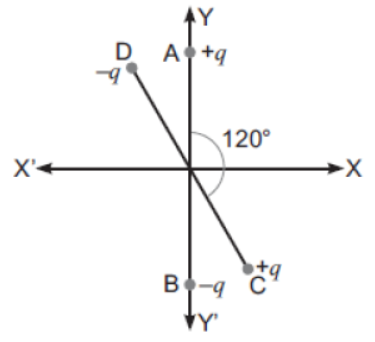
Question 22. Two small identical electrical dipoles AB and CD, each of dipole moment ‘p’ are kept at an angle of 120° as shown in the figure. What is the resultant dipole moment of this combination? If this system is subjected to electric field ( \( \vec{E} \) ) directed along + X direction, what will be the magnitude and direction of the torque acting on this?
Answer:
1. **Resultant Dipole Moment (\( p_R \)):**
The dipole moment of \( AB \) is along the \( +Y \) direction, and the dipole moment of \( CD \) is at an angle of \( 120^\circ \) to it. The magnitude of the resultant dipole moment of these two equal vectors is given by:
\[ p_R = \sqrt{p^2 + p^2 + 2p^2 \cos(120^\circ)} \]
Since \( \cos(120^\circ) = -1/2 \):
\( \implies p_R = \sqrt{2p^2 + 2p^2\left(-\frac{1}{2}\right)} \)
\( \implies p_R = \sqrt{2p^2 - p^2} = p \)
Thus, the magnitude of the resultant dipole moment is \( p \). Since the two dipole moments are equal, their resultant \( \vec{p}_R \) bisects the \( 120^\circ \) angle. Hence, the resultant makes an angle of \( 60^\circ \) with the \( +Y \) direction (or \( 30^\circ \) with the \( +X \) direction).
2. **Torque on the System (\( \tau \)):**
The electric field \( \vec{E} \) is directed along the \( +X \) direction. The angle \( \theta \) between the resultant dipole moment \( \vec{p}_R \) and the electric field \( \vec{E} \) is \( 30^\circ \).
The magnitude of the torque is:
\[ \tau = p_R E \sin(\theta) \]
\( \implies \tau = p E \sin(30^\circ) = \frac{1}{2} pE \)
The direction of this torque is perpendicular to the plane containing \( \vec{p}_R \) and \( \vec{E} \) (into the plane of the page, acting clockwise to align the resultant dipole along the electric field).
In simple words: Since the two dipoles are at 120 degrees, their combined dipole strength is just 'p', pointing at 30 degrees to the X-axis. Putting them in a horizontal electric field creates a turning force of half of 'pE' that rotates them clockwise.
Exam Tip: Use vector addition for the two dipole moments, and make sure to calculate the correct angle with the electric field (which is along the X-axis) to find the torque magnitude.
Question 23. Two uniformly large parallel thin plates having charge densities +σ and –σ are kept in the X-Z plane at a distance ‘d’ apart. Sketch an equipotential surface due to electric field between the plates. If a particle of mass m and charge ‘–q’ remains stationary between the plates, what is the magnitude and direction of this field?
Answer:
1. **Equipotential Surface:**
The electric field between two oppositely charged large parallel plates is uniform and directed perpendicular to the plates (along the \( Y \) direction). The equipotential surfaces in a uniform electric field are planes perpendicular to the field lines. Therefore, the equipotential surfaces are **planes parallel to the plates** (i.e., parallel to the \( X\text{-}Z \) plane).
2. **Magnitude and Direction of Electric Field:**
For the particle of mass \( m \) and negative charge \( -q \) to remain stationary, the upward electrostatic force must balance the downward gravitational force:
\[ F_e = F_g \]
\( \implies qE = mg \)
\( \implies E = \frac{mg}{q} \)
Since the charge is negative (\( -q \)), the electrostatic force acts in the direction opposite to the electric field. For the electrostatic force to act vertically upwards (to balance gravity), the **electric field must be directed vertically downwards** (from the positive plate to the negative plate).
In simple words: The electric field between the flat plates is uniform, so the equal-voltage surfaces are just flat planes running parallel to the plates. To keep a negative charge floating, the downward pull of gravity is balanced by an upward electrical push, requiring the electric field to point downwards.
Exam Tip: Be precise about the directions: specify that the gravitational force acts downwards, so the electrostatic force must act upwards, which dictates the downward direction of the electric field on a negative charge.
Question 24. i) A point charge (+Q) is kept in the vicinity of uncharged conducting plate. Sketch electric field lines between the charge and the plate.
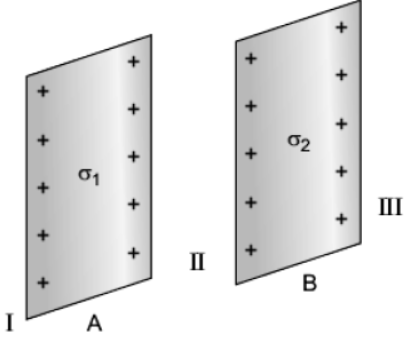
ii)Two infinitely large plane thin parallel sheets having surface charge densities σ1 and σ2 , (σ 1 > σ 2 ) are shown in the figure. Write the magnitudes and directions of the net fields in the regions marked II and III.
Answer:
(i) When a positive point charge \( +Q \) is placed near an uncharged conducting plate, it induces negative charges on the near surface of the plate. The electric field lines emerge radially from the positive charge and terminate normally (perpendicularly) on the surface of the plate:
(ii) The electric field produced by an infinite sheet of charge density \( \sigma \) is \( E = \frac{\sigma}{2\varepsilon_0} \), directed away from a positive sheet.
- **In Region II (between the sheets):**
The field \( E_1 \) due to sheet A points to the right, and the field \( E_2 \) due to sheet B points to the left. Since \( \sigma_1 > \sigma_2 \), the net field is:
\[ E_{\text{II}} = E_1 - E_2 = \frac{\sigma_1 - \sigma_2}{2\varepsilon_0} \]
The direction of the net electric field is **to the right** (from sheet A to sheet B).
- **In Region III (to the right of both sheets):**
The fields from both sheets, \( E_1 \) and \( E_2 \), point to the right. The net field is:
\[ E_{\text{III}} = E_1 + E_2 = \frac{\sigma_1 + \sigma_2}{2\varepsilon_0} \]
The direction of the net electric field is **to the right** (away from both sheets).
In simple words: Between the two sheets, their fields fight each other, so the net field is the difference between them, pointing towards the weaker sheet. To the right of both sheets, their fields work together, so they add up, pointing away from both sheets.
Exam Tip: Be sure to write the direction along with the magnitude for both regions as requested in the question.
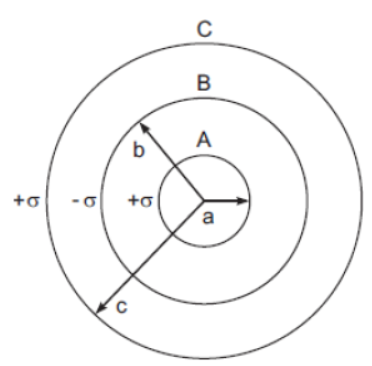
Question 25. Three concentric metallic shells A, B and C of radii a, b and c (a < b < c) have surface charge densities +σ, -σ and + σ respectively as shown in the figure.
If shells A and C are at the same potential, then obtain the relation between the radii a, b and c.
Answer:
The charges on the shells A, B, and C can be written in terms of their surface charge densities:
\( q_A = \sigma (4\pi a^2) \)
\( q_B = -\sigma (4\pi b^2) \)
\( q_C = \sigma (4\pi c^2) \)
The electric potential \( V_A \) on the surface of shell A is the sum of potentials due to shells A, B, and C:
\[ V_A = \frac{1}{4\pi\varepsilon_0} \left[ \frac{q_A}{a} + \frac{q_B}{b} + \frac{q_C}{c} \right] \]
\( \implies V_A = \frac{1}{4\pi\varepsilon_0} \left[ \frac{\sigma (4\pi a^2)}{a} - \frac{\sigma (4\pi b^2)}{b} + \frac{\sigma (4\pi c^2)}{c} \right] \]
\( \implies V_A = \frac{\sigma}{\varepsilon_0} (a - b + c) \)
Similarly, the electric potential \( V_C \) on the surface of shell C is:
\[ V_C = \frac{1}{4\pi\varepsilon_0} \left[ \frac{q_A}{c} + \frac{q_B}{c} + \frac{q_C}{c} \right] \]
\( \implies V_C = \frac{1}{4\pi\varepsilon_0 c} [ \sigma (4\pi a^2) - \sigma (4\pi b^2) + \sigma (4\pi c^2) ] \]
\( \implies V_C = \frac{\sigma}{\varepsilon_0} \left( \frac{a^2 - b^2}{c} + c \right) \)
Given that shells A and C are at the same potential (\( V_A = V_C \)):
\[ \frac{\sigma}{\varepsilon_0} (a - b + c) = \frac{\sigma}{\varepsilon_0} \left( \frac{a^2 - b^2}{c} + c \right) \]
\( \implies a - b = \frac{a^2 - b^2}{c} \)
\( \implies a - b = \frac{(a - b)(a + b)}{c} \)
Since \( a < b \), \( a - b \neq 0 \). Dividing both sides by \( a - b \):
\( \implies 1 = \frac{a + b}{c} \)
\( \implies c = a + b \)
Thus, the required relation is \( c = a + b \).
In simple words: By writing down the voltage on the innermost and outermost spheres and setting them equal, we find a beautiful rule: the radius of the outer sphere must be exactly equal to the sum of the radii of the two inner spheres.
Exam Tip: Be careful when calculating the potential on the inner shell: for any shell, the potential inside it is constant and equal to its value at its surface.
Question 26. In a type of charge configuration electric field at a point due to it is
i) independent of distance from the point
ii) inversely proportional to the distance from the point
iii) inversely proportional to the square of distance from the point
iv) inversely proportional to the cube of distance from the point
Identify the type of charge configuration in each case.
Answer:
(i) **Independent of distance:** An infinitely large plane sheet of charge (where \( E = \frac{\sigma}{2\varepsilon_0} \)).
(ii) **Inversely proportional to the distance (\( E \propto \frac{1}{r} \)):** An infinitely long straight line charge (where \( E = \frac{\lambda}{2\pi\varepsilon_0 r} \)).
(iii) **Inversely proportional to the square of the distance (\( E \propto \frac{1}{r^2} \)):** A point charge or a uniformly charged spherical shell/conductor at an external point (where \( E = \frac{q}{4\pi\varepsilon_0 r^2} \)).
(iv) **Inversely proportional to the cube of the distance (\( E \propto \frac{1}{r^3} \)):** A short electric dipole (on either its axial or equatorial plane).
In simple words: A flat sheet has a field that never fades with distance. A long wire's field fades with distance. A single point charge's field fades with the square of the distance. A dipole's field fades even faster, with the cube of the distance.
Exam Tip: Memorize how the electric field scales with distance for different shapes of charge distributions, as this is a very common conceptual board question.
Question 27. Draw or describe schematically equi potential surface for the following cases
i ) uniform electric field along z- direction
ii) an electric field that uniformly increases in magnitude but remains same in x-direction
Answer:
(i) **Uniform electric field along the Z-direction:**
The equipotential surfaces are **flat planes parallel to the X-Y plane** (perpendicular to the Z-axis). Because the electric field is uniform, these parallel planes are **equally spaced** for equal steps of potential difference.
(ii) **Electric field directed along the X-direction that uniformly increases in magnitude:**
The equipotential surfaces are **flat planes parallel to the Y-Z plane** (perpendicular to the X-axis). Since the electric field strength \( E \) increases along the X-direction, the distance \( \Delta r \) between consecutive equipotential surfaces with equal potential differences must **decrease** as we move in the direction of the increasing field (since \( E = -\frac{\Delta V}{\Delta r} \)).
In simple words: For a steady Z-field, the equal-voltage surfaces are flat sheets parallel to the floor, spaced evenly. If the field is pointing in the X-direction and getting stronger, the sheets are vertical and get crowded closer and closer together.
Exam Tip: Remember that equipotential surfaces are always perpendicular to electric field lines, and they get closer together where the electric field is stronger.
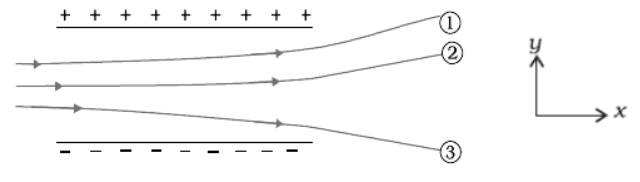
Question 28. The figure below shows tracks of three charged particles in a uniform electro static field. Give the signs of the three charges. Which particle has the highest charge to mass ratio?
Answer:
1. **Signs of the charges:**
- **Particle 1:** Negatively charged (since it is deflected upward toward the positive plate).
- **Particle 2:** Negatively charged (since it is deflected upward toward the positive plate).
- **Particle 3:** Positively charged (since it is deflected downward toward the negative plate).
2. **Highest charge-to-mass ratio (\( q/m \)):**
The vertical deflection \( y \) of a charged particle moving through a uniform electric field is given by:
\[ y = \frac{1}{2} \left( \frac{q}{m} \right) \frac{E x^2}{v^2} \]
This shows that vertical deflection is directly proportional to the charge-to-mass ratio (\( y \propto q/m \)). By observing the tracks in the diagram, **Particle 3** has the largest vertical deflection. Thus, **Particle 3** has the highest charge-to-mass ratio.
In simple words: Particles 1 and 2 are negative because they bend toward the positive plate, while 3 is positive because it bends toward the negative plate. Particle 3 bends the most, so it has the highest ratio of charge to weight.
Exam Tip: Memorize the deflection formula \( y \propto \frac{q}{m} \) as it is the standard theoretical justification required by CBSE examiners.
Question 29. In the figure shown, calculate the total electric flux of the electric field through the spheres S1 and S2. The wire AB is of linear density λ given by λ = kx, where x is the distance measured along the wire from the end A
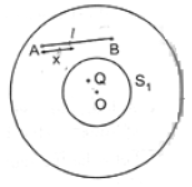
Answer:
1. **Total Charge on the Wire AB (\( q \)):**
Let the length of the wire AB be \( L \). Since the linear charge density \( \lambda \) varies along the wire as \( \lambda = kx \), we can find the total charge \( q \) by integrating this density over the entire length \( L \) of the wire:
\[ q = \int_{0}^{L} \lambda \, dx \]
\( \implies q = \int_{0}^{L} kx \, dx \)
\( \implies q = k \left[ \frac{x^2}{2} \right]_{0}^{L} = \frac{1}{2} kL^2 \)
2. **Flux through Sphere \( S_1 \) (\( \Phi_1 \)):**
The inner sphere \( S_1 \) encloses only the point charge \( Q \). Therefore, by Gauss's Law, the total electric flux through \( S_1 \) is:
\[ \Phi_1 = \frac{Q}{\varepsilon_0} \]
3. **Flux through Sphere \( S_2 \) (\( \Phi_2 \)):**
The outer sphere \( S_2 \) encloses both the point charge \( Q \) and the entire charged wire AB. Therefore, the total enclosed charge is \( Q + q \). By Gauss's Law, the total electric flux through \( S_2 \) is:
\[ \Phi_2 = \frac{Q + q}{\varepsilon_0} \]
Substituting the value of \( q \) we obtained:
\[ \Phi_2 = \frac{Q + \frac{1}{2} kL^2}{\varepsilon_0} \]
In simple words: The smaller sphere only surrounds the single point charge, so its flux is just that charge divided by \( \varepsilon_0 \). The larger sphere surrounds both the point charge and the wire, so its flux is the sum of both charges divided by \( \varepsilon_0 \).
Exam Tip: Be sure to perform the integration properly to find the total charge on the wire, and clearly state Gauss's Law for both surfaces to secure all calculation marks.
Question 30. Two concentric metallic spherical shells of radii R and 2R are given charges Q1 and Q2 respectively. The surface charge densities on the outer surfaces of the shells are equal. Determine the ratio Q1 : Q2.
Answer:
Let shell 1 be the inner shell of radius \( R \) and shell 2 be the outer shell of radius \( 2R \).
- **On the inner shell (radius \( R \default \)):**
Since it is a metallic conductor, the charge \( Q_1 \) resides entirely on its outer surface. The surface charge density \( \sigma_1 \) is:
\[ \sigma_1 = \frac{Q_1}{4\pi R^2} \]
- **On the outer shell (radius \( 2R \)):**
The charge \( Q_1 \) on the inner shell induces a charge of \( -Q_1 \) on the inner surface of the outer shell. Since the total charge given to the outer shell is \( Q_2 \), the remaining charge on its outer surface is \( Q_{\text{outer}} = Q_1 + Q_2 \). The surface charge density \( \sigma_2 \) on this outer surface is:
\[ \sigma_2 = \frac{Q_1 + Q_2}{4\pi (2R)^2} = \frac{Q_1 + Q_2}{16\pi R^2} \]
Given that the surface charge densities on the outer surfaces of both shells are equal (\( \sigma_1 = \sigma_2 \)):
\[ \frac{Q_1}{4\pi R^2} = \frac{Q_1 + Q_2}{16\pi R^2} \]
\( \implies 4Q_1 = Q_1 + Q_2 \)
\( \implies 3Q_1 = Q_2 \)
\( \implies \frac{Q_1}{Q_2} = \frac{1}{3} \)
Thus, the ratio of the charges is \( Q_1 : Q_2 = 1 : 3 \).
In simple words: The charge on the inner ball pushes some charge to the outer surface of the outer ball. Setting the surface charge densities of the outer surfaces equal shows that the outer ball must have exactly three times the charge of the inner ball.
Exam Tip: Don't forget that due to induction, the charge on the outer surface of the outer shell is the sum of the inner charge and the outer charge (\( Q_1 + Q_2 \)).
Section B: Numerical Problems
Question 1. An infinite line charge produces a field of 9 x 10⁴ N/C at a distance of 2cm. Calculate the linear charge density.
Answer:
The electric field \( E \) produced by an infinitely long straight line charge of linear charge density \( \lambda \) at a distance \( r \) is given by the formula:
\[ E = \frac{\lambda}{2\pi\varepsilon_0 r} = \frac{2k\lambda}{r} \]
where \( k = \frac{1}{4\pi\varepsilon_0} = 9 \times 10^9 \text{ N m}^2/\text{C}^2 \).
Given:
- Electric field, \( E = 9 \times 10^4 \text{ N/C} \)
- Distance, \( r = 2 \text{ cm} = 2 \times 10^{-2} \text{ m} \)
Rearranging the formula to solve for \( \lambda \):
\[ \lambda = \frac{E \cdot r}{2k} \]
Substituting the given values:
\( \implies \lambda = \frac{(9 \times 10^4 \text{ N/C}) \cdot (2 \times 10^{-2} \text{ m})}{2 \cdot (9 \times 10^9 \text{ N m}^2/\text{C}^2)} \)
\( \implies \lambda = \frac{1.8 \times 10^3}{1.8 \times 10^{10}} \)
\( \implies \lambda = 10^{-7} \text{ C/m} \)
Thus, the linear charge density is \( 10^{-7} \text{ C/m} \) (or \( 0.1 \text{ }\mu\text{C/m} \)).
In simple words: Using the formula for a charged line, we find that the charge spread out along each meter of the wire is \( 0.1 \text{ }\mu\text{C} \).
Exam Tip: Be sure to convert the distance from centimeters to meters before using it in the formula, as using SI units is necessary to get the correct answer.
Question 2. Four point charges qA = 2 μC, qB = –5 μC, qC = 2 μC, and qD = –5 μC are located at the corners of a square ABCD of side 10 cm. What is the force on a charge of 1 μC placed at the centre of the square?
Answer:
Let \( O \) be the center of the square ABCD. The distance of the center \( O \) from each of the four corners is equal, i.e., \( OA = OB = OC = OD = d \). Let a test charge of \( q_0 = 1 \text{ }\mu\text{C} \) be placed at the center \( O \).
- **Forces along diagonal AC:**
The charge at corner A (\( q_A = 2 \text{ }\mu\text{C} \)) repels the charge \( q_0 \) with a force \( \vec{F}_A \) directed along \( OC \).
The charge at corner C (\( q_C = 2 \text{ }\mu\text{C} \)) repels the charge \( q_0 \) with a force \( \vec{F}_C \) directed along \( OA \).
Since the magnitudes of the charges at A and C are equal and they are at equal distances from the center, the forces are equal in magnitude (\( F_A = F_C \)) and opposite in direction. Hence, they cancel each other out:
\[ \vec{F}_A + \vec{F}_C = 0 \]
- **Forces along diagonal BD:**
The charge at corner B (\( q_B = -5 \text{ }\mu\text{C} \)) attracts the charge \( q_0 \) with a force \( \vec{F}_B \) directed along \( OB \).
The charge at corner D (\( q_D = -5 \text{ }\mu\text{C} \)) attracts the charge \( q_0 \) with a force \( \vec{F}_D \) directed along \( OD \).
Since the magnitudes of the charges at B and D are equal and they are at equal distances from the center, the forces are equal in magnitude (\( F_B = F_D \)) and opposite in direction. Hence, they cancel each other out:
\[ \vec{F}_B + \vec{F}_D = 0 \]
Summing the forces, the net electrostatic force on the \( 1 \text{ }\mu\text{C} \) charge at the center of the square is **zero** (\( \vec{F}_{\text{net}} = 0 \)).
In simple words: The charges on opposite corners are identical, so they push or pull the center charge with equal strength in opposite directions. Because all these pulls and pushes perfectly cancel each other out, the net force is zero.
Exam Tip: Clearly state that the forces along the diagonals are equal and opposite, and draw a quick mental or physical vector diagram to verify the cancellation of all forces.
Question 3. Three small identical conducting spheres have charges –3 × 10⁻¹²C, 8 × 10⁻¹²C and 4 × 10⁻¹²C respectively. They are brought in contact and then separated. Calculate (i) charge on each sphere after separation (ii) number of electrons in excess or deficit on each sphere after separation .
Answer:
(i) **Charge on each sphere after separation:**
Since the three conducting spheres are identical, when they are brought into contact, the total charge distributes itself equally among them. The total charge of the system is:
\[ Q_{\text{total}} = q_1 + q_2 + q_3 \]
\( \implies Q_{\text{total}} = (-3 \times 10^{-12} \text{ C}) + (8 \times 10^{-12} \text{ C}) + (4 \times 10^{-12} \text{ C}) = 9 \times 10^{-12} \text{ C} \)
When separated, each sphere gets an equal share of this total charge:
\[ q' = \frac{Q_{\text{total}}}{3} = \frac{9 \times 10^{-12} \text{ C}}{3} = 3 \times 10^{-12} \text{ C} \]
(ii) **Number of electrons in excess or deficit:**
Since the final charge on each sphere is positive, there is a **deficit** of electrons. According to the quantization of charge:
\[ q' = n \cdot e \]
where \( e = 1.6 \times 10^{-19} \text{ C} \) is the elementary charge. Solving for the number of electrons \( n \):
\( \implies n = \frac{q'}{e} \)
\( \implies n = \frac{3 \times 10^{-12} \text{ C}}{1.6 \times 10^{-19} \text{ C}} = 1.875 \times 10^7 \)
Thus, there is a deficit of \( 1.875 \times 10^7 \) electrons on each sphere.
In simple words: When the spheres touch, the total charge of \( 9 \times 10^{-12} \text{ C} \) splits evenly, leaving \( 3 \times 10^{-12} \text{ C} \) on each. Because this charge is positive, each sphere is missing about \( 1.875 \times 10^7 \) electrons.
Exam Tip: Be sure to specify both the numerical value of the electrons and whether they are in "excess" or "deficit" (since the charge is positive, it is always a deficit).
Question 4. Figure below shows situations in which four charged particles are evenly spaced to the left and right of a central point. The charge values are indicated. Rank the situations according to the magnitude of the net electric field at the central, point, Increasing order.
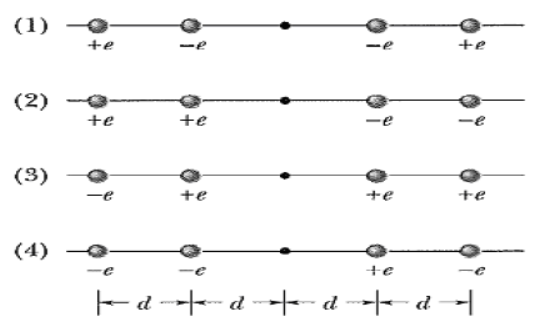
Answer:
Let \( E_0 = \frac{e}{4\pi\varepsilon_0 d^2} \) be the magnitude of the electric field at the center due to a charge of magnitude \( e \) placed at a distance \( d \). The field due to a charge at distance \( 2d \) is \( \frac{E_0}{4} \). Let us define the positive direction to be to the right (\( +\hat{i} \)).
- **Situation (1) (charges: \( +e \) at \( -2d \), \( -e \) at \( -d \), \( -e \) at \( d \), \( +e \) at \( 2d \)):**
\[ \vec{E}_1 = \left( \frac{1}{4} E_0 - E_0 + E_0 - \frac{1}{4} E_0 \right) \hat{i} = 0 \]
Magnitude = \( 0 \)
- **Situation (2) (charges: \( +e \) at \( -2d \), \( +e \) at \( -d \), \( -e \) at \( d \), \( -e \) at \( 2d \)):**
\[ \vec{E}_2 = \left( \frac{1}{4} E_0 + E_0 + E_0 + \frac{1}{4} E_0 \right) \hat{i} = 2.5 E_0 \hat{i} \]
Magnitude = \( 2.5 E_0 \)
- **Situation (3) (charges: \( -e \) at \( -2d \), \( +e \) at \( -d \), \( +e \) at \( d \), \( +e \) at \( 2d \)):**
\[ \vec{E}_3 = \left( -\frac{1}{4} E_0 + E_0 - E_0 - \frac{1}{4} E_0 \right) \hat{i} = -0.5 E_0 \hat{i} \]
Magnitude = \( 0.5 E_0 \)
- **Situation (4) (charges: \( -e \) at \( -2d \), \( -e \) at \( -d \), \( +e \) at \( d \), \( -e \) at \( 2d \)):**
\[ \vec{E}_4 = \left( -\frac{1}{4} E_0 - E_0 - E_0 + \frac{1}{4} E_0 \right) \hat{i} = -2 E_0 \hat{i} \]
Magnitude = \( 2 E_0 \)
Ranking the situations in increasing order of the magnitude of their net electric field:
\[ (1) < (3) < (4) < (2) \]
In simple words: By calculating how each charge pushes or pulls at the center point, we find that case 1 cancels out completely to zero. Case 3 has a weak field of 0.5, case 4 has a field of 2, and case 2 has the strongest field of 2.5.
Exam Tip: Pay close attention to the direction of the fields: a positive charge pushes away from itself, while a negative charge pulls toward itself. Sum these vector components carefully.
Question 5. A hollow conducting sphere of radius 8cm is given a charge 16µC.What is the electric field intensity i) at the centre of the sphere ii) on the outer surface of the sphere and iii) at a distance of 16cm from the centre of the sphere?
Answer:
Given:
- Radius of the hollow conducting sphere, \( R = 8 \text{ cm} = 0.08 \text{ m} \)
- Charge on the sphere, \( q = 16 \text{ }\mu\text{C} = 16 \times 10^{-6} \text{ C} \)
- Electrostatic constant, \( k = \frac{1}{4\pi\varepsilon_0} = 9 \times 10^9 \text{ N m}^2/\text{C}^2 \)
(i) **At the center of the sphere:**
The electric field inside a hollow charged conducting sphere is always zero because the excess charge resides entirely on the outer surface. Therefore:
\[ E = 0 \]
(ii) **On the outer surface of the sphere (\( r = R = 0.08 \text{ m} \)):**
The electric field on the surface is:
\[ E = \frac{k q}{R^2} \]
Substituting the values:
\( \implies E = \frac{(9 \times 10^9 \text{ N m}^2/\text{C}^2) \cdot (16 \times 10^{-6} \text{ C})}{(0.08 \text{ m})^2} \)
\( \implies E = \frac{1.44 \times 10^5}{6.4 \times 10^{-3}} = 2.25 \times 10^7 \text{ N/C} \)
(iii) **At a distance of 16 cm from the center (\( r = 16 \text{ cm} = 0.16 \text{ m} \)):**
Since the point is outside the sphere, we can treat the entire charge as if it were concentrated at the center:
\[ E = \frac{k q}{r^2} \]
Substituting the values:
\( \implies E = \frac{(9 \times 10^9 \text{ N m}^2/\text{C}^2) \cdot (16 \times 10^{-6} \text{ C})}{(0.16 \text{ m})^2} \)
\( \implies E = \frac{1.44 \times 10^5}{2.56 \times 10^{-2}} = 5.625 \times 10^6 \text{ N/C} \)
In simple words: The field inside the sphere is zero. On the surface, it is a very strong \( 2.25 \times 10^7 \text{ N/C} \), and at twice the distance (16 cm), the field drops to one-fourth of that value, which is \( 5.625 \times 10^6 \text{ N/C} \).
Exam Tip: Ensure that you state that the field inside is zero and show that the outside field decreases with the square of the distance.
Question 6. Four charges of -2q, q, -q and 2q are at the corners of a square ABCD ,of side 20cm, find the magnitude and the direction of the electric field at the centre of the square. Take q = 5 μC
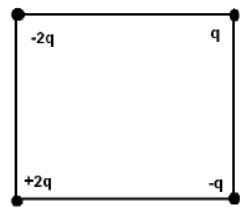
Answer:
Let the square be ABCD with side \( a = 20 \text{ cm} = 0.2 \text{ m} \). The charges are located at the corners:
- A (top-left): \( -2q \)
- B (top-right): \( +q \)
- C (bottom-right): \( -q \)
- D (bottom-left): \( +2q \)
The distance \( d \) of each corner from the center \( O \) is half of the diagonal:
\[ d = \frac{a}{\sqrt{2}} = \frac{0.2}{\sqrt{2}} = 0.1\sqrt{2} \text{ m} \]
\[ d^2 = (0.1\sqrt{2})^2 = 0.02 \text{ m}^2 \]
- **Field along diagonal AC:**
The field due to \( -2q \) at A points towards A: \( E_A = \frac{2kq}{d^2} \).
The field due to \( -q \) at C points towards C: \( E_C = \frac{kq}{d^2} \).
The net field along this diagonal is:
\( \implies E_{AC} = E_A - E_C = \frac{kq}{d^2} \text{ (pointing towards A)} \)
- **Field along diagonal DB:**
The field due to \( +2q \) at D points away from D (towards B): \( E_D = \frac{2kq}{d^2} \).
The field due to \( +q \) at B points away from B (towards D): \( E_B = \frac{kq}{d^2} \).
The net field along this diagonal is:
\( \implies E_{DB} = E_D - E_B = \frac{kq}{d^2} \text{ (pointing towards B)} \)
Since the diagonals of a square are perpendicular, the angle between \( \vec{E}_{AC} \) and \( \vec{E}_{DB} \) is \( 90^\circ \). The magnitude of the resultant electric field is:
\[ E_{\text{net}} = \sqrt{E_{AC}^2 + E_{DB}^2} = \sqrt{2} \frac{kq}{d^2} \]
Substituting the given values (\( q = 5 \times 10^{-6} \text{ C} \), \( k = 9 \times 10^9 \text{ N m}^2/\text{C}^2 \)):
\( \implies \frac{kq}{d^2} = \frac{(9 \times 10^9) \cdot (5 \times 10^{-6})}{0.02} = 2.25 \times 10^6 \text{ N/C} \)
\( \implies E_{\text{net}} = \sqrt{2} \cdot (2.25 \times 10^6 \text{ N/C}) \approx 3.18 \times 10^6 \text{ N/C} \)
**Direction:**
Since \( E_{AC} \) and \( E_{DB} \) are equal in magnitude, the net electric field bisects the angle between \( OA \) and \( OB \). This direction is **vertically upwards** (perpendicular to the top side AB).
In simple words: The fields along the diagonals combine to leave two equal vectors pointing toward A and B. Their combined effect points straight up, with a total strength of about \( 3.18 \times 10^6 \text{ N/C} \).
Exam Tip: Calculating the distance to the center correctly as \( \frac{a}{\sqrt{2}} \) and using vector addition for the perpendicular fields is crucial to avoid calculation errors.
Question 7. A point charge causes an electric flux of – 1.0 x 10³ Nm2 /C to pass through a spherical Gaussian surface of 10.0 cm radius with the charge at the centre. What is the value of point charge?
If the radius of the Gaussian surface were doubled, how much flux would pass through the surface?
Answer:
1. **Value of the Point Charge (\( q \)):**
According to Gauss's Law, the net electric flux \( \Phi \) through a closed surface is given by:
\[ \Phi = \frac{q}{\varepsilon_0} \]
Solving for the charge \( q \):
\[ q = \Phi \cdot \varepsilon_0 \]
Substituting the given values (\( \Phi = -1.0 \times 10^3 \text{ N m}^2/\text{C} \), \( \varepsilon_0 = 8.854 \times 10^{-12} \text{ C}^2/\text{N m}^2 \)):
\( \implies q = (-1.0 \times 10^3 \text{ N m}^2/\text{C}) \cdot (8.854 \times 10^{-12} \text{ C}^2/\text{N m}^2) \)
\( \implies q = -8.854 \times 10^{-9} \text{ C} = -8.85 \text{ nC} \)
2. **Flux when the radius is doubled:**
The electric flux through a closed surface depends only on the net charge enclosed inside it. It is completely independent of the shape and size (such as radius) of the Gaussian surface. Therefore, if the radius is doubled, the electric flux remains **unchanged**, i.e., \( -1.0 \times 10^3 \text{ N m}^2/\text{C} \).
In simple words: The charge at the center is about \( -8.85 \text{ nC} \). Since flux only depends on the charge inside, making the boundary twice as large doesn't change the amount of charge enclosed, so the flux stays the same.
Exam Tip: Remember to use the value of \( \varepsilon_0 = 8.854 \times 10^{-12} \text{ C}^2/\text{N m}^2 \) and state clearly that flux does not depend on the radius of the enclosing surface.
Question 8. Figure shows three point charges, +2q, -q and +3q. Two charges +2q and -q are enclosed within a surface ‘S’. What is the electric flux due to this configuration through the surface ‘S’?
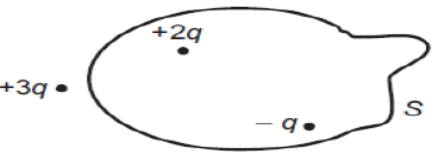
Answer: According to Gauss's Law, the total electric flux \( \Phi \) through any closed surface is determined solely by the net charge enclosed within that surface. The charge \( +3q \) lies outside the surface 'S' and therefore does not contribute to the net flux through it.
The net charge enclosed within 'S' is:
\[ Q_{\text{enclosed}} = +2q + (-q) = q \]
The electric flux \( \Phi \) through the surface 'S' is:
\[ \Phi = \frac{q}{\varepsilon_0} \]
In simple words: Only the charges inside the surface matter for calculating the flux. Adding \( +2q \) and \( -q \) gives a net charge of \( q \), so the flux is \( \frac{q}{\varepsilon_0} \). The charge outside is ignored.
Exam Tip: Be sure to explicitly state that the outside charge \( +3q \) has no contribution to the net flux, which shows a solid understanding of Gauss's Law.
Question 9. Name the charge configuration for which electric field at distances 1cm ,2cm, 3cm are in the ratio%
a) 1: 1/8 : 1/27
b) 1: 1/4 : 1/9
Answer:
(a) The ratio \( 1 : \frac{1}{8} : \frac{1}{27} \) can be written as \( \frac{1}{1^3} : \frac{1}{2^3} : \frac{1}{3^3} \). This indicates that the electric field is inversely proportional to the cube of the distance (\( E \propto \frac{1}{r^3} \)). This charge configuration is an **electric dipole** (or short dipole).
(b) The ratio \( 1 : \frac{1}{4} : \frac{1}{9} \) can be written as \( \frac{1}{1^2} : \frac{1}{2^2} : \frac{1}{3^2} \). This indicates that the electric field is inversely proportional to the square of the distance (\( E \propto \frac{1}{r^2} \)). This charge configuration is a **point charge** (or a uniformly charged spherical conductor at external points).
In simple words: (a) corresponds to a dipole because its field fades very quickly with the cube of the distance. (b) corresponds to a single point charge because its field obeys the standard inverse-square law.
Exam Tip: Recognizing power-law relationships from numerical ratios (cube for dipole, square for point charge) is a quick way to identify physical configurations.
Question 10. The electric field lines on the left have twice the separation of those on the right. If the magnitude of the field at A is 40N/C , calculate i) the magnitude of the forcce on a proton at A .ii) the magnitude of field at B.
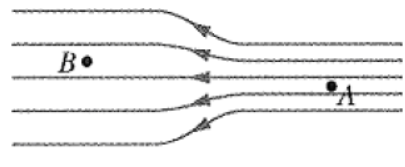
Answer:
(i) **Magnitude of the force on a proton at A (\( F_A \)):**
The electrostatic force \( F \) on a charge \( q \) in an electric field \( E \) is given by:
\[ F = q \cdot E \]
For a proton, \( q = e = 1.6 \times 10^{-19} \text{ C} \). Given \( E_A = 40 \text{ N/C} \):
\( \implies F_A = (1.6 \times 10^{-19} \text{ C}) \cdot (40 \text{ N/C}) \)
\( \implies F_A = 6.4 \times 10^{-18} \text{ N} \)
(ii) **Magnitude of the field at B (\( E_B \)):**
The strength of the electric field is inversely proportional to the separation between the electric field lines. Since the separation between the lines on the left (at B) is twice the separation on the right (at A), the electric field strength at B is half of that at A:
\[ E_B = \frac{E_A}{2} \]
Given \( E_A = 40 \text{ N/C} \):
\( \implies E_B = \frac{40 \text{ N/C}}{2} = 20 \text{ N/C} \)
In simple words: The force on a proton at point A is \( 6.4 \times 10^{-18} \text{ N} \). Since the lines at B are twice as far apart as those at A, the electric field at B is half as strong, which is \( 20 \text{ N/C} \).
Exam Tip: Remember that line density represents field strength; wider spacing directly corresponds to a weaker electric field in that region.
Question 11. Two tiny spheres , each having mass m kg and charge q coulomb are suspended from a point by insulating threads each of l metre length but negligible mass .when the system is in equilibrium, each string makes an angle θ with the vertical as shown in the figure. Prove that q2 = 16mgl2(sin2θtanθ)πε0
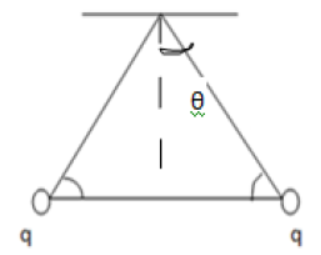
Answer:
Let each sphere carry a mass \( m \) and a charge \( q \), suspended by a thread of length \( l \). In the equilibrium state, the forces acting on each sphere are:
1. Gravitational force \( mg \) acting vertically downwards.
2. Repulsive electrostatic force \( F_e \) acting horizontally outwards.
3. Tension \( T \) in the string acting along the thread towards the suspension point.
Resolving the tension \( T \) into vertical and horizontal components:
- **Vertically:**
\[ T \cos(\theta) = mg \quad \text{--- (Equation 1)} \]
- **Horizontally:**
\[ T \sin(\theta) = F_e \quad \text{--- (Equation 2)} \]
Dividing Equation 2 by Equation 1 gives:
\[ \tan(\theta) = \frac{F_e}{mg} \]
\( \implies F_e = mg \tan(\theta) \quad \text{--- (Equation 3)} \)
From the geometry of the suspension, the horizontal distance of each sphere from the vertical line of symmetry is \( l \sin(\theta) \). Therefore, the total separation distance \( r \) between the two charged spheres is:
\[ r = 2l \sin(\theta) \]
According to Coulomb's Law, the electrostatic force \( F_e \) between the spheres is:
\[ F_e = \frac{1}{4\pi\varepsilon_0} \frac{q^2}{r^2} \]
Substituting the value of \( r \):
\( \implies F_e = \frac{1}{4\pi\varepsilon_0} \frac{q^2}{(2l \sin(\theta))^2} = \frac{q^2}{16\pi\varepsilon_0 l^2 \sin^2(\theta)} \)
Now, equating the expression for \( F_e \) to Equation 3:
\[ \frac{q^2}{16\pi\varepsilon_0 l^2 \sin^2(\theta)} = mg \tan(\theta) \]
Solving for \( q^2 \):
\( \implies q^2 = 16\pi\varepsilon_0 mgl^2 \sin^2(\theta) \tan(\theta) \)
Rearranging to match the required format:
\[ q^2 = 16mgl^2(\sin^2(\theta) \tan(\theta))\pi\varepsilon_0 \]
Hence Proved.
In simple words: By balancing the gravitational pull downwards, the tension along the string, and the electrical repulsion pushing the spheres apart, we can solve for the charge and prove this exact mathematical relation.
Exam Tip: Drawing the free-body diagram showing all three force components (\( T \default \), \( mg \), and \( F_e \)) is essential to get full marks for this derivation.
Question 12. A charge of magnitude Q is divided into two parts q and ( Q-q) such that the two parts exert maximum force on each other. Calculate the ratio Q/q
Answer:
Let the two parts of the charge be \( q \) and \( Q - q \). The electrostatic force \( F \) between them placed at a distance \( r \) is given by Coulomb's Law:
\[ F = \frac{1}{4\pi\varepsilon_0} \frac{q(Q-q)}{r^2} \]
For the force \( F \) to be maximum, its derivative with respect to \( q \) must equal zero (\( \frac{dF}{dq} = 0 \)):
\[ \frac{d}{dq} \left[ q(Q-q) \right] = 0 \]
\( \implies \frac{d}{dq} (Qq - q^2) = 0 \)
\( \implies Q - 2q = 0 \)
\( \implies Q = 2q \)
\( \implies \frac{Q}{q} = 2 \)
Thus, the required ratio is \( Q/q = 2 \).
In simple words: To get the strongest possible repulsion between two parts of a divided charge, you must split the charge exactly in half. This means the total charge is twice the size of one part.
Exam Tip: Be sure to write the derivative condition \( \frac{dF}{dq} = 0 \) as it is the mathematical basis for finding the maximum force.
Question 13. An infinite number of charges each of magnitude q ,but consecutive charges of opposite sign are placed along the X –axis at X = 1, 2,4,8 m …..Determine the intensity of electric field at X = 0 due to these charges.
Answer:
The electric field at \( x = 0 \) is the vector sum of fields produced by all the charges. Let the positive direction be along the positive X-axis. A positive charge at a positive coordinate produces an electric field pointing to the left (\( -\hat{i} \)), and a negative charge produces a field pointing to the right (\( +\hat{i} \)).
Summing the field components:
\[ E_{\text{net}} = k q \left[ \frac{1}{1^2} - \frac{1}{2^2} + \frac{1}{4^2} - \frac{1}{8^2} + \dots \right] \]
\( \implies E_{\text{net}} = k q \left[ 1 - \frac{1}{4} + \frac{1}{16} - \frac{1}{64} + \dots \right] \]
The series in the brackets is an infinite geometric progression (G.P.) with the first term \( a = 1 \) and the common ratio \( r = -\frac{1}{4} \).
The sum of an infinite G.P. is:
\[ S_\infty = \frac{a}{1 - r} = \frac{1}{1 - \left(-\frac{1}{4}\right)} = \frac{4}{5} \]
Substituting the sum back into the electric field equation:
\[ E_{\text{net}} = \frac{4}{5} k q \]
Since \( k = \frac{1}{4\pi\varepsilon_0} \):
\( \implies E_{\text{net}} = \frac{4q}{5(4\pi\varepsilon_0)} = \frac{q}{5\pi\varepsilon_0} \)
The direction of this net electric field is along the negative X-direction.
In simple words: By writing down the field of each charge and summing them as an alternating infinite geometric series, we find that the total electric field is exactly \( \frac{q}{5\pi\varepsilon_0} \).
Exam Tip: Be careful with the signs: since consecutive charges have opposite signs, their contributions alternate in direction, leading to an alternating G.P. series.
Question 14. A free pith ball of mass 8g carries a positive charge of 5 x 10⁻⁸ C. What must be the nature and the magnitude of charge that should be given to a second pith ball fixed 5cm vertically below the first pith ball so that the upper ball is stationary.
Answer:
For the upper pith ball to remain stationary, the downward force of gravity must be perfectly balanced by an upward electrostatic force. Since the second ball is located vertically below the first ball, this electrostatic force must be repulsive (pushing the upper ball upwards). Because the upper ball has a positive charge, the second ball must also have a **positive charge**.
Let us calculate the magnitude of the charge \( q_2 \):
\[ F_e = mg \]
\[ \frac{k q_1 q_2}{r^2} = mg \]
Solving for \( q_2 \):
\[ q_2 = \frac{m g r^2}{k q_1} \]
Given:
- Mass, \( m = 8 \text{ g} = 8 \times 10^{-3} \text{ kg} \)
- Charge on upper ball, \( q_1 = 5 \times 10^{-8} \text{ C} \)
- Distance, \( r = 5 \text{ cm} = 0.05 \text{ m} \)
- Acceleration due to gravity, \( g \approx 9.8 \text{ m/s}^2 \)
- Electrostatic constant, \( k = 9 \times 10^9 \text{ N m}^2/\text{C}^2 \)
Substituting these values:
\( \implies q_2 = \frac{(8 \times 10^{-3} \text{ kg}) \cdot (9.8 \text{ m/s}^2) \cdot (0.05 \text{ m})^2}{(9 \times 10^9 \text{ N m}^2/\text{C}^2) \cdot (5 \times 10^{-8} \text{ C})} \)
\( \implies q_2 = \frac{1.96 \times 10^{-4}}{450} \approx 4.36 \times 10^{-7} \text{ C} \)
Thus, the second pith ball must have a positive charge of magnitude \( 4.36 \times 10^{-7} \text{ C} \).
In simple words: The lower ball must push the upper ball up to counter its weight. This requires a positive charge (since like charges repel) with a strength of \( 4.36 \times 10^{-7} \text{ C} \).
Exam Tip: State the nature of the charge (positive) explicitly before showing the calculation to earn full conceptual credit.
Question 15. i) An electric dipole of two opposite charges of same magnitude 2µC separated by 4cm , is placed in an electric field of 3 x10 4 V/m ,at an angle of 30◦ .Calculate the torque experienced by it.
ii) An electric dipole with dipole moment 4 × 10⁻⁹ C m is aligned at 30° with the direction of a uniform electric field of magnitude 5 × 10⁴ NC–1 . Calculate the magnitude of the torque acting on the dipole.
Answer:
The torque \( \tau \) experienced by an electric dipole in a uniform electric field is given by the formula:
\[ \tau = p E \sin(\theta) \]
(i) **For the first dipole:**
- Charge, \( q = 2 \text{ }\mu\text{C} = 2 \times 10^{-6} \text{ C} \)
- Separation, \( 2a = 4 \text{ cm} = 0.04 \text{ m} \)
- Dipole moment, \( p = q \cdot 2a = (2 \times 10^{-6} \text{ C}) \cdot (0.04 \text{ m}) = 8 \times 10^{-8} \text{ C m} \)
- Electric field, \( E = 3 \times 10^4 \text{ V/m} \)
- Angle, \( \theta = 30^\circ \)
Calculating torque:
\( \implies \tau = (8 \times 10^{-8} \text{ C m}) \cdot (3 \times 10^4 \text{ V/m}) \cdot \sin(30^\circ) \)
\( \implies \tau = (2.4 \times 10^{-3}) \cdot 0.5 = 1.2 \times 10^{-3} \text{ N m} \)
(ii) **For the second dipole:**
- Dipole moment, \( p = 4 \times 10^{-9} \text{ C m} \)
- Electric field, \( E = 5 \times 10^4 \text{ N/C} \)
- Angle, \( \theta = 30^\circ \)
Calculating torque:
\( \implies \tau = (4 \times 10^{-9} \text{ C m}) \cdot (5 \times 10^4 \text{ N/C}) \cdot \sin(30^\circ) \)
\( \implies \tau = (2 \times 10^{-4}) \cdot 0.5 = 10^{-4} \text{ N m} \)
In simple words: (i) The first dipole experiences a torque of \( 1.2 \times 10^{-3} \text{ N m} \). (ii) The second dipole experiences a torque of \( 10^{-4} \text{ N m} \).
Exam Tip: Remember to calculate the dipole moment first using \( p = q(2a) \) if the charge and separation are given, and always include the unit (\( \text{N m} \)) in your final answers.
Question 16. Two point charges +9e and +1e are kept at a distance of 16 cm from each other. At what point between these charges, should a third charge q to be placed so that it remains in equilibrium?
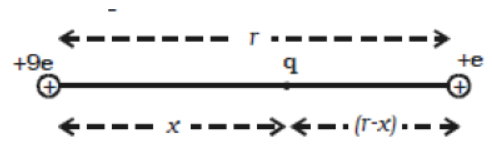
Answer:
Let the third charge \( q \) be placed at a distance \( x \) (in cm) from the charge \( +9e \). The distance of \( q \) from the other charge \( +1e \) will then be \( (16 - x) \) cm.
For the charge \( q \) to be in static equilibrium, the electrostatic forces acting on it due to both charges must be equal in magnitude:
\[ F_{1} = F_{2} \]
\[ \frac{k (9e) q}{x^2} = \frac{k (1e) q}{(16 - x)^2} \]
Canceling \( k \), \( e \), and \( q \) from both sides:
\( \implies \frac{9}{x^2} = \frac{1}{(16 - x)^2} \)
Taking the square root on both sides:
\( \implies \frac{3}{x} = \frac{1}{16 - x} \)
\( \implies 3(16 - x) = x \)
\( \implies 48 - 3x = x \)
\( \implies 4x = 48 \)
\( \implies x = 12 \text{ cm} \)
Therefore, the third charge \( q \) should be placed at a distance of **12 cm from the \( +9e \) charge** (which is 4 cm from the \( +1e \) charge).
In simple words: The larger charge is 9 times stronger than the smaller one, so the third charge must be placed further away from it. By solving the balance equation, we find it should be 12 cm away from the stronger charge.
Exam Tip: Taking the square root of both sides rather than expanding the quadratic equation makes solving the distance very quick and error-free.
Question 17. A pendulum bob of mass 80 mg , carrying a charge of 2 x10⁻⁸ C is at rest in a horizontal uniform electric field of 2 x 10⁴ V/m as shown in the figure. Calculate the tension in the thread of the pendulum and the angle θ it makes with the vertical.
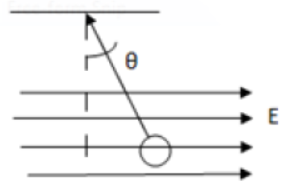
Answer:
Let \( T \) be the tension in the thread. The bob is in equilibrium under the action of three forces:
1. Gravitational force \( mg \) acting vertically downwards.
2. Electrostatic force \( F_e = qE \) acting horizontally.
3. Tension \( T \) resolved into \( T \cos(\theta) \) vertically upwards and \( T \sin(\theta) \) horizontally inwards.
Therefore, we have:
\[ T \cos(\theta) = mg \quad \text{--- (Equation 1)} \]
\[ T \sin(\theta) = qE \quad \text{--- (Equation 2)} \]
Given:
- Mass, \( m = 80 \text{ mg} = 8 \times 10^{-5} \text{ kg} \)
- Charge, \( q = 2 \times 10^{-8} \text{ C} \)
- Electric field, \( E = 2 \times 10^4 \text{ V/m} \)
- Acceleration due to gravity, \( g \approx 9.8 \text{ m/s}^2 \)
Calculating the force values:
- \( mg = (8 \times 10^{-5} \text{ kg}) \cdot (9.8 \text{ m/s}^2) = 7.84 \times 10^{-4} \text{ N} \)
- \( qE = (2 \times 10^{-8} \text{ C}) \cdot (2 \times 10^4 \text{ V/m}) = 4 \times 10^{-4} \text{ N} \)
1. **To find the angle \( \theta \):**
Dividing Equation 2 by Equation 1:
\[ \tan(\theta) = \frac{qE}{mg} \ ]
\( \implies \tan(\theta) = \frac{4 \times 10^{-4} \text{ N}}{7.84 \times 10^{-4} \text{ N}} \approx 0.51 \)
\( \implies \theta = \tan^{-1}(0.51) \approx 27^\circ \)
2. **To find the tension \( T \):**
Squaring and adding Equation 1 and Equation 2:
\[ T = \sqrt{(mg)^2 + (qE)^2} \]
\( \implies T = \sqrt{(7.84 \times 10^{-4})^2 + (4 \times 10^{-4})^2} \)
\( \implies T = \sqrt{61.47 \times 10^{-8} + 16 \times 10^{-8}} \)
\( \implies T = \sqrt{77.47 \times 10^{-8}} \approx 8.8 \times 10^{-4} \text{ N} \)
In simple words: The electrical force pulls the bob sideways with a force of \( 4 \times 10^{-4} \text{ N} \), while gravity pulls it down. This tilts the thread by an angle of about \( 27^\circ \), creating a tension of \( 8.8 \times 10^{-4} \text{ N} \) in the thread.
Exam Tip: Be sure to write the formula relating tension to the components \( T = \sqrt{(mg)^2 + (qE)^2} \) and perform the math carefully with SI units.
Question 18. Two identical spheres , each of mass 0.1 x 10⁻³ kg ,carry identical charges and are suspended by two threads of equal length. At equilibrium, they position themselves as shown in the figure. Calculate the charge on each of them .
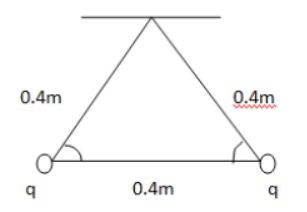
Answer:
From the given figure, the two threads and the line joining the two bobs form an equilateral triangle of side length \( 0.4 \text{ m} \). Thus, the angle between the two threads is \( 60^\circ \), which means each thread makes an angle of \( \theta = 30^\circ \) with the vertical.
At equilibrium, the forces on each sphere satisfy the relation:
\[ F_e = mg \tan(\theta) \]
\[ \frac{k q^2}{r^2} = mg \tan(\theta) \]
Solving for \( q \):
\[ q = r \sqrt{\frac{mg \tan(\theta)}{k}} \]
Given:
- Mass of each sphere, \( m = 0.1 \times 10^{-3} \text{ kg} = 10^{-4} \text{ kg} \)
- Separation distance, \( r = 0.4 \text{ m} \)
- Angle with vertical, \( \theta = 30^\circ \)
- Electrostatic constant, \( k = 9 \times 10^9 \text{ N m}^2/\text{C}^2 \)
- Acceleration due to gravity, \( g \approx 9.8 \text{ m/s}^2 \)
Substituting the values:
\( \implies q = 0.4 \cdot \sqrt{\frac{(10^{-4} \text{ kg}) \cdot (9.8 \text{ m/s}^2) \cdot \tan(30^\circ)}{9 \times 10^9 \text{ N m}^2/\text{C}^2}} \)
\( \implies q = 0.4 \cdot \sqrt{\frac{10^{-4} \cdot 9.8 \cdot 0.577}{9 \times 10^9}} \)
\( \implies q = 0.4 \cdot \sqrt{\frac{5.65 \times 10^{-4}}{9 \times 10^9}} \)
\( \implies q = 0.4 \cdot \sqrt{6.28 \times 10^{-14}} \)
\( \implies q \approx 0.4 \cdot (2.5 \times 10^{-7} \text{ C}) = 1.0 \times 10^{-7} \text{ C} \)
Thus, the charge on each sphere is \( 1.0 \times 10^{-7} \text{ C} \) (or \( 0.1 \text{ }\mu\text{C} \default \)).
In simple words: The geometry shows that the strings form an equilateral triangle, so each string hangs at 30 degrees to the vertical. Balancing the electrical repulsion against gravity tells us that each sphere has a charge of exactly \( 1.0 \times 10^{-7} \text{ C} \).
Exam Tip: Recognizing that the suspension geometry forms an equilateral triangle is the key to identifying the angle \( \theta = 30^\circ \) correctly.
Question 19. Two electric charges of q and 4q are placed at a distance of 6a apart on a horizontal plane . Find the point on the line joining them where the resultant electric field is zero.
Answer:
Since both charges are positive, the point where the net electric field is zero (the neutral point) must lie between them on the line joining them. Let this point be at a distance \( x \) from the charge \( q \). Its distance from the charge \( 4q \) will be \( (6a - x) \).
At this point, the magnitudes of the electric fields due to both charges must be equal:
\[ E_{1} = E_{2} \]
\[ \frac{k q}{x^2} = \frac{k (4q)}{(6a - x)^2} \]
Canceling \( k \) and \( q \) from both sides:
\( \implies \frac{1}{x^2} = \frac{4}{(6a - x)^2} \)
Taking the square root on both sides:
\( \implies \frac{1}{x} = \frac{2}{6a - x} \)
\( \implies 6a - x = 2x \)
\( \implies 3x = 6a \)
\( \implies x = 2a \)
Thus, the electric field is zero at a distance of **\( 2a \) from the charge \( q \)** (which is \( 4a \) from the charge \( 4q \)).
In simple words: The stronger charge \( 4q \) has a larger reach, so the point of zero field is pushed closer to the weaker charge \( q \), exactly at a distance of \( 2a \) from it.
Exam Tip: Always state clearly that the neutral point lies between the two like charges, and specify the distance from one of the charges explicitly in your final sentence.
Question 20. A point charge of 2µC is placed at the centre of a cubical Gaussian surface .Calculate the electric flux passing through i) any one face of the cube ii) entire cube .
Answer:
Given:
- Charge, \( q = 2 \text{ }\mu\text{C} = 2 \times 10^{-6} \text{ C} \)
- Permittivity of free space, \( \varepsilon_0 = 8.854 \times 10^{-12} \text{ C}^2/\text{N m}^2 \)
(i) **Electric flux passing through the entire cube (\( \Phi_{\text{total}} \)):**
According to Gauss's Law, the total electric flux passing through the entire closed cubical surface is:
\[ \Phi_{\text{total}} = \frac{q}{\varepsilon_0} \]
\( \implies \Phi_{\text{total}} = \frac{2 \times 10^{-6} \text{ C}}{8.854 \times 10^{-12} \text{ C}^2/\text{N m}^2} \approx 2.26 \times 10^5 \text{ N m}^2/\text{C} \)
(ii) **Electric flux passing through any one face of the cube (\( \Phi_{\text{face}} \)):**
Since a cube has 6 identical faces and the charge is placed symmetrically at its center, the total flux is divided equally among all 6 faces. Therefore, the flux through any single face is:
\[ \Phi_{\text{face}} = \frac{\Phi_{\text{total}}}{6} = \frac{q}{6\varepsilon_0} \]
\( \implies \Phi_{\text{face}} = \frac{2.26 \times 10^5 \text{ N m}^2/\text{C}}{6} \approx 3.77 \times 10^4 \text{ N m}^2/\text{C} \)
In simple words: The total flux through all six faces of the cube combined is \( 2.26 \times 10^5 \text{ N m}^2/\text{C} \). Because the cube is symmetrical, each of the six faces gets an equal one-sixth portion of this flux, which is \( 3.77 \times 10^4 \text{ N m}^2/\text{C} \).
Exam Tip: Be sure to divide by 6 for the flux through a single face, and do not confuse the entire cube's flux with the single-face flux.
Free study material for Physics
CBSE Physics Class 12 Chapter 1 Electric Charges And Fields Worksheet
Students can use the practice questions and answers provided above for Chapter 1 Electric Charges And Fields to prepare for their upcoming school tests. This resource is designed by expert teachers as per the latest 2026 syllabus released by CBSE for Class 12. We suggest that Class 12 students solve these questions daily for a strong foundation in Physics.
Chapter 1 Electric Charges And Fields Solutions & NCERT Alignment
Our expert teachers have referred to the latest NCERT book for Class 12 Physics to create these exercises. After solving the questions you should compare your answers with our detailed solutions as they have been designed by expert teachers. You will understand the correct way to write answers for the CBSE exams. You can also see above MCQ questions for Physics to cover every important topic in the chapter.
Class 12 Exam Preparation Strategy
Regular practice of this Class 12 Physics study material helps you to be familiar with the most regularly asked exam topics. If you find any topic in Chapter 1 Electric Charges And Fields difficult then you can refer to our NCERT solutions for Class 12 Physics. All revision sheets and printable assignments on studiestoday.com are free and updated to help students get better scores in their school examinations.
FAQs
You can download the latest chapter-wise printable worksheets for Class 12 Physics Chapter 1 Electric Charges And Fields for free from StudiesToday.com. These have been made as per the latest CBSE curriculum for this academic year.
Yes, Class 12 Physics worksheets for Chapter 1 Electric Charges And Fields focus on activity-based learning and also competency-style questions. This helps students to apply theoretical knowledge to practical scenarios.
Yes, we have provided solved worksheets for Class 12 Physics Chapter 1 Electric Charges And Fields to help students verify their answers instantly.
Yes, our Class 12 Physics test sheets are mobile-friendly PDFs and can be printed by teachers for classroom.
For Chapter 1 Electric Charges And Fields, regular practice with our worksheets will improve question-handling speed and help students understand all technical terms and diagrams.