

ICSE Solutions Voyage Class 7 Geography Chapter 9 Industries Their Need And Classification have been provided below and is also available in Pdf for free download. The Voyage ICSE solutions for Class 7 Geography have been prepared as per the latest syllabus and ICSE books and examination pattern suggested in Class 7. Questions given in ICSE Voyage book for Class 7 Geography are an important part of exams for Class 7 Geography and if answered properly can help you to get higher marks. Refer to more Chapter-wise answers for ICSE Class 7 Geography and also download more latest study material for all subjects. Chapter 9 Industries Their Need And Classification is an important topic in Class 7, please refer to answers provided below to help you score better in exams
Voyage Chapter 9 Industries Their Need And Classification Class 7 Geography ICSE Solutions
Class 7 Geography students should refer to the following ICSE questions with answers for Chapter 9 Industries Their Need And Classification in Class 7. These ICSE Solutions with answers for Class 7 Geography will come in exams and help you to score good marks
Chapter 9 Industries Their Need And Classification Voyage ICSE Solutions Class 7 Geography
Question. Discuss the importance of cottage industry for a country which has a large population with little education.
Answer: A key advantage of cottage industries is that individuals can work right from their own houses. This helps women the most since they can earn an income while looking after their homes and children. Often, the whole family joins in to help run these small setups. Some of these home setups grow so big over time that they must move to a separate workspace, but by then they usually have enough money saved up to do so.
In simple words: Cottage industries let people work from home. This is great for families and women because they can earn money without leaving their houses.
Exam Tip: Highlight how cottage industries save transportation costs and allow flexible working hours for families.
Question. What, according to you, would be the future of industries if we destroyed our forests and wildlife?
Answer: Industries that depend on forests rely entirely on forest goods to make things. If we cut down all the trees and ruin wildlife, factories that make paper, sports gear, wooden furniture, and boxes will have to close down. This happens because they will not have any materials left to create their goods.
In simple words: Without forests, factories that make things like paper and wood furniture will run out of materials and close down.
Exam Tip: Remember to name specific examples of forest-based sectors, like paper or furniture, to show how they depend directly on nature.
Think and Answer
Question. Why do you think multinational companies are attracted to establish ventures in foreign countries?
Answer: Large global businesses set up operations in other nations because they can find low-cost workers and cheaper raw materials. Additionally, developing countries often provide affordable electricity and transport facilities, which helps these corporations save a lot of money.
In simple words: Big global companies build factories in other countries to get cheap workers, cheap materials, and easy transport.
Exam Tip: Focus on cost-saving factors like cheap labor and resources when explaining why global companies expand abroad.
Values and Life Skills
Question. A lot of children below the age of 14 years work in various industries. Do you think these children should work in these industries? Why do you think they have to work there?
Answer: Child labor means making kids work on a regular, ongoing basis. Children must not work in any factories or businesses for the following reasons:
1. Working robs kids of their childhood, stopping them from growing well both in mind and body, and taking away their chance to study.
2. Young workers do not have the experience or maturity to know the immediate and future dangers of their jobs.
3. Spending long hours at work deprives children of school, normal playtime, self-growth, and love from their parents.
The main reason children end up working is poverty. Families living with very little money often have to send their kids to work to help pay for food. But ending poverty is just the very first move toward stopping child labor for good.
In simple words: Children should be in school, not working. They are forced to work because of poverty, which robs them of their childhood and puts them in danger.
Exam Tip: Clearly list the negative effects of child labor on education and health, and mention poverty as the root cause.
Exercises
A. Fill in the blanks.
Question 1. People who work together to make cars work in the _________ industry.
Answer: large-scale
In simple words: Making cars requires big factories, heavy machinery, and lots of workers, which is called a large-scale industry.
Exam Tip: Remember that car manufacturing always falls under the large-scale category because of the heavy capital and massive labor force needed.
Question 2. The USA and China are strong because they have thousands of _________.
Answer: industries
In simple words: Having many factories and businesses makes countries like the USA and China very rich and powerful.
Exam Tip: Keep in mind that a country's economic strength is directly linked to how many industries it operates.
Question 3. Nepal has _________ industries.
Answer: few
In simple words: Nepal does not have a lot of factories compared to bigger nations.
Exam Tip: Nepal is a mountainous, developing nation with limited industrial growth, so it has very few large factories.
Question 4. The _________ of an industry depends on the number of people employed, the capital invested and the area it occupies.
Answer: size
In simple words: We decide if a factory is small or large by looking at its workers, money spent, and physical space.
Exam Tip: Memorize the three factors that determine industrial size: labor, capital, and land area.
Question 5. A _________ industry is a household unit run by a family.
Answer: cottage
In simple words: A cottage industry is a very small business run by family members inside their own home.
Exam Tip: Always associate "cottage industry" with home-based and family-run setups.
B. Match the following.
Question 1. Match the items in Column A with Column B:
| Column A | Column B |
|---|---|
| 1. USA | (i) Cement |
| 2. Nepal | (ii) Bicycles |
| 3. Cottage | (iii) Many industries |
| 4. Small-scale | (iv) Few industries |
| 5. Large-scale | (v) Pottery |
Answer:
| Column A | Column B |
|---|---|
| 1. USA | (iii) Many industries |
| 2. Nepal | (iv) Few industries |
| 3. Cottage | (v) Pottery |
| 4. Small-scale | (ii) Bicycles |
| 5. Large-scale | (i) Cement |
In simple words: This matching pairs countries and types of industries with their correct descriptions or product examples, such as USA with many industries and Cottage with pottery.
Exam Tip: When matching, look for direct associations first - like pottery being handmade (cottage) and cement being heavy-duty (large-scale).
C. Choose the correct answer.
Question 1. Choose the correct option: China/Nepal has many industries.
Answer: China has many industries.
In simple words: China has a massive number of factories, whereas Nepal has very few.
Exam Tip: Remember that China is one of the world's leading industrial giants.
Question 2. Choose the correct option: Cottage industries produce handicrafts/cement.
Answer: Cottage industries produce handicrafts.
In simple words: Cottage industries make handmade items at home, not heavy products like cement.
Exam Tip: Handicrafts require simple manual tools, making them perfect for family-run cottage units.
Question 3. Choose the correct option: Small-scale industries are smaller/bigger than cottage industries.
Answer: Small-scale industries are bigger than cottage industries.
In simple words: Small-scale industries use more money, space, and workers than home-run cottage businesses.
Exam Tip: The hierarchy from smallest to largest is: Cottage - Small-scale - Large-scale.
Question 4. Choose the correct option: Sports equipment are produced by small-scale/large-scale industry.
Answer: Sports equipment are produced by small-scale industry.
In simple words: Items like bats, balls, and rackets are typically made in small-scale factories.
Exam Tip: Pay attention to textbook examples of industry types - sports items are classic examples of small-scale industries.
Question 5. Choose the correct option: Chota Nagpur Plateau is well known for steel/textile production.
Answer: Chota Nagpur Plateau is well known for steel production.
In simple words: The Chota Nagpur area has rich coal and iron mines, making it famous for making steel.
Exam Tip: Steel plants are built near raw materials like iron ore and coal, which are abundant in the Chota Nagpur Plateau.
D. State whether the following is true or false.
Question 1. The USA has many industries.
Answer: True
In simple words: The United States is a highly developed country with thousands of active factories.
Exam Tip: A large number of diverse industries is a key indicator of a highly developed economy.
Question 2. Industries do not contribute much to national income.
Answer: False (Correct Statement: Industries contribute significantly to national income.)
In simple words: Factories and businesses actually bring in a huge portion of a country's total money.
Exam Tip: Remember that industrial growth is directly linked to higher national income and GDP.
Question 3. The number of labour employed has no relation to the size of an industry.
Answer: False (Correct Statement: The size of an industry is directly related to the number of workers it employs.)
In simple words: The amount of workers a company has helps determine whether it is small or large.
Exam Tip: Labor strength is one of the fundamental criteria used to classify the scale of an industry.
Question 4. Cottage industry employ labour from outside.
Answer: False (Correct Statement: Cottage industries employ only family members.)
In simple words: These are home businesses where family members work together without hiring outside staff.
Exam Tip: In cottage industries, external workers are typically not hired, distinguishing them from small-scale industries.
Question 5. Small-scale industries employ only family members.
Answer: False (Correct Statement: Small-scale industries employ hired workers from outside.)
In simple words: Small factories do hire outside help rather than just using family members.
Exam Tip: Hiring external labor is a primary difference between a small-scale industry and a cottage industry.
E. Answer the following questions in brief.
Question 1. What is an industry?
Answer: An industry refers to a collection of individuals or companies that are involved in a specific type of trade or business. In this setup, various groups collaborate to manufacture goods or provide services. For instance, those who assemble automobiles make up the car industry, while those who design and sew garments form the clothing industry.
In simple words: An industry is a group of businesses that make the same kind of things, like cars or clothes.
Exam Tip: Define "industry" as a group of enterprises producing similar goods, and always support your answer with easy examples.
Question 2. Name the three major types of industries.
Answer: The primary types of industries include:
1. Cottage industry
2. Small-scale industry
3. Large-scale industry
4. Agro-based industry
In simple words: Industries are mainly divided into home-based (cottage), small factories, large factories, and those based on farming (agro-based).
Exam Tip: Be ready to list these types of industries, which are classified by size and raw materials.
Question 3. What goods are produced by a cottage industry?
Answer: A cottage industry produces items such as handmade crafts, woven fabrics, ornaments, clay pots, and various leather goods.
In simple words: Cottage industries make simple, handmade things like pottery, jewelry, and cloth at home.
Exam Tip: Remember to mention "handicrafts" and "pottery" as classic, easy-to-remember examples of cottage industry goods.
Question 4. Name a few goods produced by small-scale industries.
Answer: Small-scale industries manufacture items such as simple electronics, athletic gear, brass utensils, cycles, and play toys.
In simple words: Small factories make goods like bicycles, toys, sports gear, and simple electronic items.
Exam Tip: Use simple, everyday items like toys and bicycles to illustrate products made in small-scale factories.
Question 5. Which type of industry produces cement and petrochemicals?
Answer: Products like cement and petrochemicals are manufactured within large-scale industries.
In simple words: Making cement and chemicals requires massive machinery and lots of money, which is done in large-scale factories.
Exam Tip: Heavy industries like cement and petrochemicals always belong to the large-scale category because of their massive capital requirements.
F. Answer the following questions in detail.
Question 1. Why do we need industries?
Answer: We need industries for several key reasons:
1. To boost a nation's financial strength: A country becomes economically powerful when it has more factories. Powerful nations like China and the United States owe their strength to their vast industrial networks. While India has a good number of factories, it has fewer than those giants, whereas places like Nepal have only a handful.
2. To provide everyday essentials: Many items we use on a daily basis - including soap, toothbrushes, cycles, notebooks, writing pencils, medical drugs, cheese, and fruit spreads - are created by various manufacturing units.
3. To prevent a scarcity of essential items: Industries must make enough products to ensure that everyone can buy what they need easily and at affordable rates.
In simple words: Industries make countries rich, produce the daily things we use like soap and pencils, and make sure there is always enough food and medicine for everyone.
Exam Tip: When answering this in detail, structure your points under clear subheadings: economic strength, daily items, and avoiding shortages.
Question 2. What is a cottage industry?
Answer: A cottage industry is a small, home-based business operated by members of a single family. Often, skilled artisans and their relatives continue ancestral trades passed down through many generations. These home setups make various handmade crafts, woven textiles, jewelry, clay pots, and leather items. Governments actively support these small ventures because they create job opportunities and uplift the living standards of people in villages.
In simple words: A cottage industry is a family business run from home where people make handmade items like pottery and cloth. It helps village families earn money.
Exam Tip: Emphasize that cottage industries use traditional skills, family labor, and help in rural development to score full marks.
Question 3. What are the differences between a cottage industry and a small-scale industry?
Answer: The key distinctions between a cottage industry and a small-scale industry are:
1. Setting: Cottage units are mostly found in rural villages, while small-scale factories are typically set up in towns and suburban areas.
2. Labor: A cottage business is run by family members and rarely employs outside help. In contrast, small-scale enterprises depend on hired workers.
3. Market: Cottage ventures mainly produce goods to satisfy immediate local needs, whereas small-scale setups manufacture products to sell to a much larger, widespread market.
4. Money and Equipment: Cottage businesses require very little funding and use basic hand tools. However, small-scale businesses invest more money (with limits ranging from Rs. 60 lakhs up to Rs. 3 crores) and operate power-driven machinery.
In simple words: Cottage industries are rural, family-run, and use simple tools. Small-scale industries are in towns, hire workers, spend more money, and use power machines.
Exam Tip: Draw a clean comparison table in your exam or list distinct points covering location, labor, market scope, and capital/machinery.
Question 4. What are large-scale industries?
Answer: Large-scale industries are massive operations that require enormous financial investments, structured management, and a huge workforce of both trained and general workers. They utilize heavy, power-driven machinery with a high degree of automation. Typically, these factories are located near rich natural resources, cheap transit systems, reliable energy supplies, abundant labor, and big markets. Examples of such industries include steel plants, chemical processing, cement factories, train coach makers, car factories, and textile mills.
In simple words: Large-scale industries are huge factories that use big machines, cost a lot of money, and hire thousands of people to make things like steel, cars, and trains.
Exam Tip: Always list key features of large-scale industries: high capital, heavy machinery, automated work, and proximity to raw materials.
Question 5. Give an account of the factors that determine the establishment of an industry.
Answer: Several essential factors decide where an industry is set up:
1. Supply of Raw Materials: Factories that need heavy or bulky materials are built close to where those materials are found to avoid high transport expenses. For instance, steel factories are built near iron and coal mines because moving these heavy rocks long distances is very difficult.
2. Access to Power: Continuous energy is vital for any factory. A steady, affordable, and uninterrupted supply of electricity is necessary to run modern, heavy machines.
3. Good Transportation: Reliable transport networks are needed to bring raw resources to the factory and to ship finished products to buyers.
4. Access to Workers: While employees can travel from other places, having a steady supply of local skilled and unskilled workers makes it much easier to run a business.
5. Nearby Market: The main goal of any business is to sell its goods easily. Therefore, factories are built near regions where people want to buy their products. For example, warm clothing factories do best in cold regions, while cotton clothing factories thrive in warm, dry climates.
6. Additional Elements: Things like bank loans, regional climate, and government rules also play a big role in deciding where to build a factory.
In simple words: To open a factory, you need to be near raw materials, have cheap electricity, good roads, plenty of workers, and customers nearby who want to buy your goods.
Exam Tip: Remember the five main physical factors (raw materials, power, transport, labor, and market) plus human factors (government policy and capital) when listing location factors.
Let's Do Something
Question. With the help of the Internet, find out the names of three companies from the following industries:
1. Iron and steel
2. Textile
3. Cement
Answer:
1. Iron and steel: Tata Iron and Steel Corporation (TISCO), Bhilai Steel Plant, Durgapur Steel Plant.
2. Textile: Acrow India Ltd., Alchemist Corporation Ltd., Acil Cotton Industries Ltd.
3. Cement: UltraTech Cement, ACC, Ambuja Cement, Ramco Cements.
In simple words: These are real examples of large companies in India that produce steel, cloth, and cement.
Exam Tip: Knowing real-world company names for major industrial sectors shows a practical understanding of the subject.
Question G. Ask your parents to take you to a cottage or small-scale industry in your city so that you can see how goods are produced there?
Answer: You should plan a visit to a local workshop or small home-based business with your parents to see how they make products.
In simple words: This is a hands-on activity. Go with your parents to see how local crafts or products are made.
Exam Tip: Visiting a real workshop helps you understand how workers use simple tools to make goods.
H. Picture Study
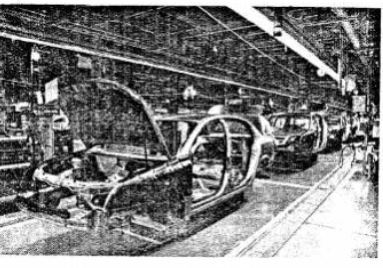
Question. This is a picture of an industry.
1. What type of industry is this?
2. Can you give two features of this industry?
Answer:
1. This depicts a large-scale manufacturing unit from the automobile sector.
2. Two main characteristics of this industry are:
- It requires massive capital investments and uses big power-driven machines with high automation.
- It employs a large workforce comprising both highly skilled and general laborers.
In simple words: The picture shows a car factory, which is a large-scale industry. These factories use huge machines, cost a lot of money, and employ many workers.
Exam Tip: Be sure to identify automobile manufacturing as a classic large-scale industry and mention its high automation and large workforce.
Free study material for Geography
ICSE Voyage Solutions Class 7 Geography Chapter 9 Industries Their Need And Classification
Students can now access the detailed Voyage Solutions for Chapter 9 Industries Their Need And Classification on our portal. These solutions have been carefully prepared as per latest ICSE Class 7 syllabus. Each solution given above has been updated based on the current year pattern to ensure Class 7 students have the most updated Geography content.
Master Voyage Textbook Questions
Our subject experts have provided detailed explanations for all the questions found in the Voyage textbook for Class 7 Geography. We have focussed on making the concepts easy for you in Chapter 9 Industries Their Need And Classification so that students can understand the concepts behind every answer. For all numerical problems and theoretical concepts these solutions will help in strengthening your analytical skill required for the ICSE examinations.
Complete Geography Exam Preparation
By using these Voyage Class 7 solutions, you can enhance your learning and identify areas that need more attention. We recommend solving the Geography Questions from the textbook first and then use our teacher-verified answers. For a proper revision of Chapter 9 Industries Their Need And Classification, students should also also check our Revision Notes and Sample Papers available on studiestoday.com.
FAQs
You can download the verified Voyage solutions for Chapter 9 Industries Their Need And Classification on StudiesToday.com. Our teachers have prepared answers for Class 7 Geography as per 2026-27 ICSE academic session.
Yes, our solutions for Chapter 9 Industries Their Need And Classification are designed as per new 2026 ICSE standards. 40% competency-based questions required for Class 7, are included to help students understand application-based logic behind every Geography answer.
Yes, every exercise in Chapter 9 Industries Their Need And Classification from the Voyage textbook has been solved step-by-step. Class 7 students will learn Geography conceots before their ICSE exams.
Yes, follow structured format of these Voyage solutions for Chapter 9 Industries Their Need And Classification to get full 20% internal assessment marks and use Class 7 Geography projects and viva preparation as per ICSE 2026 guidelines.