

ICSE Solutions Voyage Class 7 Geography Chapter 11 Renewable And Non Renewable Resources have been provided below and is also available in Pdf for free download. The Voyage ICSE solutions for Class 7 Geography have been prepared as per the latest syllabus and ICSE books and examination pattern suggested in Class 7. Questions given in ICSE Voyage book for Class 7 Geography are an important part of exams for Class 7 Geography and if answered properly can help you to get higher marks. Refer to more Chapter-wise answers for ICSE Class 7 Geography and also download more latest study material for all subjects. Chapter 11 Renewable And Non Renewable Resources is an important topic in Class 7, please refer to answers provided below to help you score better in exams
Voyage Chapter 11 Renewable And Non Renewable Resources Class 7 Geography ICSE Solutions
Class 7 Geography students should refer to the following ICSE questions with answers for Chapter 11 Renewable And Non Renewable Resources in Class 7. These ICSE Solutions with answers for Class 7 Geography will come in exams and help you to score good marks
Chapter 11 Renewable And Non Renewable Resources Voyage ICSE Solutions Class 7 Geography
Question. Discuss the ways by which you can conserve energy, especially petroleum and electricity, in your homes and school. What changes do you need to make in your daily routine to save these precious resources ?
Answer: To save energy, we can follow some simple habits at home and school.
1. Use oil and power carefully: We should ride a bicycle or walk for short trips instead of using a car. Always turn off the lights and fans when you leave a room.
2. Use water carefully: Be careful with water when you wash clothes or water plants. Do not leave the tap running when it is not needed.
In simple words: We can save energy by walking for short distances and turning off lights when we leave. We should also close water taps so water is not wasted.
Exam Tip: Remember to split your answer into two clear sections: one for saving fuel and electricity, and one for saving water.
Think and Answer
Question. Hydroelectricity is considered a good energy option for the future. Why ?
Answer: Electricity made from water is clean because water does not dirty the air like coal or gas. Since water is available locally, countries can make their own power without depending on others. This energy depends on the cycle of water, which is moved by the sun, so it is a renewable source that will never end.
In simple words: Water power is great because it does not make the air dirty. It is a natural source of energy that we can use forever.
Exam Tip: To get full marks, write down three main benefits: it does not cause pollution, it is made locally, and it is a renewable source of energy.
Value and Life Skill
Question. Electricity is very important for all of us. We need it for our homes, offices, industries and agriculture. Make a list of five different ways in which you can save electricity, for instance, switching off fans, ACs, light at home and in school when these thing are not required.
Answer: We can save electricity in the following ways:
1. Use sunlight during the day instead of turning on lamps.
2. Change old light bulbs to new LED or CFL bulbs that use less power.
3. Turn off the lights when you leave a room.
4. Pull out the plugs of machines when you are not using them.
5. Buy new home appliances that are designed to save energy.
6. Do not use the air conditioner or warm water too much.
In simple words: We can save power by turning off lights, using natural sunlight, and unplugging machines when we are not using them.
Exam Tip: Make sure you list simple, practical actions like switching off lights and using LED bulbs, as these are easy to remember and score well.
Exercises
A. Fill in the blanks.
Question 1. ________, ________, ________ are examples of renewable energy resources.
Answer: Sun, water, wind
In simple words: The sun, water, and wind are natural sources of energy that never run out.
Exam Tip: Remember that renewable resources are those that get filled back up naturally by nature.
Question 2. Solar cells use the power supplied by the ________.
Answer: Sunlight
In simple words: Solar panels use light from the sun to make electricity.
Exam Tip: Remember that solar energy comes directly from sunlight and is captured using photovoltaic cells.
Question 3. Geothermal energy is the heat of the ________.
Answer: earth
In simple words: Geothermal energy is the natural heat that comes from inside the earth.
Exam Tip: The word 'geo' means earth, and 'thermal' means heat, which helps you remember this term.
Question 4. Coal, petroleum and natural gas are ________ fuels.
Answer: fossil
In simple words: Fuels like coal and oil are made from ancient plants and animals.
Exam Tip: Fossil fuels take millions of years to form and cannot be easily replaced.
Question 5. ________ is the coal with the highest percentage of carbon.
Answer: Anthracite
In simple words: Anthracite is the best type of coal because it has the most carbon.
Exam Tip: Anthracite has the highest carbon content and produces the most heat with the least smoke.
B. Match the following.
Question. Match the items in Column A with Column B.
| Column A | Column B |
|---|---|
| 1. Solar energy | (i) Ganga |
| 2. Hydroelectricity | (ii) Wind mill |
| 3. Coal | (iii) Sun |
| 4. Wind | (iv) Non-renewable |
| 5. Farakka barrage | (v) Water |
Answer:
| Column A | Column B |
|---|---|
| 1. Solar energy | (iii) Sun |
| 2. Hydroelectricity | (v) Water |
| 3. Coal | (iv) Non-renewable |
| 4. Wind | (ii) Wind mill |
| 5. Farakka barrage | (i) Ganga |
In simple words: This table connects each resource to its source, type, or location, like matching solar power to the sun.Exam Tip: Try to match the easiest ones first, like solar energy with the sun, to help you solve the rest of the matches.
C. Choose the correct answer.
Question 1. Photovoltaic cells use the energy of
(a) sun
(b) wind
(c) water
(d) tides
Answer: (a) sun
In simple words: Photovoltaic cells are solar cells, so they use light from the sun to make power.
Exam Tip: Remember that 'photo' refers to light and 'voltaic' refers to electricity, meaning these cells use sunlight.
Question 2. Hydroelectricity is obtained by using
(a) wind
(b) water
(c) coal
(d) natural gas
Answer: (b) water
In simple words: Hydro means water, so hydroelectricity is power made from moving water.
Exam Tip: Remember that 'hydro' always relates to water, which helps you choose the correct option instantly.
Question 3. Wind mills have been used for many centuries in
(a) the USA
(b) the Netherlands
(c) Russia
(d) India
Answer: (b) the Netherlands
In simple words: People in the Netherlands have used windmills for hundreds of years to pump water and grind grain.
Exam Tip: The Netherlands is famous historically for its widespread use of traditional windmills.
Question 4. The coal that has the highest percentage of carbon is
(a) anthracite
(b) bituminous
(c) lignite
(d) peat
Answer: (a) anthracite
In simple words: Anthracite is the best kind of coal because it has the most carbon in it.
Exam Tip: Remember the order of coal quality from highest to lowest carbon: Anthracite, Bituminous, Lignite, and Peat.
Question 5. The Bhakra-Nangal Dam is situated on the river
(a) Yamuna
(b) Beas
(c) Ravi
(d) Satluj
Answer: (d) Satluj
In simple words: The Bhakra-Nangal Dam is a large dam built on the Satluj River in India.
Exam Tip: Make sure you memorize the names of major Indian dams and the specific rivers they are built on.
D. State whether the following is True or False.
Question 1. Coal and petroleum are renewable energy resources.
Answer: False
Correct statement: Coal and petroleum are non-renewable energy resources.
In simple words: Coal and oil are non-renewable because they take millions of years to form and can run out.
Exam Tip: Remember that fossil fuels like coal and petroleum cannot be replaced quickly once we use them up.
Question 2. Renewable energy resources have limited supply in nature.
Answer: False
Correct statement: Renewable energy resources have an unlimited supply in nature.
In simple words: Renewable resources like solar and wind power will never run out because nature keeps making them.
Exam Tip: Think of renewable energy as 'limitless' because things like wind and sunlight are always available.
Question 3. China, USA and Spain are major producers of wind energy.
Answer: True
In simple words: These three countries are some of the biggest makers of wind power in the world.
Exam Tip: Remember that China and the USA are leaders in many kinds of renewable energy, including wind.
Question 4. Coal takes millions of years to form.
Answer: True
In simple words: Coal is made from plants that died millions of years ago and were buried under the ground.
Exam Tip: Since coal takes millions of years to form, it is classified as a non-renewable resource.
Question 5. The Sardar Sarovar Dam is built on the river Narmada.
Answer: True
In simple words: The Sardar Sarovar Dam is a famous dam built on the Narmada River.
Exam Tip: This dam is one of the most prominent water projects in Western India, located on the Narmada River.
E. Answer the following questions brief.
Question 1. What are renewable energy resources?
Answer: These are energy resources that come from nature and are filled back up naturally. Some examples are solar power from the sun, wind power from windmills, electricity from water, energy from sea tides, and heat from inside the earth.
In simple words: Renewable energy comes from things in nature like the sun and wind that never run out.
Exam Tip: To get full marks, define renewable resources as naturally replenished and list at least three examples like solar, wind, and water.
Question 2. What is the main difference between renewable an non-renewable energy resources?
Answer:
Renewable Resources:
1. These resources can be made again in a very short time.
2. They do not pollute our air, water, or land.
3. They are natural gifts that we get for free.
4. Examples include air, water, and sunlight.
Non-Renewable Resources:
1. These resources cannot be replaced quickly once we use them.
2. They cause pollution when we use them.
3. They are not unlimited gifts from nature.
4. Examples include coal, oil, and various minerals.
In simple words: Renewable resources are clean and never run out, while non-renewable resources can run out and cause pollution.
Exam Tip: Drawing a simple comparison table with headings like 'Availability', 'Pollution', and 'Examples' is the best way to present this answer.
Question 3. What is tidal energy ?
Answer: Tidal energy is a source of power that will never run out. It is made by using the rising and falling tides of the ocean. High tides near the coast are used to run machines and make electricity, and it does not cost anything to get this energy.
In simple words: Tidal energy is power made from the natural movement of ocean waves and tides.
Exam Tip: Clearly state that tidal energy is inexhaustible and uses the rise and fall of coastal tides to make electricity.
Question 4. Which countries are major producers of wind power in the world?
Answer: The top countries that produce wind power are China, the United States, Germany, Spain, and the Netherlands.
In simple words: Countries like China and the USA make the most wind energy in the world.
Exam Tip: Memorize at least three of these countries (especially China, USA, and Germany) to write a complete answer.
Question 5. What is biogas ? How is it useful to us ?
Answer: Biogas is a gas made from animal droppings and other household organic waste. It is very useful because it gives us cheap energy that we can use for cooking and lighting on a small scale.
In simple words: Biogas is a cheap gas made from rotting waste that can be used for cooking and power.
Exam Tip: Be sure to explain both what biogas is made from (organic waste) and how it is used (cheap power for homes).
Question 6. What are fossil fuels?
Answer: These are fuels made long ago from the dead remains of plants and tiny living things. Some common examples of these fuels are coal, oil, and natural gas.
In simple words: Fossil fuels are fuels like coal and oil that were made from buried plants and animals over millions of years.
Exam Tip: Make sure to mention that fossil fuels are formed from the remains of prehistoric plants and organisms, and name the three main types.
Question 7. Name a few major producers of petroleum in the world.
Answer: The main places that produce oil are the Gulf nations like Saudi Arabia, Iraq, and Iran, along with the USA, Venezuela, Algeria, and Russia.
In simple words: Countries like Saudi Arabia, Russia, and the USA are the biggest producers of oil in the world.
Exam Tip: Grouping your answer by region (like "Gulf countries" followed by countries like Russia and USA) helps show a structured understanding.
F. Answer the following questions in one or two paragraph.
Question 1. Give an account of the use of solar energy.
Answer: Solar energy is the heat and light we get from the sun. It is always available in nature and will never run out. One common way to collect this energy is by using solar panels. These panels are made of very thin parts that turn sunlight into electric power.
We use solar cells in many everyday things like streetlights, calculators, watches, mobile phones, and traffic lights. We also use the sun's warmth to run cookers, boil water, and heat ovens.
In simple words: Solar energy is power from the sun. We use solar panels to turn sunlight into electricity for lights, phones, and calculators.
Exam Tip: Be sure to explain how solar panels work in simple terms (turning light into electricity) and give three distinct examples of how we use solar power daily.
Question 2. How is hydroelectricity generated?
Answer: The word 'hydro' refers to water, so hydroelectricity is power made from moving water. It is created when water flows down from a high place due to gravity. This fast-moving water spins the large blades of a turbine, which then produces electricity.
In simple words: Water falling from a high place spins a big turbine wheel, which makes electricity.
Exam Tip: Explain the role of gravity and the turbine in converting the kinetic energy of falling water into electrical energy.
Question 3. Explain briefly geothermal energy.
Answer: Geothermal energy is the power we get by collecting the heat from deep inside the earth. Below the outer crust, the earth contains very hot rocks. These hot materials heat up the underground water, creating steam and hot water. This steam rises to the surface through natural springs and can be used to turn turbines that produce electrical power.
In simple words: Geothermal energy is power made from the hot steam and water that comes from deep under the ground.
Exam Tip: Remember to mention that geothermal heat warms up groundwater to make steam, which is then used to spin turbines.
Question 4. What do you know about wind energy?
Answer: We can use the wind to make power. When the wind blows, it spins the three big blades of a windmill. These blades are connected to a turbine, which then works with a generator to turn the movement of the wind into electricity.
Just like sunlight, wind is a free gift from nature that we can find in many places.
In simple words: Blowing wind spins windmill blades, which turns a generator to make free, clean electricity.
Exam Tip: Be sure to write about how the moving wind turns the windmill blades, which spin a generator to make power.
Question 5. Describe the four major types of coal.
Answer: Based on how much carbon they have, coal is grouped into four kinds:
(a) Anthracite: This is the highest quality coal because it contains nearly 90% carbon.
(b) Bituminous: This is the second-best type of coal, containing 65% to 70% carbon.
(c) Lignite: This is a lower-grade coal that has only about 60% carbon.
(d) Peat: This has very low amounts of carbon, is not fully developed, and makes a lot of smoke while giving off very little heat.
In simple words: The four types of coal are Anthracite, Bituminous, Lignite, and Peat, ranked from best to worst based on carbon content.
Exam Tip: List the four types of coal in descending order of quality and include the carbon percentage for each to score maximum marks.
Question 6. Write a short note on nuclear power.
Answer: Nuclear power is often called atomic energy. It is produced when radioactive elements, like uranium and thorium, break apart. This power is created using processes called fission or fusion.
In simple words: Nuclear power is energy made by breaking down special heavy elements like uranium.
Exam Tip: Remember to mention the alternative name (atomic energy), the main elements used (uranium and thorium), and the two processes (fission and fusion).
Question 7. Write about hydroelectric projects in India.
Answer: India stands fourth in the world for having the most dams. There are over 4,800 finished large dams in the country, and many more are being constructed. Here are some of the key dams in India:
- Bhakra-Nangal Dam: Located on the Satluj River.
- Damodar Valley Project: Built on the Damodar River in West Bengal.
- Farakka Barrage: Located on the Ganga River in West Bengal.
- Sardar Sarovar Dam: Built on the Narmada River.
- Hirakud Dam: Located on the Mahanadi River.
- Nagarjuna Sagar Dam: Built on the Krishna River.
- Idukki Dam: Built on the Periyar River in Kerala.
In simple words: India has thousands of large dams that use rivers like the Satluj, Ganga, and Narmada to make clean electricity.
Exam Tip: Remember to associate each dam with the correct river (such as Bhakra-Nangal with Satluj and Sardar Sarovar with Narmada) as these are common matching and map questions.
Question 8. Why do we need to conserve our energy resources ?
Answer: It is very important to save energy, especially our common resources which might completely run out in this century. Because the population is growing, we are using up too much fuel and wasting it. We must quickly switch to alternative power sources that will not run out during our lives. In our daily routines, we should follow the three R's - reduce, reuse, and recycle. This will help us use resources wisely and keep them safe for future generations.
If we waste all our life-supporting resources, our survival on earth will be in danger.
We can easily save energy by sharing rides, turning off unused lights and fans, riding bicycles, and taking buses or trains. We should also try to use more solar, wind, and water power.
In simple words: We must save energy because conventional fuels like oil can run out soon. We can save power by turning off lights, sharing rides, and using solar and wind energy.
Exam Tip: Be sure to explain why we need to conserve energy (population growth, fuel depletion) and list daily actions like carpooling and switching off lights.
Question. Large - scale hydroelectric projects have an impact on the environment. Search the Internet to find out how these projects affect the flora and fauna, and people’s lives in the area.
Answer: Large dams have several major effects on the local area:
1. Impact on plants and animals: Building a dam floods large forest areas, which destroys the natural homes of land animals and plants. It also blocks the movement of fish and other water creatures along the river.
2. Impact on people: Large projects force local communities and villages to leave their homes because their land gets flooded. This can make it hard for them to find new places to live and work.
In simple words: Large dams can flood forests, destroy animal habitats, and force local people to move away from their homes.
Exam Tip: Divide this answer into two distinct parts: the ecological impacts on plants/animals and the social impacts on human relocation.
H. Picture Study
Look at the picture and answer the following questions.
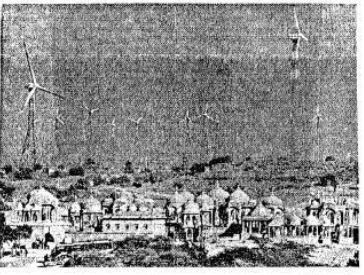
Question 1. What type of energy is generated at this site?
Answer: The site produces wind energy.
In simple words: This picture shows a wind farm where wind is used to generate clean power.
Exam Tip: Identify the large blades and tower as a windmill, which is used to generate wind energy.
Question 2. Where is this type of energy generated in India?
Answer: India has many wind farms, which are mostly located in the southern parts of the country.
In simple words: Most of the wind farms in India are built in the southern states.
Exam Tip: Name southern states like Tamil Nadu and Andhra Pradesh as leading regions for wind energy generation in India.
I. Map work.
Question. On the outline map of India given here, mark and name any five hydroelectric projects in India.
Answer:
The five major hydroelectric projects marked on the map of India are:
1. Lower Jhelum (Jammu and Kashmir)
2. Salal (Jammu and Kashmir)
3. Ramganga (Uttarakhand)
4. Harduaganj (Uttar Pradesh)
5. Sardar Sarovar (Gujarat)
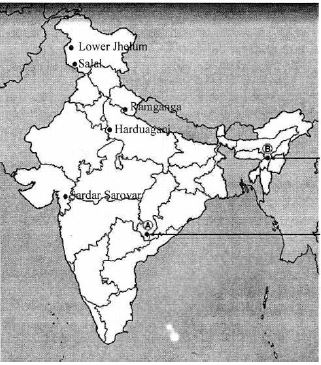
In simple words: These are five key stations in India that make electricity using river water.
Exam Tip: Practice pointing out Jhelum and Salal in the far north, and Sardar Sarovar on the western side of the India map.
Let's Do Something
Question. Where does your water come from? Each city has a different source for its water supply like reservoirs, rivers or wells. Find out where your town or city gets its supply of water from.
Answer: If you live in Jalandhar City in Punjab, your water comes from the Bist Doab Canal System.
Note for Students: You should find out where the water in your own town or city comes from and write down its name.
In simple words: Different cities get their water from different places like lakes, rivers, or canals. Find out your city's water source!
Exam Tip: For local activity questions, always give a specific local example like a nearby river or municipal canal system to show real-world research.
Free study material for Geography
ICSE Voyage Solutions Class 7 Geography Chapter 11 Renewable And Non Renewable Resources
Students can now access the detailed Voyage Solutions for Chapter 11 Renewable And Non Renewable Resources on our portal. These solutions have been carefully prepared as per latest ICSE Class 7 syllabus. Each solution given above has been updated based on the current year pattern to ensure Class 7 students have the most updated Geography content.
Master Voyage Textbook Questions
Our subject experts have provided detailed explanations for all the questions found in the Voyage textbook for Class 7 Geography. We have focussed on making the concepts easy for you in Chapter 11 Renewable And Non Renewable Resources so that students can understand the concepts behind every answer. For all numerical problems and theoretical concepts these solutions will help in strengthening your analytical skill required for the ICSE examinations.
Complete Geography Exam Preparation
By using these Voyage Class 7 solutions, you can enhance your learning and identify areas that need more attention. We recommend solving the Geography Questions from the textbook first and then use our teacher-verified answers. For a proper revision of Chapter 11 Renewable And Non Renewable Resources, students should also also check our Revision Notes and Sample Papers available on studiestoday.com.
FAQs
You can download the verified Voyage solutions for Chapter 11 Renewable And Non Renewable Resources on StudiesToday.com. Our teachers have prepared answers for Class 7 Geography as per 2026-27 ICSE academic session.
Yes, our solutions for Chapter 11 Renewable And Non Renewable Resources are designed as per new 2026 ICSE standards. 40% competency-based questions required for Class 7, are included to help students understand application-based logic behind every Geography answer.
Yes, every exercise in Chapter 11 Renewable And Non Renewable Resources from the Voyage textbook has been solved step-by-step. Class 7 students will learn Geography conceots before their ICSE exams.
Yes, follow structured format of these Voyage solutions for Chapter 11 Renewable And Non Renewable Resources to get full 20% internal assessment marks and use Class 7 Geography projects and viva preparation as per ICSE 2026 guidelines.