

ICSE Solutions Goyal Brothers Class 10 Physics Chapter 4 Calorimetry have been provided below and is also available in Pdf for free download. The Goyal Brothers ICSE solutions for Class 10 Physics have been prepared as per the latest syllabus and ICSE books and examination pattern suggested in Class 10. Questions given in ICSE Goyal Brothers book for Class 10 Physics are an important part of exams for Class 10 Physics and if answered properly can help you to get higher marks. Refer to more Chapter-wise answers for ICSE Class 10 Physics and also download more latest study material for all subjects. Chapter 4 Calorimetry is an important topic in Class 10, please refer to answers provided below to help you score better in exams
Goyal Brothers Chapter 4 Calorimetry Class 10 Physics ICSE Solutions
Class 10 Physics students should refer to the following ICSE questions with answers for Chapter 4 Calorimetry in Class 10. These ICSE Solutions with answers for Class 10 Physics will come in exams and help you to score good marks
Chapter 4 Calorimetry Goyal Brothers ICSE Solutions Class 10 Physics
Exercise - 1
Question 1. Define calorie.
Answer: A calorie is the quantity of thermal energy needed to increase the temperature of exactly \( 1\ \text{g} \) of pure water by \( 1^\circ\text{C} \) - specifically from \( 14.5^\circ\text{C} \) to \( 15.5^\circ\text{C} \).
In simple words: A calorie is a unit of heat energy. It is the exact amount of heat needed to make one gram of water one degree Celsius hotter, specifically raising it from 14.5 to 15.5 degrees.
Exam Tip: When defining a calorie, always mention the specific temperature range (from 14.5°C to 15.5°C) to secure full marks.
Question 2. State the modern unit of heat energy. How is this unit related to calorie ?
Answer: The contemporary unit used for measuring thermal energy is the **joule (J)**.
The conversion between a calorie and a joule is defined as:
\( 1\ \text{calorie} = 4.186\ \text{J} \approx 4.2\ \text{J} \) (approximately)
Alternatively:
\( 1\ \text{J} \approx 0.24\ \text{calorie} \)
In simple words: The standard modern unit for heat is the joule. One calorie is equal to about 4.2 joules, which means a calorie is a slightly larger unit of energy than a joule.
Exam Tip: Remember the approximation \( 1\ \text{cal} = 4.2\ \text{J} \) for quick calculations, but use \( 4.186\ \text{J} \) if high precision is requested in the question.
Question 3. What do you understand by the term thermal capacity ? State its unit is SI system.
Answer: Thermal capacity (or heat capacity) of a body refers to the total amount of heat energy needed to elevate the temperature of its entire mass by \( 1^\circ\text{C} \) (or \( 1\ \text{K} \)).
In the SI system, its unit is expressed as **joule per kelvin (\(\text{J K}^{-1}\))**.
In simple words: Thermal capacity is how much heat an entire object needs to absorb to get warmer by one degree. It is measured in joules per kelvin.
Exam Tip: Do not confuse thermal capacity with specific heat capacity. Thermal capacity depends on the total mass of the body, whereas specific heat capacity is defined per unit mass.
Question 4. Define specific heat capacity and state its SI and CGS units.
Answer: Specific heat capacity is defined as the quantity of heat energy required to increase the temperature of a unit mass (\( 1\ \text{kg} \) or \( 1\ \text{g} \)) of a substance by \( 1^\circ\text{C} \) or \( 1\ \text{K} \).
- **SI Unit:** \( \text{J kg}^{-1}\ \text{K}^{-1} \) (or \( \text{J kg}^{-1}\ ^\circ\text{C}^{-1} \))
- **CGS Unit:** \( \text{J g}^{-1}\ ^\circ\text{C}^{-1} \) (or \( \text{cal g}^{-1}\ ^\circ\text{C}^{-1} \))
In simple words: Specific heat capacity is the amount of heat needed to raise the temperature of just one gram or kilogram of a substance by one degree. Its standard metric unit is J/(kg·K).
Exam Tip: Make sure you learn the exact units of specific heat capacity in both systems. A common mistake is writing the units of heat capacity instead of specific heat capacity.
Question 5. Is the specific heat capacity of ice greater, equal to or less than water ?
Answer: The specific heat capacity of ice is lower than that of water. Specifically, the heat capacity of ice is roughly half of that of liquid water (\( 2100\ \text{J kg}^{-1}\ \text{K}^{-1} \) compared to \( 4200\ \text{J kg}^{-1}\ \text{K}^{-1} \)).
In simple words: Ice has a lower specific heat capacity than liquid water. This means ice heats up or cools down twice as fast as liquid water when given the same amount of heat.
Exam Tip: Remember the numeric values: water is \( 4200\ \text{J kg}^{-1}\ \text{K}^{-1} \) and ice is \( 2100\ \text{J kg}^{-1}\ \text{K}^{-1} \). These constants are extremely helpful in calorimeter numericals.
Question 6. Explain the following :
(a) Water is used in hot water bottles for fomentation purposes.
(b) Water is used as a coolant in motor car radiators.
(c) A wise farmer always waters his fields in the evening, if there is a forecast for frost.
(d) Wet soil does not get as hot as dry soil in the sun.
(e) Water is sprinkled on the roads in the evening during hot summer.
(f) Water is used for internal heating in cold countries.
(g) Cold water is poured on the burns caused on the skin by some hot object.
(h) Water rubs are kept in warehouses storing fruits and vegetables in cold countries during winter.
Answer:
(a) Due to its remarkably high specific heat capacity, water can store a large amount of heat energy and cool down very slowly. This property allows hot water bottles to supply steady warmth over an extended period.
(b) Water is an exceptionally effective coolant because of its high specific heat capacity. As it flows through the radiator pipes, it absorbs a massive amount of thermal energy from the vehicle's engine with only a nominal increase in its own temperature.
(c) Watering the crops during freezing nights protects them from cold damage. Since water has a high specific heat capacity, it slowly releases heat, preventing the ambient temperature around the plants from plunging to \( 0^\circ\text{C} \). Without this, the water inside the delicate capillary tubes of the plants would freeze and expand, bursting their veins.
(d) Water requires significantly more heat energy to raise its temperature compared to dry soil. Consequently, wet soil warms up much more slowly and stays cooler under solar radiation than dry soil.
(e) Because of its high specific heat capacity, water sprinkled on roads absorbs and carries away a substantial amount of heat from the hot asphalt as it evaporates, cooling the surrounding air on hot summer evenings.
(f) In cold climates, water-based central heating systems are preferred because water can carry a vast amount of thermal energy from a central boiler and distribute it steadily to different rooms without cooling down too quickly.
(g) Cold water absorbs a large amount of thermal energy from the burned skin due to its high specific heat capacity. This rapid removal of heat cools the injured tissue quickly and provides immediate relief from pain.
(h) Water tubs kept in warehouses release a tremendous amount of heat as they slowly cool during freezing winter nights. This continuous release of heat maintains the indoor temperature above the freezing point, protecting fruits and vegetables from freezing and bursting.
In simple words: All these phenomena happen because water has an unusually high specific heat capacity. This means it takes a lot of heat to warm water up, and it releases a lot of heat when it cools down, making it perfect for keeping things warm, cooling engines down, or protecting crops from freezing.
Exam Tip: For 'reason-based' questions involving water, always use the key phrase 'high specific heat capacity of water' as the starting point of your explanation to guarantee full marks.
Question 7. Explain how is land breeze caused ?
Answer: A land breeze is a wind that blows from the land toward the sea during the night. After sunset, the land cools down much faster than the sea because the land has a significantly lower specific heat capacity than water. Consequently, the air over the warm sea water remains warm, rises, and creates a region of low atmospheric pressure over the sea. The cooler, denser air over the land (high-pressure zone) then rushes toward the sea (low-pressure zone), causing a land breeze.
In simple words: At night, land cools down faster than water. This makes the air over the warm sea rise, creating low pressure. Cooler air from the land then blows toward the sea to fill the space, creating a land breeze.
Exam Tip: Clearly distinguish between land breeze (nighttime, land to sea) and sea breeze (daytime, sea to land) by explaining how low and high-pressure zones develop due to different cooling rates.
Question 8. Explain the formation of sea breeze.
Answer: A sea breeze is a cool wind that blows from the sea toward the land during the daytime. During the day, the land heats up much more rapidly than the water because of its low specific heat capacity. This rapid heating warms the air above the land, causing it to expand, become lighter, and rise, creating a low-pressure area over the land. Meanwhile, the cooler air over the sea forms a high-pressure zone, which blows toward the land to take its place.
In simple words: During the day, the sun heats the land faster than the sea. The hot air over the land rises, and the cooler air from the sea blows in to replace it, creating a refreshing sea breeze.
Exam Tip: When explaining breezes, always relate the temperature difference to the specific heat capacity differences between water and soil.
Question 9. Why is the weather in coastal regions moderate ?
Answer: Coastal regions experience moderate weather due to the high specific heat capacity of water relative to land. During the day, land heats up quickly while the sea remains relatively cool, giving rise to sea breezes that lower the daytime temperature on land. At night, the land cools down rapidly while the sea stays warm, creating land breezes that prevent the temperature on land from dropping too low. This continuous exchange of air moderates the temperature of coastal areas year-round.
In simple words: Because water takes a long time to warm up and cool down, the sea acts like a giant natural air conditioner. It blows cool air onto the land during hot days and warm air during cold nights, keeping the coastal weather mild and pleasant.
Exam Tip: To answer why coastal weather is moderate, combine the concepts of specific heat capacity, rapid temperature changes on land, and the resulting land and sea breezes.
Multiple Choice Questions
Question 1. The specific heat capacity of a substance :
(a) changes with the mass of given substance.
(b) changes with the area or volume of substance.
(c) changes with rise or fall in temperature.
(d) is a constant quantity for a given substance.
Answer: (d) is a constant quantity for a given substance.
In simple words: Specific heat capacity is a unique, fixed property of a material. It does not change regardless of how much mass, volume, or size of the material you have.
Exam Tip: Specific heat capacity depends solely on the nature of the substance and its state, making it a characteristic constant for that material.
Question 2. Land and sea breezes are formed in coastal regions because :
(a) water has very high specific heat capacity than the land.
(b) land has very high specific heat capacity than the water.
(c) sea water cools the cooler regions. .
(d) all the above.
Answer: (a) water has very high specific heat capacity than the land.
In simple words: Because water heats up and cools down much more slowly than land, it creates the temperature and pressure differences that drive these breezes.
Exam Tip: Remember that water's high heat capacity causes it to behave as a thermal buffer, regulating coastal temperatures and driving convection currents.
Question 3. The base of cooking pans is made thicker and heavy because:
(a) it lowers the heat capacity of pan
(b) it increases the heat capacity of pan
(c) the food does not get charred and keeps hot for long time
(d) both (a) and (c)
Answer: (d) both (a) and (c)
In simple words: Making the pan thicker increases its weight and thermal capacity. This ensures heat is distributed evenly so the food does not burn easily, and the pan retains heat for a much longer time.
Exam Tip: Even though a heavier base technically increases the overall heat capacity, this keeps the food from burning and ensures the pan retains heat well after the flame is off.
Question 4. The S.I. unit of specific heat capacity is :
(a) JKg-1
(b) JK-1
(c) JKg-1K-1
(d) kJkg-1 K-1
Answer: (c) JKg-1K-1
In simple words: The standard international unit for specific heat capacity is joules per kilogram per kelvin, written as J kg^-1 K^-1.
Exam Tip: Be careful not to select option (b) which represents thermal capacity; specific heat capacity must include the mass dimension (\(\text{kg}^{-1}\)).
Question 5. The specific heat capacity of water in S.I. system is :
(a) 4.2 Jkg-1 K-1
(b) 42 JKg-1 K-1
(c) 4200 JKg-1 k-1
(d) 420 JKg-1 K-1
Answer: (c) 4200 JKg-1 k-1
In simple words: Water has a very high specific heat capacity of 4200 joules per kilogram per kelvin.
Exam Tip: The value \( 4200\ \text{J kg}^{-1}\ \text{K}^{-1} \) is equivalent to \( 1\ \text{cal g}^{-1}\ ^\circ\text{C}^{-1} \). Ensure you are using the correct units in calculation problems.
Question 6. S.I. unit of thermal capacity is :
(a) Jkg-1
(b) kJ Kg-1
(c) Jkg-1K-1
(d) cal oC-1
Answer: (c) Jkg-1K-1
In simple words: The unit for thermal capacity is joules per kelvin. When calculated per unit mass, it is expressed as J kg^-1 K^-1.
Exam Tip: Thermal capacity is measured in \( \text{J K}^{-1} \) or \( \text{J }^\circ\text{C}^{-1} \). Ensure you read the question options carefully, as sometimes CGS units or combined units are presented in tests.
Numerical Problems on Specific Heat Capacity
Practice Problems 1
Question 1. A solid of mass 0.15 kg is heated from 10°C to 90°C. If the specific heat capacity of the solid is 390 Jkg-10 C-1, find the heat absorbed by the solid.
Answer: Given:
- Mass of the solid, \( m = 0.15\ \text{kg} \)
- Initial temperature, \( T_1 = 10^\circ\text{C} \)
- Final temperature, \( T_2 = 90^\circ\text{C} \)
- Specific heat capacity, \( c = 390\ \text{J kg}^{-1}\ ^\circ\text{C}^{-1} \)
The increase in temperature is:
\( \Delta T = T_2 - T_1 = 90^\circ\text{C} - 10^\circ\text{C} = 80^\circ\text{C} \)
The total thermal energy absorbed by the solid is calculated as:
\( Q = m \cdot c \cdot \Delta T \)
\( Q = 0.15\ \text{kg} \times 390\ \text{J kg}^{-1}\ ^\circ\text{C}^{-1} \times 80^\circ\text{C} \)
\( Q = 4680\ \text{J} \)
Therefore, the heat absorbed by the solid is \( 4680\ \text{J} \).
In simple words: Using the formula \( Q = mc\Delta T \), we multiply the mass (0.15 kg), the specific heat capacity (390), and the temperature rise (80°C) to find that the solid absorbs 4680 joules of heat.
Exam Tip: Always write down the formula \( Q = mc\Delta T \) and show the temperature difference \( \Delta T \) calculation clearly to secure step marks.
Question 2. A liquid of mass 0.2 kg and temperature 135°C is cooled to 25°C. If the specific heat capacity of liquid is 750 Jkg-10 C-1, find the heat energy given out.
Answer: Given:
- Mass of the liquid, \( m = 0.2\ \text{kg} \)
- Initial temperature, \( T_1 = 135^\circ\text{C} \)
- Final temperature, \( T_2 = 25^\circ\text{C} \)
- Specific heat capacity of the liquid, \( c = 750\ \text{J kg}^{-1}\ ^\circ\text{C}^{-1} \)
The decrease in temperature is:
\( \Delta T = T_1 - T_2 = 135^\circ\text{C} - 25^\circ\text{C} = 110^\circ\text{C} \)
The thermal energy released by the liquid is given by:
\( Q = m \cdot c \cdot \Delta T \)
\( Q = 0.2\ \text{kg} \times 750\ \text{J kg}^{-1}\ ^\circ\text{C}^{-1} \times 110^\circ\text{C} \)
\( Q = 16500\ \text{J} \)
Thus, the total heat energy given out is \( 16500\ \text{J} \).
In simple words: When the liquid cools down by 110°C, it releases heat. By multiplying the mass, specific heat, and temperature drop together, we find it gives out 16,500 joules of energy.
Exam Tip: Whether a substance is heated or cooled, the same formula \( Q = mc\Delta T \) is used. Ensure you state the final answer with proper units (J or kJ).
Practice Problems 2
Question 1. 0.08 kg of a substance is heated from 30°C to 130°C when 2000 calories of energy is supplied to it Calculate the specific heat capacity of the substance in (a) calories, (b) joules.
Answer: Given:
- Mass of the substance, \( m = 0.08\ \text{kg} \)
- Initial temperature, \( T_1 = 30^\circ\text{C} \)
- Final temperature, \( T_2 = 130^\circ\text{C} \)
- Heat energy supplied, \( Q = 2000\ \text{calories} \)
The rise in temperature is:
\( \Delta T = 130^\circ\text{C} - 30^\circ\text{C} = 100^\circ\text{C} \)
**(a) Specific heat capacity in calories (\( c_{\text{cal}} \)):**
Using the formula \( Q = m \cdot c \cdot \Delta T \):
\( c_{\text{cal}} = \frac{Q}{m \cdot \Delta T} \)
\( c_{\text{cal}} = \frac{2000}{0.08 \times 100} = \frac{2000}{8} = 250\ \text{cal kg}^{-1}\ ^\circ\text{C}^{-1} \)
**(b) Specific heat capacity in joules (\( c_{\text{joules}} \)):**
Since \( 1\ \text{calorie} = 4.2\ \text{J} \):
\( c_{\text{joules}} = 250 \times 4.2 = 1050\ \text{J kg}^{-1}\ ^\circ\text{C}^{-1} \)
Thus, the specific heat capacity of the substance is:
(a) \( 250\ \text{cal kg}^{-1}\ ^\circ\text{C}^{-1} \)
(b) \( 1050\ \text{J kg}^{-1}\ ^\circ\text{C}^{-1} \).
In simple words: First, we find the heat capacity in calories by dividing the heat (2000 cal) by the mass and temperature rise, getting 250 cal/(kg·°C). Then, we convert it to joules by multiplying by 4.2, which gives 1050 J/(kg·°C).
Exam Tip: When converting specific heat capacity from calories to joules, directly multiply the value by 4.2 (or 4.186 if specified).
Question 2. 0.50 kg of lead at 327°C is cooled to 27°C, when it gives off 22500 calories of energy. Calculate the specific heat 1 capacity of lead in (a) calories, (b) joules.
Answer: Given:
- Mass of lead, \( m = 0.50\ \text{kg} \)
- Initial temperature, \( T_1 = 327^\circ\text{C} \)
- Final temperature, \( T_2 = 27^\circ\text{C} \)
- Heat energy released, \( Q = 22500\ \text{calories} \)
The fall in temperature is:
\( \Delta T = 327^\circ\text{C} - 27^\circ\text{C} = 300^\circ\text{C} \)
**(a) Specific heat capacity in calories (\( c_{\text{cal}} \)):**
Using the formula \( Q = m \cdot c \cdot \Delta T \):
\( c_{\text{cal}} = \frac{Q}{m \cdot \Delta T} \)
\( c_{\text{cal}} = \frac{22500}{0.50 \times 300} = \frac{22500}{150} = 150\ \text{cal kg}^{-1}\ ^\circ\text{C}^{-1} \)
**(b) Specific heat capacity in joules (\( c_{\text{joules}} \)):**
Since \( 1\ \text{calorie} = 4.2\ \text{J} \):
\( c_{\text{joules}} = 150 \times 4.2 = 630\ \text{J kg}^{-1}\ ^\circ\text{C}^{-1} \)
Thus, the specific heat capacity of lead is:
(a) \( 150\ \text{cal kg}^{-1}\ ^\circ\text{C}^{-1} \)
(b) \( 630\ \text{J kg}^{-1}\ ^\circ\text{C}^{-1} \).
In simple words: Lead cools down by 300°C and gives away 22,500 calories of heat. Dividing this heat by the mass and temperature change gives 150 cal/(kg·°C). Multiplying by 4.2 translates this into 630 J/(kg·°C).
Exam Tip: Always check the units required in the final answer. If both calories and joules are asked, calculate calories first and then convert it into joules using the conversion factor.
Practice Problems 3
Question 1. 272 calories of heat is required to heat 0.02 kg of a metal of specific heat capacity 170 cal kg-10 C-1 to a temperature T. If the initial temperature of the metal is 20°C, calculate the final temperature T.
Answer: Given:
- Heat supplied, \( Q = 272\ \text{calories} \)
- Mass of the metal, \( m = 0.02\ \text{kg} \)
- Specific heat capacity, \( c = 170\ \text{cal kg}^{-1}\ ^\circ\text{C}^{-1} \)
- Initial temperature, \( T_1 = 20^\circ\text{C} \)
Let the final temperature be \( T \). The rise in temperature is \( \Delta T = (T - 20)^\circ\text{C} \).
Using the relation \( Q = m \cdot c \cdot \Delta T \):
\( 272 = 0.02 \times 170 \times (T - 20) \)
\( 272 = 3.4 \times (T - 20) \)
\( T - 20 = \frac{272}{3.4} = 80 \)
\( T = 80 + 20 = 100^\circ\text{C} \)
Therefore, the final temperature \( T \) of the metal is \( 100^\circ\text{C} \).
In simple words: We plug the known values into the equation \( Q = mc(T_{\text{final}} - T_{\text{initial}}) \). Solving for the final temperature, we find that the metal is heated up to 100°C.
Exam Tip: When solving for an unknown temperature, keep the term \( (T - T_1) \) intact until the final step of simplification to avoid algebraic mistakes.
Question 2. 3.75 × 10⁵ calories of heat is given out by 5 kg of water at 100°C. Calculate the temperature of cooled water. Specific heat capacity of water is 1000 cal kg-1 °C-1.
Answer: Given:
- Heat energy released, \( Q = 3.75 \times 10^5\ \text{calories} \)
- Mass of water, \( m = 5\ \text{kg} \)
- Initial temperature, \( T_1 = 100^\circ\text{C} \)
- Specific heat capacity of water, \( c = 1000\ \text{cal kg}^{-1}\ ^\circ\text{C}^{-1} \)
Let the final temperature of the cooled water be \( T \). The decrease in temperature is \( \Delta T = (100 - T)^\circ\text{C} \).
Using the formula \( Q = m \cdot c \cdot \Delta T \):
\( 3.75 \times 10^5 = 5 \times 1000 \times (100 - T) \)
\( 375000 = 5000 \times (100 - T) \)
\( 100 - T = \frac{375000}{5000} \)
\( 100 - T = 75 \)
\( T = 100 - 75 = 25^\circ\text{C} \)
Thus, the final temperature of the cooled water is \( 25^\circ\text{C} \).
In simple words: Water starts at 100°C and cools down as it releases heat. By solving \( Q = mc\Delta T \), we calculate that the temperature drop is 75°C, meaning the water cools down to 25°C.
Exam Tip: Since the substance is cooling down, write the temperature difference as \( (T_{\text{initial}} - T_{\text{final}}) \), which is \( (100 - T) \), to keep the values positive and straightforward.
Question 3. A burner, supplies heat energy at a rate of 20 Js-1 Find the specific heat capacity of a solid of mass 25 g, if its temperature rises by 80°C in one minute.
Answer: Given:
- Rate of heat supply (Power), \( P = 20\ \text{J s}^{-1} \)
- Time duration, \( t = 1\ \text{minute} = 60\ \text{s} \)
- Mass of the solid, \( m = 25\ \text{g} \)
- Rise in temperature, \( \Delta T = 80^\circ\text{C} \)
First, calculate the total heat energy \( Q \) supplied by the burner:
\( Q = P \times t = 20\ \text{J s}^{-1} \times 60\ \text{s} = 1200\ \text{J} \)
Next, find the specific heat capacity \( c \) of the solid using \( Q = m \cdot c \cdot \Delta T \):
\( c = \frac{Q}{m \cdot \Delta T} \)
\( c = \frac{1200}{25 \times 80} \)
\( c = \frac{1200}{2000} = 0.6\ \text{J g}^{-1}\ ^\circ\text{C}^{-1} \)
Therefore, the specific heat capacity of the solid is \( 0.6\ \text{J g}^{-1}\ ^\circ\text{C}^{-1} \).
In simple words: In one minute, the burner supplies 1200 joules of heat (20 joules per second times 60 seconds). Dividing this heat by the mass and temperature rise gives us a specific heat capacity of 0.6 J/(g·°C).
Exam Tip: Always convert time into seconds when a rate in \( \text{J s}^{-1} \) (Watts) is given, as the calculations must be consistent in standard time units.
Question 4. A liquid of mass 100 g loses heat at a rate of 200 Js-1 for 1 minute. If the temperature of liquid drops by 100°C, calculate the specific heat capacity of the liquid.
Answer: Given:
- Mass of the liquid, \( m = 100\ \text{g} \)
- Rate of heat loss, \( P = 200\ \text{J s}^{-1} \)
- Time, \( t = 1\ \text{minute} = 60\ \text{s} \)
- Temperature drop, \( \Delta T = 100^\circ\text{C} \)
First, calculate the total heat energy \( Q \) lost by the liquid:
\( Q = P \times t = 200\ \text{J s}^{-1} \times 60\ \text{s} = 12000\ \text{J} \)
Now, find the specific heat capacity \( c \) of the liquid using \( Q = m \cdot c \cdot \Delta T \):
\( c = \frac{Q}{m \cdot \Delta T} \)
\( c = \frac{12000}{100 \times 100} \)
\( c = \frac{12000}{10000} = 1.2\ \text{J g}^{-1}\ ^\circ\text{C}^{-1} \)
Therefore, the specific heat capacity of the liquid is \( 1.2\ \text{J g}^{-1}\ ^\circ\text{C}^{-1} \).
In simple words: The liquid loses 12,000 joules of heat in one minute. Dividing this heat loss by the mass (100 g) and the temperature drop (100°C) gives a specific heat capacity of 1.2 J/(g·°C).
Exam Tip: Ensure that you match the units of mass (grams) with the units in your final specific heat capacity value (\( \text{J g}^{-1}\ ^\circ\text{C}^{-1} \)).
Practice Problems 4
Question 1. A heater, rated 1000 W, is used to heat 1.5 kg of water at 40°C to its boiling point. Calculate the time in which the water starts to boil Specific heat capacity of water is 4200. J kg-10 C-1.
Answer: Given:
- Power rating of the heater, \( P = 1000\ \text{W} = 1000\ \text{J s}^{-1} \)
- Mass of water, \( m = 1.5\ \text{kg} \)
- Initial temperature, \( T_1 = 40^\circ\text{C} \)
- Final temperature (boiling point), \( T_2 = 100^\circ\text{C} \)
- Specific heat capacity of water, \( c = 4200\ \text{J kg}^{-1}\ ^\circ\text{C}^{-1} \)
The rise in temperature is:
\( \Delta T = 100^\circ\text{C} - 40^\circ\text{C} = 60^\circ\text{C} \)
The total heat energy \( Q \) required to heat the water to boiling point is:
\( Q = m \cdot c \cdot \Delta T \)
\( Q = 1.5\ \text{kg} \times 4200\ \text{J kg}^{-1}\ ^\circ\text{C}^{-1} \times 60^\circ\text{C} \)
\( Q = 1.5 \times 252000 = 378000\ \text{J} \)
Let \( t \) be the heating time in seconds. Assuming no heat is lost, the heat supplied by the heater equals the heat absorbed by the water:
\( Q = P \times t \)
\( 378000 = 1000 \times t \)
\( t = \frac{378000}{1000} = 378\ \text{s} \)
Therefore, the water starts to boil in \( 378\ \text{seconds} \) (or \( 6\ \text{minutes}\ 18\ \text{seconds} \)).
In simple words: To heat 1.5 kg of water from 40°C to boiling (100°C) requires 378,000 joules of heat. Since the 1000 W heater supplies 1000 joules per second, it takes exactly 378 seconds to make the water boil.
Exam Tip: Always remember that the boiling point of pure water under standard conditions is 100°C. If the problem does not state the final temperature explicitly but says "boiling point", use 100°C.
Question 2. 400 g of mercury of specific heat capacity 0.14 Jg-1 °C-1 is heated by a 200 W heater for 1 min. and 40 s. If initially mercury is at 0°C, calculate its final temperature.
Answer: Given:
- Mass of mercury, \( m = 400\ \text{g} \)
- Specific heat capacity of mercury, \( c = 0.14\ \text{J g}^{-1}\ ^\circ\text{C}^{-1} \)
- Power of the heater, \( P = 200\ \text{W} = 200\ \text{J s}^{-1} \)
- Time duration, \( t = 1\ \text{minute}\ 40\ \text{s} = 60\ \text{s} + 40\ \text{s} = 100\ \text{s} \)
- Initial temperature, \( T_1 = 0^\circ\text{C} \)
First, calculate the total heat energy \( Q \) supplied by the heater:
\( Q = P \times t = 200\ \text{W} \times 100\ \text{s} = 20000\ \text{J} \)
Let the final temperature of mercury be \( T \). The temperature rise is \( \Delta T = (T - 0) = T^\circ\text{C} \).
Using the formula \( Q = m \cdot c \cdot \Delta T \):
\( 20000 = 400 \times 0.14 \times T \)
\( 20000 = 56 \times T \)
\( T = \frac{20000}{56} \approx 357.14^\circ\text{C} \)
Therefore, the final temperature of the mercury is \( 357.1^\circ\text{C} \).
In simple words: The heater supplies 20,000 joules of energy over 100 seconds. Using the heating formula, we find this energy raises the temperature of the mercury from 0°C to 357.1°C.
Exam Tip: Check that the unit of mass (grams) is consistent with the unit of specific heat capacity (\(\text{g}^{-1}\)) to avoid any scaling errors.
Practice Problems 5
Question 1. A solid of mass 150 g at 200°C is placed in 0.4 kg of water at 20°C till a constant temperature is attained. If the S.H.C. of the solid is 0.5 Jg-1 K-1, find the resulting temperature of the mixture.
Answer: Given:
- **For the solid:**
Mass, \( m_1 = 150\ \text{g} \)
Initial temperature, \( T_1 = 200^\circ\text{C} \)
Specific heat capacity, \( c_1 = 0.5\ \text{J g}^{-1}\ ^\circ\text{C}^{-1} \) (since \( 1\ \text{K}^{-1} \) temperature change is equal to \( 1^\circ\text{C}^{-1} \))
- **For the water:**
Mass, \( m_2 = 0.4\ \text{kg} = 400\ \text{g} \)
Initial temperature, \( T_2 = 20^\circ\text{C} \)
Specific heat capacity of water, \( c_2 = 4.2\ \text{J g}^{-1}\ ^\circ\text{C}^{-1} \)
Let the final equilibrium temperature of the mixture be \( \theta \).
According to the principle of calorimetry (assuming no heat loss to the surroundings):
\( \text{Heat lost by solid} = \text{Heat gained by water} \)
\( m_1 \cdot c_1 \cdot (T_1 - \theta) = m_2 \cdot c_2 \cdot (\theta - T_2) \)
\( 150 \times 0.5 \times (200 - \theta) = 400 \times 4.2 \times (\theta - 20) \)
\( 75 \times (200 - \theta) = 1680 \times (\theta - 20) \)
\( 15000 - 75\theta = 1680\theta - 33600 \)
\( 1680\theta + 75\theta = 15000 + 33600 \)
\( 1755\theta = 48600 \)
\( \theta = \frac{48600}{1755} \approx 27.7^\circ\text{C} \)
Therefore, the final resulting temperature of the mixture is \( 27.7^\circ\text{C} \).
In simple words: According to the rule of heat exchange, hot objects lose heat while cold objects gain it until they reach the same temperature. By solving the equation, we find the final temperature of the water and solid mixture is 27.7°C.
Exam Tip: Convert all masses to the same unit (either both in grams or both in kilograms) before setting up the calorimetry equation to avoid basic errors.
Question 2. A liquid of mass 100 g at 120°C is poured in water at 20°C, when the final temperature recorded is 40°C. If the specific heat capacity of the liquid is 0.8 Jg-1 °C-1, calculate the initial mass of water.
Answer: Given:
- **For the liquid:**
Mass, \( m_1 = 100\ \text{g} \)
Initial temperature, \( T_1 = 120^\circ\text{C} \)
Specific heat capacity, \( c_1 = 0.8\ \text{J g}^{-1}\ ^\circ\text{C}^{-1} \)
- **For the water:**
Initial temperature, \( T_2 = 20^\circ\text{C} \)
Specific heat capacity of water, \( c_2 = 4.2\ \text{J g}^{-1}\ ^\circ\text{C}^{-1} \)
- **For the mixture:**
Final temperature, \( \theta = 40^\circ\text{C} \)
Let the initial mass of water be \( m_2 \).
Using the principle of calorimetry:
\( \text{Heat lost by liquid} = \text{Heat gained by water} \)
\( m_1 \cdot c_1 \cdot (T_1 - \theta) = m_2 \cdot c_2 \cdot (\theta - T_2) \)
\( 100 \times 0.8 \times (120 - 40) = m_2 \times 4.2 \times (40 - 20) \)
\( 80 \times 80 = m_2 \times 4.2 \times 20 \)
\( 6400 = 84 \times m_2 \)
\( m_2 = \frac{6400}{84} \approx 76.19\ \text{g} \)
Therefore, the initial mass of water was \( 76.19\ \text{g} \) (or \( 0.076\ \text{kg} \)).
In simple words: The hot liquid loses heat as it cools down, and the cold water gains that heat as it warms up. Equating these two values, we calculate that the starting mass of the water was 76.19 grams.
Exam Tip: Always write the heat exchange equation clearly: \( \text{Heat Lost} = \text{Heat Gained} \). Keeping your steps organized makes checking your work much easier.
Question 3. A solid of mass 50 g at 150°C is placed in 100 g of water at 11°C, when the final temperature recorded is 20°C. Find the specific heat capacity of the solid.
Answer: Given:
- **For the solid:**
Mass, \( m_1 = 50\ \text{g} \)
Initial temperature, \( T_1 = 150^\circ\text{C} \)
- **For the water:**
Mass, \( m_2 = 100\ \text{g} \)
Initial temperature, \( T_2 = 11^\circ\text{C} \)
Specific heat capacity of water, \( c_2 = 4.2\ \text{J g}^{-1}\ ^\circ\text{C}^{-1} \)
- **For the mixture:**
Final temperature, \( \theta = 20^\circ\text{C} \)
Let the specific heat capacity of the solid be \( c_1 \).
According to the law of conservation of energy:
\( \text{Heat lost by solid} = \text{Heat gained by water} \)
\( m_1 \cdot c_1 \cdot (T_1 - \theta) = m_2 \cdot c_2 \cdot (\theta - T_2) \)
\( 50 \times c_1 \times (150 - 20) = 100 \times 4.2 \times (20 - 11) \)
\( 50 \times 130 \times c_1 = 420 \times 9 \)
\( 6500 \times c_1 = 3780 \)
\( c_1 = \frac{3780}{6500} \approx 0.58\ \text{J g}^{-1}\ ^\circ\text{C}^{-1} \)
Therefore, the specific heat capacity of the solid is \( 0.58\ \text{J g}^{-1}\ ^\circ\text{C}^{-1} \).
In simple words: The hot solid drops from 150°C to 20°C, losing heat. The water warms up from 11°C to 20°C, gaining that heat. By equating the two, we find the specific heat capacity of the solid is 0.58 J/(g·°C).
Exam Tip: Calorimetry calculations rely on the assumption of no heat loss to the surroundings. Always state this assumption if a theoretical explanation is asked alongside numerical questions.
Practice Problems 6
Question 1. 20 g of hot water at 80°C is poured into 60 g of cold water, when the temperature of cold water rises by 20°C. Calculate the initial temperature of cold water.
Answer: Given:
- **For the hot water:**
Mass, \( m_1 = 20\ \text{g} \)
Initial temperature, \( T_1 = 80^\circ\text{C} \)
- **For the cold water:**
Mass, \( m_2 = 60\ \text{g} \)
Rise in temperature, \( \Delta T_2 = 20^\circ\text{C} \)
Let the initial temperature of the cold water be \( T_{\text{cold}} \).
The final temperature \( \theta \) of the mixture is:
\( \theta = T_{\text{cold}} + 20^\circ\text{C} \)
The temperature drop for the hot water is:
\( \Delta T_1 = T_1 - \theta = 80 - (T_{\text{cold}} + 20) = (60 - T_{\text{cold}})^\circ\text{C} \)
Since both substances are water, their specific heat capacity \( c \) is the same and cancels out:
\( \text{Heat lost by hot water} = \text{Heat gained by cold water} \)
\( m_1 \cdot c \cdot \Delta T_1 = m_2 \cdot c \cdot \Delta T_2 \)
\( 20 \times (80 - \theta) = 60 \times 20 \)
\( 80 - \theta = \frac{1200}{20} \)
\( 80 - \theta = 60 \)
\( \theta = 20^\circ\text{C} \)
Since \( \theta = T_{\text{cold}} + 20^\circ\text{C} \):
\( 20 = T_{\text{cold}} + 20 \)
\( T_{\text{cold}} = 0^\circ\text{C} \)
Therefore, the initial temperature of the cold water was \( 0^\circ\text{C} \).
In simple words: The hot water transfers its heat to the cold water. Since both are water, we can cancel out their specific heat capacities. Solving the formula shows the mixture ends up at 20°C, meaning the cold water started at 0°C.
Exam Tip: When mixing identical substances (like water with water), you do not need to plug in the specific heat capacity value because it cancels out on both sides of the equation.
Question 2. 50 g of a hot solid of specific heat capacity 0.25 Jg-10 C-1 and at 100°C is placed in 80 g of cold water, when the temperature of cold water rises by 3°C. Find the initial temperature of cold water.
Answer: Given:
- **For the hot solid:**
Mass, \( m_1 = 50\ \text{g} \)
Specific heat capacity, \( c_1 = 0.25\ \text{J g}^{-1}\ ^\circ\text{C}^{-1} = \frac{1}{4}\ \text{J g}^{-1}\ ^\circ\text{C}^{-1} \)
Initial temperature, \( T_1 = 100^\circ\text{C} \)
- **For the cold water:**
Mass, \( m_2 = 80\ \text{g} \)
Specific heat capacity, \( c_2 = 4.2\ \text{J g}^{-1}\ ^\circ\text{C}^{-1} = \frac{42}{10}\ \text{J g}^{-1}\ ^\circ\text{C}^{-1} \)
Rise in temperature, \( \Delta T_2 = 3^\circ\text{C} \)
Let the final equilibrium temperature of the mixture be \( \theta \).
Using the principle of calorimetry:
\( \text{Heat lost by hot solid} = \text{Heat gained by water} \)
\( m_1 \cdot c_1 \cdot (T_1 - \theta) = m_2 \cdot c_2 \cdot \Delta T_2 \)
\( 50 \times \frac{1}{4} \times (100 - \theta) = 80 \times 4.2 \times 3 \)
\( 12.5 \times (100 - \theta) = 1008 \)
\( 1250 - 12.5\theta = 1008 \)
\( 12.5\theta = 1250 - 1008 \)
\( 12.5\theta = 242 \)
\( \theta = \frac{242}{12.5} = 19.36^\circ\text{C} \)
Since the water temperature rose by \( 3^\circ\text{C} \) to reach this final temperature \( \theta \):
\( T_{\text{cold}} = \theta - 3^\circ\text{C} = 19.36^\circ\text{C} - 3^\circ\text{C} = 16.36^\circ\text{C} \)
Therefore, the initial temperature of the cold water was \( 16.36^\circ\text{C} \).
In simple words: The hot solid cools down to a final temperature of 19.36°C as it transfers heat to the water. Since the water's temperature rose by 3°C to reach this point, it must have started at 16.36°C.
Exam Tip: Convert fractional specific heat values (like 0.25 to 1/4) to make your manual multiplications and divisions easier and less prone to errors.
Practice Problems 7
Question 1. What mass of a solid of specific heat capacity 0.75 Jg-10 C-1 will have heat capacity 93.75 Jg-1 °C-1 ?
Answer: Given:
- Specific heat capacity of the solid, \( c = 0.75\ \text{J g}^{-1}\ ^\circ\text{C}^{-1} \)
- Thermal (heat) capacity of the solid, \( C' = 93.75\ \text{J }^\circ\text{C}^{-1} \)
The relation between thermal capacity and specific heat capacity is:
\( \text{Thermal Capacity} = \text{Mass} \times \text{Specific Heat Capacity} \)
\( C' = m \cdot c \)
\( 93.75 = m \times 0.75 \)
\( m = \frac{93.75}{0.75} = 125\ \text{g} \)
Therefore, the mass of the solid is \( 125\ \text{g} \) (or \( 0.125\ \text{kg} \)).
In simple words: Thermal capacity is the heat capacity of the entire object, while specific heat is for just one gram. Dividing the total capacity (93.75) by the specific heat (0.75) tells us the object weighs 125 grams.
Exam Tip: Remember the fundamental formula: \( C' = m \cdot c \). Always ensure your units for thermal capacity and specific heat capacity match before dividing.
Question 2. A solid of mass 1.2 kg has sp. heat capacity of 1.4 Jg-1 °C-1. Calculate its heat capacity in SI units.
Answer: Given:
- Mass of the solid, \( m = 1.2\ \text{kg} \)
- Specific heat capacity, \( c = 1.4\ \text{J g}^{-1}\ ^\circ\text{C}^{-1} \)
First, convert the specific heat capacity into SI units (\( \text{J kg}^{-1}\ \text{K}^{-1} \)):
\( c = 1.4\ \text{J g}^{-1}\ ^\circ\text{C}^{-1} = 1.4 \times 1000\ \text{J kg}^{-1}\ \text{K}^{-1} = 1400\ \text{J kg}^{-1}\ \text{K}^{-1} \)
Now, calculate the heat capacity \( C' \) using the formula:
\( C' = m \cdot c \)
\( C' = 1.2\ \text{kg} \times 1400\ \text{J kg}^{-1}\ \text{K}^{-1} = 1680\ \text{J K}^{-1} \)
Therefore, the heat capacity of the solid in SI units is \( 1680\ \text{J K}^{-1} \).
In simple words: First, we convert the specific heat to standard units by multiplying by 1000, getting 1400 J/(kg·K). Multiplying this by the mass (1.2 kg) gives the total heat capacity of 1680 J/K.
Exam Tip: Be very careful with units! If the question asks for the answer in 'SI units', convert grams to kilograms first so your final unit is J/K rather than J/°C.
Practice Problems 8
Question 1. A solid of mass 0.15 kg and at 100°C is placed in 0.25 kg of water, contained in a copper calorimeter of mass 0. 12 kg at 10°C. If the final temperature of the mixture is 20°C, calculate the sp. heat capacity of the solid.
(given, H.C. of water = 4200 Jkg-1 k-1, SHC of copper = 400 J Kg-1 k-1)
Answer: Given:
- **For the solid:**
Mass, \( m_1 = 0.15\ \text{kg} \)
Initial temperature, \( T_1 = 100^\circ\text{C} \)
- **For the calorimeter assembly (water + copper vessel):**
Mass of water, \( m_2 = 0.25\ \text{kg} \)
Specific heat capacity of water, \( c_2 = 4200\ \text{J kg}^{-1}\ \text{K}^{-1} \)
Mass of copper calorimeter, \( m_3 = 0.12\ \text{kg} \)
Specific heat capacity of copper, \( c_3 = 400\ \text{J kg}^{-1}\ \text{K}^{-1} \)
Initial temperature of assembly, \( T_2 = 10^\circ\text{C} \)
- **For the mixture:**
Final temperature, \( \theta = 20^\circ\text{C} \)
The temperature drop for the solid is:
\( \Delta T_1 = 100^\circ\text{C} - 20^\circ\text{C} = 80^\circ\text{C} \)
The temperature rise for the water and calorimeter is:
\( \Delta T_2 = 20^\circ\text{C} - 10^\circ\text{C} = 10^\circ\text{C} \)
According to the principle of calorimetry:
\( \text{Heat lost by solid} = \text{Heat gained by water} + \text{Heat gained by calorimeter} \)
\( m_1 \cdot c_1 \cdot \Delta T_1 = (m_2 \cdot c_2 + m_3 \cdot c_3) \cdot \Delta T_2 \)
\( 0.15 \times c_1 \times 80 = (0.25 \times 4200 + 0.12 \times 400) \times 10 \)
\( 12 \times c_1 = (1050 + 48) \times 10 \)
\( 12 \times c_1 = 1098 \times 10 \)
\( 12 \times c_1 = 10980 \)
\( c_1 = \frac{10980}{12} = 915\ \text{J kg}^{-1}\ \text{K}^{-1} \)
Therefore, the specific heat capacity of the solid is \( 915\ \text{J kg}^{-1}\ \text{K}^{-1} \).
In simple words: The heat lost by the cooling solid is absorbed by both the water and the copper container holding it. By equating the heat lost to the sum of heat gained, we find the solid's specific heat capacity is 915 J/(kg·K).
Exam Tip: In calorimeter problems, never forget to calculate the heat absorbed by the calorimeter itself. It behaves as a separate thermal body warming up alongside the water.
Question 2. A piece of brass of mass 200 g and 100°C, is placed in 400 g of turpentine oil, contained in a copper calorimeter of mass 50 g at 15°C. The final temperature recorded is 23CC. Find the sp. heat capacity of turpentine oil.
[SHC for brass = 370 J kg-1 k-1 ; SCH of copper = 390 J Kg-1 k-1 ]
Answer: Given:
- **For the brass piece:**
Mass, \( m_1 = 200\ \text{g} = 0.2\ \text{kg} \)
Initial temperature, \( T_1 = 100^\circ\text{C} \)
Specific heat capacity, \( c_1 = 370\ \text{J kg}^{-1}\ \text{K}^{-1} \)
- **For the calorimeter assembly (turpentine oil + copper vessel):**
Mass of turpentine oil, \( m_2 = 400\ \text{g} = 0.4\ \text{kg} \)
Mass of copper calorimeter, \( m_3 = 50\ \text{g} = 0.05\ \text{kg} \)
Specific heat capacity of copper, \( c_3 = 390\ \text{J kg}^{-1}\ \text{K}^{-1} \)
Initial temperature of assembly, \( T_2 = 15^\circ\text{C} \)
- **For the mixture:**
Final temperature, \( \theta = 23^\circ\text{C} \)
The temperature drop for the brass is:
\( \Delta T_1 = 100^\circ\text{C} - 23^\circ\text{C} = 77^\circ\text{C} \)
The temperature rise for the oil and calorimeter is:
\( \Delta T_2 = 23^\circ\text{C} - 15^\circ\text{C} = 8^\circ\text{C} \)
Let the specific heat capacity of turpentine oil be \( c_2 \).
Using the principle of calorimetry:
\( \text{Heat lost by brass} = \text{Heat gained by turpentine oil} + \text{Heat gained by calorimeter} \)
\( m_1 \cdot c_1 \cdot \Delta T_1 = (m_2 \cdot c_2 + m_3 \cdot c_3) \cdot \Delta T_2 \)
\( 0.2 \times 370 \times 77 = (0.4 \times c_2 + 0.05 \times 390) \times 8 \)
\( 5698 = (0.4 \cdot c_2 + 19.5) \times 8 \)
\( 5698 = 3.2 \cdot c_2 + 156 \)
\( 3.2 \cdot c_2 = 5698 - 156 \)
\( 3.2 \cdot c_2 = 5542 \)
\( c_2 = \frac{5542}{3.2} = 1731.875\ \text{J kg}^{-1}\ \text{K}^{-1} \)
Therefore, the specific heat capacity of turpentine oil is \( 1731.8\ \text{J kg}^{-1}\ \text{K}^{-1} \).
In simple words: The hot brass piece cools down, releasing 5,698 joules of heat. This energy is absorbed by the turpentine oil and the copper calorimeter. Setting up the equation helps us find that the oil's specific heat capacity is 1731.8 J/(kg·K).
Exam Tip: Ensure all masses are converted to kilograms (\( \text{kg} \)) when using specific heat capacities given in \( \text{J kg}^{-1}\ \text{K}^{-1} \). Mixing grams and kilograms will lead to incorrect answers.
Practice Problems 9
Question 1. A copper vessel contains 200 g of water at 24°C. When 112 g of water at 42°C is added, the resultant temperature of water is 30°C. Calculate the thermal capacity of the calorimeter.
Answer: Given:
- **For the calorimeter + cold water:**
Mass of cold water, \( m_1 = 200\ \text{g} \)
Initial temperature, \( T_1 = 24^\circ\text{C} \)
- **For the hot water added:**
Mass of hot water, \( m_2 = 112\ \text{g} \)
Initial temperature, \( T_2 = 42^\circ\text{C} \)
- **For the mixture:**
Resultant temperature, \( \theta = 30^\circ\text{C} \)
Specific heat capacity of water, \( c_{\text{water}} = 4.2\ \text{J g}^{-1}\ ^\circ\text{C}^{-1} \)
Let the thermal (heat) capacity of the copper calorimeter be \( C' \).
The temperature rise of the cold water and calorimeter is:
\( \Delta T_1 = 30^\circ\text{C} - 24^\circ\text{C} = 6^\circ\text{C} \)
The temperature drop of the hot water is:
\( \Delta T_2 = 42^\circ\text{C} - 30^\circ\text{C} = 12^\circ\text{C} \)
According to the principle of calorimetry:
\( \text{Heat lost by hot water} = \text{Heat gained by cold water} + \text{Heat gained by calorimeter} \)
\( m_2 \cdot c_{\text{water}} \cdot \Delta T_2 = (m_1 \cdot c_{\text{water}} + C') \cdot \Delta T_1 \)
\( 112 \times 4.2 \times 12 = (200 \times 4.2 + C') \times 6 \)
\( 470.4 \times 12 = (840 + C') \times 6 \)
Divide both sides by 6:
\( 470.4 \times 2 = 840 + C' \)
\( 940.8 = 840 + C' \)
\( C' = 940.8 - 840 = 100.8\ \text{J }^\circ\text{C}^{-1} \)
Therefore, the thermal capacity of the calorimeter is \( 100.8\ \text{J }^\circ\text{C}^{-1} \).
In simple words: The hot water poured into the container loses heat, while the cold water and the copper vessel absorb it. Using the calorimetry balance equation, we calculate the heat capacity of the empty copper vessel to be 100.8 J/°C.
Exam Tip: The term 'thermal capacity' represents \( m \cdot c \). You do not need to separate the mass and specific heat of the calorimeter; solve directly for the combined term \( C' \).
Question 2. A copper calorimeter contains 50 g of water at 16°C. When 40 g of water at 36°C is added, the resulting temperature of the mixture is 24°C. Calculate the heat capacity of the calorimeter.
Answer: Given:
- **For the calorimeter + cold water:**
Mass of cold water, \( m_1 = 50\ \text{g} \)
Initial temperature, \( T_1 = 16^\circ\text{C} \)
- **For the hot water added:**
Mass of hot water, \( m_2 = 40\ \text{g} \)
Initial temperature, \( T_2 = 36^\circ\text{C} \)
- **For the mixture:**
Resultant temperature, \( \theta = 24^\circ\text{C} \)
Specific heat capacity of water, \( c_{\text{water}} = 4.2\ \text{J g}^{-1}\ ^\circ\text{C}^{-1} \)
Let the heat capacity of the calorimeter be \( C' \).
The temperature rise of the cold system is:
\( \Delta T_1 = 24^\circ\text{C} - 16^\circ\text{C} = 8^\circ\text{C} \)
The temperature drop of the hot water is:
\( \Delta T_2 = 36^\circ\text{C} - 24^\circ\text{C} = 12^\circ\text{C} \)
According to the principle of calorimetry:
\( \text{Heat lost by hot water} = \text{Heat gained by cold water} + \text{Heat gained by calorimeter} \)
\( m_2 \cdot c_{\text{water}} \cdot \Delta T_2 = (m_1 \cdot c_{\text{water}} + C') \cdot \Delta T_1 \)
\( 40 \times 4.2 \times 12 = (50 \times 4.2 + C') \times 8 \)
\( 168 \times 12 = (210 + C') \times 8 \)
\( 2016 = 8 \times (210 + C') \)
\( 210 + C' = \frac{2016}{8} = 252 \)
\( C' = 252 - 210 = 42\ \text{J }^\circ\text{C}^{-1} \)
Therefore, the heat capacity of the calorimeter is \( 42\ \text{J }^\circ\text{C}^{-1} \).
In simple words: The hot water cools down and loses energy. This energy warms up both the cold water and the copper calorimeter. Setting up the energy balance equation shows the calorimeter's heat capacity is 42 J/°C.
Exam Tip: Always check whether the specific heat of water is given as 4.2 J/(g·°C) or 4186 J/(kg·K) to ensure your calculations align with standard values.
Practice Problems 10
Question 1. A liquid X of specific heat capacity 1050 J kg-1 K-1 and at 90°C is mixed with a liquid Y of specific heat capacity 2362,5 J kg-1 K-1 and 20°C, when the final temperature recorded is 50°C. Find in what proportion the weights of the liquids are mixed.
Answer: Given:
- **For liquid X:**
Specific heat capacity, \( c_1 = 1050\ \text{J kg}^{-1}\ \text{K}^{-1} \)
Initial temperature, \( T_1 = 90^\circ\text{C} \)
- **For liquid Y:**
Specific heat capacity, \( c_2 = 2362.5\ \text{J kg}^{-1}\ \text{K}^{-1} \)
Initial temperature, \( T_2 = 20^\circ\text{C} \)
- **For the mixture:**
Final temperature, \( \theta = 50^\circ\text{C} \)
Let \( m_1 \) and \( m_2 \) be the masses (weights) of liquid X and liquid Y respectively.
Using the principle of calorimetry:
\( \text{Heat lost by liquid X} = \text{Heat gained by liquid Y} \)
\( m_1 \cdot c_1 \cdot (T_1 - \theta) = m_2 \cdot c_2 \cdot (\theta - T_2) \)
\( m_1 \times 1050 \times (90 - 50) = m_2 \times 2362.5 \times (50 - 20) \)
\( m_1 \times 1050 \times 40 = m_2 \times 2362.5 \times 30 \)
\( m_1 \times 42000 = m_2 \times 70875 \)
\( \frac{m_1}{m_2} = \frac{70875}{42000} \)
Divide numerator and denominator by 2625:
\( \frac{m_1}{m_2} = \frac{27}{16} \)
Therefore, the weights of the liquids are mixed in the proportion of \( 27 : 16 \).
In simple words: We set up the heat exchange equation between the hot liquid X and the cold liquid Y. Simplifying the ratio of their masses shows they must be mixed in a 27:16 ratio.
Exam Tip: When asked to find the proportion or ratio of masses, solve for the fraction \( \frac{m_1}{m_2} \) directly by keeping the mass variables as placeholders.
Question 2. Your are required to make a water bath of 50 kg at 45°C, by mixing hot water at 90°C, with cold water at 20°C. Calculate the amount of hot water required.
Answer: Given:
- Total mass of the water bath, \( M = 50\ \text{kg} \)
- Required final temperature, \( \theta = 45^\circ\text{C} \)
- Temperature of hot water, \( T_1 = 90^\circ\text{C} \)
- Temperature of cold water, \( T_2 = 20^\circ\text{C} \)
Let the mass of hot water required be \( x\ \text{kg} \).
Then, the mass of cold water required is \( (50 - x)\ \text{kg} \).
Since both liquids are water, their specific heat capacity is identical and cancels out on both sides:
\( \text{Heat lost by hot water} = \text{Heat gained by cold water} \)
\( x \cdot c \cdot (90 - 45) = (50 - x) \cdot c \cdot (45 - 20) \)
\( x \times 45 = (50 - x) \times 25 \)
\( 45x = 1250 - 25x \)
\( 45x + 25x = 1250 \)
\( 70x = 1250 \)
\( x = \frac{1250}{70} \approx 17.86\ \text{kg} \)
Therefore, the amount of hot water required is \( 17.86\ \text{kg} \).
In simple words: To make a 50 kg bath at 45°C, we mix some hot water at 90°C and cold water at 20°C. By setting up the heat equation, we find that we need exactly 17.86 kg of hot water (and the rest, 32.14 kg, will be cold water).
Exam Tip: When solving mixture problems with a fixed total mass, define one mass as \( x \) and the other as \( (\text{Total} - x) \) to keep the equation single-variable.
Practice Problems 11
Question 1. Heat energy is given to 100 g of water, such that its temperature rises by 10 K. When the same heat energy is given to a liquid L of mass 50 g its temperature rises by 50 K. Calculate
1. heat energy given to water
2. the specific heat capacity of liquid L.
[Take sp. heat capacity of water = 4200 J Kg-1 k-1]
Answer:
Given:
- Mass of water, \( m_w = 100\ \text{g} = 0.1\ \text{kg} \)
- Temperature rise of water, \( \Delta T_w = 10\ \text{K} \)
- Specific heat capacity of water, \( c_w = 4200\ \text{J kg}^{-1}\ \text{K}^{-1} \)
- Mass of liquid L, \( m_L = 50\ \text{g} = 0.05\ \text{kg} \)
- Temperature rise of liquid L, \( \Delta T_L = 50\ \text{K} \)
1. **Heat energy supplied to water (\( Q \)):**
Using the heat equation:
\( Q = m_w \cdot c_w \cdot \Delta T_w \)
\( Q = 0.1\ \text{kg} \times 4200\ \text{J kg}^{-1}\ \text{K}^{-1} \times 10\ \text{K} = 4200\ \text{J} \)
2. **Specific heat capacity of liquid L (\( c_L \)):**
Since the identical quantity of heat energy (\( Q = 4200\ \text{J} \)) is transferred to liquid L:
\( Q = m_L \cdot c_L \cdot \Delta T_L \)
\( 4200 = 0.05\ \text{kg} \times c_L \times 50\ \text{K} \)
\( 4200 = 2.5 \times c_L \)
\( c_L = \frac{4200}{2.5} = 1680\ \text{J kg}^{-1}\ \text{K}^{-1} \)
In simple words: First, we find that the water absorbs 4200 joules of heat using the heat formula. Since liquid L absorbs the exact same 4200 joules of heat, we use that value to find its specific heat capacity is 1680 J/(kg·K).
Exam Tip: Make sure you convert the mass to kilograms (from 100g to 0.1kg and 50g to 0.05kg) so that your final specific heat capacity value matches the standard SI unit system.
Question 2. Heat energy is given to 80 g of alcohol (sp. heat capacity 2200 J kg-1 K-1) when its temperature rises by 20 K. If the same heat energy is given to 200 g of mercury of sp. heat capacity 140 J kg-1 K-1, what is the rise in temperature.
Answer: Given:
- **For alcohol:**
Mass, \( m_a = 80\ \text{g} = 0.08\ \text{kg} \)
Specific heat capacity, \( c_a = 2200\ \text{J kg}^{-1}\ \text{K}^{-1} \)
Rise in temperature, \( \Delta T_a = 20\ \text{K} \)
- **For mercury:**
Mass, \( m_m = 200\ \text{g} = 0.2\ \text{kg} \)
Specific heat capacity, \( c_m = 140\ \text{J kg}^{-1}\ \text{K}^{-1} \)
First, calculate the heat energy \( Q \) absorbed by the alcohol:
\( Q = m_a \cdot c_a \cdot \Delta T_a \)
\( Q = 0.08\ \text{kg} \times 2200\ \text{J kg}^{-1}\ \text{K}^{-1} \times 20\ \text{K} = 3520\ \text{J} \)
Since the same quantity of heat energy is transferred to the mercury, let \( \Delta T_m \) be the temperature rise of the mercury:
\( Q = m_m \cdot c_m \cdot \Delta T_m \)
\( 3520 = 0.2\ \text{kg} \times 140\ \text{J kg}^{-1}\ \text{K}^{-1} \times \Delta T_m \)
\( 3520 = 28 \times \Delta T_m \)
\( \Delta T_m = \frac{3520}{28} \approx 125.7\ \text{K} \)
In simple words: The heat given to the alcohol is 3520 joules. Sending this same amount of heat into the 200 g of mercury heats it up by a much larger margin, rising its temperature by 125.7 K because mercury has a very low specific heat capacity.
Exam Tip: Always keep intermediate values like 3520 J clear. A change in temperature in Kelvin (\( \text{K} \)) is identical to a change in temperature in degrees Celsius (\( ^\circ\text{C} \)).
Practice Problems 12
Question 1. A copper ball is dropped from a vertical height of 1200 m. If the initial temperature of copper ball at the height is 12°C, what is its temperature of copper is 400 Jkg-1 °C-1 and g = 10 ms-2.
Answer: Given:
- Vertical height, \( h = 1200\ \text{m} \)
- Initial temperature of the ball, \( T_1 = 12^\circ\text{C} \)
- Specific heat capacity of copper, \( c = 400\ \text{J kg}^{-1}\ ^\circ\text{C}^{-1} \)
- Acceleration due to gravity, \( g = 10\ \text{m s}^{-2} \)
When the ball falls, its potential energy (P.E.) at the top is converted entirely into kinetic energy (K.E.) just before striking the ground, which then transforms completely into thermal energy on impact:
\( \text{Potential Energy (P.E.)} = \text{Heat Energy Produced (Q)} \)
\( m \cdot g \cdot h = m \cdot c \cdot \Delta T \)
Since mass \( m \) is present on both sides, it cancels out:
\( g \cdot h = c \cdot \Delta T \)
\( 10 \times 1200 = 400 \times \Delta T \)
\( 12000 = 400 \times \Delta T \)
\( \Delta T = \frac{12000}{400} = 30^\circ\text{C} \)
The final temperature of the copper ball \( T_2 \) is:
\( T_2 = T_1 + \Delta T = 12^\circ\text{C} + 30^\circ\text{C} = 42^\circ\text{C} \)
Therefore, the temperature of the copper ball on reaching the ground is \( 42^\circ\text{C} \).
In simple words: As the ball falls, its height energy turns into heat energy when it hits the ground. Surprisingly, the mass of the ball doesn't affect how hot it gets. The temperature rise is 30°C, so the final temperature goes from 12°C to 42°C.
Exam Tip: Understand that mass cancels out in energy conversion problems (\( mgh = mc\Delta T \")), meaning objects of any mass dropped from the same height experience the same temperature rise.
Question 2. A waterfall is 1.5 km high. If the temperature of water at its top is 20°C find its temperature at the bottom of waterfall, assuming all the kinetic energy is converted into heat energy.
[Take g - 10 ms-2 and sp. heat capacity of water = 4200 J Kg-1 c-1]
Answer: Given:
- Height of the waterfall, \( h = 1.5\ \text{km} = 1500\ \text{m} \)
- Initial temperature of water at the top, \( T_1 = 20^\circ\text{C} \)
- Specific heat capacity of water, \( c = 4200\ \text{J kg}^{-1}\ ^\circ\text{C}^{-1} \)
- Acceleration due to gravity, \( g = 10\ \text{m s}^{-2} \)
The mechanical energy at the top (P.E.) converts into kinetic energy as the water falls, which then completely transforms into heat energy at the bottom:
\( m \cdot g \cdot h = m \cdot c \cdot \Delta T \)
\( g \cdot h = c \cdot \Delta T \)
\( 10 \times 1500 = 4200 \times \Delta T \)
\( 15000 = 4200 \times \Delta T \)
\( \Delta T = \frac{15000}{4200} = \frac{25}{7} \approx 3.57^\circ\text{C} \)
The temperature of the water at the bottom of the waterfall \( T_2 \) is:
\( T_2 = T_1 + \Delta T = 20^\circ\text{C} + 3.57^\circ\text{C} = 23.57^\circ\text{C} \)
Therefore, the temperature at the bottom of the waterfall is \( 23.57^\circ\text{C} \).
In simple words: When water falls from a high place, its mechanical energy turns into heat at the bottom. Falling 1.5 kilometers raises the water's temperature by 3.57°C, bringing the final temperature to 23.57°C.
Exam Tip: Convert heights from kilometers to meters first (\( 1.5\ \text{km} = 1500\ \text{m} \)) to ensure standard SI units are maintained throughout the equation.
Exercise - 2
Question 1. (a) What do you understand by the term latent heat of fusion?
(b) Why does the temperature remain constant during the fusion of a substance ?
Answer:
(a) **Latent heat of fusion** is the quantity of heat energy supplied to transform a substance from its solid state to its liquid state at its melting point without any change in its temperature.
(b) During fusion, the temperature remains constant because the absorbed thermal energy is not used to increase the kinetic energy of the molecules (which would raise the temperature). Instead, it is utilized to break the strong intermolecular bonds of attraction, thereby increasing the potential energy of the molecules.
In simple words: Latent heat is the 'hidden' heat needed to melt a solid into a liquid without making it hotter. The temperature doesn't go up during melting because all the heat energy is busy breaking the bonds holding the solid's molecules together.
Exam Tip: To explain why the temperature stays constant during melting, specify that the heat increases the 'potential energy' of the molecules, not their 'kinetic energy'.
Question 2. What do you understand by the term specific latent heat of fusion ? State its C.GS. and S.I. unit.
Answer: **Specific latent heat of fusion** is defined as the quantity of heat energy required to convert a unit mass (e.g., \( 1\ \text{kg} \) or \( 1\ \text{g} \)) of a substance from its solid phase to its liquid phase at its melting point without any alteration in temperature.
**Units:**
- **CGS Unit:** calorie per gram (\( \text{cal g}^{-1} \))
- **SI Unit:** joule per kilogram (\( \text{J kg}^{-1} \))
In simple words: Specific latent heat is the exact amount of heat needed to melt just one gram or kilogram of a solid without changing its temperature. It is measured in cal/g or J/kg.
Exam Tip: Be careful with the definition: 'specific' latent heat must mention 'unit mass', whereas 'latent heat' refers to the total mass.
Question 3. Define specific latent heat of fusion of ice. State its magnitude in calories and joules.
Answer: The **specific latent heat of fusion of ice** is the quantity of thermal energy needed to convert a unit mass of ice at \( 0^\circ\text{C} \) into liquid water at \( 0^\circ\text{C} \).
**Magnitude:**
- In CGS units: \( 80\ \text{cal g}^{-1} \)
- In SI units: \( 3.36 \times 10^5\ \text{J kg}^{-1} \) (or \( 336000\ \text{J kg}^{-1} \))
In simple words: This is the heat needed to turn 1 gram of ice at 0°C into water at 0°C. You need 80 calories of heat for every gram of ice, or 336,000 joules for every kilogram.
Exam Tip: Memorize both values (\( 80\ \text{cal/g} \) and \( 336\ \text{J/g} \) or \( 3.36 \times 10^5\ \text{J/kg} \)) as they are frequently tested and are essential constants for numericals.
Question 4. The specific heat of fusion of lead is 27 Jg-1. What do you understand from the statement ?
Answer: This statement implies that \( 1\ \text{g} \) of lead at its melting point (\( 327^\circ\text{C} \)) requires exactly \( 27\ \text{J} \) of heat energy to transform completely from its solid state to its liquid state without any increase in its temperature.
In simple words: This means that if you have 1 gram of solid lead at its melting temperature, you must supply exactly 27 joules of heat to melt it completely into liquid lead.
Exam Tip: In 'what do you understand' questions, always mention two key things: the exact mass (1 g) and that the temperature remains constant during the state change.
Question 5. Why should bits of ice to wiped dry before adding them to the calorimeter during the determination of specific latent heat of fusion of ice ?
Answer: If the ice pieces are not dried, any liquid water droplets clinging to their surface will also be added to the calorimeter. Since this water is already in the liquid state, it will not absorb the required latent heat of fusion from the water inside the calorimeter. This would lead to a lower calculated heat transfer, introducing errors and resulting in an incorrect value for the specific latent heat of fusion.
In simple words: If the ice is wet, you are adding some water along with the ice. This water is already melted, so it won't absorb any melting heat from the calorimeter, making your final calculations wrong.
Exam Tip: State clearly that surface water does not absorb the latent heat of fusion, which is why it skews the mass of actual melting ice in the calorimetry equation.
Question 6. Explain the following :
(a) Why does the weather become moderate in cold countries when the freezing of lakes and other water bodies start ?
(b) Why does it become very cold when ice starts melting in the cold countries ?
(c) Why is melting of ice a better coolant than water at zero degree Celsius ?
(d) Why does ice-cream feel more colder than water at 0°C ?
(e) Why does the weather become warm, when it snows ?
(f) Why does the weather become very cold after a hail storm ?
(g) Why are icebergs carried thousands of kilometers away without melting substantially ?
(h) Why does snow/ice not melt rapidly on the mountains during summer ?
Answer:
(a) When water in lakes and ponds begins to freeze, every kilogram of water releases its latent heat of fusion (\( 3.36 \times 10^5\ \text{J} \)) into the surrounding air. This continuous release of thermal energy warms the local atmosphere, moderating the extreme cold.
(b) As ice starts melting, it absorbs a tremendous amount of latent heat (\( 3.36 \times 10^5\ \text{J} \) per kg) directly from the surrounding air. This rapid extraction of heat cools down the surrounding atmosphere, making the weather feel exceptionally cold.
(c) Ice at \( 0^\circ\text{C} \) is a superior coolant compared to liquid water at \( 0^\circ\text{C} \) because it must first absorb its latent heat of fusion (\( 3.36 \times 10^5\ \text{J/kg} \)) to melt into water at \( 0^\circ\text{C} \). Consequently, it extracts much more thermal energy from the substance being cooled.
(d) Ice-cream contains ice which absorbs a large amount of latent heat (\( 336\ \text{J/g} \)) from your mouth as it melts. In contrast, water at \( 0^\circ\text{C} \) only absorbs sensible heat as its temperature rises. Therefore, ice-cream causes a much sharper drop in the temperature of the mouth, feeling colder.
(e) During snowfall, water vapor in the upper atmosphere condenses and freezes into snow, releasing its latent heat of crystallization into the atmosphere. This liberated heat warms the surrounding air, making the weather feel milder.
(f) After a hailstorm, the fallen ice balls absorb a massive amount of latent heat from the surroundings to melt. This large-scale heat extraction causes the local ambient temperature to drop sharply, making it very cold.
(g) Due to the extremely high specific latent heat of fusion of ice (\( 3.36 \times 10^5\ \text{J/kg} \)), icebergs require a vast amount of thermal energy to melt completely. Since heat is transferred very slowly from the sea to the iceberg, they float long distances without melting fully.
(h) Snow has a very high specific latent heat of fusion (\( 336000\ \text{J/kg} \)). To melt the massive amounts of snow on mountains, a colossal amount of heat energy from the sun is required, which is absorbed slowly. This ensures that the snow melts gradually throughout summer, supplying rivers continuously.
In simple words: All these everyday situations are explained by water's extremely high specific latent heat of fusion (336,000 joules per kg). Water must release this massive amount of heat to freeze, and ice must absorb this same massive heat to melt. This slow heat exchange moderates climates and keeps ice from melting all at once.
Exam Tip: In any explanation regarding ice melting or water freezing, always mention the numerical value of the latent heat of ice (\( 3.36 \times 10^5\ \text{J/kg} \) or \( 80\ \text{cal/g} \)) to support your reasoning.
Question. (a) What do you understand by the term greenhouse effect ?
(b) Name the two main greenhouse gases and how they enter the atmosphere.
Answer:
(a) The **greenhouse effect** is the natural warming process of the Earth's lower atmosphere. Short-wavelength solar radiation passes through the atmosphere and warms the Earth's surface during the day. At night, the Earth radiates this energy back as long-wavelength infrared radiation. Atmospheric gases (greenhouse gases) absorb these outgoing long-wavelength rays, trapping the heat and keeping the planet's surface warm.
(b) The two primary greenhouse gases and their atmospheric entry sources are:
1. **Carbon dioxide (\(\text{CO}_2\)):**
- Enters through the combustion of fossil fuels in power plants and internal combustion engines in vehicles.
- Released heavily due to deforestation (fewer trees to absorb \(\text{CO}_2\)) and industrial activities.
2. **Methane (\(\text{CH}_4\)):**
- Released during the anaerobic decomposition of dead organic and vegetable matter, particularly in flooded rice paddy fields and marshy lands.
- Also enters from leaks in coal mines, sewage treatment plants, and agricultural activities.
In simple words: The greenhouse effect is like a blanket around the Earth. During the day, the sun warms the Earth, and at night, gases in the air trap some of this heat from escaping back into space. The two main gases are carbon dioxide (from cars and factories) and methane (from decomposing waste and wet fields).
Exam Tip: Differentiate clearly between short-wavelength infrared rays (which can pass through the atmosphere from the sun) and long-wavelength infrared rays (which are emitted by the Earth and trapped by greenhouse gases).
Multiple Choice Questions
Question 1. The amount of heat energy required to melt a given mass of a substance at its melting point without any rise in temperature is called :
(a) heat capacity
(b) sp. heat capacity
(c) latent heat of fusion
(d) sp. latent heat of fusion
Answer: (c) latent heat of fusion
In simple words: The heat needed to melt any given mass of solid at its melting point without raising its temperature is called latent heat of fusion. If it was for exactly 1 gram, it would be 'specific' latent heat.
Exam Tip: Direct definitions are common in MCQs. Always distinguish between 'latent heat' (for any mass \( m \)) and 'specific latent heat' (for unit mass \( 1\ \text{kg} \)).
Question 2. The SI unit of specific latent heat is :
(a) Jg-1
(b) cal g-1
(c) J kg-1
(d) J kg-1 K-1
Answer: (c) J kg-1
In simple words: In the standard metric system, specific latent heat is measured in joules per kilogram (J/kg).
Exam Tip: Latent heat does not involve a change in temperature, so its unit must not contain any temperature dimension (\( \text{K} \) or \( ^\circ\text{C} \)), eliminating option (d).
Question 3. The sepcific latent heat of fusion of ice in SI system is :
(a) 80 cal g-1
(b) 336 × 103 J kg-1
(c) 2260 × 103 J kg-1
(d) 336 J kg-1
Answer: (b) 336 × 103 J kg-1
In simple words: In standard international units, the specific latent heat of ice is 336,000 J/kg, which is written as 336 x 10^3 J/kg.
Exam Tip: Pay attention to the requested unit system. Option (a) is correct in CGS, but the question explicitly specifies the SI system.
Question 4. Global warming will result in :
(a) increase in agricultural production
(b) decrease in the level of sea water
(c) decrease in disease caused by bacteria
(d) increase in the level of sea water
Answer: (d) increase in the level of sea water
In simple words: Global warming melts glaciers and polar ice caps, raising the overall level of the sea, which can cause coastal flooding.
Exam Tip: Global warming's primary environmental impact includes thermal expansion of seawater and glacial melting, which directly raise sea levels.
Question 5. Which is not a greenhouse gas :
(a) methane
(b) ozone
(c) carbon dioxide
(d) chlorofluorocarbons
Answer: (b) ozone
In simple words: While methane, carbon dioxide, and chlorofluorocarbons are major greenhouse gases, ozone is primarily known as a protective layer in the stratosphere.
Exam Tip: Tropospheric ozone behaves weakly as a greenhouse gas, but in typical academic questions, ozone is identified as the non-primary greenhouse gas compared to the major contributors.
Question 6. With the increase in carbon dioxide in the atmosphere the acidity of oceans will :
(a) decrease
(b) remain unaffected
(c) increase
(d) none of these
Answer: (c) increase
In simple words: As carbon dioxide increases, more of it dissolves in ocean water to form carbonic acid, making the oceans more acidic.
Exam Tip: Dissolved carbon dioxide forms carbonic acid (\( \text{H}_2\text{CO}_3 \)), which dissociates to release hydrogen ions, lowering the pH and increasing ocean acidity.
Practice Problems 1
Question 1. 4000 calories of heat energy is supplied to crushed ice at 0°C, such that it completely melts to form water at 0°C. If sp. latent heat of fusion of ice is 80 cal g-1, what is the mass of ice ?
Answer: Given:
- Heat energy supplied, \( Q = 4000\ \text{calories} \)
- Specific latent heat of fusion of ice, \( L = 80\ \text{cal g}^{-1} \)
The relationship between heat required for melting and latent heat is:
\( Q = m \cdot L \)
Substituting the given values:
\( 4000 = m \times 80 \)
\( m = \frac{4000}{80} = 50\ \text{g} \)
Therefore, the mass of the melted ice is \( 50\ \text{g} \).
In simple words: To melt ice at 0°C into water at 0°C, we use the formula \( Q = mL \). Dividing the total heat (4000 cal) by the specific latent heat (80 cal/g) tells us that 50 grams of ice melted.
Exam Tip: Always check that your units are consistent. Here, heat is in calories and latent heat is in cal/g, so the mass will naturally be calculated in grams.
Question 2. A solid of mass 80 g and at 80°C melts completely to form liquid at 80°C by absorbing 640 J of heat energy. What is the sp. latent heat of fusion of solid ?
Answer: Given:
- Mass of the solid, \( m = 80\ \text{g} \)
- Heat energy absorbed, \( Q = 640\ \text{J} \)
Using the state-change formula:
\( Q = m \cdot L \)
\( 640 = 80 \times L \)
\( L = \frac{640}{80} = 8\ \text{J g}^{-1} \)
Therefore, the specific latent heat of fusion of the solid is \( 8\ \text{J g}^{-1} \).
In simple words: Melting 80 grams of solid required 640 joules of heat without changing the temperature. Dividing the energy by the mass gives a specific latent heat of 8 joules per gram.
Exam Tip: When heat causes only a change of state without any change in temperature, always use the formula \( Q = mL \), not \( Q = mc\Delta T \).
Practice Problems 2
Question 1. 100 g of ice at -10°C is heated on a gas stove till it forms water at 80°C. Calculate :
1. Heat energy required to bring the ice to 0°C.
2. Heat energy required to melt the ice
3. Heat energy required to bring water to 80°C.
[Sp. heat capacity of ice = 2 J g-1 °C-1, Sp. heat capacity of water = 4.2 J g-1 °C-1, and Sp. latent heat of ice = 336 J g-1]
Answer: Given:
- Mass of ice, \( m = 100\ \text{g} \)
- Initial temperature, \( T_1 = -10^\circ\text{C} \)
- Specific heat capacity of ice, \( c_{\text{ice}} = 2\ \text{J g}^{-1}\ ^\circ\text{C}^{-1} \)
- Specific latent heat of ice, \( L = 336\ \text{J g}^{-1} \)
- Specific heat capacity of water, \( c_{\text{water}} = 4.2\ \text{J g}^{-1}\ ^\circ\text{C}^{-1} \)
1. **Heat energy required to raise the temperature of ice from \(-10^\circ\text{C}\) to \(0^\circ\text{C}\) (\( Q_1 \)):**
\( Q_1 = m \cdot c_{\text{ice}} \cdot \Delta T \)
\( Q_1 = 100\ \text{g} \times 2\ \text{J g}^{-1}\ ^\circ\text{C}^{-1} \times [0 - (-10)]^\circ\text{C} \)
\( Q_1 = 100 \times 2 \times 10 = 2000\ \text{J} \)
2. **Heat energy required to melt the ice at \(0^\circ\text{C}\) into water at \(0^\circ\text{C}\) (\( Q_2 \)):**
\( Q_2 = m \cdot L \)
\( Q_2 = 100\ \text{g} \times 336\ \text{J g}^{-1} = 33600\ \text{J} \)
3. **Heat energy required to heat the water from \(0^\circ\text{C}\) to \(80^\circ\text{C}\) (\( Q_3 \)):**
\( Q_3 = m \cdot c_{\text{water}} \cdot \Delta T \)
\( Q_3 = 100\ \text{g} \times 4.2\ \text{J g}^{-1}\ ^\circ\text{C}^{-1} \times (80 - 0)^\circ\text{C} \)
\( Q_3 = 100 \times 4.2 \times 80 = 33600\ \text{J} \)
In simple words: Heating ice from -10°C to 0°C takes 2,000 joules of heat. Melting that ice at a steady 0°C takes 33,600 joules. Finally, heating the melted water from 0°C to 80°C takes another 33,600 joules.
Exam Tip: Break down multi-stage heat problems into separate, sequential steps: heating the solid, melting the solid at constant temperature, and then heating the resulting liquid.
Question 2. 400 g of wax at 10°C is heated to 80°C, when it starts melting. On complete melting wax is further heated so that temperature rises to 130°C. Calculate
(a) Heat energy required to bring the wax to its melting point
(b) Heat energy required to melt the wax
(c) Heat energy required to bring the molten wax to 130° C.
Answer: Given:
- Mass of the wax, \( m = 400\ \text{g} \)
- Specific heat capacity of solid wax, \( c_{\text{solid}} = 1.5\ \text{J g}^{-1}\ ^\circ\text{C}^{-1} \)
- Specific latent heat of fusion of wax, \( L = 80\ \text{J g}^{-1} \)
- Specific heat capacity of liquid wax, \( c_{\text{liquid}} = 1.8\ \text{J g}^{-1}\ ^\circ\text{C}^{-1} \)
(a) **Heat required to raise the solid wax from \(10^\circ\text{C}\) to its melting point (\(80^\circ\text{C}\)):**
\( Q_1 = m \cdot c_{\text{solid}} \cdot \Delta T_1 \)
\( Q_1 = 400\ \text{g} \times 1.5\ \text{J g}^{-1}\ ^\circ\text{C}^{-1} \times (80 - 10)^\circ\text{C} \)
\( Q_1 = 400 \times 1.5 \times 70 = 42000\ \text{J} \)
(b) **Heat required to melt the solid wax completely at \(80^\circ\text{C}\):**
\( Q_2 = m \cdot L \)
\( Q_2 = 400\ \text{g} \times 80\ \text{J g}^{-1} = 32000\ \text{J} \)
(c) **Heat required to raise the temperature of the molten wax from \(80^\circ\text{C}\) to \(130^\circ\text{C}\):**
\( Q_3 = m \cdot c_{\text{liquid}} \cdot \Delta T_2 \)
\( Q_3 = 400\ \text{g} \times 1.8\ \text{J g}^{-1}\ ^\circ\text{C}^{-1} \times (130 - 80)^\circ\text{C} \)
\( Q_3 = 400 \times 1.8 \times 50 = 36000\ \text{J} \)
In simple words: To warm up the solid wax to its melting point takes 42,000 joules. Melting it at a steady 80°C takes 32,000 joules. Then, heating the liquid wax from 80°C to 130°C takes 36,000 joules.
Exam Tip: Remember that solid wax and liquid wax have different specific heat capacities. Make sure you use \( c_{\text{solid}} \) for the warming step and \( c_{\text{liquid}} \) for the heating of the melted liquid.
Practice Problems 3
Question 1. A solid initially at 0°C is heated. The graph shows variation in temperature with the amount of heat energy supplied. If the specific heat capacity of solid 0.8 Jg10 °C-1, from the graph, calculate (a) the mass of solid and (b) specific latent heat offusion of solid.
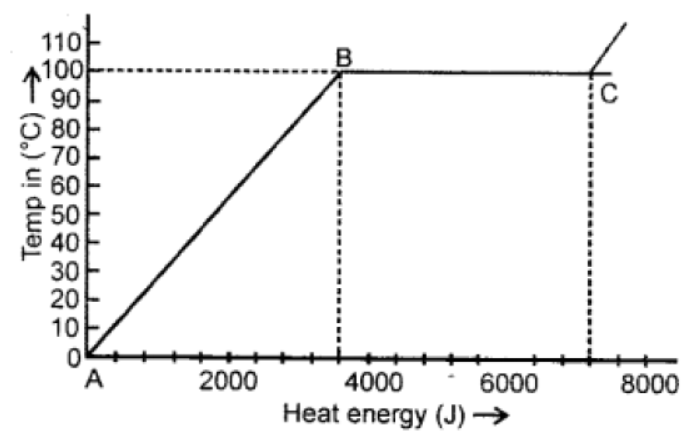
Answer: Let us analyze the temperature-heat graph of the heating process:
- **Region AB (Solid heating stage):**
The temperature rises from \( 0^\circ\text{C} \) to \( 100^\circ\text{C} \) (melting point).
Temperature rise, \( \Delta T = 100^\circ\text{C} - 0^\circ\text{C} = 100^\circ\text{C} \)
Heat supplied, \( Q_1 = 3600\ \text{J} \)
Specific heat capacity of solid, \( c = 0.8\ \text{J g}^{-1}\ ^\circ\text{C}^{-1} \)
- **Region BC (Melting stage at constant temperature):**
Melting takes place at a constant \( 100^\circ\text{C} \).
Heat supplied during melting, \( Q_2 = 7200\ \text{J} - 3600\ \text{J} = 3600\ \text{J} \)
**(a) Calculate the mass of the solid (\( m \)):**
Using the sensible heat formula for region AB:
\( Q_1 = m \cdot c \cdot \Delta T \)
\( 3600 = m \times 0.8 \times 100 \)
\( 3600 = 80 \times m \)
\( m = \frac{3600}{80} = 45\ \text{g} \)
**(b) Calculate the specific latent heat of fusion of the solid (\( L \)):**
Using the latent heat formula for region BC:
\( Q_2 = m \cdot L \)
\( 3600 = 45 \times L \)
\( L = \frac{3600}{45} = 80\ \text{J g}^{-1} \)
In simple words: From the graph, heating the solid from 0°C to 100°C takes 3600 joules of heat. This lets us calculate that the mass is 45 grams. Then, the flat horizontal part of the graph shows that melting also takes 3600 joules, which gives us a specific latent heat of 80 J/g.
Exam Tip: In heating curves, the sloped regions represent temperature changes (\( Q = mc\Delta T \)), while the flat horizontal plateaus represent phase changes (\( Q = mL \)) at a constant temperature.
Question 2. A solid initially at 60°C is heated. The graph shows variation in temperature with the amount of heat energy supplied. If the specific heat capacity of solid is 1.2 Jg1 °C-1, from the graph, calculate (i) the mass of solid and (ii) specific latent heat offusion of solid.
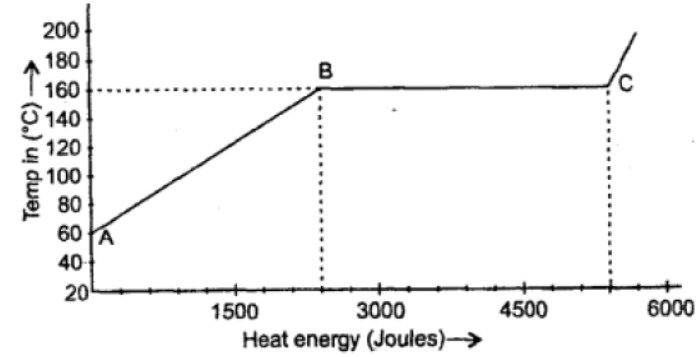
Answer: By analyzing the temperature-heat graph:
- **Sloped Region AB (Heating stage):**
The temperature rises from \( 60^\circ\text{C} \) to \( 160^\circ\text{C} \).
Temperature rise, \( \Delta T = 160^\circ\text{C} - 60^\circ\text{C} = 100^\circ\text{C} \)
Heat supplied, \( Q_1 = 2400\ \text{J} \)
Specific heat capacity of solid, \( c = 1.2\ \text{J g}^{-1}\ ^\circ\text{C}^{-1} \)
- **Flat Region BC (Melting stage):**
The horizontal line shows phase change at a constant temperature of \( 160^\circ\text{C} \).
Heat supplied during melting, \( Q_2 = 5400\ \text{J} - 2400\ \text{J} = 3000\ \text{J} \)
**(i) Calculate the mass of the solid (\( m \)):**
Using the sensible heat formula:
\( Q_1 = m \cdot c \cdot \Delta T \)
\( 2400 = m \times 1.2 \times 100 \)
\( 2400 = 120 \times m \)
\( m = \frac{2400}{120} = 20\ \text{g} \)
**(ii) Calculate the specific latent heat of fusion of the solid (\( L \)):**
Using the latent heat formula:
\( Q_2 = m \cdot L \)
\( 3000 = 20 \times L \)
\( L = \frac{3000}{20} = 150\ \text{J g}^{-1} \)
In simple words: According to the graph, raising the temperature from 60°C to 160°C takes 2400 joules of heat, which lets us find that the mass is 20 grams. The flat part shows that melting the solid at 160°C takes 3000 joules, giving a specific latent heat of 150 J/g.
Exam Tip: To calculate the heat used for melting from a graph, always subtract the heat at the start of the horizontal line from the heat at the end of the line (e.g., \( 5400\ \text{J} - 2400\ \text{J} \)).
Practice Problems 4
Question 1. Water at 80°C is poured into a bucket containing 1.5 kg of crushed ice at 0°C, such that all the ice melts and the final temperature records is 0°C. Calculate the amount of hot water added to the ice.
[Take sp. H.C. of water 4200 J g-1 °C-1 and sp. latent heat of ice = 336 × 103 J kg-1]
Answer: Let the mass of hot water added be \( x\ \text{kg} \).
The hot water cools down from \( 80^\circ\text{C} \) to \( 0^\circ\text{C} \) during the process. The heat released by this hot water (\( Q_{\text{released}} \)) is:
\( Q_{\text{released}} = m \cdot c_w \cdot \Delta T_w = x \times 4200\ \text{J kg}^{-1}\ ^\circ\text{C}^{-1} \times (80 - 0)^\circ\text{C} \)
\( Q_{\text{released}} = x \times 4200 \times 80 = 336,000 x\ \text{J} \)
The crushed ice at \( 0^\circ\text{C} \) melts completely into water at \( 0^\circ\text{C} \). The heat absorbed for this melting process (\( Q_{\text{absorbed}} \)) is:
\( Q_{\text{absorbed}} = m_{\text{ice}} \cdot L = 1.5\ \text{kg} \times 336 \times 10^3\ \text{J kg}^{-1} \)
\( Q_{\text{absorbed}} = 504,000\ \text{J} \)
According to the principle of calorimetry:
\( Q_{\text{released}} = Q_{\text{absorbed}} \)
\( 336,000 x = 504,000 \)
\( x = \frac{504,000}{336,000} = 1.5\ \text{kg} \)
Therefore, the mass of hot water added to the ice is \( 1.5\ \text{kg} \).
In simple words: The heat released as the hot water cools down to 0°C is equal to the heat absorbed by the ice to melt. Equating these two values, we calculate that exactly 1.5 kilograms of hot water must be added.
Exam Tip: Identify the state of each component at the start and end. Since the final mixture is at 0°C, the ice only undergoes a change of state (\( mL \)), while the hot water undergoes a change of temperature (\( mc\Delta T \)).
Question 2. 1.6 kg of boiling water at 100°C is poured into 2 kg of crushed ice at [336 × 103 J kg-1]0 °C, such that final temperature recorded is 0°C. Calculate the specific heat of ice.
Answer: Let \( L \) represent the specific latent heat of fusion of ice.
According to the principle of calorimetry, the heat lost by the boiling water as it cools from \( 100^\circ\text{C} \) to \( 0^\circ\text{C} \) is equal to the heat absorbed by the crushed ice as it melts at \( 0^\circ\text{C} \):
\( \text{Heat gained by ice} = \text{Heat lost by boiling water} \)
\( m_{\text{ice}} \cdot L = m_{\text{water}} \cdot c_w \cdot \Delta T \)
Given:
- Mass of water, \( m_{\text{water}} = 1.6\ \text{kg} \)
- Mass of ice, \( m_{\text{ice}} = 2\ \text{kg} \)
- Specific heat capacity of water, \( c_w = 4200\ \text{J kg}^{-1}\ ^\circ\text{C}^{-1} \)
- Temperature change of boiling water, \( \Delta T = 100^\circ\text{C} - 0^\circ\text{C} = 100^\circ\text{C} \)
Substituting these values into the equation:
\( 2 \times L = 1.6 \times 4200 \times 100 \)
\( 2L = 672000 \)
\( L = \frac{672000}{2} = 336000\ \text{J kg}^{-1} \)
Thus, the calculated value is \( 336 \times 10^3\ \text{J kg}^{-1} \).
In simple words: The boiling water cools down from 100°C to 0°C, releasing 672,000 joules of heat. All of this heat is absorbed by the 2 kilograms of ice to melt, giving a specific latent heat of fusion of 336,000 J/kg.
Exam Tip: Though the question text asks to 'calculate the specific heat of ice' due to a textbook printing error, the numerical solution calculates the 'specific latent heat of fusion of ice' (\( L \)). Follow the standard \( mL = mc\Delta T \) working to get full marks.
Practice Problems 5
Question 1. 40 g of ice at - 10° C is heated by a heater of power 250 W, such that water formed from it, attains the temp, equal to the boiling point of water. For how long is the heater switched on?
[Sp. h.c. of ice = 2 Jg-1 °C-1 ; Sp. latent heat of ice = 340 Jg-1]
Answer: The entire process can be divided into three consecutive stages:
1. **Stage 1: Warming the ice from \(-10^\circ\text{C}\) to \(0^\circ\text{C}\) (\( Q_1 \)):**
Using \( Q_1 = m \cdot c_{\text{ice}} \cdot \Delta T_1 \):
\( Q_1 = 40\ \text{g} \times 2\ \text{J g}^{-1}\ ^\circ\text{C}^{-1} \times [0 - (-10)]^\circ\text{C} \)
\( Q_1 = 40 \times 2 \times 10 = 800\ \text{J} \)
2. **Stage 2: Melting the ice at \(0^\circ\text{C}\) to water at \(0^\circ\text{C}\) (\( Q_2 \)):**
Using \( Q_2 = m \cdot L_{\text{ice}} \):
\( Q_2 = 40\ \text{g} \times 340\ \text{J g}^{-1} = 13600\ \text{J} \)
3. **Stage 3: Heating the water from \(0^\circ\text{C}\) to its boiling point of \(100^\circ\text{C}\) (\( Q_3 \)):**
Using \( Q_3 = m \cdot c_w \cdot \Delta T_2 \):
\( Q_3 = 40\ \text{g} \times 4.2\ \text{J g}^{-1}\ ^\circ\text{C}^{-1} \times (100 - 0)^\circ\text{C} \)
\( Q_3 = 40 \times 4.2 \times 100 = 16800\ \text{J} \)
**Total heat energy required (\( Q_{\text{total}} \)):**
\( Q_{\text{total}} = Q_1 + Q_2 + Q_3 \)
\( Q_{\text{total}} = 800\ \text{J} + 13600\ \text{J} + 16800\ \text{J} = 31200\ \text{J} \)
**Calculating time (\( t \)):**
Given the power of the heater is \( P = 250\ \text{W} = 250\ \text{J/s} \):
\( t = \frac{\text{Energy consumed}}{\text{Power}} = \frac{31200\ \text{J}}{250\ \text{J/s}} = 124.8\ \text{s} \)
Therefore, the heater must be switched on for \( 124.8\ \text{seconds} \).
In simple words: Heating the ice to 0°C takes 800 joules. Melting it takes 13,600 joules, and boiling the water takes 16,800 joules, adding up to 31,200 joules total. With a 250-watt heater supplying 250 joules per second, it takes 124.8 seconds.
Exam Tip: In multi-stage thermal calculations, clearly label each intermediate heat quantity (\( Q_1, Q_2, Q_3 \)) and specify the different specific heat constants for ice and water to prevent calculation mix-ups.
Question 2. An immersion heater is placed in crushed ice at - 40°C, contained in a perpex jar, such that water at 50°C is formed. If the power of heater is 200 W and it is switched on for 3 min. and 20s. Calculate the initial mass of ice S.H.C. of ice - 2.1 Jg-1 °C-1 and latent heat of ice = 336 Jg-1
Answer: Let the initial mass of the ice be \( m\ \text{g} \).
The heating process consists of three successive stages:
1. **Stage 1: Raising the ice temperature from \(-40^\circ\text{C}\) to \(0^\circ\text{C}\) (\( Q_1 \)):**
\( Q_1 = m \cdot c_{\text{ice}} \cdot \Delta T_1 = m \times 2.1\ \text{J g}^{-1}\ ^\circ\text{C}^{-1} \times 40^\circ\text{C} = 84m\ \text{J} \)
2. **Stage 2: Melting the ice at \(0^\circ\text{C}\) to water at \(0^\circ\text{C}\) (\( Q_2 \)):**
\( Q_2 = m \cdot L_{\text{ice}} = m \times 336\ \text{J g}^{-1} = 336m\ \text{J} \)
3. **Stage 3: Heating the water from \(0^\circ\text{C}\) to \(50^\circ\text{C}\) (\( Q_3 \)):**
\( Q_3 = m \cdot c_{\text{water}} \cdot \Delta T_2 = m \times 4.2\ \text{J g}^{-1}\ ^\circ\text{C}^{-1} \times 50^\circ\text{C} = 210m\ \text{J} \)
**Total heat energy required (\( Q_{\text{total}} \)):**
\( Q_{\text{total}} = 84m + 336m + 210m = 630m\ \text{J} \)
**Energy supplied by the immersion heater:**
- Heater Power, \( P = 200\ \text{W} = 200\ \text{J/s} \)
- Time duration, \( t = 3\ \text{minutes}\ 20\ \text{seconds} = (3 \times 60) + 20 = 200\ \text{seconds} \)
\( \text{Energy supplied} = P \times t = 200\ \text{J/s} \times 200\ \text{s} = 40000\ \text{J} \)
Equating the energy required to the energy supplied:
\( 630m = 40000 \)
\( m = \frac{40000}{630} \approx 63.49\ \text{g} \)
Therefore, the initial mass of the ice is \( 63.49\ \text{g} \).
In simple words: Heating, melting, and warming the ice to 50°C requires a total of 630m joules, where m is the mass in grams. The heater supplies 40,000 joules in 200 seconds. Equating the two, the starting mass of the ice is calculated to be 63.49 grams.
Exam Tip: In calorimetry equations, keep the mass variable \( m \) as a multiplier in each term, then factor it out to simplify the equation: \( Q_{\text{total}} = m(c_{\text{ice}}\Delta T_1 + L + c_{\text{water}}\Delta T_2) \).
Question 3. A burner supplies heat energy at a rate of 434 JS-1 for 60 seconds when 40 g of ice at 0°C changes to water at 75°C. Calculate latent heat of ice.
Answer: Given:
- Power of the burner, \( P = 434\ \text{J s}^{-1} \)
- Time duration, \( t = 60\ \text{s} \)
- Mass of ice, \( m = 40\ \text{g} \)
- Initial temperature, \( T_1 = 0^\circ\text{C} \)
- Final temperature of water, \( T_2 = 75^\circ\text{C} \)
- Specific heat capacity of water, \( c_w = 4.2\ \text{J g}^{-1}\ ^\circ\text{C}^{-1} \)
The total heat energy \( Q \) supplied by the burner is:
\( Q = P \times t = 434\ \text{J s}^{-1} \times 60\ \text{s} = 26040\ \text{J} \)
This supplied heat is spent in two stages:
1. **Melting the ice at \(0^\circ\text{C}\) to water at \(0^\circ\text{C}\) (\( Q_1 \)):**
\( Q_1 = m \cdot L_{\text{ice}} = 40 \times L_{\text{ice}} \)
2. **Warming the melted water from \(0^\circ\text{C}\) to \(75^\circ\text{C}\) (\( Q_2 \)):**
\( Q_2 = m \cdot c_w \cdot \Delta T = 40\ \text{g} \times 4.2\ \text{J g}^{-1}\ ^\circ\text{C}^{-1} \times (75 - 0)^\circ\text{C} = 12600\ \text{J} \)
According to the energy balance equation:
\( Q_{\text{total}} = Q_1 + Q_2 \)
\( 26040 = 40 L_{\text{ice}} + 12600 \)
\( 40 L_{\text{ice}} = 26040 - 12600 \)
\( 40 L_{\text{ice}} = 13440 \)
\( L_{\text{ice}} = \frac{13440}{40} = 336\ \text{J g}^{-1} \)
Therefore, the specific latent heat of fusion of ice is \( 336\ \text{J g}^{-1} \).
In simple words: The burner supplies 26,040 joules of heat in one minute. Of this, 12,600 joules are used to heat the water to 75°C, leaving 13,440 joules to melt the 40 grams of ice. This means the latent heat of ice is 336 J/g.
Exam Tip: When working backwards to find the latent heat \( L \), calculate the sensible heating part \( mc\Delta T \) first, then subtract it from the total energy before solving for \( L \).
Practice Problems 6
Question 1. A vessel of mass 80 g (S.H.C. =0.8 Jg-1 °C-1) contains 250 g of water at 35°C. Calculate the amount of ice at 0°C, which must be added to it, so that final temperature is 5°C.
[Sp. latent heat of ice = 340 Jg-1]
Answer: Let the mass of ice added be \( M\ \text{g} \).
When ice is added to the water in the vessel:
1. **Heat absorbed by the ice to melt and then warm to \(5^\circ\text{C}\) (\( Q_{\text{gained}} \)):**
- Heat to melt ice at \(0^\circ\text{C}\): \( M \cdot L = M \times 340\ \text{J} \)
- Heat to warm the melted water from \(0^\circ\text{C}\) to \(5^\circ\text{C}\): \( M \cdot c_w \cdot \Delta T_{\text{melted}} = M \times 4.2\ \text{J g}^{-1}\ ^\circ\text{C}^{-1} \times (5 - 0)^\circ\text{C} = 21M\ \text{J} \)
\( Q_{\text{gained}} = M(340 + 21) = 361M\ \text{J} \)
2. **Heat released by the vessel and the water as they cool from \(35^\circ\text{C}\) to \(5^\circ\text{C}\) (\( Q_{\text{lost}} \)):**
The temperature drop is:
\( \Delta T_{\text{cool}} = 35^\circ\text{C} - 5^\circ\text{C} = 30^\circ\text{C} \)
- Heat lost by water: \( m_{\text{water}} \cdot c_w \cdot \Delta T_{\text{cool}} = 250\ \text{g} \times 4.2\ \text{J g}^{-1}\ ^\circ\text{C}^{-1} \times 30^\circ\text{C} = 31500\ \text{J} \)
- Heat lost by vessel: \( m_{\text{vessel}} \cdot c_{\text{vessel}} \cdot \Delta T_{\text{cool}} = 80\ \text{g} \times 0.8\ \text{J g}^{-1}\ ^\circ\text{C}^{-1} \times 30^\circ\text{C} = 1920\ \text{J} \)
\( Q_{\text{lost}} = 31500 + 1920 = 33420\ \text{J} \)
According to the principle of calorimetry:
\( Q_{\text{gained}} = Q_{\text{lost}} \)
\( 361M = 33420 \)
\( M = \frac{33420}{361} \approx 92.57\ \text{g} \)
Therefore, the mass of ice that must be added is \( 92.57\ \text{g} \).
In simple words: The water and the container cool down, releasing a total of 33,420 joules of heat. This energy is absorbed by the added ice to melt and warm up to 5°C. Equating the heat gained to the heat lost, we find that 92.57 grams of ice must be added.
Exam Tip: Remember that the ice added undergoes two stages: first it absorbs latent heat to melt (\( mL \)), and then the resulting water absorbs sensible heat (\( mc\Delta T \)) as its temperature rises to the final mixture temperature.
Question 2. A vessel of mass 100 g (S.H.C. = 0.2 cal g-1 °C-1] contains 500 g of water at 37°C. Calculate the amount of ice, which should be added to the vessel, so that the final temperature is 17°C.
[S.H.C. of water = 1 cal g-1 °C-1 and S.L.H. of ice = 80 cal g-1]
Answer: Let the mass of ice added be \( M\ \text{g} \).
Since all values are provided in CGS units, we perform calculations using calories:
1. **Heat gained by the ice to melt and then warm to \(17^\circ\text{C}\) (\( Q_{\text{gained}} \)):**
- Heat to melt ice at \(0^\circ\text{C}\): \( M \cdot L = M \times 80\ \text{cal} \)
- Heat to raise temperature of melted water from \(0^\circ\text{C}\) to \(17^\circ\text{C}\): \( M \cdot c_w \cdot \Delta T_{\text{melted}} = M \times 1\ \text{cal g}^{-1}\ ^\circ\text{C}^{-1} \times 17^\circ\text{C} = 17M\ \text{cal} \)
\( Q_{\text{gained}} = M(80 + 17) = 97M\ \text{cal} \)
2. **Heat lost by the vessel and water in cooling from \(37^\circ\text{C}\) to \(17^\circ\text{C}\) (\( Q_{\text{lost}} \)):**
The temperature drop is:
\( \Delta T_{\text{cool}} = 37^\circ\text{C} - 17^\circ\text{C} = 20^\circ\text{C} \)
- Heat lost by water: \( m_{\text{water}} \cdot c_w \cdot \Delta T_{\text{cool}} = 500\ \text{g} \times 1\ \text{cal g}^{-1}\ ^\circ\text{C}^{-1} \times 20^\circ\text{C} = 10000\ \text{cal} \)
- Heat lost by vessel: \( m_{\text{vessel}} \cdot c_{\text{vessel}} \cdot \Delta T_{\text{cool}} = 100\ \text{g} \times 0.2\ \text{cal g}^{-1}\ ^\circ\text{C}^{-1} \times 20^\circ\text{C} = 400\ \text{cal} \)
\( Q_{\text{lost}} = 10000 + 400 = 10400\ \text{cal} \)
According to the principle of calorimetry:
\( Q_{\text{gained}} = Q_{\text{lost}} \)
\( 97M = 10400 \)
\( M = \frac{10400}{97} \approx 107.2\ \text{g} \)
Therefore, the mass of ice to be added is \( 107.2\ \text{g} \).
In simple words: The warm water and the copper vessel cool down by 20°C, releasing 10,400 calories of heat. The added ice absorbs this heat to melt and warm up to 17°C. Solving this balance shows we must add 107.2 grams of ice.
Exam Tip: In CGS units, the specific heat capacity of water is exactly \( 1\ \text{cal g}^{-1}\ ^\circ\text{C}^{-1} \), which makes calculations very easy. Always ensure you are working entirely within one unit system.
Question 3. 10g of ice at 0°C is added to 10g of water at 80°C, such that the temperature of mixture is 0°C. Calculate the sp. latent heat of ice.
[S.H.C. of water = 4.2 Jg-1 °C-1]
Answer: Given:
- Mass of ice, \( m_{\text{ice}} = 10\ \text{g} \)
- Mass of water, \( m_{\text{water}} = 10\ \text{g} \)
- Initial temperature of water, \( T_1 = 80^\circ\text{C} \)
- Final temperature of the mixture, \( \theta = 0^\circ\text{C} \)
- Specific heat capacity of water, \( c_w = 4.2\ \text{J g}^{-1}\ ^\circ\text{C}^{-1} \)
Since the final temperature is \( 0^\circ\text{C} \), the ice only melts and does not experience any rise in temperature.
Using the calorimetry equation:
\( \text{Heat gained by ice to melt} = \text{Heat lost by water in cooling to } 0^\circ\text{C} \)
\( m_{\text{ice}} \cdot L_{\text{ice}} = m_{\text{water}} \cdot c_w \cdot (T_1 - \theta) \)
\( 10 \times L_{\text{ice}} = 10 \times 4.2 \times (80 - 0) \)
\( 10 \times L_{\text{ice}} = 10 \times 4.2 \times 80 \)
\( L_{\text{ice}} = 4.2 \times 80 = 336\ \text{J g}^{-1} \)
Therefore, the specific latent heat of ice is \( 336\ \text{J g}^{-1} \).
In simple words: The water cools from 80°C to 0°C, releasing 3,360 joules of heat. This heat is absorbed by the 10 grams of ice to melt completely at 0°C. Dividing the heat by the mass of ice gives a specific latent heat of 336 J/g.
Exam Tip: Since the final temperature of the mixture is exactly 0°C, the melted ice water does not undergo any warming, meaning \( Q_{\text{gained}} \) contains only the phase-change term \( mL \).
Practice Problems 7
Question 1. A metal ball of mass 0.5 kg and at 900°C is placed on a block of ice, till it attains the temperature of ice. If the S.H.C. of metal ball is 850 J kg-1 K-1, calculate the amount of ice, which melts. Take S.L.H of ice 34 × 104 J kg-1.
Answer: Given:
- Mass of the metal ball, \( m = 0.5\ \text{kg} \)
- Initial temperature of the ball, \( T_1 = 900^\circ\text{C} \)
- Final temperature (temperature of ice), \( \theta = 0^\circ\text{C} \)
- Specific heat capacity of the metal ball, \( c = 850\ \text{J kg}^{-1}\ \text{K}^{-1} \)
- Specific latent heat of fusion of ice, \( L = 34 \times 10^4\ \text{J kg}^{-1} \)
Let the mass of ice that melts be \( M\ \text{kg} \).
The temperature drop of the metal ball is:
\( \Delta T = 900^\circ\text{C} - 0^\circ\text{C} = 900^\circ\text{C} \)
Using the principle of calorimetry:
\( \text{Heat absorbed by ice to melt} = \text{Heat released by the metal ball} \)
\( M \cdot L = m \cdot c \cdot \Delta T \)
\( M \times (34 \times 10^4) = 0.5 \times 850 \times 900 \)
\( 340000 \times M = 382500 \)
\( M = \frac{382500}{340000} = 1.125\ \text{kg} \)
Therefore, the mass of ice that melts is \( 1.125\ \text{kg} \).
In simple words: The hot metal ball cools from 900°C to 0°C, releasing 382,500 joules of heat. This heat is absorbed by the ice block, causing 1.125 kilograms of ice to melt.
Exam Tip: In block of ice problems, the ice does not change temperature (it remains at 0°C), so only use the phase-change equation \( Q = mL \) for the ice.
Question 2. Calculate the temperature of a furnace, when a 400 g of copper ball, taken out from it, melts only 400 g of ice to form water at 0°C. Take S.H.C. of copper = 0.4 Jg-1 °C-1 and S.L.H. of ice = 336 Jg-1
Answer: Let the temperature of the furnace (which is the initial temperature of the copper ball) be \( T^\circ\text{C} \).
Given:
- Mass of the copper ball, \( m_{\text{copper}} = 400\ \text{g} \)
- Specific heat capacity of copper, \( c_{\text{copper}} = 0.4\ \text{J g}^{-1}\ ^\circ\text{C}^{-1} \)
- Mass of ice melted, \( m_{\text{ice}} = 400\ \text{g} \)
- Specific latent heat of fusion of ice, \( L = 336\ \text{J g}^{-1} \)
- Final temperature of the system, \( \theta = 0^\circ\text{C} \)
Using the principle of calorimetry:
\( \text{Heat lost by copper ball} = \text{Heat gained by ice to melt} \)
\( m_{\text{copper}} \cdot c_{\text{copper}} \cdot (T - \theta) = m_{\text{ice}} \cdot L \)
\( 400 \times 0.4 \times (T - 0) = 400 \times 336 \)
Since the mass of both is \( 400\ \text{g} \), we can simplify by dividing both sides by 400:
\( 0.4 \times T = 336 \)
\( T = \frac{336}{0.4} = 840^\circ\text{C} \)
Therefore, the temperature of the furnace is \( 840^\circ\text{C} \).
In simple words: The hot copper ball drops to 0°C, releasing heat to melt 400 grams of ice. Because both masses are equal, we can simplify the equation directly to show that the starting temperature of the furnace was 840°C.
Exam Tip: Check if the mass of the heating solid and the melting ice are equal. If so, they cancel out on both sides, saving you valuable time in calculations.
Question 3. A metal ball of 0.20 kg and at 200°C, when placed on an ice block melts 100 g of ice, when its temp, stops falling. If sp. latent heat of ice is 340 Jg-1. Calculate specific heat capacity of metal ball
Answer: Let the specific heat capacity of the metal ball be \( c \).
Given:
- Mass of the metal ball, \( m_{\text{ball}} = 0.20\ \text{kg} = 200\ \text{g} \)
- Initial temperature of the ball, \( T_1 = 200^\circ\text{C} \)
- Mass of ice melted, \( m_{\text{ice}} = 100\ \text{g} \)
- Specific latent heat of fusion of ice, \( L = 340\ \text{J g}^{-1} \)
- Final temperature of the ball, \( \theta = 0^\circ\text{C} \)
Using the principle of calorimetry:
\( \text{Heat lost by metal ball} = \text{Heat gained by ice to melt} \)
\( m_{\text{ball}} \cdot c \cdot (T_1 - \theta) = m_{\text{ice}} \cdot L \)
\( 200 \times c \times (200 - 0) = 100 \times 340 \)
\( 40000 \times c = 34000 \)
\( c = \frac{34000}{40000} = 0.85\ \text{J g}^{-1}\ ^\circ\text{C}^{-1} \)
Therefore, the specific heat capacity of the metal ball is \( 0.85\ \text{J g}^{-1}\ ^\circ\text{C}^{-1} \).
In simple words: The metal ball cools down by 200°C, releasing heat to melt 100 grams of ice. Equating the heat lost to the heat gained, we find the specific heat capacity of the metal is 0.85 J/(g·°C).
Exam Tip: Be sure to convert the mass of the metal ball from kilograms to grams (\( 0.20\ \text{kg} = 200\ \text{g} \)) so that all mass units are consistent with the latent heat unit (\( \text{J/g} \)).
Practice Problems 8
Question 1. A 30 watt immersion heater just keeps 600 g of molten metal at its melting point. The heater is switched off and the temperature starts falling after 6 min. Calculate sp. latent heat of fusion of the metal
Answer: Given:
- Power of the immersion heater, \( P = 30\ \text{W} = 30\ \text{J/s} \)
- Mass of the molten metal, \( m = 600\ \text{g} \)
- Time taken to solidify, \( t = 6\ \text{minutes} = 6 \times 60 = 360\ \text{seconds} \)
The total heat energy \( Q \) lost by the metal during solidification is equal to the electrical energy that was keeping it molten:
\( Q = P \times t = 30\ \text{W} \times 360\ \text{s} = 10800\ \text{J} \)
Let \( L \) be the specific latent heat of fusion of the metal. During phase change:
\( Q = m \cdot L \)
\( 10800 = 600 \times L \)
\( L = \frac{10800}{600} = 18\ \text{J g}^{-1} \)
Therefore, the specific latent heat of fusion of the metal is \( 18\ \text{J g}^{-1} \).
In simple words: Since the 30-watt heater keeps the metal molten, turning it off means the metal loses 10,800 joules of heat in 6 minutes to solidify. Dividing this energy by the 600 g of metal gives a latent heat of 18 J/g.
Exam Tip: The energy supplied to keep a substance at its melting point is equal to the latent heat lost during solidification: \( P \times t = mL \).
Question 2. A hydrocarbon of mass 1.5 kg is just kept in molten state by a heater of 500 W. If the heater is switched off, the temperature starts dropping after 4 mins. Calculate sp. latent heat of fusion of hydrocarbon.
Answer: Given:
- Mass of the hydrocarbon, \( m = 1.5\ \text{kg} \)
- Power of the heater, \( P = 500\ \text{W} = 500\ \text{J/s} \)
- Time taken to solidify, \( t = 4\ \text{minutes} = 4 \times 60 = 240\ \text{seconds} \)
The heat energy \( Q \) lost by the hydrocarbon during solidification is equal to the energy supplied by the heater:
\( Q = P \times t = 500\ \text{W} \times 240\ \text{s} = 120000\ \text{J} \)
Let \( L \) be the specific latent heat of fusion of the hydrocarbon:
\( Q = m \cdot L \)
\( 120000 = 1.5 \times L \)
\( L = \frac{120000}{1.5} = 80000\ \text{J kg}^{-1} \)
Therefore, the specific latent heat of fusion of the hydrocarbon is \( 80000\ \text{J kg}^{-1} \).
In simple words: The heater supplies 120,000 joules of energy to keep the hydrocarbon molten. Once turned off, the hydrocarbon loses this same amount of heat to solidify in 4 minutes. Dividing this heat by the mass gives a latent heat of 80,000 J/kg.
Exam Tip: Solidification is the reverse of fusion. The heat released during solidification is mathematically identical to the latent heat of fusion absorbed during melting.
Practice Problems 9
Question 1. 500 g of water at 60°C is contained in a vessel of negligible heat capacity. Into this water is added 400 g of ice at 0°C. Calculate the amount of ice which does not melt.
[Take SHC of water = 4.2 J g-1 °C-1 and SLH of ice = 336 Jg-1]
Answer: Given:
- Mass of water, \( m_w = 500\ \text{g} \)
- Initial temperature of water, \( T_w = 60^\circ\text{C} \)
- Mass of ice added, \( m_{\text{ice}} = 400\ \text{g} \)
- Specific heat capacity of water, \( c_w = 4.2\ \text{J g}^{-1}\ ^\circ\text{C}^{-1} \)
- Specific latent heat of fusion of ice, \( L = 336\ \text{J g}^{-1} \)
First, calculate the maximum heat energy \( Q_{\text{lost}} \) that the water can release if it cools all the way down to \( 0^\circ\text{C} \):
\( Q_{\text{lost}} = m_w \cdot c_w \cdot (T_w - 0) \)
\( Q_{\text{lost}} = 500\ \text{g} \times 4.2\ \text{J g}^{-1}\ ^\circ\text{C}^{-1} \times 60^\circ\text{C} = 126000\ \text{J} \)
Let \( m' \) be the mass of ice that can be melted by this heat:
\( Q_{\text{lost}} = m' \cdot L \)
\( 126000 = m' \times 336 \)
\( m' = \frac{126000}{336} = 375\ \text{g} \)
Since only \( 375\ \text{g} \) of ice melts out of the total \( 400\ \text{g} \) added:
\( \text{Amount of unmelted ice} = m_{\text{ice}} - m' = 400\ \text{g} - 375\ \text{g} = 25\ \text{g} \)
Therefore, the amount of ice which does not melt is \( 25\ \text{g} \).
In simple words: The warm water can release a maximum of 126,000 joules of heat as it cools to 0°C. This energy is only enough to melt 375 grams of ice. Since 400 grams of ice was added, 25 grams of ice will remain unmelted.
Exam Tip: In ice-mixture problems, always check if the warm water has enough energy to melt all the ice. If not, the final mixture temperature is guaranteed to be 0°C with some ice remaining.
Question 2. 2 kg of water at 100° is contained in a vessel of negligible heat capacity. Into this water is added 3 kg of ice at 0°C. Calculate the amount of water at 0°C at the end of experiment.
[Take SHC of water = 4.2 J g-1 °C-1 and SLH of ice = 336 × 103 J]
Answer: Given:
- Mass of water, \( m_w = 2\ \text{kg} \)
- Initial temperature of water, \( T_w = 100^\circ\text{C} \)
- Mass of ice added, \( m_{\text{ice}} = 3\ \text{kg} \)
- Specific heat capacity of water, \( c_w = 4200\ \text{J kg}^{-1}\ \text{K}^{-1} \)
- Specific latent heat of fusion of ice, \( L = 3.36 \times 10^5\ \text{J kg}^{-1} \)
First, calculate the maximum heat energy \( Q_{\text{lost}} \) released by the boiling water as it cools to \( 0^\circ\text{C} \):
\( Q_{\text{lost}} = m_w \cdot c_w \cdot (T_w - 0) \)
\( Q_{\text{lost}} = 2\ \text{kg} \times 4200\ \text{J kg}^{-1}\ \text{K}^{-1} \times 100^\circ\text{C} = 840000\ \text{J} \)
Let \( M \) be the mass of ice that melts using this heat:
\( Q_{\text{lost}} = M \cdot L \)
\( 840000 = M \times 3.36 \times 10^5 \)
\( M = \frac{840000}{336000} = 2.5\ \text{kg} \)
The total mass of liquid water at \( 0^\circ\text{C} \) at the end of the experiment is the sum of the initial water and the newly melted ice:
\( \text{Total water} = m_w + M = 2\ \text{kg} + 2.5\ \text{kg} = 4.5\ \text{kg} \)
Therefore, the amount of water at \( 0^\circ\text{C} \) is \( 4.5\ \text{kg} \).
In simple words: The boiling water cools to 0°C, releasing 840,000 joules of heat. This melts 2.5 kg of the added ice. Adding this newly melted ice to the original 2 kg of water gives a total of 4.5 kg of liquid water at the end.
Exam Tip: Remember that the final mass of liquid water includes BOTH the original water and the water formed by the melting of the ice.
Practice Problems 10
Question 1. A vessel with a negligible heat capacity contains 1000 g ice at 0°C. Into it is poured 100 g of water at 100°C. What would be the result at the end of experiment ?
[Take SHC of water = 4.2 J g-1 °C-1 and SLH of ice = 336 Jg-1 ]
Answer: Given:
- Mass of ice, \( m_{\text{ice}} = 1000\ \text{g} \)
- Mass of hot water, \( m_w = 100\ \text{g} \)
- Temperature of hot water, \( T_w = 100^\circ\text{C} \)
- Specific heat capacity of water, \( c_w = 4.2\ \text{J g}^{-1}\ ^\circ\text{C}^{-1} \)
- Specific latent heat of fusion of ice, \( L = 336\ \text{J g}^{-1} \)
First, calculate the maximum heat energy \( Q_{\text{lost}} \) released by the boiling water as it cools to \( 0^\circ\text{C} \):
\( Q_{\text{lost}} = m_w \cdot c_w \cdot (T_w - 0) \)
\( Q_{\text{lost}} = 100\ \text{g} \times 4.2\ \text{J g}^{-1}\ ^\circ\text{C}^{-1} \times 100^\circ\text{C} = 42000\ \text{J} \)
Next, calculate the heat required to melt the entire \( 1000\ \text{g} \) of ice:
\( Q_{\text{melt\_all}} = m_{\text{ice}} \cdot L = 1000\ \text{g} \times 336\ \text{J g}^{-1} = 336000\ \text{J} \)
Since the available heat (\( 42000\ \text{J} \)) is much less than the heat required to melt all the ice (\( 336000\ \text{J} \)), only a fraction of the ice will melt, and the final temperature of the mixture will remain at \( 0^\circ\text{C} \).
Let \( M \) be the mass of ice that actually melts:
\( Q_{\text{lost}} = M \cdot L \)
\( 42000 = M \times 336 \)
\( M = \frac{42000}{336} = 125\ \text{g} \)
The remaining unmelted ice is:
\( \text{Unmelted ice} = 1000\ \text{g} - 125\ \text{g} = 875\ \text{g} \)
Thus, at the end of the experiment:
- The final temperature of the mixture is \( 0^\circ\text{C} \).
- The mixture contains \( 875\ \text{g} \) of unmelted ice and \( 225\ \text{g} \) of water (\( 100\ \text{g} \) original + \( 125\ \text{g} \) melted).
In simple words: The boiling water only has enough heat (42,000 joules) to melt 125 grams of the ice. The remaining 875 grams of ice do not melt, and the entire mixture stays cold at a final temperature of 0°C.
Exam Tip: When some ice remains unmelted at the end of the heat exchange, the system exists in a state of phase equilibrium, meaning the final temperature of the mixture is always exactly 0°C.
Question 2. What will be the result whn 400 g of copper clips at 500°C with 800 g of crushed ice at 0°C ? [ Sp. heat capacity of copper = 0.42 J g-1 K-1, Sp. latent heat of fusion of ice = 340 J g-1 ]
Answer: We first find the total thermal energy given up by the copper clips as they cool to 0°C: \( Q = m c (T - 0) \) \( Q = 400 \times 0.42 \times (500 - 0) = 84000 \text{ J} \) Now we calculate the energy needed to turn all 800 g of ice into water at 0°C: \( Q_{\text{melt}} = m_{\text{ice}} L = 800 \times 340 = 272000 \text{ J} \) Since the heat needed (\( 272000 \text{ J} \)) is greater than the heat available from the copper clips (\( 84000 \text{ J} \)), only a portion of the ice will melt. Let \( m' \) represent the mass of ice that actually undergoes fusion: \( 340 m' = 84000 \)
\( \implies m' = \frac{84000}{340} \approx 247 \text{ g} \) Therefore, the remaining solid ice is: \( 800 - 247 = 553 \text{ g} \) Since ice and water coexist, the final temperature is 0°C.
In simple words: The hot copper clips do not carry enough heat to melt all the ice. They can only melt 247 g of it, so 553 g of ice remains solid, and the temperature stays at 0°C.
Exam Tip: In heat transfer problems, always compare the maximum available heat from the hot body with the total heat required for a complete phase change of the cold body to determine if a full state change is possible.
Questions from ICSE Examination papers 2006
Question 1. Give two reasons as to why copper Le preferred over other metals for making calorimeters.
Answer: 1. Copper has an extremely low specific heat capacity (\( 0.093 \text{ cal g}^{-1} \text{ }^{\circ}\text{C}^{-1} \)) and is a superb conductor. This allows it to quickly reach the same temperature as its contents. 2. Because of its low specific heat capacity, the calorimeter absorbs a negligible amount of heat energy from the mixture inside it to reach thermal equilibrium.
In simple words: Copper is used because it transfers heat very quickly and absorbs almost no heat itself, which keeps the temperature readings of the mixture inside highly accurate.
Exam Tip: When asked why copper is used for calorimeters, always highlight two key properties: its high thermal conductivity and its very low specific heat capacity.
Question 2. Calculate the amount of heat released when 5.0 g of water at 20°C is changed to ice at 0°C. (Specific heat capacity of water = 4.2 Jg-1 °C-1) [ Sp. latent heat of fusion of ice = 336 J g-1 ]
Answer: The total thermal energy emitted comprises two parts: first, cooling the liquid water from 20°C to 0°C, and second, freezing the water into ice at 0°C. Given parameters: - Mass (\( m \)) = \( 5 \text{ g} \) - Specific heat capacity of water (\( c \)) = \( 4.2 \text{ J g}^{-1} \text{ }^{\circ}\text{C}^{-1} \) - Latent heat of fusion of ice (\( L \)) = \( 336 \text{ J g}^{-1} \) Total energy released: \( Q = m c \Delta T + m L \) \( Q = 5 \times 4.2 \times (20 - 0) + 5 \times 336 \) \( Q = 420 + 1680 = 2100 \text{ J} \) Thus, the energy given off is \( 2100 \text{ J} \).
In simple words: To turn 20°C water into 0°C ice, we must first cool it down to freezing point, which releases 420 J of heat, and then freeze it into solid ice, releasing another 1680 J, giving a total of 2100 J.
Exam Tip: Do not forget that phase change problems involving a temperature change always require a two-step calculation: one using \( mc\Delta T \) for the temperature drop, and another using \( mL \) for the change of state.
Question 3. A piece of iron of mass 2 kg has a thermal capacity of 966 J°C-1.
(a) How much heat is needed to warm it by 15°C ?
(b) What is its specific heat capacity in S.I. units ?
(c) What is the principle calorimetry ?
Answer: (a) Given: - Mass of the iron piece (\( m \)) = \( 2 \text{ kg} \) - Heat capacity (\( C' \)) = \( 966 \text{ J }^{\circ}\text{C}^{-1} \) - Increase in temperature (\( \Delta T \)) = \( 15 \text{ }^{\circ}\text{C} \) The heat energy required is given by: \( Q = C' \times \Delta T = 966 \times 15 = 14490 \text{ J} \) (b) The formula for specific heat capacity (\( c \)) is: \( c = \frac{C'}{m} = \frac{966}{2} = 483 \text{ J kg}^{-1} \text{ K}^{-1} \) (or \( \text{J kg}^{-1} \text{ }^{\circ}\text{C}^{-1} \)) (c) Under ideal conditions with no external thermal loss, the principle of calorimetry states: Heat given out by the hot substance = Heat absorbed by the cold substance.
In simple words: (a) To heat the iron by 15°C, we multiply its heat capacity by 15 to get 14,490 J. (b) Dividing this heat capacity by its mass of 2 kg gives a specific heat capacity of 483 J/kg°C. (c) The main rule of calorimetry is that all heat lost by hot things must equal the heat gained by cold things.
Exam Tip: Be careful with units: heat capacity is expressed in \( \text{J }^{\circ}\text{C}^{-1} \), while specific heat capacity must include the unit of mass, \( \text{J kg}^{-1} \text{ K}^{-1} \).
Question 4. Explain why water is used in hot water bottles for fomentation and also as a universal coolant.
Answer: Water has an exceptionally high specific heat capacity of about \( 4200 \text{ J kg}^{-1} \text{ K}^{-1} \). This property allows it to store a large amount of thermal energy and release it very gradually, making it ideal for hot water bottles during fomentation. Similarly, it can absorb substantial heat from its surroundings without a rapid rise in its own temperature, which makes it a highly efficient coolant.
In simple words: Water can hold a huge amount of heat and cools down very slowly. This keeps hot water bottles warm for a long time and helps engines stay cool by taking away lots of heat.
Exam Tip: For conceptual questions about water's heating or cooling abilities, always explicitly state its high specific heat capacity value of \( 4200 \text{ J kg}^{-1} \text{ K}^{-1} \) as the core reason.
2007
Question 5. Some hot water was added to three times the mass of cold water at 10°C and the resulting temperature was found to be 20°C. What was the temperature of the hot water ?
Answer: Let the mass of the hot water be \( m \). Thus, the mass of the cold water is \( 3m \). Given parameters: - Initial temperature of the cold water = \( 10 \text{ }^{\circ}\text{C} \) - Equilibrium temperature of the mixture = \( 20 \text{ }^{\circ}\text{C} \) - Let \( \theta \) be the initial temperature of the hot water. The heat energy released by the hot water as it cools is: \( Q_{\text{lost}} = m \times c \times (\theta - 20) \) The heat energy absorbed by the cold water is: \( Q_{\text{gained}} = 3m \times c \times (20 - 10) = 3m \times c \times 10 \) Applying the principle of calorimetry (heat lost = heat gained): \( m \times c \times (\theta - 20) = 3m \times c \times 10 \) Dividing both sides by \( m \times c \): \( \theta - 20 = 30 \)
\( \implies \theta = 50 \text{ }^{\circ}\text{C} \) The temperature of the hot water was \( 50 \text{ }^{\circ}\text{C} \).
In simple words: Since there is three times more cold water than hot water, the cold water's temperature only goes up by 10°C. This means the hot water's temperature must drop three times as much, which is 30°C. So, the hot water started at 50°C.
Exam Tip: When using the calorimetry equation, always cancel out common terms like mass (\( m \)) and specific heat capacity (\( c \)) from both sides early to simplify your algebraic steps.
Question 6. (a) (i) What is meant by Specific heat capacity of a substance ?
(ii) Why does the heat supplied to substance during its change of state not cause any rise in its temperature? (3)
(b) A substance is in the form of a solid at 0°C. The amount of heat added to this substance and the temperature of the substance are plotted on the following graph :
If the specific heat capacity of the solid substance is 500J/kg°C, find from the graph :
1. the mass of the substance
2. the specific latent heat of fusion of the substance in the liquid state.
Answer: (a) (i) The specific heat capacity of a substance is defined as the quantity of heat energy required to raise the temperature of a unit mass (e.g., \( 1 \text{ kg} \)) of that substance by \( 1 \text{ }^{\circ}\text{C} \) (or \( 1 \text{ K} \)). (ii) During a change of state, the heat supplied to a substance is utilized solely to overcome the intermolecular forces of attraction and increase the potential energy of the molecules, rather than increasing their average kinetic energy. Since temperature is a measure of average kinetic energy, the temperature remains constant during this phase. (b) 1. From the graph, we can see that \( 800 \text{ J} \) of heat is absorbed by the solid to raise its temperature from \( 0 \text{ }^{\circ}\text{C} \) to \( 80 \text{ }^{\circ}\text{C} \). Using the heat equation: \( Q = m c \Delta T \) Where: - \( Q = 800 \text{ J} \) - \( c = 500 \text{ J kg}^{-1}\text{ }^{\circ}\text{C}^{-1} \) - \( \Delta T = 80 - 0 = 80 \text{ }^{\circ}\text{C} \) Substituting these values: \( 800 = m \times 500 \times 80 \) \( m = \frac{800}{40000} = 0.02 \text{ kg} \) (or \( 20 \text{ g} \)) 2. The horizontal part of the graph represents the phase change (melting) at a constant temperature of \( 80 \text{ }^{\circ}\text{C} \). The heat absorbed during melting is: \( Q_{\text{latent}} = 1600 - 800 = 800 \text{ J} \) Using the formula: \( Q_{\text{latent}} = m L \) Where \( m = 0.02 \text{ kg} \): \( 800 = 0.02 \times L \)
\( \implies L = \frac{800}{0.02} = 40000 \text{ J kg}^{-1} \)
In simple words: (a)(i) Specific heat is how much heat is needed to make 1 kg of a substance 1°C hotter. (ii) When a solid melts, the heat goes into breaking the bonds between molecules to turn it into liquid, so the temperature doesn't go up. (b) By looking at how much heat is needed to warm the substance and melt it, we find its mass is 0.02 kg and its latent heat of fusion is 40,000 J/kg.
Exam Tip: In phase change graphs, the flat horizontal sections represent latent heat (change of state), while the sloped sections represent sensible heat (temperature change). Always state the formula \( Q = mc\Delta T \) for the slope and \( Q = mL \) for the flat line clearly in your working.
2008
Question 7. In what way will the temperature of water at the bottom of a waterfall be different from the temperature at the top ? Give a reason for your answer.
Answer: The temperature of the water at the base of the waterfall will be slightly higher than that at the peak. The water at the top possesses gravitational potential energy. As it cascades downwards, this potential energy is converted into kinetic energy, which upon hitting the bottom is transformed into thermal energy, resulting in a temperature increase.
In simple words: As water falls from a height, its motion energy changes into heat energy when it crashes at the bottom, making the water slightly warmer at the base than at the top.
Exam Tip: Clearly trace the energy conservation sequence: Potential Energy \( \to \) Kinetic Energy \( \to \) Heat Energy to earn full marks on this standard question.
Question 8. A certain quantity of ice at 0°C is heated till it changes into steam at 100°C. Draw a time-temperature heating curve to represent it. Label the two phase changes in your graph.
Answer:
The graph above illustrates the heating curve for ice starting at \( 0 \text{ }^{\circ}\text{C} \) and converting to steam at \( 100 \text{ }^{\circ}\text{C} \). - Segment **AB** represents the phase change of ice melting into water at a constant temperature of \( 0 \text{ }^{\circ}\text{C} \) (fusion). - Segment **BC** shows the liquid water being heated from \( 0 \text{ }^{\circ}\text{C} \) to \( 100 \text{ }^{\circ}\text{C} \). - Segment **CD** depicts the phase transition where water boils and converts into steam at a constant temperature of \( 100 \text{ }^{\circ}\text{C} \) (vaporization).
In simple words: The graph shows how temperature changes over time. When ice melts at 0°C (AB) and when water boils at 100°C (CD), the line stays completely flat because the temperature doesn't change during a phase transition.
Exam Tip: Always clearly label the horizontal plateaus at \( 0 \text{ }^{\circ}\text{C} \) as "Melting of Ice" and at \( 100 \text{ }^{\circ}\text{C} \) as "Vaporization / Boiling" to secure full marks on heating curve diagrams.
Question 9.
1. Define heat capacity of a given body. What is its SI unit?
2. What is the relation between heat capacity and specific heat capacity of a substance ?
Answer: 1. The heat capacity of an object is defined as the total quantity of thermal energy needed to increase its temperature by \( 1 \text{ }^{\circ}\text{C} \) (or \( 1 \text{ K} \)). In the SI system, its unit is \( \text{J K}^{-1} \). 2. The mathematical relationship between the two is: Heat Capacity = Mass \( \times \) Specific Heat Capacity
In simple words: 1. Heat capacity is how much heat is needed to make a whole object 1°C warmer, measured in Joules per Kelvin. 2. To find it, you just multiply the object's mass by its specific heat capacity.
Exam Tip: Be sure to distinguish between heat capacity (which depends on the total mass of the object) and specific heat capacity (which is a property of the material itself and is independent of mass).
Question 10. A piece of ice of mass 40 g is dropped into 200 g of water at 50°C. Calculate the final temperature of water after all the ice has melted. (specific heat capacity of water = 4200 J/kg °C, specific latent heat of fusion of ice = 336 × 103 J/kg)
Answer: Let the final equilibrium temperature of the mixture be \( T \). Given values: - Mass of hot water (\( m_w \)) = \( 200 \text{ g} = 0.2 \text{ kg} \) - Mass of ice (\( m_i \)) = \( 40 \text{ g} = 0.04 \text{ kg} \) - Initial temperature of water = \( 50 \text{ }^{\circ}\text{C} \) - Initial temperature of ice = \( 0 \text{ }^{\circ}\text{C} \) - Specific heat capacity of water (\( c \)) = \( 4200 \text{ J kg}^{-1}\text{ }^{\circ}\text{C}^{-1} = 4.2 \text{ J g}^{-1}\text{ }^{\circ}\text{C}^{-1} \) - Specific latent heat of fusion of ice (\( L \)) = \( 336 \times 10^3 \text{ J kg}^{-1} = 336 \text{ J g}^{-1} \) **Heat absorbed by the ice to melt and warm up to \( T \):** \( Q_{\text{absorbed}} = m_i L + m_i c (T - 0) \) \( Q_{\text{absorbed}} = (40 \times 336) + (40 \times 4.2 \times T) \) \( Q_{\text{absorbed}} = 13440 + 168 T \) **Heat lost by the hot water in cooling to \( T \):** \( Q_{\text{lost}} = m_w c (50 - T) \) \( Q_{\text{lost}} = 200 \times 4.2 \times (50 - T) \) \( Q_{\text{lost}} = 840 (50 - T) = 42000 - 840 T \) **Equating heat lost and heat gained:** \( 13440 + 168 T = 42000 - 840 T \) \( 168 T + 840 T = 42000 - 13440 \) \( 1008 T = 28560 \)
\( \implies T = \frac{28560}{1008} \approx 28.33 \text{ }^{\circ}\text{C} \) So, the final temperature after all the ice has melted is \( 28.33 \text{ }^{\circ}\text{C} \).
In simple words: The hot water loses heat to melt the ice and then warm up the melted ice water. By setting the heat lost equal to the heat gained, we calculate that the final temperature of the mixture settles at 28.33°C.
Exam Tip: When given specific heat and latent heat values in SI units (\( \text{J kg}^{-1} \)), you must either convert all masses to kilograms or convert the constants to \( \text{J g}^{-1} \). Mixing units is a common source of arithmetic errors.
2009
Question 11.
(a) Why do pieces of ice added to a drink cool it much faster than ice cold water added to it ?
(b) 40g of water at 60°C is poured into a vessel containing 50g of water at 20° C. The final temperature recorded is 30°C. Calculate the thermal capacity of the vessel. (Take specific heat capacity of water as 4.2 Jg-1 °C-1 ).
Answer: (a) Every gram of ice at \( 0 \text{ }^{\circ}\text{C} \) absorbs an additional \( 336 \text{ J} \) of latent heat of fusion from the drink to melt into water at \( 0 \text{ }^{\circ}\text{C} \), compared to water already at \( 0 \text{ }^{\circ}\text{C} \). This extra absorption of energy results in a much faster cooling effect. (b) Let \( C' \) represent the thermal capacity of the vessel. **Hot water:** - Mass (\( m_1 \)) = \( 40 \text{ g} \) - Initial Temp (\( T_1 \)) = \( 60 \text{ }^{\circ}\text{C} \) **Cold water & Vessel:** - Mass of cold water (\( m_2 \)) = \( 50 \text{ g} \) - Initial Temp (\( T_2 \)) = \( 20 \text{ }^{\circ}\text{C} \) - Final Temperature of the mixture (\( T \)) = \( 30 \text{ }^{\circ}\text{C} \) - Specific heat capacity of water (\( c \)) = \( 4.2 \text{ J g}^{-1}\text{ }^{\circ}\text{C}^{-1} \) **Heat lost by the hot water:** \( Q_{\text{lost}} = m_1 \times c \times (T_1 - T) \) \( Q_{\text{lost}} = 40 \times 4.2 \times (60 - 30) = 168 \times 30 = 5040 \text{ J} \) **Heat gained by the cold water and the vessel:** \( Q_{\text{gained}} = [m_2 \times c \times (T - T_2)] + [C' \times (T - T_2)] \) \( Q_{\text{gained}} = [50 \times 4.2 \times (30 - 20)] + [C' \times (30 - 20)] \) \( Q_{\text{gained}} = [210 \times 10] + [10 C'] = 2100 + 10 C' \) **By the principle of conservation of energy (Heat lost = Heat gained):** \( 5040 = 2100 + 10 C' \) \( 10 C' = 5040 - 2100 \) \( 10 C' = 2940 \)
\( \implies C' = 294 \text{ J }^{\circ}\text{C}^{-1} \) The thermal capacity of the vessel is \( 294 \text{ J }^{\circ}\text{C}^{-1} \).
In simple words: (a) Ice cools a drink faster than cold water because ice must melt first, and melting takes a lot of extra heat (336 Joules per gram) out of the drink. (b) The hot water loses 5040 J of heat, of which the cold water takes 2100 J. The remaining 2940 J goes into warming the vessel by 10°C, meaning its heat capacity is 294 J/°C.
Exam Tip: Don't forget that both the cold water and the vessel containing it start at the same initial temperature and are warmed up together to the final mixture temperature.
Question 12.
(a) State in brief, the meaning of each of the following:
1. The heat capacity of a body is 50 J °C-1.
2. The specfic latent heat of fusion of ice is 336000 J kg-1.
3. The specific heat capacity of copper is 0.4 J g1 °C-1
(b) (i) What is the principle of the method of mixtures ?,(ii) Name the law on which this principle is based.
Answer: (a) 1. This indicates that the entire object requires \( 50 \text{ J} \) of thermal energy to increase its temperature by \( 1 \text{ }^{\circ}\text{C} \). 2. This means that \( 336000 \text{ J} \) of heat is needed to fully melt \( 1 \text{ kg} \) of ice at \( 0 \text{ }^{\circ}\text{C} \) into liquid water at the same temperature. 3. This states that \( 1 \text{ g} \) of copper needs \( 0.4 \text{ J} \) of heat energy to raise its temperature by \( 1 \text{ }^{\circ}\text{C} \). (b) (i) The principle of the method of mixtures states that in an isolated system where no thermal exchange occurs with the environment, the heat energy lost by hot substances is exactly equal to the heat energy gained by cold substances. (ii) This principle is direct consequence of the Law of Conservation of Energy.
In simple words: (a) 1. 50 J of heat makes the body 1°C warmer. 2. It takes 336,000 J of heat to melt 1 kg of ice at 0°C. 3. 1 g of copper needs 0.4 J of heat to get 1°C hotter. (b) The mixture rule says heat lost by hot things always equals heat gained by cold things, which comes from the law that energy cannot be created or destroyed.
Exam Tip: When defining specific latent heat of fusion, always specify that the melting happens at a constant temperature (i.e., at \( 0 \text{ }^{\circ}\text{C} \)) to secure full credit.
Question 12(c). Calculate the amount of ice which is required to cool 150 g of water contained in a vessel of mass 100 g at 30°C, such that the final temperature of the mixture is 5°C. (Take specific heat capacity of material of vessel as 0. 4 Jg-1 °C-1, specific latent heat of fusion of ice = 336 Jg-1, specific heat capacity of water – 4.2 J g-1 °C-1.)
Answer: Let \( m \) be the required mass of ice. **Heat lost by the water and the vessel in cooling from 30°C to 5°C:** - Temperature drop (\( \Delta T_{\text{cool}} \)) = \( 30 - 5 = 25 \text{ }^{\circ}\text{C} \) - Heat lost by water: \( Q_{\text{water}} = m_w c_w \Delta T_{\text{cool}} = 150 \times 4.2 \times 25 = 15750 \text{ J} \) - Heat lost by vessel: \( Q_{\text{vessel}} = m_v c_v \Delta T_{\text{cool}} = 100 \times 0.4 \times 25 = 1000 \text{ J} \) Total heat lost = \( 15750 + 1000 = 16750 \text{ J} \) **Heat gained by the ice to melt and then raise its temperature to 5°C:** - Heat to melt ice at 0°C: \( Q_1 = m L = m \times 336 \) - Heat to warm the melted ice from 0°C to 5°C: \( Q_2 = m c_w (5 - 0) = m \times 4.2 \times 5 = 21 m \) Total heat gained = \( 336 m + 21 m = 357 m \) **According to the principle of calorimetry:** Total Heat Gained = Total Heat Lost \( 357 m = 16750 \)
\( \implies m = \frac{16750}{357} \approx 46.92 \text{ g} \) Therefore, \( 46.92 \text{ g} \) of ice is required.
In simple words: The warm water and its container lose a total of 16,750 J of heat as they cool down. The ice absorbs this heat first to melt and then to warm up to 5°C, requiring 46.92 g of ice to balance the energy.
Exam Tip: Remember that melted ice becomes water at \( 0 \text{ }^{\circ}\text{C} \) and must be heated to the final temperature of the mixture (\( 5 \text{ }^{\circ}\text{C} \)) using the specific heat capacity of water.
2010
Question 13.
(a) (i) Define the term ‘specific latent heat of fusion of a substance.
(ii) Name the liquid which has the highest specific heat capacity.
(iii) Name two factors on which the heat absorbed or given out by a body depends.
(b) (i) An equal quantity of heat is supplied to two substances A and B. The substance A shows a greater rise in temperature. What can you say about the heat capacity of A as compared to that of B ?
(ii) What energy change would you expect to take place in the molecules of a substance when it undergoes
1. a change in its temperature ?
2. a change in its state without any change in its temperature?
(c) 50 g of ice at 0°C is added to 300g of a liquid at 30°C. What will be the final temperature of the mixture when all the ice has melted ? The specific heat capacity of the liquid as 2.65 J g-1 °C-1 while that of water is 4.2 J g-1 °C-1. Specific latent heat of fusion of ice = 336 J g-1.
Answer: (a) (i) Specific latent heat of fusion is defined as the amount of heat energy required to transition a unit mass (e.g., \( 1 \text{ kg} \)) of a substance from solid to liquid state at its melting point without any change in temperature. (ii) Water possesses the highest specific heat capacity of all ordinary liquids. (iii) The thermal energy absorbed or released by an object depends on: 1. The mass of the object. 2. The specific heat capacity of the material. 3. The temperature change of the substance. (b) (i) The heat absorbed is related to heat capacity by the equation: \( Q = \text{Heat Capacity} \times \Delta T \) Since the same amount of heat \( Q \) is supplied to both substances, their heat capacities are inversely proportional to their rise in temperature. Since substance A shows a greater temperature rise, its heat capacity must be lower than that of B. (ii) 1. **Change in temperature:** This corresponds to an increase in the average kinetic energy of the molecules of the substance. 2. **Change in state at constant temperature:** There is no change in average kinetic energy. Instead, the heat energy increases the potential energy of the molecules to break the bonds of attraction between them. (c) Let the final temperature of the mixture be \( \theta \). **Heat gained:** - Heat gained by 50 g of ice to melt at 0°C: \( Q_1 = m_i L = 50 \times 336 = 16800 \text{ J} \) - Heat gained to warm the resulting water to \( \theta \): \( Q_2 = m_i c_w (\theta - 0) = 50 \times 4.2 \times \theta = 210 \theta \) - Total heat gained = \( 16800 + 210 \theta \) **Heat lost by the liquid:** \( Q_{\text{lost}} = m_l c_l (30 - \theta) \) \( Q_{\text{lost}} = 300 \times 2.65 \times (30 - \theta) = 795 \times (30 - \theta) = 23850 - 795 \theta \) **According to the principle of calorimetry (Heat gained = Heat lost):** \( 16800 + 210 \theta = 23850 - 795 \theta \) \( 210 \theta + 795 \theta = 23850 - 16800 \) \( 1005 \theta = 7050 \)
\( \implies \theta = \frac{7050}{1005} \approx 7.01 \text{ }^{\circ}\text{C} \) The final temperature of the mixture is \( 7.01 \text{ }^{\circ}\text{C} \).
In simple words: (a) Latent heat is the energy needed to melt 1 kg of a substance without making it hotter. Water has the highest heat capacity. (b) A heats up faster than B, meaning A holds less heat per degree (lower capacity). Warming increases molecular kinetic energy, while melting increases molecular potential energy. (c) Setting the heat needed to melt and warm the ice equal to the heat lost by the liquid gives a final mixture temperature of 7.01°C.
Exam Tip: Remember that temperature is directly proportional to molecular kinetic energy, while a state change at constant temperature alters only molecular potential energy.
2011
Question 14.
(a) (i) Differentiate between heat and temperature. (ii) Define Calorimetry. (2)
(b) 200 g of hot water at 80°C is added to 300 g of cold water at 10°C. Calculate the final temperature of the water. Consider the heat taken by the container to by negligible, [specific heat capacity of water is 4200 J kg-1 °C-1]
Answer: (a) (i) Comparison between Heat and Temperature:
| Heat | Temperature |
|---|---|
| Heat is the total thermal energy transferred between systems. | Temperature is a measure of the average kinetic energy of the molecules. |
| Its SI unit is the Joule (J). | Its SI unit is the Kelvin (K). |
| It is measured using the principle of calorimetry. | It is measured using a thermometer. |
| It is an additive quantity (the total heat is the sum of individual heats). | It is not an additive quantity. |
(ii) Calorimetry is defined as the scientific technique used to measure the quantity of heat energy exchanged (absorbed or released) during chemical or physical processes. (b) Let the final temperature of the water mixture be \( T \). Given: - Mass of hot water (\( m_1 \)) = \( 200 \text{ g} = 0.2 \text{ kg} \) - Mass of cold water (\( m_2 \)) = \( 300 \text{ g} = 0.3 \text{ kg} \) - Initial temperature of hot water (\( T_1 \)) = \( 80 \text{ }^{\circ}\text{C} \) - Initial temperature of cold water (\( T_2 \)) = \( 10 \text{ }^{\circ}\text{C} \) - Specific heat capacity of water (\( c \)) = \( 4200 \text{ J kg}^{-1}\text{ }^{\circ}\text{C}^{-1} = 4.2 \text{ J g}^{-1}\text{ }^{\circ}\text{C}^{-1} \) **Heat lost by hot water:** \( Q_{\text{lost}} = m_1 \times c \times (80 - T) \) \( Q_{\text{lost}} = 200 \times 4.2 \times (80 - T) = 840 (80 - T) \) **Heat gained by cold water:** \( Q_{\text{gained}} = m_2 \times c \times (T - 10) \) \( Q_{\text{gained}} = 300 \times 4.2 \times (T - 10) = 1260 (T - 10) \) **Using the principle of calorimetry (Heat lost = Heat gained):** \( 840 (80 - T) = 1260 (T - 10) \) We can simplify by dividing both sides by 420: \( 2 (80 - T) = 3 (T - 10) \) \( 160 - 2T = 3T - 30 \) \( 5T = 190 \)
\( \implies T = \frac{190}{5} = 38 \text{ }^{\circ}\text{C} \) The final temperature of the water is \( 38 \text{ }^{\circ}\text{C} \).
In simple words: (a) Heat is the actual energy moving from hot to cold, while temperature tells us how hot or cold an object is. Calorimetry is just measuring heat flow. (b) Mixing 200 g of 80°C water with 300 g of 10°C water results in a final warm temperature of 38°C once they balance out.
Exam Tip: When distinguishing between heat and temperature, construct a neat comparison table with distinct parameters like definition, SI unit, and measurement device to secure maximum presentation marks.
Question 15. (a) (i) Explain why the weather becomes very cold after a hailstorm. (ii) What happens to the heat supplied to a substance when the heat supplied causes no change in the temperature of the substance ? (3) (b) (i) When 1 g of ice at 0 °C melts to form 1 g of water at 0 °C then, is the latent heat absorbed by the ice or given out by the ice ? (ii) Give one example where high specific heat capacity of water is used as a heat reservoir. (iii) Give one example where high specific heat capacity of water is used for cooling purposes. (3) (c) 250 g of water at 30°C is present in a copper vessel of mass 50 g. Calculate the mass of ice required to bring down the temperature of the‘ vessel and its contents to 5°C. Specific latent heat of fusion of ice = 336 × 10³ J kg⁻¹ Specific heat capacity of copper vessel = 400 J kg⁻¹ °C⁻¹ Specific heat capacity of water = 336 × 10³ J kg⁻¹ °C⁻¹ (4)
Answer: (a) (i) Following a hailstorm, the fallen ice starts melting. It absorbs a large quantity of latent heat of fusion from the surrounding atmosphere, causing the temperature of the air to drop drastically. (ii) When the supplied thermal energy does not raise the temperature, it is called latent heat. It goes toward increasing the potential energy of the molecules (weakening intermolecular forces during a state change) and doing expansion work against external atmospheric pressure. (b) (i) Latent heat is absorbed by the ice. (Water at 0°C contains more heat than ice at 0°C, because 1 g of ice absorbs 336 J of energy to turn into water). (ii) Farmers in cold climates fill their fields or wrap bottles of wine/juice in water because water has a high specific heat capacity, releasing a lot of heat before freezing and keeping them warm. (iii) Water is used in car radiators and cooling jackets of heavy machinery because its high specific heat capacity allows it to carry away large amounts of heat without boiling easily. (c) Let mass of ice be \( m \) grams. - Heat absorbed by ice to melt at 0°C and then warm to 5°C: \( Q_{\text{gained}} = m L + m c_w \Delta T_{\text{ice}} = m(336) + m(4.2)(5 - 0) = 336m + 21m = 357m \text{ J} \) - Heat lost by water and copper vessel cooling from 30°C to 5°C (\( \Delta T = 25 \text{ }^{\circ}\text{C} \)): \( Q_{\text{lost}} = (m_w c_w + m_v c_v) \Delta T \) Mass of water = 250 g, specific heat of water = 4.2 J/g°C. Mass of vessel = 50 g, specific heat of copper = 400 J/kg°C = 0.4 J/g°C. \( Q_{\text{lost}} = [250 \times 4.2 + 50 \times 0.4] \times 25 \) \( Q_{\text{lost}} = [1050 + 20] \times 25 = 1070 \times 25 = 26750 \text{ J} \) - Principle of Calorimetry: \( 357m = 26750 \) \( m = 74.93 \text{ g} \) Therefore, \( 74.93 \text{ g} \) of ice is required.
In simple words: (a) Melting hail absorbs heat from the air, making it freezing cold. Latent heat changes molecular bonds rather than temperature. (b) Melting ice absorbs heat. Water is an excellent heat reservoir and coolant due to its high heat capacity. (c) A total of 26,750 J of heat is released by the vessel and water, requiring 74.93 g of ice to absorb it and balance the system.
Exam Tip: Be extremely careful with specific heat capacity units. Water has a specific heat capacity of 4200 J/kg°C (or 4.2 J/g°C) and copper has 400 J/kg°C (or 0.4 J/g°C). Convert all units consistently.
2012
Question 16. (a) Differentiate between heat capacity and specific heat capacity
(b) A hot solid of mass 60 g at 100°C is placed in 150 g of water at 20°C. The final steady temperature recorded is 25°C. Calculate the specific heat capacity of the solid. [Specific heat capacity of water = 4200 J kg⁻¹ °C⁻¹]
Answer: (a) Comparison between Heat Capacity and Specific Heat Capacity:
| Parameter | Heat Capacity | Specific Heat Capacity |
|---|---|---|
| Definition | The amount of heat required to raise the temperature of the entire body by 1°C (or 1 K). | The amount of heat required to raise the temperature of a unit mass of the substance by 1°C (or 1 K). |
| SI Unit | \( \text{J K}^{-1} \) (or \( \text{J }^{\circ}\text{C}^{-1} \)) | \( \text{J kg}^{-1}\text{ K}^{-1} \) (or \( \text{J kg}^{-1}\text{ }^{\circ}\text{C}^{-1} \)) |
| Mass Dependency | It depends on the mass of the body and changes as mass changes. | It is a characteristic property of the material and remains constant regardless of mass. |
| Formula | \( C' = m \times c \) | \( c = \frac{C'}{m} \) |
(b) Let the specific heat capacity of the solid be \( c_s \). Converting masses to SI units: - Mass of solid (\( m_s \)) = \( 60 \text{ g} = 0.06 \text{ kg} \) - Mass of water (\( m_w \)) = \( 150 \text{ g} = 0.15 \text{ kg} \) - Temperature drop of solid (\( \Delta T_s \)) = \( 100 - 25 = 75 \text{ }^{\circ}\text{C} \) - Temperature rise of water (\( \Delta T_w \)) = \( 25 - 20 = 5 \text{ }^{\circ}\text{C} \) Using the principle of calorimetry (Heat lost = Heat gained): \( m_s c_s \Delta T_s = m_w c_w \Delta T_w \) \( 0.06 \times c_s \times 75 = 0.15 \times 4200 \times 5 \) \( 4.5 c_s = 3150 \)
\( \implies c_s = \frac{3150}{4.5} = 700 \text{ J kg}^{-1}\text{ }^{\circ}\text{C}^{-1} \) Therefore, the specific heat capacity of the solid is \( 700 \text{ J kg}^{-1}\text{ }^{\circ}\text{C}^{-1} \).
In simple words: (a) Heat capacity is for the whole object, while specific heat capacity is for exactly 1 kilogram of the material. (b) The hot solid cools down and transfers 3150 J of heat to the water. Balancing this heat loss and gain shows the solid's specific heat capacity is 700 J/kg°C.
Exam Tip: When presenting differences, always construct a comparative table. For the numerical, converting mass to kilograms (\( 60\text{ g} = 0.06\text{ kg} \) and \( 150\text{ g} = 0.15\text{ kg} \)) avoids any confusion with SI units.
Question 17. (a) (i) Write an expression for the heat energy liberated by a hot body. (ii) Some heat is provided to a body to raise its temperature by 25°C. What will be the corresponding rise in temperature of the body as shown on the kelvin scale ? (iii) What happens to the average kinetic energy of the molecules as ice melts at 0°C ? (b) A piece of ice at 0°C is heated at a constant rate and its temperature recorded at regular intervals till steam is formed at 100°C. Draw a temperature-time graph to represent the change in phase. Label the different parts of your graph. [3] (c) 40 g of ice at 0°C is used to bring down the temperature of a certain mass of water at 60°C to 10°C. Find the mass of water used. [ Specific heat capacity of water = 4200 J kg⁻¹ °C⁻¹ ] [ Specific latent heat of fusion of ice = 336 × 10³ J kg⁻¹] [4]
Answer: (a) (i) The thermal energy released is given by the formula: \( Q = m \times c \times \Delta T \) (where \( m \) is mass, \( c \) is specific heat capacity, and \( \Delta T \) is temperature drop). (ii) A temperature change of \( 25 \text{ }^{\circ}\text{C} \) corresponds to exactly \( 25 \text{ K} \) on the Kelvin scale, since the size of one degree is identical on both scales. (iii) The average kinetic energy of the molecules remains completely constant during melting because the temperature is unchanged at 0°C. (b)
(c) Let the required mass of water be \( m \). - Heat absorbed by 40 g of ice to melt at 0°C: \( Q_1 = m_i L = 40 \text{ g} \times 336 \text{ J g}^{-1} = 13440 \text{ J} \) - Heat absorbed by the melted ice water to warm up to 10°C: \( Q_2 = m_i c_w \Delta T_1 = 40 \text{ g} \times 4.2 \text{ J g}^{-1}\text{ }^{\circ}\text{C}^{-1} \times 10 \text{ }^{\circ}\text{C} = 1680 \text{ J} \) - Total heat absorbed = \( 13440 + 1680 = 15120 \text{ J} \) - Heat given off by water of mass \( m \) cooling from 60°C to 10°C: \( Q_{\text{lost}} = m c_w \Delta T_2 = m \times 4.2 \times (60 - 10) = 210 m \text{ J} \) Applying the principle of calorimetry (Heat lost = Heat gained): \( 210 m = 15120 \)
\( \implies m = \frac{15120}{210} = 72 \text{ g} \) Therefore, \( 72 \text{ g} \) of water was used.
In simple words: (a) Heat lost is calculated as mass times specific heat times temperature fall. A temperature change is the same in Celsius and Kelvin. Molecular motion doesn't change during melting because the temperature stays at 0°C. (b) The heating graph has flat segments representing phase changes where heat is absorbed without warming up. (c) The ice absorbs 15,120 J of heat to melt and warm up to 10°C, which requires 72 g of water initially at 60°C to cool down.
Exam Tip: A common mistake is forgetting that temperature difference (e.g., \( \Delta T \)) has the same numerical value in both Celsius and Kelvin. Always double-check that you calculate both melting and subsequent heating for the ice.
2013
Question 18. (a) Define the term ‘Heat capacity’ and state its S.I. unit (b) How much heat energy is released when 5 g of water at 20°C changes to ice at 0° C? [Specific heat capacity of water = 4.2 Jg⁻¹ °C⁻¹ ; Specific latent heat of fusion of ice – 336 g⁻¹]
Answer: (a) Heat capacity is the thermal energy needed to raise the temperature of a given body by 1 K (or 1°C). Its SI unit is \( \text{J K}^{-1} \). (b) The total heat released consists of: - Cooling water from 20°C to 0°C: \( Q_{\text{cooling}} = m c_w \Delta T = 5 \text{ g} \times 4.2 \text{ J g}^{-1}\text{ }^{\circ}\text{C}^{-1} \times 20 \text{ }^{\circ}\text{C} = 420 \text{ J} \) - Freezing water into ice at 0°C: \( Q_{\text{freezing}} = m L = 5 \text{ g} \times 336 \text{ J g}^{-1} = 1680 \text{ J} \) - Total heat energy released: \( Q_{\text{total}} = 420 + 1680 = 2100 \text{ J} \)
In simple words: (a) Heat capacity is the total heat required to make a whole object 1°C hotter, measured in J/K. (b) The water cools to 0°C (releasing 420 J) and then freezes (releasing 1680 J), giving a total heat release of 2100 J.
Exam Tip: Always make sure to write the SI unit of heat capacity as \( \text{J K}^{-1} \) or \( \text{J }^{\circ}\text{C}^{-1} \). When water turns to ice, both the sensible heat change and the latent heat change must be accounted for.
Question 19. (a) (i) It is observed that the temperature of the surrounding starts falling when the ice in a frozen lake starts melting. Give a reason for the observation. (ii) How is the heat capacity of the body related to its specific heat capacity ? (b) (i) Why does a bottle of soft drink cool faster when surrounded by ice cubes than by ice cold water, both at 0° C ? (ii) A certain amount of heat Q will warm 1 g of material X by 3°C and 1 g of material Y by 4°C. Which material has a higher specific heat capacity. (c) A calorimeter of mass 50 g and specific heat capacity 0.42 J g⁻¹ °C⁻¹ contains some mass of water at 20°C. A metal piece of mass 20 g at 100 °C is dropped into the calorimeter. After stirring, the final temperature of the mixture is found to be 22°C. Find the mass of water used in the calorimeter. [specific heat capacity of the metal piece = 0.3 Jg⁻¹ °C⁻¹] [ specific heat capacity of water = 4.2 Jg⁻¹ °C⁻¹ ] (4)
Answer: (a) (i) As lake ice melts, it requires massive amounts of latent heat of fusion (\( 336 \times 10^3 \text{ J kg}^{-1} \)), which it absorbs directly from the surrounding air, cooling the atmosphere. (ii) Relationship: Heat Capacity = Mass \( \times \) Specific Heat Capacity. (b) (i) Every gram of ice at 0°C absorbs an extra 336 J of latent heat of fusion to melt into water at 0°C, absorbing more heat from the soft drink than ice-cold water does at the same temperature. (ii) Material X has a higher specific heat capacity. Since \( Q = m c \Delta T \), for equal mass and heat, temperature change (\( \Delta T \)) is inversely proportional to specific heat capacity (\( c \)). Since X shows a smaller rise in temperature (\( 3\text{ }^{\circ}\text{C} \) vs \( 4\text{ }^{\circ}\text{C} \)), it requires more energy per degree, indicating a higher specific heat capacity. (c) Let the mass of water be \( m \). - Heat lost by metal piece: \( Q_{\text{lost}} = m_m c_m (100 - 22) = 20 \times 0.3 \times 78 = 468 \text{ J} \) - Heat gained by calorimeter and water: \( Q_{\text{gained}} = (m_c c_c + m_w c_w) (22 - 20) \) \( Q_{\text{gained}} = (50 \times 0.42 + m \times 4.2) \times 2 = 42 + 8.4 m \text{ J} \) Equating heat lost and heat gained: \( 42 + 8.4 m = 468 \) \( 8.4 m = 426 \)
\( \implies m = \frac{426}{8.4} \approx 50.7 \text{ g} \) The mass of water used is approximately \( 50.7 \text{ g} \).
In simple words: (a) Melting ice cools the surrounding air because it takes 336,000 J of heat from it per kilogram. Heat capacity is mass times specific heat. (b) Ice cools drinks faster than water because it draws 336 Joules more heat per gram just to melt. Material X has a higher specific heat capacity because it heats up less with the same heat. (c) The metal piece drops by 78°C and releases 468 J of heat, which warms the calorimeter and 50.7 g of water by 2°C.
Exam Tip: When solving calorimeter mixture problems, always include the heat absorbed by both the container (calorimeter) and the liquid (water) inside it.
2014
Question 20. 50 g of metal piece at 27 °C requires 2400 J of heat energy so as to attain a temperature of327 °C. Calculate the specific heat capacity of the metal.
Answer: Using the heat transfer equation: \( Q = m \times c \times \Delta T \) Given: - \( Q = 2400 \text{ J} \) - \( m = 50 \text{ g} = 0.05 \text{ kg} \) - \( \Delta T = 327 - 27 = 300 \text{ }^{\circ}\text{C} \) Substituting values: \( 2400 = 0.05 \times c \times 300 \) \( 2400 = 15 c \)
\( \implies c = \frac{2400}{15} = 160 \text{ J kg}^{-1}\text{ }^{\circ}\text{C}^{-1} \) (or \( 0.16 \text{ J g}^{-1}\text{ }^{\circ}\text{C}^{-1} \)).
In simple words: We find the specific heat capacity by dividing the total heat (2400 J) by the product of the metal's mass (0.05 kg) and its temperature rise (300°C), which gives 160 J/kg°C.
Exam Tip: Ensure your final answer is converted into proper SI units (\( \text{J kg}^{-1}\text{ }^{\circ}\text{C}^{-1} \)) or clearly state the units used to avoid losing marks.
Question 21. (a) Heat energy is supplied at a constant rate to 100g of ice at 0 °C. The ice is converted into water at 0 °C in 2 minutes. How much time will be required to raise the temperature of water from 0 °C to 20 °C ? [Given : sp. heat capacity of water – 4.2 J g⁻¹ °C⁻¹] sp. latent heat of ice = 336 J g⁻¹. [4] (b) Specific heat capacity of substance A is 3.8 J g⁻¹ K⁻¹ ] whereas the Specific heat capacity of substance B is 0.4 J g⁻¹ K⁻¹. 1. Which of the two is a good conductor of heat? 2. How is one led to the above conclusion? 3. If substances A and B are liquids then which one would be more useful in car radiators?
Answer: (a) - Heat needed to melt 100 g of ice: \( Q_1 = m L = 100 \times 336 = 33600 \text{ J} \) - Since melting takes 2 minutes (\( 120 \text{ seconds} \)), the rate of heat supply (Power, \( P \)) is: \( P = \frac{Q_1}{t_1} = \frac{33600}{120} = 280 \text{ J/s} \) - Heat required to warm water from 0°C to 20°C: \( Q_2 = m c_w \Delta T = 100 \times 4.2 \times 20 = 8400 \text{ J} \) - Time required to heat the water (\( t_2 \)): \( t_2 = \frac{Q_2}{P} = \frac{8400}{280} = 30 \text{ seconds} \) (or \( 0.5 \text{ minutes} \)). (b) 1. Substance B is a better conductor of heat. 2. A lower specific heat capacity means a substance requires less thermal energy to raise its temperature, allowing heat to flow through it faster and make it a better thermal conductor. 3. Liquid A is more suitable for car radiators because its high specific heat capacity allows it to absorb a vast amount of heat from the engine without raising its own temperature excessively or boiling away quickly.
In simple words: (a) It takes 33,600 J to melt the ice in 2 minutes, meaning heat is supplied at 280 J/s. Heating the water to 20°C takes 8,400 J, which takes exactly 30 seconds. (b) Substance B is a better conductor because it heats up easily due to low heat capacity. Liquid A is better for car radiators because its high heat capacity keeps the engine cooler for longer.
Exam Tip: Make sure to convert minutes to seconds (\( 2 \text{ min} = 120 \text{ s} \)) before calculating power in Watts (J/s) to ensure correct dimensional analysis.
2015
Question 22. (a) Rishi is surprised when he sees water boiling at 115 °C in a container. Give reasons as to why water can boil at the above temperature. [2] (b) Which property of water makes it an effective coolant?
Answer: (a) Water can boil at 115°C due to: 1. Presence of soluble impurities: The boiling point of water increases with the addition of dissolved solutes. 2. High pressure: Boiling point rises with an increase in surrounding pressure (e.g., in a pressure cooker or sealed container). (b) The exceptionally high specific heat capacity of water (\( 4.2 \text{ J g}^{-1}\text{ }^{\circ}\text{C}^{-1} \)) makes it an excellent coolant.
In simple words: (a) Water boils at a higher temperature if it has dissolved impurities or if it is inside a sealed container that builds up pressure. (b) Water makes a great coolant because it can absorb a lot of heat without getting extremely hot itself.
Exam Tip: State both pressure increase and the presence of impurities as distinct reasons for the elevation of boiling point to get full marks.
Question 23. (a) 1. Water in lakes and ponds do not freeze at once in cold countries. Give a reason is support of your answer. 2. What is the principle of Calorimetry? 3. Name the law on which this principle is based. 4. State the effect of an increase of impurities on the melting point of ice. (b) A refrigerator converts 100 g of water at 20°C to ice at – 10°C in 35 minutes. Calculate the average rate of heat extraction in terms of watts. Given: Specific heat capacity of ice = 2.1 J g⁻¹ C⁻¹ Specific heat capacity of water = 4.2 J g⁻¹ C⁻¹ Specific latent heat of fusion of ice = 336 J g⁻¹ [4]
Answer: (a) 1. The high specific latent heat of fusion of ice (\( 336 \text{ J g}^{-1} \keys{} \)) means a massive amount of heat must be extracted from water before it can freeze, causing the freezing process to be very gradual. 2. The principle of calorimetry states that in a closed, thermally insulated system, the total thermal energy lost by hot substances equals the total thermal energy gained by cold substances. 3. This principle is founded on the law of conservation of energy. 4. Adding soluble impurities lowers the freezing/melting point of ice below 0°C. (b) Total heat extracted: - Cool water from 20°C to 0°C: \( Q_1 = m c_w \Delta T_w = 100 \times 4.2 \times (20 - 0) = 8400 \text{ J} \) - Freeze water to ice at 0°C: \( Q_2 = m L = 100 \times 336 = 33600 \text{ J} \) - Cool ice from 0°C to -10°C: \( Q_3 = m c_i \Delta T_i = 100 \times 2.1 \times [0 - (-10)] = 2100 \text{ J} \) - Total heat extracted (\( Q_{\text{total}} \)): \( Q_{\text{total}} = 8400 + 33600 + 2100 = 44100 \text{ J} \) - Time (\( t \)) = 35 minutes = \( 35 \times 60 = 2100 \text{ seconds} \) - Average rate of heat extraction (Power): \( P = \frac{Q_{\text{total}}}{t} = \frac{44100}{2100} = 21 \text{ Watts} \)
In simple words: (a) Water freezes slowly because it has to release a large amount of latent heat. Calorimetry means heat lost equals heat gained. Impurities lower the melting point. (b) The total heat removed to cool, freeze, and sub-cool the ice is 44,100 J. Over 2,100 seconds, this equals an extraction rate of 21 Watts.
Exam Tip: When calculating the rate of heat extraction, always sum up the heat changes for all three stages (cooling water, freezing, cooling ice) and divide by the total time converted into seconds to obtain the answer in Watts.
2016
Question 24. (a) Calculate the mass of ice required to lower the tempera-ture of 300 g of water at 40°C to water 0°C. [Specific latent heat of ice = 336 J, Specific heat capacity of water is 4.2 Jg⁻¹ °C⁻¹] (b) What do you understand by the following statements : (i) The heat capacity of water is 60 JK⁻¹. (ii) The specific heat capacity of lead is 130 Jkg⁻¹ K⁻¹. (c) State two factors on which heat absorbed by a body depends.
Answer: (a) Let \( m \) be the mass of ice. - Heat gained by ice to melt at 0°C: \( Q_{\text{gained}} = m L = m \times 336 \text{ J} \) - Heat lost by water in cooling from 40°C to 0°C: \( Q_{\text{lost}} = m_w c_w \Delta T = 300 \times 4.2 \times (40 - 0) = 50400 \text{ J} \) Equating lost and gained: \( 336 m = 50400 \)
\( \implies m = \frac{50400}{336} = 150 \text{ g} \) (b) (i) This indicates that the given body of water requires \( 60 \text{ J} \) of thermal energy to raise its temperature by \( 1 \text{ K} \) (or \( 1\text{ }^{\circ}\text{C} \)). (ii) This means that exactly \( 130 \text{ J} \) of heat energy is required to raise the temperature of \( 1 \text{ kg} \) of lead by \( 1 \text{ K} \) (or \( 1\text{ }^{\circ}\text{C} \)). (c) The quantity of heat absorbed by a body depends on: 1. The mass of the body. 2. The specific heat capacity of its material. 3. The change in temperature of the body.
In simple words: (a) To cool 300 g of water from 40°C to 0°C, 50,400 J of heat must be removed, requiring 150 g of ice to melt. (b) Water's heat capacity of 60 J/K means it takes 60 J to warm it up by 1°C. Lead's specific heat capacity means 1 kg of lead needs 130 J of heat to warm up by 1°C. (c) Heat absorption is decided by mass, the material type, and the temperature rise.
Exam Tip: Make sure to state both the mass and the temperature rise when explaining definitions of heat capacity versus specific heat capacity.
Question 25. (a) 1. What is the principle of methods of mixtures ? 2. What is the other name given to it ? 3. Name the law on which this principle is based. (b) Some ice is heated at a constant rate and its temperature is recorded after every few seconds, till steam is formed at 100°C. Draw the temperature-time graph to represent the change. Label two phase changes in the graph. (c) A copper vessel of mass 100 g contains 150 g of water at 50°C. How much ice is needed to cool it to 5°C ? Given : Sp. heat capacity of copper = 0.4 J g⁻¹⁰ C⁻¹ Sp. heat capacity of water = 4.2 Jg⁻¹⁰ C⁻¹ Sp. latent heat of fusion of ice 336 Jg⁻¹⁰ C⁻¹
Answer: (a) 1. The principle of methods of mixtures states that when bodies at different temperatures are mixed in an insulated enclosure, the total heat lost by the hotter bodies is equal to the total heat gained by the colder bodies. 2. This is also called the principle of calorimetry. 3. It is based on the law of conservation of energy. (b)
(c) Let mass of ice be \( m \). - Heat lost by the copper vessel and water cooling from 50°C to 5°C (\( \Delta T = 45 \text{ }^{\circ}\text{C} \)): \( Q_{\text{lost}} = (m_c c_c + m_w c_w) \Delta T \) \( Q_{\text{lost}} = (100 \times 0.4 + 150 \times 4.2) \times 45 \) \( Q_{\text{lost}} = (40 + 630) \times 45 = 670 \times 45 = 30150 \text{ J} \) - Heat gained by the ice to melt at 0°C and then heat up to 5°C: \( Q_{\text{gained}} = m L + m c_w \Delta T_i = m \times 336 + m \times 4.2 \times (5 - 0) \) \( Q_{\text{gained}} = 336m + 21m = 357m \text{ J} \) Applying the calorimetry formula (Heat gained = Heat lost): \( 357m = 30150 \)
\( \implies m = \frac{30150}{357} \approx 84.45 \text{ g} \) Therefore, \( 84.45 \text{ g} \) of ice is needed.
In simple words: (a) The rule of mixtures says heat lost by hot objects equals heat gained by cold objects, based on energy conservation. (b) The graph shows temperature plateaus when ice melts at 0°C and when water boils at 100°C. (c) The water and vessel release a total of 30,150 J as they cool, requiring 84.45 g of ice to melt and warm up to absorb this energy.
Exam Tip: Always include the heat capacity of the vessel alongside the water inside when computing the total heat lost or gained by the container.
Free study material for Physics
ICSE Goyal Brothers Solutions Class 10 Physics Chapter 4 Calorimetry
Students can now access the detailed Goyal Brothers Solutions for Chapter 4 Calorimetry on our portal. These solutions have been carefully prepared as per latest ICSE Class 10 syllabus. Each solution given above has been updated based on the current year pattern to ensure Class 10 students have the most updated Physics content.
Master Goyal Brothers Textbook Questions
Our subject experts have provided detailed explanations for all the questions found in the Goyal Brothers textbook for Class 10 Physics. We have focussed on making the concepts easy for you in Chapter 4 Calorimetry so that students can understand the concepts behind every answer. For all numerical problems and theoretical concepts these solutions will help in strengthening your analytical skill required for the ICSE examinations.
Complete Physics Exam Preparation
By using these Goyal Brothers Class 10 solutions, you can enhance your learning and identify areas that need more attention. We recommend solving the Physics Questions from the textbook first and then use our teacher-verified answers. For a proper revision of Chapter 4 Calorimetry, students should also also check our Revision Notes and Sample Papers available on studiestoday.com.
FAQs
You can download the verified Goyal Brothers solutions for Chapter 4 Calorimetry on StudiesToday.com. Our teachers have prepared answers for Class 10 Physics as per 2026-27 ICSE academic session.
Yes, our solutions for Chapter 4 Calorimetry are designed as per new 2026 ICSE standards. 40% competency-based questions required for Class 10, are included to help students understand application-based logic behind every Physics answer.
Yes, every exercise in Chapter 4 Calorimetry from the Goyal Brothers textbook has been solved step-by-step. Class 10 students will learn Physics conceots before their ICSE exams.
Yes, follow structured format of these Goyal Brothers solutions for Chapter 4 Calorimetry to get full 20% internal assessment marks and use Class 10 Physics projects and viva preparation as per ICSE 2026 guidelines.