

ICSE Solutions Goyal Brothers Class 9 History Civics Chapter 9 The Delhi Sultanate have been provided below and is also available in Pdf for free download. The Goyal Brothers ICSE solutions for Class 9 History Civics have been prepared as per the latest syllabus and ICSE books and examination pattern suggested in Class 9. Questions given in ICSE Goyal Brothers book for Class 9 History Civics are an important part of exams for Class 9 History Civics and if answered properly can help you to get higher marks. Refer to more Chapter-wise answers for ICSE Class 9 History Civics and also download more latest study material for all subjects. Chapter 9 The Delhi Sultanate is an important topic in Class 9, please refer to answers provided below to help you score better in exams
Goyal Brothers Chapter 9 The Delhi Sultanate Class 9 History Civics ICSE Solutions
Class 9 History Civics students should refer to the following ICSE questions with answers for Chapter 9 The Delhi Sultanate in Class 9. These ICSE Solutions with answers for Class 9 History Civics will come in exams and help you to score good marks
Chapter 9 The Delhi Sultanate Goyal Brothers ICSE Solutions Class 9 History Civics
Exercises
Question 1. Who laid the foundation of the Delhi Sultanate?
Answer: The Delhi Sultanate was started by Qutub-ud-din Aibak.
In simple words: Qutub-ud-din Aibak was the leader who built the Delhi Sultanate.
Exam Tip: Remember to write the full name 'Qutub-ud-din Aibak' with correct spelling to get full marks.
Question 2. Name any two Inscriptions to reconstruct the age of the Delhi Sultanate.
Answer: Two inscriptions that help us learn about this period are:
1. The Pehowa Inscription
2. The Sarban Inscription
In simple words: These two old writings on stone help us know the history of Delhi.
Exam Tip: Listing just the names of the two inscriptions is enough for this short-answer question.
Question 3. Mention any two ways in which Inscriptions may be used for reconstructing the history of the Delhi Sultanate.
Answer:
1. Useful Extra Information - Inscriptions act as helpful extra sources rather than the only way to learn about the Sultanate. They are carved on coins, buildings, pillars, and graves. These writings use languages like Sanskrit, Arabic, or sometimes both. For instance, the earliest coin from Muhammad Bakhtiyar Khilji has writing in both Sanskrit and Arabic. Also, the well-known traveler Ibn Batuta read a special writing carved on the Delhi Jama Masjid.
2. Historical Records of Delhi's Growth - The Pehowa writing from the reign of Pratihara King Mahendrapala shows that the Tomara Rajputs set up Delhi in 736 AD. It explains that this Rajput clan controlled the Haryana area and made Dhilika, which we now call Delhi, their capital city. Another writing, the Sarban Inscription from South Delhi, gives a short summary of Delhi's rulers up to the time of Muhammad Tughlaq's rule from 1325 to 1351.
In simple words: Old writings carved on stones and coins show us who ruled Delhi. They also tell us when the city was first built and who its leaders were.
Exam Tip: For long answers, make sure to name specific historical figures like King Mahendrapala and Muhammad Tughlaq to get maximum marks.
Question 4. Mention any two architectural features of Qutab Minar.
Answer:
1. The doorway to enter the building is located on the north side. On the inside, a circular winding staircase goes up to every balcony.
2. The tower is built using materials like red sandstone, marble, and grey quartzite. It is the tallest stone tower in the country.
In simple words: The Qutab Minar has an entrance on the north side with winding stairs inside. It is made of red sandstone, marble, and grey quartzite.
Exam Tip: Remember to highlight that it is constructed from three distinct stones: red sandstone, marble, and grey quartzite.
Question 5. Mention any two measures taken by Alauddin Khalji for control of the Market.
Answer:
1. Setting Fixed Prices - He decided the exact cost for every single item. This included basic food grains, cooking oil, sugar, and tiny things like needles, as well as expensive items like imported cloth and animals.
2. Creating Specialized Markets - He opened three separate markets in Delhi. These were for food, cloth, and livestock. Each market was run by an officer called a 'Shahna', and anyone who cheated buyers was punished severely.
In simple words: Alauddin Khalji set fixed prices for all goods so shopkeepers could not overcharge. He also made three separate markets watched by officers called Shahna.
Exam Tip: Use the term 'Shahna' when describing market control, as it is a key historical keyword that examiners look for.
Question 6. Mention any two schemes of Muhammed Tughlaq that failed and made him extremely unpopular.
Answer: Two projects that failed and made him very disliked were:
1. He raised taxes in the fertile Doab region, which is the land lying between the Ganga and Yamuna rivers.
2. He chose to move his capital city from Delhi to Devagiri, also called Daulatabad, to have it in the center of his empire. He forced all the residents of Delhi to move with him. Both of these ideas failed because they caused great trouble to the public.
In simple words: Muhammad Tughlaq raised taxes on farmers during a bad time and tried to force everyone in Delhi to move to a new capital city far away.
Exam Tip: Be sure to mention both 'Doab' and the change of capital to 'Devagiri' or 'Daulatabad' to clearly answer this question.
Question 7. Why did Muhammad Tughlak’s scheme for increased taxation in Doab fail ?
Answer: The tax plan failed because a terrible famine struck the region when the rains did not come. Even though the local people protested, the ruler's officers kept collecting the taxes without showing any mercy. Because of this, farmers had to leave their fields and run away. Although the Sultan later tried to assist them with loans for seeds and oxen, and ordered wells to be dug to water the fields, it was too late to save the plan.
In simple words: The tax increase failed because there was no rain and a terrible famine occurred. Farmers had to leave their lands because officers forced them to pay anyway.
Exam Tip: Focus on the cause-and-effect relationship: lack of rain led to famine, harsh tax collection forced farmers to flee, and late help from the Sultan could not fix the damage.
Question 8. Mention any one reason why Muhammad Tughlaq decided to transfer his Capital from Delhi to Devagiri (Daulatabad) ?
Answer: In the year 1327, the Sultan chose to shift his capital city because Devagiri, renamed Daulatabad, was located right in the center of his vast empire. He wanted to rule more easily from a central spot. However, he insisted on moving every single person living in Delhi to this new place, which made the move fail since the citizens hated being forced to travel so far.
In simple words: The ruler shifted his capital to Devagiri because it was in the middle of his kingdom, but forcing all of Delhi's citizens to move there made it fail.
Exam Tip: Mention the year 1327 and explain the strategic reason (central location) to write a complete answer.
Question 9. Who was the greatest of the Lodi Kings?
Answer: Sikandar Lodi is considered the most outstanding ruler among the Lodi kings.
In simple words: Sikandar Lodi was the most successful and powerful king of the Lodi dynasty.
Exam Tip: Sikandar Lodi is the key historical figure here; keep his spelling accurate.
Question 10. Who was the commander-in-chief of the army during the Sultanate period ?
Answer: The Sultan himself held the position of the supreme head of the military forces during this era.
In simple words: The king or Sultan was the main leader of the entire army.
Exam Tip: State clearly that the Sultan held the highest military authority directly.
Question 11. Who was the highest officer in the government during the Delhi Sultanate ?
Answer: The most senior official in the administration was the Wazir, who acted as the Chief Minister.
In simple words: The chief minister, known as the Wazir, was the top officer in the government.
Exam Tip: Always write the term 'Wazir' along with its translation 'Chief Minister' for full marks.
Question 12. Name the two important provinces under Khljis and the Tughlaqs.
Answer: Some of the key regions controlled by these rulers were Gujarat and Bengal. Other major areas included Jaunpur, Malwa, Khandesh, and the Deccan.
In simple words: Bengal and Gujarat were two of the main areas ruled by these dynasties.
Exam Tip: Even though the question asks for two, remembering a few others like Bengal, Gujarat, or Malwa gives you safe options.
Question 13. Mention any two sources of revenue during the Sultanate period.
Answer: The primary ways the government collected money were:
1. A tax on land, which was normally about a tenth of the crop harvest.
2. Wealth and goods seized as spoils during battles.
In simple words: The government made money by taxing a share of the crops and taking treasures won in battles.
Exam Tip: Specify the exact fraction 'one-tenth' for the land tax to show precise historical knowledge.
Question 14. Name any two archaeological sources to reconstruct the age fo the Delhi Sultanate.
Answer: Two physical monuments from this era are:
1. The Qutab Minar
2. The Illahi Darwaza
In simple words: These two famous historic buildings in Delhi show us how they built things back then.
Exam Tip: Keep the names of the monuments clear and spelt correctly.
Question 15. Mention any two ways in which Iltutmish consolidated the Turkish conquests in India?
Answer: Iltutmish strengthened his rule in the following ways:
1. He crushed the uprisings led by the Amirs and defeated the rebellious rulers of Sindh and Bengal.
2. He made Delhi the main capital and introduced a new, purely Arabic style of coins. He also chose his daughter Raziya to rule after him because his sons were not fit to lead.
In simple words: Iltutmish stopped revolts in Bengal and Sindh, set up Delhi as the capital, and started using Arabic coins to make his empire strong.
Exam Tip: Remember to list actions like crushing rebellions and introducing Arabic coins to answer this multi-point question successfully.
Question 16. Who was Razia Sultana? Who plotted against her?
Answer: Raziya Sultana was the daughter of King Iltutmish. A group of powerful nobles formed a conspiracy against her and her husband Altunia, leading to their assassination in the year 1240.
In simple words: Raziya Sultana was Iltutmish's daughter and a female ruler. Her own court officials planned against her and had her and her husband killed.
Exam Tip: State her relationship to Iltutmish and mention the year 1240 for a complete, mark-earning answer.
Question 17. What measures were taken by Balban to crush the Turkish Nobles?
Answer: Balban used very harsh and strict rules to control the nobles:
1. He brought strict discipline around the Delhi area and made sure the nobles feared him by giving heavy punishments for even minor mistakes.
2. He publicly whipped some of these officials to set an example, and set up strong army guards at the northwest borders to keep things secure.
In simple words: Balban was very strict. He punished nobles severely for small mistakes and whipped some of them in public to make everyone fear his power.
Exam Tip: Emphasize Balban's 'policy of sternness and severity' (iron and blood) as it is a crucial historical theme.
Question 18. Mention any two new elements of architecture style introduced by the Muslims in India.
Answer: Two fresh features brought to Indian building design by Muslim rulers are:
1. Large, spacious buildings with plenty of open air.
2. The construction of tombs and mosques.
In simple words: They started building big, open spaces, along with places of worship called mosques and grand burial places called tombs.
Exam Tip: Naming mosques, tombs, and spacious designs directly addresses the two-element requirement.
Question 19. Mention two important features of mosques.
Answer: Two important features of mosques are:
1. These buildings contain a large, open yard with a covered walkway held up by pillars around it.
2. They feature a main hall for prayers that has a small curved alcove, called a Mehrab, on the west wall.
In simple words: A mosque has a big open courtyard with pillars around it, and a prayer room with a special niche called a Mehrab on the west wall.
Exam Tip: Do not forget to mention the 'Mehrab' and its location on the 'western wall', as these are vital architectural details.
Question 20. How did Alaudin Khalji expand his empire?
Answer: He expanded his kingdom through several campaigns:
1. Northern Conquests: He launched attacks on Malwa and Gujarat, and also overcame the Rajput chiefs at Chittor and Ranthambhor.
2. Southern Campaigns: He targeted four rich southern states - the Yadavas of Devagiri, the Kakatiyas of Warangal, the Hoysalas of Dwarasamudra, and the Pandya rule at Madurai. He chose his general, Malik Kafur, to lead these southern missions.
In simple words: Alauddin Khalji expanded his empire by conquering Malwa, Gujarat, and Rajput lands, and sending his general Malik Kafur to conquer rich southern kingdoms.
Exam Tip: For expansion-related answers, always mention the key general, Malik Kafur, who led the southern conquests.
Question 21. Who was Timur Lang?
Answer: Timur Lang, also called Timur the Lame, was a warrior from central Asia who gained control of that region and launched an attack on Delhi.
In simple words: Timur Lang was an outside attacker from Central Asia who came and invaded the city of Delhi.
Exam Tip: Clearly state that he was an invader from Central Asia to score full marks.
Structured Questions
Question 1. Give a brief account of the reign of Alauddin Khalji under the following headings.
(a) His main conquests
(b)Treatment meted out to the rulers of Southern India.
Answer:
(a) The king initiated military raids on regions like Malwa and Gujarat. He succeeded in defeating Rajput rulers at both Chittor and Ranthambhor. Following this, he turned his attention toward four wealthy southern kingdoms - the Yadavas of Devagiri, the Kakatiyas of Warangal, the Hoysalas of Dwarasamudra, and the Pandya rule centered in Madurai. He gave the responsibility of these southern campaigns to Malik Kafur, his trusted army general.
(b) While Malik Kafur successfully led these southern operations and gathered massive wealth - including hundreds of elephants, thousands of horses, and vast amounts of gold and precious gems - Alauddin decided not to take over these lands permanently. Instead, he allowed the southern rulers to keep their thrones. In exchange, they had to accept the Delhi Sultan as their supreme leader and pay him regular taxes to ensure peace and safety.
In simple words: Alauddin Khalji conquered parts of northern and southern India. Instead of ruling the south directly, he made their kings pay him taxes to keep their kingdoms.
Exam Tip: In structured questions, write your answers in clearly marked sub-sections (a and b) matching the question format to earn maximum clarity points.
Question 2. Why did Muhammad Tughlaq’s following schemes prove a failure?
(a) An increase in taxation in the Doab.
(b) Introduction of Token Currency.
Answer:
(a) He raised tax rates in the fertile Doab region between the Ganga and Yamuna rivers to increase his treasury's wealth. However, this policy failed completely because the area suffered from several years of severe drought right at that time.
(b) In 1329, the Sultan brought in a new system of token money, declaring that cheap brass and copper coins had the same value as expensive gold and silver ones. This trial failed quickly. People hid their gold and silver coins, and started making fake copper money in their own homes. Because of this fake money, buying and selling stopped completely.
In simple words: Muhammad Tughlaq raised taxes during a long dry spell when crops failed. He also tried using cheap metal coins as money, which led to a flood of fake coins and ruined business.
Exam Tip: Clearly state the reasons for failure for both parts: consecutive droughts for the tax scheme, and the flood of home-made counterfeit coins for the currency scheme.
Question 3. Give an account of the administration of the Sultanate of Delhi under the following heads:
(a) Position of the Sultan
(b) His Ministers
Answer:
(a) The ruler of Delhi held absolute power as an unrestricted leader. He served as the main administrator and was the final judge in all court matters. He also led the military as its supreme commander. His authority was immense, and he was fully in charge of protecting his kingdom. Citizens could complain to him directly if any official or judge treated them unfairly. Since there was no legal way to unseat a ruler, he could only be overthrown by a violent rebellion or civil war.
(b) Because a single ruler could not run the whole country alone, he had helpers. The chief among them was the Wazir, who acted as the prime minister. Other main ministers included the Diwan, who managed the state funds, the Qazi, who served as the top judge, and the Ariz, who was the military minister. The military minister had the job of finding new soldiers, giving them weapons, and paying their wages.
In simple words: The Sultan held ultimate power over the law and the army. He ruled with the help of a chief minister called the Wazir and other ministers who managed money, laws, and soldiers.
Exam Tip: Be sure to name the Wazir, Diwan, Qazi, and Ariz, and state what duties each minister had.
Question 4. Study the picture of Qutab Minar and answer the following questions:
(a) Where is it located ?
(b) Name the rulers who started and completed the construction of the structure.
(c) Name the Muslim Saint after whom the structure is named.
(d) Mention three important features of the structure.
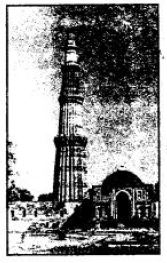
Answer: The answers regarding the Qutab Minar are as follows:
(a) The Qutab Minar is situated in the city of Delhi.
(b) The work on this building was begun by Qutub-ud-din Aibak and was finished by Iltutmish.
(c) It was named in honor of Qutub-ud-din, a holy Muslim saint from Ush, located close to Baghdad.
(d) Three key aspects of the building are:
1. It is a round tower that reaches a total height of 72.5 meters.
2. The tower is made of five levels, which get narrower as they go up, with balconies separating each floor. Every level has a unique design and beautiful Arabic writing carved on it.
3. To enter, one must use the north door, which leads to a winding stairway inside going up to each balcony.
In simple words: The Qutab Minar is in Delhi. It was begun by Qutub-ud-din Aibak, completed by Iltutmish, and named after a saint. It is a 72.5-meter-high round tower with five floors.
Exam Tip: For part (b), make sure to credit both Qutub-ud-din Aibak (started) and Iltutmish (completed) to secure full marks.
Short Answer Questions
Question 1. Who was the founder of the slave dynasty in India ?
Answer: Qutubuddin Aibak is known as the creator who established the Slave dynasty in the country.
In simple words: Qutubuddin Aibak was the first ruler and founder of the Slave dynasty in India.
Exam Tip: Ensure you write 'Qutubuddin Aibak' as the founder of this dynasty.
Question 2. Why was Qutubuddin known as Lakhbaksh ?
Answer: He received this name because of his highly generous habit of giving away large sums of money to people.
In simple words: He was called Lakhbaksh because he gave away lots of money to help others.
Exam Tip: The word 'Lakhbaksh' means 'giver of lakhs', which highlights his generosity. Mentioning this meaning helps secure full marks.
Question 3. Mention any two military reforms introduced by Alauddin.
Answer: Two major military changes he made are:
1. Creating a Permanent Army - He was the first Delhi ruler to set up a regular, lasting army. He brought in high-grade horses and used a special mark on them (called dagh) so soldiers could not swap them for poorer horses.
2. Introduction of 'Chehra' - He started a system of record-keeping (known as chehra) which served as a detailed description or identity card for every soldier.
In simple words: Alauddin Khalji built a permanent army, marked horses with a stamp called dagh so they could not be swapped, and gave soldiers ID cards called chehra.
Exam Tip: Use the key historical terms 'dagh' (branding of horses) and 'chehra' (descriptive roll of soldiers) when discussing his military reforms.
Question 4. How did Alauddin Khalji expand his empire ?
Answer: The ruler controlled a huge part of northern India. In the year 1313, he expanded by taking over several southern kingdoms, including Devagiri, Warangal, Dwarasamudra, and Madurai. The yearly taxes paid by these defeated states were then used to support and pay for his military forces.
In simple words: Alauddin Khalji conquered kingdoms in both north and south India, and used the taxes they paid him to fund his large army.
Exam Tip: Mention the year 1313 and name the southern kingdoms to present a detailed answer.
Question 5. Mention the two controversial steps taken by Muhammad-bin-Tughlaq.
Answer: Two highly debated choices made by Muhammad-bin-Tughlaq are listed below:
1. He moved his capital city from Delhi to Devagiri.
2. He started using coins made of cheap metals, known as token currency.
In simple words: Muhammad-bin-Tughlaq made two major moves that caused lots of trouble. First, he changed his capital's location. Second, he made new coins out of cheap metal.
Exam Tip: Remember both points clearly. Use simple terms like 'moving the capital' and 'cheap metal coins' to secure full marks.
Question 6. Which dynasty of the Delhi Sultanate built The Qutab Minar ?
Answer: The Slave dynasty of the Delhi Sultanate constructed this monument. Specifically, Qutb-ud-din Aibak started building it in the year AD 1199.
In simple words: The Qutab Minar was built by the Slave dynasty. A ruler named Qutb-ud-din Aibak started it in 1199.
Exam Tip: Always mention the year 1199 and the name of the ruler, Qutb-ud-din Aibak, when writing this answer.
Question 7. Who was the commander-in-chief of the army during the Sultanate period ?
Answer: The king or Sultan held the highest post as the head of the military during this era.
In simple words: The Sultan was the main boss of the whole army.
Exam Tip: The Sultan himself was the absolute leader of the army. Do not confuse him with other military ministers.
Question 8. Name the department which dealt with state correspondence during the Sultanate period.
Answer: The department that looked after official letters and records was called Diwan-i-insha.
In simple words: Diwan-i-insha was the name of the office that sent and received official letters for the king.
Exam Tip: Spelling counts. Write 'Diwan-i-insha' correctly to get full marks on this question.
Question 9. What was the iqta system ?
Answer: In this period, the kingdom was split into smaller lands called iqtas. Giving away the tax money collected from these lands was called the iqta system. The officers who got these lands were known as iqtadars. They used this tax money to pay for their own needs, help their families, and keep soldiers ready to fight for the king when a war broke out.
In simple words: The king gave pieces of land to his officers instead of cash. The officers collected taxes from the land to support themselves and keep soldiers ready for the king.
Exam Tip: Be sure to explain who 'iqtadars' were and how they had to supply soldiers to the king during wars.
Question 10. Name the author of the book, Tarikh-i-Firuzshahi.
Answer: This famous historical book was crafted by the writer Ziauddin Barani.
In simple words: A writer named Ziauddin Barani wrote this book.
Exam Tip: Clearly state the name 'Ziauddin Barani'. Double-check the spelling of the author's name.
Question 11. Why were the early rulers of slave dynasty called the Mamluk Sultans ?
Answer: The initial kings of this line got this name because they had once been slaves to Turkish masters, or they were the children of former slaves.
In simple words: They were called Mamluk because they were born to slaves or had been slaves themselves before becoming kings.
Exam Tip: Make sure to mention that 'Mamluk' connects to being a slave or a slave's child.
Question 12. Mention any two reasons for the defeat of Rajputs by the Turks.
Answer: Here are two main reasons why the Turks defeated the Rajputs:
1. The Turkish forces had very skilled generals who used clever, modern battle plans. In contrast, the Rajputs relied on old ways of fighting.
2. Even though Rajput warriors were great with swords and spears up close, they were not as good at archery as the Turks. The Turks knew this weakness and used it to their advantage.
In simple words: The Turks won because they had better battle plans and better bowmen. The Rajputs used older ways of fighting and were weak at long-distance combat.
Exam Tip: Highlight the difference in military tactics and the superior archery skills of the Turkish army to get full marks.
Question 13. Who was Muhammad Ghori ? Why did he invade India ?
Answer: Also called Muizzuddin Muhammad bin Sam, Muhammad Ghori became the king of Ghazni, located in modern-day Afghanistan, in 1173. Being highly ambitious, he wished to build a large empire in India. The immense riches and strong military assets of India caught his eye. He believed he could use these resources to protect his own kingdom. After making his hold on Ghazni secure, he focused on India and launched many attacks there between 1175 and 1206.
In simple words: Muhammad Ghori was a king from Ghazni who wanted to expand his empire. He attacked India many times to take its wealth and use its power to protect his own land.
Exam Tip: Mention his goal of building an empire and his desire for India's wealth to explain his actions fully.
Question 14. Mention the four architectural features brought in by the Turks in India.
Answer: The new building styles introduced by the Turks had four major elements - arches, domes, tall minarets, and supported roofs. To decorate their structures, they carved geometric patterns and flower shapes along with lines of holy writings from the Quran.
In simple words: The Turks brought new designs like domes, arches, minarets, and propped roofs. They decorated buildings with pretty patterns and holy writings.
Exam Tip: List all four key structures clearly: arches, domes, minarets, and supported roofs.
Question 15. Who was Razia Sultana ? To which dynasty did she belong?
Answer: She was the daughter of the ruler Iltutmish and was a member of the Slave Dynasty.
In simple words: Razia Sultana was the daughter of a king named Iltutmish. She belonged to the Slave Dynasty.
Exam Tip: Name both her father, Iltutmish, and the Slave Dynasty to get full marks.
Question 16. What measures were taken by Alauddin Khalji for regulating the prices ?
Answer: Alauddin Khalji is highly famous for managing his markets. He set fixed prices for every single item, ranging from grain, sugar, and oil to needles, expensive clothes, horses, and animals. He built three separate markets in Delhi for different goods, which were run by an officer called the Shahna. Anyone caught cheating faced very harsh punishments.
In simple words: He fixed the prices of all daily goods so merchants could not overcharge. He set up three main markets supervised by an officer to prevent cheating.
Exam Tip: Mention the name of the controller, 'Shahna', and the creation of three separate markets to make your answer complete.
Question 17. Mention any two measures taken by Alauddin Khilji to crush the power of the nobles.
Answer: Here are the ways he stopped the nobles from getting too powerful:
1. Nobles were banned from throwing parties, celebrating, or marrying among themselves without getting the Sultan's approval first.
2. Nobody was allowed to drink wine or use other intoxicating substances.
3. Playing games for money was outlawed, and those who did so were punished harshly.
In simple words: He stopped nobles from meeting or marrying without his permission. He also banned alcohol and gambling to keep them under control.
Exam Tip: Even if the question asks for two, listing all three points shows a thorough understanding and ensures maximum credit.
Question 18. With reference to the Delhi Sultanate, mention to which dynasties the following belonged: (a) Razia Sultana (b) Ibrahim Lodhi (c) Firoz Shah (d) Qutb-ud-Din Aibak
Answer:
(a) Slave Dynasty
(b) Lodhi Dynasty
(c) Tughlag Dynasty
(d) Slave Dynasty
In simple words: This list matches famous kings and queens from the Delhi Sultanate to the family lines they belonged to.
Exam Tip: Double-check each ruler's name carefully. Do not confuse Firoz Shah (Tughlaq) with other dynasties.
Structured Questions.
Question 1. With reference to the sources of information about the Delhi Sultanate, give the significance of the following: (a) Inscriptions (b) Qutub Minar
Answer:
(a) Inscriptions - These acts as extra pieces of evidence rather than the only way to learn about this period. You can find them carved on old coins, buildings, road markers, and graves. They were written in different languages like Sanskrit, Arabic, or a mix of both. For instance, the earliest coin made by Muhammad Bakhtiyar Khilji has writings in both Sanskrit and Arabic. Also, the well-known traveler Ibn Batuta spotted and read a special inscription at the Jama Masjid in Delhi.
(b) Qutub Minar - The construction of this grand tower began in the year AD 1199 under Qutub-ud-din Aibak. He built it in honor of a respected Sufi saint named Qutb-ud-din Bakhtiyar Kaki. The work was finished later by Iltutmish in 1230. The tower features beautiful flower patterns, detailed carvings, and holy lines from the Quran.
In simple words: Inscriptions are writings on coins and walls that help us learn history. The Qutub Minar is a famous tower built by early kings to honor a holy saint.
Exam Tip: Make sure to explain that inscriptions were written in multiple languages and name the Sufi saint associated with the Qutub Minar.
2. With reference to the Slave dynasty, answer the following questions:
Question 2(a). Why were the early rulers of the Slave dynasty called the Mamluk Sultans ?
Answer: The term Mamluk comes from an Arabic word which means owned. These kings got this title because they were originally slaves of Turkish master, or their fathers had been slaves.
In simple words: Mamluk means 'owned' in Arabic. The rulers were called this because they or their fathers started out as slaves.
Exam Tip: Always explain the literal meaning of the word 'Mamluk' as 'owned' to secure maximum marks.
Question 2(b). Who was Qutubuddin Aibak ? State any two of his qualities.
Answer: Qutubuddin Aibak was the leader who started the Slave dynasty. He loved learning and literature, inviting famous writers like Hasan Nizami and Fakhre Mudir to his court. Because he gave away wealth very generously, people called him 'Lakhbaksh'. He also began building the Qutub Minar in Delhi to honor the well-known Sufi saint Khwaja Qutub-ud-din Bakhtiyar Kaki.
In simple words: He was the first king of the Slave Dynasty. He was very kind, gave lots of charity (earning him the name Lakhbaksh), and started building the Qutub Minar.
Exam Tip: Remember to mention the title 'Lakhbaksh' and explain its meaning (giver of lakhs) as one of his key qualities.
3. With reference to the Khilji dynasty, answer the following questions:
Question 3(a). What were the steps taken by Alauddin Khilji to regulate prices ?
Answer: He set fixed prices for all daily goods, including grains, sugar, and oil. To make this work, he created three separate markets in Delhi. The first market was for food grains, the second was for expensive fabrics, and the third was for horses, slaves, and farm animals. Each area was supervised by a special officer called a Shahna. Anyone who cheated customers or used false weights faced severe punishments.
In simple words: He controlled prices so things were cheap. He set up three markets with a special officer to watch over them and punish dishonest sellers.
Exam Tip: Describe the three specific types of markets he created to show a thorough understanding.
Question 3(b). What were the methods adopted by Alauddin Khilji to crush the power of the nobility ?
Answer: To stop the nobles from rebelling against him when he became king, he took these strong steps:
1. Nobles were banned from throwing parties, celebrating, or marrying among themselves without getting the Sultan's approval first.
2. Nobody was allowed to drink wine or use other intoxicating substances.
3. Playing games for money was outlawed, and those who did so were punished harshly.
4. He started paying his army in cash rather than giving them land grants.
5. He created a highly active network of spies to monitor what the nobles were doing.
In simple words: He stopped nobles from gathering or marrying without permission, banned alcohol and gambling, paid soldiers in cash, and used secret spies to watch everyone.
Exam Tip: List at least three to four distinct points, including the use of cash salaries and spies, to secure full marks.
Question 3(c). What measures did Alauddin Khilji take to increase the revenue?
Answer: He took several steps to collect as much tax money as possible. He took direct charge of all the land in his kingdom. He started a system to measure fields and decide taxes based on the actual size. He raised the tax rate from one-third of the crops to half of them, and ordered that taxes must be paid in cash, not in grains. He also put special tax collectors in charge to gather this money.
In simple words: He measured all fields to decide taxes, raised the tax rate to half of the harvest, demanded cash payments, and hired special tax collectors.
Exam Tip: Mention the increase of tax to one-half and the requirement to pay in cash as the most critical points.
4. With reference to the reign of Muhammad-bin-Tughlaq, explain the following:
Question 4(a). His attempts to transfer the capital from Delhi to Daulatabad.
Answer: As his kingdom grew toward the south, he moved his capital to a city called Devagiri, which he renamed Daulatabad. His main reasons for this move were:
1. Daulatabad sat right in the middle of his empire, making it easier to manage the southern lands.
2. Delhi was suffering from a terrible shortage of food at the time.
3. Delhi faced constant attacks from Mongol armies. Consequently, he forced all the citizens of Delhi, including holy figures, to move to the new city around 1328-29.
In simple words: He moved his capital to Daulatabad because it was in the center of the country, Delhi was facing a food shortage, and Mongol invaders were threatening Delhi.
Exam Tip: Detail all three reasons: central location, famine in Delhi, and Mongol threats, to get maximum credit.
Question 4(b). Introduction of token currency.
Answer: He decided to use a new system called token currency. This meant issuing bronze coins instead of silver ones, because silver was running in short supply. However, the plan failed completely because people began making huge amounts of fake bronze coins at home.
In simple words: He replaced valuable silver coins with cheaper bronze ones. This failed because people easily made fake bronze coins themselves.
Exam Tip: Clearly explain that the shortage of silver led to the bronze coins, and mention how fake coins caused the system to fail.
Question 4(c). Increased taxation in Doab and its consequences.
Answer: He wanted to expand his kingdom into Central Asia, which meant he needed a huge army and lots of money to pay his troops. To raise these funds, he increased taxes on the highly fertile lands between the Ganga and Yamuna rivers. Sadly, a terrible food shortage hit the region at the same time. The farmers could not pay the extra taxes and rebelled. However, tax officers showed no pity and used force to collect the money, causing many farmers to leave their fields and run away into the forests.
In simple words: He raised taxes on rich farmland to pay for a big army. When a famine hit, farmers couldn't pay, so the harsh tax collectors drove them to run away into the wild.
Exam Tip: Explain both the cause (paying for a large army) and the tragic results (famine, rebellion, and farmers fleeing) to write a complete answer.
Question 5. With reference to the administrative system of the Delhi Sultanate, give the functions of each of the following officials: (a) Ariz-i-mumalik (b) Wazir
Answer:
(a) Ariz-i-mumalik - This official was the military minister. However, he did not lead the troops in battle, as the Sultan held that supreme command. Instead, this minister's main duties were to sign up new soldiers, provide weapons, and handle their salaries.
(b) Wazir - The most important official in the government was the wazir, who worked as the Prime Minister. He oversaw the duties of all other government workers.
In simple words: The Ariz-i-mumalik looked after the army's needs like hiring and paying soldiers. The Wazir was the Prime Minister who checked everyone else's work.
Exam Tip: Clearly state that the Ariz-i-mumalik did not command the army, but took care of recruitment and salaries, while the Wazir acted as Prime Minister.
Question 6. Study the picture of Qutab Minar and answer the following questions: (a) Who began erecting this monument ? Where is it located? (b) Name the saint after whom the monument is named. (c) Name the ruler who completed the construction of Qutab Minar. (d) Mention three important features of the monument.
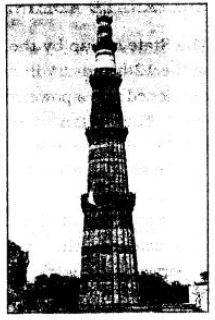
Answer:
(a) Qutub-ud-Din Aibak started building this tower, which is situated in Delhi.
(b) The tower gets its name from a respected Sufi saint named Qutb-ud-din Bakhtiyar Kaki.
(c) The work was finished in the year AD 1230 by the ruler Iltutmish.
(d) It has five levels separated by open balconies. The structure stands 71.4 meters high and measures 13.8 meters across at its base. It was built using red sandstone, marble, and grey quartzite.
In simple words: The Qutub Minar is a tall tower in Delhi. It was started by Qutub-ud-din Aibak and finished by Iltutmish. It has five floors and is built of red sandstone and marble.
Exam Tip: Learn the exact measurements (71.4 meters height, 13.8 meters base diameter) and materials used to get maximum points.
7. With reference to the invasion of Muhammad Ghori, answer the following questions:
Question 7(a). Why did Muhammad Ghori invade India ?
Answer: Muhammad Ghori invaded India to gain access to its vast wealth and strong military power. He believed he could use these assets to defend and support his own empire. After making his capital at Ghazni secure, he focused on India and led multiple military attacks there between 1175 and 1206.
In simple words: Muhammad Ghori wanted to take India's wealth and use its resources to make his own kingdom stronger.
Exam Tip: Make sure to connect Ghori's invasions to his goal of protecting and strengthening the Ghurid Empire with India's resources.
Question 7(b). Briefly describe the conflict between Prithviraj Chauhan in the two battles of Tarain.
Answer: In the first fight at Tarain in 1191, the army of Prithviraj Chauhan totally defeated Muhammad Ghori. To get revenge, Ghori returned with a fresh army in 1192. This second battle became a major turning point in India's history. This time, the Turkish forces won, and many Rajput soldiers were killed. Prithviraj tried to run away but was caught. The Turkish army then took control of Ajmer. Coins from that time suggest that Prithviraj might have been allowed to rule Ajmer for a little while, as they show his name on one side and Ghori's name on the other.
In simple words: The first battle in 1191 was won by Prithviraj. The second battle in 1192 was won by Ghori, which changed Indian history as the Turks took over.
Exam Tip: Be clear about the years (1191 and 1192) and how the outcome shifted from the first battle to the second.
Question 7(c). What were the cause of success of the Turks against the Rajputs ?
Answer: The Turks succeeded against the Rajputs due to several factors:
1. The Turkish force relied heavily on horse soldiers, and their horses were much stronger and lasted longer in battle.
2. They had brilliant generals from many regions who used modern battle plans, while the Rajputs kept using old-fashioned methods.
3. Although Rajput warriors fought incredibly well face-to-face with swords and spears, they were not as skilled at using bows and arrows. The Turks knew this, stayed at a safe distance, and attacked from afar. Additionally, the Rajputs were split into different clans that cared more about their own pride than working together, meaning the Turks only had to fight separate groups instead of a single, united army.
In simple words: The Turks won because they had stronger horses, better battle plans, and better long-distance archers. The Rajputs fought separately in divided clans instead of as one united army.
Exam Tip: Explain how the lack of unity among Rajput clans and the superior Turkish cavalry and archers combined to bring about the Rajput defeat.
8. With reference to the social life during the Sultanate period, answer the following questions:
Question 8(a). Explain the caste divisions which existed in the social structure.
Answer: Hindu social rules changed very little during this era. According to old religious texts, Brahmins remained at the top, followed by Kshatriyas, whose job was to protect the public. Vaishyas worked in trade, while Shudras were expected to serve the other groups, though they could take up different jobs. However, people faced strict rules against mixing with those outside the caste system. Meanwhile, the Muslim community was split by race and origin, including Turkish, Iranian, Arab, Afghan, and Abyssinian groups. In the 1200s, Turkish Muslims held the most power. Muslims were also divided by jobs and religious sects. Even with these divisions, Hindus and Muslims still interacted and mingled with each other.
In simple words: Hindu society kept its traditional four castes, with Brahmins at the top. Muslims were also divided by their home countries and jobs. However, Hindus and Muslims still spoke and lived together.
Exam Tip: Explain both the Hindu caste system and the racial/ethnic divisions among Muslims to provide a complete picture of the society.
Question 8(b). Explain the inequalities which existed between rulers and the ruled during the Sultanate period.
Answer: Life in this era was full of deep divisions. In the cities, rich merchants and rulers lived in grand style. On the other hand, the vast majority of ordinary citizens led very basic lives and faced constant struggles. Still, they found happiness in frequent fairs and religious festivals that broke up their dull daily routines.
In simple words: The rich rulers and merchants lived in grand luxury, while ordinary people had a hard, simple life. However, festivals and fairs brought joy to the poor.
Exam Tip: Make sure to contrast the luxurious lifestyle of the wealthy with the hard daily life of the common people.
Question 8(c). Describe the condition of women during the Sultanate period.
Answer: The status of Hindu women saw almost no progress. Old customs like marrying girls off at a very young age and expecting complete obedience to their husbands remained common. Various foreign visitors wrote about the practice of Sati. The traveler Ibn Batuta noted that people had to get permission from the Sultan before performing Sati. Additionally, the custom of covering the face, or purdah, was highly common among wealthy women.
In simple words: Women had very few rights. Girls were married young, the practice of Sati still happened, and wealthy women had to follow the purdah system by covering their faces.
Exam Tip: Include specific historical details such as early marriage, Sati (referencing Ibn Batuta), and the purdah custom to write a strong answer.
Free study material for History Civics
ICSE Goyal Brothers Solutions Class 9 History Civics Chapter 9 The Delhi Sultanate
Students can now access the detailed Goyal Brothers Solutions for Chapter 9 The Delhi Sultanate on our portal. These solutions have been carefully prepared as per latest ICSE Class 9 syllabus. Each solution given above has been updated based on the current year pattern to ensure Class 9 students have the most updated History Civics content.
Master Goyal Brothers Textbook Questions
Our subject experts have provided detailed explanations for all the questions found in the Goyal Brothers textbook for Class 9 History Civics. We have focussed on making the concepts easy for you in Chapter 9 The Delhi Sultanate so that students can understand the concepts behind every answer. For all numerical problems and theoretical concepts these solutions will help in strengthening your analytical skill required for the ICSE examinations.
Complete History Civics Exam Preparation
By using these Goyal Brothers Class 9 solutions, you can enhance your learning and identify areas that need more attention. We recommend solving the History Civics Questions from the textbook first and then use our teacher-verified answers. For a proper revision of Chapter 9 The Delhi Sultanate, students should also also check our Revision Notes and Sample Papers available on studiestoday.com.
FAQs
You can download the verified Goyal Brothers solutions for Chapter 9 The Delhi Sultanate on StudiesToday.com. Our teachers have prepared answers for Class 9 History Civics as per 2026-27 ICSE academic session.
Yes, our solutions for Chapter 9 The Delhi Sultanate are designed as per new 2026 ICSE standards. 40% competency-based questions required for Class 9, are included to help students understand application-based logic behind every History Civics answer.
Yes, every exercise in Chapter 9 The Delhi Sultanate from the Goyal Brothers textbook has been solved step-by-step. Class 9 students will learn History Civics conceots before their ICSE exams.
Yes, follow structured format of these Goyal Brothers solutions for Chapter 9 The Delhi Sultanate to get full 20% internal assessment marks and use Class 9 History Civics projects and viva preparation as per ICSE 2026 guidelines.