

Download the latest CBSE Class 11 Sociology Terms Concepts and their use in Sociology Notes in PDF format. These Class 11 Sociology revision notes are carefully designed by expert teachers to align with the 2026-27 syllabus. These notes are great daily learning and last minute exam preparation and they simplify complex topics and highlight important definitions for Class 11 students.
Revision Notes for Class 11 Sociology Introducing Sociology Chapter 2 Terms Concepts and their use in Sociology
To secure a higher rank, students should use these Class 11 Sociology Introducing Sociology Chapter 2 Terms Concepts and their use in Sociology notes for quick learning of important concepts. These exam-oriented summaries focus on difficult topics and high-weightage sections helpful in school tests and final examinations.
Introducing Sociology Chapter 2 Terms Concepts and their use in Sociology Revision Notes for Class 11 Sociology
The subject matter of Sociology is familiar, just because words do exist to denote it. The terms and concepts of sociology are different from common sense knowledge or naturalistic explanation. Many of the concepts reflect the concern of social thinkers to understand and map the social changes. The terms and concepts we discuss in sociology help us and are the tools through which we can understand reality. They are keys to open locks to understand society.
I. Aggregate
Aggregates are a collection of people in the same place and at the same time without having any contact. Example: Passengers waiting at a railway station or airport or bus stop or a cinema audience.
II. Quasi Group
Aggregates can also be called a Quasi Group. It lacks structure or organization, and whose members may be unaware, or less aware, of the existence of groupings. Example: Social classes, status groups, age and gender groups, crowds.
Quasi Group may become a social group in time and may be in some specific situations. This will occur when the members of the group have a feeling of oneness or we feeling. For example the members of a particular caste or community may not be organized as a collective body, they may have a ‘we’ feeling and over a period of time give rise to political parties. So this political party became a social group.
III. Social Groups
A social group refers to a collection of continuously interacting persons who share common interest, culture, values and norms within a given society.
Characteristics of Social Groups
(i) Persistent interaction to provide continuity
(ii) A stable pattern of these interactions
(iii) The members of the group share a sense of belongingness
(iv) Shared interest
(v) Acceptance of common norms and values
(vi) A definable structure
IV. Types of Social Groups
Many sociologists and social anthropologists have categorized groups into different types. Following are the major social groups found in society.
Primary group and secondary group
Primary group
Primary group is used to refer to a small group of people connected by intimate and face-to-face association and co-operation. Family, village, neighborhood, peer group are examples for primary groups.
Features of Primary Group
1. Small in size
2. Direct and face-to-face relationship
3. Members have a sense of belongingness
4. Intimate close relationships
5. person oriented
Secondary Groups
Secondary groups are relatively large groups that maintain formal and impersonal relationships. Schools, student associations, hospitals, and government offices etc. are example for this. The primary groups are person-oriented, whereas the secondary groups are goal oriented.
Characteristics of the Secondary Group
● Formal relations
● Based on specific goal
● It is relatively large in size
● Indirect communication
● Temporary in nature
Community
A community is a social group with some degree of “we feeling” and living in a given area. The relationship in a community is highly personal, intimate and enduring. E.g. village
Features of Community
● Community sentiment or “we feeling”
● locality
● The members share personal and long lasting relationships
Association
It is the group of people organized for a particular purpose. Association is a secondary group. Eg., family, church, trade union, music club, neighbourhood group.
In-Groups and Out-Groups
In-groups are those groups in which an individual has a tendency to identify himself with a particular group in a particular situation for a particular reason. The term was coined by W.G Sumner. This feeling separates ‘us’ or ‘we’ from ‘them’ or ‘they’. Students belonging to a particular school may form an ‘in-group’ as against those who do not belong to the school. An in group is also known as “We Group”.
Out – Groups
A group in which an individual is not a member is called an Out Group. This is also known as “they group”. The member of the In-Group shows aloofness, hatred and enmity towards the members of the Out Group. Migrants are example for this.
Reference Groups
The groups whose life styles are imitated are known as reference groups. Individuals constantly watch such groups and show interest in becoming members of such groups. We do not belong to our reference groups but we do identify ourselves with that group. E.g., a person imitates the life style of any movie actor or during the colonial period, many middle class Indians tried to imitate the English man. Reference groups are an important source of information about culture, lifestyle, aspirations, and goals.
Peer Groups
Peer group is a group of people having similar age, interests and status etc. This group is much similar to primary group. It is made up of the contemporaries of a person. A person’s classmates, school mates and playmate constitutes peer group. Peer group have a strong influence over the individual during the adolescence period.
V. Social Stratification
Social stratification is the process of dividing individuals and groups in to different layers, strata and divisions. Social stratification refers to the existence of structured inequalities between groups in terms of material or symbolic rewards. In a stratified society the most favored will be on the top and the least favored remain at the bottom. Stratification plays a crucial role in organizing society. Four types of system of stratification exist in society
● Slavery
● Caste
● Estate
● class
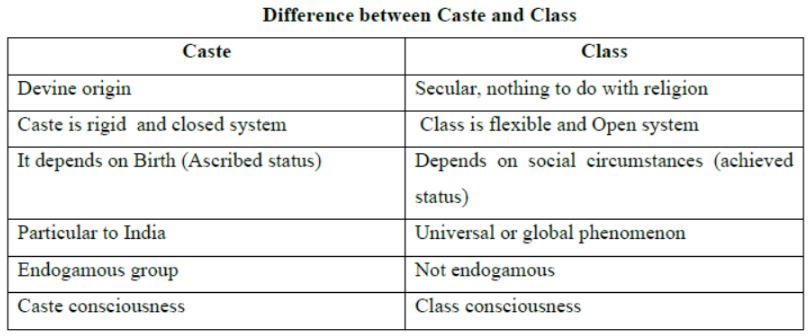
Caste
The caste system as a form of social stratification is peculiar to Indian society. In the caste system, the social status of an individual is determined by birth. In the caste hierarchy of traditional India, different castes had different social status. Each position in the caste structure was defined in terms of its purity or pollution relative to others. Those who were pure placed at the top of the caste hierarchy have high social status and social resources but the polluted caste were remained at the bottom have social exclusion and low social status.
The priestly Brahmin is pure and has a high status in the caste hierarchy. The Panchamar or Out Caste has been given a lower status in the caste hierarchy. According to the Chaturvarnya system, there were four castes namely Brahmins, Kshathriyas, Vaishyas and Shudras. There are innumerable occupation-based caste groups, called jatis can be seen.
The Indian caste system has undergone many changes. Industrialization, Urbanization, legislation, modern education and democracy have done serious damage to the caste system.
Class
A social class is a group of people having essentially the same social status in a given society. Class is an important kind of social stratification found in the modern civilized world. The basis of class is wealth.
Conflict View on Class
According to Karl Marx, economic factors are responsible for the emergence of different social classes. Therefore, social classes are defined by their relation to the means of production. According to him there are two classes in industrial society i.e. the capitalist and the working class. He described those who own the means of production as the capitalist and those who own only their own labor can be called the working class.
Weber defined class in terms of life chances. This refers to the rewards and advantages afforded by market capacity. According to Weber, economic relations, prestige and political power are the main factors which create social inequality.
Functionalist View on Social Class
The functionalist theory of social stratification begins from the general assumption that no society is “classless” or unstratified. Functionalist argued that stratification system is universal. It has come in to being due to the functional necessity of the social system. Social inequality or stratification is thus an unconsciously evolved device by which societies ensure that the most important positions are deliberately filled by the most qualified persons.
VI. Status and Role
Status and role are seen as twin concepts. Status refers to the position occupied by an individual in a given society or in a group. Status refers to the social position in which special rights and duties are assigned to it. E.g., the position held by the mother.
Status: Ascribed Status, Achieved Status
Ascribed Status
An ascribed status is a social position, which a person occupies because of birth, or assumes involuntarily. An individual has absolutely no choice over it. One’s age, caste, race and kinship are all ascribed status.
Achieved Status
It refers to a social position that a person occupies voluntarily by personal ability, achievements, virtues and choices. The most common bases for achieved status are educational qualifications, income, and professional expertise.
Status Set
In a modern society an individual occupies multiple statuses which are termed as status set.
Status Sequence
An Individuals acquire different status at various stages of life can be called as status sequence. For example a son becomes a father; father becomes a grandfather and then great grandfather and so on.
Prestige
The value attached to the status or office is called prestige. Every status is accorded certain rights and values. People can rank status in terms of their high or low prestige. The prestige of a doctor may be high in comparison to a shopkeeper, even if the doctor may earn less.
Role
Role is the dynamic or behavioral aspect of status. It is the function of a status. Role is the behavior that society expects from a person in a certain position. Status is occupied, but roles are played. Status is an institutionalized role.
Role Conflict
Role conflict is the incompatibility among roles corresponding to one or more status. It occurs when contrary expectations arise from two or more roles. For example, when a working woman plays the role of mother and wife at home and as a professional in the workplace she experiences role conflict.
Role Stereotyping
It is the process of reinforcing specific roles for some members of the society. Social roles and status are often wrongly seen as fixed and unchanging. E.g., men and women are socialized in such a way that men are breadwinners and women are home makers.
VII. Social Control
Social control is the various means used by the society to control its members. Through this society bring its members to obey the social norms. This is a kind of influence exerted by the society over its members. Social control is essential for maintaining the social order and social welfare.
Functionalist View on Social Control
(i) The use of force to regulate the behavior of the individual and groups
(ii) Enforcing of values and patterns for maintaining order in society.
Conflict View on Social Control
Conflict theorists perceive society as full of inequality, injustice and exploitation.
Conflict theorist argued that social control as a mechanism by which the dominant classes impose their culture over the rest of the society.
Types of Social Control
1. Formal Social Control
Formal social control is the use of systematic, codified and other formal mechanisms to control the social behavior. It is consciously created. Various rules are laid down to make it specific. Failure to obey with formal social control will result in severe punishment. E.g., school, nation, police
2. Informal Social Control
It is a personal, non-codified and informal form of social control. These are not purposively created. These include smiles, facial expressions, body language, jokes, frowns, and laughter. Failure to comply with informal social regulations will not result in punishment.
CBSE Class 11 Sociology Introducing Sociology Chapter 2 Terms Concepts and their use in Sociology Notes
Students can use these Revision Notes for Introducing Sociology Chapter 2 Terms Concepts and their use in Sociology to quickly understand all the main concepts. This study material has been prepared as per the latest CBSE syllabus for Class 11. Our teachers always suggest that Class 11 students read these notes regularly as they are focused on the most important topics that usually appear in school tests and final exams.
NCERT Based Introducing Sociology Chapter 2 Terms Concepts and their use in Sociology Summary
Our expert team has used the official NCERT book for Class 11 Sociology to design these notes. These are the notes that definitely you for your current academic year. After reading the chapter summary, you should also refer to our NCERT solutions for Class 11. Always compare your understanding with our teacher prepared answers as they will help you build a very strong base in Sociology.
Introducing Sociology Chapter 2 Terms Concepts and their use in Sociology Complete Revision and Practice
To prepare very well for y our exams, students should also solve the MCQ questions and practice worksheets provided on this page. These extra solved questions will help you to check if you have understood all the concepts of Introducing Sociology Chapter 2 Terms Concepts and their use in Sociology. All study material on studiestoday.com is free and updated according to the latest Sociology exam patterns. Using these revision notes daily will help you feel more confident and get better marks in your exams.
FAQs
You can download the teacher prepared revision notes for CBSE Class 11 Sociology Terms Concepts and their use in Sociology Notes from StudiesToday.com. These notes are designed as per 2026-27 academic session to help Class 11 students get the best study material for Sociology.
Yes, our CBSE Class 11 Sociology Terms Concepts and their use in Sociology Notes include 50% competency-based questions with focus on core logic, keyword definitions, and the practical application of Sociology principles which is important for getting more marks in 2026 CBSE exams.
Yes, our CBSE Class 11 Sociology Terms Concepts and their use in Sociology Notes provide a detailed, topic wise breakdown of the chapter. Fundamental definitions, complex numerical formulas and all topics of CBSE syllabus in Class 11 is covered.
These notes for Sociology are organized into bullet points and easy-to-read charts. By using CBSE Class 11 Sociology Terms Concepts and their use in Sociology Notes, Class 11 students fast revise formulas, key definitions before the exams.
No, all study resources on StudiesToday, including CBSE Class 11 Sociology Terms Concepts and their use in Sociology Notes, are available for immediate free download. Class 11 Sociology study material is available in PDF and can be downloaded on mobile.