

Download the latest CBSE Class 11 Sociology Doing Sociology Research Methods Notes in PDF format. These Class 11 Sociology revision notes are carefully designed by expert teachers to align with the 2026-27 syllabus. These notes are great daily learning and last minute exam preparation and they simplify complex topics and highlight important definitions for Class 11 students.
Revision Notes for Class 11 Sociology Introducing Sociology Chapter 5 Doing Sociology Research Methods
To secure a higher rank, students should use these Class 11 Sociology Introducing Sociology Chapter 5 Doing Sociology Research Methods notes for quick learning of important concepts. These exam-oriented summaries focus on difficult topics and high-weightage sections helpful in school tests and final examinations.
Introducing Sociology Chapter 5 Doing Sociology Research Methods Revision Notes for Class 11 Sociology
Objectivity and Subjectivity
If the research is unbiased and based on facts alone, it is said to be objective. To become objective in sociological research is more difficult than natural sciences. The opposite of objectivity is subjectivity. The research that is based on individual values and preferences is called subjective research. If the community identities of the researcher like family, caste, religion, class, etc are influenced in the social research, it becomes subjective.
Self reflexivity is needed to make the research more objective. The ability of viewing one’s own research in the view point of the subjects of research is called Self reflexivity. The documentation of all procedures and the sources of evidences, and the presentation of social background of the researcher are helpful to make objectivity in the research.
The multiple versions of truth in the social world and many perspectives in the social sciences arise further complications in the realisation of objectivity.
Multiple Methods and Choice of Methods
There different methods in sociological research. Different methods are more or less suited to tackle different types of research questions. Moreover, every method has its own strengths and weaknesses. The method chosen for the research should be appropriate one for answering the question that is being asked. For eg. In order to find out whether Indian families are still ‘joint families’, then a census or survey is the best method. if one wishes to compare the status of women in joint and nuclear families, then interviews, case studies or participant observation may all be appropriate methods..
Different Ways to classify Various Research Methods
1. Quantitative and Qualitative methods: Quantitative method deals with countable or measurable variables like proportions, averages, etc. Qualitative method deals with more abstract and hard to measure phenomena like attitudes, emotions and so on.
2. Methods based on primary and secondary data) :Methods that are based on the data collected by the researcher afresh are called Methods based on primary data. Surveys and interviews generate
primary data. But methods that rely on already existing data in the form of documents or other records and artefacts are based on secondary data. Historical methods rely on secondary material found in archives.
3. Micro and Macro Methods : Methods designed to work in small intimate settings usually with a single researcher are called micro methods. Eg:-interview and participant observation. Methods designed to tackle large scale research involving large numbers of respondents and investigators are called macro methods .Eg:-Survey and Historical methods.
Triangulation
Use of multiple methods to bear on the same research problem from different vantage points in order to complement each other to produce a much better result is referred to as triangulation.
Participant Observation
Participant observation refers to a particular method by which sociologist learns about society, culture and people by living among the community as one of them. This method is often called field work as s/he studies the people in their own fields.
Merits of participant observation : it enables in depth study and allows much time to correct the initial mistakes.
Demerits : Generalisation is not possible and it needs longer period.
Field work in Social Anthropology
Bronislaw Malinowski, a Polish anthropologist, is believed to have established field work as the distinctive method of social anthropology. He lived with the tribes of Trobriand islands of Southern Pacific for a year and half observing their social life and finally wrote a famous book about their culture. The major steps of participant observation conducted by social anthropologists are;
1. To conduct a census in order to collect the details like sex, age and family of the people under study.
2. To map the physical layout of the village or settlement, including the location of houses and other socially relevant sites.
3. To construct a genealogy of the community based on the information obtained in the census.
4. To create a family tree for individual members. This exercise helps the social anthropologist to understand the kinship system of the community.
5. To prepare a diary notes after learning the language of the community on the daily life of the people and significant aspects like Festivals, religious or other collective events, modes of earning a living, family relations, modes of child rearing, etc .The anthropologist usually depends on one or two people for most of the information. Such people are called ‘informants’ or ‘principal informants.
Field work in Sociology
The famous American Sociologist, William Foote Whyte Spent three and half years with members of the gang in an American slum who were mostly poor unemployed youth by observing their life and wrote a book ‘Street Conrner Society’. Another American sociologist, Michael Burawoy , worked for several months as a machinist in a Chicago factory and wrote about the experience of work from the perspective of workers.
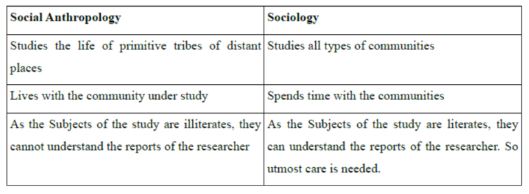
The major field works conducted in sociology in these days are village studies. Examples of village studies are ‘Remembered village’ of M.N.Srinivas, and ‘Indian village’ of S.C. Dube. The major differences between field works of sociology and social anthropology are;
Survey
Survey is a research method that provides an aggregated picture about a large population in a short period of time. Now a days, Sample surveys are conducted extensively. it allows to generalise results for a large group while actually studying only a small portion of this population who are representatives. The large group is called population and the small representative group is called sample. Samples are selected from population depending up on following two principles;
1. Stratification: After considering the relevant subgroups of population like caste, class, religion, age, gender,etc, the samples are selected. This is called stratified sampling.
2. Randomisation: This is the method of sample selection from the units of person or village or household purely on chance. For eg, when we toss a coin, the chance of falling with the ‘head’ side up or the ‘tail’ side up is exactly the same.
Sampling Errors
The characteristics of the sample will closely resemble the characteristics of the population it is drawn from. There may be small differences, but the chance of such deviationsoccuring can be specified. The error occured by using a small sample to stand for a large population is known as the margin of error, or sampling error.
Non-sampling Errors
Errors due not to the sampling process but to faults or shortcomings of the research design or the manner in which it was implemented are non-sampling errors. If the questions in the survey become more personal or provoking, the respondents will not respond honestly.
Merits of survey :it allows data collection from a large population in a short period and it enables generalisation.
Demerit: it does not provide in depth information.
Interview
Interview is a method of collecting data through the face to face conversation. It has two forms; structured and unstructured. Structured interview is a type of formal interview in which the order of questions are already prepared and the information is collected in the order of questions. Unstructured interview is an informal method in which questions are not prepared in advance but asked in accordance to the context.
CBSE Class 11 Sociology Introducing Sociology Chapter 5 Doing Sociology Research Methods Notes
Students can use these Revision Notes for Introducing Sociology Chapter 5 Doing Sociology Research Methods to quickly understand all the main concepts. This study material has been prepared as per the latest CBSE syllabus for Class 11. Our teachers always suggest that Class 11 students read these notes regularly as they are focused on the most important topics that usually appear in school tests and final exams.
NCERT Based Introducing Sociology Chapter 5 Doing Sociology Research Methods Summary
Our expert team has used the official NCERT book for Class 11 Sociology to design these notes. These are the notes that definitely you for your current academic year. After reading the chapter summary, you should also refer to our NCERT solutions for Class 11. Always compare your understanding with our teacher prepared answers as they will help you build a very strong base in Sociology.
Introducing Sociology Chapter 5 Doing Sociology Research Methods Complete Revision and Practice
To prepare very well for y our exams, students should also solve the MCQ questions and practice worksheets provided on this page. These extra solved questions will help you to check if you have understood all the concepts of Introducing Sociology Chapter 5 Doing Sociology Research Methods. All study material on studiestoday.com is free and updated according to the latest Sociology exam patterns. Using these revision notes daily will help you feel more confident and get better marks in your exams.
FAQs
You can download the teacher prepared revision notes for CBSE Class 11 Sociology Doing Sociology Research Methods Notes from StudiesToday.com. These notes are designed as per 2026-27 academic session to help Class 11 students get the best study material for Sociology.
Yes, our CBSE Class 11 Sociology Doing Sociology Research Methods Notes include 50% competency-based questions with focus on core logic, keyword definitions, and the practical application of Sociology principles which is important for getting more marks in 2026 CBSE exams.
Yes, our CBSE Class 11 Sociology Doing Sociology Research Methods Notes provide a detailed, topic wise breakdown of the chapter. Fundamental definitions, complex numerical formulas and all topics of CBSE syllabus in Class 11 is covered.
These notes for Sociology are organized into bullet points and easy-to-read charts. By using CBSE Class 11 Sociology Doing Sociology Research Methods Notes, Class 11 students fast revise formulas, key definitions before the exams.
No, all study resources on StudiesToday, including CBSE Class 11 Sociology Doing Sociology Research Methods Notes, are available for immediate free download. Class 11 Sociology study material is available in PDF and can be downloaded on mobile.