

Official CBSE Assignments for Class 8 Mathematics
Explore structured practice materials through the CBSE Class 8 Mathematics Practical Geometry Assignment Set 01. Tailored for Class 8 learners, utilizing these Mathematics assignments ensures thorough preparation and strengthens foundational knowledge before final CBSE evaluations.
Solved Practice Assignments for Mathematics
Access the complete assignment PDF for Class 8 Mathematics below. Regular practice with these targeted academic tasks builds familiarity with standard question patterns and helps secure higher marks in final school evaluations.
Question. If we add the number of REVOLUTIONS made by the hour hand and the minute hand in a day (24 hours), we would get:

(A) 25
(B) 26
(C) 72
(D) 84
Answer : B
Question. Dhruv's alarm clock gains 3 seconds every minute. Every night at 10:00 PM, he adjusts the clock to show the correct time and sets the alarm for 6:20 AM. What is the ACTUAL time when Dhruv's alarm clock rings in the morning?
(A) 5:36 AM
(B) 5:55 AM
(C) 5:20 AM
(D) 6:45 AM
Answer : B
Question. How many DIFFERENT sized squares can be drawn using the dots of the grid below as corners ?
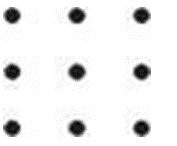
(A) 4
(B) 3
(C) 2
(D) 1
Answer : B
Question. Given below are the steps of construction to construct a quadrilateral ABCD where AB = 5.6 cm, BC = 4.1 cm, CD = 4.4 cm, AD = 3.3 cm and ∠A = 75°. Which of the following steps is INCORRECT?
Step 1 : Draw AB = 5.6 cm and construct ∠BAX = 75°.
Step 2 : With A as centre and radius = 3.3 cm, cut off AD = 3.3 cm along AX.
Step 3 : Join BD. With D as centre and radius = 4.1 cm, draw an arc.
Step 4 : With B as centre and radius = 4.1 cm, draw an arc to cut the arc drawn in above step at C. Join BC, CD to obtain the required quadrilateral ABCD.
(A) Step 1 only
(B) Step 2 only
(C) Step 3 only
(D) Step 4 only
Answer : C
Question. Arrange the steps of construction while constructing a parallelogram ABCD, given that AB = 5 cm, BC = 4 cm and ∠B = 60°.
1. With A as centre and radius equal to 4 cm, draw an arc cutting AY at D.
2. At A, draw ∠YAB = 120°. [∴ A + B = 180°]
3. At B, draw ∠XBA = 60°.
4. Draw AB = 5 cm.
5. Join CD.
6. With B as centre and radius equal to 4 cm, drawn an arc cutting BX at C.
(A) 4, 3, 6, 2, 1, 5
(B) 4, 3, 2, 6, 5, 1
(C) 4, 6, 3, 1, 2, 5
(D) 4, 3, 6, 2, 5, 1
Answer : A
Question. To construct a quadrilateral ABCD, which of the following parts is necessary ?
(A) Length of AB
(B) Length of BC
(C) Measure of ∠A, ∠B and ∠C
(D) All of these
Answer : D
Question. Arrange the steps (i) to (iv) in correct order, while constructing a parallelogram ABCD,
given AB = 6 cm, AD = 4 cm, and diagonal BD = 3 cm.
Step 1 : Draw AB = 6 cm
Step (i) : Join AD and BD.
Step (ii) : With A as centre, draw an arc of radius 4 cm.
Step (iii) : With B and D as centres and with 4 cm and 6 cm as radii, respectively, draw arcs to cut each other at C.
Step (iv) : With B as centre, draw an arc of radius 3 cm to cut the arc drawn in step (ii) at point D.
Step 6 : Join CD and BC. ABCD is the required parallelogram.
(A) (ii), (iv), (iii), (i)
(B) (iii), (ii), (v), (iv)
(C) (ii), (iv), (i), (iii)
(D) None of these
Answer : C
Question. If AB||DC, AB = 7 cm, BC = 6 cm, AD = 6.5 cm and ∠B = 70°, then which figure can be constructed?
(A) Square
(B) Trapezium
(C) Rhombus
(D) Rectangle
Answer : B
Question. Given below are the steps of construction of a quadrilateral ABCD, where AB = 3.5 cm, BC = 6.5 cm, ∠A = 75°, ∠B = 105° and ∠C = 120°. Which of the following steps is INCORRECT?
Step 1 : Draw AB = 3.5 cm.
Step 2 : Draw ∠XAB = 75° at A and ∠ABY = 105° at B.
Step 3 : With B as centre and radius BC = 6.5 cm, draw an arc to intersect BY at C.
Step 4 : At C, draw ∠ADC = 120° such that CZ meets AX at D.
(A) Step 1 only
(B) Step 2 only
(C) Step 3 only
(D) Step 4 only
Answer : D
Question. To construct a kite, which of the following is necessary?
(A) Two adjacent unequal sides and included diagonal
(B) Two adjacent equal sides and included diagonal
(C) Length of opposite sides
(D) None of these
Answer : A
Question. Arrange the steps of construction while constructing a quadrilateral ABCD given AB = 5.1 cm, AD = 4 cm, BC = 2.5 cm, ∠A = 60° and ∠B = 85°.
Step 1 : With B as centre and radius 2.5 cm, cut off BC = 2.5 cm along BY.
Step 2 : Construct ∠XAB = 60° at A.
Step 3 : Join CD.
Step 4 : With A as centre and radius 4 cm, cut off AD = 4 cm along AX.
Step 5 : Draw AB = 5.1 cm.
Step 6 : Construct ∠ABY = 85° at B.
(A) 5, 2, 4, 1, 3, 6
(B) 5, 4, 2, 1, 6, 3
(C) 5, 2, 4, 6, 1, 3
(D) 5, 2, 4, 1, 6, 3
Answer : C
Question. Which of the following statements is true about the construction of a quadrilateral where
AB = 3 cm, BC = 5 cm, AC = 9 cm,
AD = 6 cm, CD = 2 cm?
(A) It is possible to draw the quadrilateral.
(B) It is not possible to draw the quadrilateral, since AD + DC < AC.
(C) It is possible to draw the quadrilateral, since AD + DC < AC
(D) None of these
Answer : B
Question. It is possible to construct a quadrilateral with the sufficient data (other than five simple cases), where less than ___ parts but some other relations between them are given.
(A) Four
(B) Five
(C) Three
(D) Two
Answer : B
Question. To construct a convex quadrilateral, which of the following cases is INCORRECT ?
(A) When the lengths of four sides and one diagonal are given.
(B) When the lengths of three sides and the two diagonals are given.
(C) When the lengths of four sides and one angle are given.
(D) When the lengths of two sides and two included angles are given.
Answer : D
Question. Which of the following steps is INCORRECT while constructing a rhombus ABCD, given that AC = 8 cm and BD = 6 cm?
Step 1 : Draw AC = 8 cm.
Step 2 : Draw PQ, the perpendicular of AC. PQ intersects AC at point O.
Step 3 : With O as centre and radius equal to 3 cm, drawn an arc cutting OP at D.
Step 4 : With O as centre and radius equal to 3 cm, draw another arc cutting OQ at B.
Step 5 : Join AB, BC, CD and DA.
(A) Step 2 only
(B) Step 3 only
(C) Step 4 only
(D) Both Step 2 and Step 5
Answer : A
Question. Which of the given properties of a parallelogram is necessary to construct it ?
(A) Opposite sides of a parallelogram
(B) Opposite angles of a parallelogram
(C) Diagonals of a parallelogram
(D) Both (A) and (B)
Answer : D
Question. Arrange the steps of construction while constructing a quadrilateral ABCD given AB = 5.3 cm, AD = 2.9 cm, ∠A = 70°, ∠B = 95° and ∠C = 85°.
Step 1 : With A as centre and radius 2.9 cm, draw an arc to cut AX at D.
Step 2 : At B, draw ∠ZBA = 95° so that ZB intersects YD at C.
Step 3 : Draw AB = 5.3 cm.
Step 4 : At D draw ∠ADY = 110°
Step 5 : At A draw ∠XAB = 70°.
(A) 3, 4, 2, 1, 5
(B) 3, 5, 1, 4, 2
(C) 3, 1, 5, 4, 2
(D) 3, 5, 4, 2, 1
Answer : B
Question. Match the following.
| Column-I | Column-II |
| (P) Construction of a quadrilateral can be possible if at least | (1) two unequal sides and included diagonal are given. |
| (Q) Construction of quadrilateral must satisfy | (2) five independent elements are given |
| (R) A kite can be drawn if its | (3) 4 sides, 4 angles and 2 diagonals |
| (S) A quadrilateral has | (4) triangle inequality and angle sum property of a triangle |
P Q R S
(A) 3 2 4 1
(B) 3 4 2 1
(C) 2 4 1 3
(D) 4 3 1 2
Answer : C
Q 1 Name the quadrilateral whose opposite sides are parallel.
Q 2 Name the quadrilateral whose diagonals are equal and bisect each other at right angle.
Q 3 Why do we call square as a regular quadrilateral?
Q 4 Construct the quadrilateral ABCD in which AB = 5 cm, BC= 4 cm, ∠A = 60°, ∠B = 105° and ∠C = 105°.
Q 5 The adjacent sides SP and PQ of a parallelogram PQRS are 4 cm each. State the measure of all the sides. What is another name of this figure?
Q 6 The ratio of two adjacent sides of a parallelogram is 4:5. If its perimeter is 72 cm, find its adjacent sides.
Q 7 The park in a town is made in the form of a kite. Its perimeter is 90 metres and one side is 10m more than other side. What are the lengths of other sides?
Q 8 Construct the trapezium ABCD in which AB ||CD, AB = 8 cm, BC = 6 cm, CD = 4 cm and √B = 60°.
Q 9 Construct the quadrilateral ABCD in which AB = 4.5 cm, BC = 5.5 cm, CD = 4 cm, AD = 6 cm and AC = 7 cm.
Q 10 Construct the quadrilateral PQRS where PQ = 4 cm, QR = 6 cm, RS = 5 cm, PS = 5.5 cm and PR = 7 cm.
Q 11 Construct Quadrilateral ABCD in which AB = 3.5 cm, BC = 4 cm, CD = 5cm, ∠B = 45°and ∠C = 150°.
Q 12 Construct the quadrilateral TRUE in which TR = 3.5 cm, RU = 3 cm, UE = 4 cm, ∠R = 75° and ∠U =120°.
Q 13 Construct the parallelogram ABCD with AB = 3.5 cm, BC = 4 cm and AC = 6.5 cm.
Click on link below to download CBSE Class 8 Mathematics Practical Geometry Assignment Set A
Free study material for Mathematics
Download Practice Assignments: Class 8 Mathematics Chapter 04 Practical Geometry
Download Assignment: Chapter 04 Practical Geometry (Class 8 Mathematics)
Review targeted chapter assignments for Class 8 Mathematics Chapter 04 Practical Geometry. Built according to official CBSE guidelines, these downloadable problem sets help students build accuracy and prepare effectively for school tests.
Why Practice Class 8 Mathematics Assignments?
- Curriculum Standards: Assignments match modern CBSE sample formats to ensure relevant preparation.
- Thorough Revision: Detailed problem sets reinforce core concepts and eliminate conceptual weak spots.
- Execution Speed: Timed practice with assignment sets sharpens overall response timing.
How to Approach Mathematics Chapter 04 Practical Geometry Assignments
- Concept Foundation: Review the NCERT book for Class 8 Mathematics thoroughly before diving into assignment tasks.
- Self-Evaluation: Solve exercises independently before inspecting professional answer guides.
- Progress Monitoring: Note down complex formulas or concepts, clearing them up using available online practice aids.
FAQs
You can download free PDF assignments for Class 8 Mathematics Chapter 04 Practical Geometry from StudiesToday.com. These practice sheets have been updated for the 2026-27 session covering all concepts from latest NCERT textbook.
Yes, our teachers have given solutions for all questions in the Class 8 Mathematics Chapter 04 Practical Geometry assignments. This will help you to understand step-by-step methodology to get full marks in school tests and exams.
Yes. These assignments are designed as per the latest CBSE syllabus for 2026. We have included huge variety of question formats such as MCQs, Case-study based questions and important diagram-based problems found in Chapter 04 Practical Geometry.
Practicing topicw wise assignments will help Class 8 students understand every sub-topic of Chapter 04 Practical Geometry. Daily practice will improve speed, accuracy and answering competency-based questions.
Yes, all printable assignments for Class 8 Mathematics Chapter 04 Practical Geometry are available for free download in mobile-friendly PDF format.